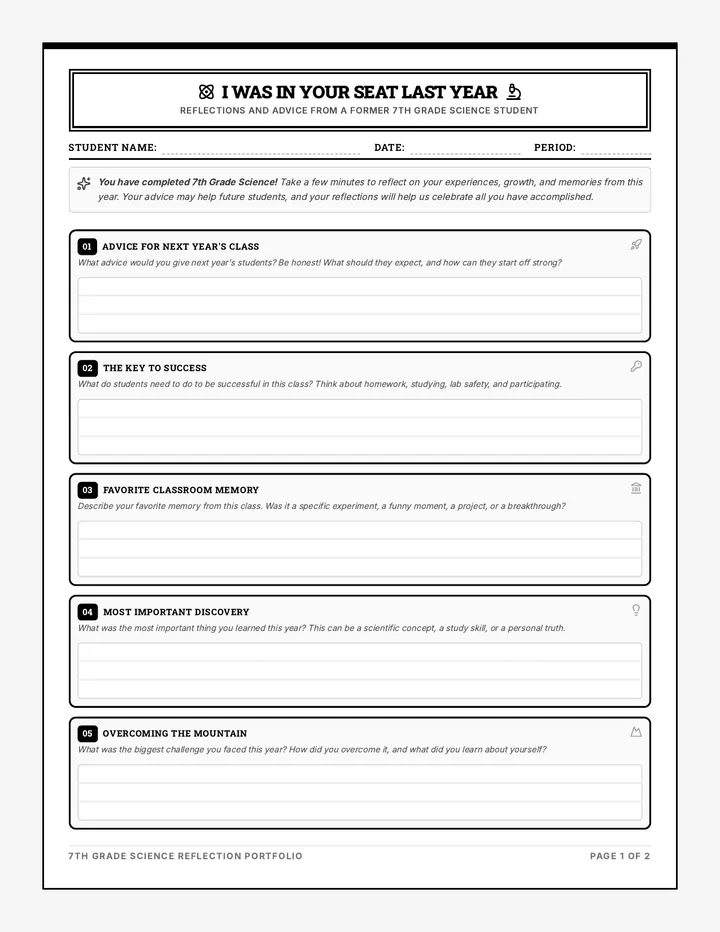
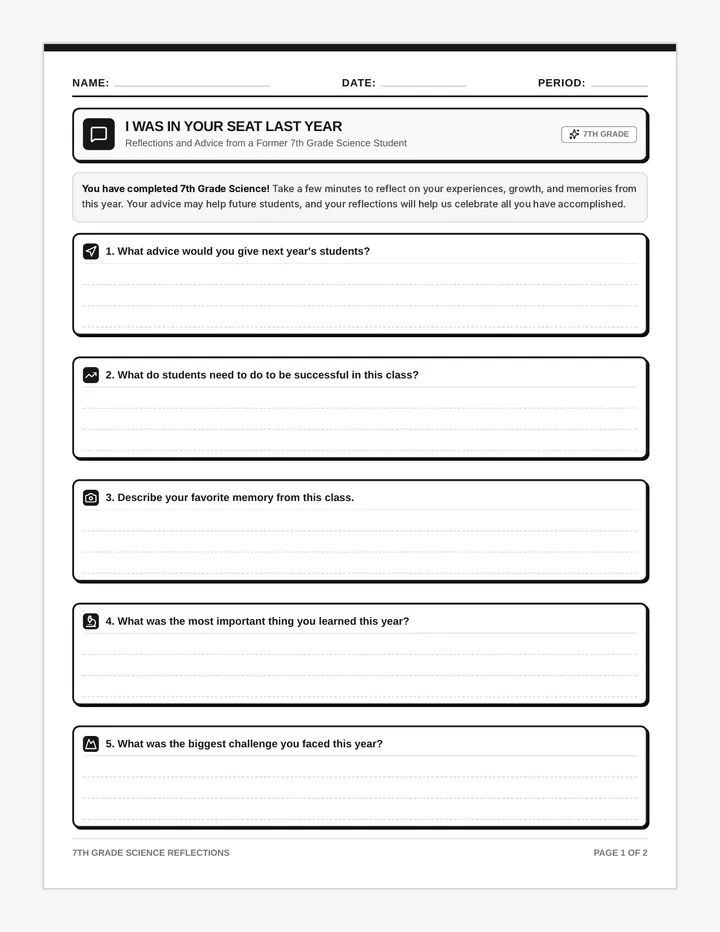
A reflective warm-up activity for students to consider the importance of classroom routines and set personal goals for punctuality and preparation.
A final review and celebratory slide deck for 'The System Architect' program. Updated to fix content overflow and ensure white-on-colored text contrast.
A final synthesis worksheet where students create a personalized 'Maintenance Plan'. Updated with enlarged writing areas, personalized tool lines, and higher contrast instructions. themed around the System Architect curriculum.
A facilitator guide for the final week of 'The System Architect' program. It guides the synthesis of all learned skills into a personal 'Maintenance Plan' for long-term anxiety management. Updated for better page flow.
A slide deck for Week 7 of 'The System Architect' program. It explores social anxiety through the 'Spotlight Glitch' and teaches students to 'tune' their social antenna. Updated to fix content overflow and layout issues.
A set of social scenario cards for the 'Network Signals' lesson. Updated to the 'System Architect' theme with high contrast, single-page layout, and large response areas.
A facilitator guide for Week 7, focusing on social anxiety, the 'spotlight effect' myth, and applying coping tools to peer-to-peer interactions. Updated to the 'System Architect' theme.
A cognitive reframing worksheet that uses a debugging metaphor. Updated to fit on a single page, increase handwriting spacing, and include requested strengths-based phrasing.
A facilitator guide for Week 6, focusing on identifying and challenging cognitive distortions (glitches) through a computer programming metaphor. Updated to the 'System Architect' theme.
A visual guide for Week 5 of 'The System Architect' program. Updated to fix content overflow, add requested phrasing, and improve white-on-colored text contrast.
A practice log and technique guide for 'Cooling the Core' and 'Hardware Softening' relaxation skills. Updated to the 'System Architect' theme with high contrast and single-page layout.
A facilitator guide for Week 5, teaching students physical strategies like Square Breathing and Progressive Muscle Relaxation. Updated to the 'System Architect' theme.
A slide deck for Week 4 of 'The System Architect' program. It frames grounding as a 'System Reset' and provides visual guidance for the 5-4-3-2-1 technique. Updated with high contrast and tech-themed labels.
A high-contrast reference card for the 5-4-3-2-1 grounding technique, themed around a 'System Reset'. Updated for clarity, contrast, and single-page layout.
A detailed facilitator guide for Week 4, introducing grounding techniques as the first set of tools in the Mind Mechanics toolbox. Updated to the 'System Architect' theme.
A student worksheet for auditing personal system triggers across academic, social, and environmental domains. Updated to fit the tech-themed 'System Architect' program on a single page.
A detailed facilitator guide for Week 3 of the Mind Mechanics program, focusing on identifying individual anxiety triggers across academic, social, and environmental categories.
A visual presentation for Week 2, illustrating how physical sensations act as diagnostic 'sensors' for the brain's internal state. Updated with a concluding interactive slide and tool definitions.
An interactive body mapping activity where students identify and color-code their physical responses to anxiety. Updated with improved page breaks, text contrast, and a light work area.
A detailed facilitator guide for Week 2 of the Mind Mechanics program, focusing on the physical manifestations of anxiety and how to identify 'body sensors'. Updated to fix page break issues.
A student worksheet for the first week of the 'System Architect' program. It includes an 'Alert Audit' and a 'System Logic' check. Updated to fit on a single page with improved layout.
An introductory slide deck for the 'System Architect' program. It introduces the tech theme, frames anxiety as a security protocol, and uses strengths-based language. Updated to fix content bleeding and improve contrast.
A comprehensive facilitator guide for the first week of the 'System Architect' program. It introduces the tech-themed metaphor, uses strengths-based language to describe anxiety as a security protocol, and provides scripts for normalization. Updated for better page breaks and usability.
Instructional guide for teachers with timing, teaching points, and tips for delivering the first lesson on career clusters.
Revised self-audit worksheet for Lesson 3, now with a clean single-page layout and improved student work area.
Presentation for Lesson 3, defining hard vs. soft skills and highlighting the top skills employers look for in candidates.
Revised student worksheet for Lesson 1, now featuring all 16 clusters in the bank and improved single-page layout.
Revised introductory presentation for Lesson 1, now including all 16 career clusters with visual icons and descriptions.
A high-impact informational handout that explains the critical link between parental support and a child's long-term success, featuring reflective prompts for parents.
A facilitator's guide featuring three impactful opening questions for the Parenting Journey presentation, along with tips for engaging parents and creating a supportive atmosphere.
A professional feedback form for parents to evaluate the Parenting Journey presentation, including rating scales and reflection questions.
A professional and welcoming presentation slide for Burlington Public Schools' Parenting Journey program, highlighting key benefits for parents at all stages.
A presentation for Week 3 that defines anxiety triggers. Updated to fix tracking/kerning issues and improve text contrast.
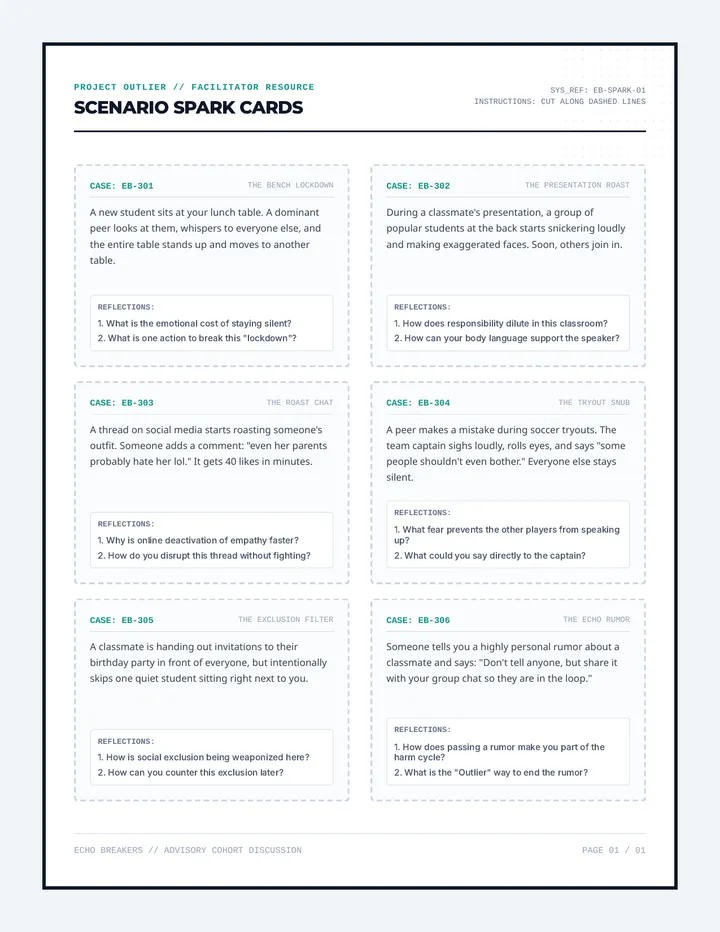
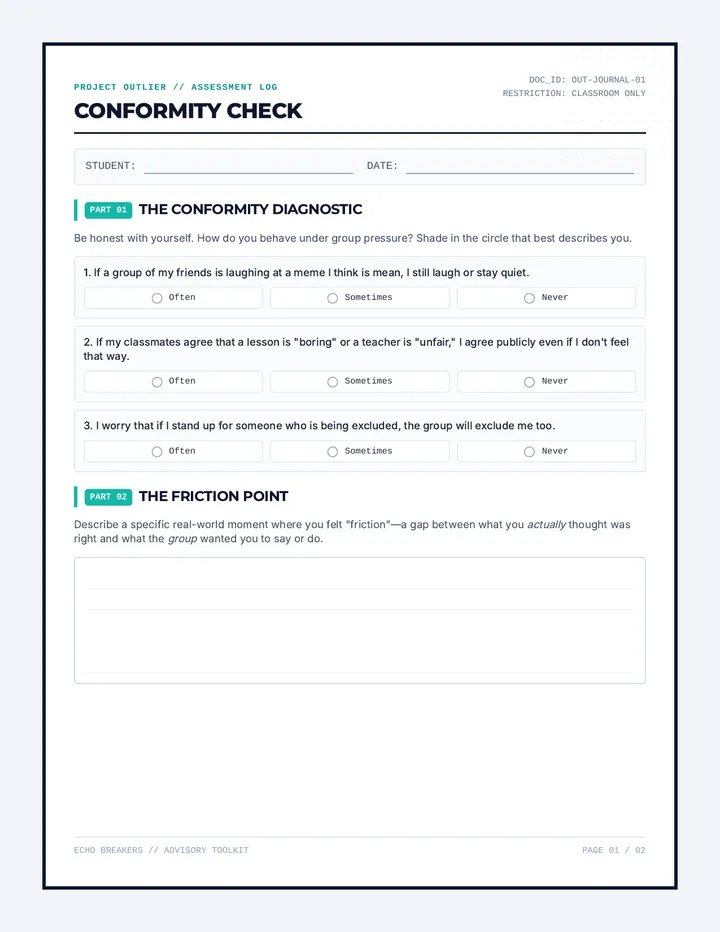
A set of social navigation challenge cards for 7th grade students to practice personal space, responding to 'No', and handling rejection across various school environments like the hallway, lunchroom, and library.
A teacher's facilitation guide with expanded role-play scenarios, corrective prompts, and sensitive framing for teaching social boundaries to students.
A guide for handling rejection and the difference between 'Not Now' and 'No'. Revised for improved layout, page breaks, and formatting consistency. Highlighting clear boundaries and respectful responses. Includes structured writing lines for student responses.
A student-facing guide focusing on personal space rules, the 'Exit Path' concept, and how to respond when asked to move. Revised for layout consistency, improved diagramming, and optimal page usage. Includes structured writing lines for student responses.
A set of social navigation slides focusing on personal space, responding to 'No', and handling rejection. Includes practice challenge cases for classroom discussion.
A comprehensive answer key and exemplar response guide for the Brain Lab workbook, covering scientific terminology, mindset flips, and personal reflection prompts.
A robust 10-page facilitation guide for educators to implement the Brain Lab workbook, featuring learning objectives, pacing tables, instructional strategies, differentiation tips, and an assessment rubric.
A comprehensive 10-page student workbook exploring the science of neuroplasticity, brain anatomy, and growth mindset. It features a "Brain Lab" theme with engaging visuals and dedicated student reflection areas.
Lesson plan for Session 19: Self-Correction Code. Teaches students how to handle language mistakes with confidence using specific 'patch phrases' and self-acceptance. includes mini-quiz and scenarios. Optimized for one-page print.
Lesson plan for Session 18: Listening Levels. Teaches active listening techniques, mirroring, and paraphrasing in English with added practice scenarios and a final mini-quiz. Optimized for one-page print.
Facilitator word-for-word scripts for the ESL and EQ expansion block (Sessions 17-19). Includes actual role-play text, a Mastery Quiz section, and improved visual hierarchy for spoken lines.
Second ESL extension for the Quest Log workbook, covering Sessions 17-19. Focuses on Empathy validation, Active Listening (Mirroring), and mid-conversation Self-Correction strategies. All content fits on 3 high-contrast pages with improved legibility.