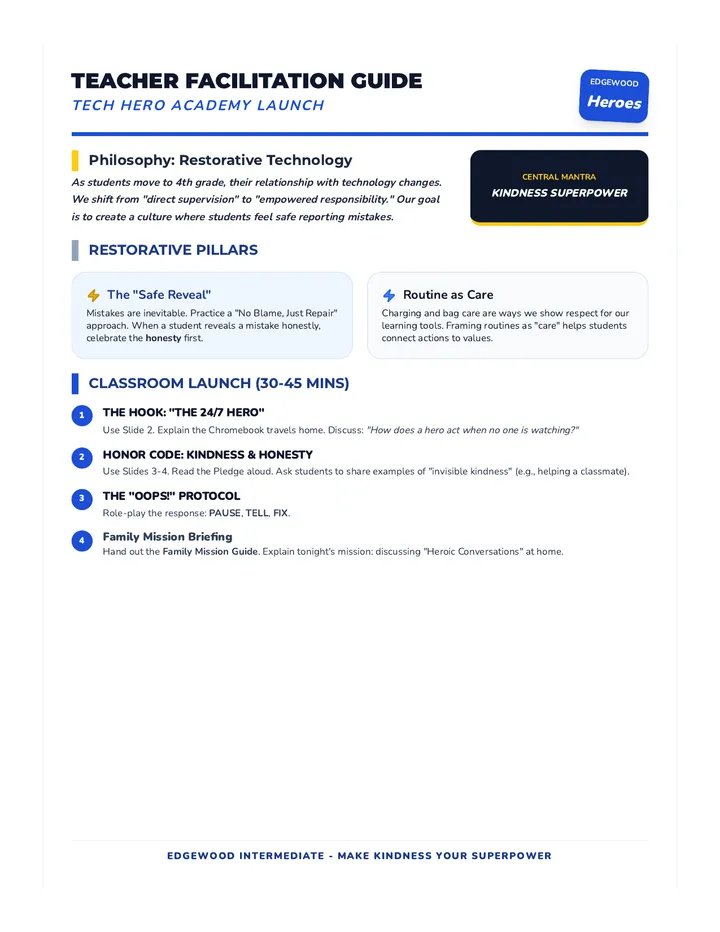
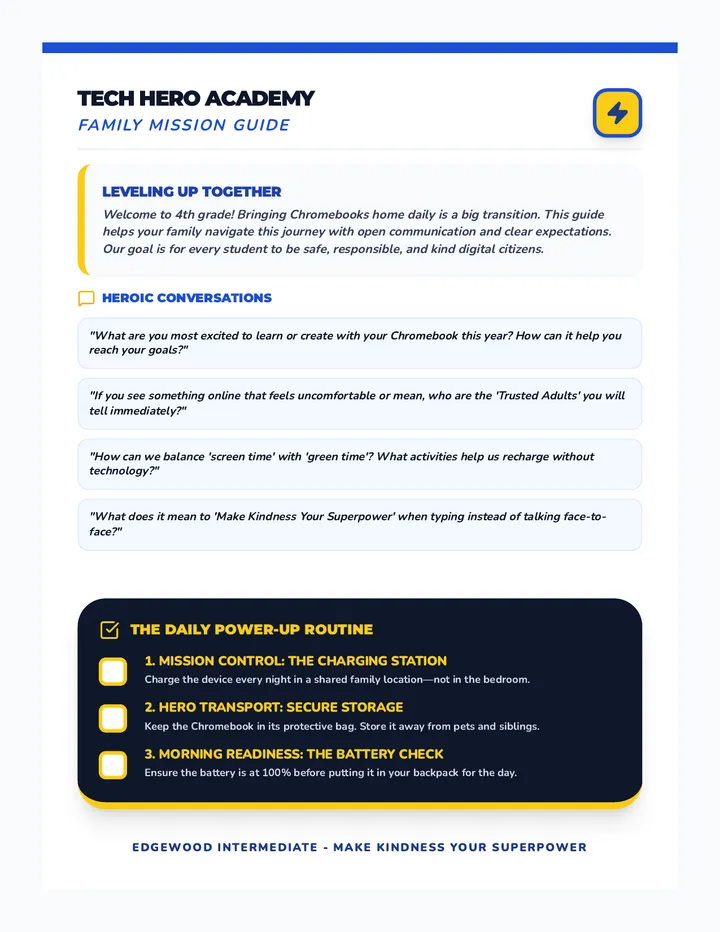
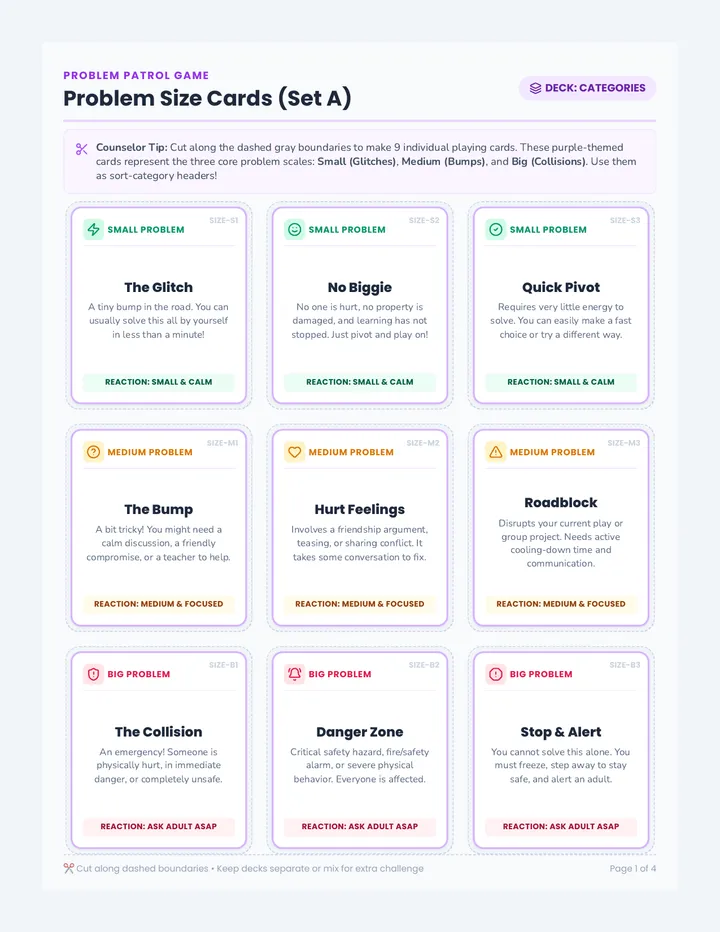
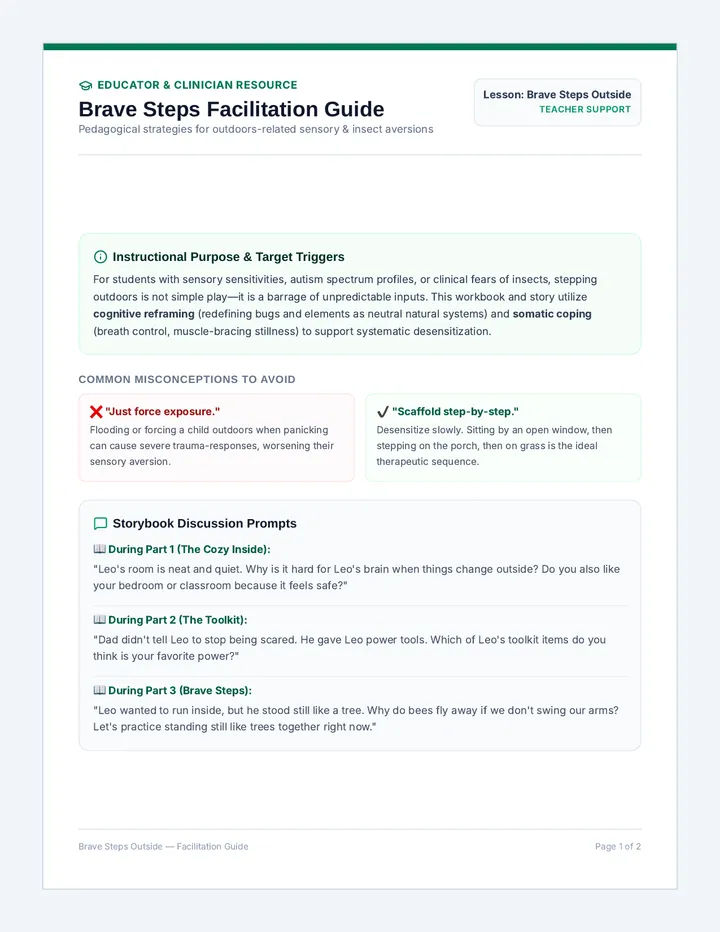
A vibrant and engaging 8-slide presentation to guide a Tier 1 lesson on autism acceptance, featuring the 'color filter' analogy and the Respect Rainbow concept.
A 5-page workbook bundle for students in the Grit Mountain unit, featuring reflection activities, drawing spaces for academic and social grit, and a final graduation certificate. Revised for high contrast and clear work areas.
A comprehensive teacher's lesson plan for a 20-minute session on self-control, including timing, discussion prompts, and instructions for integrating the slides, anchor chart, and game.
A space-themed printable board game with a 36-square path and 18 situation cards designed to help students practice identifying scenarios as either within their circle of control or outside of it. Includes a teacher answer key.
A visual anchor chart for the classroom that clearly distinguishes between internal things students can control and external factors they cannot, using a space-themed 'Command Center' design.
An interactive slide deck for a 20-minute lesson on the Circle of Control, featuring a space-themed 'Command Center' aesthetic and specific scenario challenges to help students differentiate between internal and external factors.
A comprehensive unit overview for the Grit Mountain SEL program, detailing the 5-lesson sequence, learning objectives, and implementation tips for 3rd and 4th grade teachers.
A large-format classroom anchor chart (poster) that visually reinforces the 'Comedy Compass' system. It uses high-contrast icons, bold color-coded zones for Green (Go) and Red (Stop) times, and prominently features the core self-regulation question for students to reference at a glance.
Educational slides for the final lesson of the Grit Mountain unit, celebrating student growth and reviewing key strategies.
The final lesson plan in the Grit Mountain unit, summarizing the unit and helping 3rd and 4th graders create a personal toolkit for perseverance. Revised to fix page breaks and contrast.
Educational slides for Lesson 4 of the Grit Mountain unit, teaching students how to handle frustration and practice when learning new hobbies.
The fourth lesson plan in the Grit Mountain unit, focusing on overcoming frustration when learning new hobbies and skills for 3rd and 4th graders. Revised to fix page breaks, contrast, and add the card activity.
Educational slides for Lesson 3 of the Grit Mountain unit, teaching social grit and relationship resilience to 3rd and 4th graders.
The third lesson plan in the Grit Mountain unit, focusing on social grit and navigating friendship challenges for 3rd and 4th graders. Revised to fix page breaks and contrast.
Educational slides for Lesson 2 of the Grit Mountain unit, teaching neuroplasticity. Revised for high contrast and clearer visuals.
The second lesson plan in the Grit Mountain unit, focusing on the brain science of mistakes and neuroplasticity for 3rd and 4th graders. Revised to fix page breaks and contrast.
Educational slides for Lesson 1 of the Grit Mountain unit, introducing the 'Power of Yet'. Revised for better layout and text spacing.
The first lesson plan in the Grit Mountain unit, focusing on academic perseverance and the 'Power of Yet' for 3rd and 4th graders. Revised to fix page breaks and contrast.
A compact, visually high-contrast reference card for students. It features the Green and Red zones of humor, teacher social cues to watch for, and the core 'Check-In' question to help students self-regulate their classroom jokes.
A teacher guide for the Comedy Compass lesson. It includes objectives, pacing, discussion questions, common misconceptions about humor timing, and differentiation tips for varied learners.
A student worksheet for auditing classroom humor timing. It features signal identification exercises and reflective prompts on how humor impacts classroom dynamics and following teacher cues.
A comprehensive 8-slide presentation designed to help students understand the social nuances of humor in the classroom. It uses a 'Comedy Compass' theme to categorize situations into 'Green Zones' (appropriate times) and 'Red Zones' (focused learning times), emphasizing the importance of following teacher directions and reading social cues.
A collection of printable feedback cards with prompts for students to leave positive, specific comments on their classmates' empathy art.
A student-facing worksheet designed like a framed museum canvas for students to illustrate empathy and write their 'Artist Statement' explaining their work.
A facilitation script for the teacher to guide students through the gallery experience, including opening remarks, drawing prompts, and reflection questions.
A visually engaging presentation with museum-themed slides to introduce the concept of empathy, provide artist instructions, and set classroom expectations for the gallery walk.