A foundational lesson on elapsed time using visual strategies like number lines and clock jumps, specifically designed for 3rd-grade special education students focusing on whole hours and 30-minute increments.
A direct instruction lesson focused on phoneme-grapheme mapping to help students decode grade-level vocabulary. This lesson provides a structured "Sound Lab" approach to breaking down unknown words into their individual sounds and corresponding letters.
A comprehensive system for tracking IEP progress across multiple lagging skills, including a master overview and specialized data logs for Academic, Executive Functioning, Social-Emotional, and Functional Life Skills.
A restorative behavioral intervention focused on resolving physical conflict and verbal aggression through a formal behavior contract and daily progress tracking.
Teacher resources, unit overview, and facilitator guides for the Brain Squad Mastery curriculum.
A deep dive into the biological parts of the brain (Amygdala, Prefrontal Cortex, Hippocampus, and Brain Stem) and how they function as the home for Sparky and Professor PFC.
Reviewing unit concepts through a final quiz and celebrating mastery of brain squad strategies.
Discovering personal hobbies and interests that act as tools for emotional regulation and positive expression.
Applying brain squad concepts to real-world scenarios through skits and 'What Would You Do?' games.
Using a visual flowchart to guide students through the process of moving from a trigger to a smart brain response.
Understanding the 'flipped lid' concept and the difference between immediate reactions and thoughtful responses.
Identifying personal and environmental triggers that activate the emotional brain.
Exploring how Autism impacts the connection between the emotional and smart brain, focusing on sensory processing and executive function.
Introduction to the two parts of the brain: the emotional/reactive brain (Sparky) and the smart/thinking brain (Professor PFC).
Materijali za sustav nagrađivanja (žetoniranje) usmjeren na točnost i pripremljenost učenika za nastavu. Sadrži tjednu karticu za prikupljanje naljepnica i katalog mogućih nagrada.
A social-emotional learning lesson focused on helping students with autism understand social boundaries, role clarity, and knowing when to disengage from peer interactions, particularly in unstructured settings like the school bus.
A foundational lesson on basic coordinating conjunctions (and, but, or) designed for students with IEPs. The lesson uses visual metaphors of 'glue' and 'connections' to help students understand how words join ideas together.
A simplified introduction to the Homestead Act and Westward Expansion, adapted for students with diverse learning needs and focusing on the journey of homesteaders.
A simplified lesson on the Artemis II mission to the Moon, designed for students with diverse learning needs. Students explore key science vocabulary and basic facts about the mission through a guided worksheet.
A foundational literacy lesson for non-verbal students focusing on the book 'Shhh! Bears are Sleeping', using visual supports to build vocabulary related to hibernation and seasons.
A 20-minute interactive choose-your-own-adventure speech therapy session at a 3rd-grade reading level. Students guide a young space scout on a mission to Mars while targeting /sh/ and vocalic /r/ sounds and fluency strategies.
A 20-minute speech-language therapy session focused on mixed articulation, fluency, and intelligibility goals using space-themed narrative prompts. Students practice target sounds and repair strategies while narrating a mission to Mars.
A series of hands-on cut-and-paste activities designed to help IEP students master skip counting by 2s, 5s, and 10s through visual patterns and tactile learning.
A neurodiversity-affirming lesson that uses the 'Broken Record' and 'Reset Button' analogies to help students understand the experience of OCD. It focuses on the difference between obsessions and compulsions, reframes repetitive behaviors, and provides practical ways for classmates to be supportive allies.
A compassionate and neurodiversity-affirming lesson that uses the 'Sensitive Smoke Detector' and 'Brain Freeze' analogies to help students understand the experience of anxiety. It focuses on empathy, physical symptoms, and practical ways to support classmates during moments of worry.
A neurodiversity-affirming lesson designed to help students understand the ADHD experience through analogies like 'The Fast Engine' and 'The Busy Librarian.' It covers focus, hyperactivity, and executive function to build empathy and allyship in the classroom.
A foundational sentence structure lesson for IEP students focusing on SVO, compound sentences, adjectives, and WH-questions. Uses a construction theme to make grammar concrete and visual.
A lesson focused on slowing down impulsivity and managing performance anxiety during digraph review. It integrates growth mindset principles into explicit decoding practice for UFLI Lesson 49.
A week-long Tier II intervention focused on improving Nonsense Word Fluency through consonant blend mastery. Includes three 30-minute sessions using a 'Secret Agent' theme to engage students in decoding.
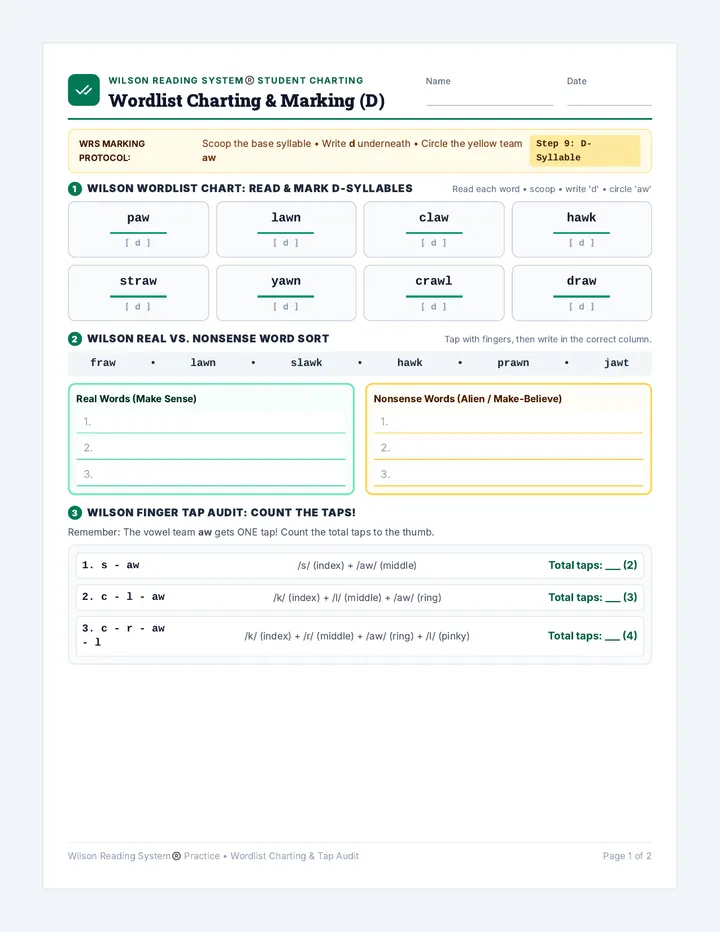
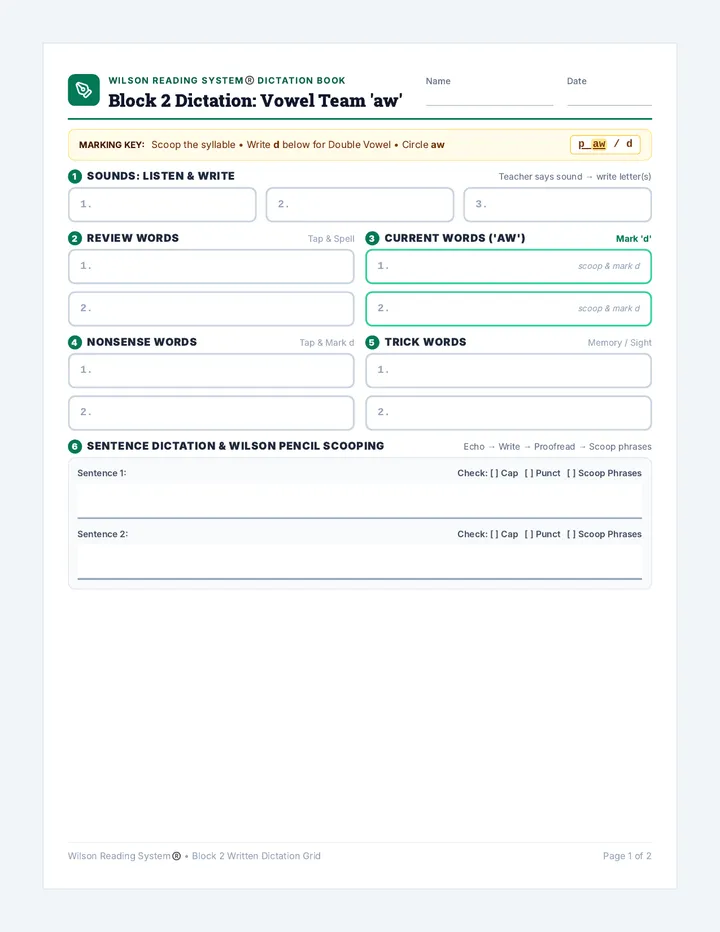
A collection of word lists and tracking tools focusing on the 'oa', 'oe', and 'ie' (long i) vowel teams. Designed for structured literacy practice and IEP data collection.
A 30-minute professional development session for K-8 and preschool behavior staff focusing on restorative questioning and the LSCI debriefing framework to repair relationships after behavioral incidents.
A comprehensive summer support package for students with self-regulation needs, including individualized routines, sensory strategies, caregiver coaching, and progress monitoring aligned to IEP goals.
A comprehensive progress monitoring collection featuring 5 distinct word sets (75 words total) for tracking mastery of vowel teams and diphthongs. Each set includes a student reading list and a multi-trial teacher tracking sheet.
A progress monitoring tool designed to assess a student's ability to decode words with initial and final s-blends, r-blends, and l-blends. This lesson includes a student reading list and a teacher scoring checklist.
Focuses on the implementation of external structures, including checklists and reward systems, to reinforce positive behavioral changes and build long-term habits.
This lesson teaches students to recognize physical signals of dysregulation and introduces the 'Power Pause' as a primary behavioral modification tool for impulse control.