Friendship Fires Lesson Plan Friendship Firefighters
Lesson Plan: How to Put Out Friendship Fires
20 Minutes
Learning Objective
Students will be able to identify the difference between tattling and reporting and explain the specific harm caused by gossip and exclusion.
Audience
4th Grade
Tier 1 Classroom
Why It Matters
Understanding the difference between tattling and reporting helps students address issues constructively, promoting a safer and more respectful classroom. Learning about the harm of gossip fosters empathy and builds stronger, more positive friendships.
Instructional Approach
Through guided discussion, an interactive whisper-chain game, and personal reflection, students will learn to manage social conflicts and "mend fences" after disagreements.
Teacher Preparation (10 mins)
Review Lesson Plan & Script
Print Warm Up Sheets (1/student)
Print Mending Fences (1/student)
Print Exit Tickets (1/student)
Print Parent Guides (1/student)
Prepare "Rumor Sentence" paper
Lesson Flow
1
Warm Up: What's the Spark?
2 Mins
Distribute Friendship Fire Warm Up . Students reflect on a time they saw a small problem grow. This activates prior knowledge of social conflict.
2
Connect: Intro to Friendship Fires
3 Mins
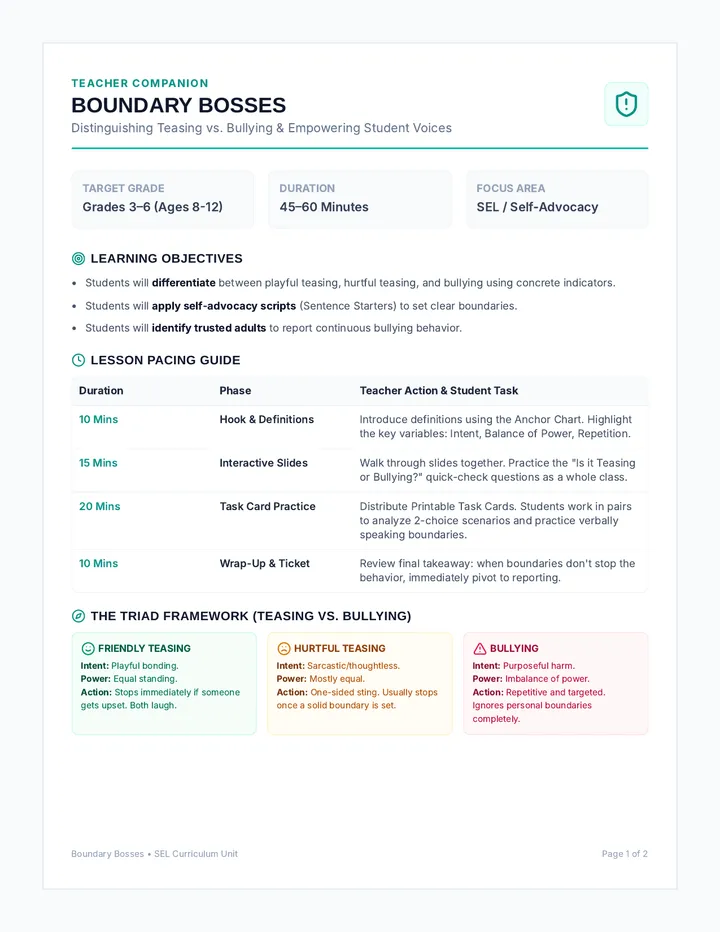
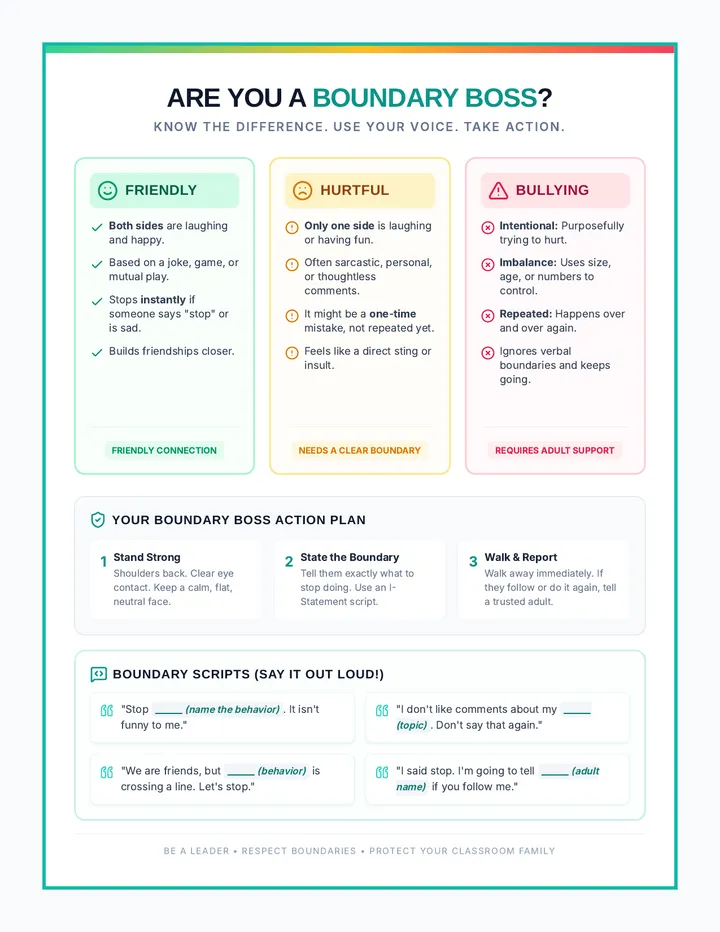
Use the Slide Deck and Script . Define "Friendship Fires." Introduce the critical difference between Tattling (to get in trouble) vs. Reporting (to keep safe).
3
Teach: Understanding the Heat
7 Mins
Discuss Gossip and Exclusion . Explain how gossip acts as "fuel" that spreads the fire. Guide students to share how words can cause harm without naming names.
4
Practice: The Rumor Chain Game
5 Mins
Facilitate the game (refer to Game Guide ). Reflect on how messages change and the impact of spreading unverified information.
5
Reflect: Mending Fences
3 Mins
Transition to repair. Distribute Mending Fences Worksheet for independent practice. Conclude with Cool Down exit ticket.
Don't Fuel the Fire Slide Deck How to Put Out
Friendship Fires
What causes them? How can we stop them from growing?
4th Grade SEL
Tattling vs. Reporting
1
Tattling
Telling an adult to get someone in trouble for something minor.
2
Reporting
Telling an adult to keep someone safe or solve a serious problem.
Gossip: The Spark
What is gossip? Spreading rumors or talking about private business.
Why can gossip hurt? It breaks trust and creates "fire."
When we spread rumors, we fuel the fire!
Exclusion: Leaving Out
How does gossip lead to exclusion?
Why is it important to include everyone?
Mending Fences
Mistakes happen. How can we fix them?
Apologize
Understand
Make it Right
The Rumor Chain Game
1
Listen carefully!
2
Pass the message.
3
See how it changes!
"One small spark of rumor can grow into a wildfire of hurt."
Be a Friendship
Firefighter!
How can YOU put out friendship fires?
Think First
Stay Kind
Report Danger
Friendship Fires Script Instructional Script
How to Put Out Friendship Fires
Teacher Resource
Part 1
Connect: What's the Spark? (3 mins)
"Good morning, everyone! Look at our lesson title today: 'How to Put Out Friendship Fires Before They Spread.' That sounds intriguing, doesn't it? What do you think a 'friendship fire' might be? Turn and talk to a partner for about 30 seconds and share your ideas."
(Allow students to discuss. Listen for keywords like arguments, disagreements, hurt feelings, gossip.)
"That's right! Friendship fires are those moments when things get heated between friends. Maybe it's a disagreement, or someone feels left out, or words are said that cause hurt. Just like a real fire, if we don't put out these 'friendship fires' quickly, they can spread and cause a lot more damage."
Part 2
Teach & Model: Understanding the Heat (7 mins)
"Today, we're going to learn how to be 'friendship firefighters'! One of the first things we need to understand is the difference between tattling and reporting . Let's look at this on our slides."
Switch to Slide 2: Tattling vs. Reporting
"Can someone read the definitions for us? What's the main difference you notice? When might you tattle ? When would it be important to report ? Think-Pair-Share on this."
Allow time for discussion and guide them to understand the safety and problem-solving aspect of reporting.
"Excellent! Now, another big 'spark' that can start friendship fires is something called gossip . Has anyone heard that word before? What do you think gossip is?"
Switch to Slide 3: Gossip
"Gossip is when we talk about other people's private business, often spreading rumors or things that might not even be true. It's like adding fuel to a small spark, making it grow into a big fire. How do you think it feels to be the person being gossiped about? How can gossip lead to people feeling left out?"
Switch to Slide 4: Exclusion
"Gossip often leads to exclusion . When we talk negatively about someone, others might start to avoid that person, making them feel lonely and left out. We want to be inclusive, right?"
Part 3
Practice: The Rumor Chain Game (7 mins)
"Alright, now let's see how quickly a 'friendship fire' can spread if we're not careful. We're going to play The Rumor Chain Game !"
Switch to Slide 6: The Rumor Chain Game
"I'm going to whisper a simple sentence to the first person in each row. That person will then whisper it as they heard it to the next person, and so on, down the line. The last person will say the sentence out loud. Remember, no talking above a whisper, and try to repeat it precisely!"
Friendship Fire Warm Up Friendship Fire Warm Up
Name: _________________________________________________ Date: ________________
Unit: Social Conflict
"Sometimes small disagreements can turn into big problems if we don't know how to handle them. Let's think about how those fires start."
Part 1: Spot the Spark
Think about a time when you saw a small problem between friends start to get bigger. What happened?
Part 2: Quick Action
Looking back at that situation, what is one thing that could have been done to stop the "fire" from spreading?
Friendship Firefighters Cool Down Cool Down
Friendship Firefighter Exit Ticket
Name:
Date:
1
What is one thing you learned today about putting out a "friendship fire"?
2
How will you try to be a "friendship firefighter" this week?
Official Friendship Firefighter Certification
The Rumor Chain Game Guide Game Guide
The Rumor Chain
Interactive Activity
Learning Objective
To demonstrate how quickly and inaccurately information can spread through gossip and rumors, emphasizing the distortion of facts over time.
Materials Needed
Pre-written sentence on paper
A quiet classroom environment
Instructions
1
Introduction
Explain that messages change as they are passed along. Relate this to how rumors and gossip spread in real life.
2
Form Groups
Divide the class into small groups or use existing rows (5–7 students per group is ideal).
3
The Message
"The cat with the striped tail found a shiny blue ball in the park."
Whisper this to the first person in each group. They may only hear it once!
4
Whisper Chain
Students whisper the sentence to the next person exactly as they heard it. No repeating or asking for clarification.
5
The Reveal
The last student in each group says their version out loud. Reveal the original sentence and compare!
Post-Game Discussion
Question 1
"What happened to the message as it traveled down the chain?"
Question 2
"Why do you think the message changed so much?"
Question 3
"How does this game relate to spreading gossip about someone?"
Question 4
"What can we learn about how we share info about others?"
Key Takeaway
Even simple messages get distorted. Never pass along info you haven't verified!
Mending Fences Letter of Apology Worksheet Mending Fences
A Sincere Letter of Apology
Name:
Date:
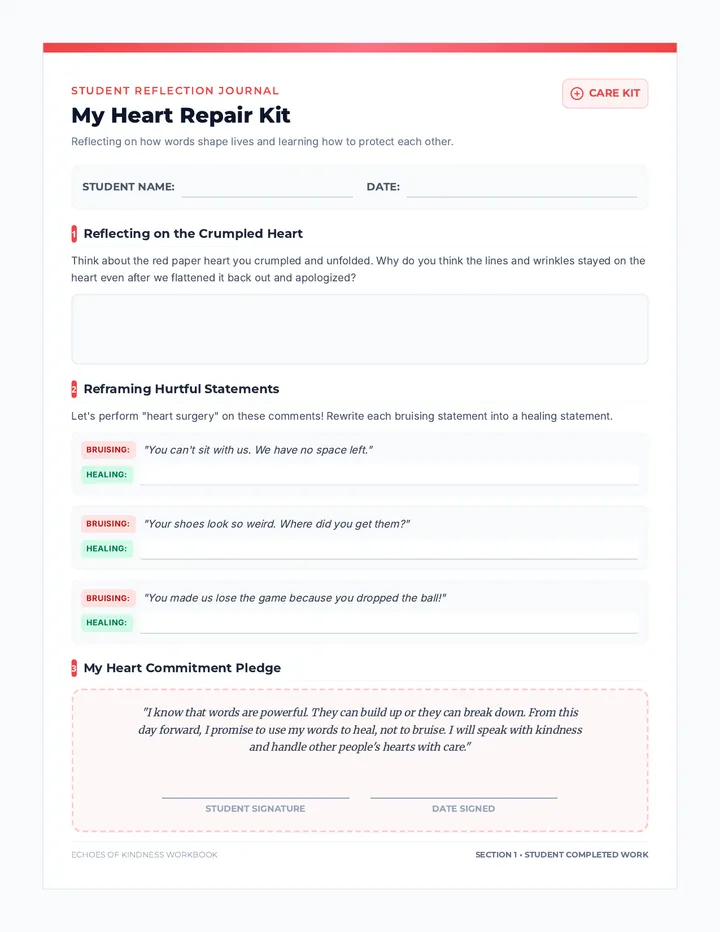
"Sometimes, even when we don't mean to, our words or actions can hurt a friend. Writing an apology can help mend a friendship fire. Imagine you had a disagreement with a friend, or maybe you accidentally said something that spread a rumor. Use the space below to write a letter of repair."
Repair
Dear
I am writing this letter because...
I understand that what I did or said...
In the future, I will try to...
I hope we can still be friends.
Sincerely,
Be Honest
Take Responsibility
No "Buts"
Answer Key for Mending Fences Letter of Apology Teacher Resource
Answer Key
Mending Fences Worksheet
Grading Guide & Examples
Grading Note
This worksheet is designed for personal reflection and authentic repair. There is no single "correct" answer. Instead, evaluate student work based on the sincerity and completeness of the apology components below.
Components of a Sincere Apology
Acknowledgement
The student clearly identifies what they did wrong (e.g., "I shared a rumor about your test grade").
Empathy
The student describes the impact on the friend (e.g., "I know that made you feel embarrassed").
Responsibility
The student avoids using "but" or blaming others for their choice.
Commitment
The student provides a concrete plan for the future (e.g., "I will check with you before I talk about your business").
Exemplar Response
"Dear Alex,"
"I am writing this letter because I told Sarah that you were mad at her even though you didn't say that."
"I understand that what I did or said was gossip and it probably made you feel frustrated because I was speaking for you. It caused a 'friendship fire' between you and Sarah."
"In the future, I will try to mind my own business and only share my own feelings, not yours. I will also apologize to Sarah for spreading the rumor."
"I hope we can still be friends. Sincerely, Jordan"
Friendship Firefighter Curriculum Resource
How to Put Out Friendship Fires: Parent Guide Home-School Connection
How to Put Out Friendship Fires
Dear Parents and Guardians,
Today in class, your child participated in a lesson called "How to Put Out Friendship Fires Before They Spread." The goal of this lesson was to help students understand the difference between tattling and reporting, and to recognize the damaging effects of gossip on their friendships.

What Your Child Learned
Tattling vs. Reporting: Tattling is to get someone in minor trouble; reporting is to keep someone safe .
The Harm of Gossip: How spreading rumors acts as "fuel" for social conflict.
Mending Fences: The importance of sincere apologies and repairing relationships.
Why It Matters
4th grade is a pivotal time for social development. By learning these skills now, students build the empathy and conflict-resolution tools they need for middle school and beyond.
How You Can Help at Home
Discuss the "Rumor Chain"
Ask your child about the game they played. Discuss how information can get distorted and how gossip can hurt feelings even if the story wasn't meant to be mean.
Reinforce Reporting
Talk about situations where it's important to report (danger, bullying) versus when it might be tattling (minor annoyances). Encourage them to think about intent .
Practice Apologies
If your child has a disagreement with a sibling or friend, encourage them to think about how they can sincerely apologize. Sincerity means taking responsibility without saying "but."
Thank you for supporting your child's social-emotional learning!