Lenny.com
Explore
Create
ActivitiesNewMathEnglish Language ArtsScience & EngineeringSocial StudiesGlobal LanguagesHealth & Physical EducationSpecial EducationCounseling & Life SkillsArts & CreativityESL
Lenny.com
Lenny.com
Explore
Create
ActivitiesNewMathEnglish Language ArtsScience & EngineeringSocial StudiesGlobal LanguagesHealth & Physical EducationSpecial EducationCounseling & Life SkillsArts & CreativityESL
Lenny.com
Lenny.com

Solutions

Lenny for EducatorsLenny for SchoolsLenny for Districts

Product

ExploreSign inCreateSupportAbout

Resources

Getting startedMTSS Acceleration Program

© 2026 Lenny Learning Inc.

TermsPrivacyAccessibility
LinkedInInstagramX
Lenny

Make Geometric Constructions

Compass and straightedge techniques for bisecting angles, segments, and constructing perpendicular lines. Develops precision through the creation of parallel lines and inscribed regular polygons.

MathNumbers & CountingCounting ObjectsNumber NamesComparing NumbersNumber OperationsCounting SequenceNumbers 0-10Place Value Understanding and SystemAdd and Subtract Within 20Addition and Subtraction ConceptsAddition and Subtraction EquationsAddition and Subtraction ProblemsFoundations for MultiplicationMultiplication and Division PropertiesMultiply and Divide Within 100Multiplication and Division ProblemsFactors and MultiplesProperties of OperationsPatterns and RelationshipsGenerate and Analyze PatternsMulti-Digit ArithmeticPlace Value OperationsMulti-Digit and Decimal OperationsNumerical ExpressionsFour Operations and PatternsFour Operations Problem SolvingMeasurement & DataMeasurable AttributesMeasuring LengthsMeasure and Estimate Lengths in Standard UnitsRelate Addition and Subtraction to LengthClassifying and Counting ObjectsTime and MoneyArea Concepts and MeasurementPerimeter and Area MeasuresAngle Concepts and MeasurementTime, Volume, and MassMeasurement Unit ConversionsGeometryIdentifying ShapesShapes and AttributesShape Attributes and ReasoningShapes and CompositionClassifying 2D FiguresGeometric Figures and RelationshipsLines, Angles, and ShapesAngle, Area, and VolumeGeometric MeasurementVolume of 3D ShapesCoordinate Plane ApplicationsTransformations in the PlaneCongruence and SimilarityUnderstand congruence in terms of rigid motionsSimilarity and TransformationsProve Theorems Involving SimilarityPythagorean TheoremTrigonometry for General TrianglesMake Geometric ConstructionsProve Geometric TheoremsTheorems About CirclesFind Arc Lengths And Areas of Sectors of CirclesVolume FormulasRelationships Between Two-Dimensional and Three-Dimensional ObjectsProve Simple Geometric Theorems AlgebraicallyTranslate Between Geometric Description and Equation for Conic SectionApply Geometric Concepts in Modeling SituationsFractions & DecimalsFractions as NumbersBuilding FractionsFraction Equivalence and OrderingAdding and Subtracting FractionsMultiplying and Dividing FractionsDividing FractionsDecimal FractionsMulti-Digit Computation and FactorsAdd, Subtract, Multiply, and Divide Rational NumbersRational Number SystemIrrational Numbers and ApproximationsRatiosRatios and ProportionsProportional RelationshipsUnit RateAlgebraAlgebraic ExpressionsGenerate Equivalent ExpressionsQuantitative RelationshipsProportional Relationships and Linear EquationsEquations and InequalitiesEquation Solving and ReasoningLinear Equations and SystemsGraph Equations and InequalitiesSystems of EquationsReal-World Algebraic ProblemsQuantitative Reasoning with UnitsExpression StructureEquivalent Expression FormsRadicals and Integer ExponentsRational ExponentsRational and Irrational NumbersPolynomial OperationsPolynomial IdentitiesPolynomial Zeros and FactorsRational ExpressionsComplex Number OperationsComplex Numbers in PolynomialsComplex Numbers on PlaneStatistics & ProbabilityRepresent and Interpret DataData DistributionsStatistical VariabilityProbability ModelsCompound Event ProbabilitiesStatistical SamplingInterpret Categorical and Quantitative DataBivariate Data PatternsInterpret Linear ModelsComparing Two PopulationsRandom Processes in StatisticsIndependence and Conditional ProbabilityExpected ValuesProbability-Based Decision MakingStatistical Inference and ConclusionsFunctionsFunction Concepts and NotationDefine and Compare FunctionsInterpret Functions in ContextAnalyze Function RepresentationsModel Relationships with FunctionsIdentify Linear vs Exponential GrowthDistinguish Between Function TypesCompare Growth RatesInterpret Function ExpressionsBuild Functions from RelationshipsConstruct and Model FunctionsTransform and Combine FunctionsModel Comparison and SelectionSolve Exponential EquationsTrigonometryTrigonometric Ratios Involving Right TrianglesTrigonometric Functions and Unit CircleModel with Trigonometric FunctionsTrigonometric IdentitiesVectors & MatricesIntroduction to Vectors and MatricesVector QuantitiesVector OperationsMatrix OperationsCalculusLimits and ContinuityDerivative Concepts and NotationDerivative Rules and TechniquesApplications of DerivativesOptimization ProblemsRelated RatesCurve Sketching and AnalysisIntegration Concepts and NotationAntiderivatives and Indefinite IntegralsDefinite Integrals and AreaFundamental Theorem of CalculusIntegration TechniquesApplications of IntegrationDifferential EquationsSequences and SeriesParametric and Polar FunctionsVector-Valued Functions

Videos

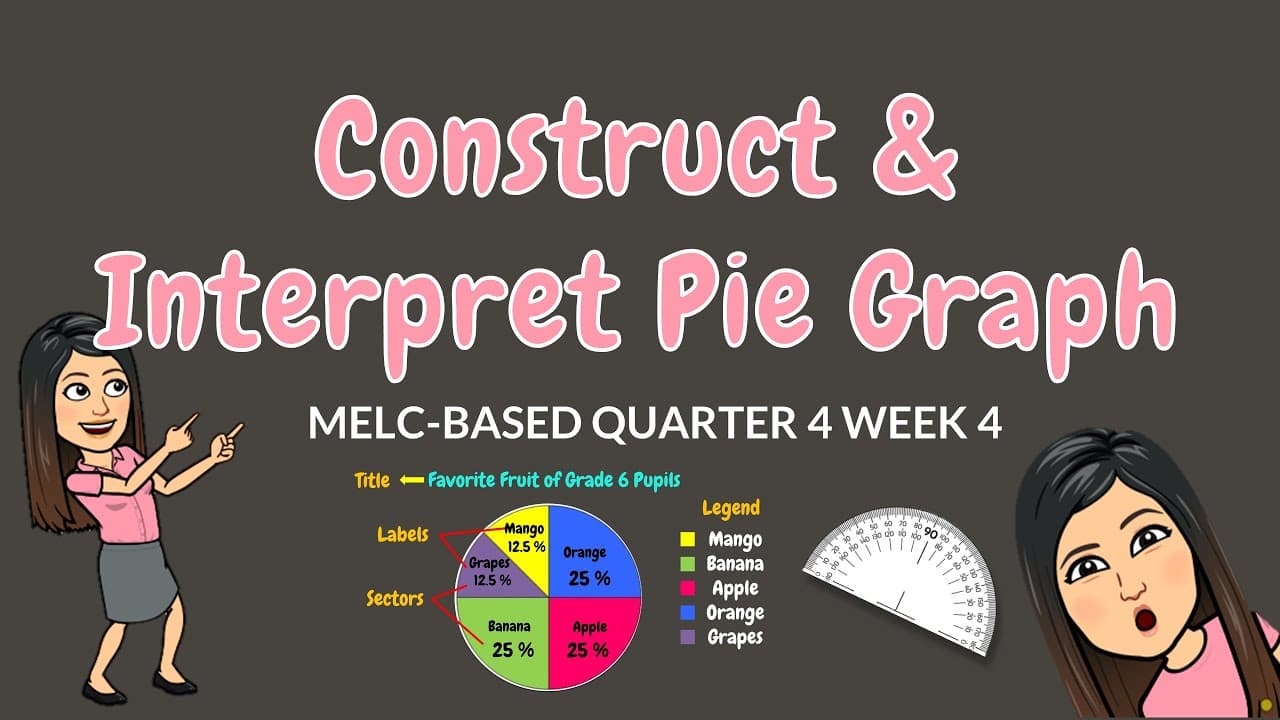
How to Construct and Interpret a Pie Graph Using Family Budgets

How to Construct and Interpret a Pie Graph Using Family Budgets

This instructional video provides a comprehensive, step-by-step guide on how to construct and interpret a pie graph (circle graph) using real-world data. Through the example of the Santos family's weekly expenses, the narrator demonstrates the complete process of data visualization, from organizing raw numbers into a table to drawing the final graph. The video breaks down complex procedures into five manageable steps: organizing data, converting amounts to percentages, computing degrees for each sector, constructing the graph using a protractor, and adding a descriptive title. The content integrates multiple mathematical concepts, including data handling, decimals, percentages, and geometry. Key topics include calculating percentages from part-to-whole relationships, converting percentages to decimal forms, understanding the properties of a circle (360 degrees), and measuring angles with a protractor. It also touches on financial literacy by using a family budget as the central dataset. For educators, this video serves as an excellent direct-instruction tool for upper elementary and middle school mathematics. It visually scaffolds the calculations for long division and multiplication, making it accessible for students learning these operations. The segment on interpretation offers valuable practice in reading data visualizations, asking students to identify largest/smallest shares and calculate values from percentages, promoting critical thinking and data literacy.

Sheena DoriaSheena Doria

12mins 23s

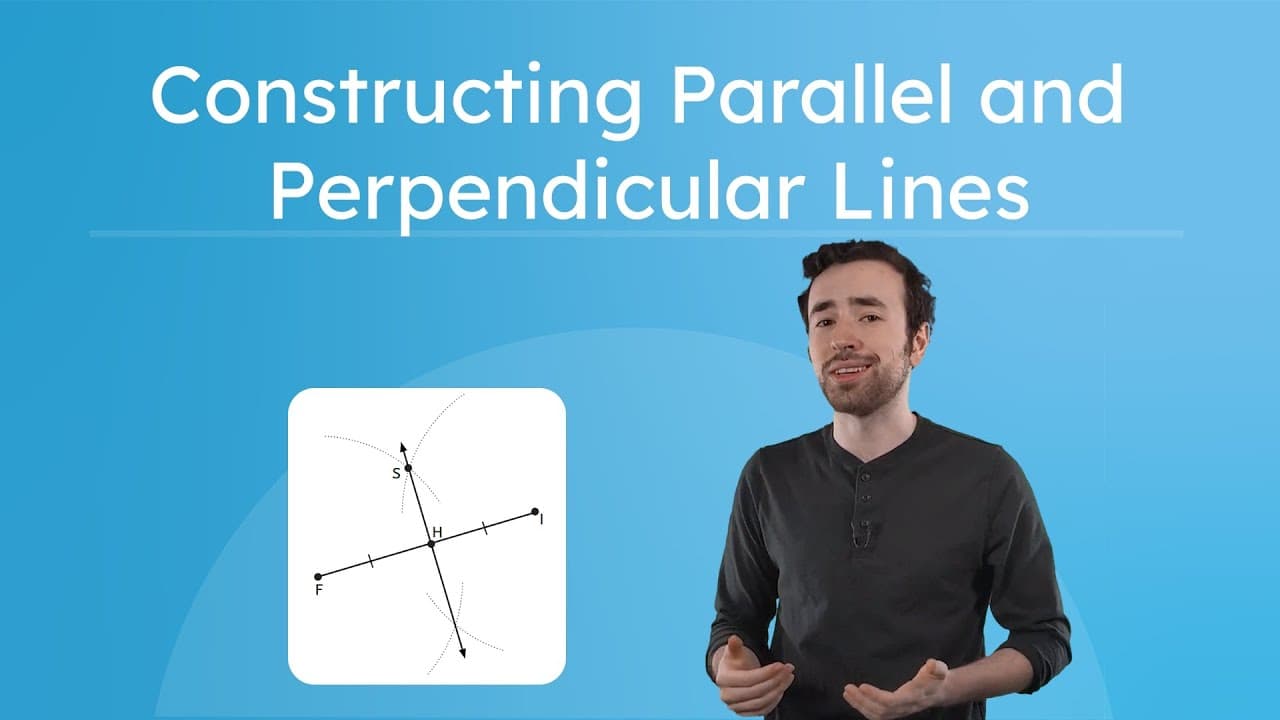
Mastering Geometry: Constructing Parallel and Perpendicular Lines

Mastering Geometry: Constructing Parallel and Perpendicular Lines

This instructional video guides students through the fundamental geometric skills of constructing parallel and perpendicular lines using only a compass and straightedge. The lesson begins by clearly defining the properties of parallel and perpendicular lines, including the specific notation and symbols used to identify them in geometric diagrams. It emphasizes the historical context of these methods, dating back thousands of years to early mathematicians. The core of the video demonstrates two step-by-step construction techniques: the 'angle copy method' for creating parallel lines and the 'perpendicular bisector' method for creating perpendicular lines that divide a segment into two equal parts. The instructor, Justin, uses clear digital animations of a compass and straightedge to model the precise physical movements students need to replicate, making the abstract procedural knowledge concrete and accessible. For educators, this video serves as an excellent primary instruction tool or review resource for high school geometry units on constructions. It explicitly addresses mathematical vocabulary like 'bisect', 'segment', and 'plane', and models correct geometric notation. The video encourages active participation, prompting students to pause and construct along with the narrator, making it perfect for a flipped classroom model or a guided in-class activity.

Miacademy & MiaPrep Learning ChannelMiacademy & MiaPrep Learning Channel

8mins 8s

Mastering Geometric Dilations on and off the Grid

Mastering Geometric Dilations on and off the Grid

This comprehensive math lesson introduces students to the geometric concept of dilations—transformations that resize objects while maintaining their shape. The video begins by grounding the concept in real-world examples, such as comparing phone sizes, measuring cups, and the relationship between real vehicles and toy models. It explains the core logic of scale factors: values between 0 and 1 create reductions (shrinking), while values greater than 1 create enlargements (growing). The lesson emphasizes that dilations are not isometries because the size of the object changes, unlike translations or rotations. The content covers two distinct methods for performing dilations. First, it demonstrates a classical geometric construction approach using a straightedge and compass to find images based on a center of dilation and rays. It uses Russian nesting dolls to visually illustrate how images radiate from a center point. Second, it transitions to the coordinate plane, teaching students how to calculate new coordinates by determining the "rise and run" distance from a specific center of dilation (which is not always the origin) and multiplying those distances by the scale factor. This video is highly valuable for middle and high school geometry classrooms as it connects abstract formulas to tangible visuals. It addresses common student stumbling blocks, such as dilating from a point other than the origin (0,0) and understanding that the center, preimage, and image points must always be collinear. The clear, step-by-step walkthroughs of problems on a coordinate grid provide excellent modeling for students learning to perform these transformations manually.

Miacademy & MiaPrep Learning ChannelMiacademy & MiaPrep Learning Channel

15mins 9s

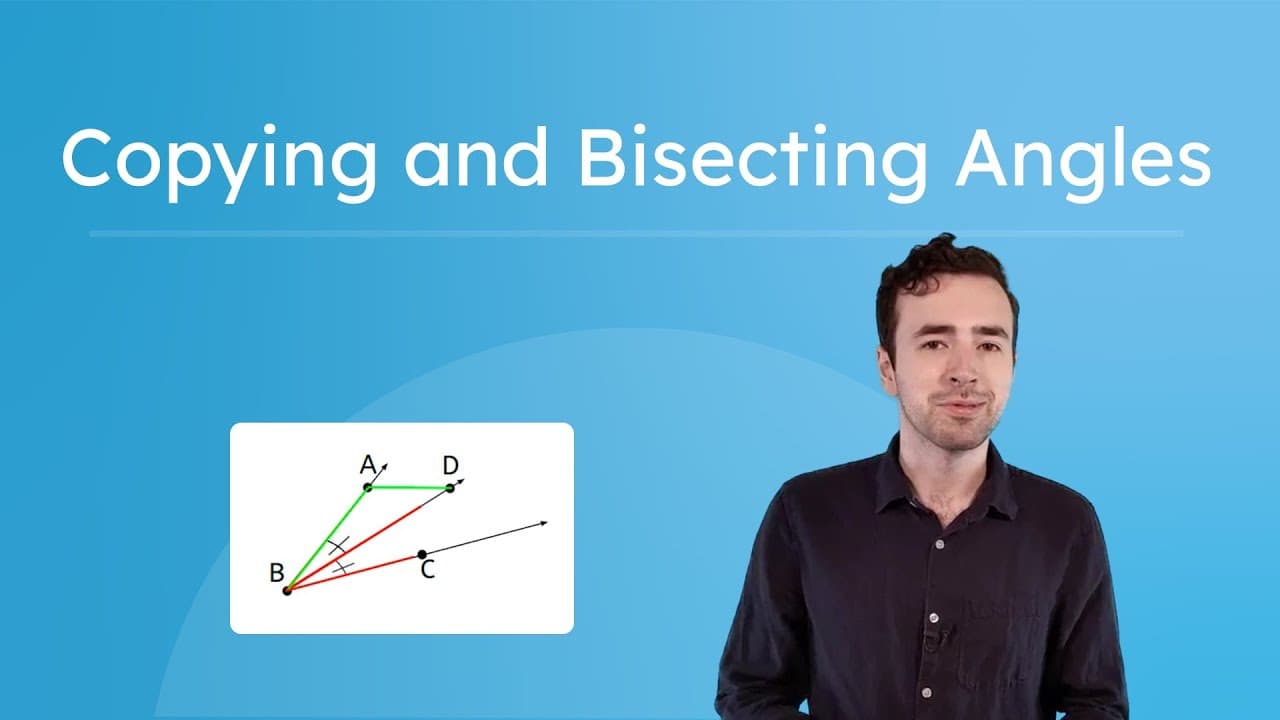
How to Copy and Bisect Angles in Geometry

How to Copy and Bisect Angles in Geometry

This educational video provides a clear introduction to two fundamental geometric constructions: copying an angle and bisecting an angle. Hosted by an instructor named Justin, the lesson guides students through the theoretical understanding needed before attempting these constructions with a straightedge and compass. The video serves as a pre-activity briefing, focusing heavily on the mathematical notation, symbols, and vocabulary required to describe these geometric processes accurately.

Miacademy & MiaPrep Learning ChannelMiacademy & MiaPrep Learning Channel

4mins 31s

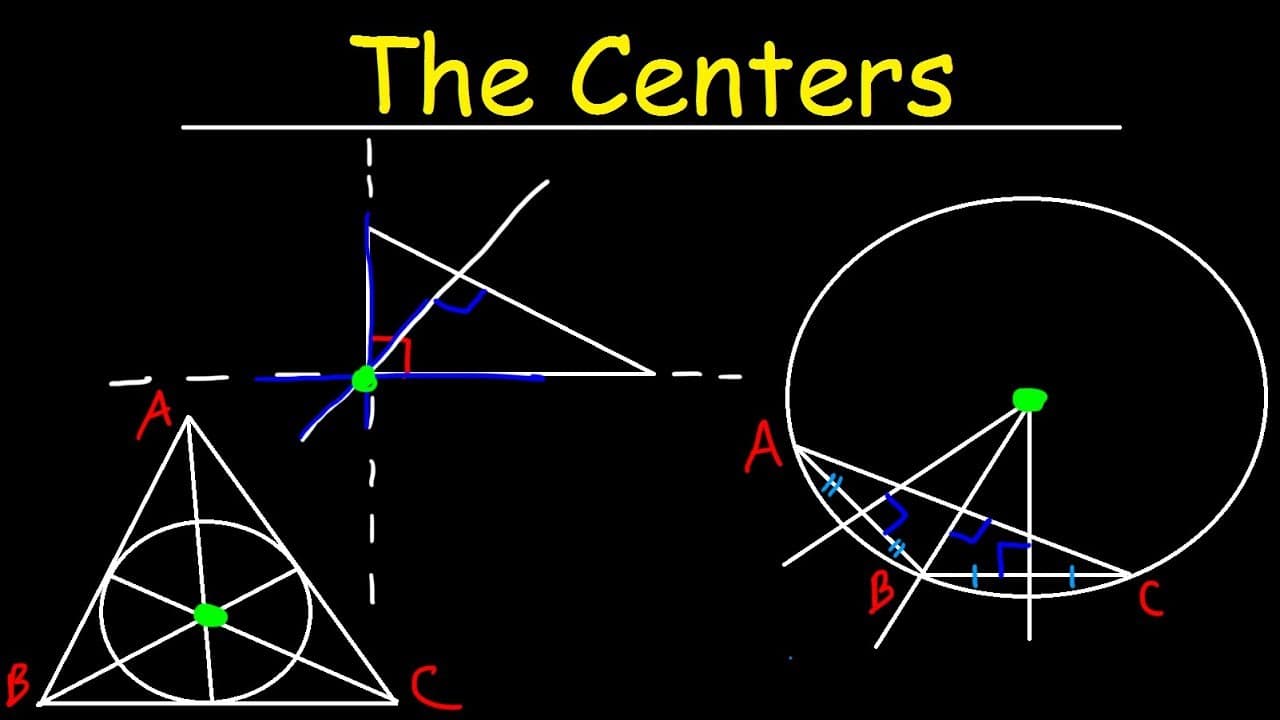
Understanding Triangle Centers: Incenter, Centroid, Orthocenter, and Circumcenter

Understanding Triangle Centers: Incenter, Centroid, Orthocenter, and Circumcenter

This comprehensive geometry tutorial provides a detailed exploration of the four primary centers of a triangle: the incenter, centroid, orthocenter, and circumcenter. Through step-by-step hand-drawn demonstrations, the video explains the geometric construction required to locate each center, distinguishing between angle bisectors, medians, altitudes, and perpendicular bisectors. The narrator clearly illustrates how the location of these centers shifts depending on whether the triangle is acute, right, or obtuse, providing a thorough visual guide for students. Key themes include geometric construction, the properties of special line segments within triangles, and the relationship between triangle classification and points of concurrency. The video specifically details the "2/3 to 1/3" ratio property of the centroid and clarifies the difference between inscribed and circumscribed circles. It also visually demonstrates why certain centers, like the orthocenter and circumcenter, can fall outside the triangle, addressing a common point of confusion for learners. For educators, this video serves as an excellent instructional module or review tool for high school geometry units. It can be used to introduce the concept of concurrency or as a visual aid to support lessons on construction with a compass and straightedge. The clear, isolated examples for each triangle type allow teachers to pause and check for understanding, while the comparative summary at the end reinforces the distinctions between the four centers, making it valuable for test preparation and concept consolidation.
The Organic Chemistry TutorThe Organic Chemistry Tutor

17mins 57s

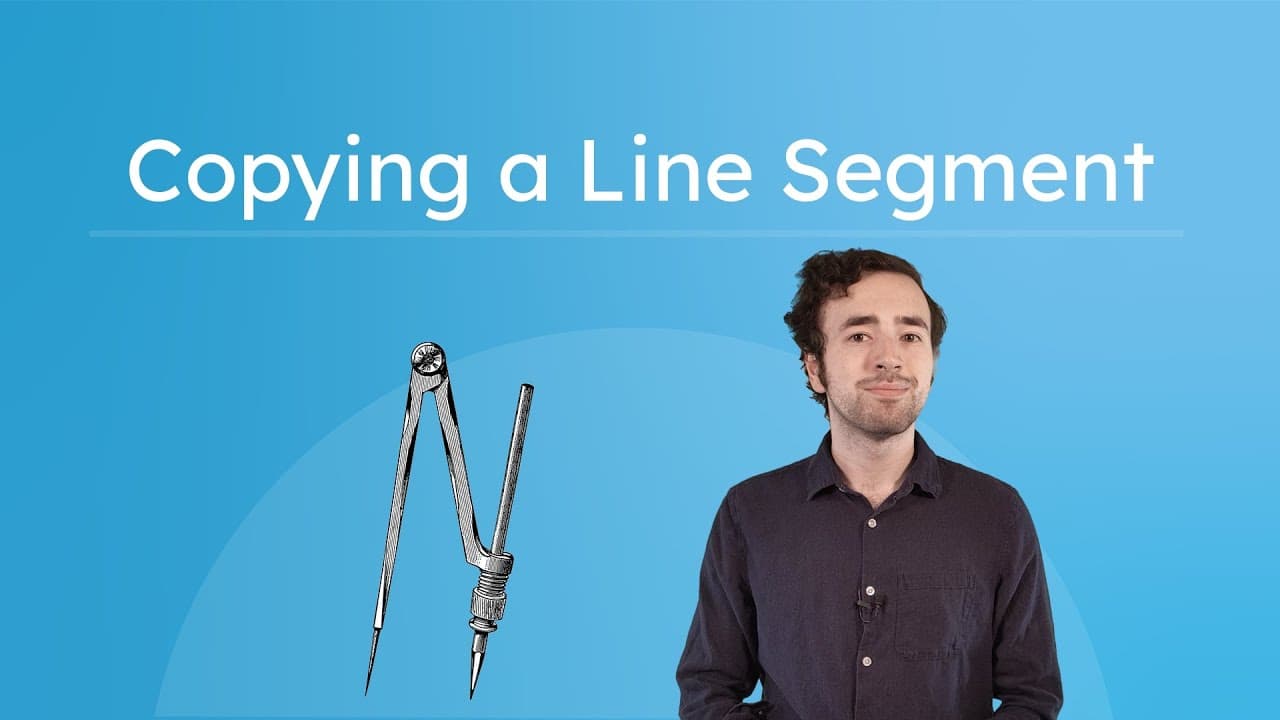
How to Copy a Line Segment Using a Compass

How to Copy a Line Segment Using a Compass

This educational video provides a clear, step-by-step tutorial on how to perform one of the most fundamental geometric constructions: copying a line segment using only a compass and a straightedge. Hosted by an engaging instructor named Justin, the lesson begins by establishing the difference between measuring with a ruler and constructing with geometric tools. It guides students through the practical skills needed to handle a compass effectively, such as aligning the tips and applying pressure correctly, before diving into the mathematical procedures. The video covers two main examples: first, copying a single line segment to create a congruent segment, and second, constructing a new segment that is exactly four times the length of an original segment. Throughout the process, the video introduces and reinforces key geometric vocabulary like "congruent," "arc," and "intersection." It visually demonstrates the precise movements required, using digital animations to show where to place the compass needle and how to swing arcs to transfer distances. This resource is highly valuable for geometry classrooms as it helps transition students from arithmetic measurement to abstract geometric reasoning. It addresses common student difficulties with physical compass manipulation and provides a scaffolded approach to construction. Teachers can use this video to introduce the topic of geometric constructions, review congruence notation, or as a practical guide during hands-on practice sessions.

Miacademy & MiaPrep Learning ChannelMiacademy & MiaPrep Learning Channel

8mins 14s

Materials

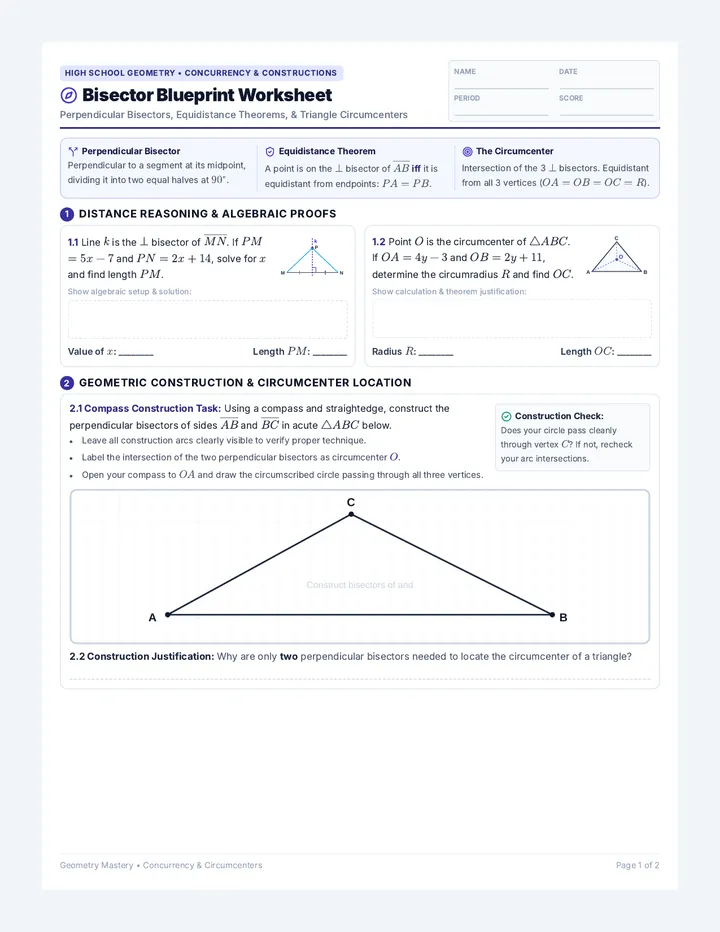
Bisector Blueprint Worksheet

Bisector Blueprint Worksheet

A comprehensive 2-page geometry worksheet focusing on constructing perpendicular bisectors, locating the circumcenter, applying distance equidistance theorems, and solving coordinate and real-world spatial problems.

M

Muneem

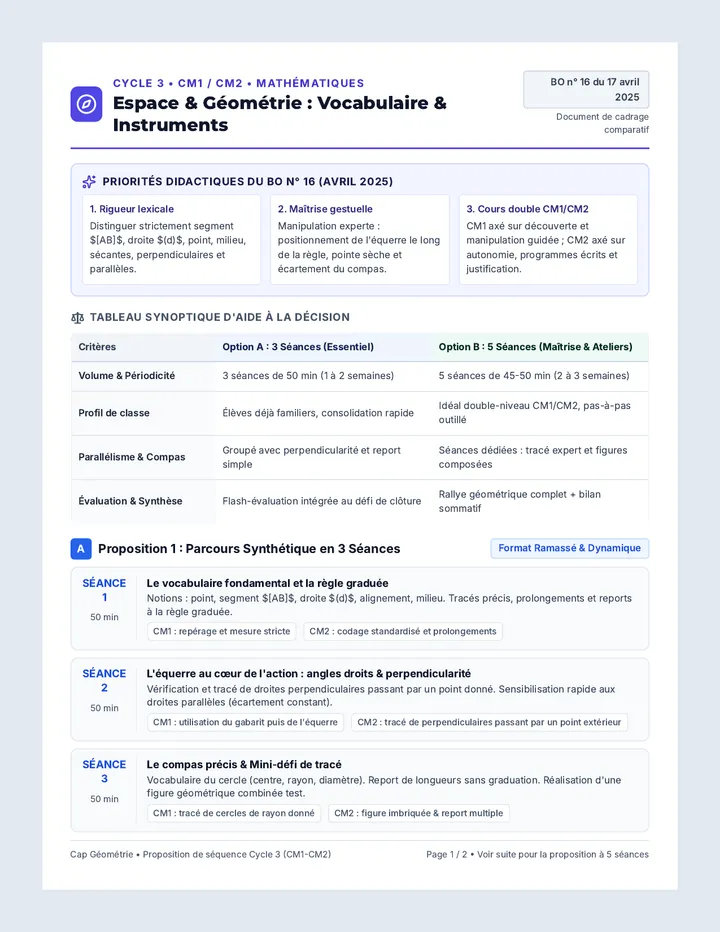
Cap Geometrie Guide

Cap Geometrie Guide

Document de cadrage comparatif présentant deux propositions de séquence (3 séances vs 5 séances) en géométrie pour le double-niveau CM1/CM2, conformes aux recommandations du BO n° 16 du 17 avril 2025. Inclut le déroulé séance par séance, la différenciation par niveau et les critères de choix pédagogique.

LP

LAURENT PERCHE

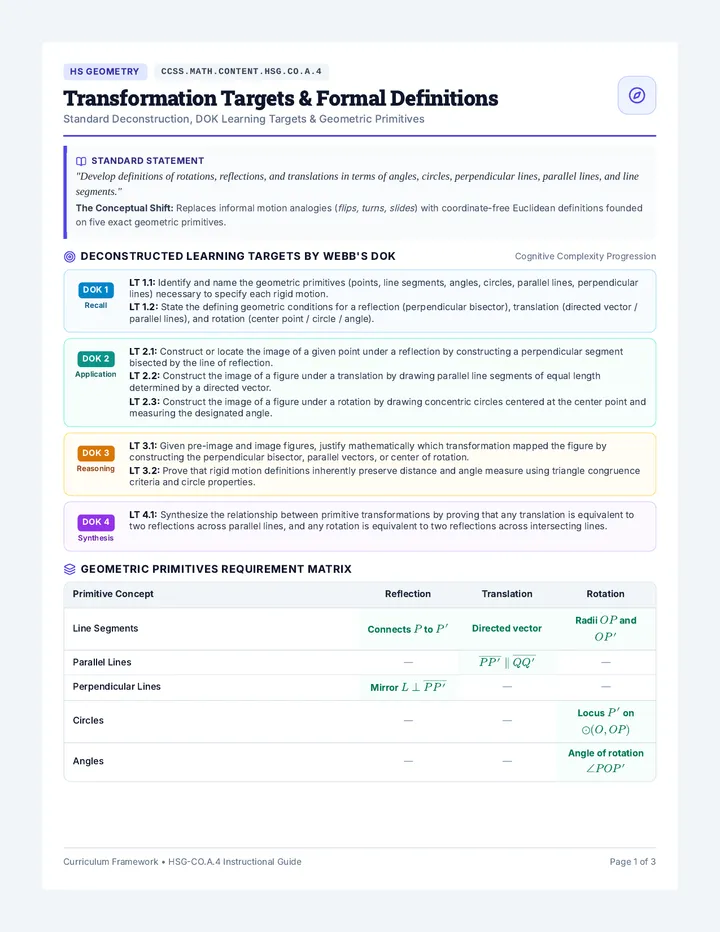
Transformation Targets Teacher Guide

Transformation Targets Teacher Guide

Comprehensive curriculum and instructional guide unpacking CCSS HSG-CO.A.4 into Webb's Depth of Knowledge (DOK 1-4) learning targets. Features rigorous Euclidean definitions of rotations, reflections, and translations built from geometric primitives with annotated technical diagrams and assessment probes.

Sequences

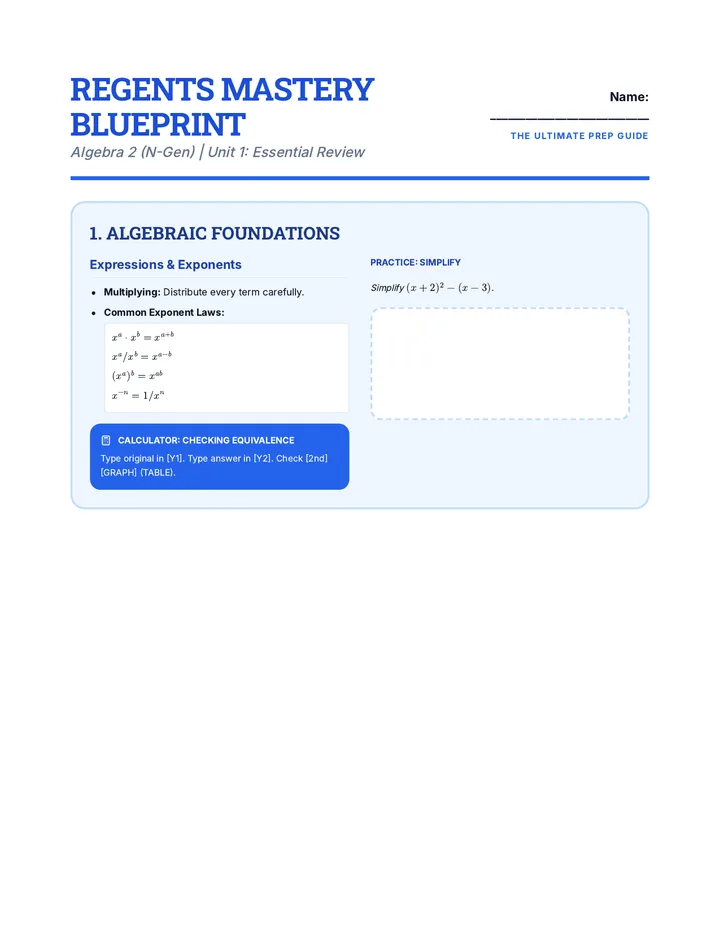
Regents Mastery Blueprint Study Guide

Regents Mastery Suite

A comprehensive review suite for the New York State Mathematics Regents exams, including Algebra 1, Geometry, and Algebra 2, featuring mastery blueprints, calculator strategies, and exam-taking tips.

KB

Kayla Borozny

15
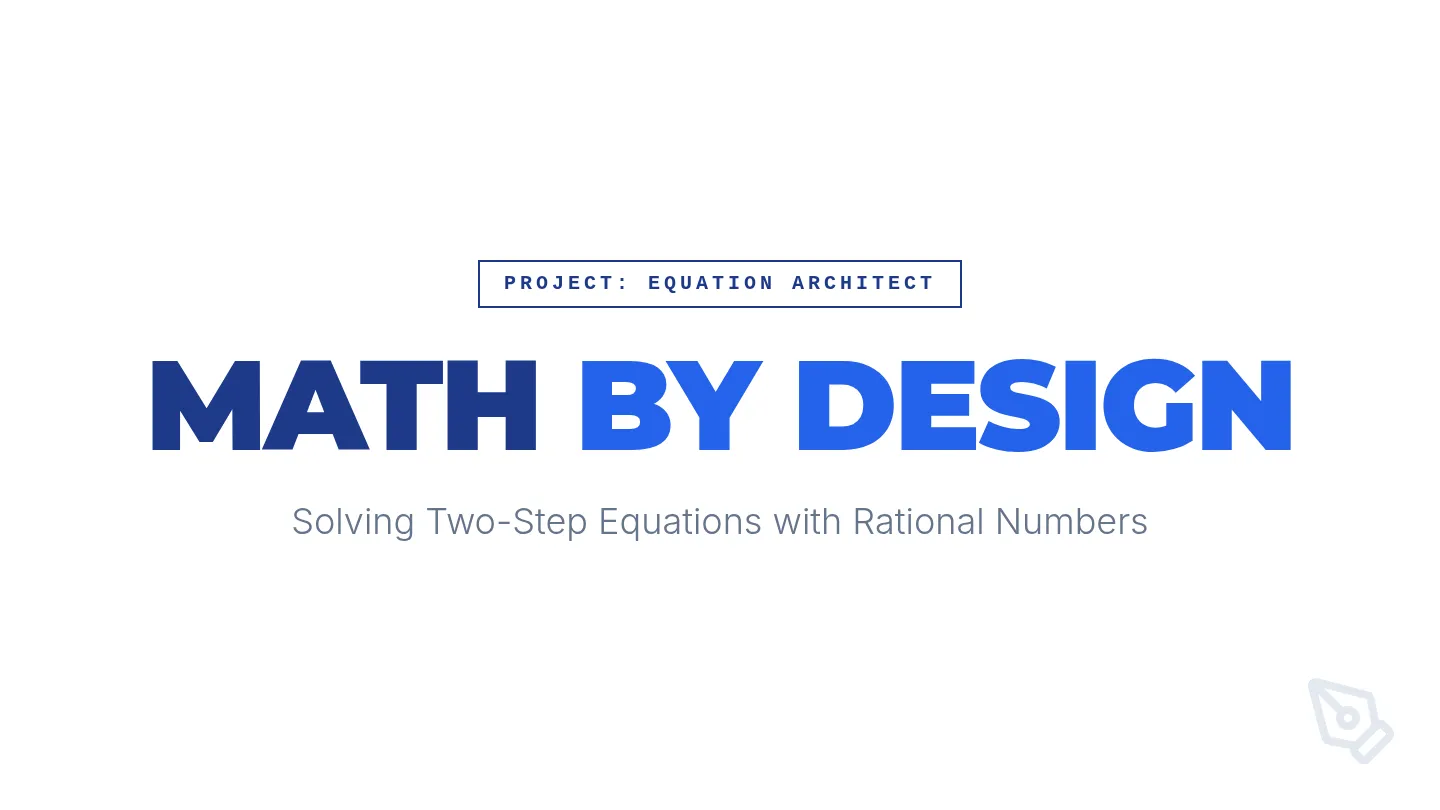
Equation Architect Slides

Geometric Foundations

A comprehensive unit covering 7th-grade geometry standards, focusing on scale drawings, geometric constructions, 3D cross-sections, angle relationships, and solving real-world area, volume, and surface area problems.

D

dbonicoro

25
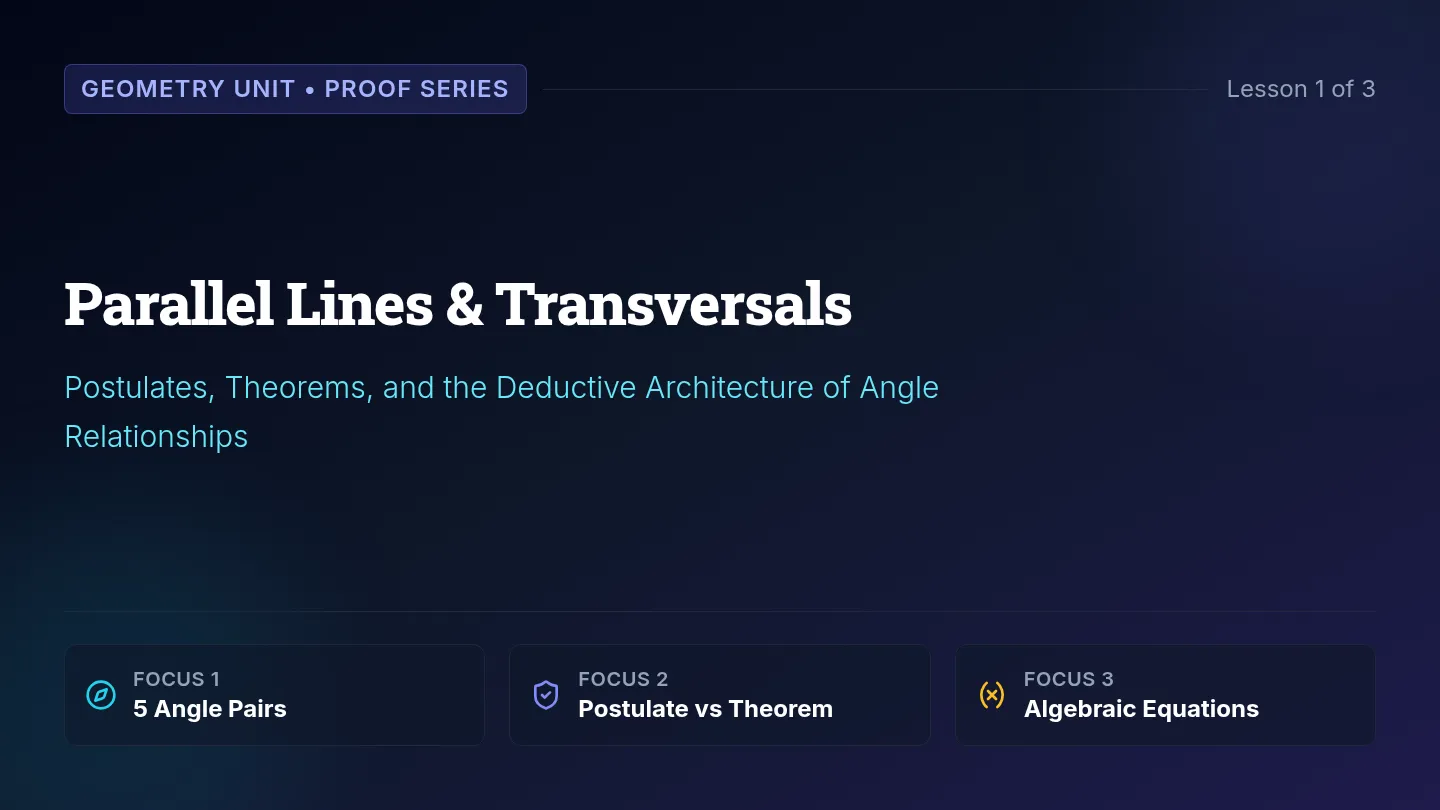
Angle Foundations Slides

Parallel Proof Protocol

A comprehensive multi-day geometry sequence covering angle relationships, formal two-column, flowchart, and paragraph proofs, converses, and auxiliary line applications for parallel lines cut by transversals.

J

jminear

9
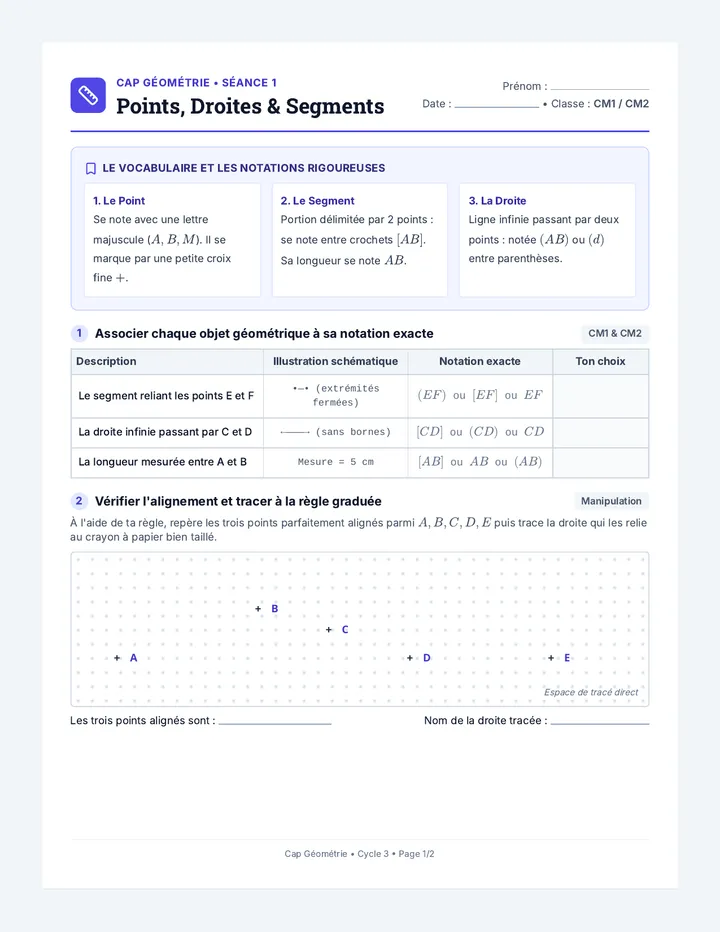
Points et Segments Fiche

Cap Geometrie

Séquence d'apprentissage de 5 séances conforme aux programmes du BO n° 16 du 17 avril 2025 pour le CM1/CM2, articulant maîtrise rigoureuse du vocabulaire géométrique, manipulation experte des instruments (règle, équerre, compas), différenciation pédagogique et programmes de construction.

LP

LAURENT PERCHE

10
Motifs Parallèles Présentation

Architectes d'Angles

Un parcours complet sur les angles, les droites parallèles et les polygones, mettant l'accent sur l'identification, le calcul et la justification géométrique.

JO

J Oua

6
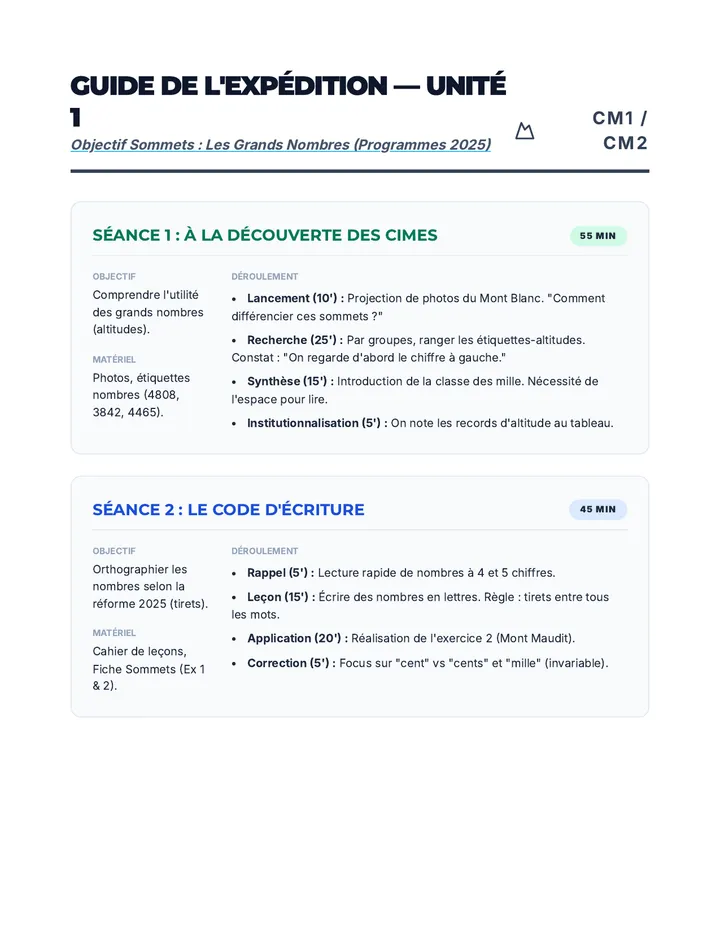
Guide Expedition Teacher Guide

Expédition Mont Blanc

Un programme annuel complet de mathématiques pour CM1/CM2 articulé autour de l'ascension du Mont Blanc, couvrant les nouveaux programmes 2025. Chaque unité propose 10 séances structurées : découverte, exercices, remédiation et évaluation.

6

Lessons

Urban Architect Guide

Boundary Blueprint

A high school geometry lesson where students learn to construct Voronoi diagrams using perpendicular bisectors to solve real-world spatial optimization problems in urban planning.

BW

Brian Whalen

5
Guide de l'Aventure 5eme

Cap sur la 5eme

Une séquence d'accueil complète pour les élèves de 5ème en France, comprenant un guide d'aventure recto-verso pour leur cahier, un tableau de bord d'auto-évaluation et un diaporama de rentrée dynamique. Le tout est conçu sous un thème de "Quête de l'Aventure Mathématique" ludique et moderne.

AC

Anne Cécile SLB

5
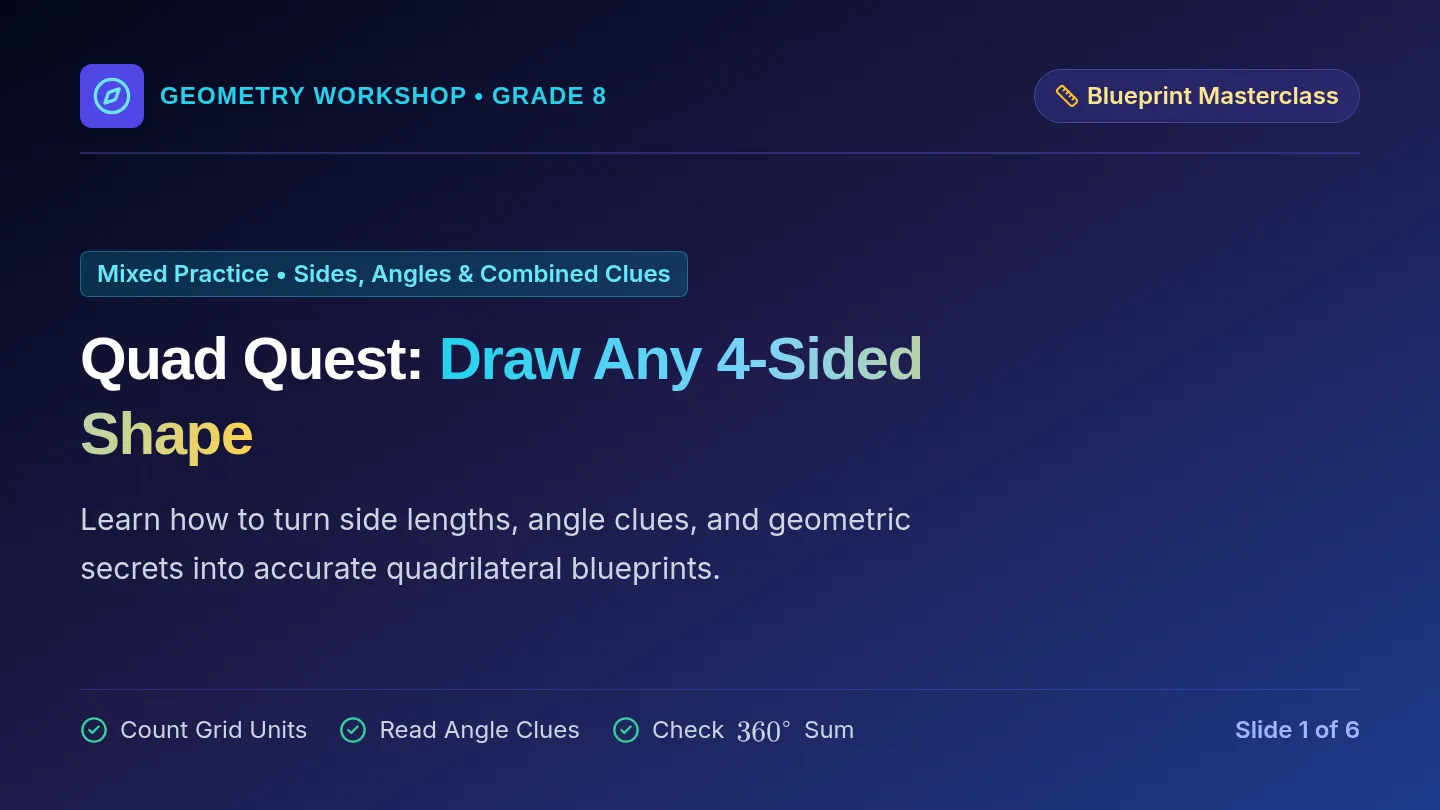
Quad Quest Slides

Quad Quest

A hands-on geometry lesson where 8th-grade students learn step-by-step strategies to construct quadrilaterals using side lengths, angle measures, and combined geometric clues. Includes visual instruction slides and a scaffolded, blueprint-themed practice worksheet.

L

Logan-Greene

3
CM1 Maths Referentiel Document

Maths Cycle 3 Referentiels

Référentiels structurés des compétences et attendus d'apprentissage en mathématiques pour le CM1 et le CM2, conformes aux programmes 2025 de l'Éducation Nationale.

LP

LAURENT PERCHE

3
Divine Designs Lesson Plan

Divine Designs

A high school geometry and art history exploration where students discover geometric principles, symmetry, and tessellations used in historic architecture worldwide, culminating in their own architectural blueprint design.

D

dticehurst

4
Circle Quest Worksheet

Circle Quest Challenge

A creative geometry project where students demonstrate their mastery of circle parts and theorems by illustrating 30 distinct geometric concepts within a set of circles.

AC

Anjoe Calamba

3