Transformation Targets Teacher Guide
HS Geometry CCSS.MATH.CONTENT.HSG.CO.A.4
Transformation Targets & Formal Definitions
Standard Deconstruction, DOK Learning Targets & Geometric Primitives
Standard Statement
"Develop definitions of rotations, reflections, and translations in terms of angles, circles, perpendicular lines, parallel lines, and line segments."
The Conceptual Shift: Replaces informal motion analogies (flips, turns, slides) with coordinate-free Euclidean definitions founded on five exact geometric primitives.
Deconstructed Learning Targets by Webb's DOK
Cognitive Complexity Progression
DOK 1 Recall
LT 1.1: Identify and name the geometric primitives (points, line segments, angles, circles, parallel lines, perpendicular lines) necessary to specify each rigid motion.
LT 1.2: State the defining geometric conditions for a reflection (perpendicular bisector), translation (directed vector / parallel lines), and rotation (center point / circle / angle).
DOK 2 Application
LT 2.1: Construct or locate the image of a given point under a reflection by constructing a perpendicular segment bisected by the line of reflection.
LT 2.2: Construct the image of a figure under a translation by drawing parallel line segments of equal length determined by a directed vector.
LT 2.3: Construct the image of a figure under a rotation by drawing concentric circles centered at the center point and measuring the designated angle.
DOK 3 Reasoning
LT 3.1: Given pre-image and image figures, justify mathematically which transformation mapped the figure by constructing the perpendicular bisector, parallel vectors, or center of rotation.
LT 3.2: Prove that rigid motion definitions inherently preserve distance and angle measure using triangle congruence criteria and circle properties.
DOK 4 Synthesis
LT 4.1: Synthesize the relationship between primitive transformations by proving that any translation is equivalent to two reflections across parallel lines, and any rotation is equivalent to two reflections across intersecting lines.
Geometric Primitives Requirement Matrix
| Primitive Concept | Reflection | Translation | Rotation |
|---|
| Line Segments | Connects \(P\) to \(P'\) | Directed vector | Radii \(OP\) and \(OP'\) |
| Parallel Lines | — | \(\overline{PP'} \parallel \overline{QQ'}\) | — |
| Perpendicular Lines | Mirror \(L \perp \overline{PP'}\) | — | — |
| Circles | — | — | Locus \(P'\) on \(\odot(O, OP)\) |
| Angles | — | — | Angle of rotation \(\angle POP'\) |
Curriculum Framework • HSG-CO.A.4 Instructional Guide Page 1 of 3
Axiomatic Euclidean Formulations
Formal Transformation Definitions
Coordinate-Free Geometry
1
Reflection across Line \(L\) (\(r_L\))
Perpendicular Lines Line Segments
A reflection across a line \(L\) is a transformation mapping each point \(P\) to \(P'\) such that:
- If \(P \in L\), then \(r_L(P) = P\) (invariant point on the mirror line).
- If \(P \notin L\), then line \(L\) is the perpendicular bisector of line segment \(\overline{PP'}\).
Primitives Used: Line segment \(\overline{PP'}\), perpendicular relationship \(L \perp \overline{PP'}\), and equal segments \(PM = MP'\) where \(M = L \cap \overline{PP'}\).
L P P' M
2
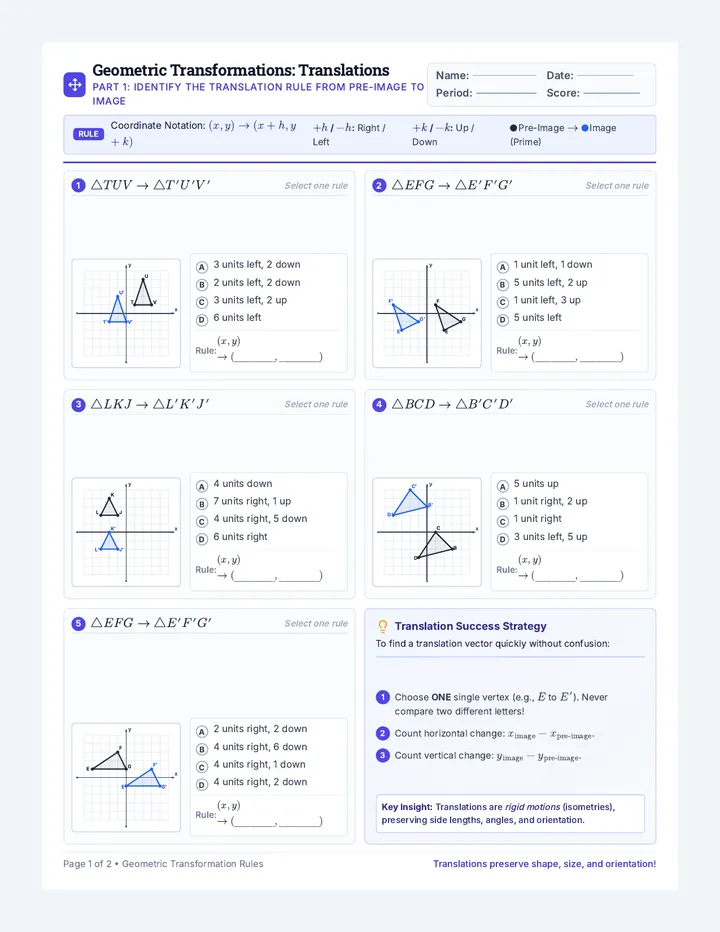
Translation along Vector \(\vec{v}\) (\(T_{\vec{v}}\))
Parallel Lines Line Segments
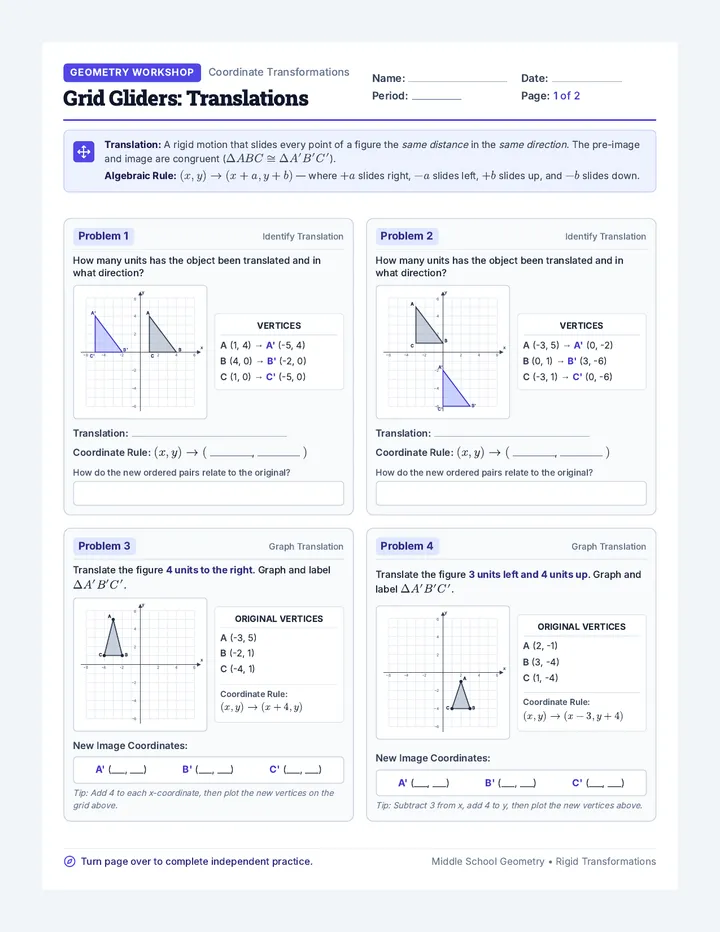
A translation along a directed line segment \(\vec{v}\) maps each point \(P\) to \(P'\) such that:
- The directed segment \(\overline{PP'}\) matches the exact direction and length of \(\vec{v}\).
- For any two distinct points \(P\) and \(Q\), the segments satisfy \(\overline{PP'} \parallel \overline{QQ'}\) and \(PP' = QQ'\).
- If \(P, Q, Q', P'\) are non-collinear, they form a parallelogram \(P P' Q' Q\).
Primitives Used: Directed line segments, parallel lines (\(\overline{PP'} \parallel \overline{QQ'}\)), and equidistant lengths (\(PP' = QQ'\)).
v⃗ P P' Q Q' ►► ►►
3
Rotation about Center \(O\) by Angle \(\theta\) (\(R_{O,\theta}\))
Circles Angles Line Segments
A rotation about center \(O\) by directed angle \(\theta\) maps each point \(P\) to \(P'\) such that:
- For the center: \(R_{O,\theta}(O) = O\) (unique fixed center point).
- For any point \(P \neq O\): \(OP = OP'\). Point \(P'\) lies on the circle with center \(O\) and radius \(r = OP\).
- The directed angle \(m\angle POP' = \theta\) (positive = counterclockwise).
Primitives Used: Concentric circles centered at \(O\), radius line segments (\(\overline{OP} \cong \overline{OP'}\)), and central angle \(\angle POP'\).
θ O P P'
Structural Unity of the Three Definitions
Every rigid motion preserves distance (isometry) by Euclidean construction: reflections preserve distance via isosceles triangles formed across the perpendicular bisector; translations preserve distance via opposite sides of parallelograms; rotations preserve distance via congruent radii of concentric circles.
Curriculum Framework • HSG-CO.A.4 Instructional Guide Page 2 of 3
Classroom Implementation & Diagnostics
DOK Tasks & Misconception Traps
Formative Assessment
Sample Classroom Tasks by DOK Level
DOK 1-2 Task • Construction from Primitives Focus: Compass & Straightedge
Prompt: Point \(A\) and line \(m\) are given. Without using coordinates, explain step-by-step how to construct \(r_m(A)\) using only a compass and straightedge. Which specific geometric definition guarantees your construction is exact?
Teacher Look-For: Student constructs an arc centered at \(A\) intersecting \(m\) at two points, then creates congruent intersecting arcs to produce the perpendicular bisector line segment \(\overline{AA'}\).
DOK 3 Task • Non-Routine Justification Focus: Center & Circle Identification
Prompt: Triangle \(ABC\) is rotated to triangle \(A'B'C'\), but the center of rotation \(O\) is hidden. Prove where point \(O\) must be located using only perpendicular bisectors of segments \(\overline{AA'}\) and \(\overline{BB'}\).
Teacher Look-For: Student connects rotation definition (\(OA = OA'\) and \(OB = OB'\)) to the Perpendicular Bisector Theorem: any point equidistant from endpoints lies on the perpendicular bisector; hence \(O\) is the intersection of the perpendicular bisectors of \(\overline{AA'}\) and \(\overline{BB'}\).
Critical Student Misconceptions & Precision Watchouts
Misconception 1
The "Informal Flip" Fallacy
Students treat reflections as "flipping a card over" without verifying that \(\overline{PP'}\) is strictly perpendicular to line \(L\).
Intervention: Have students draw slanted mirror lines and test with right-angle squares to check perpendicularity.
Misconception 2
Internal vs. External Center
Students assume figures only rotate "around their own center" (like a spinning top) rather than around an arbitrary external center \(O\).
Intervention: Use compass circles anchored at external point \(O\); demonstrate that every vertex travels on its own concentric circle.
Misconception 3
Ignoring Vector Direction
Students treat translations as scalar "distances moved" rather than directed segments requiring both magnitude and parallel trajectory.
Intervention: Require drawing translation vectors for multiple vertices to confirm parallel segments.
Diagnostic Questioning Framework
Prompting Perpendicularity: "If you fold the plane along line \(L\), points \(P\) and \(P'\) coincide. What geometric angle does line \(L\) make with segment \(\overline{PP'}\)? Why must it be \(90^\circ\)?"
Prompting Circular Motion: "As point \(P\) rotates \(\theta^\circ\) around \(O\), what geometric path does \(P\) trace? What defines the radius of that circular path?"
Curriculum Framework • HSG-CO.A.4 Instructional Guide Page 3 of 3