Stuck on Counting Pips?
Apply blue tape across the face of the 2-tiles so individual squares are invisible. Force the child to treat the bar as a solid block.
Loses Count When Screened?
Use partial screening: leave the last tile half exposed. Tap on the cloth rhythmically to reinforce spatial location of the hidden units.
Confuses Tiles vs. Dots?
Ask: "Hold up tiles in your left hand, count dots with your right finger." Anchor vocabulary: tiles (things) vs. dots (pips).
10-Second Exit Check: Hide 3 tiles (6). Place 1 tile outside. Ask: "6 dots are hiding. How many dots in all?"
Intervention Triage Two Tile Leap
Two Tile Leap • AVMR II Intervention Cue Ring Set Print on cardstock, laminate, and attach with binder ring
CARD 12 Grand Challenge
A cloth hides 18 dots.
Every piece is a 2-tile. How many tiles are hiding?
Track by twos: 2, 4, 6, 8, 10, 12, 14, 16, 18!
Number of Tiles:
Two Tile Leap • AVMR II Student Task Cards Page 2 of 2 • Cards 7–12
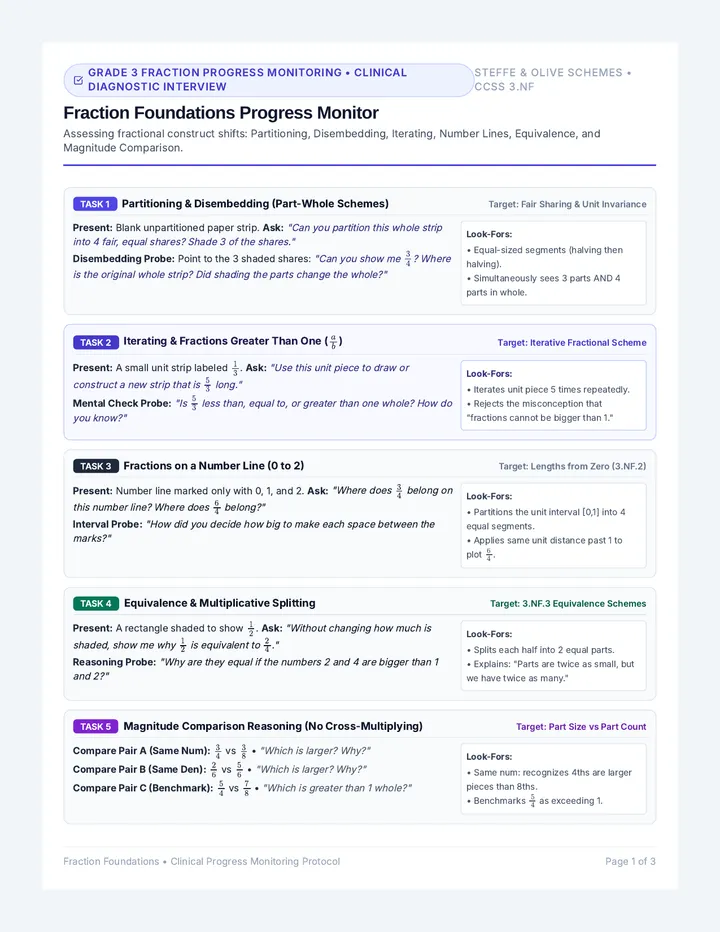
Target: Part Size vs Part Count
Compare Pair A (Same Num): \(\frac{3}{4}\) vs \(\frac{3}{8}\) • "Which is larger? Why?"
Compare Pair B (Same Den): \(\frac{2}{6}\) vs \(\frac{5}{6}\) • "Which is larger? Why?"
Compare Pair C (Benchmark): \(\frac{5}{4}\) vs \(\frac{7}{8}\) • "Which is greater than 1 whole?"
Look-Fors: • Same num: recognizes 4ths are larger pieces than 8ths. • Benchmarks \(\frac{5}{4}\) as exceeding 1.
Fraction Foundations • Clinical Progress Monitoring Protocol Page 1 of 3
Student Assessment Probe Form A • Fraction Concepts
Name:
Date:
1. Partitioning the Whole Strip Show equal shares
a. Partition this entire bar into 4 equal shares. Then shade \(\frac{3}{4}\).
Write the unit fraction for 1 share:
2. Iterating the Unit Fraction Building fractions greater than 1
This small strip is \(\frac{1}{3}\) of a candy bar:
\(\frac{1}{3}\)
← This is 1 unit share.
Draw a candy bar that is \(\frac{5}{3}\) long by repeating this unit piece:
3. Fractions on the Number Line Locating 0 to 2
Partition the number line and plot these three fractions: \(\frac{2}{4}\), \(\frac{4}{4}\), and \(\frac{6}{4}\).
0
1
2
4. Show Equivalence
Split the bottom bar to prove that \(\frac{1}{2} = \frac{2}{4}\):
\(\frac{1}{2}\)
5. Compare Using >, <, =
\(\frac{3}{4}\)
\(\frac{3}{8}\)
\(\frac{5}{6}\)
\(\frac{2}{6}\)
\(\frac{5}{4}\)
1
Fraction Foundations Assessment Probe Page 2 of 3
Intervention Roster & Construct Mastery Matrix Multi-Tiered Support System
Track individual student scheme progression across Baseline (B), Mid-Point (M), and Post-Intervention (P).
Coding: 0 = Pre-Fractional • 1 = Part-Whole • 2 = Iterative • 3 = Relational
| Student Name | T1: Partition | T2: Iterate (>1) | T3: Number Line | T4: Equivalence | T5: Compare | Overall Scheme |
|---|---|---|---|---|---|---|
| 1. | B / M / P | B / M / P | B / M / P | B / M / P | B / M / P | Level: ___ |
| 2. | B / M / P | B / M / P | B / M / P | B / M / P | B / M / P | Level: ___ |
| 3. | B / M / P | B / M / P | B / M / P | B / M / P | B / M / P | Level: ___ |
| 4. | B / M / P | B / M / P | B / M / P | B / M / P | B / M / P | Level: ___ |
| 5. | B / M / P | B / M / P | B / M / P | B / M / P | B / M / P | Level: ___ |
Level 0 Pre-Fractional
Counts shaded pieces as whole objects ("3 things"). Ignores fair shares or unequal sizes.
Move: Fair-sharing tasks with paper folding & dough.
Level 1 Part-Whole Only
Successfully partitions & shades \(\frac{3}{4}\), but cannot conceptualize fractions > 1 ("You can't have 5 thirds").
Move: Cuisenaire rods & iterating unit strips past 1.
Level 2 Iterative Scheme
Treats \(\frac{1}{b}\) as a measuring unit. Iterates 5 times to make \(\frac{5}{3}\). Places fractions on 0–2 number lines.
Move: Multiplicative splitting for equivalence (\(\frac{2}{4} = \frac{1}{2}\)).
Level 3 Relational Scheme
Reasons flexibly about inverse denominator size (\(\frac{3}{4} > \frac{3}{8}\)), generates equivalent forms, benchmarks to 1.
Move: Ready for addition/subtraction with like units.
MTSS Tier Guidance & Decision Framework Post-Assessment Action Plan
Tier 3 (Intensive 1:1) Students at Level 0. Daily 15-min intervention with physical paper strips and equal sharing.
Tier 2 (Targeted Small Group) Students at Level 1. 3× weekly 25-min intervention focusing on unit fractions as iterable lengths on number lines.
Tier 1 (Core Alignment) Students at Level 2+. Solid on iterating; ready for classroom core instruction and equivalence tasks.
Fraction Foundations Progress Monitoring Protocol • Steffe & Olive MTSS Page 3 of 3
Teacher Instructional Flow Core Script & Facilitation Protocol
Lead students sequentially from physical folding to mental iteration, and finally to linear measurement.
PHASE 1
8 Minutes • Paper Folding
Teacher Action:
Give each student two identical paper strips. Keep one strip untouched as the "Master Whole." Have students fold the second strip in half, then half again. Crease sharply to produce 4 equal segments. Cut along folds to produce four separate unit pieces.
Verbatim Script:
Say: "Hold up one cut piece. How many of these exact pieces did it take to make our Master Whole?" [Wait: 4 pieces]
Say: "Because it takes 4 equal pieces to recreate the whole, we call this one piece one-fourth, written as \(\frac{1}{4}\)."
Crucial Disembedding Probe: "Lay 3 cut pieces next to the Master Whole. Show me \(\frac{3}{4}\). Is the Master Whole still one whole? Did our pieces lose their name?"
Student Target: Recognizes that \(\frac{3}{4}\) is formed by 3 pieces of size \(\frac{1}{4}\), and the whole remains invariant.
PHASE 2
10 Minutes • Measuring Unit
Teacher Action:
Have students use a single \(\frac{1}{4}\) strip as a measuring ruler. Instruct them to iterate (repeat) the strip along a line, chanting the fraction count as they lay each piece down: "\(\frac{1}{4}\), \(\frac{2}{4}\), \(\frac{3}{4}\), \(\frac{4}{4}\)... and one more makes \(\frac{5}{4}\)!"
Verbatim Script:
Say: "We count whole numbers: 1, 2, 3, 4. We can count fractions the exact same way by counting units of \(\frac{1}{4}\)!"
Chant & Touch: "\(\frac{1}{4}\)... \(\frac{2}{4}\)... \(\frac{3}{4}\)... \(\frac{4}{4}\)... What comes next?"
Address Misconception: If student hesitates at \(\frac{4}{4}\), ask: "Do we stop counting inches when we reach a foot? No! We keep counting: 5 fourths (\(\frac{5}{4}\)), 6 fourths (\(\frac{6}{4}\))!"
Key Probe: "Compare your \(\frac{5}{4}\) train to our Master Whole strip. Is \(\frac{5}{4}\) longer, shorter, or the same? Why?"
PHASE 3
12 Minutes • Linear Representation
Teacher Action:
Unroll the 0-to-2 number tape. Align the Master Whole strip from 0 to 1 to establish the unit interval. Then use the \(\frac{1}{4}\) unit piece to physically hop along the line, drawing tick marks and recording values.
Verbatim Script:
Say: "The number line starts at 0. A fraction is the distance from 0."
Prompt: "Place your \(\frac{1}{4}\) piece at 0. Make a mark at the end. That mark is \(\frac{1}{4}\). Hop again. That's \(\frac{2}{4}\). Hop again: \(\frac{3}{4}\). Hop again: \(\frac{4}{4}\)."
Ask: "Look where \(\frac{4}{4}\) landed! What whole number is right there? Why do \(\frac{4}{4}\) and 1 live at the exact same address?"
Challenge: "Keep hopping past 1! Plot \(\frac{5}{4}\), \(\frac{6}{4}\), and \(\frac{8}{4}\). Where does \(\frac{8}{4}\) land?" [At 2]
Fraction Builders • Step-by-Step Teacher Intervention Guide Page 2 of 3
Equivalence & Relational Reasoning Deepening Fractional Magnitude
Guiding students to reason about the size and quantity of shares without relying on mechanical cross-multiplication tricks.
3.NF.3 Scheme
The Action Routine:
Fold a strip in half (\(\frac{1}{2}\)). Shade one half. Now fold the strip in half again without changing the shaded region.
\(\frac{1}{2}\) becomes \(\frac{2}{4}\)
The Reasoning Questions:
Ask: "Did the shaded space get bigger, smaller, or stay the exact same?"
Ask: "Why are there now 2 pieces shaded instead of 1? What happened to the size of each piece?"
Target Anchor Rule: "Each piece split into 2 smaller pieces. We have twice as many pieces, but each piece is half as big! That's why \(\frac{1}{2} = \frac{2}{4}\)."
Same Numerator \(\frac{3}{4}\) vs \(\frac{3}{8}\)
Compare 3 fourths to 3 eighths.
Reasoning: We have the same number of pieces (3), but fourths are cut into fewer shares, so fourths are much bigger pieces than eighths! Therefore \(\frac{3}{4} > \frac{3}{8}\).
Same Denominator \(\frac{2}{6}\) vs \(\frac{5}{6}\)
Compare 2 sixths to 5 sixths.
Reasoning: The pieces are the exact same size (sixths). 5 pieces is clearly more pieces than 2 pieces! Therefore \(\frac{5}{6} > \frac{2}{6}\).
Benchmark to 1 \(\frac{5}{4}\) vs \(\frac{7}{8}\)
Compare a fraction > 1 to < 1.
Reasoning: \(\frac{4}{4}\) is 1 whole, so \(\frac{5}{4}\) is greater than 1. But \(\frac{7}{8}\) needs one more eighth to reach 1. So \(\frac{5}{4} > \frac{7}{8}\).
Whole-Number Bias in Denominators: Student says \(\frac{1}{8} > \frac{1}{4}\) because 8 is bigger than 4. Pivot: "Would you rather share a pizza with 4 kids or 8 kids? More shares means smaller pieces!"
Counting Tick Marks Instead of Spaces: Student counts the tick lines on the number line instead of unit interval distances. Pivot: "A frog doesn't count lines—the frog counts hops! Trace the jump from 0 to 1."
1-Minute Exit Transfer Check
Teacher places a clip past 1 at \(\frac{6}{4}\). Ask: "How many fourth-hops did it take to get here from 0? Name this fraction!"
Mastery Evidence States "\(\frac{6}{4}\)" and notes it is past 1
Fraction Builders • Step-by-Step Teacher Intervention Guide Page 3 of 3
\(\frac{3}{4}\)
\(\frac{3}{8}\)
Same Numerator
My Reasoning:
\(\frac{5}{6}\)
\(\frac{2}{6}\)
Same Denominator
My Reasoning:
\(\frac{5}{4}\)
\(\frac{7}{8}\)
Benchmark to 1
My Reasoning:
Fraction Foundations Assessment Suite • Student Independent Probe Page 2 of 2
Exemplar Justification: "\(\frac{4}{4}\) lands right on 1 because 4 fourths makes 1 whole distance. \(\frac{6}{4}\) is 2 more fourths past 1."
Fraction Foundations Assessment Guide • Tasks 1 to 3 Page 1 of 2
Scoring Rubrics: Tasks 4 & 5 • Diagnostic Action Profile Evaluation Page 2
TASK 4
Score: [ ] / 4
3–4 Pts: Full Understanding
Accurately splits Model B into 4 equal parts, shades 2 parts (\(\frac{2}{4}\)). Explains that cutting each half into 2 smaller pieces creates twice as many pieces that are each half as big.
1–2 Pts: Partial / Emerging
Draws \(\frac{2}{4}\) correctly on the visual model, but written justification is superficial ("they look like the same size") without multiplicative reasoning.
0 Pts: Minimal / Pre-Fractional
Claims \(\frac{2}{4}\) is greater than \(\frac{1}{2}\) because 2 and 4 are larger numbers than 1 and 2. Fails to partition Model B into fourths.
Exemplar Justification: "When you split each half into 2 pieces, you get 4 pieces in the whole. The shaded part now has 2 pieces. It covers the same amount of space because each piece is half as big."
TASK 5
Score: [ ] / 4
3–4 Pts: Full Understanding
Correctly places all 3 signs (>, >, >). Written explanations articulate piece size (same numerator), piece count (same denominator), and benchmarking to 1 whole.
1–2 Pts: Partial / Emerging
Gets 2 of 3 signs correct, but reasoning relies on memory tricks or drawing imprecise circles rather than analytical size/count properties.
0 Pts: Minimal / Pre-Fractional
Exhibits whole-number bias: states \(\frac{3}{8} > \frac{3}{4}\) because 8 > 4. Cannot explain comparisons conceptually.
Exemplar Justification: "\(\frac{3}{4} > \frac{3}{8}\) because both have 3 pieces, but fourths are bigger than eighths. \(\frac{5}{4} > \frac{7}{8}\) because \(\frac{5}{4}\) is greater than 1 whole, while \(\frac{7}{8}\) is less than 1."
17–20 Points Level 3: Relational Mastery
Full iterative scheme. Flexibly compares, proves equivalence, and reasons on number lines.
Tier 1 Core Alignment
12–16 Points Level 2: Iterative Scheme
Iterates unit fractions past 1 and maps number lines. Needs targeted scaffolding for equivalence.
Tier 2 Targeted Group
7–11 Points Level 1: Constrained Part-Whole
Partitions and shades within 1 whole. Cannot conceptualize fractions > 1; weak number line sense.
Tier 2/3 Intensive Group
0–6 Points Level 0: Pre-Fractional
Persistent whole-number bias. Ignores fair shares. Needs concrete folding and equal sharing tasks.
Tier 3 1:1 Intervention
Clinical Interventionist Qualitative Notes & Action Plan:
Fraction Foundations Assessment Guide • Tasks 4 & 5 • Diagnostic Action Profile Page 2 of 2
8 Minutes • Splitting Scheme
Teacher Action:
Show a strip partitioned into fourths with 3 parts shaded (\(\frac{3}{4}\)). Slice each fourth vertically down the center into 2 equal parts.
Verbatim Script:
Say: "Here is \(\frac{3}{4}\). Watch closely: I am going to split every fourth in half."
Ask: "How many total pieces make the whole strip now?" [Wait: 8 pieces]
Ask: "How many shaded pieces do we have now?" [Wait: 6 pieces]
Anchor Rule: "Did the shaded space change? No! We have twice as many pieces, but each piece is half as big. That's why \(\frac{3}{4} = \frac{6}{8}\)!"
PHASE 2
10 Minutes • Relational Comparison
Teacher Action:
Unroll the 0-to-3 number tape. Mark \(\frac{1}{2}\), \(1\), \(1\frac{1}{2}\), \(2\), and \(2\frac{1}{2}\) with bold flags. Ask students to compare fractions using \(\frac{1}{2}\) as a benchmark.
Verbatim Script:
Present: \(\frac{3}{8}\) and \(\frac{4}{6}\). Ask: "Which is greater without finding common denominators?"
Benchmark Reasoning: "Look at \(\frac{3}{8}\). What is half of 8? (4). So \(\frac{4}{8}\) is \(\frac{1}{2}\). Is \(\frac{3}{8}\) less than or more than \(\frac{1}{2}\)?" [Less than]
Prompt: "Now look at \(\frac{4}{6}\). What is half of 6? (3). So \(\frac{4}{6}\) is more than \(\frac{1}{2}\)! Therefore, \(\frac{4}{6} > \frac{3}{8}\)!"
Plot on Line: Have student physically place clips at \(\frac{3}{8}\) (before \(\frac{1}{2}\)) and \(\frac{4}{6}\) (after \(\frac{1}{2}\)).
PHASE 3
12 Minutes • Distributing & Joining
Teacher Action:
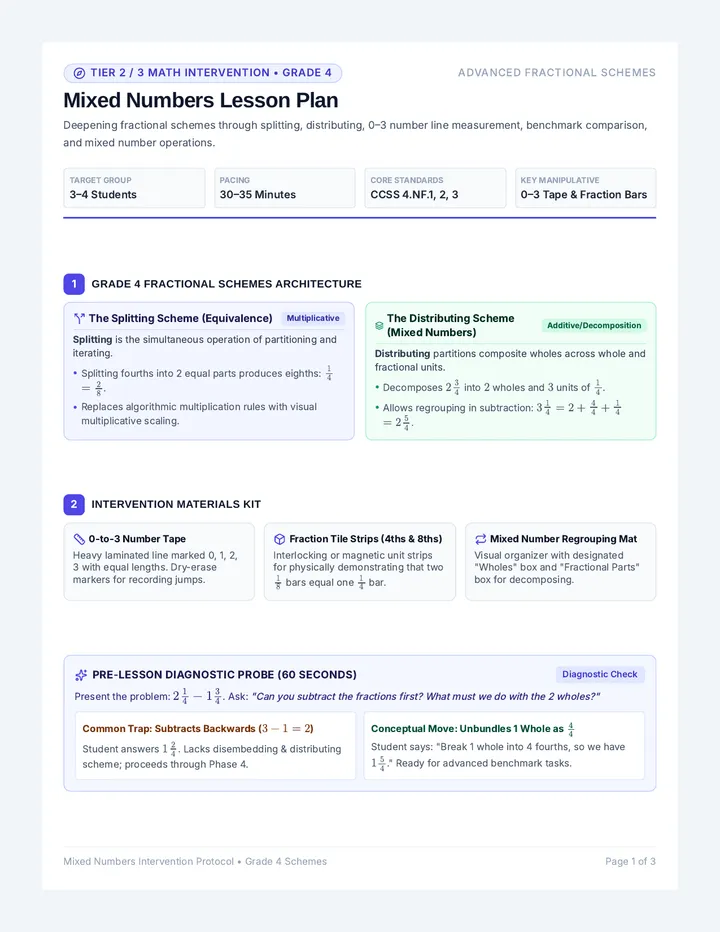
Use the regrouping mat. Separate wholes into the Wholes Box and fourths into the Fractions Box. Join wholes (\(1+2=3\)) and join fourths (\(\frac{3}{4} + \frac{2}{4} = \frac{5}{4}\)).
Verbatim Script:
Say: "We distribute the addition: wholes add with wholes, fourths add with fourths!"
Ask: "We have \(3\) wholes and \(\frac{5}{4}\). What do you notice about \(\frac{5}{4}\)?"
Recompose: "Four fourths (\(\frac{4}{4}\)) makes another whole! So we trade \(\frac{4}{4}\) for \(1\) whole block. What is our new total?" [\(3 + 1 = 4\) wholes, with \(\frac{1}{4}\) left over \(\rightarrow 4\frac{1}{4}\)]
Verify on Number Tape: Start at \(1\frac{3}{4}\), hop \(2\) wholes to \(3\frac{3}{4}\), then hop \(\frac{2}{4}\) to land on \(4\frac{1}{4}\).
Mixed Numbers Intervention Protocol • Grade 4 Schemes Page 2 of 3
Disembedding in Subtraction Regrouping & Assessment Matrix
Mastering the disembedding routine for unbundling wholes without standard whole-number subtraction confusion.
Core G4 Target
The Problem Setup:
We need to subtract \(\frac{3}{4}\), but we only have \(\frac{1}{4}\) in the fraction box.
\(3\frac{1}{4} = 2 + \frac{4}{4} + \frac{1}{4} = 2\frac{5}{4}\)
The Teacher Questions:
Ask: "Can we take 3 fourths away from 1 fourth? No! Where can we get more fourths?"
Prompt: "Unbundle 1 whole block into 4 fourths. Move them to the fraction box."
Execute: "Now we have \(2\) wholes and \(\frac{5}{4}\). Now subtract \(1\frac{3}{4}\): wholes: \(2-1=1\); fourths: \(\frac{5}{4} - \frac{3}{4} = \frac{2}{4}\). Final answer: \(1\frac{2}{4}\) (or \(1\frac{1}{2}\))!"
Observed Behavior
Construct Stage
In-the-Moment Teacher Pivot
Subtracts smaller fraction from larger: \(3\frac{1}{4} - 1\frac{3}{4} = 2\frac{2}{4}\).
Whole Number Trap Ignores fraction order.
Physical barrier: Lay down 3 full strips and 1 fourth. Ask: "Physically pick up and remove 1 whole and 3 fourths. Show me how you get the 3 fourths."
Converts to improper fractions mechanically (\(\frac{13}{4} - \frac{7}{4}\)) but makes counting errors.
Algorithmic Reliant Lacks distributing sense.
Regrouping Mat: Anchor students in decomposing only 1 whole: "\(3\frac{1}{4} = 2\frac{5}{4}\)". Keeps numbers manageable.
Decomposes flexibly; reasons with \(\frac{1}{2}\) benchmark; navigates 0–3 number line fluently.
Relational & Distributive Full G4 Mastery.
Extend to unlike units: "If we have fourths and eighths, how can our splitting scheme help us add them?"
1-Minute Mastery Check
Solve: \(4\frac{1}{5} - 2\frac{3}{5}\). Show how you unbundle 1 whole into fifths!
Target Evidence Rewrites as \(3\frac{6}{5} \rightarrow 1\frac{3}{5}\)
Mixed Numbers Intervention Protocol • Grade 4 Schemes Page 3 of 3
0
1
2
3
Plot: \(\frac{5}{4}\)
Plot: \(\frac{7}{4}\)
Plot: \(\frac{10}{4}\)
3
Write >, <, or = and your mathematical reasoning
\(\frac{3}{8}\)
\(\frac{4}{6}\)
Reasoning:
\(\frac{5}{10}\)
\(\frac{4}{8}\)
Reasoning:
4
Show complete work and final simplified answers
Problem A: Addition \(1\frac{3}{4} + 1\frac{3}{4}\)
Show your work:
Final Answer:
Problem B: Subtraction \(3\frac{1}{4} - 1\frac{3}{4}\)
Show your work:
Final Answer:
Mixed Numbers Intervention Mat • Grade 4 Advanced Schemes Page 2 of 2 • Independent Practice (Without Hints)
| Partial / Emerging (1–2 Pts) |
|---|
| Pre-Fractional (0 Pts) |
|---|
| 1. Splitting & Equivalence | Splits each third into 2 equal parts. Explains: "Twice as many pieces, but each piece is half the size." | Splits model correctly visually, but cannot explain why the numbers multiply by 2. | Draws unequal lines; claims \(\frac{4}{6} > \frac{2}{3}\) due to larger numbers. |
| 2. Number Line (0 to 3) | Partitions all 3 unit intervals equally into fourths. Accurately plots \(1\frac{1}{4}, \frac{7}{4}, 2\frac{3}{4}\). | Plots points between 0 and 1, but misplaces fractions past 1; counts tick marks instead of spaces. | Places points randomly without equal spacing between whole numbers. |
| 3. Benchmark to 1/2 | Correct sign (<). Explains \(\frac{4}{10} < \frac{5}{10} = \frac{1}{2}\), while \(\frac{5}{8} > \frac{4}{8} = \frac{1}{2}\). | Selects correct sign, but explanation relies on drawing rough circles or memory tricks. | Selects > because \(10 > 8\) (whole-number bias in denominators). |
| 4. Addition Recompose | Adds wholes (\(3\)) and fifths (\(\frac{7}{5}\)). Recomposes \(\frac{7}{5}\) into \(1\frac{2}{5}\) to get \(4\frac{2}{5}\). | Finds \(3\frac{7}{5}\), but cannot convert improper fractional part into wholes. | Adds across: \(2\frac{3}{5} + 1\frac{4}{5} = 3\frac{7}{10}\) (adds denominators). |
| 5. Subtraction Unbundle | Unbundles 1 whole: \(3\frac{1}{6} \rightarrow 2\frac{7}{6}\). Subtracts to obtain \(1\frac{2}{6}\) (or \(1\frac{1}{3}\)). | Converts to \(\frac{19}{6} - \frac{11}{6} = \frac{8}{6}\), but struggles to write as a mixed number. | Subtracts smaller from larger numerator: \(3\frac{1}{6} - 1\frac{5}{6} = 2\frac{4}{6}\). |
17–20 Points Level 3: Distributive Mastery
Mastered G4 standards. Regroups fluently and reasons with benchmarks.
Tier 1 Core Ready
12–16 Points Level 2: Emergent Regrouping
Navigates number lines well. Needs support unbundling wholes in subtraction.
Tier 2 Targeted Group
7–11 Points Level 1: Constrained Part-Whole
Struggles with fractions > 1. Lacks splitting schemes for equivalence.
Tier 2/3 Intensive Group
0–6 Points Level 0: Whole-Number Bias
Adds denominators across; reverses subtraction order. Needs concrete bars.
Tier 3 1:1 Intervention
Clinical Interventionist Observations & Next Steps:
Mixed Numbers Assessment Suite • Scoring Guide & MTSS Rubric Page 3 of 3 (Examiner Rubric)
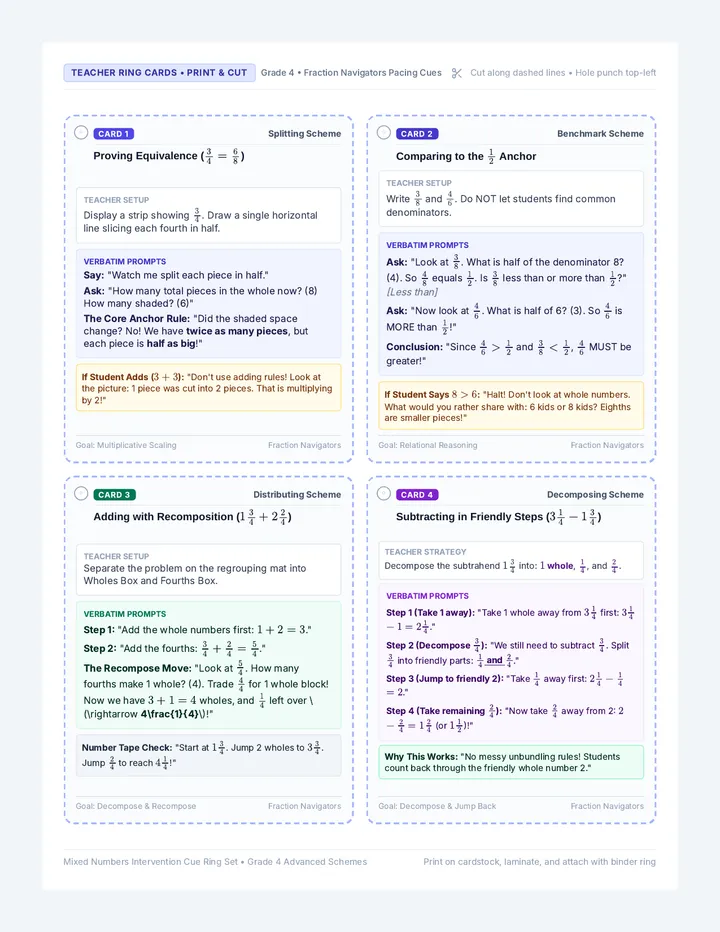
Goal: Decompose & Recompose Fraction Navigators
○
CARD 4 Decomposing Scheme
Teacher Strategy
Decompose the subtrahend \(1\frac{3}{4}\) into: \(1\) whole, \(\frac{1}{4}\), and \(\frac{2}{4}\).
Verbatim Prompts
Step 1 (Take 1 away): "Take 1 whole away from \(3\frac{1}{4}\) first: \(3\frac{1}{4} - 1 = 2\frac{1}{4}\)."
Step 2 (Decompose \(\frac{3}{4}\)): "We still need to subtract \(\frac{3}{4}\). Split \(\frac{3}{4}\) into friendly parts: \(\frac{1}{4}\) and \(\frac{2}{4}\)."
Step 3 (Jump to friendly 2): "Take \(\frac{1}{4}\) away first: \(2\frac{1}{4} - \frac{1}{4} = 2\)."
Step 4 (Take remaining \(\frac{2}{4}\)): "Now take \(\frac{2}{4}\) away from 2: \(2 - \frac{2}{4} = 1\frac{2}{4}\) (or \(1\frac{1}{2}\))!"
Why This Works: "No messy unbundling rules! Students count back through the friendly whole number 2."
Goal: Decompose & Jump Back Fraction Navigators
Mixed Numbers Intervention Cue Ring Set • Grade 4 Advanced Schemes Print on cardstock, laminate, and attach with binder ring