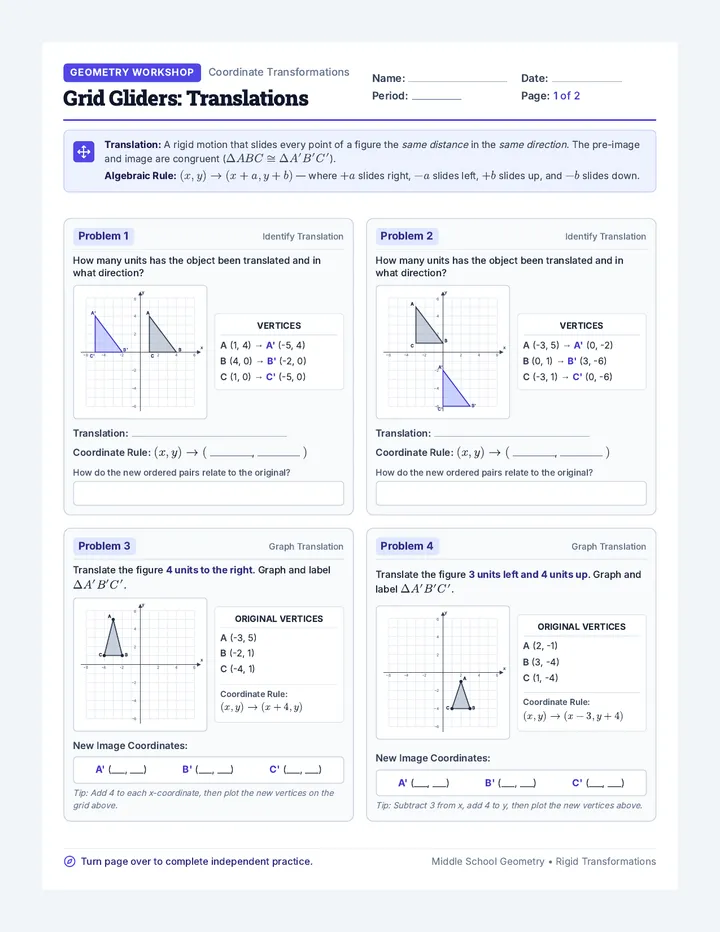
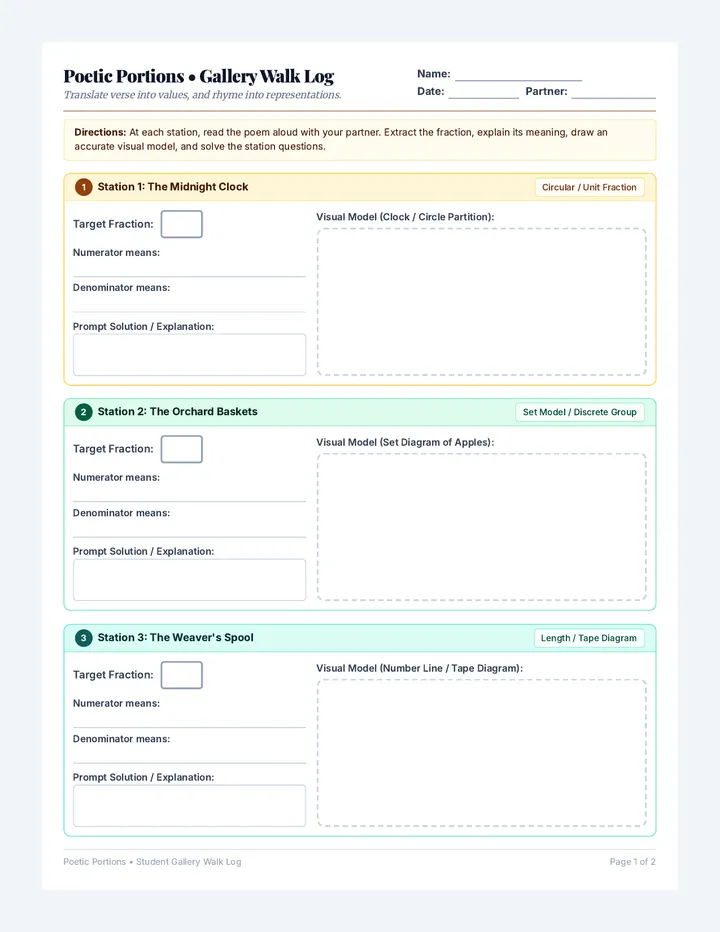
A cross-curricular mathematics and language arts lesson where students participate in a gallery walk to analyze, interpret, and model fractional values embedded within poetic stanzas. Students decode fractional relationships of sets, lengths, and regions described in verse while building conceptual understanding.
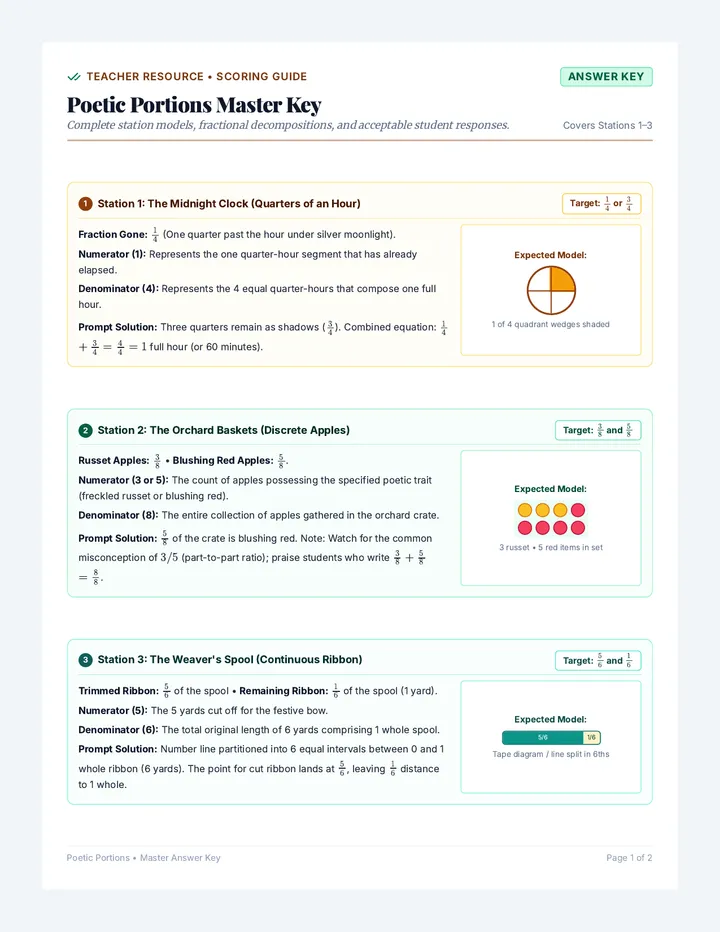
The silk ribbon is a continuous measurement of length. The 6-yard ribbon is divided into six 1-yard segments.
Station 3 Investigation Questions
What fractional part of the total ribbon was trimmed away for the festive bow?
Locate both the cut portion and the leftover portion on a fraction number line from 0 to 1 whole ribbon. What fraction remains on the spool?
Record your answers in Station Box 3 on your recording sheet. Poetic Portions • Station 3 of 6
4
Gallery Walk Station
Rain on the Windowpane
Model: Area Grid / Equivalence
Verse IV
“Ten glass panes in the farmhouse wall,
Watching the autumn drizzle fall.
Five panes blurred by misty steam,
While five stay clear for the morning beam.”
— From Window Gazing at Dawn
Mist
Mist
Mist
Mist
Mist
Clear
Clear
Clear
Clear
Clear
Window Grid: 10 Total Panes
Poet's Imagery Clues:
The window is divided into ten equal glass panes. Exactly half the panes are clouded by mist and half are sunny!
Station 4 Investigation Questions
Express the misty panes as a fraction out of ten. Then find an equivalent fraction with a smaller denominator.
If two more panes fogged up during the storm, what would the new fraction of misty panes become?
Record your answers in Station Box 4 on your recording sheet. Poetic Portions • Station 4 of 6
5
Gallery Walk Station
The Baker's Morning Tray
Model: Fraction of a Set / Equal Groups
Verse V
“Twelve sweet pastries warm and round,
The finest batch in the valley town.
Two equal thirds were whisked away,
Before the church bells announced the day.”
— From Cinnamon & Clove Verses
• • • • 1/3 (4)
• • • • 1/3 (4)
• • • • 1/3 (4)
12 Pastries Grouped in 3 Equal Thirds
Poet's Imagery Clues:
The whole is a set of 12 pastries. The poet partitions them into three equal groups (“thirds”).
Station 5 Investigation Questions
How many individual pastries are in each third of the tray?
How many actual pastries were “whisked away” if two thirds were sold? What fraction remains?
Record your answers in Station Box 5 on your recording sheet. Poetic Portions • Station 5 of 6
6
Gallery Walk Station
Constellation Map
Model: Complementary Parts of 1 Whole
Verse VI
“Twelve bright stars in the northern skies,
Sparkle and shine to the watcher's eyes.
Seven blaze white with a fierce, bold light,
While five faint embers attend the night.”
— From Astronomer's Starlit Notebook
★ ★ ★ ★ ★ ★ ★ ✧ ✧ ✧ ✧ ✧
12 Stars (7 Bold ★, 5 Faint ✧)
Poet's Imagery Clues:
The constellation contains 12 stars total. Every star is either fierce and bold or a faint ember. Together they make the complete constellation!
Station 6 Investigation Questions
What fraction of the stars blaze with bold white light? What fraction are faint embers?
Write an addition sentence showing how the two fractions combine to equal \(\frac{12}{12}\) (or 1 full constellation).
Record your answers in Station Box 6 on your recording sheet. Poetic Portions • Station 6 of 6
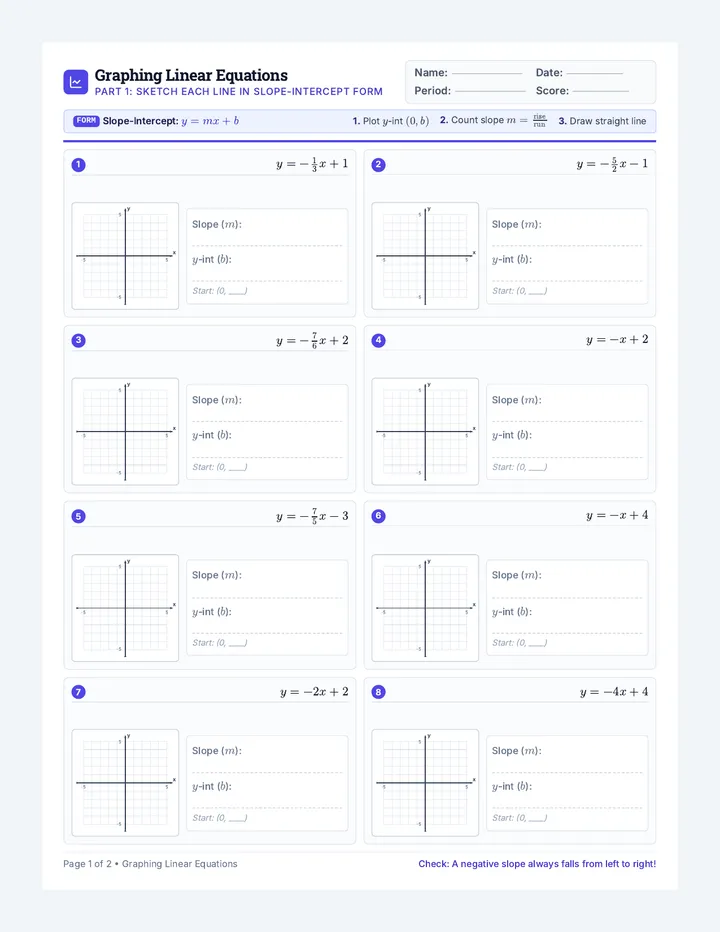
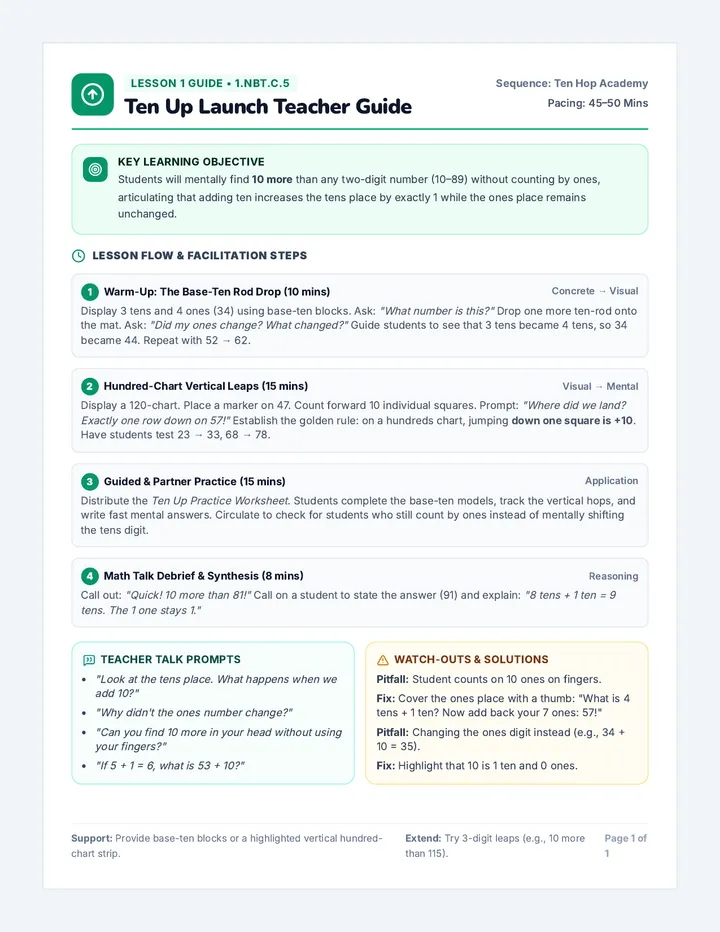
Assessment guidelines and debrief takeaways.
Page 2 of 2
4 Station 4: Rain on the Windowpane \(\frac{5}{10} = \frac{1}{2}\)
Solutions: Misty panes = \(\frac{5}{10}\). Simplified / equivalent fraction = \(\frac{1}{2}\). Extension prompt: If two more fog up, \(5 + 2 = 7\) misty panes, resulting in \(\frac{7}{10}\) misty and \(\frac{3}{10}\) clear.
5 Station 5: The Baker's Morning Tray \(\frac{2}{3}\) of 12 = 8 pastries
Solutions: 12 pastries split into 3 equal thirds means 4 pastries per third (\(\frac{1}{3} \times 12 = 4\)). Two thirds whisked away = \(4 + 4 = 8\text{ pastries}\). Remaining fraction is \(\frac{1}{3}\) (or 4 pastries left on tray).
6 Station 6: Constellation Map \(\frac{7}{12}\) bold • \(\frac{5}{12}\) faint
4 • AdvancedIdentifies all fractions, labels context precisely, accurate models.
3 • ProficientIdentifies both fractions and creates correct visual models.
2 • DevelopingIdentifies fractions with minor labeling or modeling confusion.
1 • NoviceConfuses part-to-part ratio (e.g., 2/3 instead of 2/5). Needs re-teach.
Core Synthesis Takeaways for Class Debrief:
Remind students that poets use fractions to create rhythm, tension, and vivid imagery of loss, remainder, and harmony. Emphasize that whether counting objects (apples, stars, turtles) or measuring continuous lengths and areas (ribbons, clockfaces, windowpanes), the denominator always tells us the whole story!