Stress Signal Teacher Guide Stress Signal Detectives
Teacher Facilitation Guide
LESSON 1
Learning Objective
Students will be able to identify at least three physiological signals their body sends when experiencing stress or "big emotions" by creating a personalized Body Map.
The Hook: The Dashboard Analogy
"Imagine your body is a high-tech car. When a car starts to overheat or runs low on gas, warning lights flash on the dashboard. Our bodies have 'warning lights' too! When we start to feel overwhelmed, panicked, or angry, our 'dashboard' signals us before we even realize what's happening."
Materials Needed
Body Warning Lights Worksheet
Colored pencils/markers
Chart paper for class "Dashboard"
Instructional Steps
1
Brainstorming the 'Warning Lights' (10 mins)
Ask students: "What happens to your body when you're super nervous for a test or really angry at a sibling?" List responses on the board. Common signals include: racing heart, sweaty palms, shaky hands, stomach knots, "hot" face, shallow breathing.
2
The 'Fight or Flight' Connection (5 mins)
Briefly explain that these signals are the body's way of trying to protect us. It's the "Security System" (Amydgala) kicking in. We call this 'Fight, Flight, or Freeze'.
3
Body Map Workshop (20 mins)
Hand out the Body Warning Lights Worksheet . Students color in the areas where they personally feel stress. Encourage specific colors (e.g., Red for 'hot/angry', Blue for 'shaky/nervous').
Scout Leader Prompts
Which warning light usually turns on FIRST for you? That's your "Early Warning Signal."
Why is it helpful to notice these lights before we lose our cool?
Do all people have the same warning lights? Why or why not?
Support
Provide a "Menu of Sensations" with pictures (e.g., a picture of a stomach with a knot) for students to point to and color.
Extension
Have students write a "User Manual" for their body, explaining what to do when specific lights turn on (e.g., "If heart is racing, take 3 deep breaths").
Body Warning Lights Worksheet Body Warning Lights
Case File: Stress Signal Detection
NAME:
DATE:
1. Color Your Body Map
Where do you feel big feelings? Use different colors to show your "Warning Lights" on the silhouette below.
COLOR HERE
Warning Light Color Key
FEELING HOT / ANGRY
FEELING SHAKY / SCARED
TIGHT MUSCLES / KNOTS
OTHER: ________________
2. Top 3 Signals
What are the 3 biggest clues your body gives you when you are stressed?
My "Early Warning" Signal:
(The light that turns on FIRST)
Stress Signal Slides Lesson 1
Stress Signal
Detectives
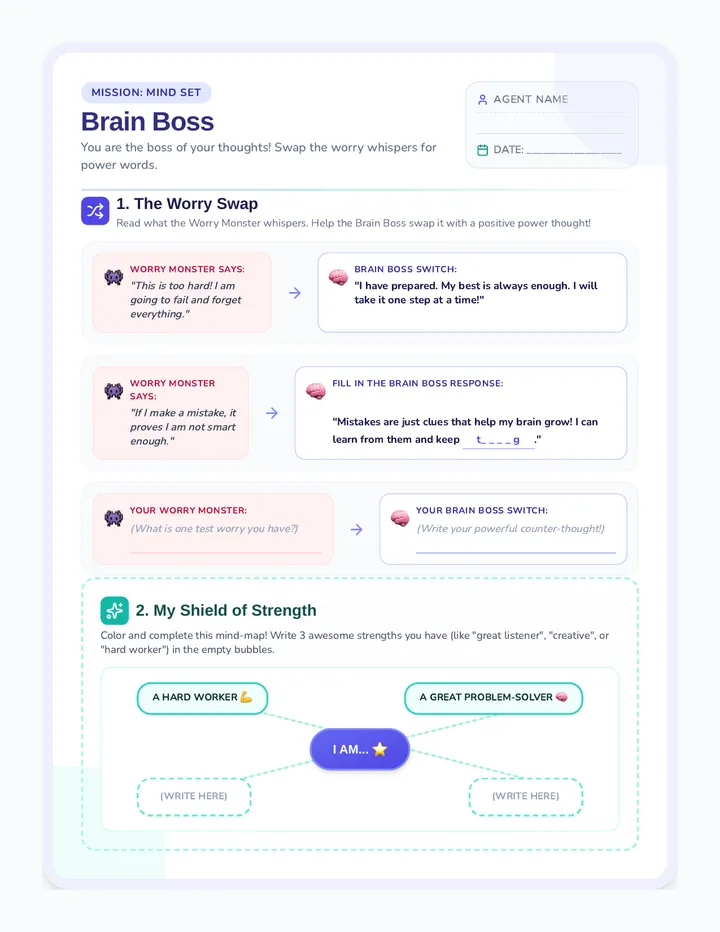
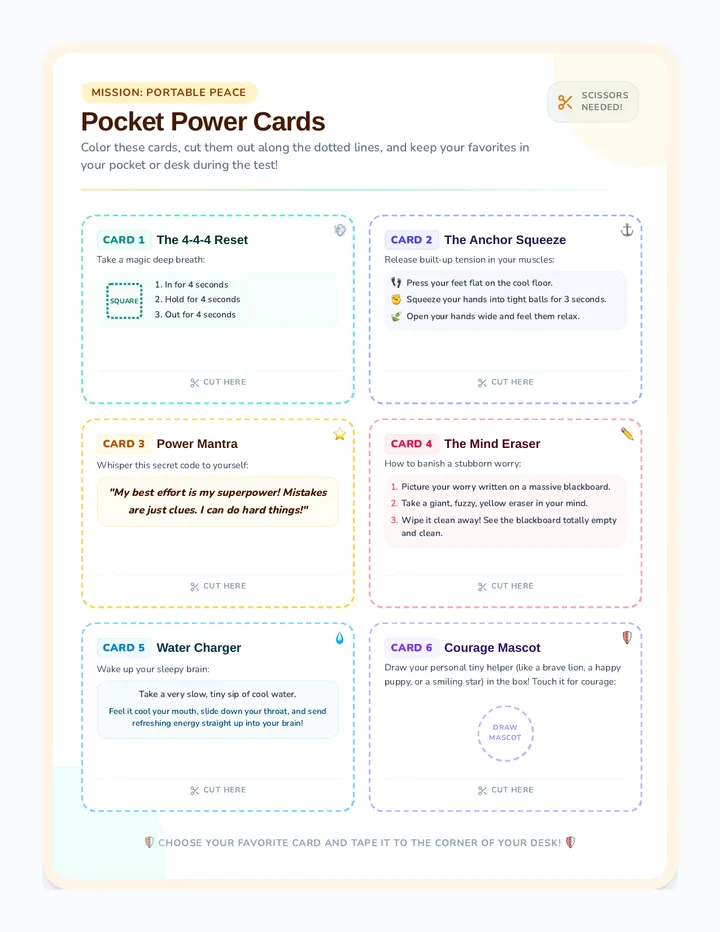
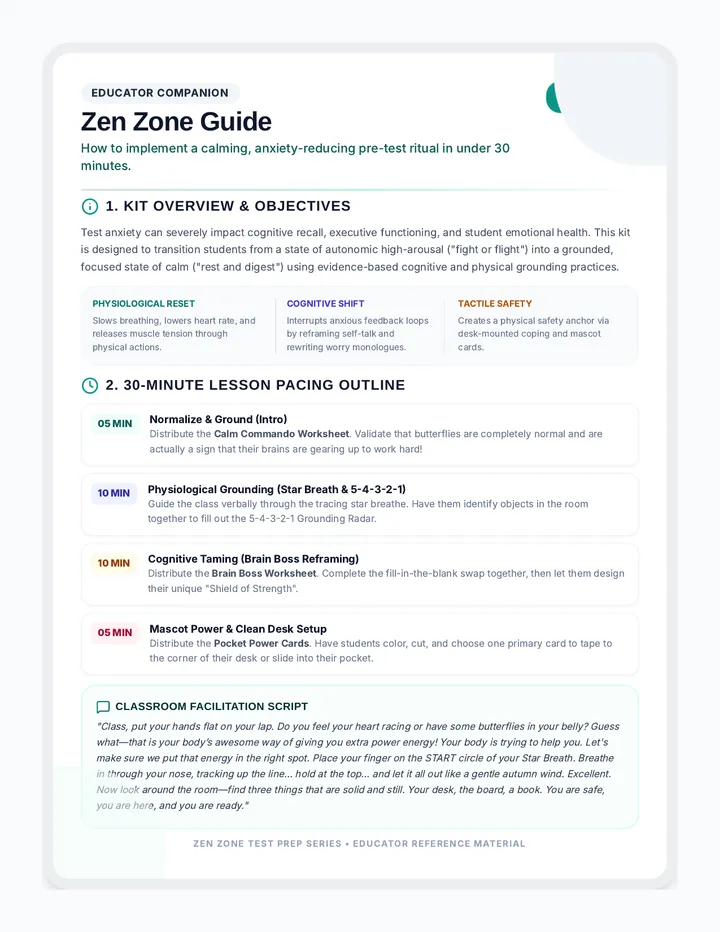
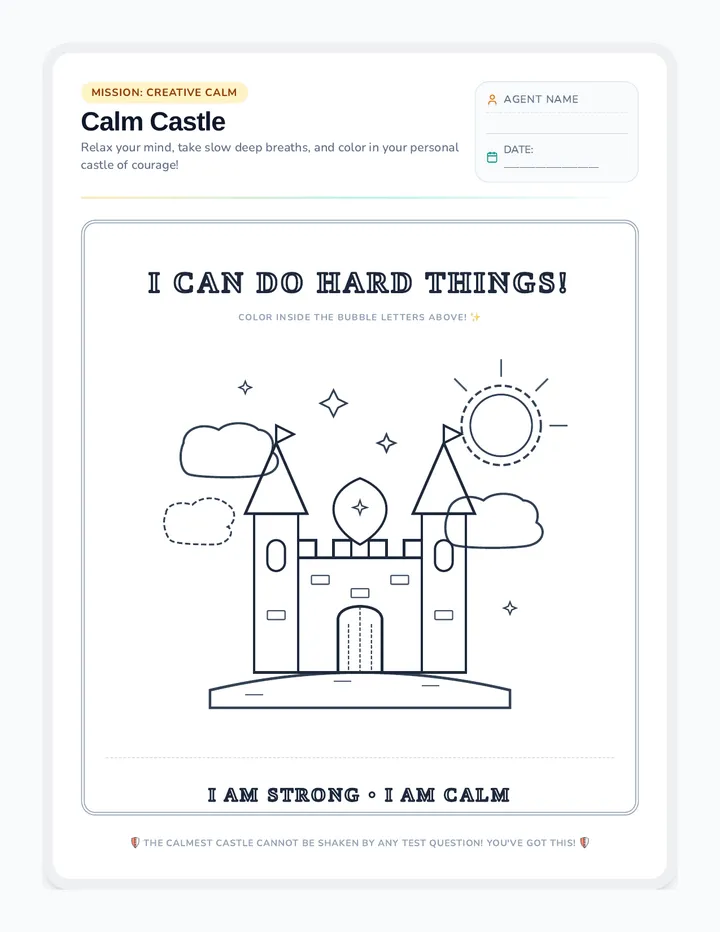
Learning to read your body's "Warning Lights" before they overheat.
The Dashboard Test
If your body was a High-Tech Racing Car, what warning lights would turn on when things start to go wrong?
"When we feel overwhelmed, our body sends signals before our brain even knows why!"
Body Dashboard Status
What does stress look like?
The Motor
Racing heart or chest feeling tight.
The Exhaust
Fast, shallow breathing or holding breath.
The Radiator
Feeling hot, sweaty palms, or red face.
Why does this happen?
The Security System
Your brain has a tiny part called the Amygdala. It's like a 24/7 security guard.
Fight "I'm going to push back!"
Flight "I need to get out of here!"
Freeze "I can't move or think!"
Your Mission
Grab your Body Warning Lights worksheet and map out YOUR personal signals!
Start Investigation
Grounding Countdown Teacher Guide The Sensory Countdown
Teacher Facilitation Guide
LESSON 2
Learning Objective
Students will practice and demonstrate the 5-4-3-2-1 grounding technique to shift focus from internal distress to their external environment.
The Hook: 10-Second Search
"We're going on a high-speed hunt. You have 10 seconds to find 5 things in this room that are the color blue. Ready... Go! ... Now, how many of you noticed the clock or the door while you were looking? When we search for specific things, our brain changes focus. That's a superpower we can use when we feel stressed!"
Materials Needed
Sensory Countdown Slides
Sensory Scavenger Hunt Worksheet
Timer
Instructional Steps
1
The Grounding Concept (5 mins)
Explain that "Grounding" means bringing your brain back to your body and the room you are in. It's like an anchor for a boat in a storm.
2
The 5-4-3-2-1 Walkthrough (15 mins)
Model the technique slowly.
- 5 Things you See: Be specific (the wood grain on the desk, the dust in the light).
- 4 Things you Feel: Physical touch (chair against back, shoes on feet).
- 3 Things you Hear: (the hum of the AC, a car outside).
- 2 Things you Smell: (pencil shavings, lunch from the cafeteria).
- 1 Thing you Taste: (the inside of your mouth, or a recent snack).
3
Scavenger Hunt Practice (20 mins)
Students use the Sensory Scavenger Hunt Worksheet to practice the technique around the classroom or outside. Emphasize observation over speed.
Scout Leader Prompts
Which sense was the easiest to find? Which was the hardest?
How did your body feel after the countdown compared to before ?
Can you do this countdown without anyone else knowing you are doing it? (The "Invisible Tool" concept).
Support
Provide a "Sensory Card" with icons for each step to help students remember the order (5-4-3-2-1).
Extension
Challenge students to create a "Sensory Poem" using their observations from the countdown.
Sensory Countdown Slides Grounding Skill
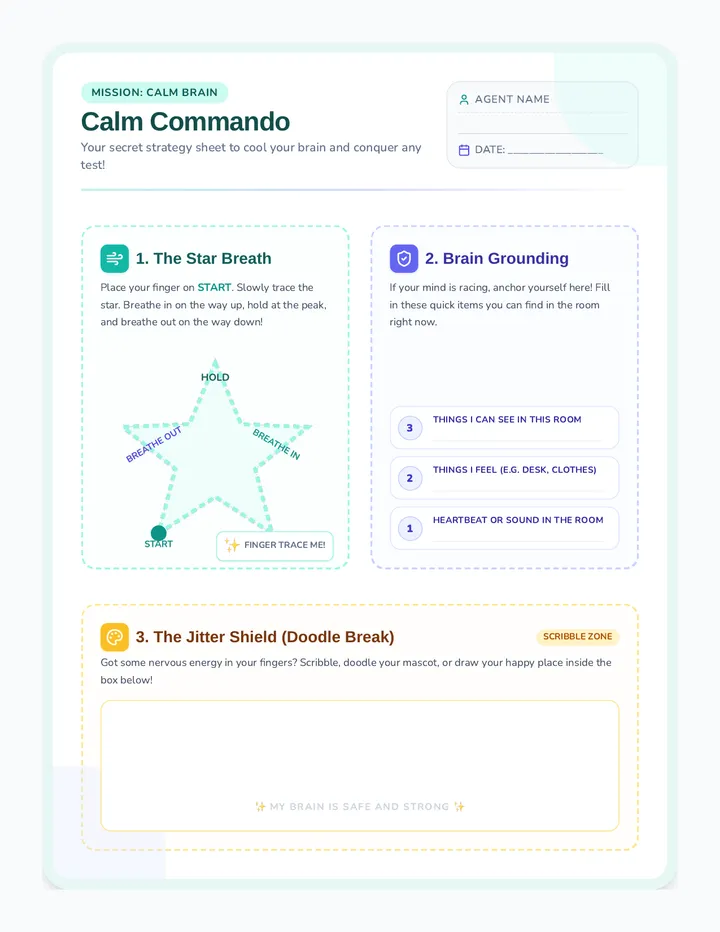
The 5-4-3-2-1
Countdown
Using your 5 Senses to drop anchor in the present moment.
Drop Your Anchor
When our feelings are like a stormy sea, our brain can drift away into worry or panic.
"Grounding is a way to pull our brain back to the safe harbor of NOW ."
The Sensory Sequence
5
SEE
Look for colors, shapes, or tiny details.
4
FEEL
Texture of clothes, cold air, or weight.
3
HEAR
Distant birds, clock ticking, or hums.
2
SMELL
Soap, paper, or maybe just fresh air.
1
TASTE
Toothpaste, water, or your own tongue.
Why 5-4-3-2-1?
It interrupts the Panic Loop in your brain.
It is Invisible. You can do it anywhere!
"The more you practice when you're calm, the better it works when you're stressed."
Investigation Time!
Use your Sensory Scavenger Hunt worksheet to find your anchors in this room.
Begin Countdown
Sensory Scavenger Hunt Worksheet Sensory Scavenger Hunt
Grounding Mission: 5-4-3-2-1
NAME:
DATE:
Mission Briefing: Explore your environment. Find specific, interesting details for each sense. Try to find things you haven't noticed before!
5 THINGS I SEE
4 THINGS I FEEL
3 THINGS I HEAR
Turn over for smells and tastes
2 SMELLS
1 TASTE
Mission Debrief
How does your body feel NOW that you have completed the sensory countdown?
Scout Signature: _______________________ Mission Accomplished
Tactile Anchor Teacher Guide Tactile Anchor Hunt
Teacher Facilitation Guide
LESSON 3
Learning Objective
Students will explore how specific tactile sensations (touch) can provide immediate emotional grounding and identify personal "anchor objects" for crisis management.
The Hook: Mystery Box Challenge
"I have several 'Mystery Boxes' with hidden items inside. Your mission is to reach in and describe only what it feels like to your hands. Is it cold? Rough? Fuzzy? Notice how much concentration it takes to describe a feeling. That concentration is what helps us stay grounded."
Materials Needed
Mystery Boxes (shoe boxes with arm holes)
Textured items: smooth stones, sandpaper, silk, cold packs, velvet, cotton balls.
Texture Detective Log
Instructional Steps
1
The Science of Touch (5 mins)
Explain that touch is our largest sense (skin). Intense or interesting sensations can "jolt" the brain back into the body when we feel "floaty" or panicked.
2
Texture Exploration Stations (25 mins)
Set up stations with different textures. Students use the Texture Detective Log to rate how each sensation makes them feel (Calm, Focused, Alert, or Uncomfortable).
- Cold: Use an ice pack (great for immediate panic interruption).
- Rough: Sandpaper or bark (great for bringing focus to the present).
- Soft: Velvet or feathers (great for soothing).
3
Finding Your Anchor (10 mins)
Have students identify one texture they liked most. This is their "Anchor Texture." Discuss objects they could carry (a "fidget," a smooth pebble) that use this texture.
Scout Leader Prompts
Why does a cold sensation work so fast to help someone stop panicking?
If you could keep one "Anchor Object" in your pocket, what would it be?
How is focusing on a texture different from focusing on a sound?
Support
Allow students to use a word bank of descriptive textures (bumpy, slick, fuzzy) to help them fill out their logs.
Extension
Students research "Sensory Rooms" or "Calm Down Corners" and design one for the classroom based on their texture findings.
Tactile Anchor Slides Lesson 3
Tactile
Anchors
How the power of touch keeps us steady when feelings get heavy.
The Body's Giant Sensor
Your Skin is your body's largest sensory organ!
A sharp, cold, or rough texture can interrupt a panic signal.
Holding a specific "anchor object" tells your brain: "I am right here, right now."
Tactile Input = Safety Signal
Mystery Box Mission
"Close your eyes. Reach in. What do your fingers tell you? Don't guess what the object IS... describe what the texture FEELS like."
Common Anchors
COLD
Wakes up the brain instantly.
ROUGH
Forces focus to the fingertips.
SOFT
Sends a 'calm down' message.
SMOOTH
Soothing and rhythmic to touch.
Detective Log
It's time to visit the stations and find YOUR favorite anchor texture.
Texture Detective Log Texture Detective Log
Grounding Mission: Tactile Anchoring
NAME:
DATE:
1. Station Investigation
Object / Texture Description (Words) How it makes me feel Mystery Box 1 Calm Sleepy Excited Alert
|
| Mystery Box 2 | |
Calm Sleepy Excited Alert
|
| Ice Pack / Cold | |
Calm Sleepy Excited Alert
|
| Sandpaper / Bark | |
Calm Sleepy Excited Alert
|
| Cotton / Silk | |
Calm Sleepy Excited Alert
|
My Anchor Choice
Which texture helped you feel the most "grounded" (steady and present)?
Why did this texture work for you?
The Pocket Anchor
What is a small object you could keep with you that has this texture?
Sketch your anchor object here
End of Detective Case #003
Movement Grounding Teacher Guide Earth Connection Drills
Teacher Facilitation Guide
LESSON 4
Learning Objective
Students will practice movement-based grounding techniques that engage large muscle groups to release pent-up physical tension and re-establish a sense of physical stability.
The Hook: The Unstoppable Wall
"Everyone, stand up and face the wall. On the count of three, I want you to try to push that wall into the next room using all your strength. 1... 2... 3... PUSH! ... Stop. Now, notice your muscles. Notice your feet on the floor. That wall didn't move, but how did YOUR body change?"
Materials Needed
Movement Grounding Slides
Grounding Drills Worksheet
Open space for movement
Instructional Steps
1
The "Energy Release" Concept (5 mins)
Explain that when we are stressed, our bodies create extra energy for 'Fight or Flight'. If we don't use it, we feel shaky or "stuck". Movement lets that energy out safely.
2
The 4 Drills (20 mins)
Model and practice the following:
- Wall Push: Hands flat, arms locked, engaging core.
- Heel Stomp: Stomping heels hard into the floor to feel the impact.
- Chair Press: Sitting down and pushing hands into the seat to lift the body slightly.
- Toe Scrunch: Curling toes hard into the ground (invisible grounding).
3
Personal Drill Menu (15 mins)
Students test each movement and record their "Stability Score" on the Grounding Drills Worksheet . They identify which movement makes them feel most "solid."
Scout Leader Prompts
Why does feeling the floor under your heels make you feel safer?
Which of these drills could you do at your desk without drawing attention?
How does your breathing change after a 'Wall Push'?
Support
For students with mobility issues, focus on "invisible" exercises like muscle clenching/releasing (progressive muscle relaxation) in the hands or face.
Extension
Students create their own "Grounding Dance" - a sequence of 3 movements they can use to reset their energy.
Movement Grounding Slides Grounding Skill
Earth
Connection
Using your muscles and gravity to find your balance.
Trapped Energy
Stress creates High Voltage energy in your muscles.
"If we don't use that energy, it makes us feel jumpy, shaky, or like we're going to explode!"
The Stability Drills
The Wall Push
Push all that stress into the wall.
The Heel Stomp
Feel the floor support your weight.
The Chair Press
Push yourself UP to stay DOWN.
The Toe Scrunch
An invisible anchor in your shoes.
Gravity is Your Friend
"When your brain is spinning, your feet need to know exactly where they are. Moving with force tells your brain: YOU ARE SAFE. YOU ARE SOLID. YOU ARE HERE."
Mission: Stability
Stand up, clear some space, and let's find our center of gravity.
Begin Drill
Grounding Drills Worksheet Grounding Drills
Grounding Mission: Earth Connection
NAME:
DATE:
The Stability Test
Perform each drill for 30 seconds. Afterwards, rate how "solid" or "steady" you feel on a scale of 1 to 5.
1. Wall Push
Hands flat on the wall, arms locked. Push as hard as you can without moving your feet.
Stability Score:
1
2
3
4
5
2. Heel Stomp
Lift one foot at a time and stomp your heel down hard. Feel the 'thud' through your whole body.
Stability Score:
1
2
3
4
5
3. Chair Press
Sit and put your hands on the sides of your chair. Press down hard as if you are trying to lift yourself up.
Stability Score:
1
2
3
4
5
4. Toe Scrunch
Inside your shoes, curl your toes as hard as you can, then release. Repeat until you feel your feet 'anchored'.
Stability Score:
1
2
3
4
5
The "Invisible" Winner
Which of these drills could you use in the middle of a classroom or a cafeteria without anyone noticing? Why would that be a useful "superpower"?
Safety Plan Teacher Guide Safety Plan Strategy
Teacher Facilitation Guide
LESSON 5
Learning Objective
Students will synthesize their knowledge of physiological signals and sensory grounding techniques to create a personalized Sensory Safety Plan and a conceptual "Superhero Toolkit."
The Hook: The Utility Belt
"Every superhero has a utility belt with the perfect tools for every crisis. Batman doesn't just hope he has a gadget; he plans for it! Today, we are building YOUR sensory utility belt. When the 'Panic Monster' attacks, what tools will you have ready?"
Materials Needed
Safety Plan Slides
Sensory Superhero Toolkit (Worksheet)
Small boxes or envelopes (optional, for physical toolkit)
Instructional Steps
1
Reviewing the "Signals" (5 mins)
Quickly recap Lesson 1. Ask: "How do we know when it's time to reach for our toolkit?" (When the dashboard lights turn on!).
2
Choosing Your Top 3 (10 mins)
Students review their previous worksheets (Countdown, Texture Log, Movement Drills) and select the three most effective strategies for them personally.
3
Creating the Toolkit (25 mins)
Students complete the Sensory Superhero Toolkit worksheet. They should be specific: "If my heart races, I will do 5-4-3-2-1" or "If I feel shaky, I will stomp my heels."
Scout Leader Prompts
Where is a safe place to keep your Safety Plan so you can find it easily?
Who are your "Backup Heroes" (adults) you can talk to when your toolkit isn't enough?
How does having a plan make you feel about the next time you feel a big emotion?
Support
Provide cut-out icons of all the techniques learned (Countdown, Stomping, etc.) for students to glue onto their "Utility Belt."
Extension
Students create a "Grounding Badge" or card to carry in their backpack or keep in their desk as a visual reminder.
Safety Plan Slides Final Mission
Sensory
Superhero
Building your personalized toolkit for emotional strength.
Our Journey So Far
The Signals
Dashboard Lights
The Countdown
5-4-3-2-1
The Anchors
Texture & Touch
The Drills
Body Stability
Your Utility Belt
Superheroes don't panic when things go wrong—they reach for their tools.
"Today, you choose which tools go in your belt."
The Plan Components
1
My Early Warning Signal (Notice the alarm).
2
My Top 3 Tools (The Grounding Drills).
3
My Backup Heroes (Adults I can trust).
Mission Launch
Complete your Sensory Superhero Toolkit . This is your personal shield against the storm.
Create My Plan
Sensory Superhero Toolkit Worksheet Sensory Superhero Toolkit
Grounding Mission: Final Safety Plan
NAME:
DATE:
THE ALARM BELLS
I will use my tools when I notice these Body Signals:
Signal 1
Signal 2
My Top 3 Grounding Tools
TOOL #1
(How to do it)
TOOL #2
(How to do it)
TOOL #3
(How to do it)
MY BACKUP HEROES
Adults I can trust if my tools aren't working:
MISSION PROMISE
"I promise to check my 'Dashboard Lights' and use my tools to stay grounded and safe."
Hero Signature:
MISSION COMPLETE