A student-facing practice worksheet for the Grade 6 CogAT Verbal Battery, featuring challenging questions across all three subtests with standardized styling and improved layout. Corrected page breaks for Part 3.
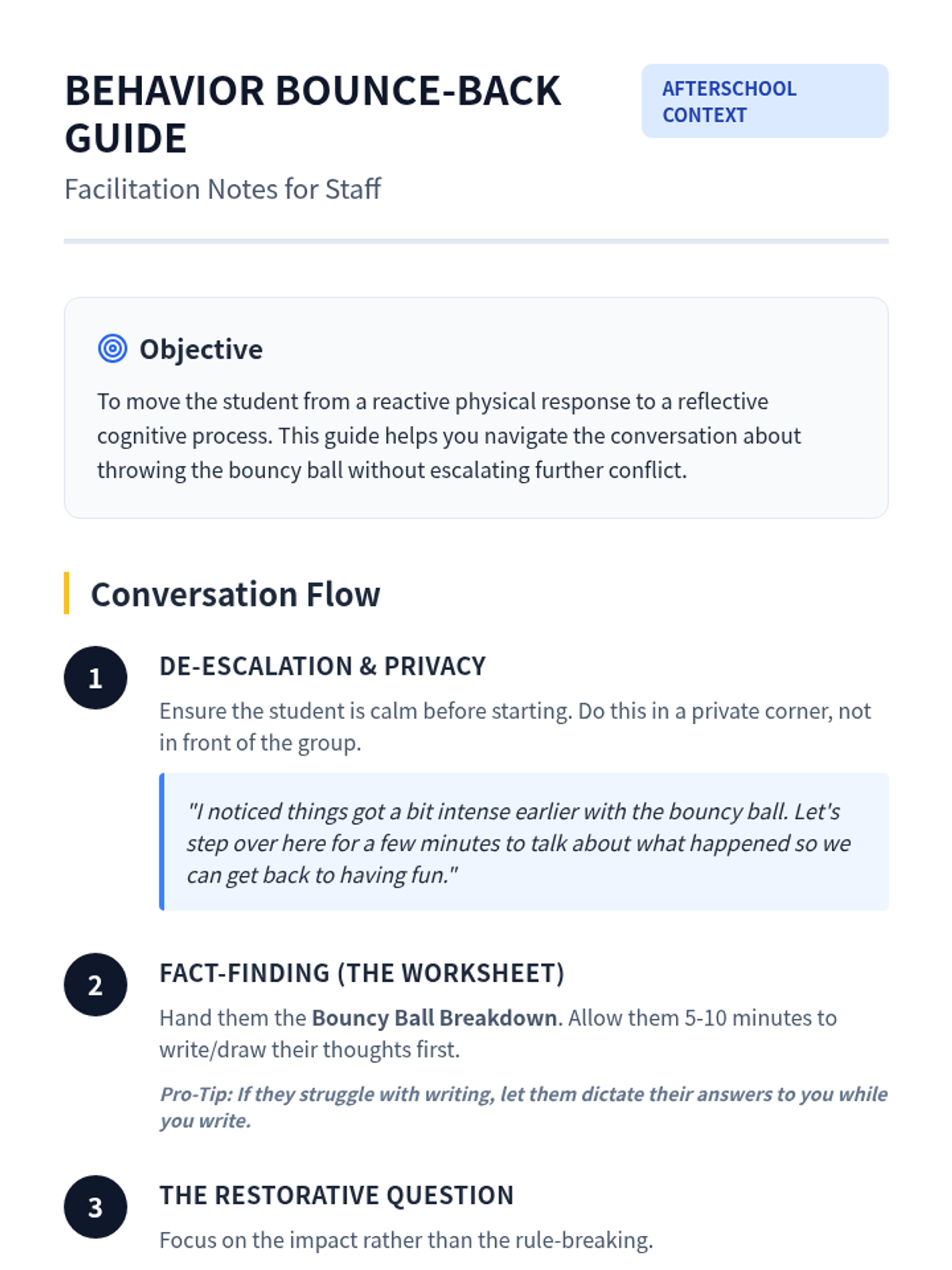
A facilitation guide for afterschool staff to conduct a restorative conversation with a student about throwing objects. Revised to fix page breaks and include a notes section.
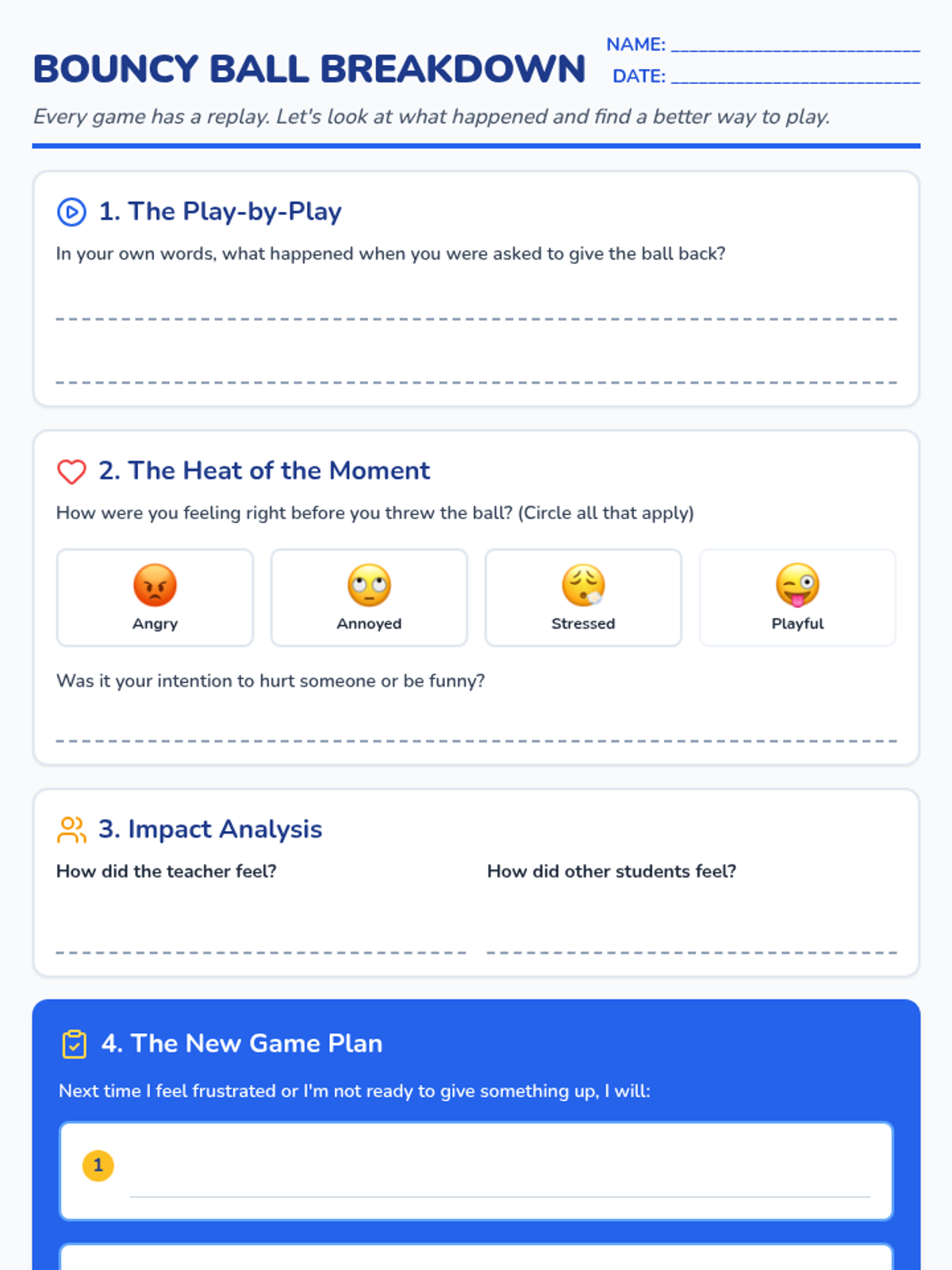
A reflective behavior worksheet for students to process the ball-throwing incident, focusing on feelings, impact, and future strategies. Optimized for single-page printing with legible work areas.
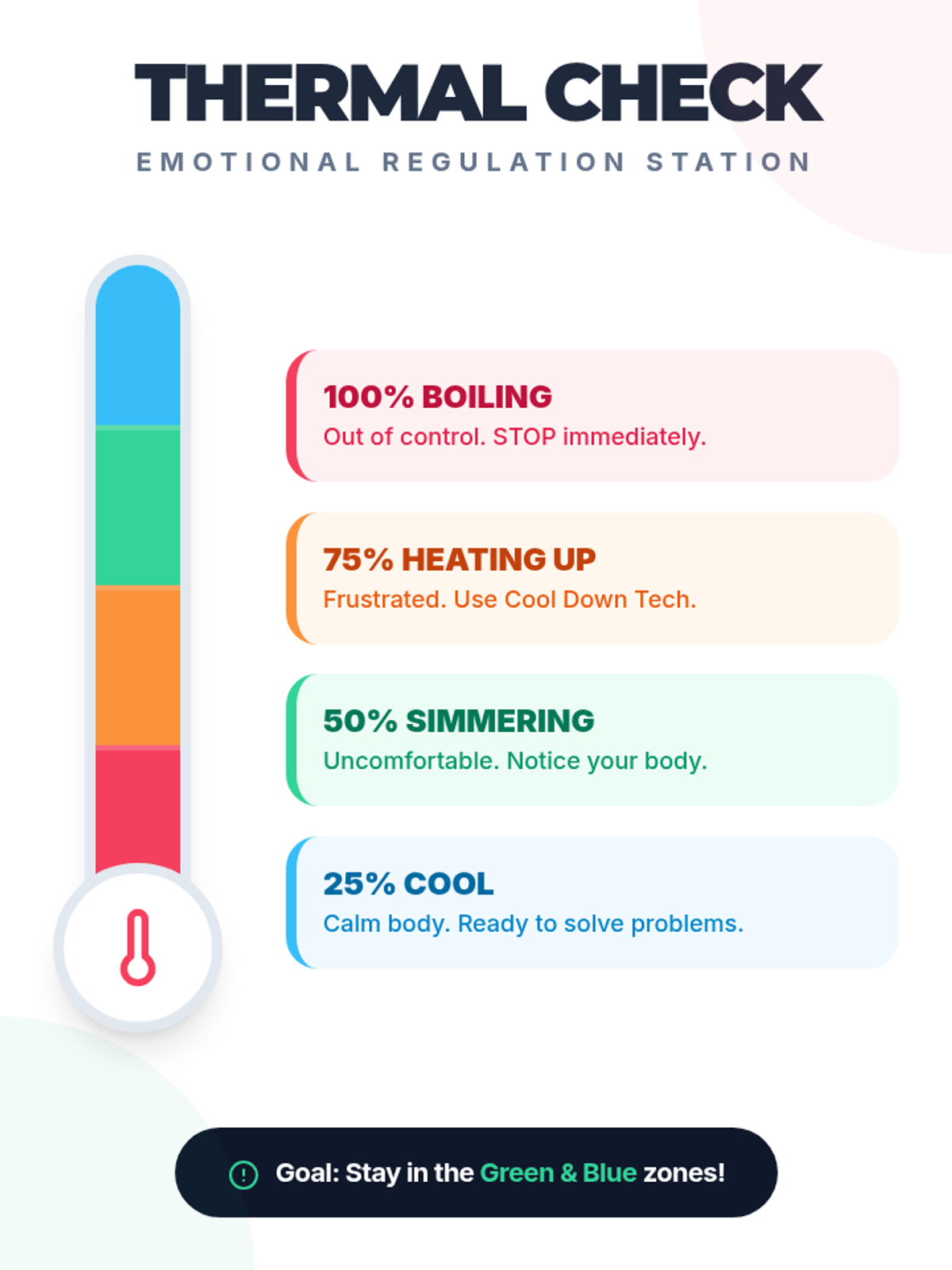
A set of 5 classroom posters for the Peace Lab lesson, covering the Emotional Thermometer, I-Statement formula, Cool Down Tech, Win-Win solutions, and a Knowledge Check.
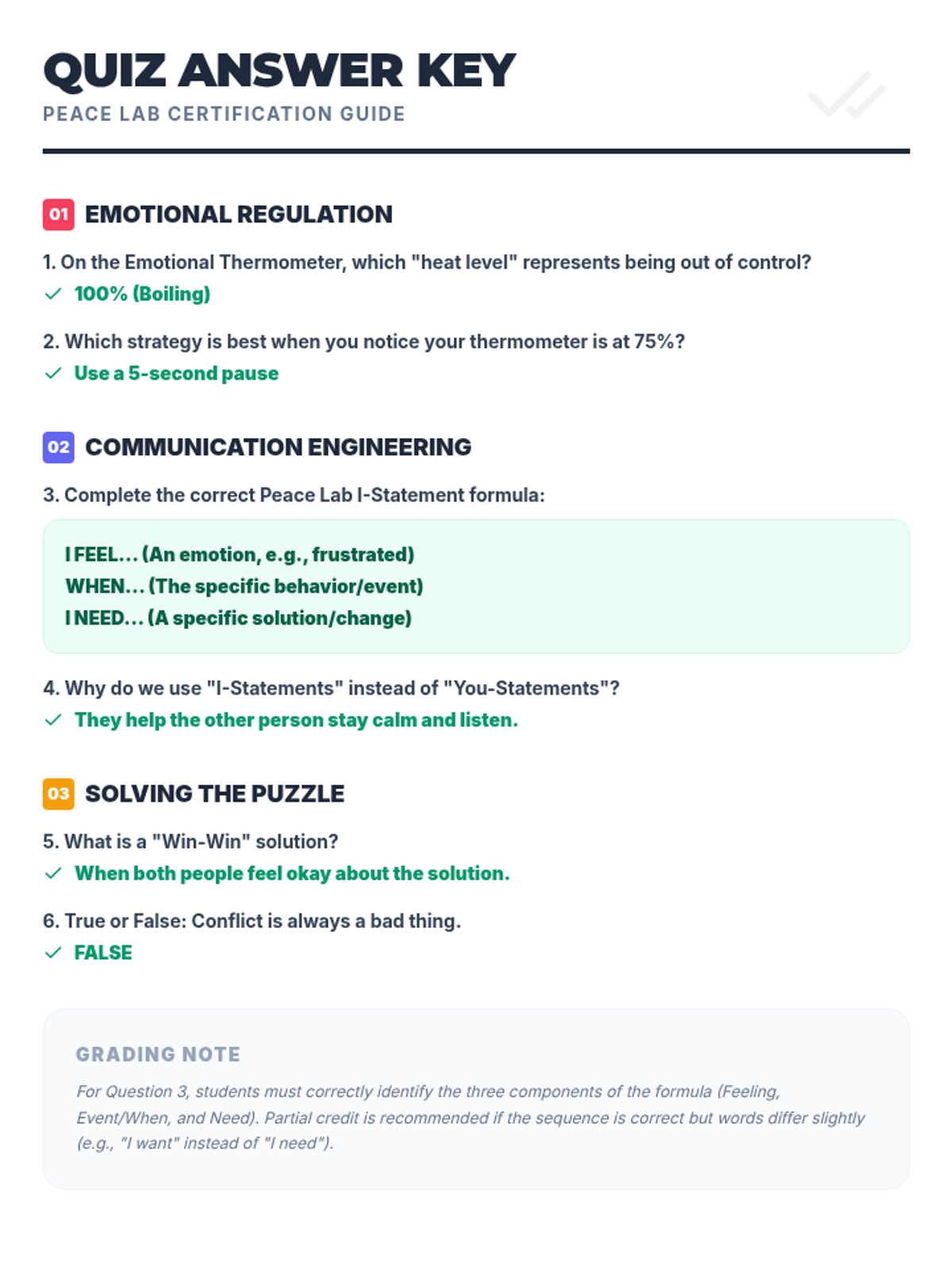
An answer key for the Peace Lab Quiz, providing correct responses and grading notes for the facilitator.
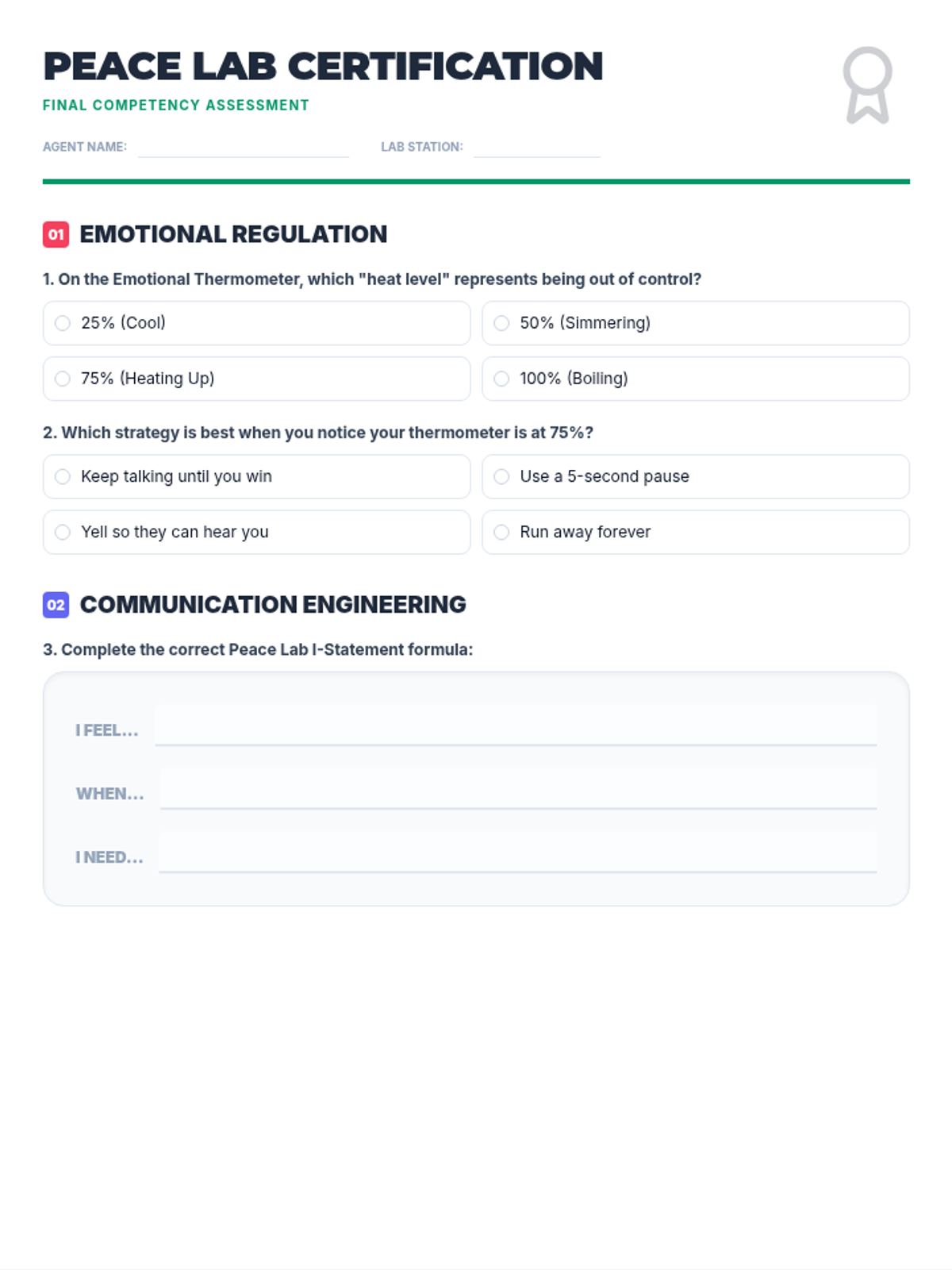
A comprehensive 6-question quiz ('Certification') to assess student understanding of the Peace Lab concepts: emotional regulation, I-statements, and win-win solutions.
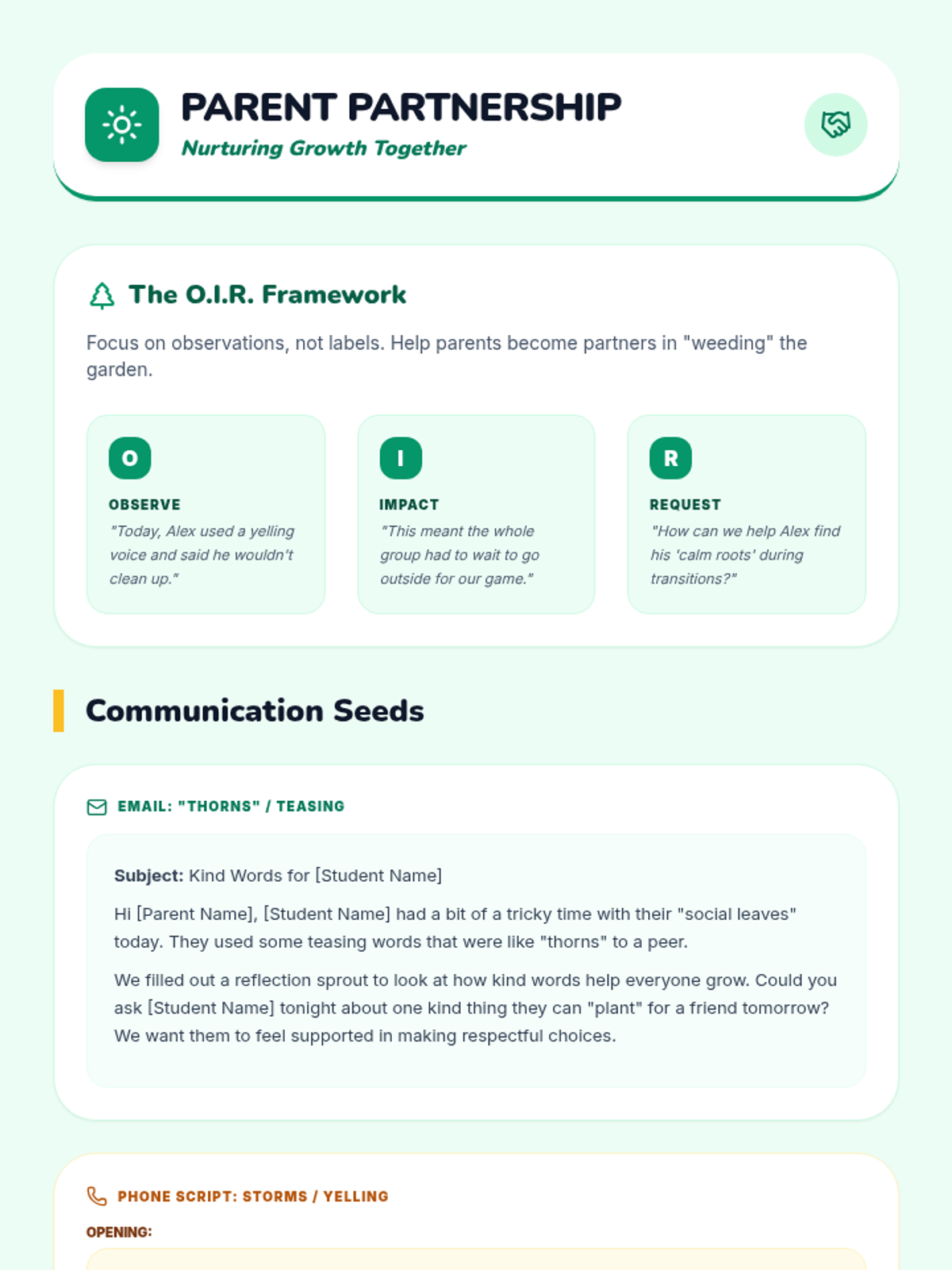
A teacher resource providing templates and frameworks for communicating with parents about difficult middle school behaviors like defiance, yelling, and roasting.
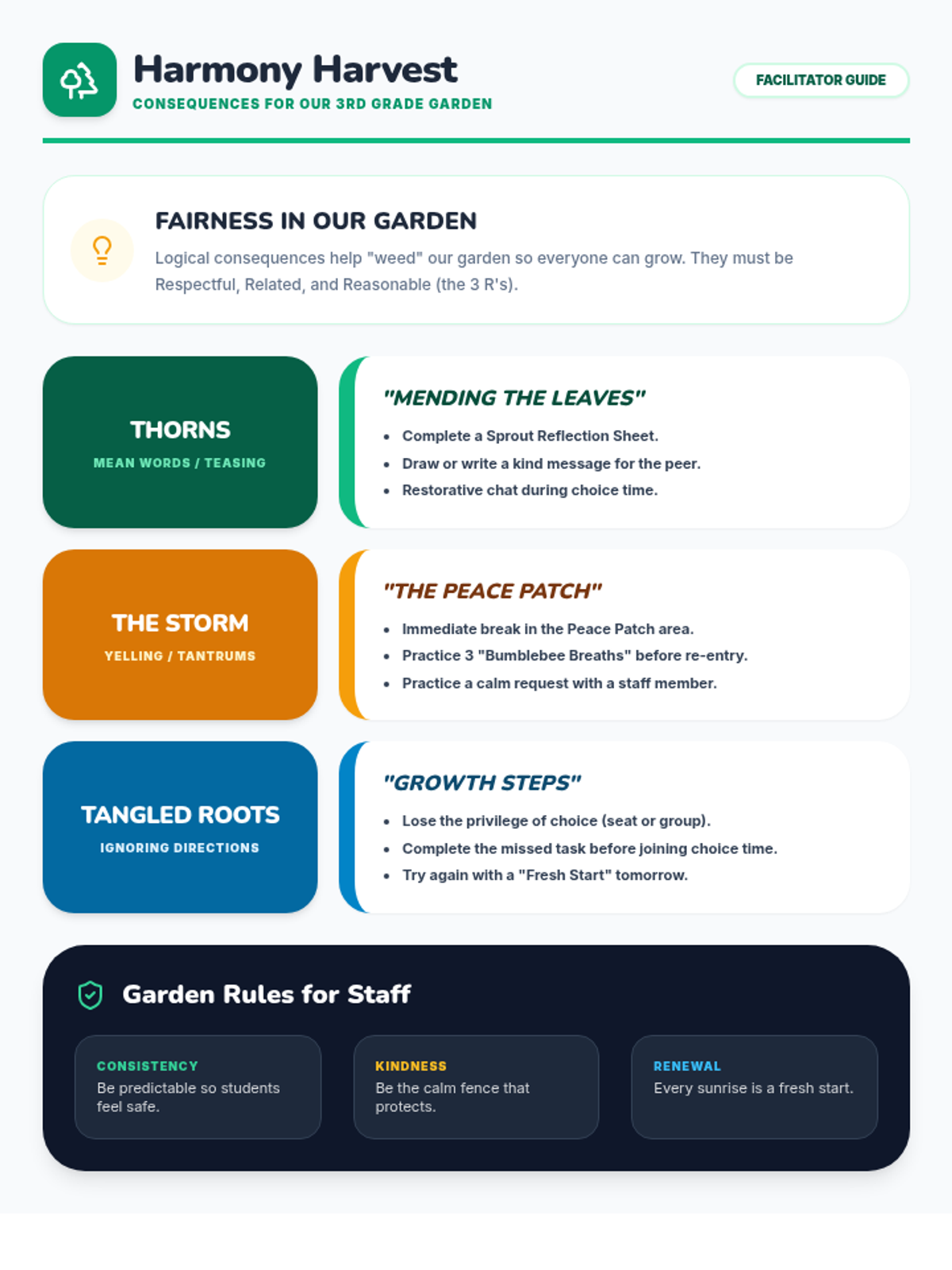
A colorful, nature-themed guide outlining logical consequences for 3rd-grade behaviors like mean words, tantrums, and defiance in an after-school setting.
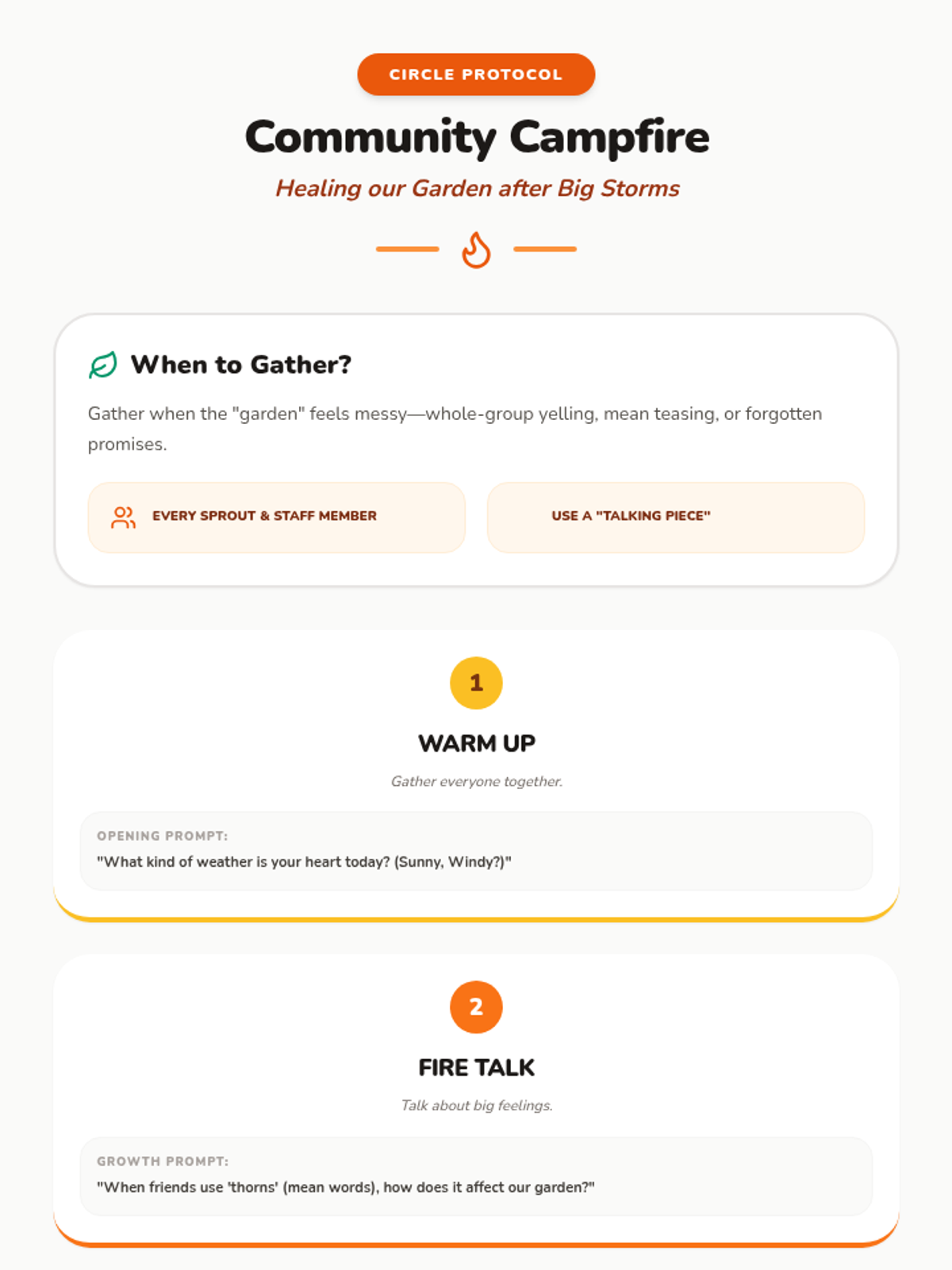
A facilitation guide for teachers to lead restorative circles, specifically focused on repairing classroom community after incidents of peer 'roasting' and collective disrespect.
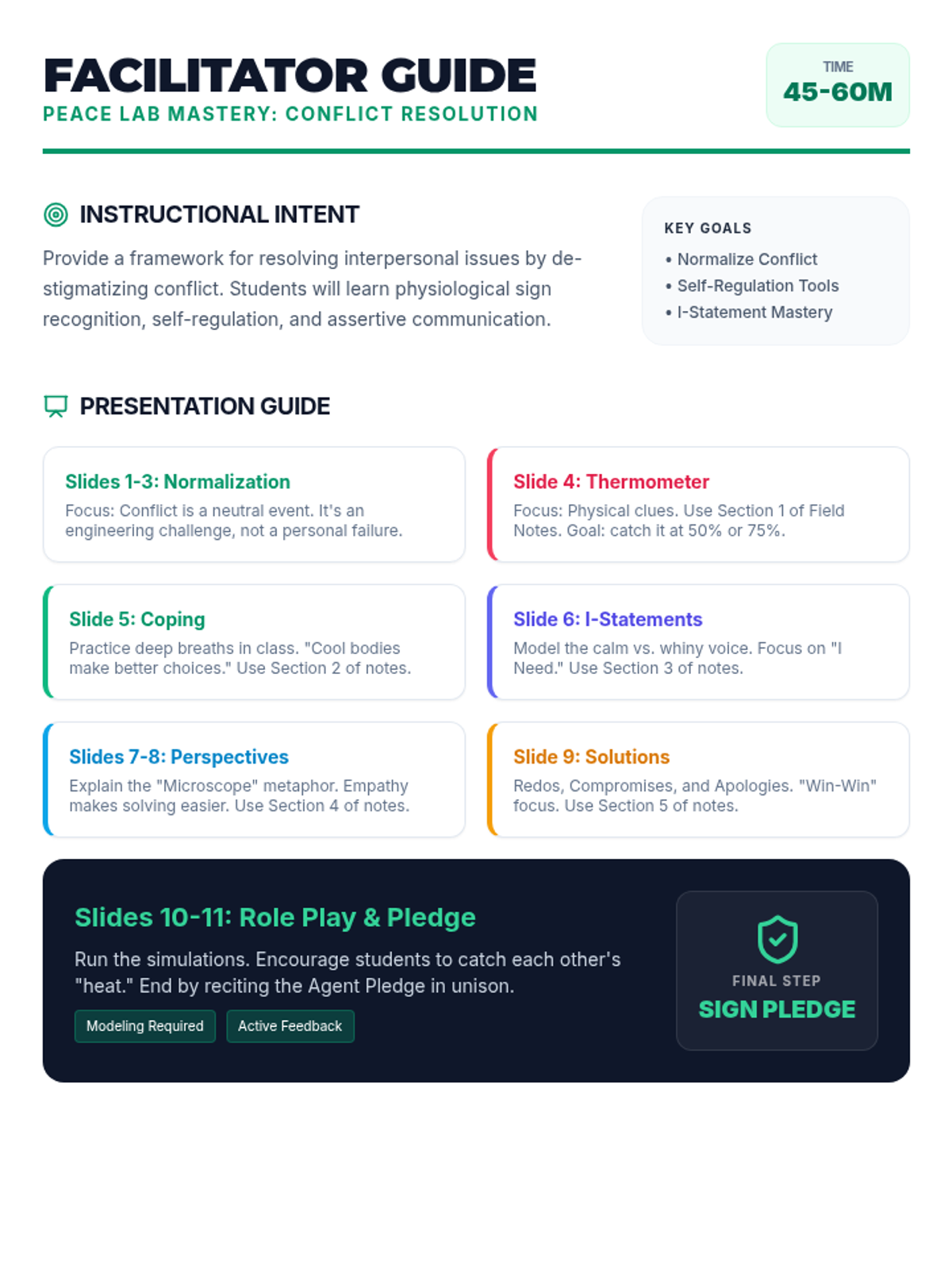
A facilitator guide for teachers to deliver the Peace Lab Mastery lesson. Includes discussion prompts, engagement timing, and tips for modeling social skills.
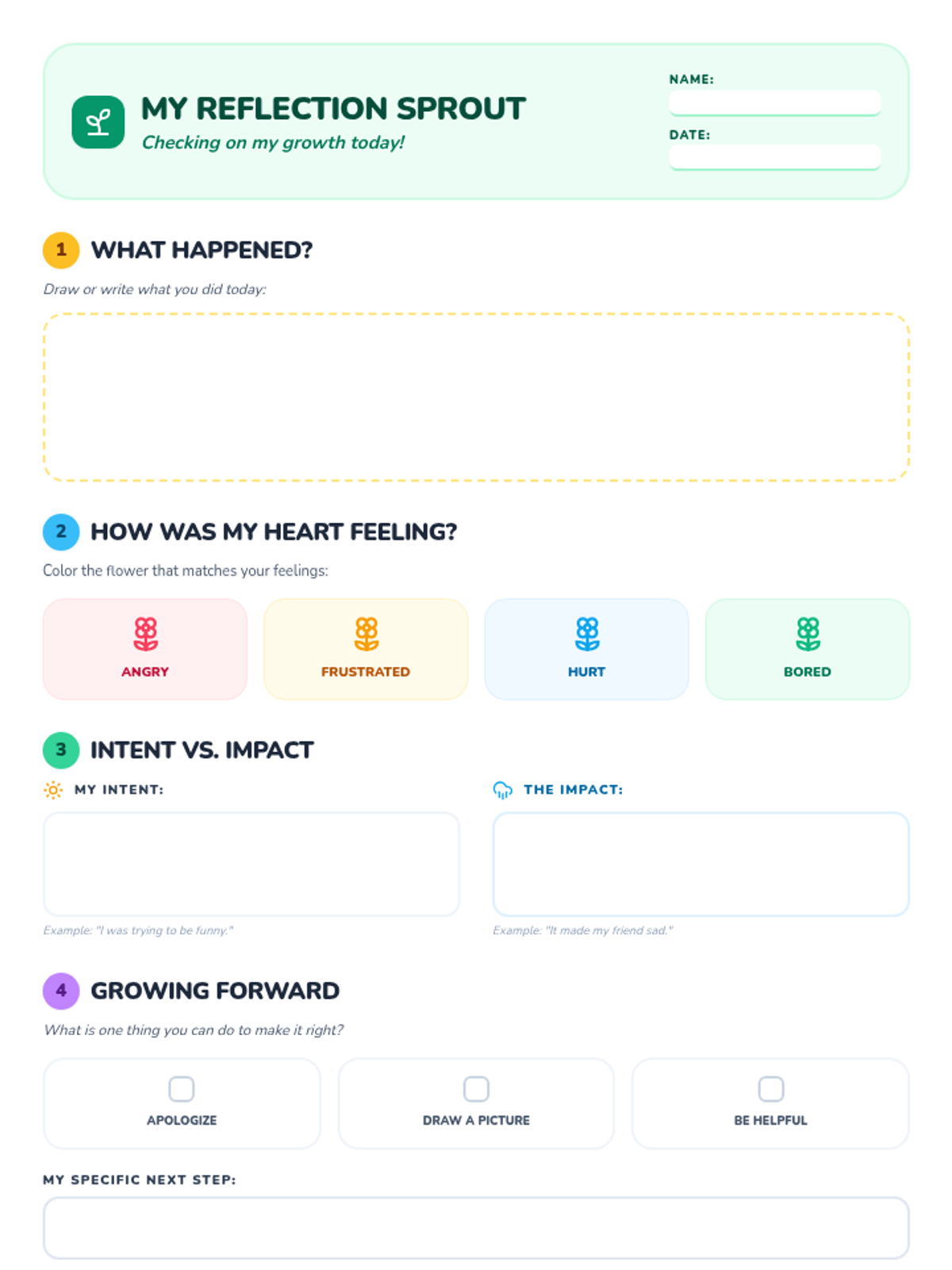
A colorful, nature-themed student reflection worksheet for 3rd graders to process behavior, understand feelings, and plan restorative steps.
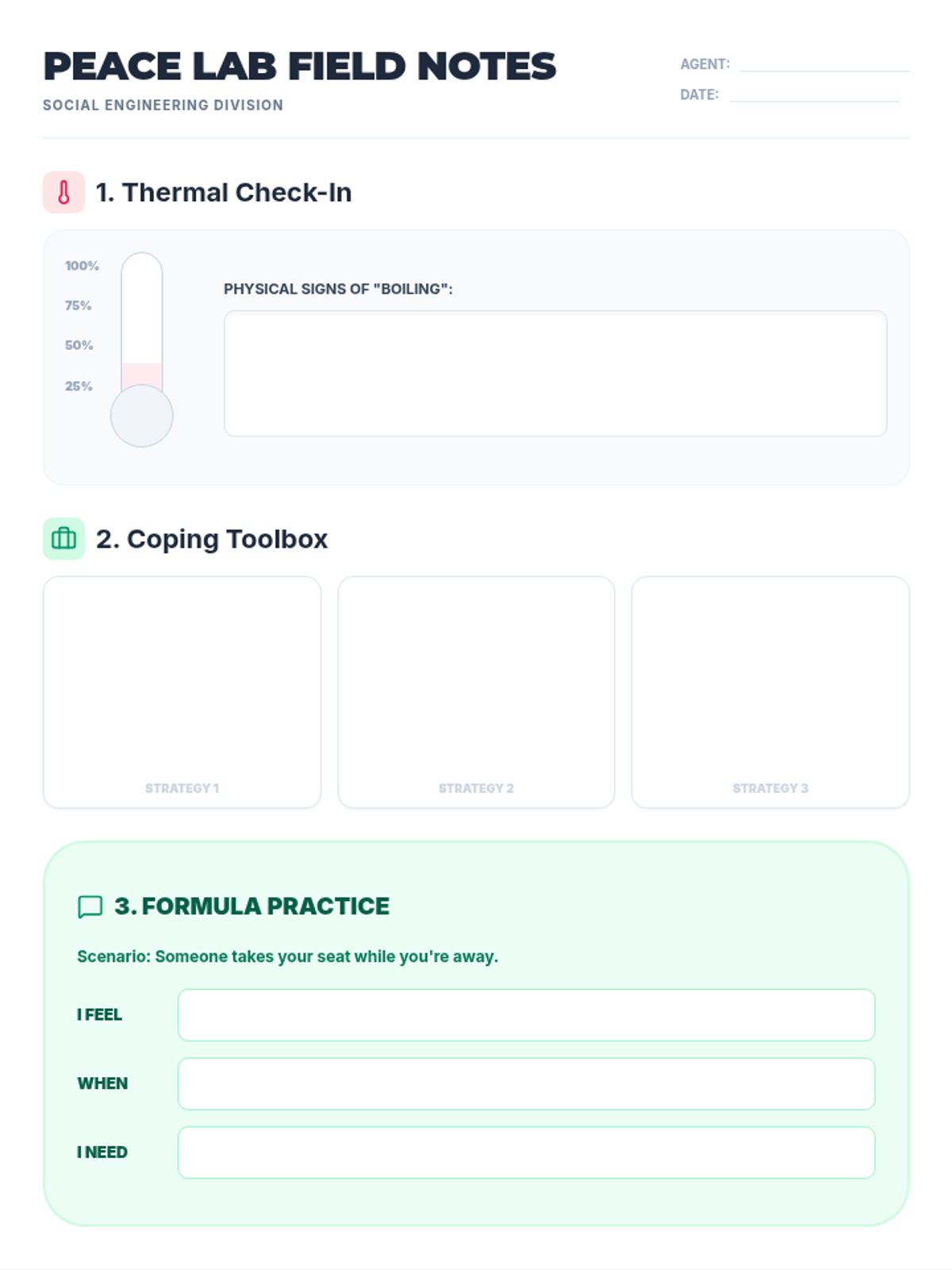
A 2-page student worksheet ('Field Notes') designed to accompany the Peace Lab presentation. Includes sections for emotional thermometer check-ins, coping strategies, and I-statement practice.
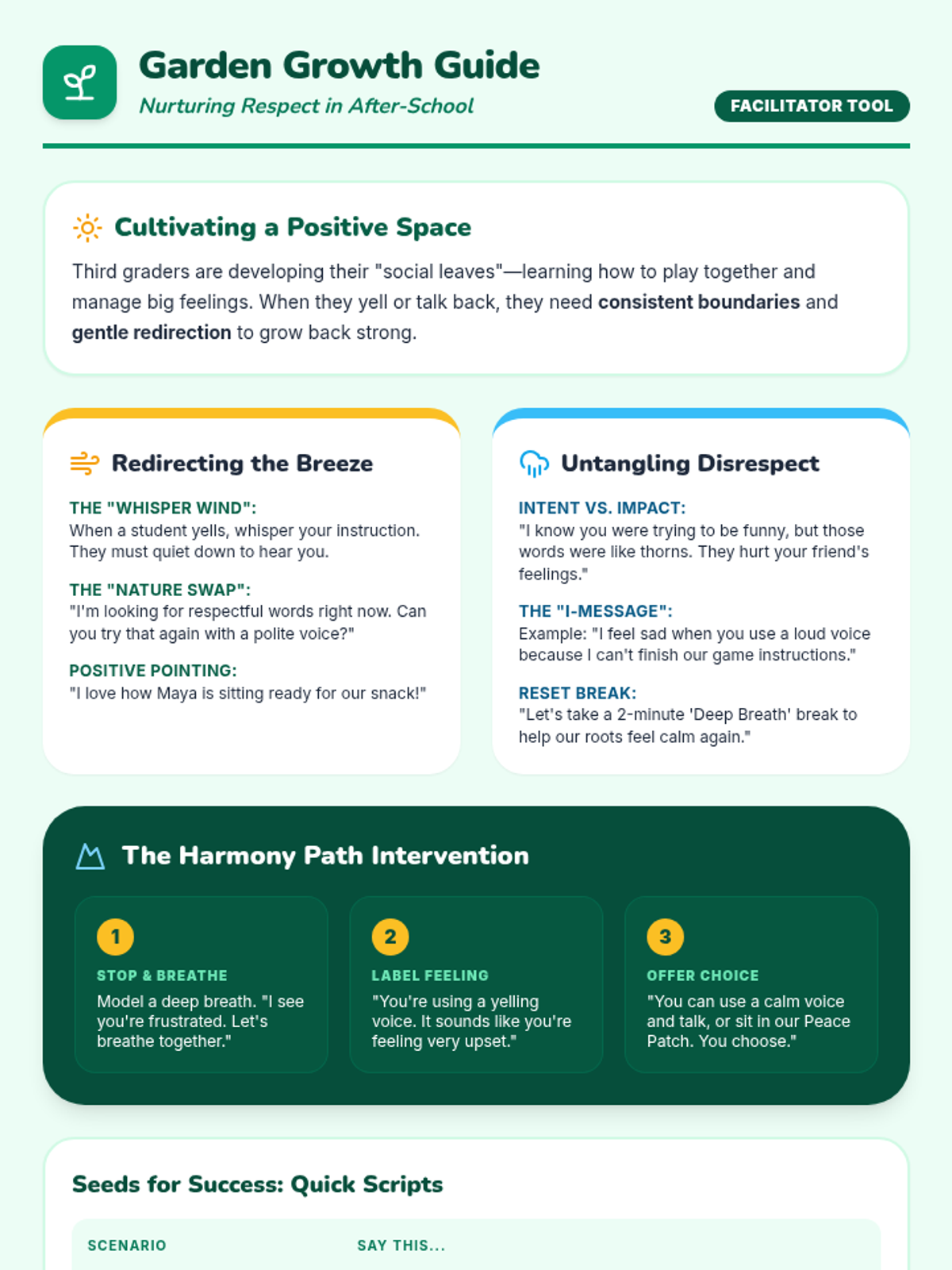
A colorful, nature-themed facilitator guide for after-school staff, providing 3rd-grade appropriate scripts and de-escalation strategies for handling disrespect and big emotions.
A 11-slide presentation designed for students to learn conflict resolution skills. It features 'The Peace Lab' theme with a focus on emotional regulation, I-statements, and perspective-taking.
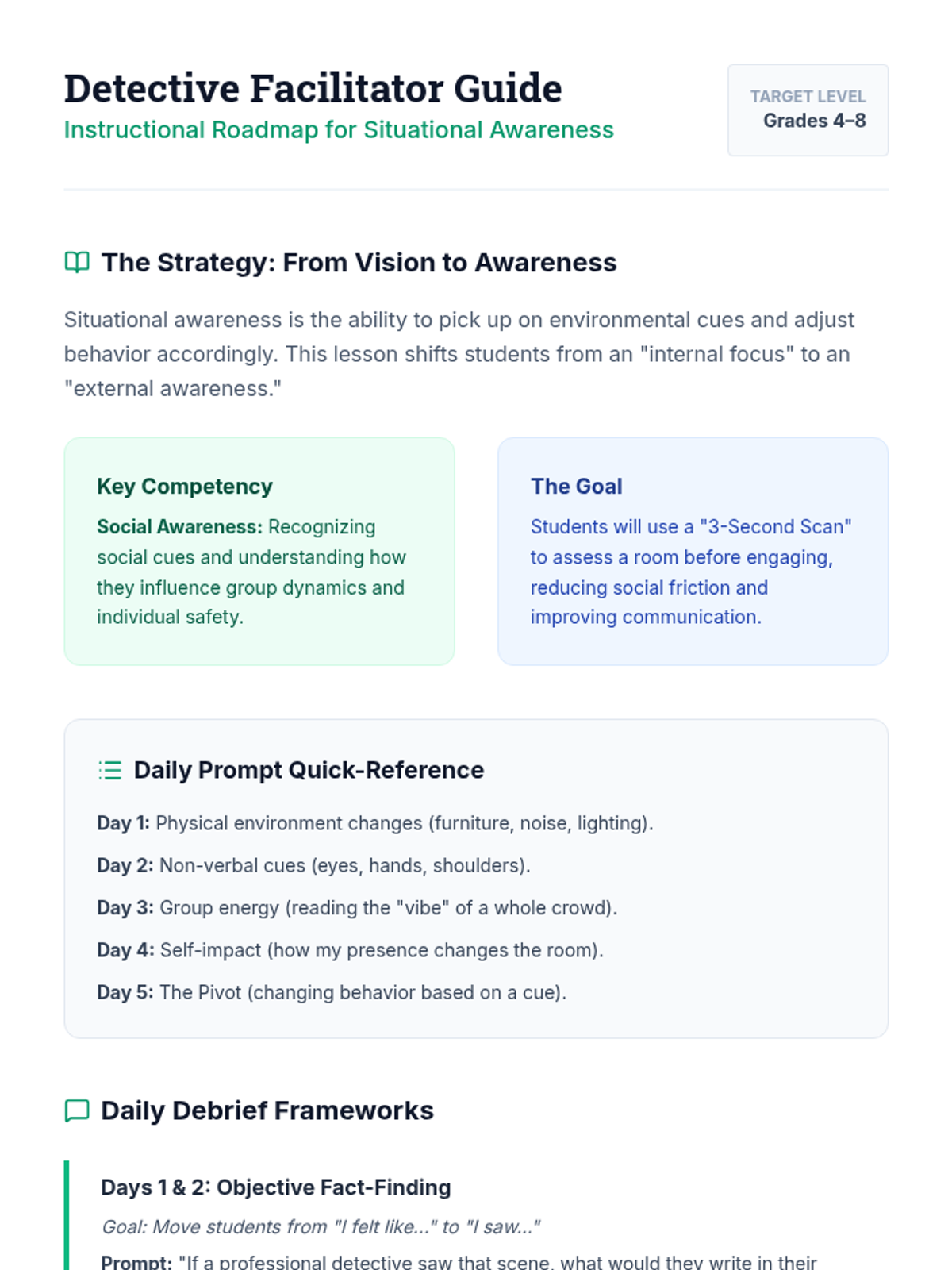
A teacher's guide for implementing the Social Detectives lesson, including instructional strategies, discussion frameworks, and facilitation tips for situational awareness.
A classroom presentation introducing the concept of situational awareness, including the '3-Second Scan' technique and reading non-verbal cues.
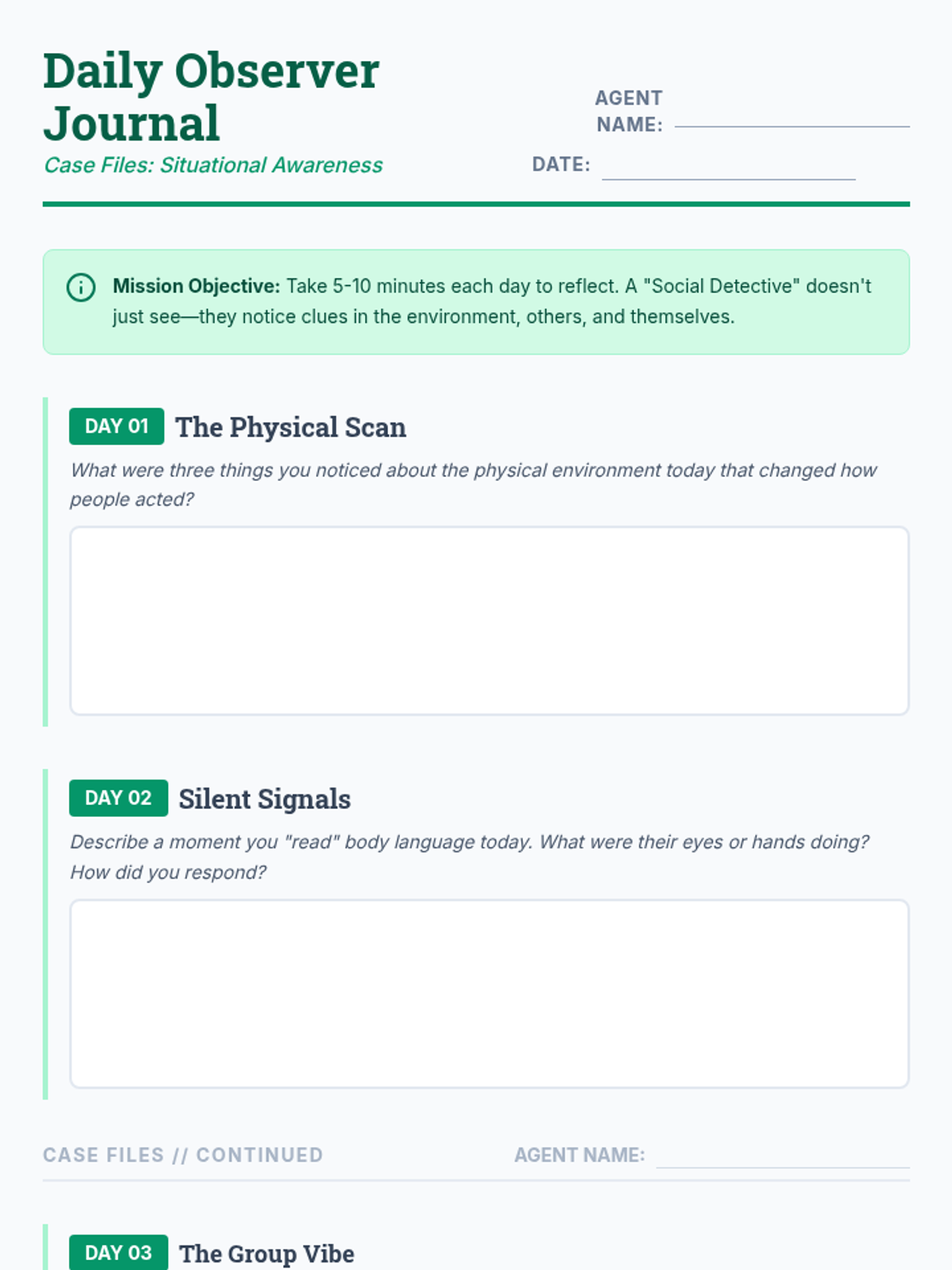
A 5-day daily reflection journal for students to practice situational awareness, focusing on physical environments, social cues, and personal impact.
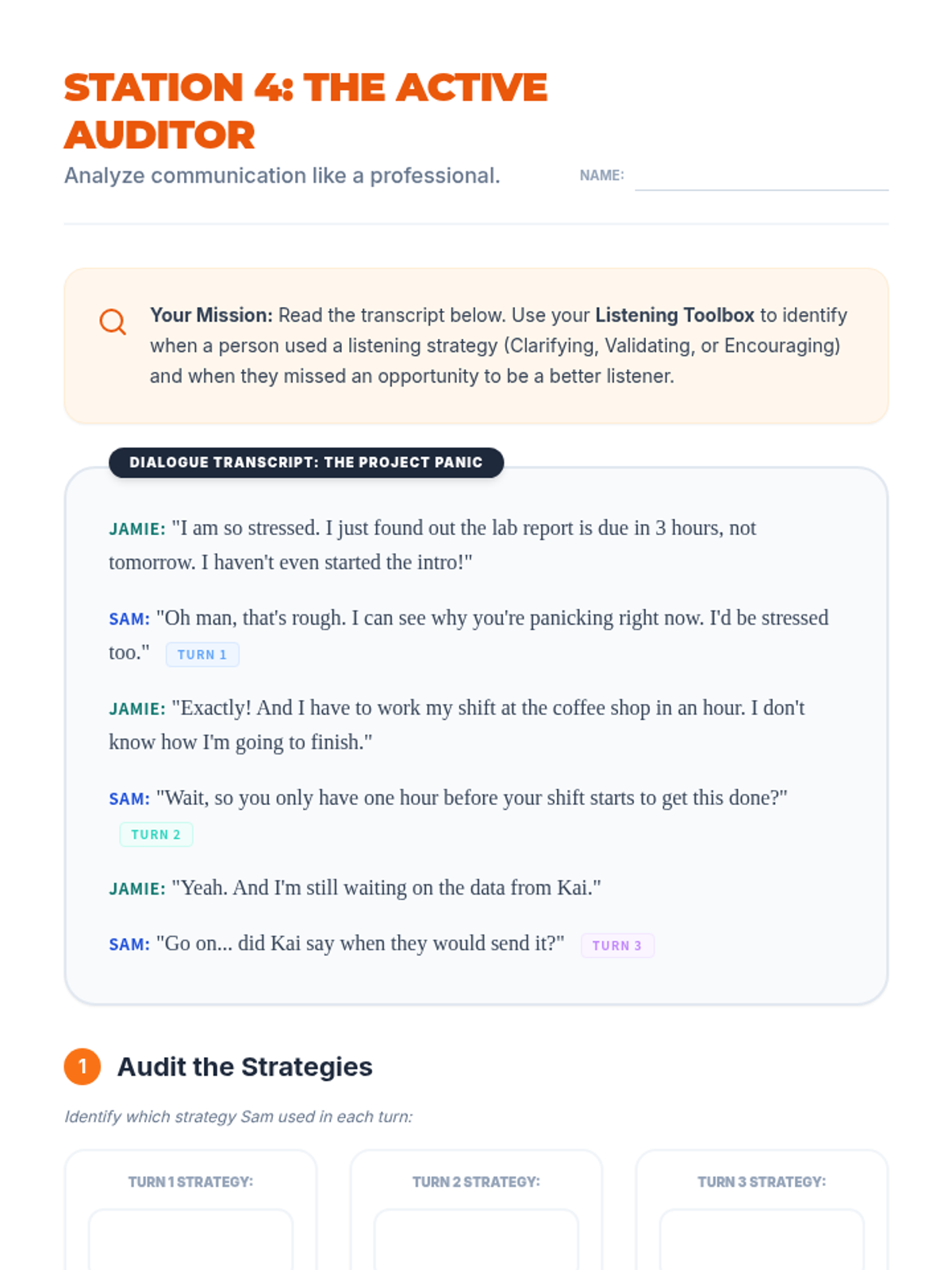
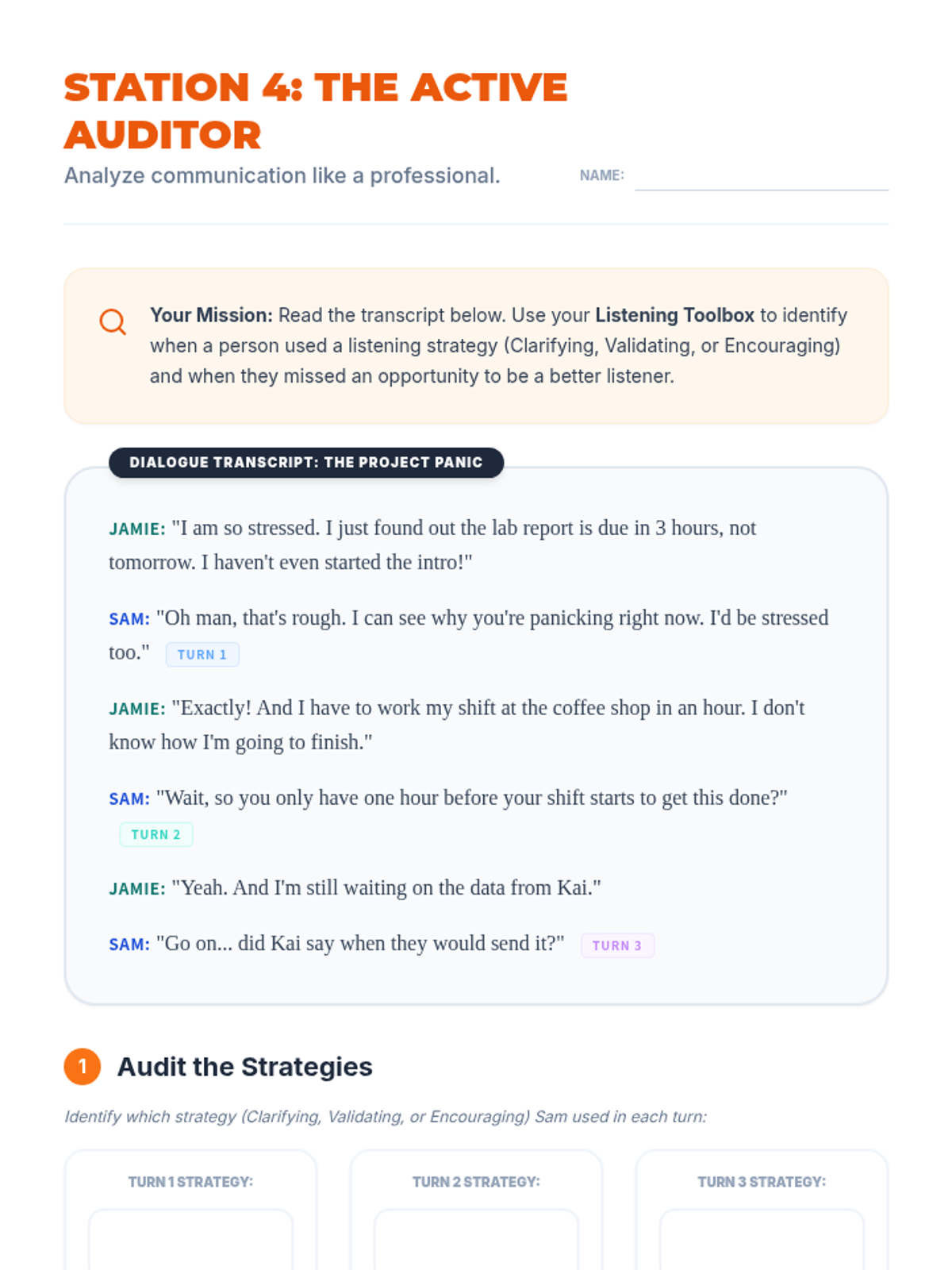
A worksheet for Station 4: The Active Auditor, where students analyze a dialogue script to identify and evaluate the use of active listening cues. Flow and spacing optimized for accessibility. Terminology updated to 'Listening Strategies'.
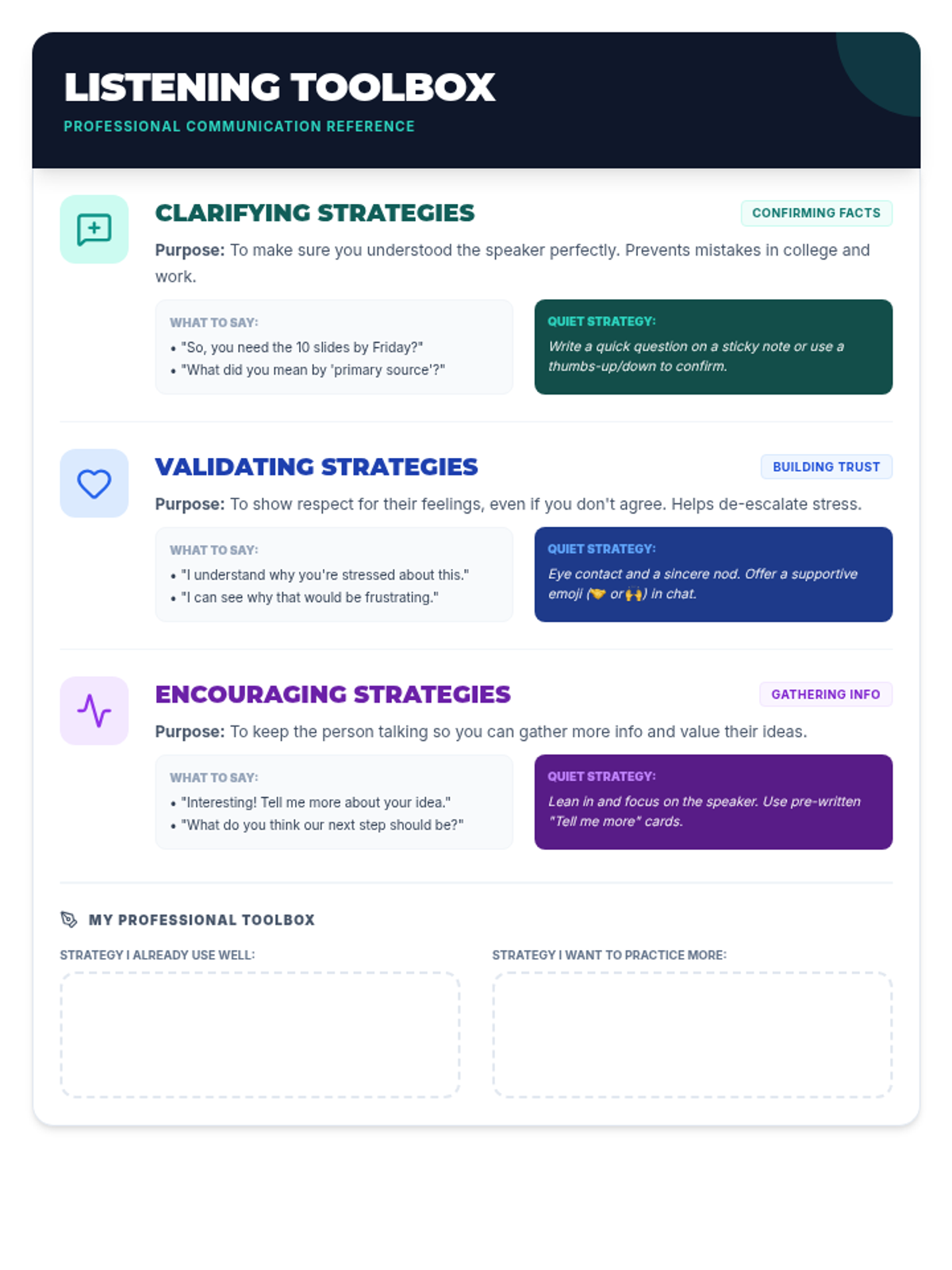
A student-facing reference sheet defining clarifying, validating, and encouraging strategies with clear explanations, purpose statements, and sample phrases for professional use. Includes inclusive quiet strategies and college examples. Terminology updated to 'Listening Strategies'.
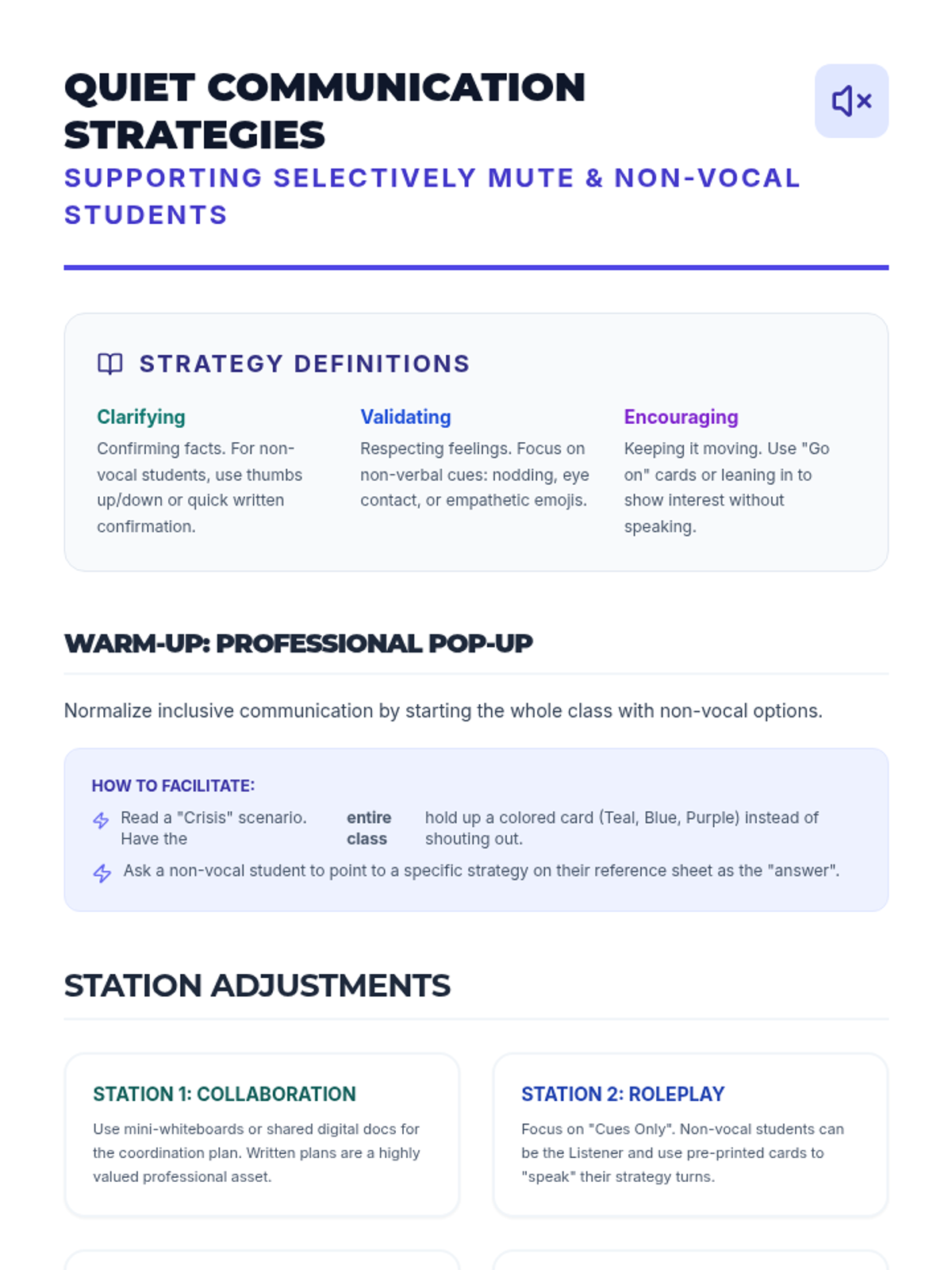
Teacher guide focused on supporting selectively mute and non-vocal students during the communication lesson, providing station-specific strategies and inclusive participation options. Updated with post-secondary focus and layout fixes. Terminology updated to 'Listening Strategies'.
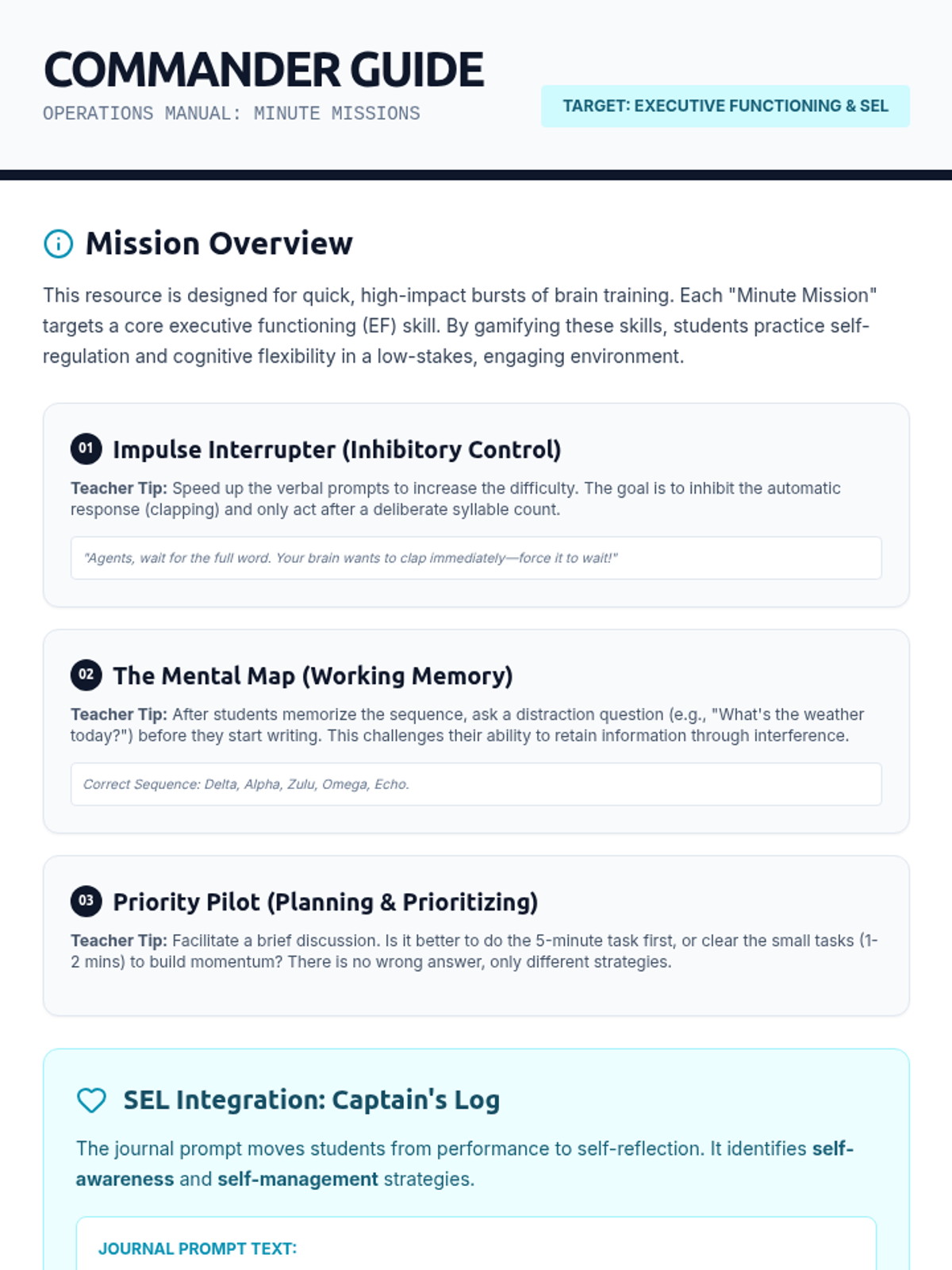
A teacher resource guide providing facilitation tips, skill breakdowns, and SEL discussion prompts for the Mission Control activities.
A visual presentation guide for 'Minute Missions', providing high-engagement challenges for impulse control, working memory, and planning.
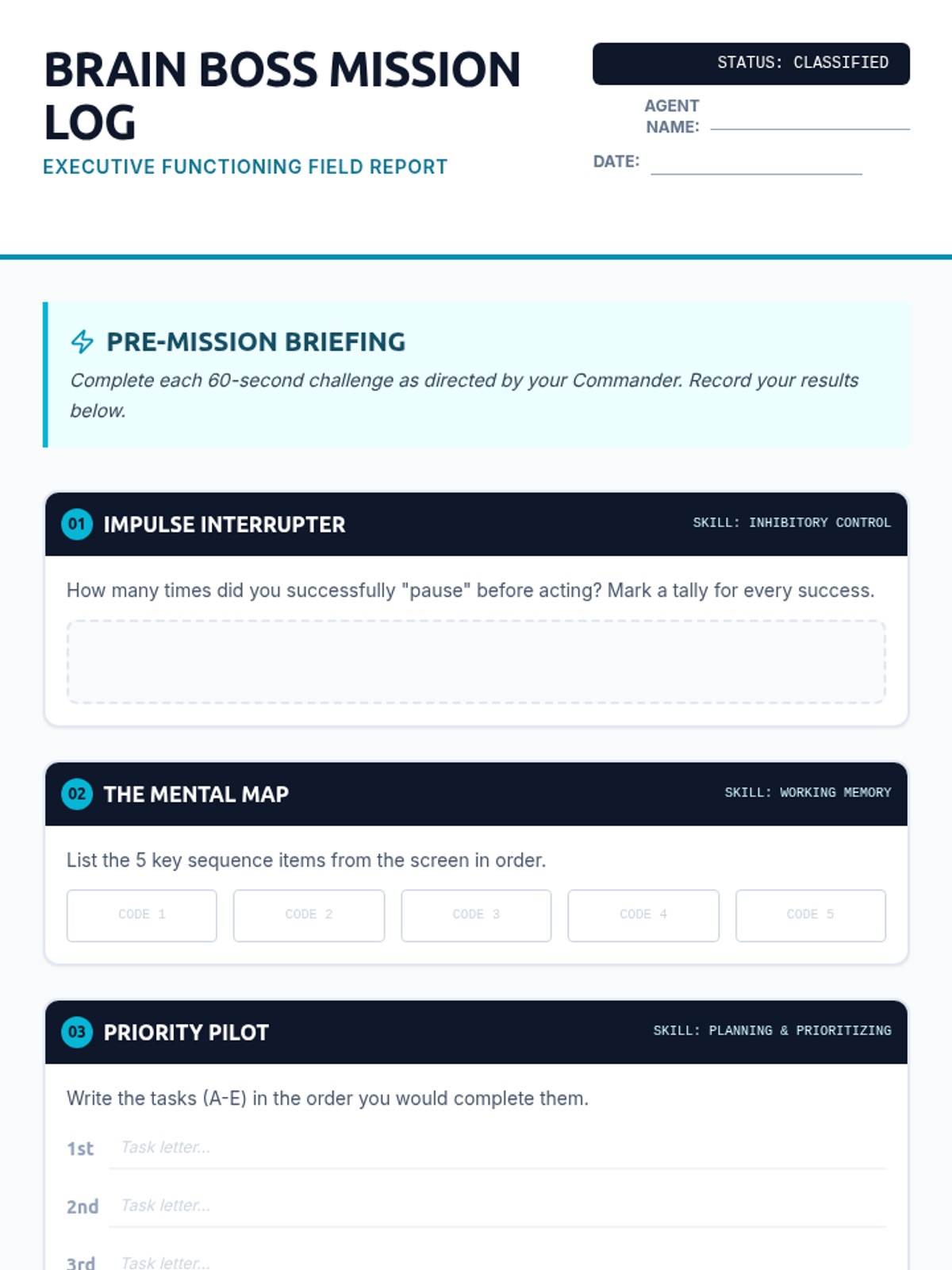
A student-facing worksheet for recording results of 'Minute Missions' and completing a reflective SEL journal prompt focused on executive functioning skills.
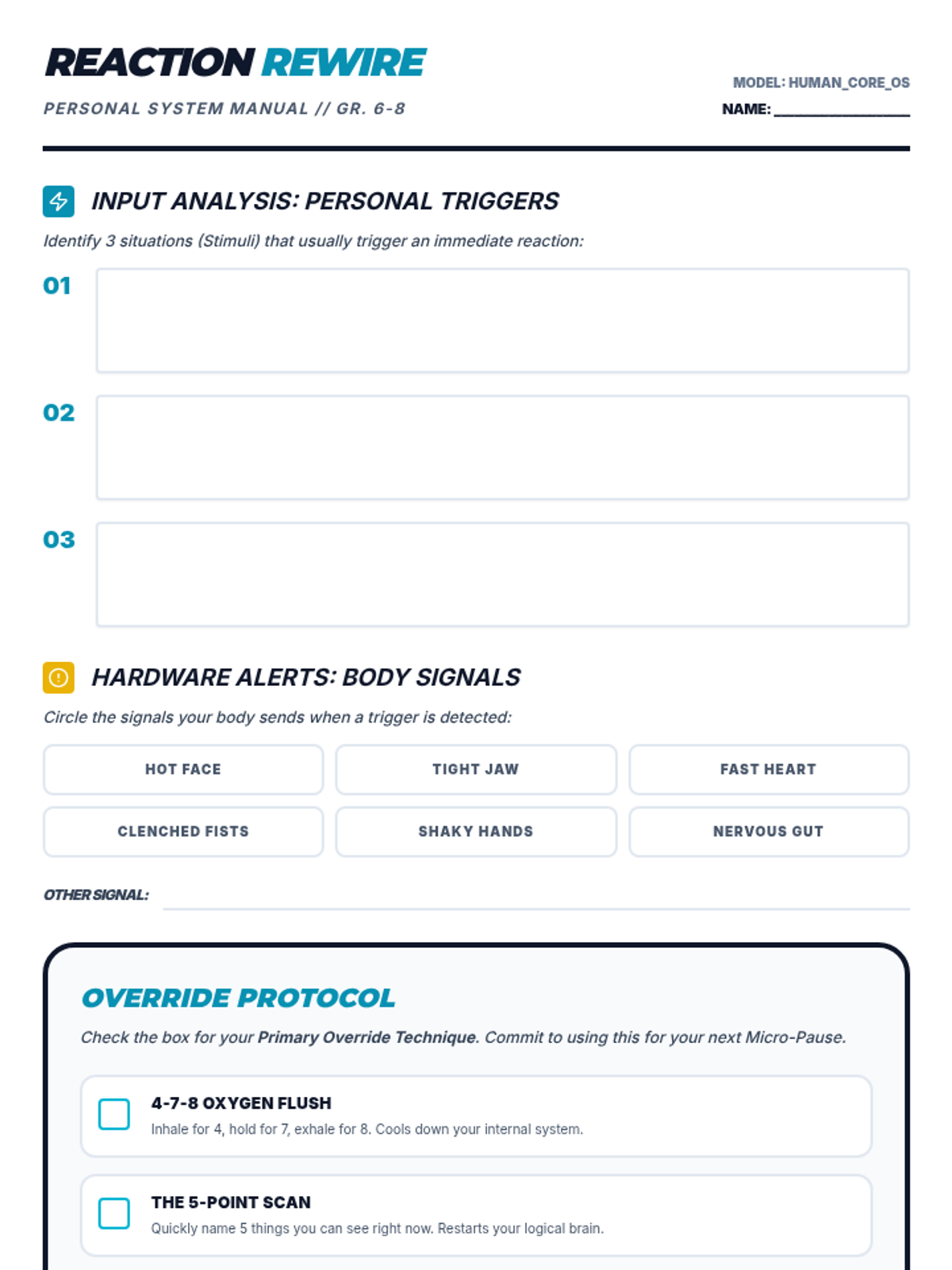
A personal reflection worksheet where students identify their own triggers and physical warning signs. They select a primary 'System Override' technique to commit to using in future high-tension situations.
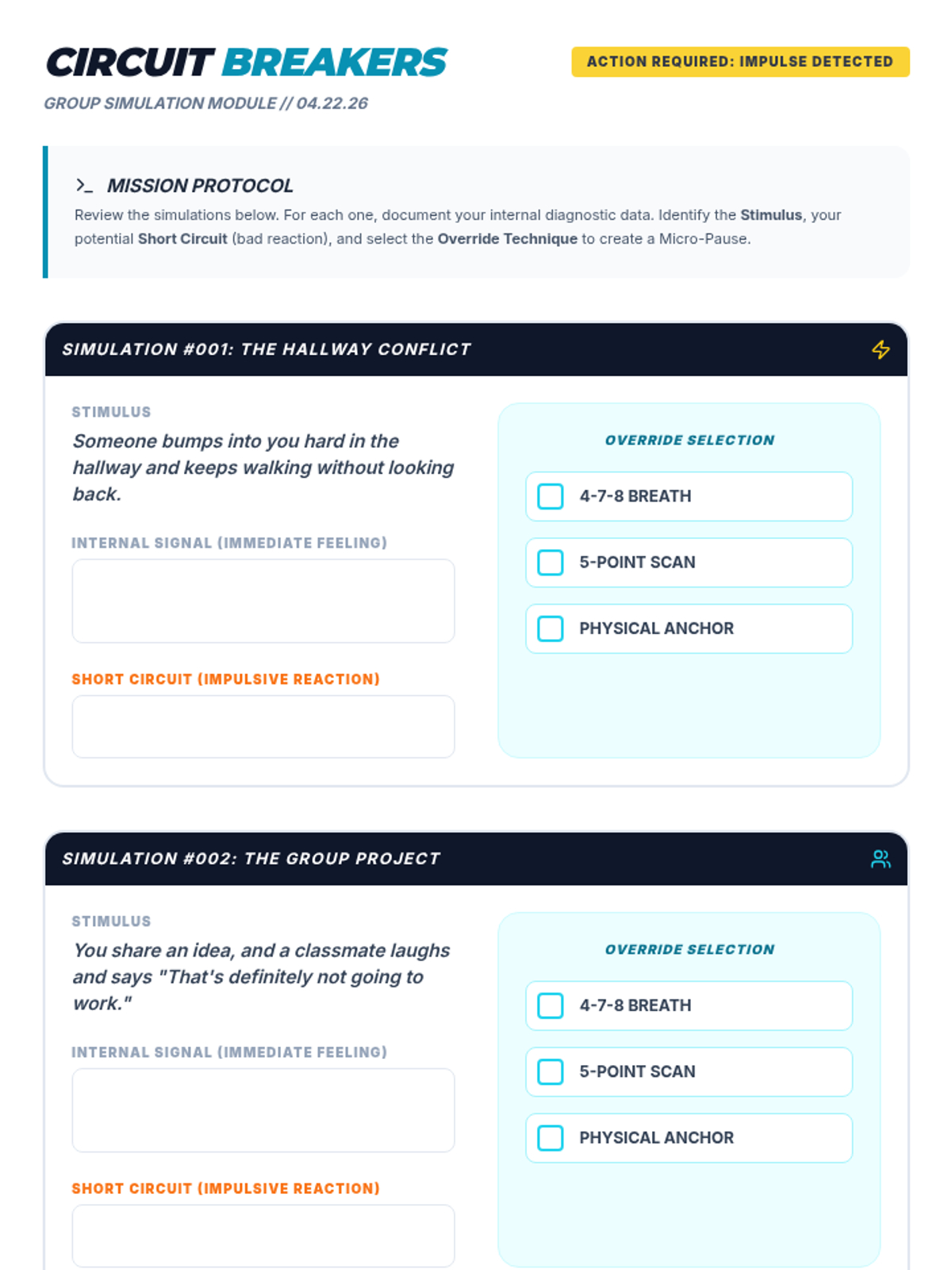
A group activity document featuring three common middle school scenarios where impulsivity is triggered. Students analyze the stimulus, identify their physical response, and select a specific 'System Override' technique to practice the micro-pause.
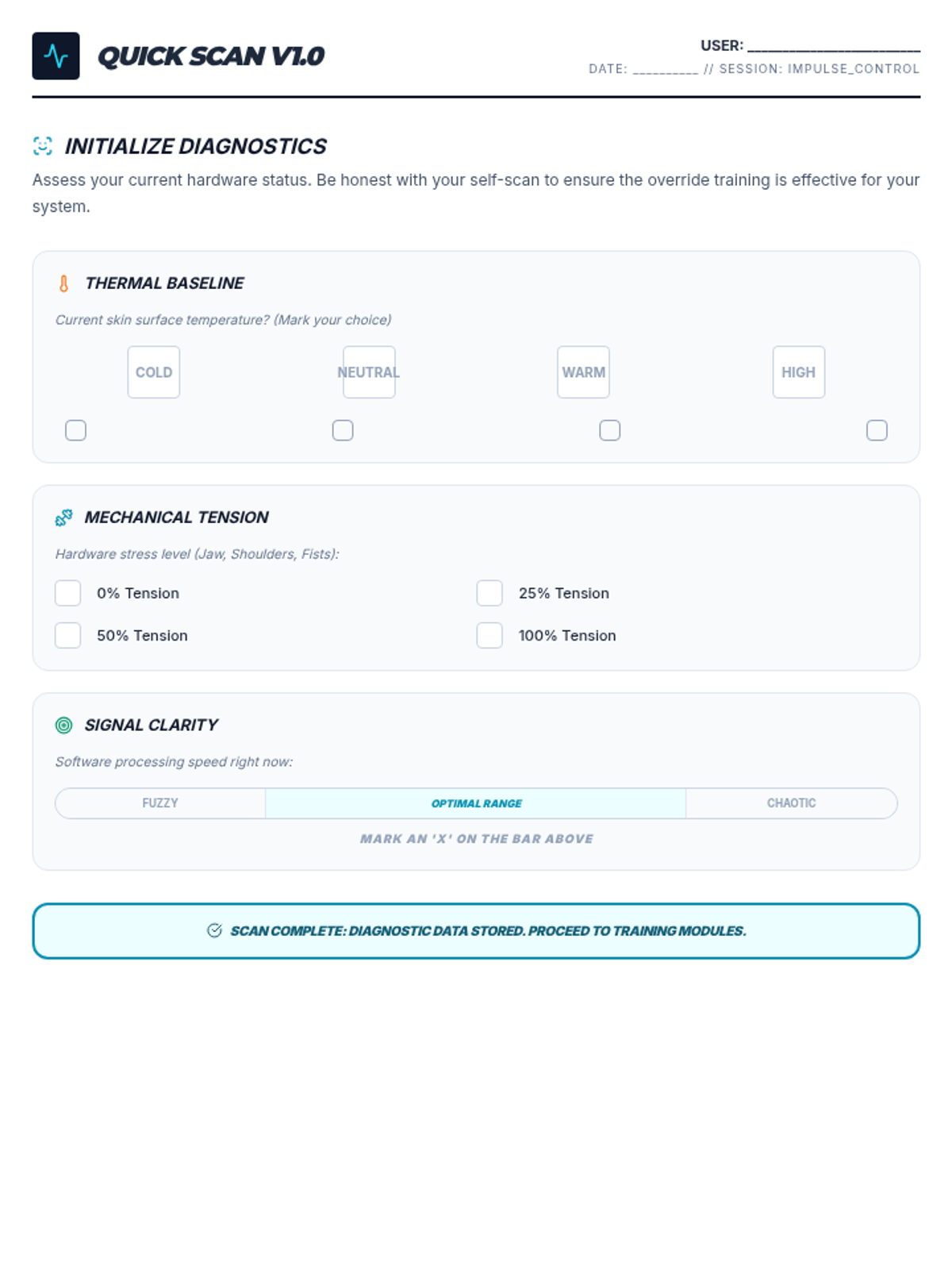
A quick student self-assessment tool used as a warm-up. It uses a diagnostic scan metaphor to help middle schoolers identify their current physical tension and emotional state before starting the lesson.
A visually engaging slide deck that uses a 'System Override' and 'Circuit Board' metaphor to teach middle schoolers about impulse control. It breaks down the stimulus-response model and introduces three specific micro-pause techniques: the 4-7-8 Breath, the 5-Point Scan, and the Physical Anchor.
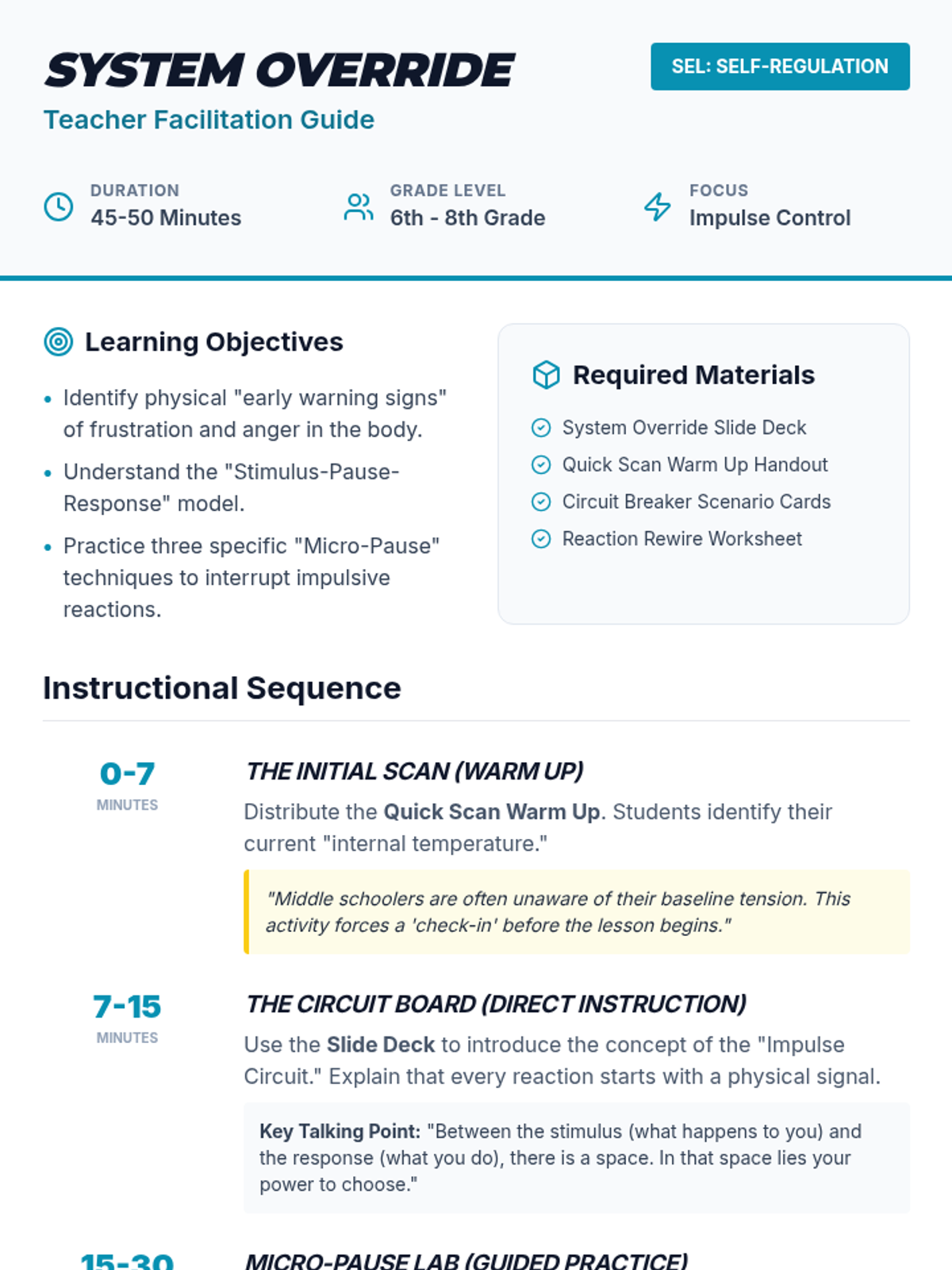
A comprehensive teacher facilitation guide for the Impulse Interrupter lesson, including a timed instructional sequence, learning objectives, and differentiation strategies. It frames emotional regulation through a 'system override' and 'circuitry' metaphor suitable for middle schoolers.
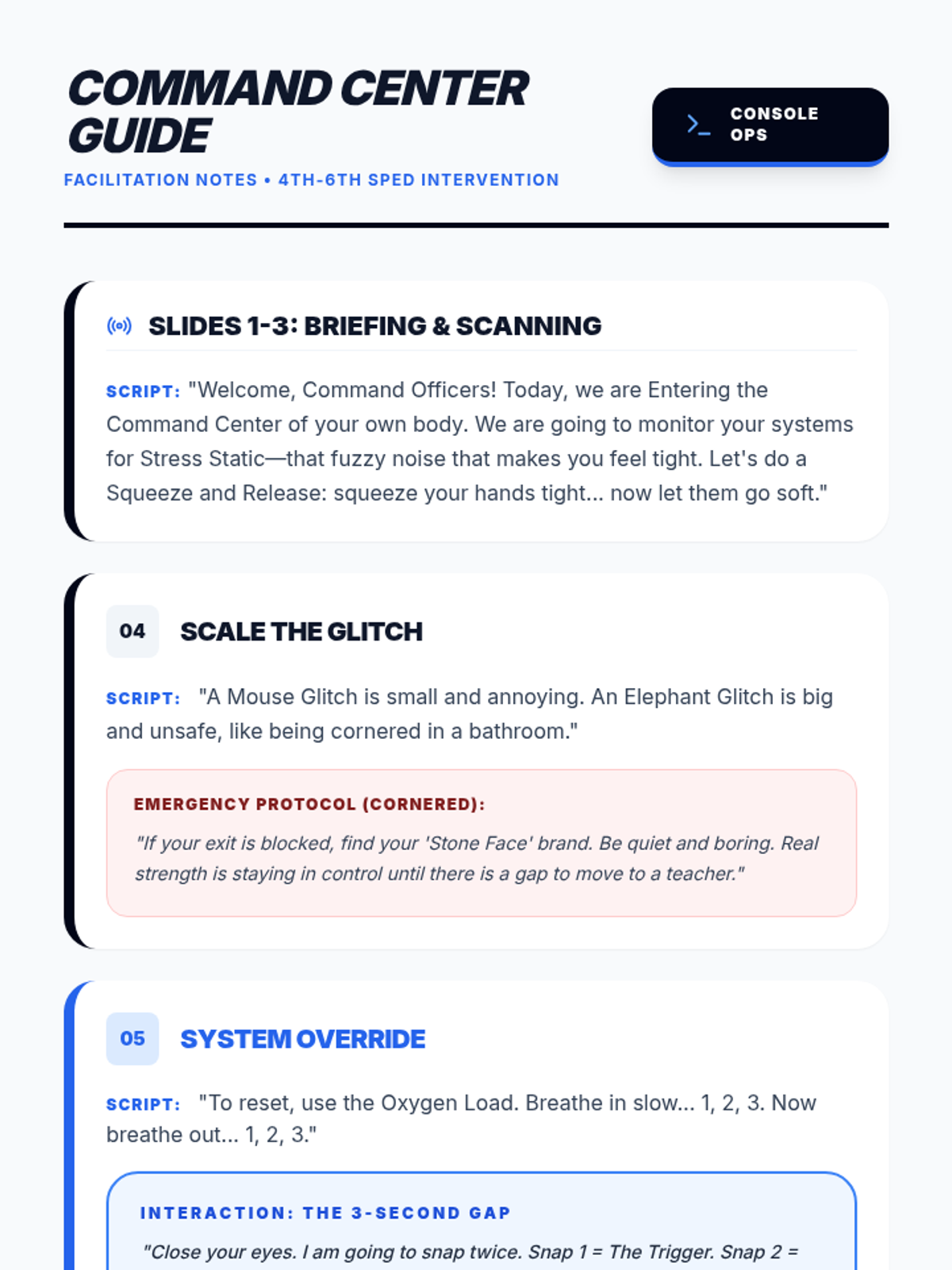
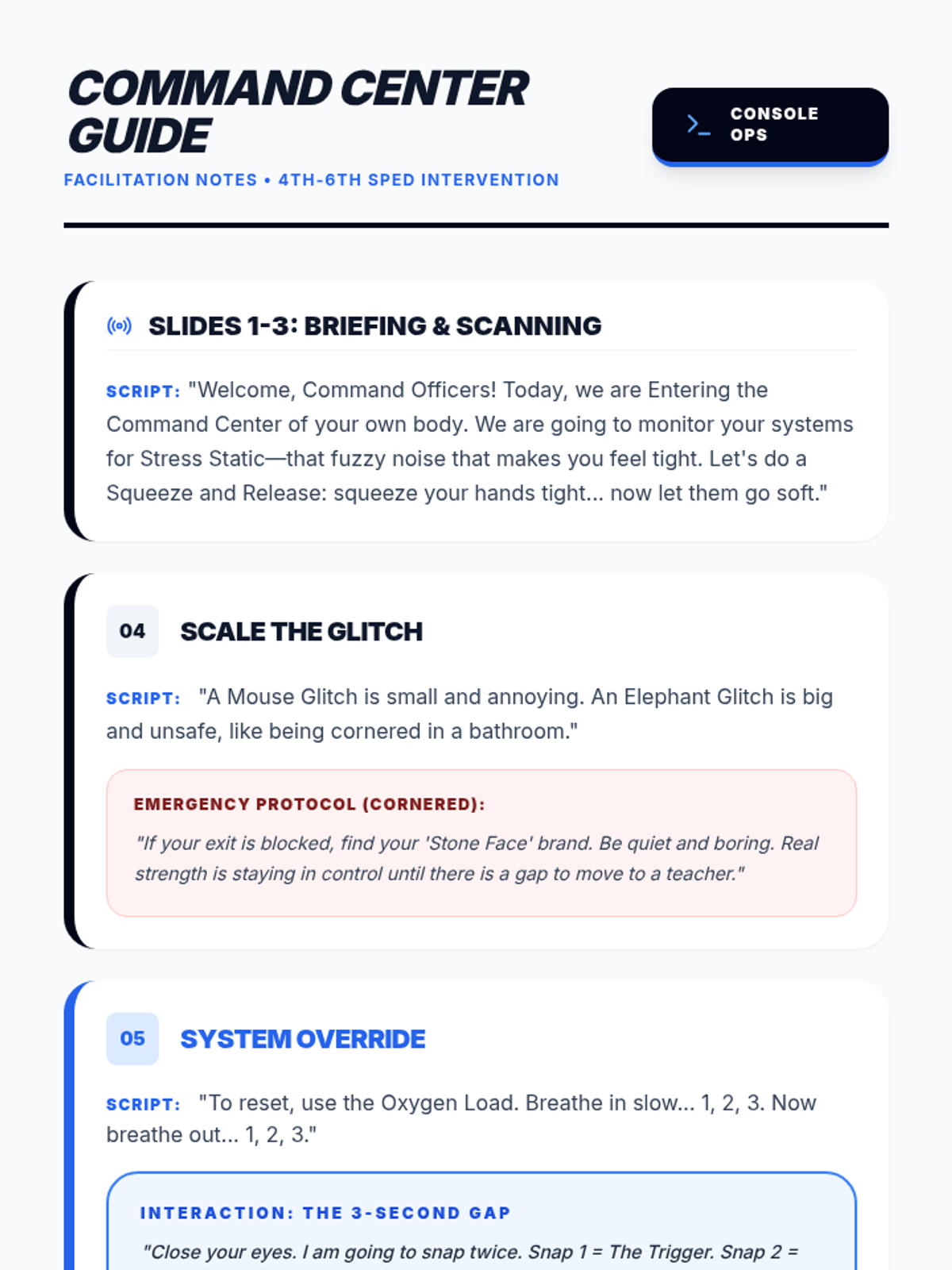
A detailed facilitation guide for the specialized SPED lesson 'The Calm Console'. Includes simplified scripts, sensory-based analogies (Static, Grit), and specific de-escalation guidance. Updated for content completeness with Pressure Patrol alignment and improved single-page layout. Updated for engagement and numbering.
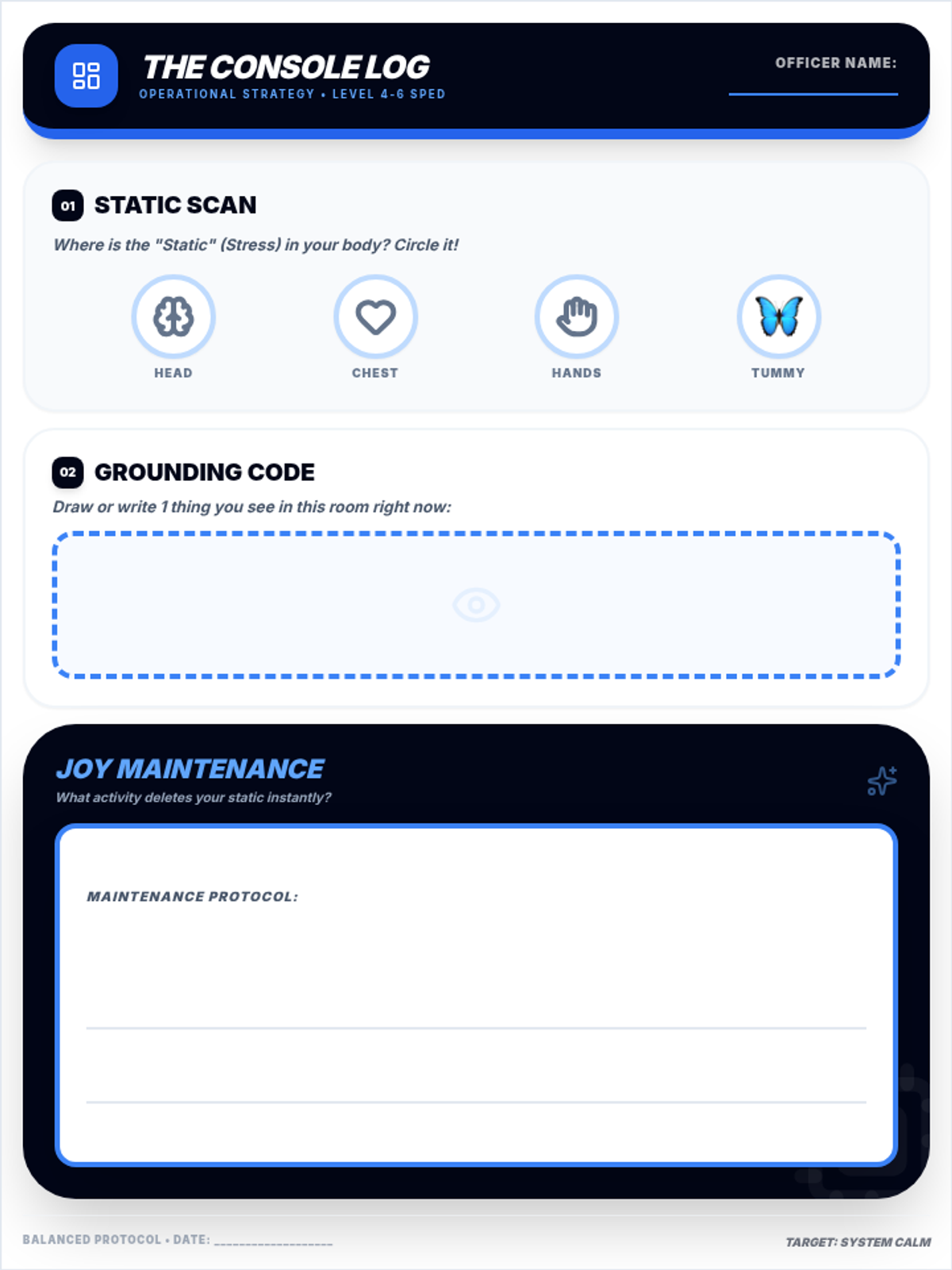
A visual, Command Center themed worksheet for 4th-6th grade SPED students. Includes a body scan checklist, a sensory grounding drawing area, and a joy-based proactive habit section with large, clear work areas. Updated for accessibility and single-page fitting.
A specialized 8-slide presentation for 4th-6th grade Special Education students using a 'Command Center' theme. Features high-impact visuals and simplified language to teach body signals, stress scaling (Mouse vs. Elephant), sensory grounding, and school-wide Pressure Patrol alignment. Updated with fixed icons and contrast.
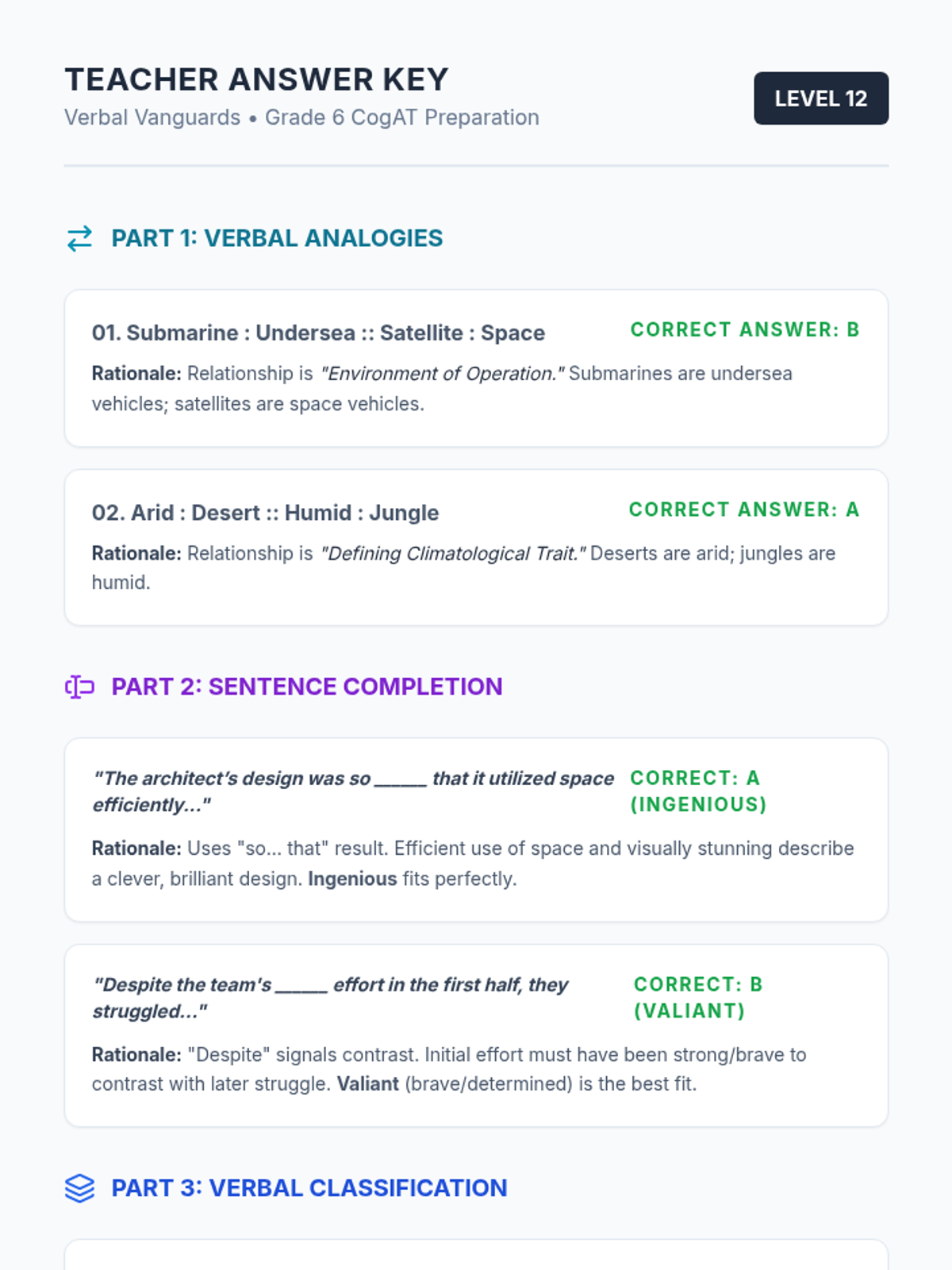
The teacher answer key for the Verbal Vanguards practice set, featuring clear rationales and optimized layout with sentence context and fixed page breaks.
A high-impact slide deck for Grade 6 CogAT Verbal Battery preparation, featuring strategy breakdowns and interactive practice for Analogies, Sentence Completion, and Classification. Correct answers have uniform styling for classroom discussion.
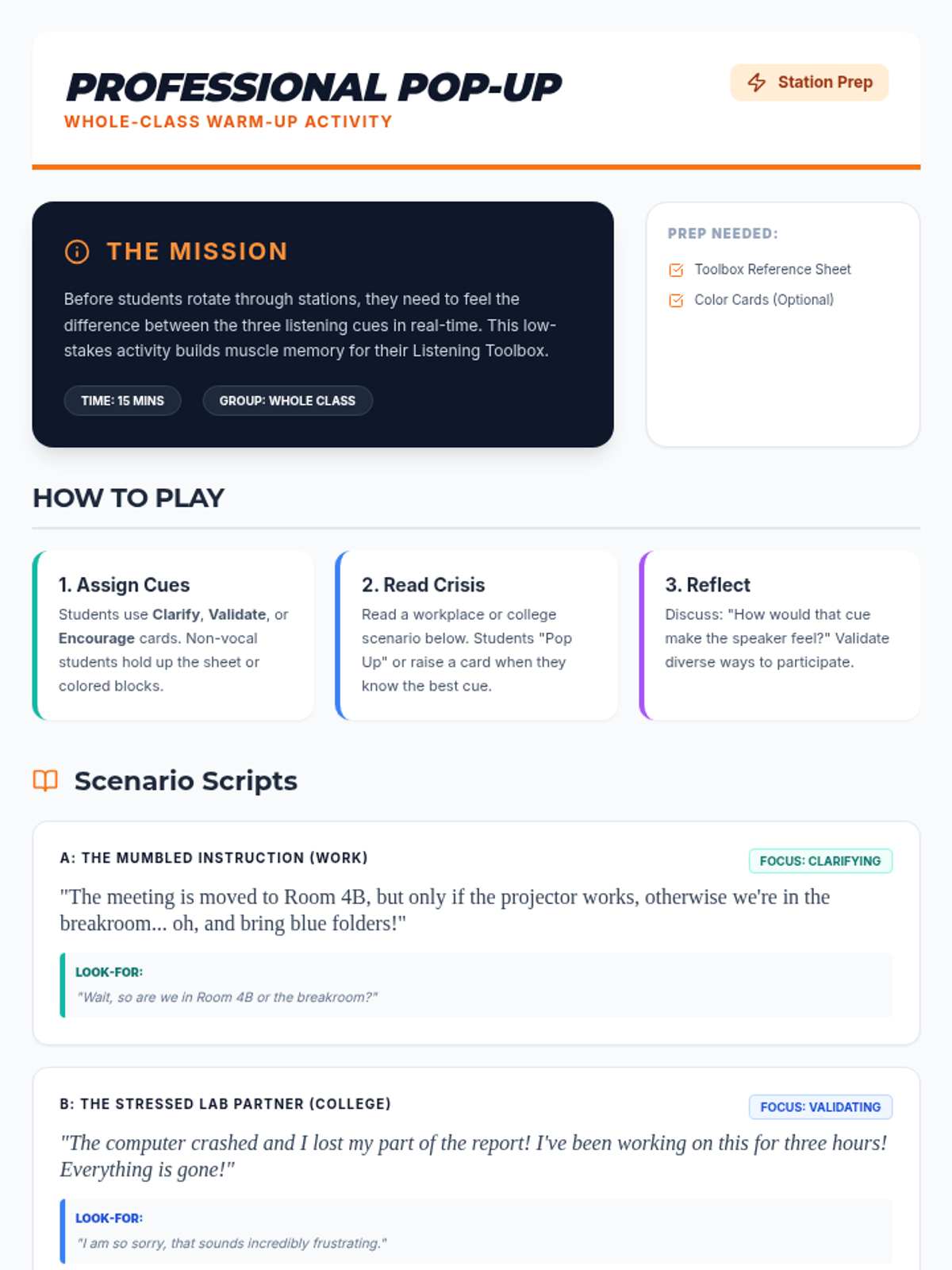
A whole-class preparatory activity called 'Professional Pop-Up' where students practice identifying and using active listening cues in real-time workplace and college scenarios. Terminology updated to 'Listening Strategies'.
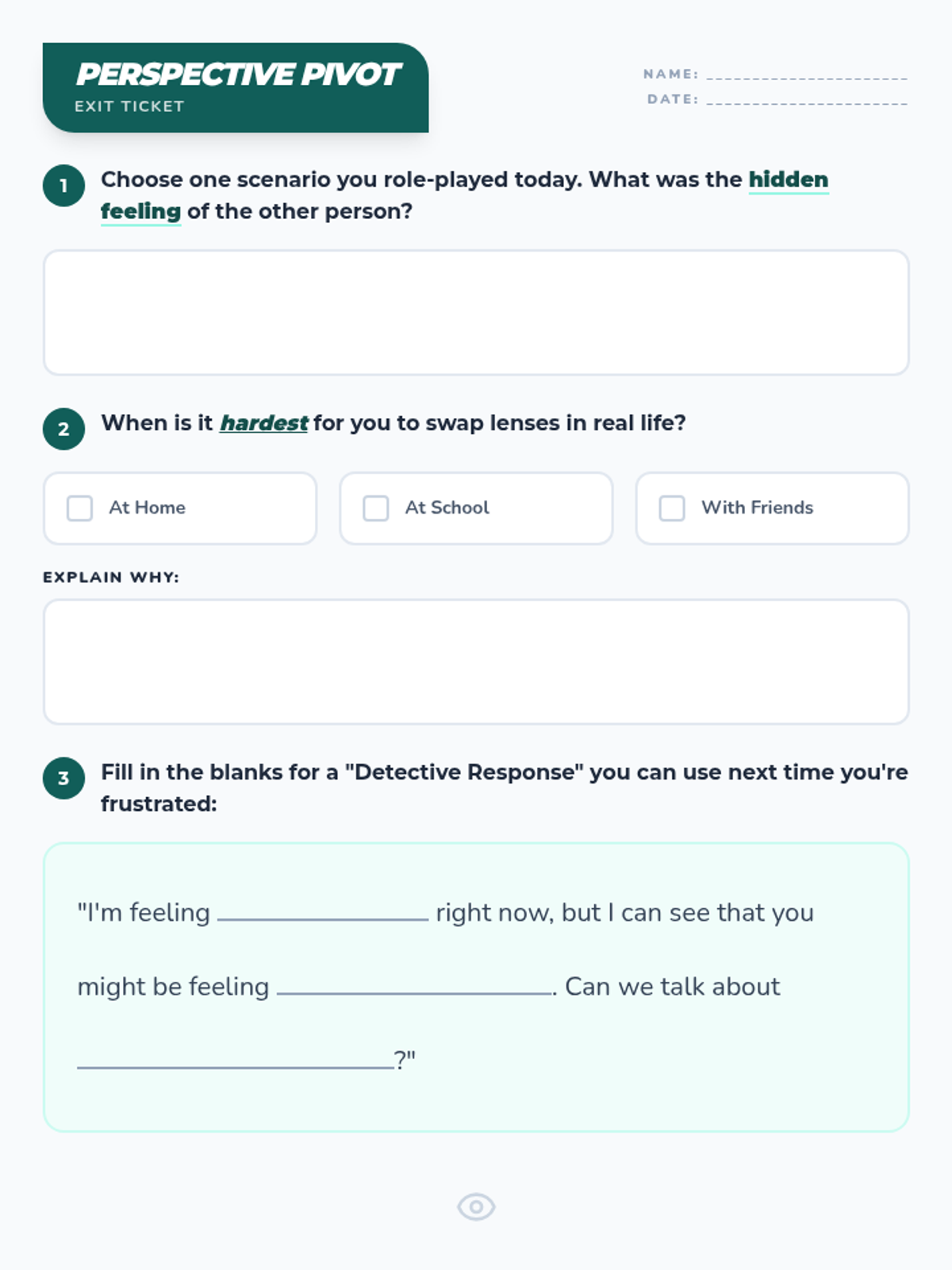
A reflection sheet for students to complete after the role-play activity. It asks them to identify hidden feelings in scenarios, reflect on their own challenges with perspective-taking, and practice a scripted empathetic response.
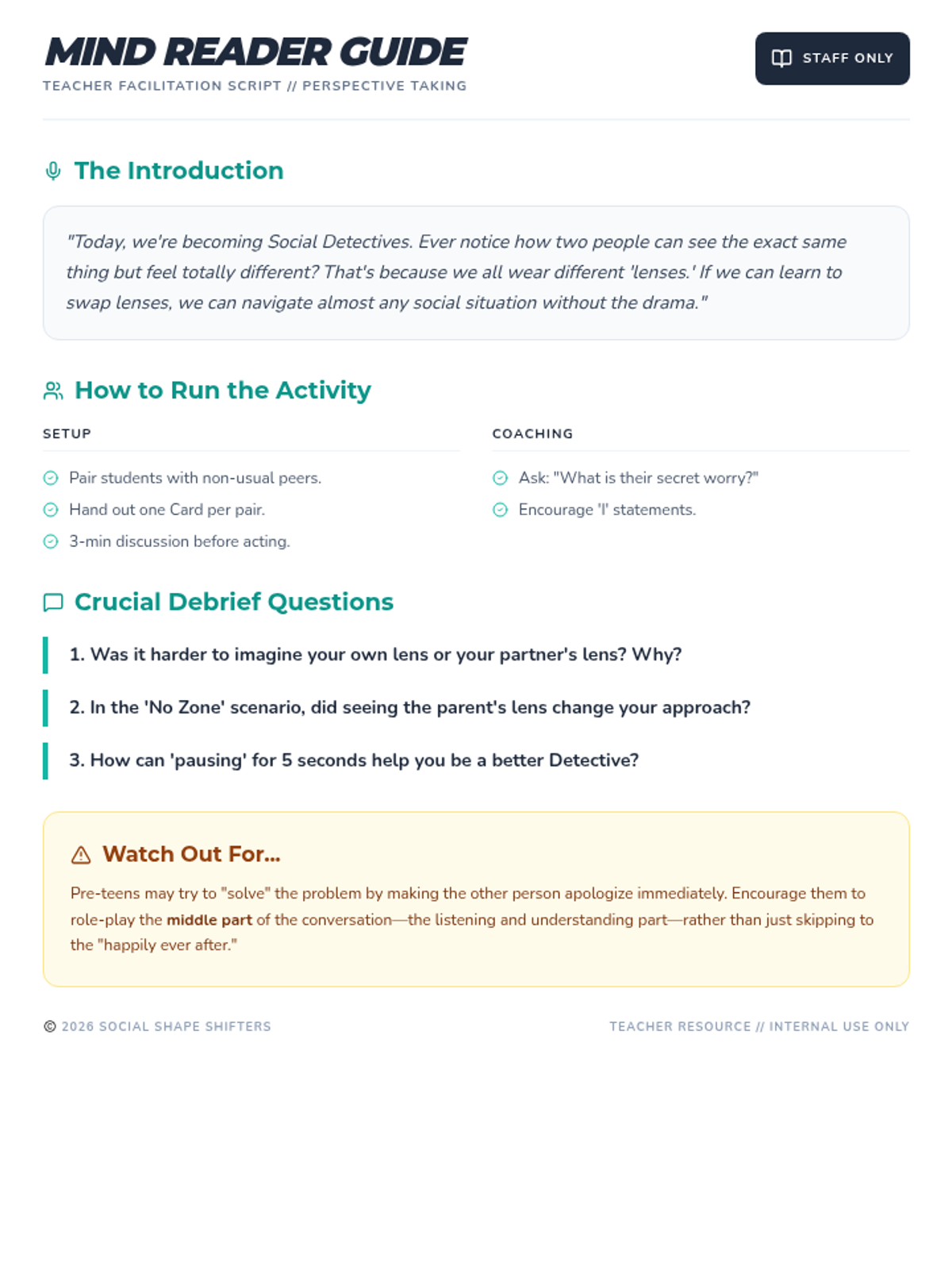
A facilitation guide for teachers to lead the perspective-taking activity. Includes a scripted introduction, role-play coaching tips, debrief questions, and advice on managing common student challenges during the exercise.
An engaging slide deck for pre-teens that introduces the concept of social 'lenses' (perspective taking). It provides a 'Social Detective' framework for pausing, swapping perspectives, and choosing empathetic responses, including practice scenarios.
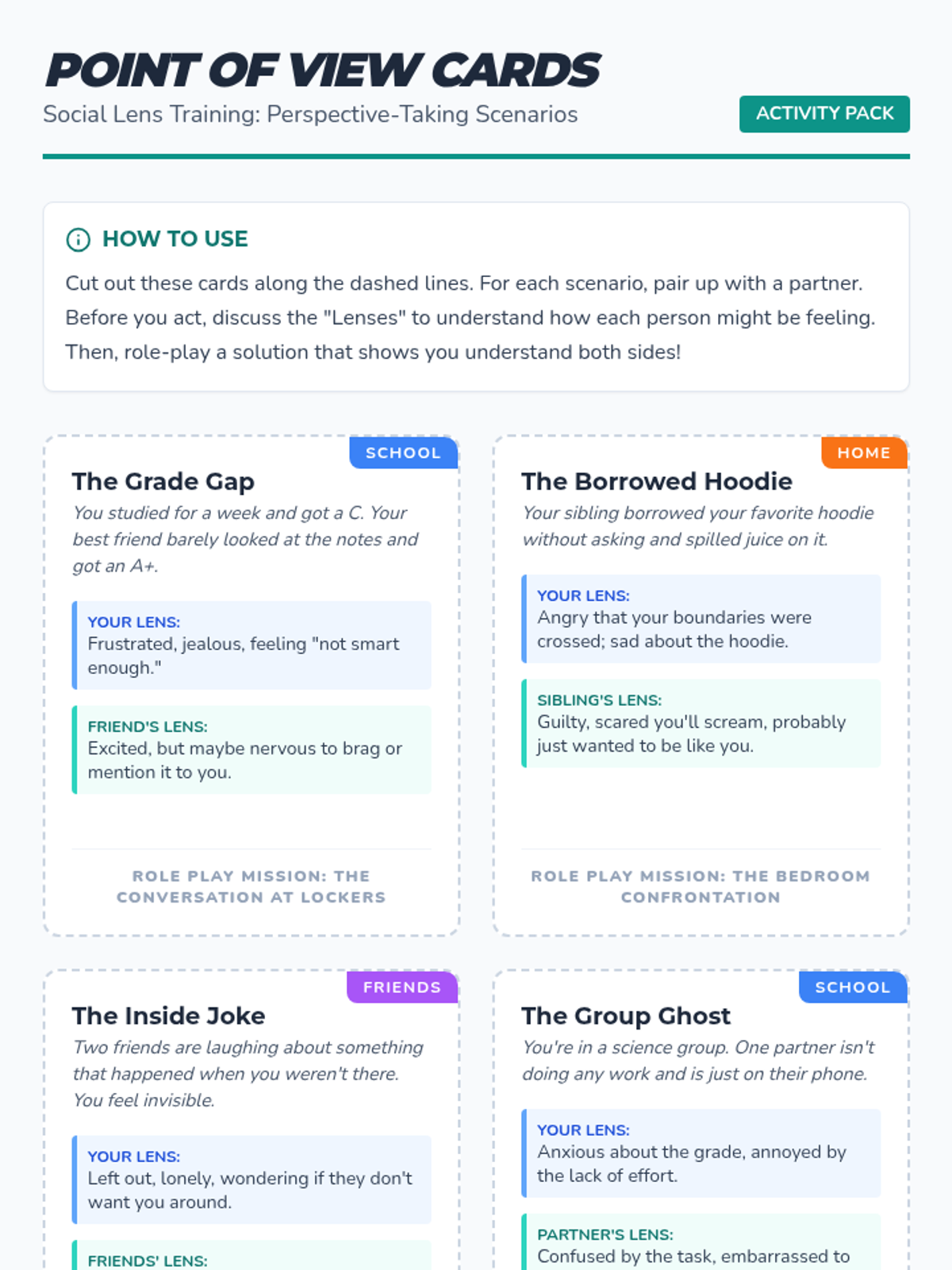
A set of 6 printable role-play cards featuring realistic social scenarios for pre-teens. Each card highlights different perspectives ('lenses') for school, home, and peer settings to help students practice empathy and effective communication.
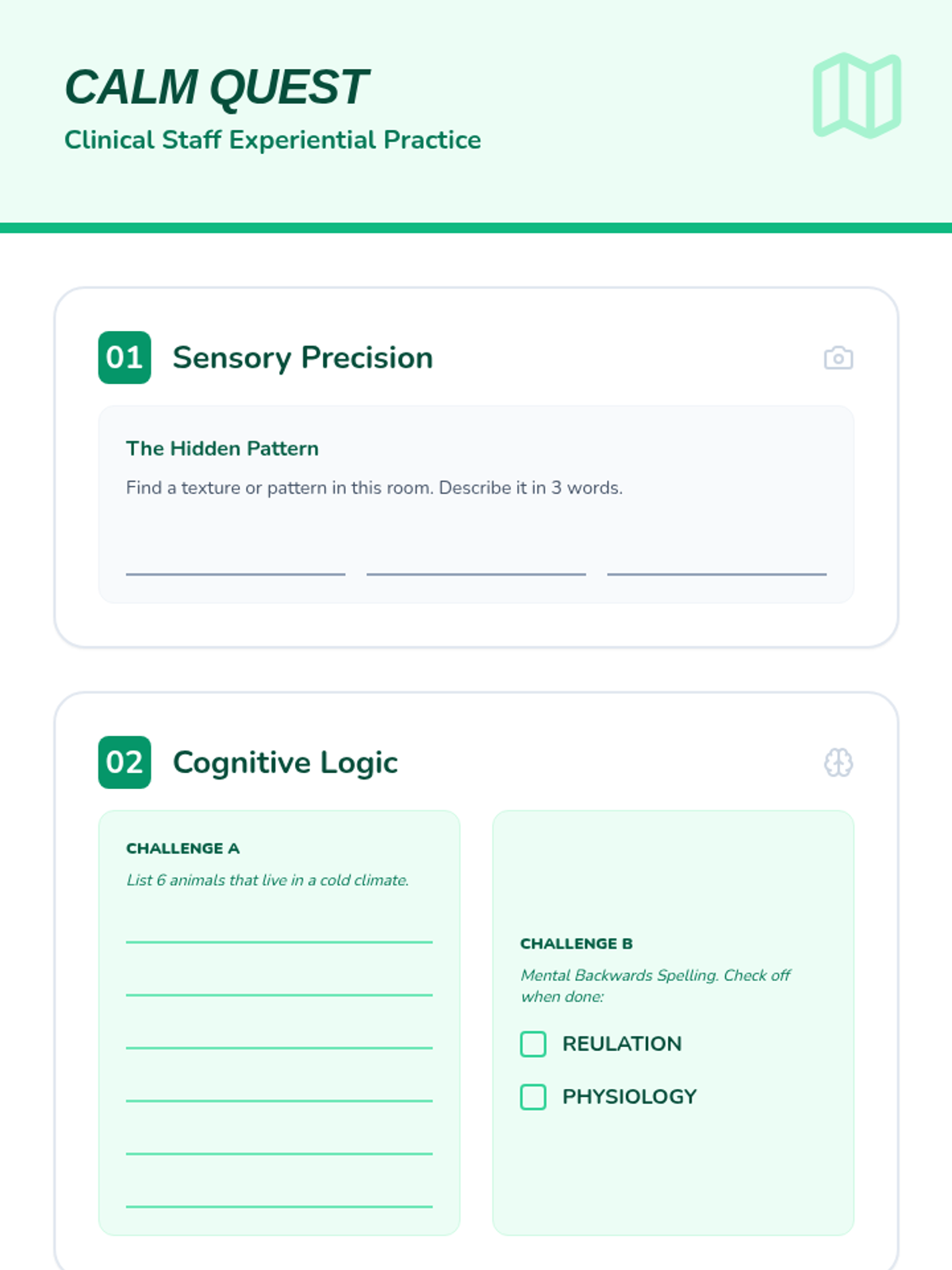
An experiential "scavenger hunt" for clinical staff to practice grounding techniques themselves. Includes sensory precision tasks, cognitive override challenges, and a section for developmental adaptation.
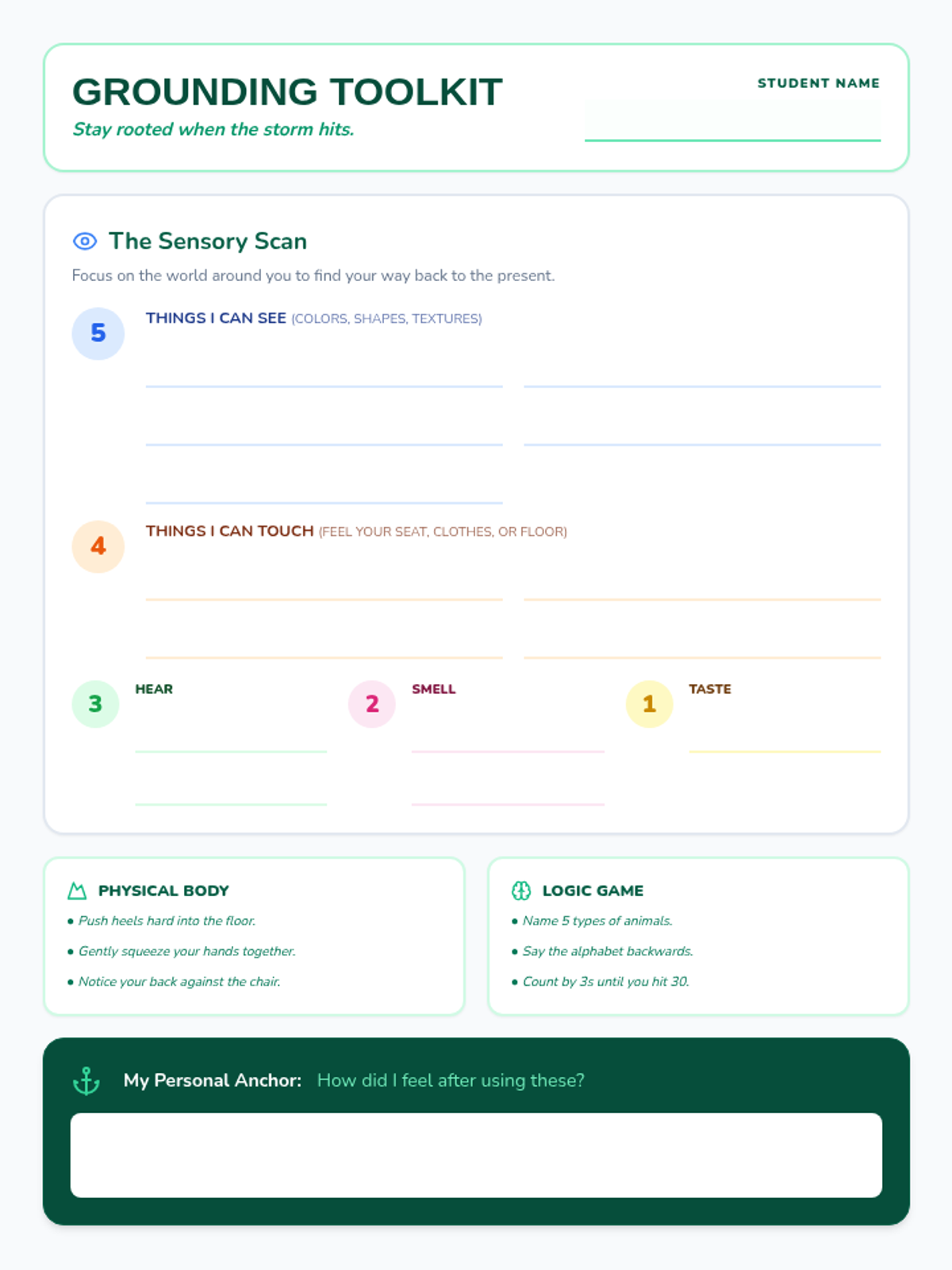
A student-facing toolkit with fillable sections for the 5-4-3-2-1 technique, physical anchors like "Tree Roots," and cognitive "Mind Games" to use during moments of anxiety.
A visually calming and professional slide deck for clinical staff training, featuring the Window of Tolerance model, sensory 5-4-3-2-1 steps, and cognitive grounding exercises.
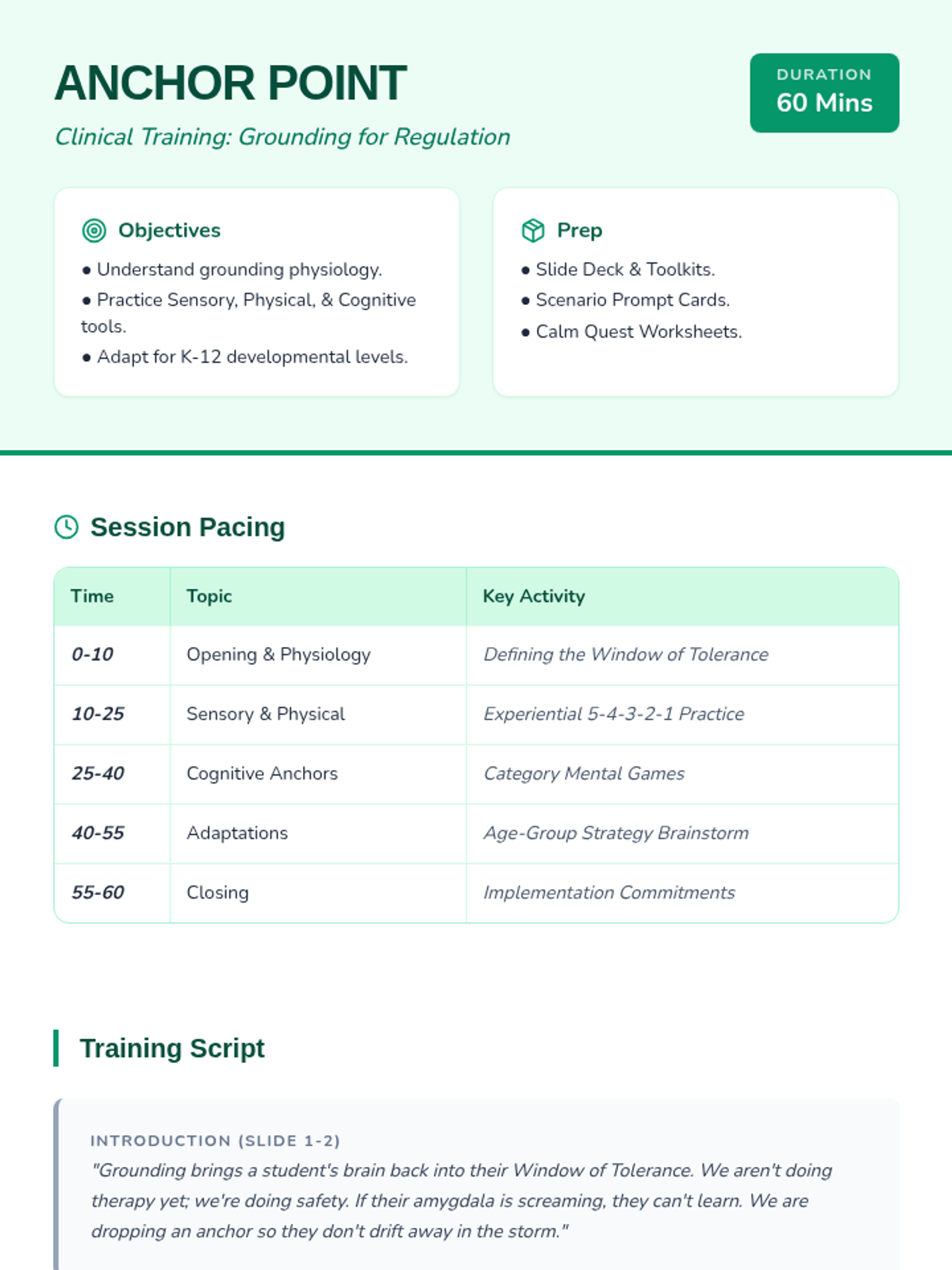
A comprehensive facilitator guide for clinical staff, including a training script, session pacing, and scenario-based practice prompts for teaching grounding techniques.