A student exit ticket for personal reflection and peer appreciation, designed to reinforce trust-building behaviors practiced during the lesson.
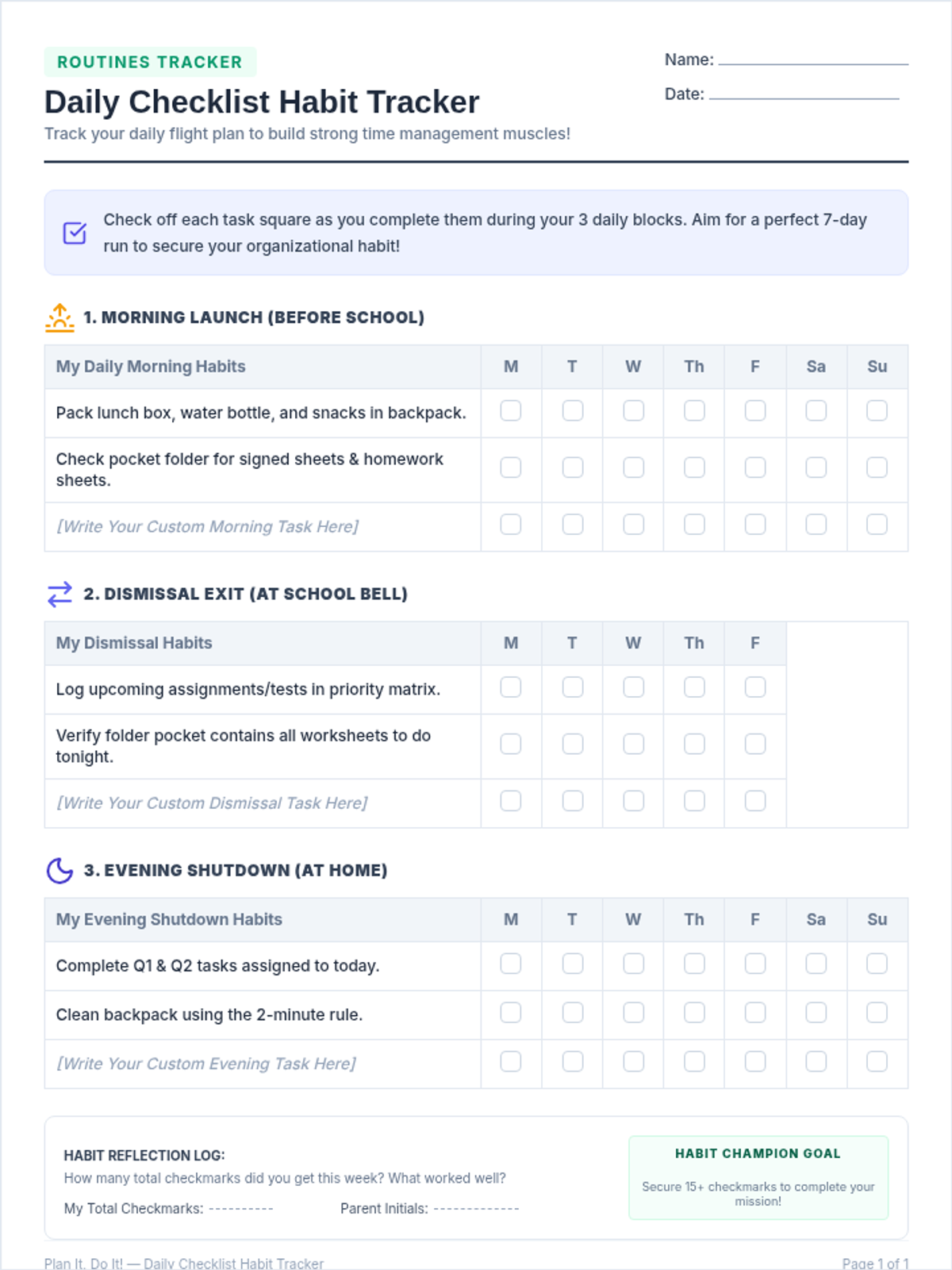
A 1-page daily habit tracker divided into three physical time-of-day blocks (Morning, Dismissal, Evening). Features customizable checklist items and a weekly checkbox grid (Monday-Sunday) to log execution.
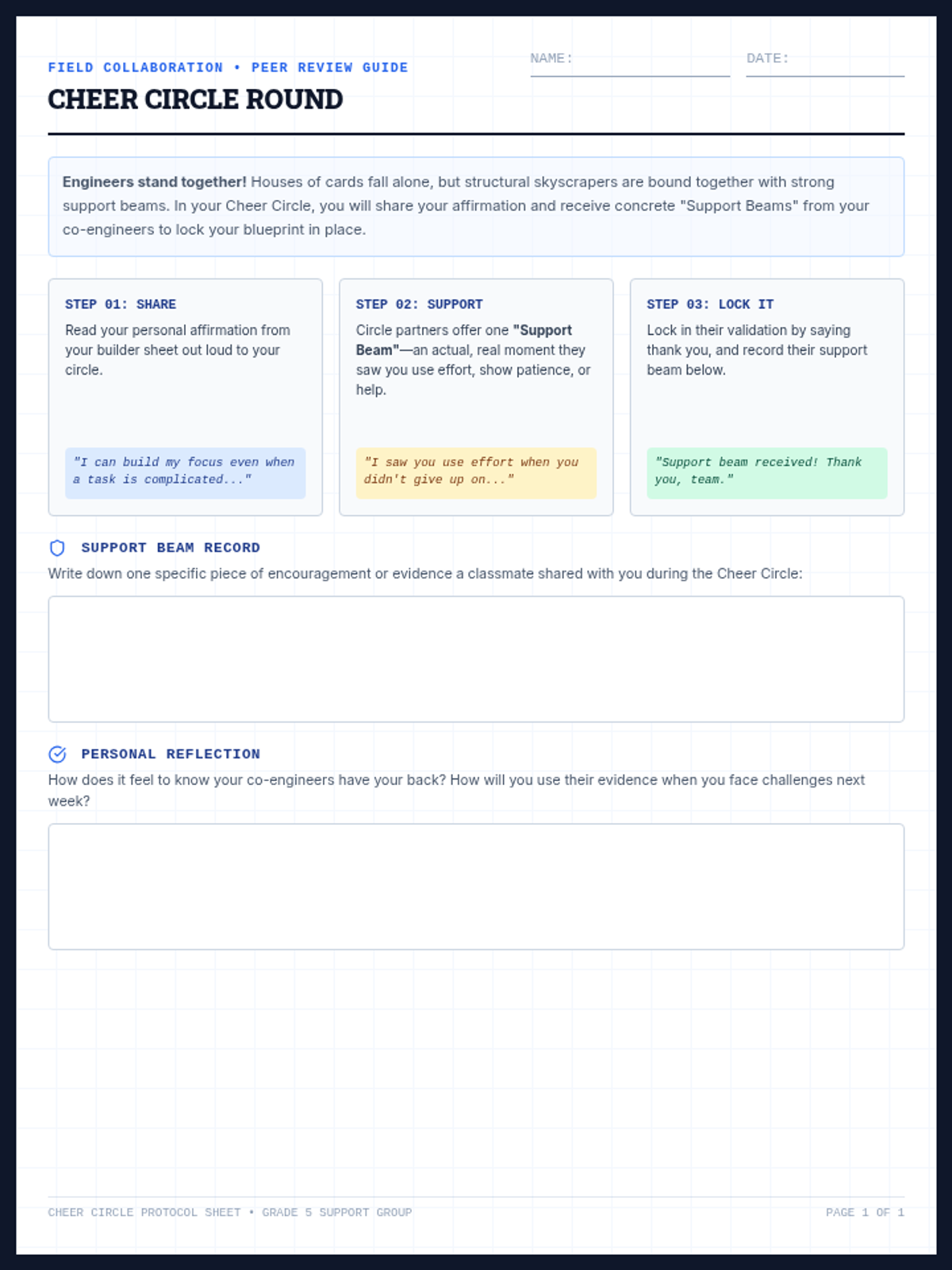
A printable 1-page peer facilitation activity sheet styled like a field collaboration guide. Helps 5th graders deliver actionable, evidence-focused peer encouragement and document support beams.
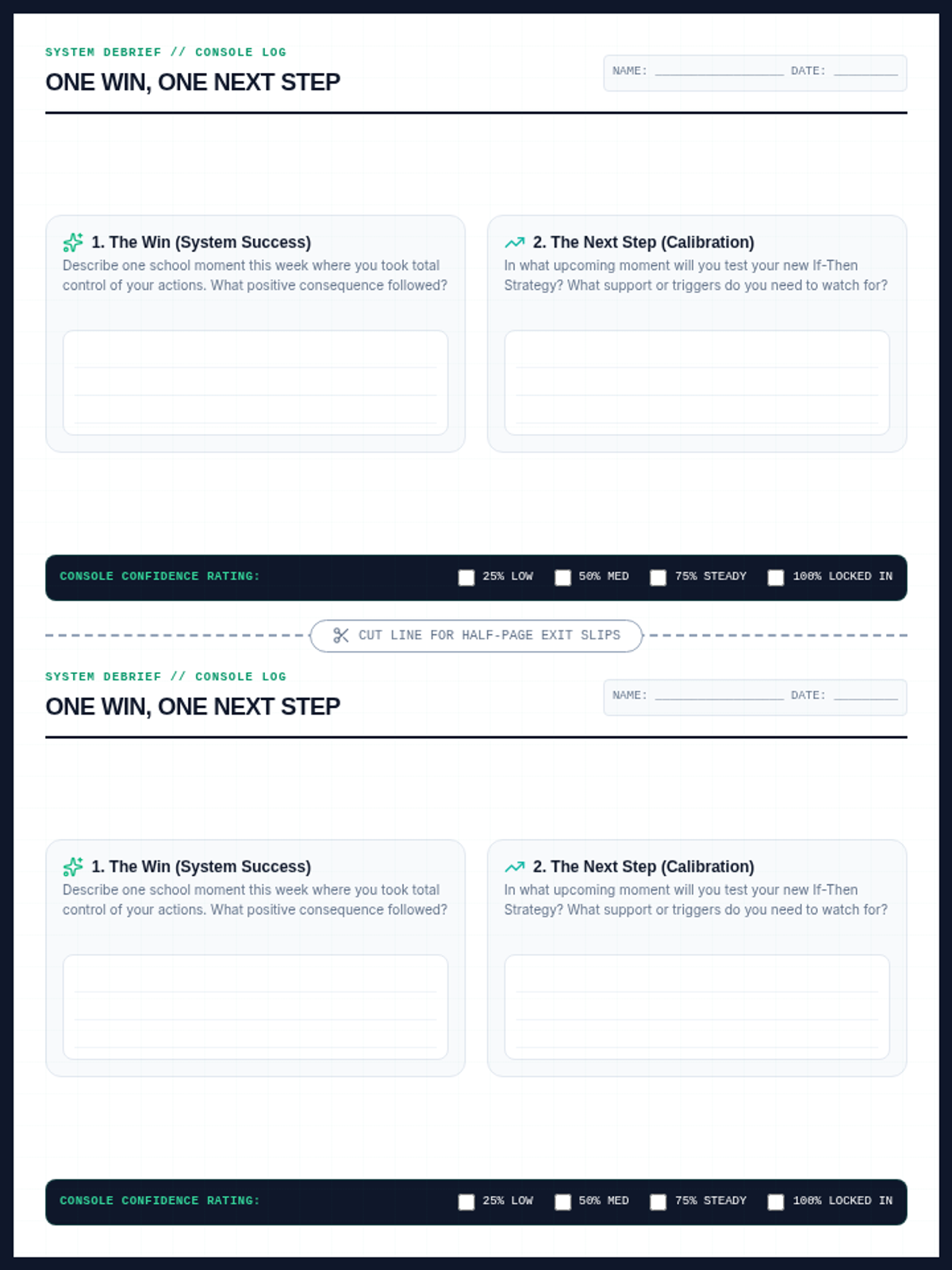
A double-up, half-page exit ticket designed to be cut in half to save paper. Students record 'One Win' where they owned their behavior and 'One Next Step' to implement their if-then strategy, including a system confidence slider rating.
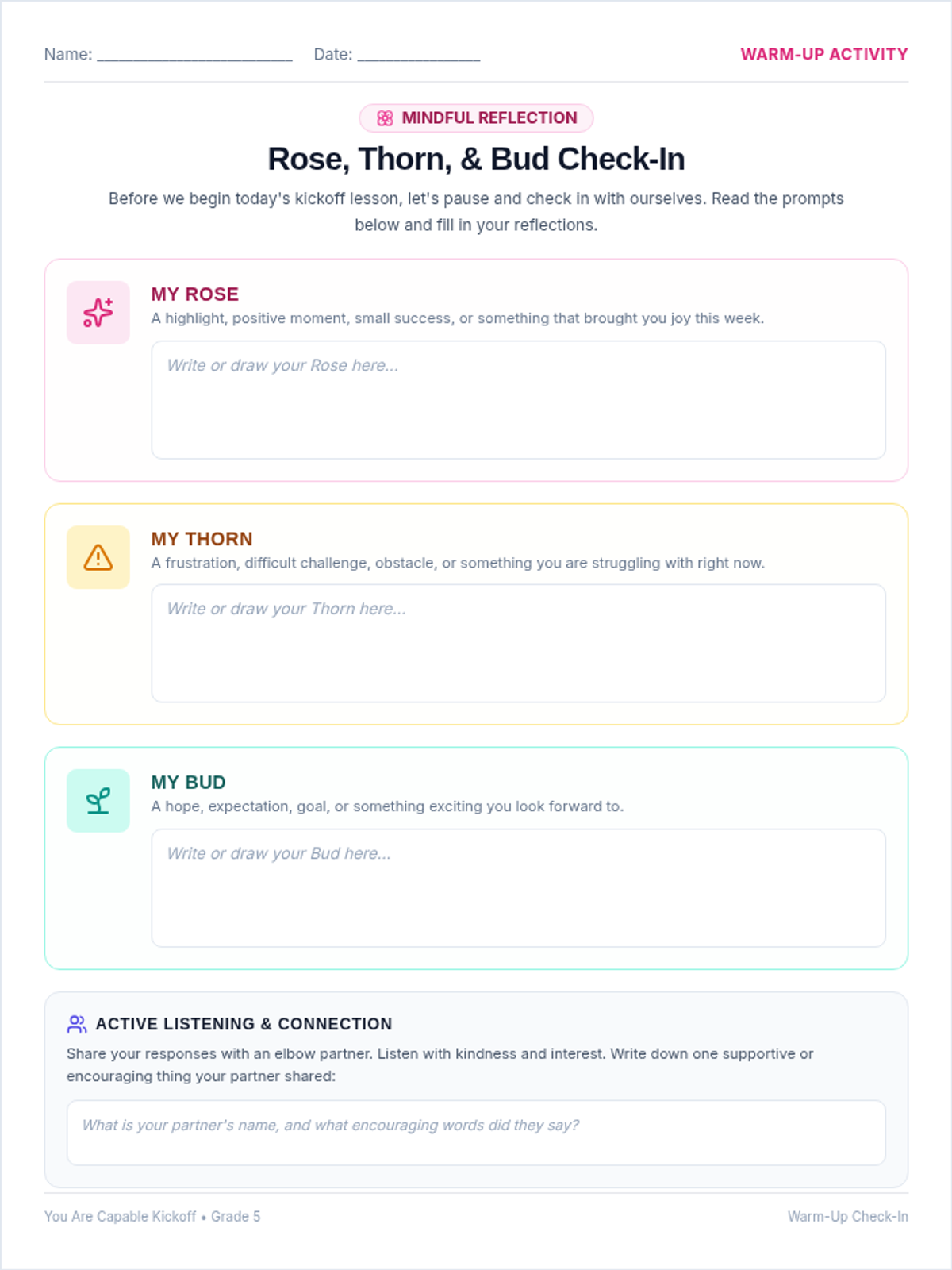
A beautiful 1-page student reflection activity sheet containing categorized prompts and writing spaces for the Rose-Thorn-Bud emotional check-in.
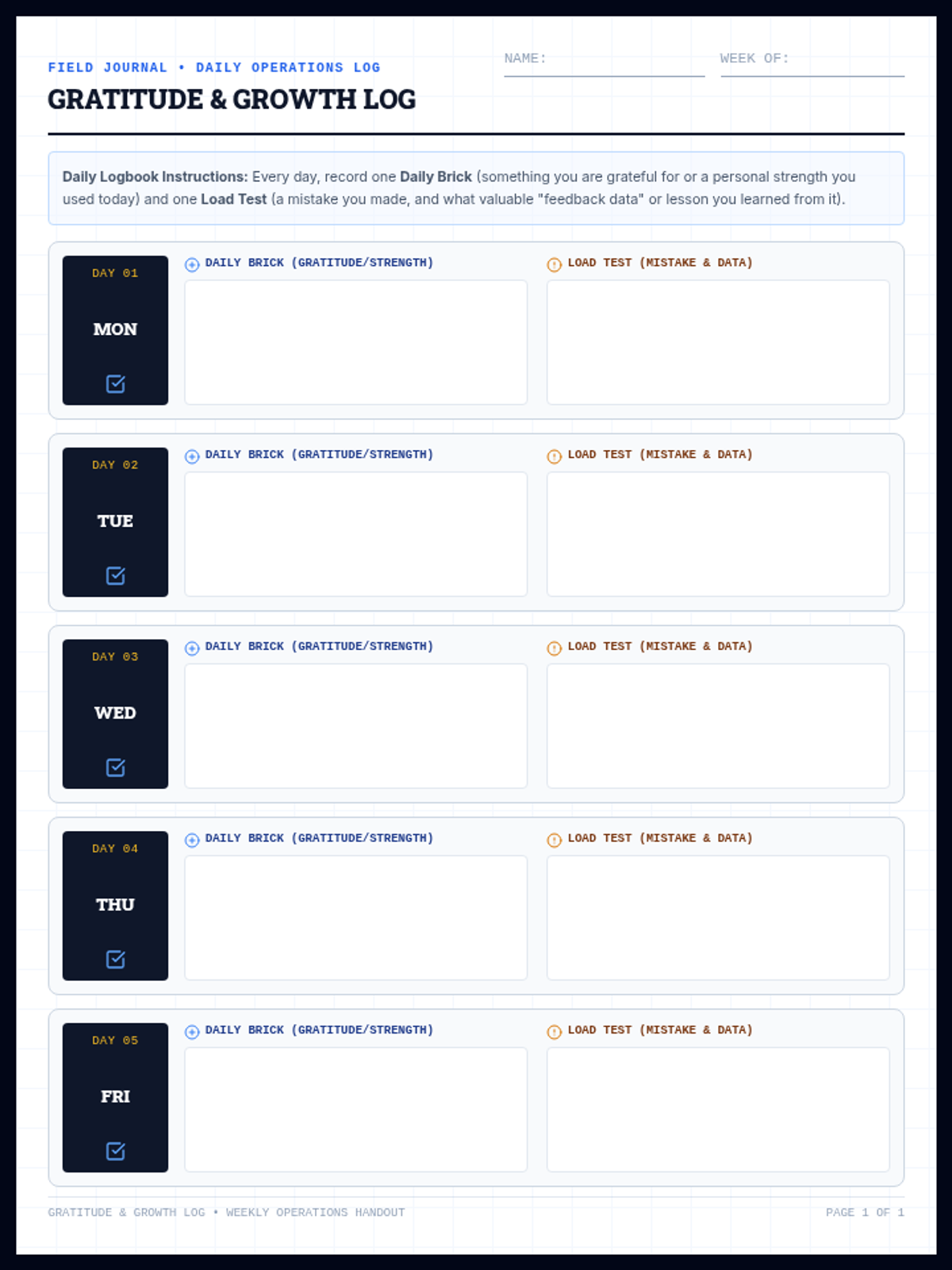
A weekly tracking log sheet styled like an engineer's daily logbook. Space to record "Daily Bricks" (gratitude/strengths) and "Load Tests" (mistakes that offered valuable data) for 5 days of journaling.
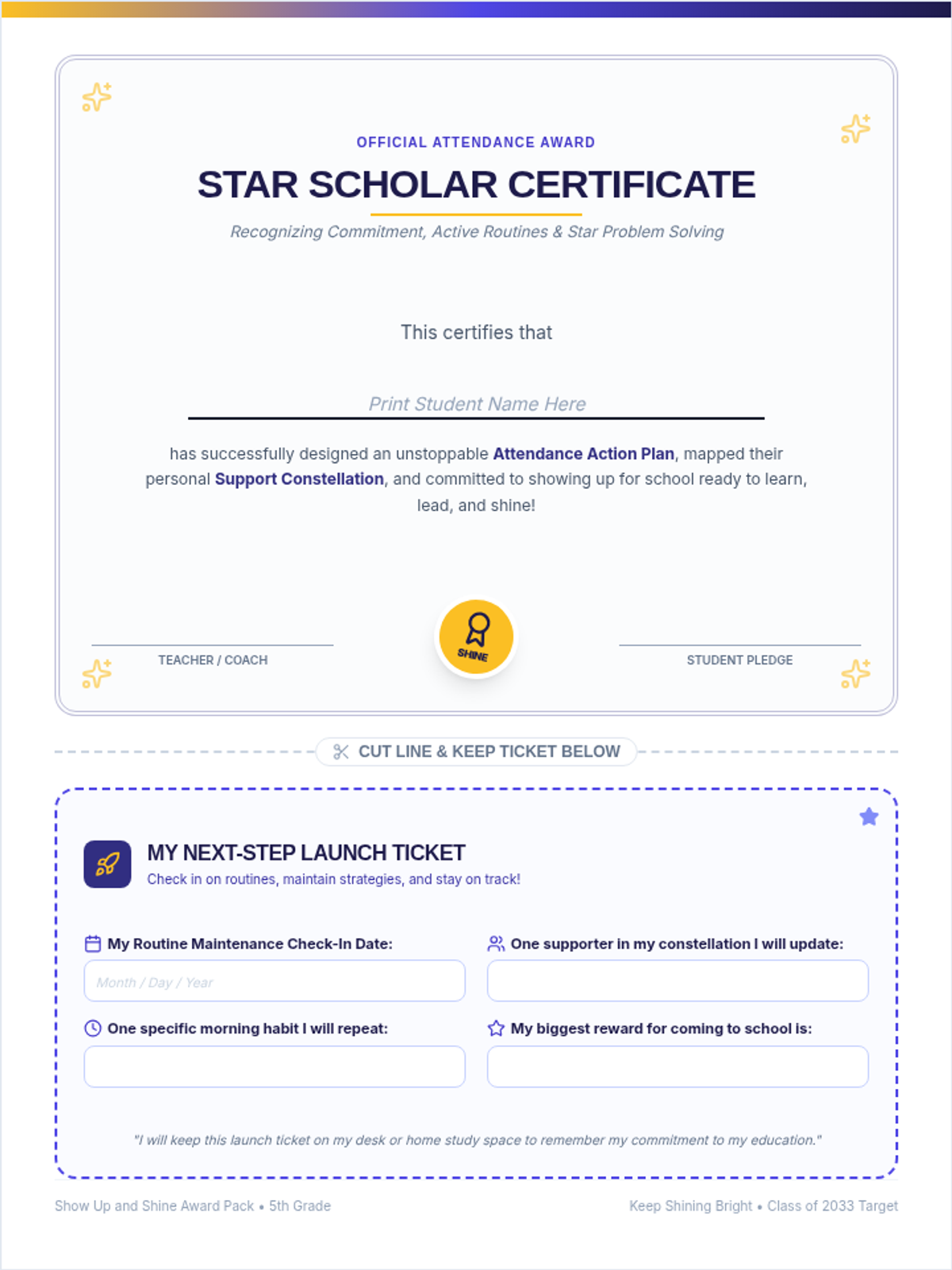
A beautiful, print-ready, dual-purpose document featuring an elegant Star Scholar Certificate of Growth on the top half, and a cut-out 'Next Step' commitment check-in ticket on the bottom half.
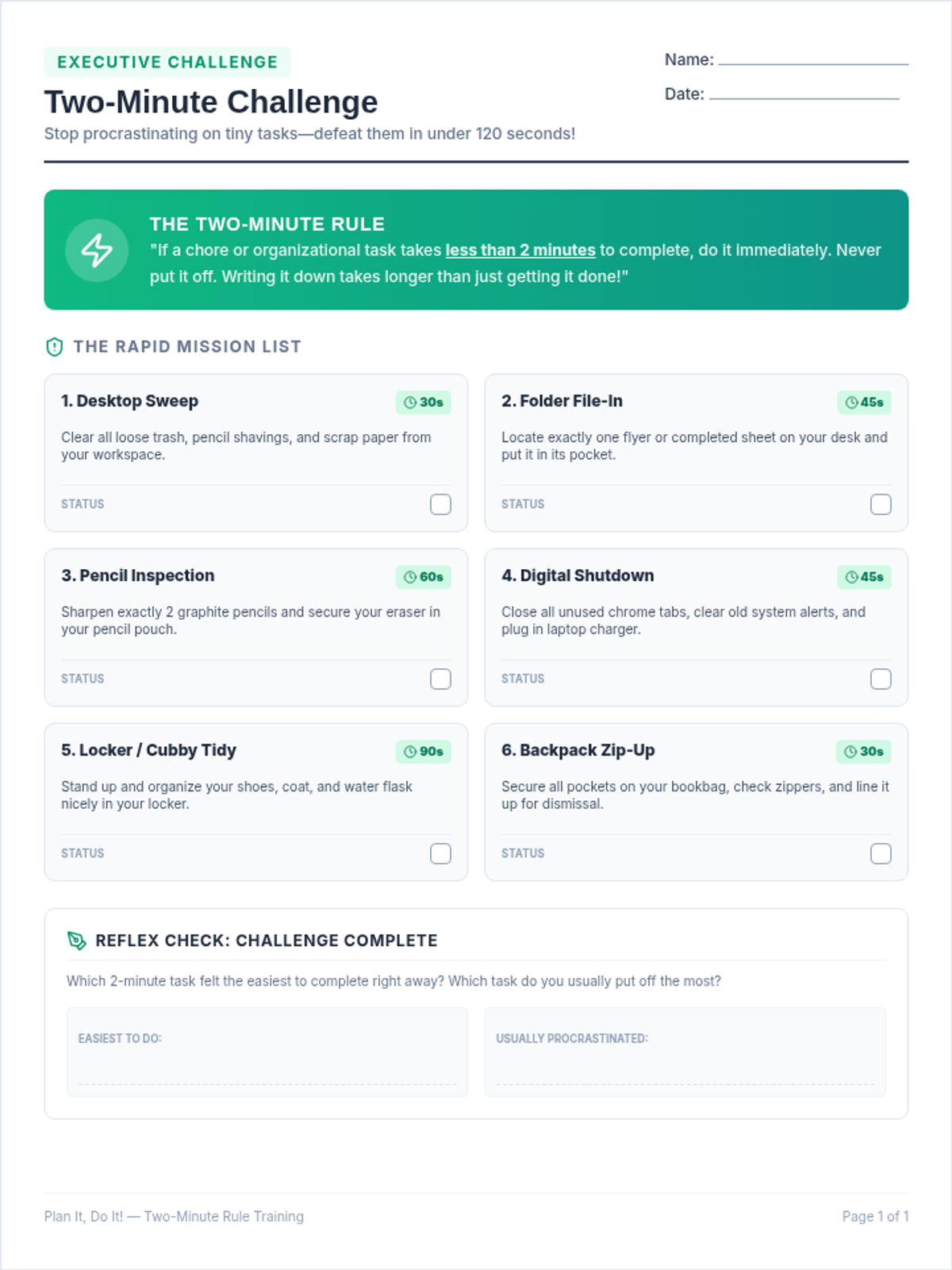
A 1-page structured student handout for the 'Two-Minute Rule Challenge'. Features a gamified sequence of quick physical actions (clean desk, file folder, sharpen pencil) that students complete to practice immediate execution.
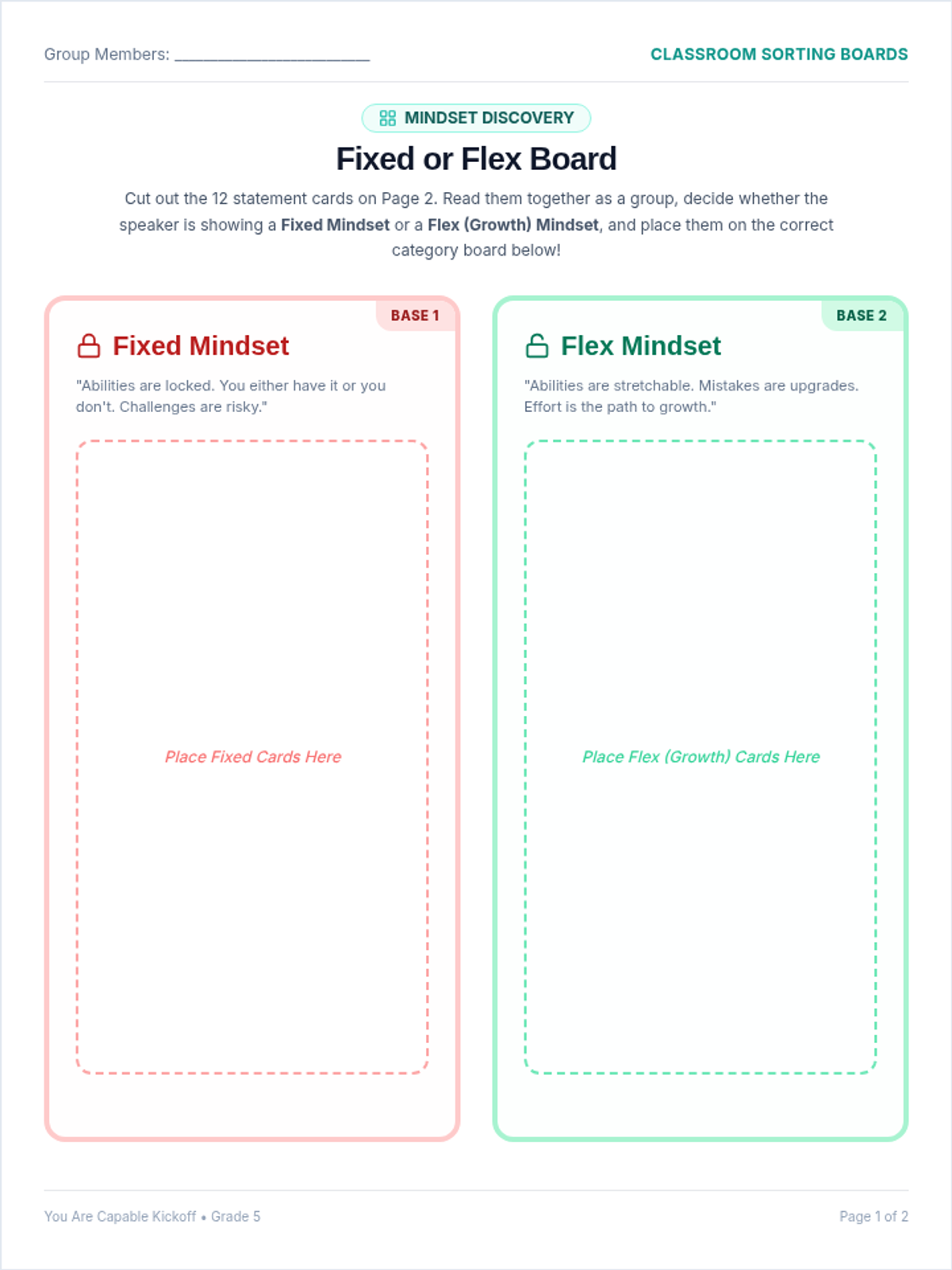
A printable 2-page classroom card sort activity featuring category landing bases and 12 distinct scenario and self-talk cards for student classification.
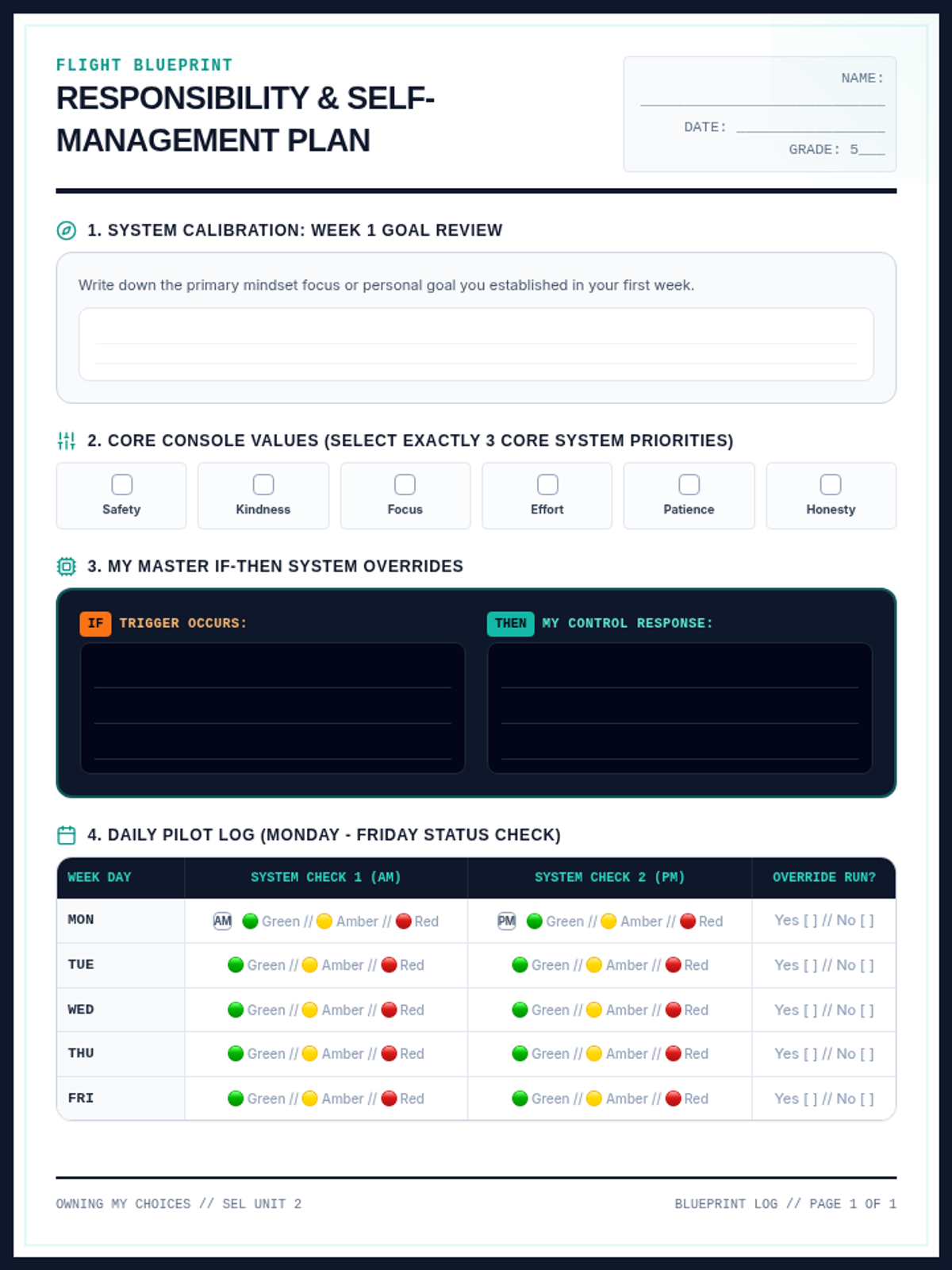
A personal student-facing self-management contract and tracking plan. Features a structured grid where students record their past goals, select core self-management values, commit to their if-then rules, and track their system performance across Monday through Friday.
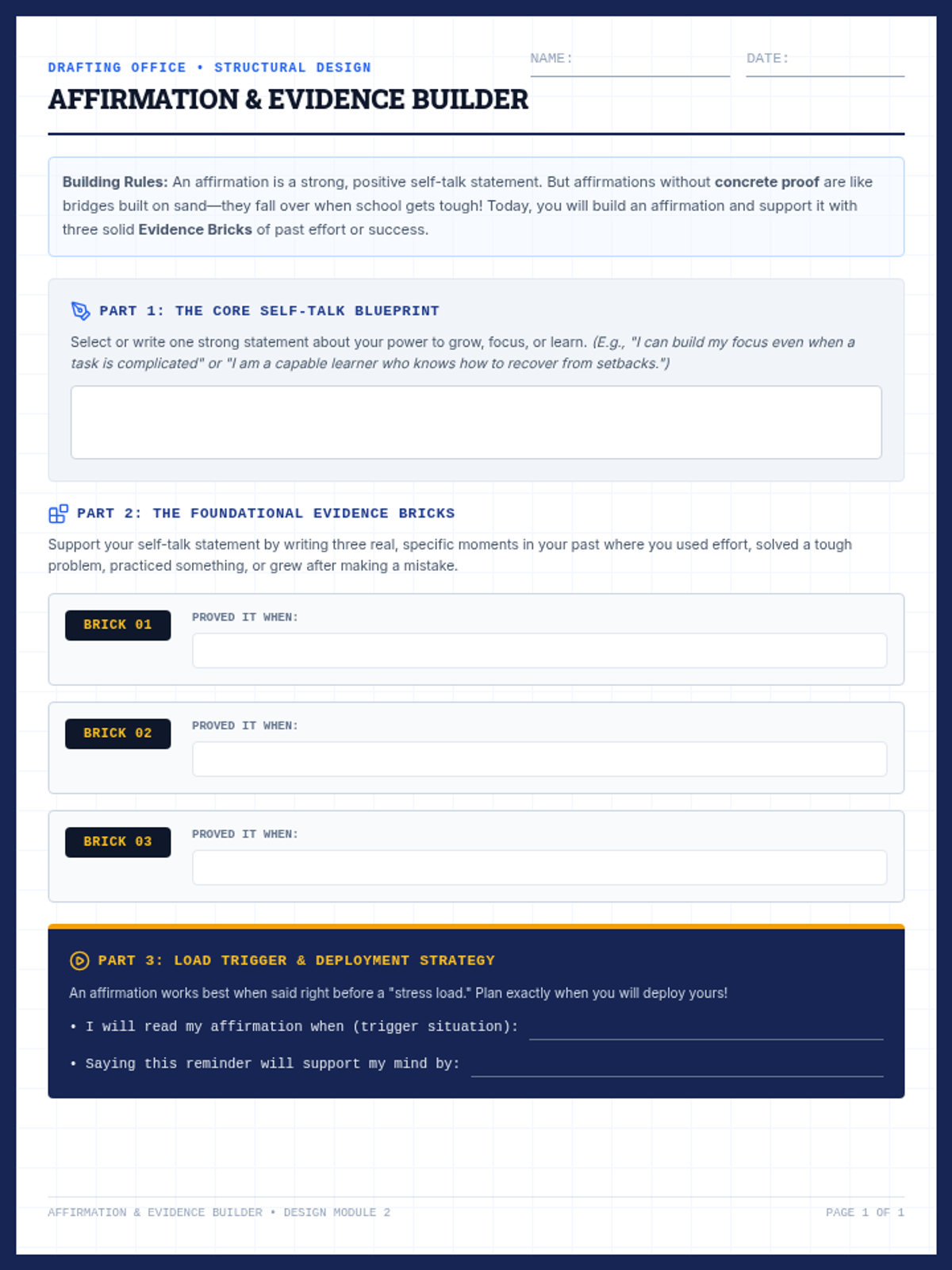
A step-by-step student worksheet styled like an architectural design sheet. Guides 5th graders to construct a personalized affirmation and anchor it with three concrete "evidence bricks" of past effort and success.
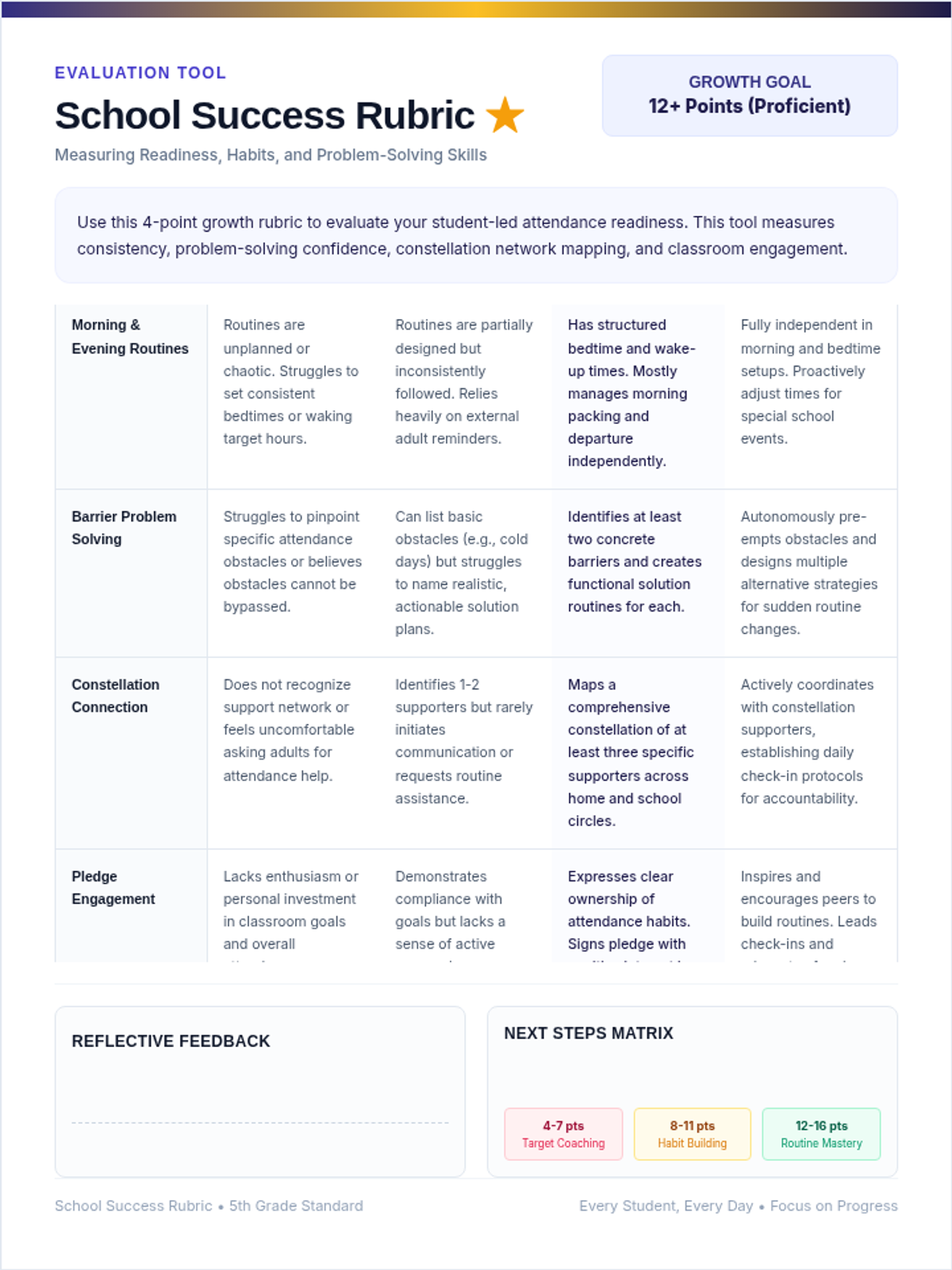
A comprehensive 4-point rubric designed for students or teachers to assess attendance routines, barrier problem-solving skills, support network engagement, and overall school readiness.
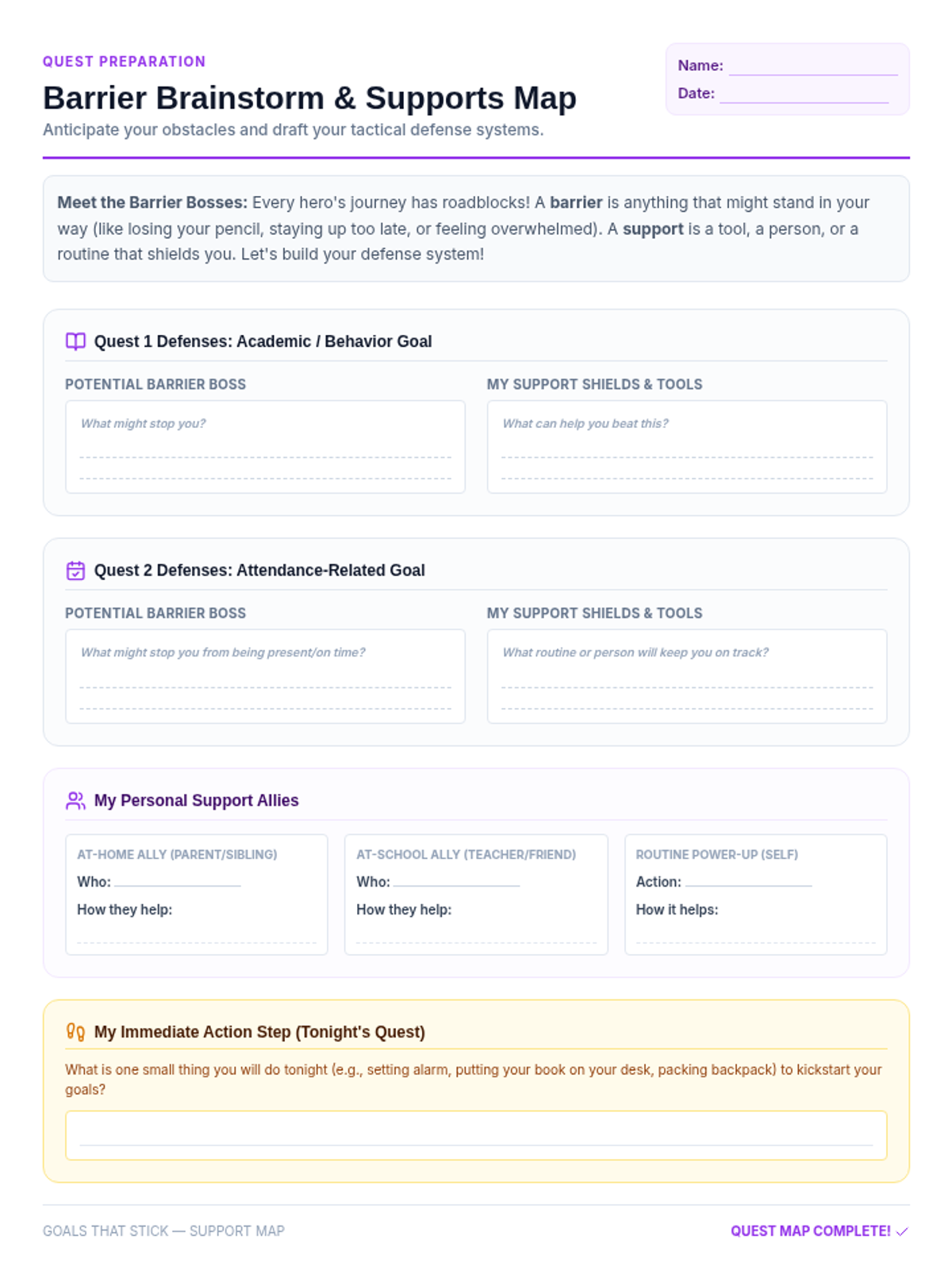
A reflective student-facing activity sheet where students anticipate specific personal barriers (e.g., waking up late, forgetfulness) to their goals and identify concrete external and internal supports to overcome them.
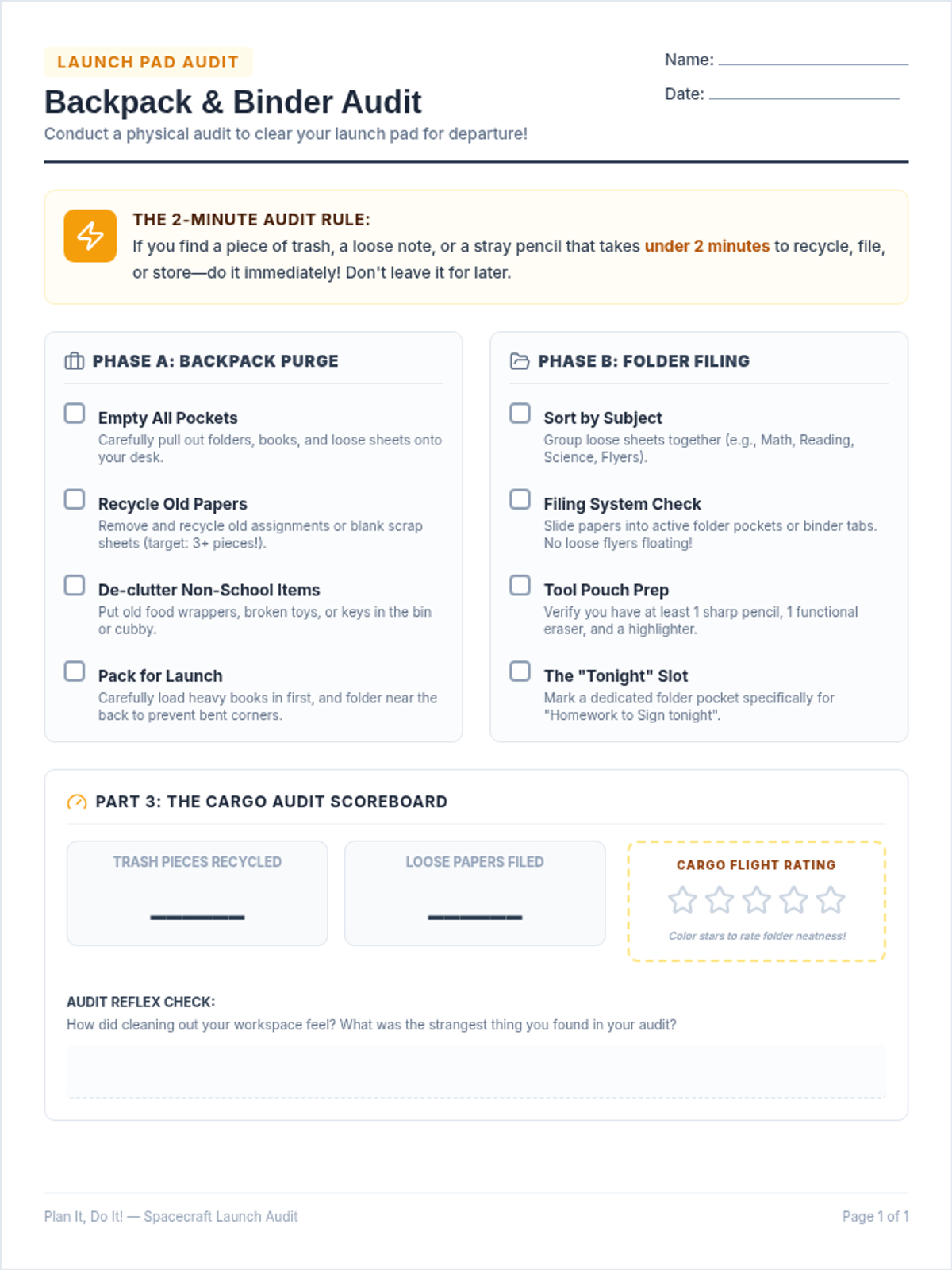
A 1-page physical auditing tool for students to clean, sort, and organize their backpacks and binders. Includes interactive checklists, trash tallies, and a gamified spacecraft rating scale.
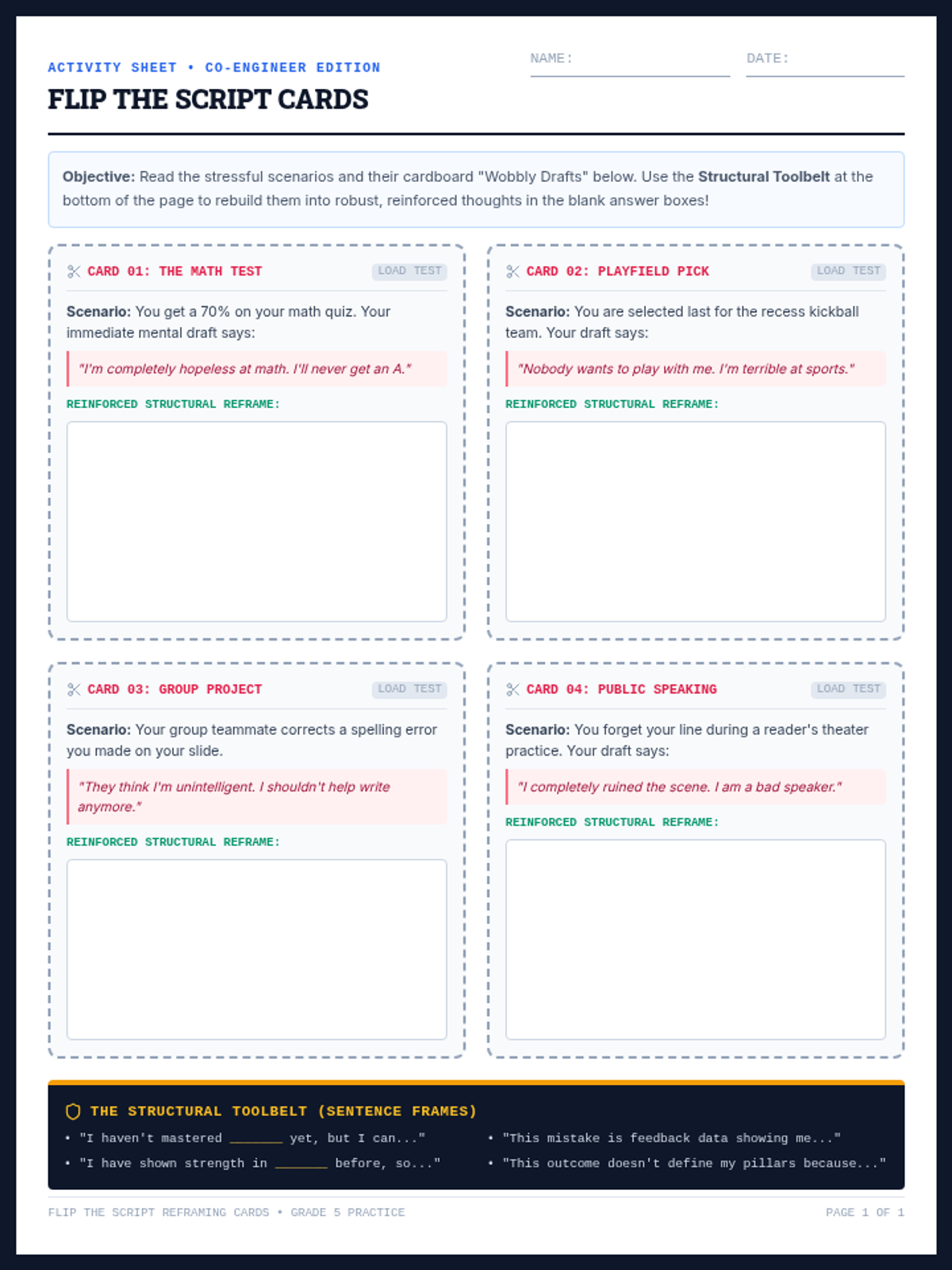
A printable 1-page activity sheet featuring a 2x2 grid of scissor-cut scenario cards. Includes a student header, a toolbelt of supportive sentence frames, and clear prompts to rebuild wobbly thoughts into structural reframes.
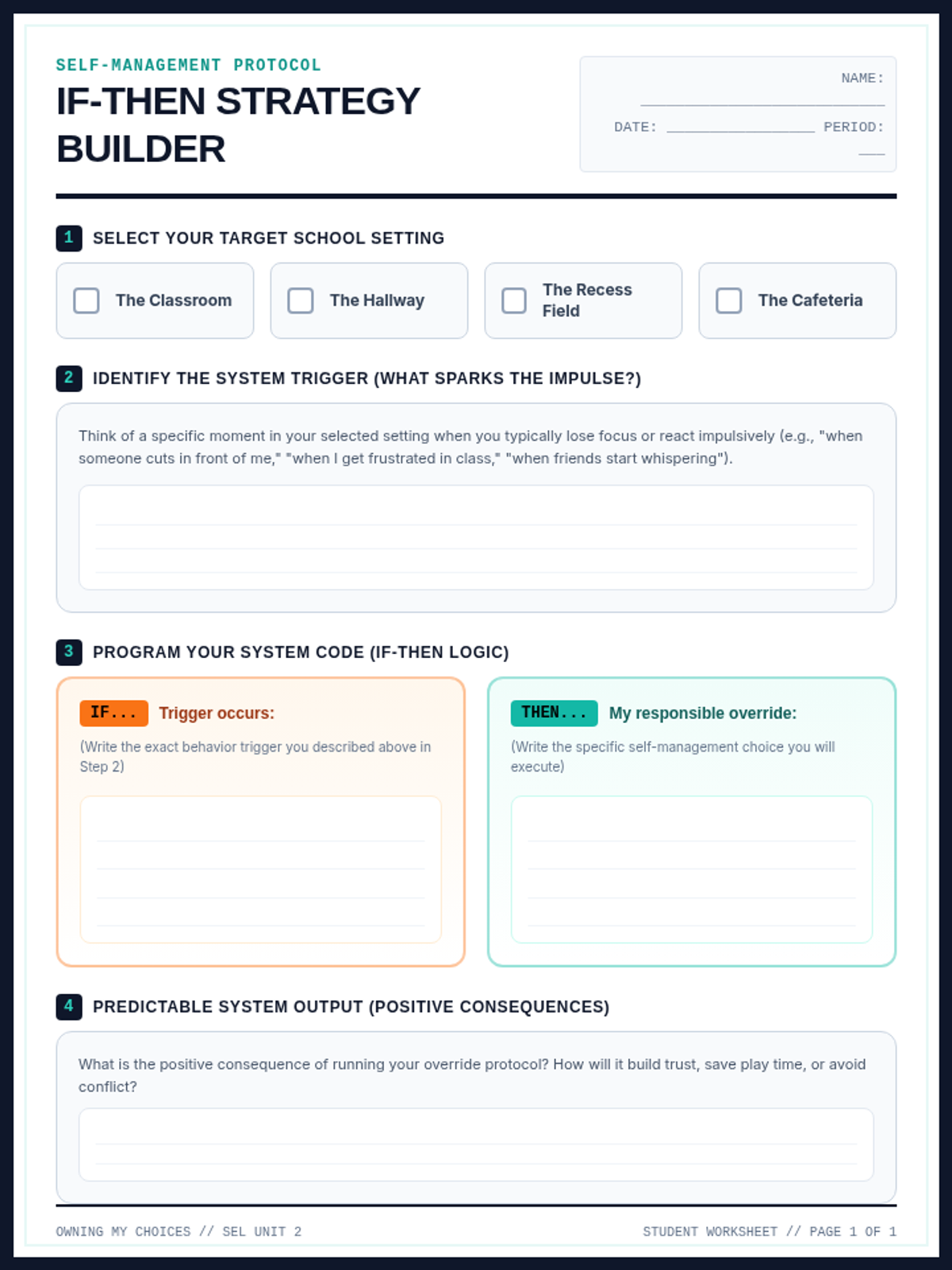
A student-facing graphic organizer to design custom implementation intentions. Features an 'If-Then Compiler' layout where students identify a school setting, target triggers, write out their 'If-Then' code, and list positive consequences.
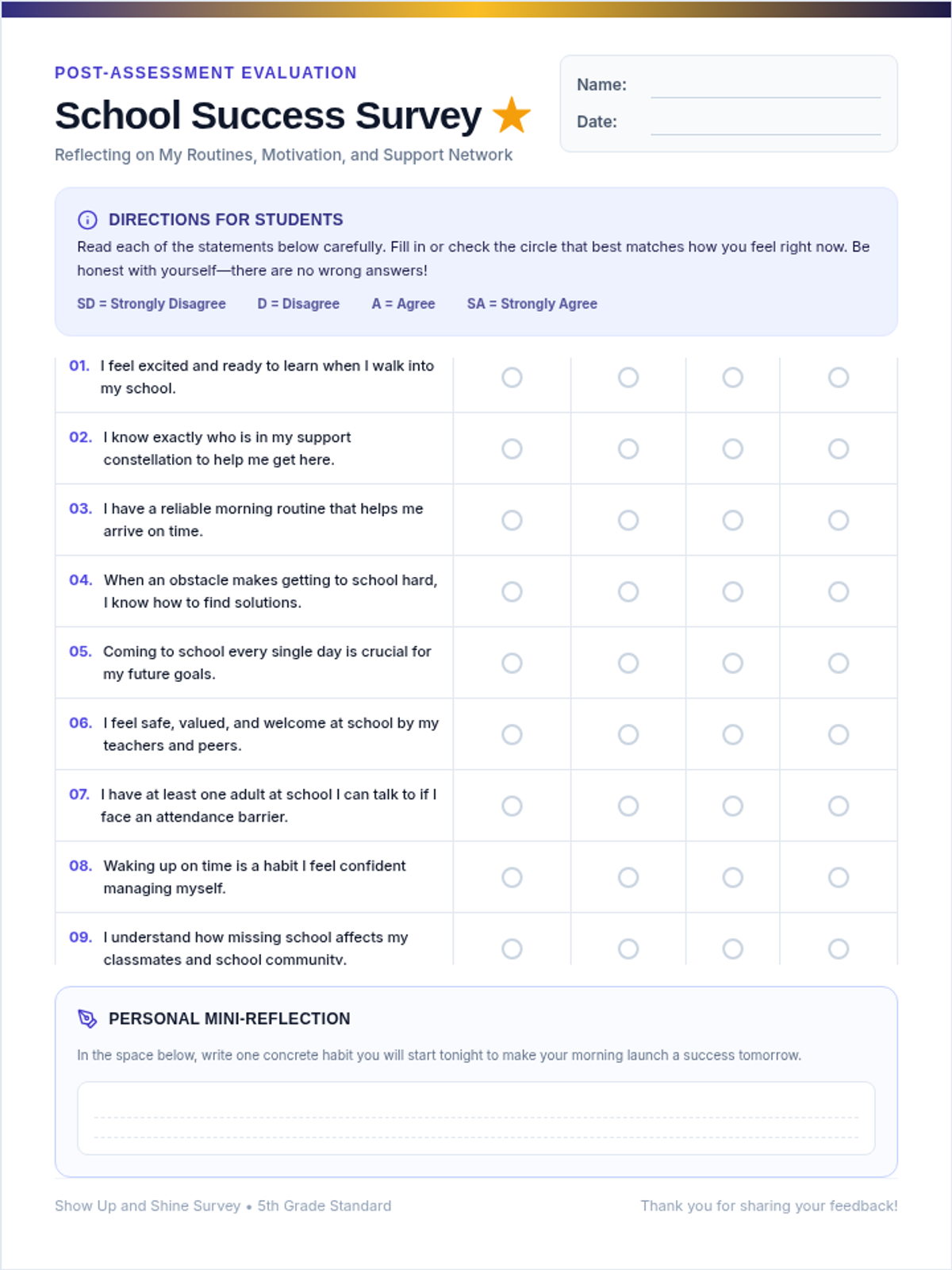
A student-facing 10-item Likert scale post-assessment survey designed to measure students' school engagement, routine confidence, barrier problem-solving skills, and support network awareness.
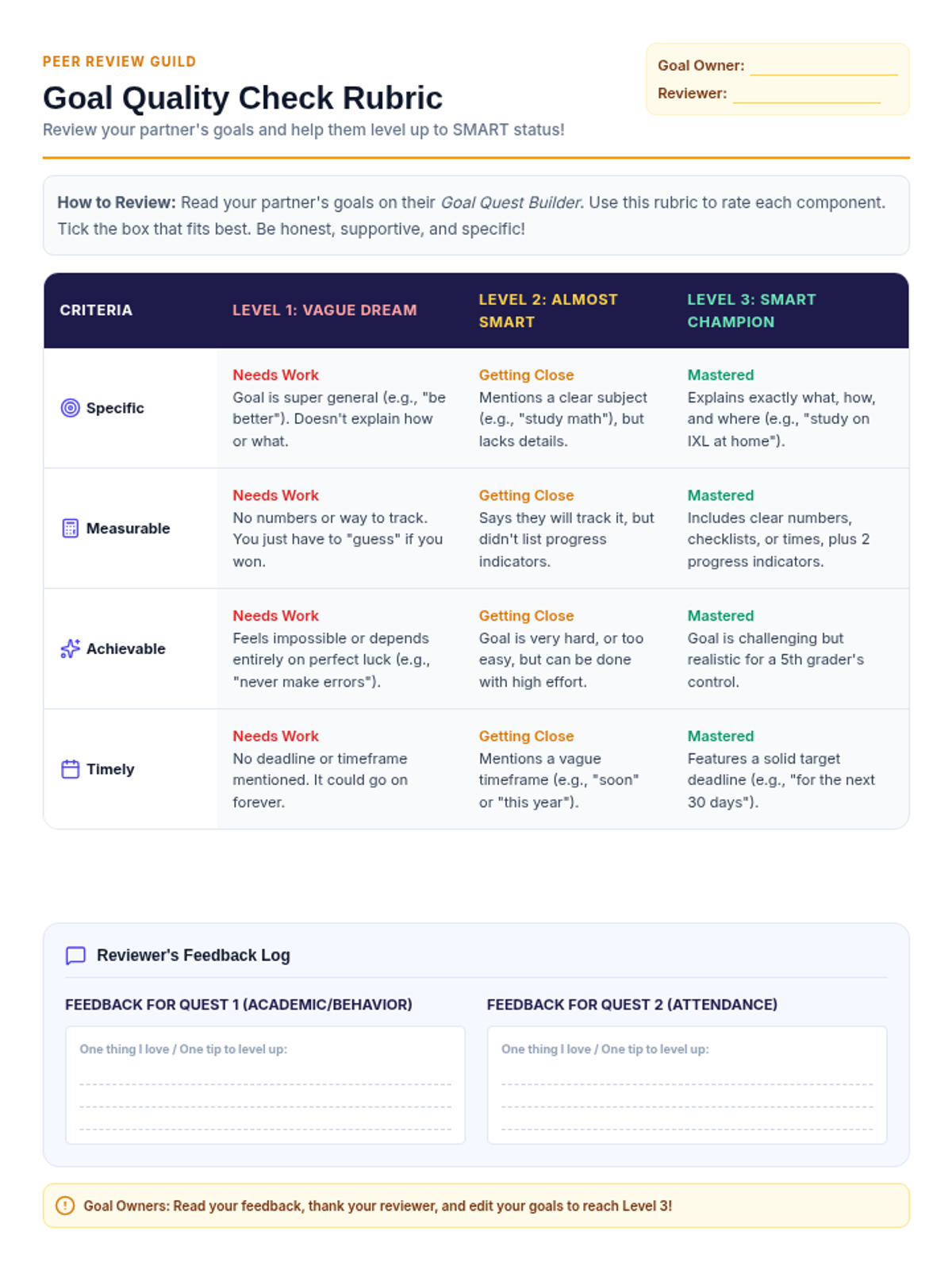
A structured peer-assessment checklist and rubric where partners score each other's goals on the SMART criteria and provide actionable written feedback to help finalize the drafts.
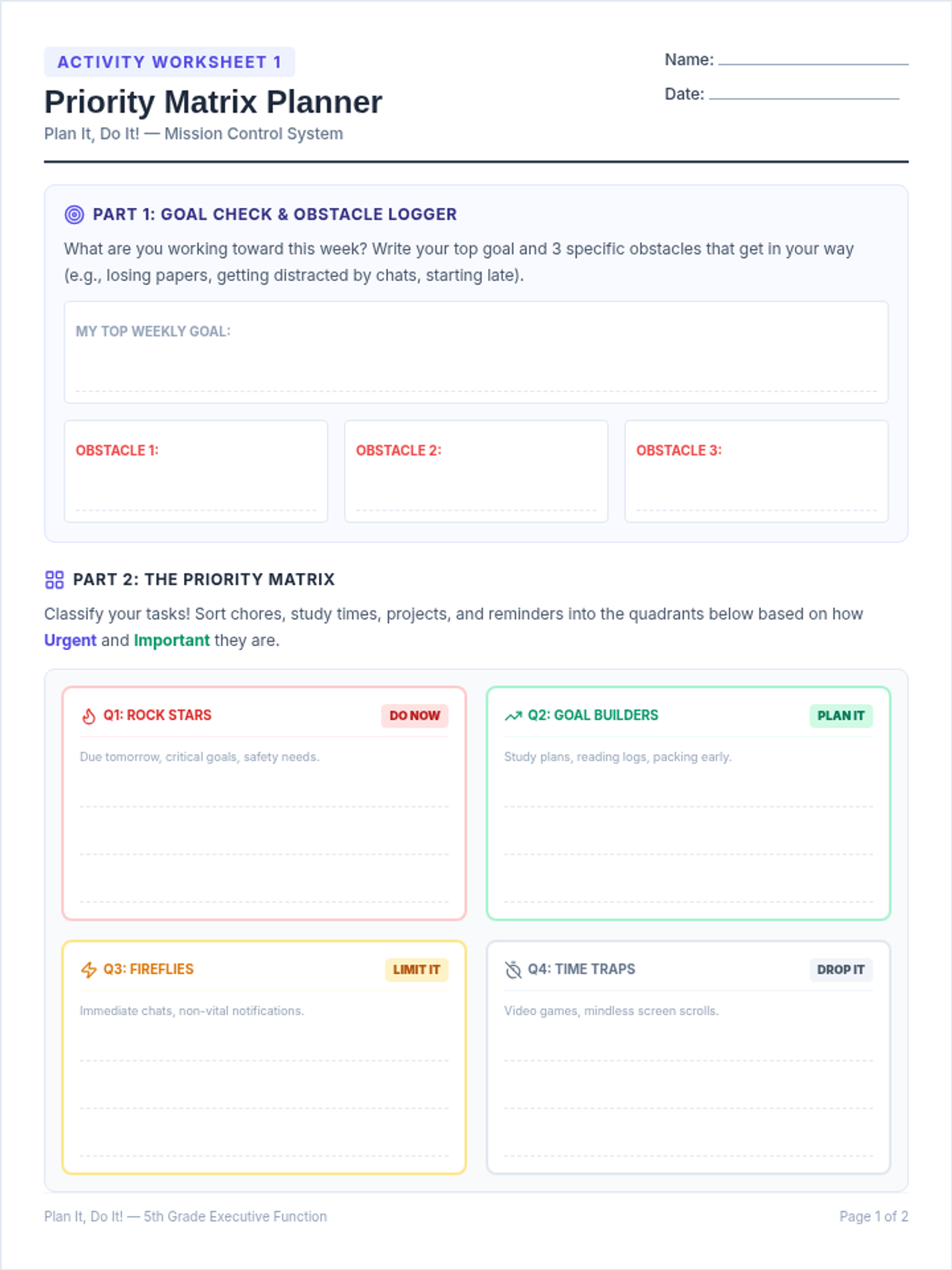
A 2-page print-ready student worksheet. Page 1 contains a goal-check warm-up and an blank 2x2 Priority Matrix grid. Page 2 contains a horizontal layout Weekly Action Planner to map tasks to days of the week.
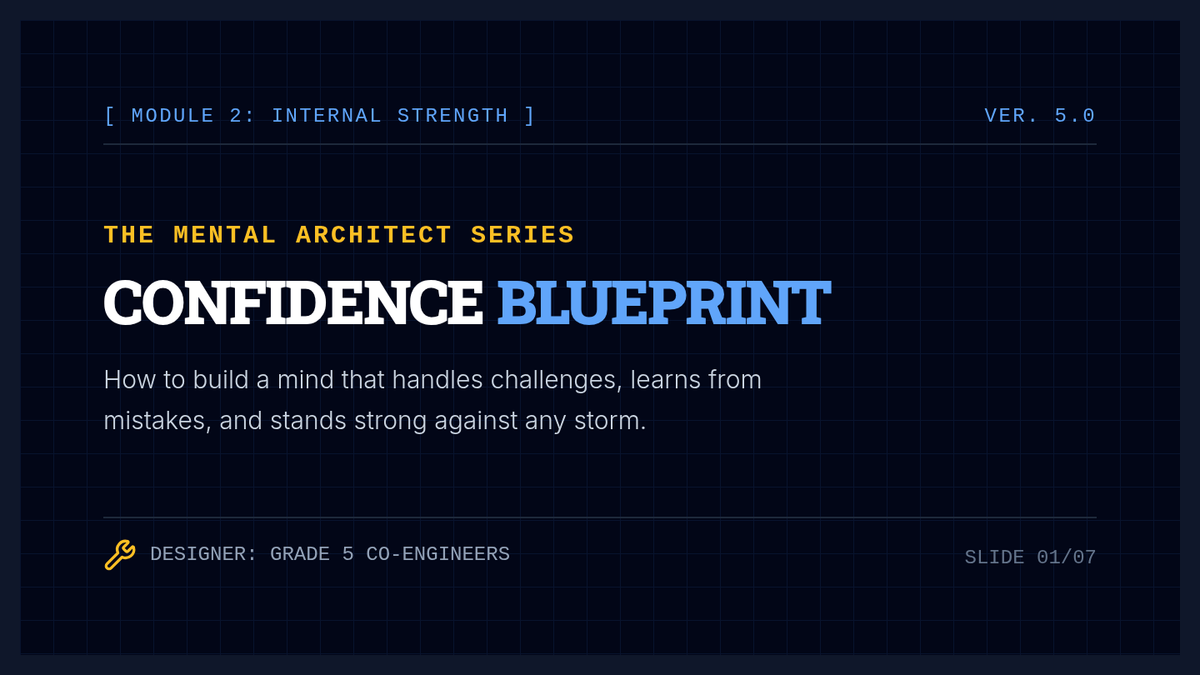
A 7-slide presentation styled as a structural blueprint with deep slate-blues and energetic amber accents. Serves as the primary instructional tool, guiding 5th graders through self-esteem distinctions, data-driven mistake mindsets, and affirmation drafting.
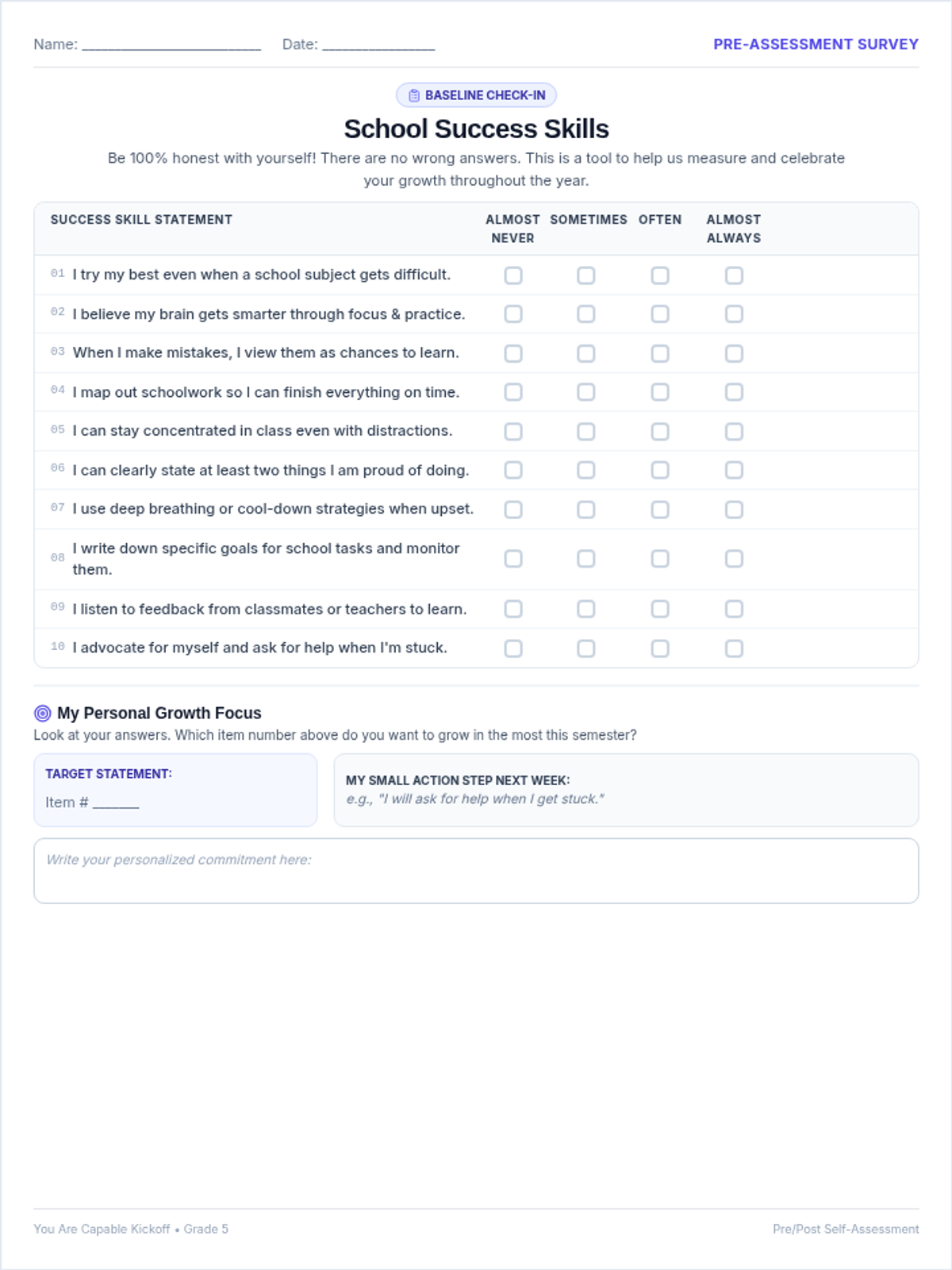
A 10-item printable student Likert-scale self-assessment survey mapping self-talk, organization, focus, and collaboration with a goal-setting extension.
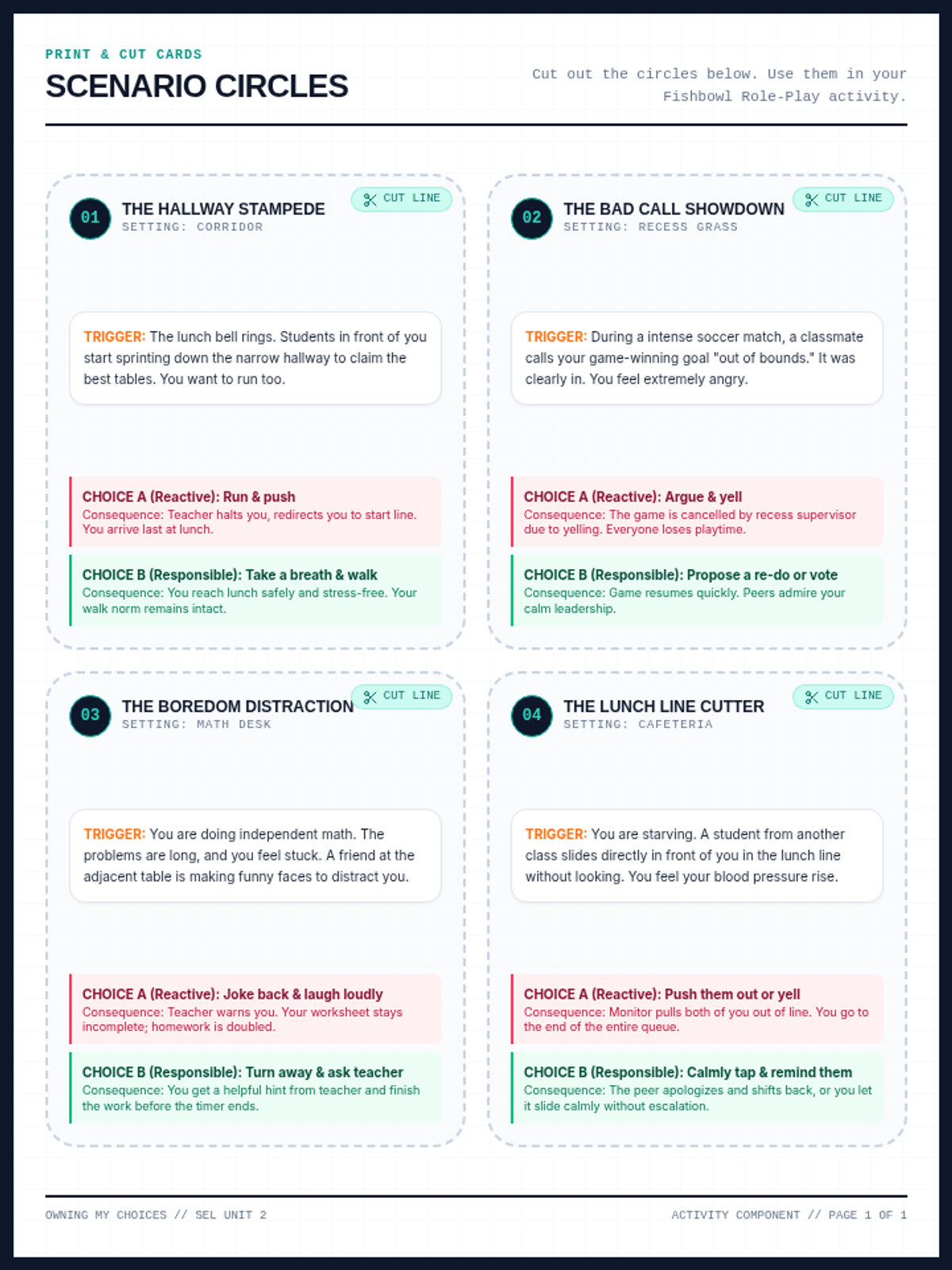
A printable set of 4 role-play cards in a 2x2 layout, designed as retro-futuristic circular dial gages. Each card presents a 5th grade school scenario (Hallway, Recess, Classroom, Cafeteria) with a clear trigger, reactive Choice A, and responsible Choice B.
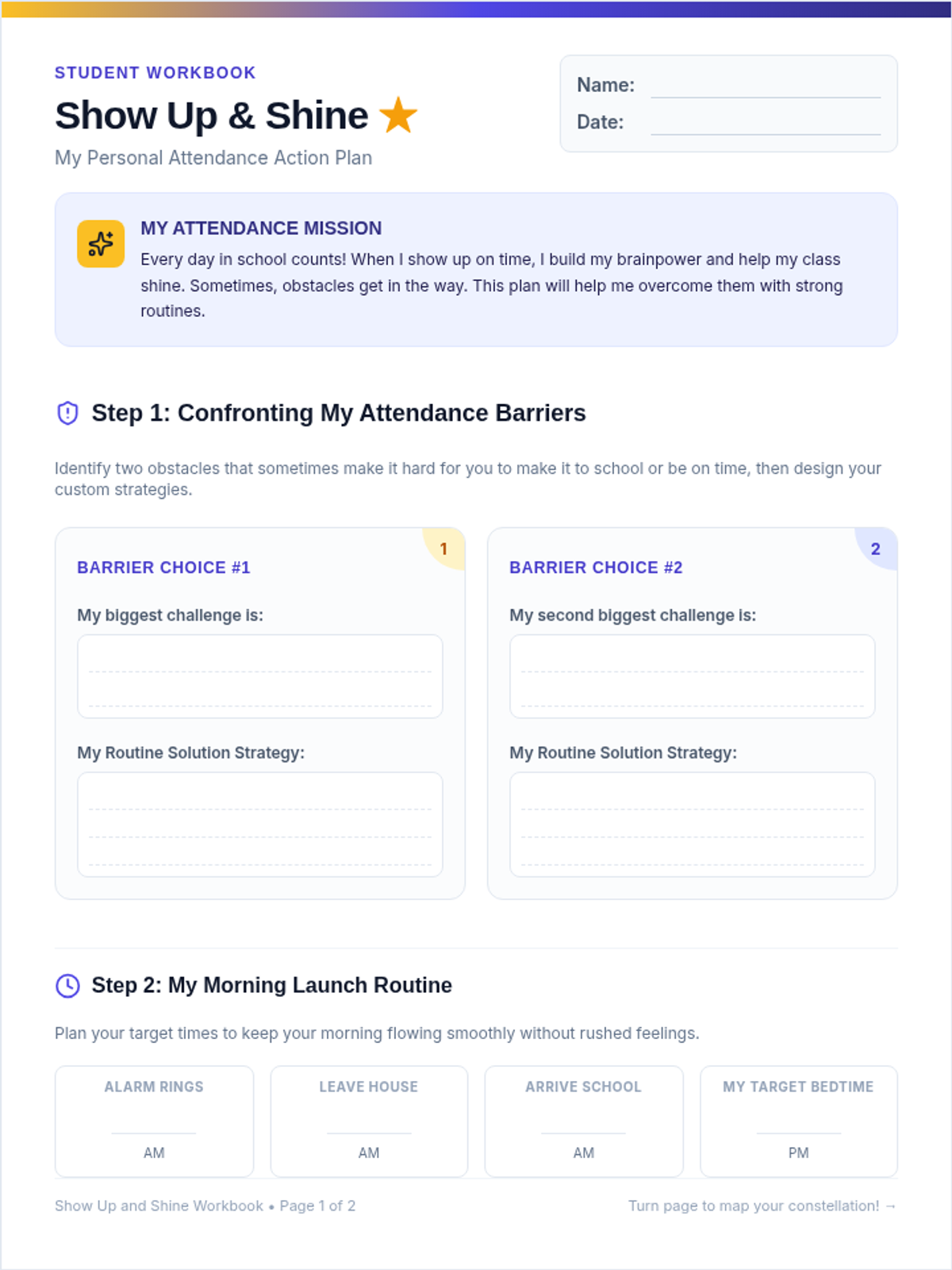
A student-facing 2-page worksheet where 5th graders identify their unique school attendance barriers, outline actionable routines, and map their support networks using a celestial 'constellation' themed diagram.
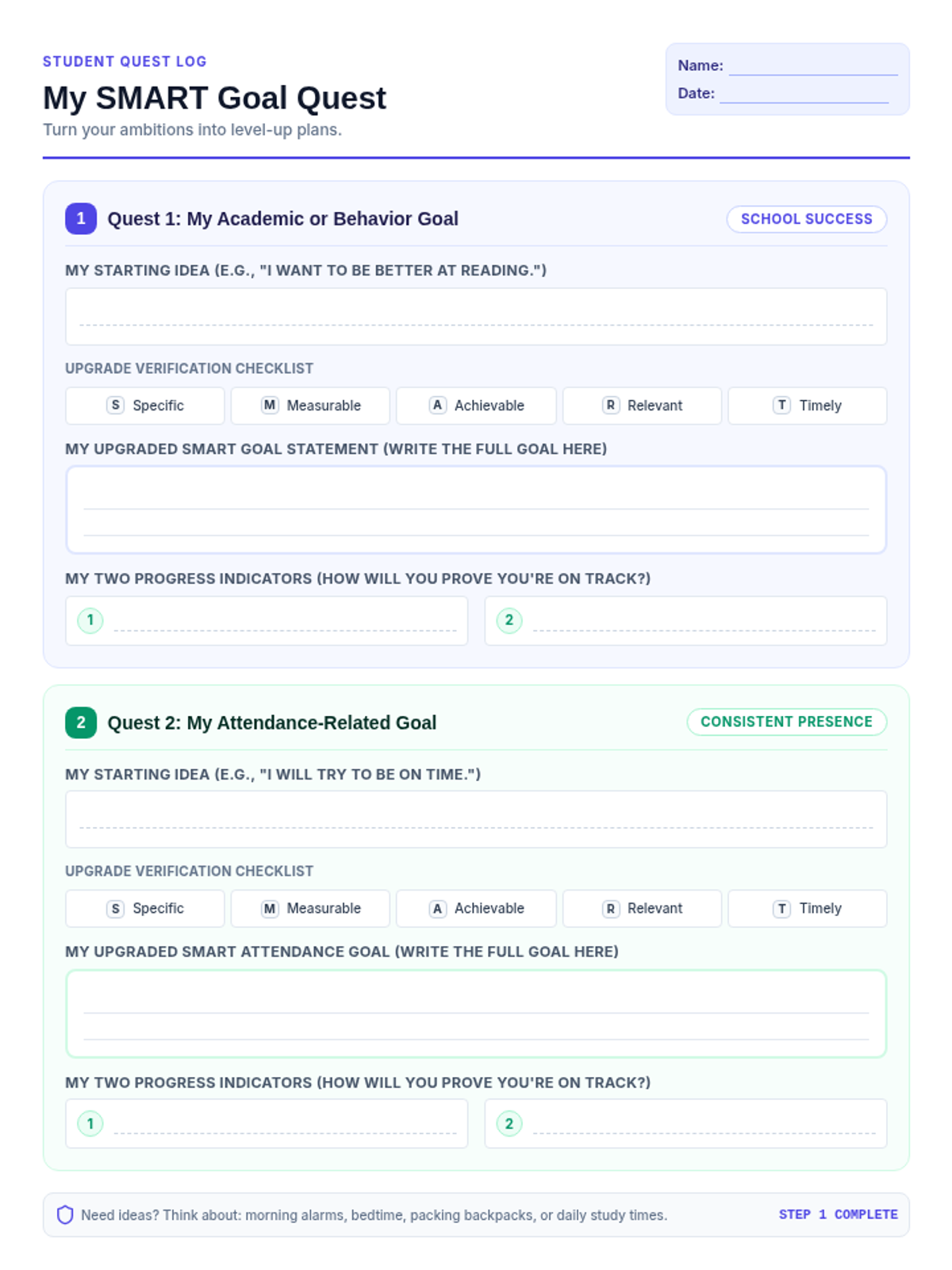
A structured printable where students draft their academic/behavior goal and attendance goal, with checkboxes for SMART criteria and spaces to define two progress indicators for each.
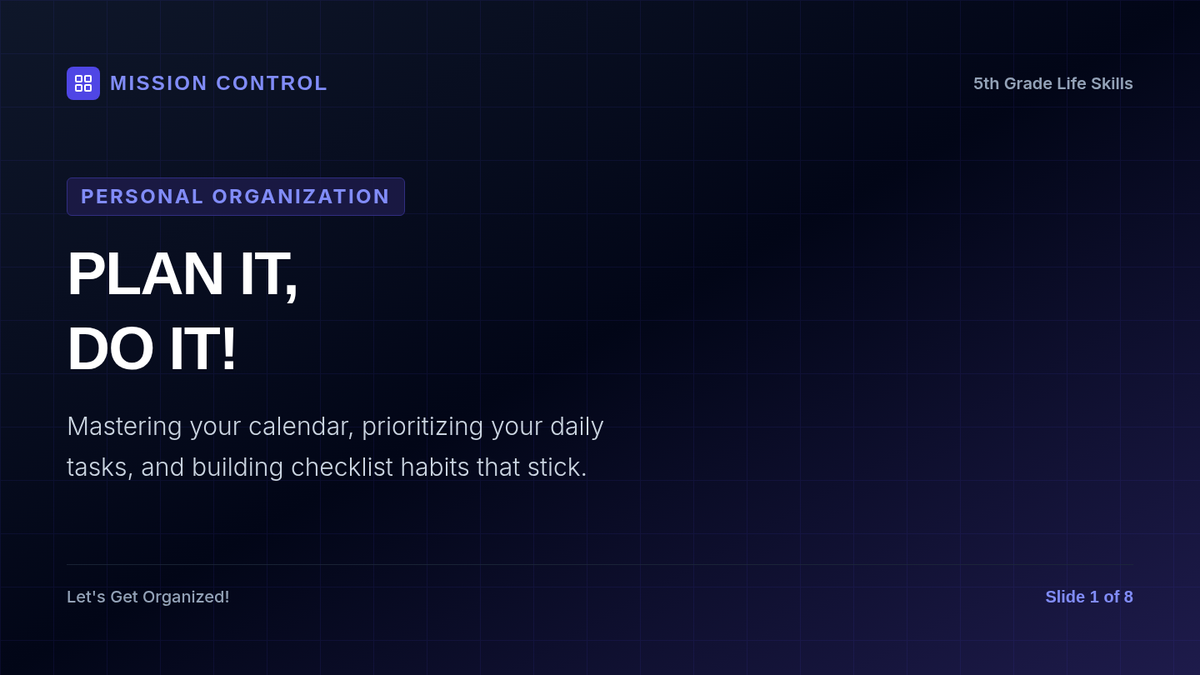
A 16:9 interactive-style slide deck designed to lead a 45-minute instruction. Introduces the Priority Matrix, the Two-Minute Rule, and coordinates the physical and tracking activities.
An engaging 5-slide visual presentation deck introducing fifth graders to SMART goals, demonstrating how to transform vague goals, and outlining progress tracking and obstacle planning.
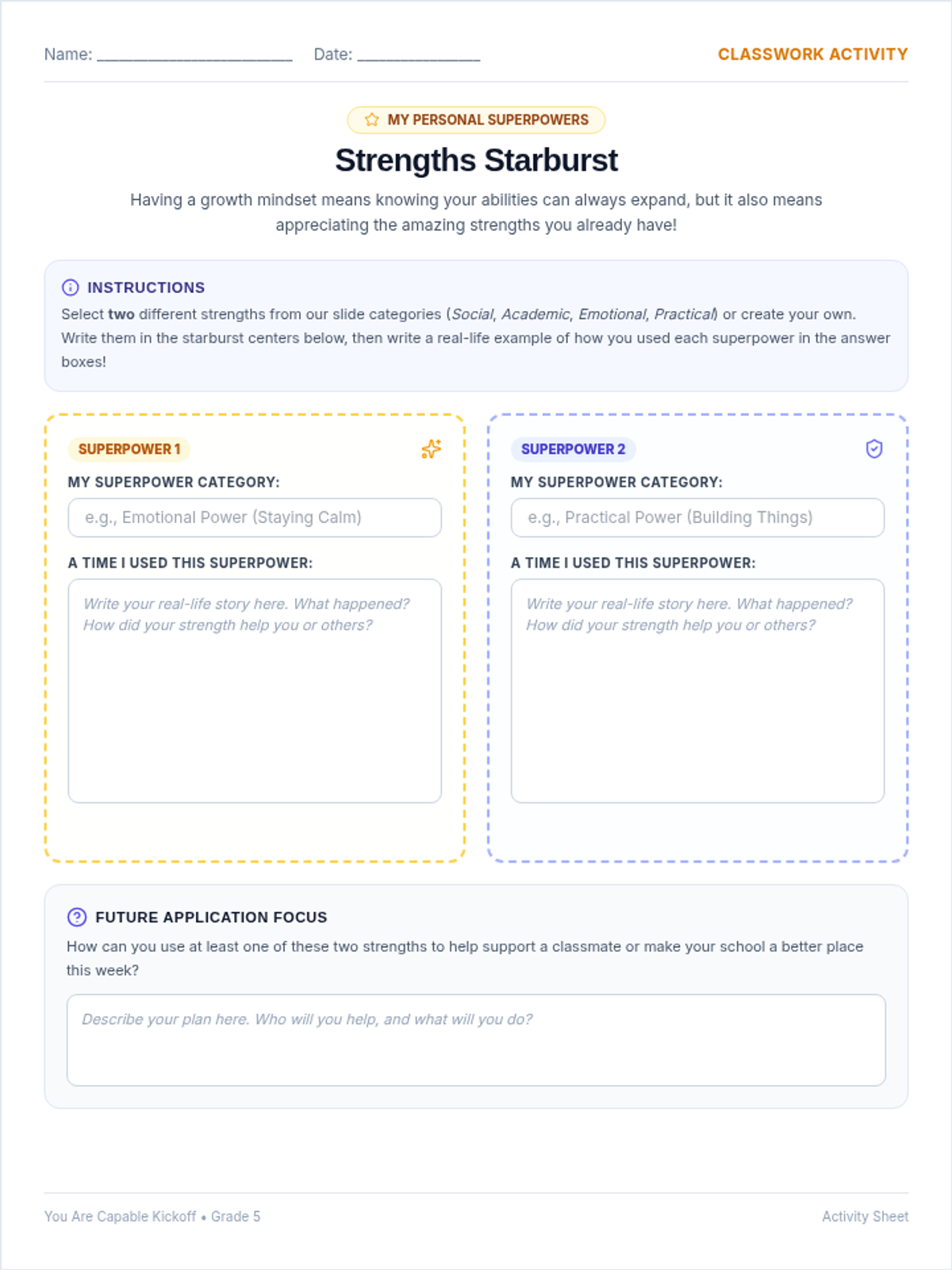
An interactive 1-page student graphic organizer designed to help 5th graders identify, categorize, and reflect on their personal strengths.
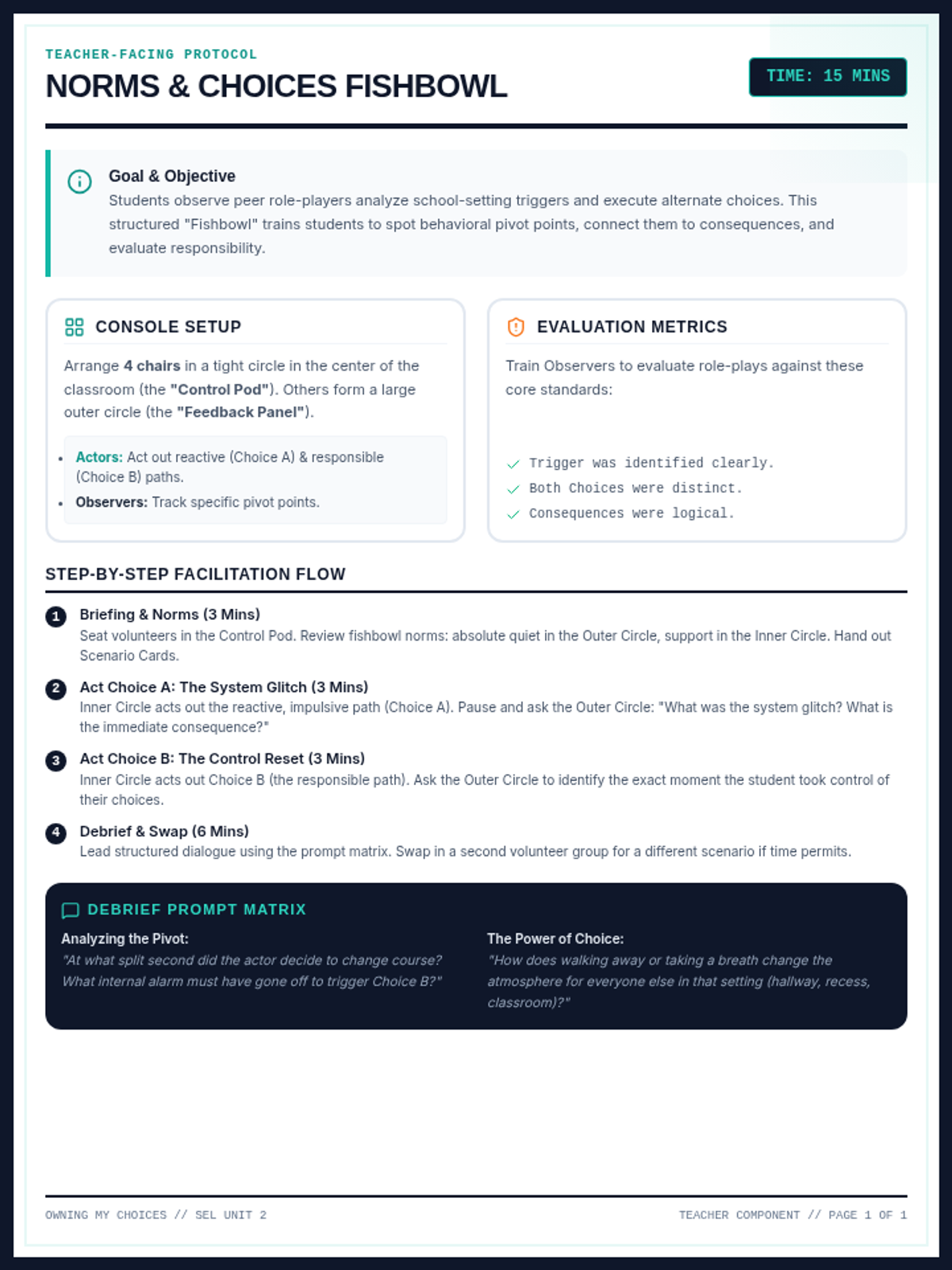
A 1-page teacher-facing facilitation guide for running the fishbowl role-play activity. Includes setup instructions, stage directions, step-by-step facilitation steps, and key questions to debrief student observations using a Control Center theme.
A visually stunning, celestial-themed 6-slide presentation for the 'Show Up and Shine' attendance lesson. It covers attendance barriers, problem-solving, support mapping, and celebrating personal growth, designed with a dark starry theme and large, readable text.
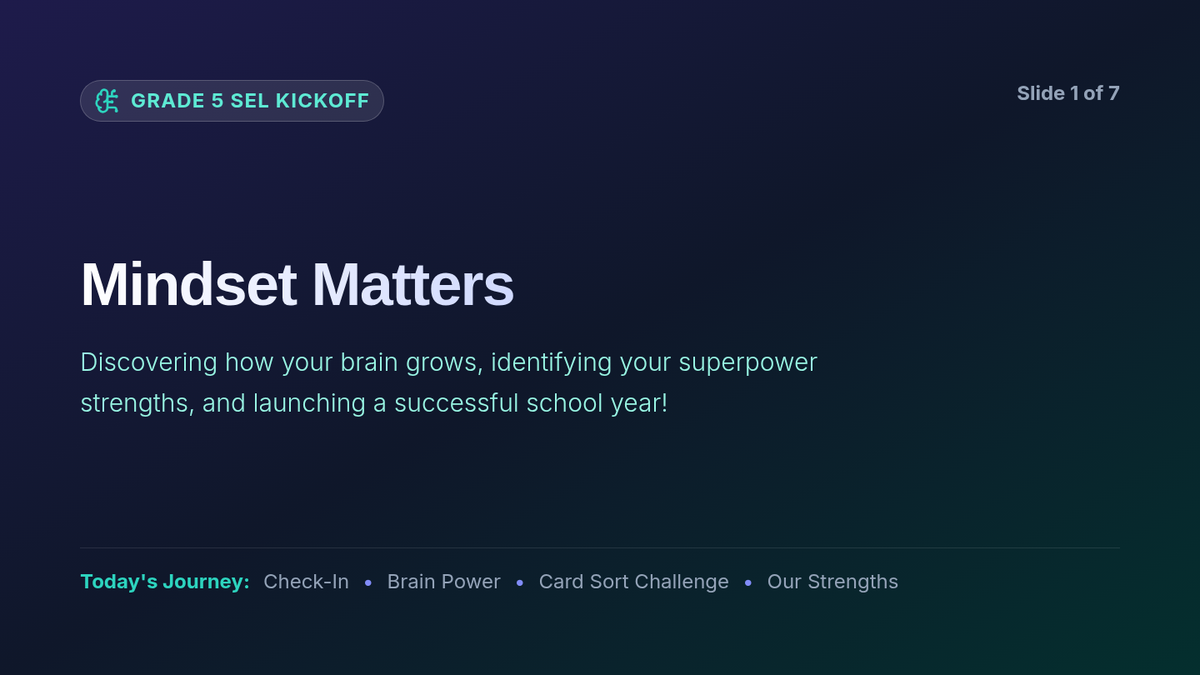
An engaging 7-slide presentation introducing 5th graders to brain growth (neuroplasticity), growth vs. fixed mindset self-talk, and personal strengths exploration.
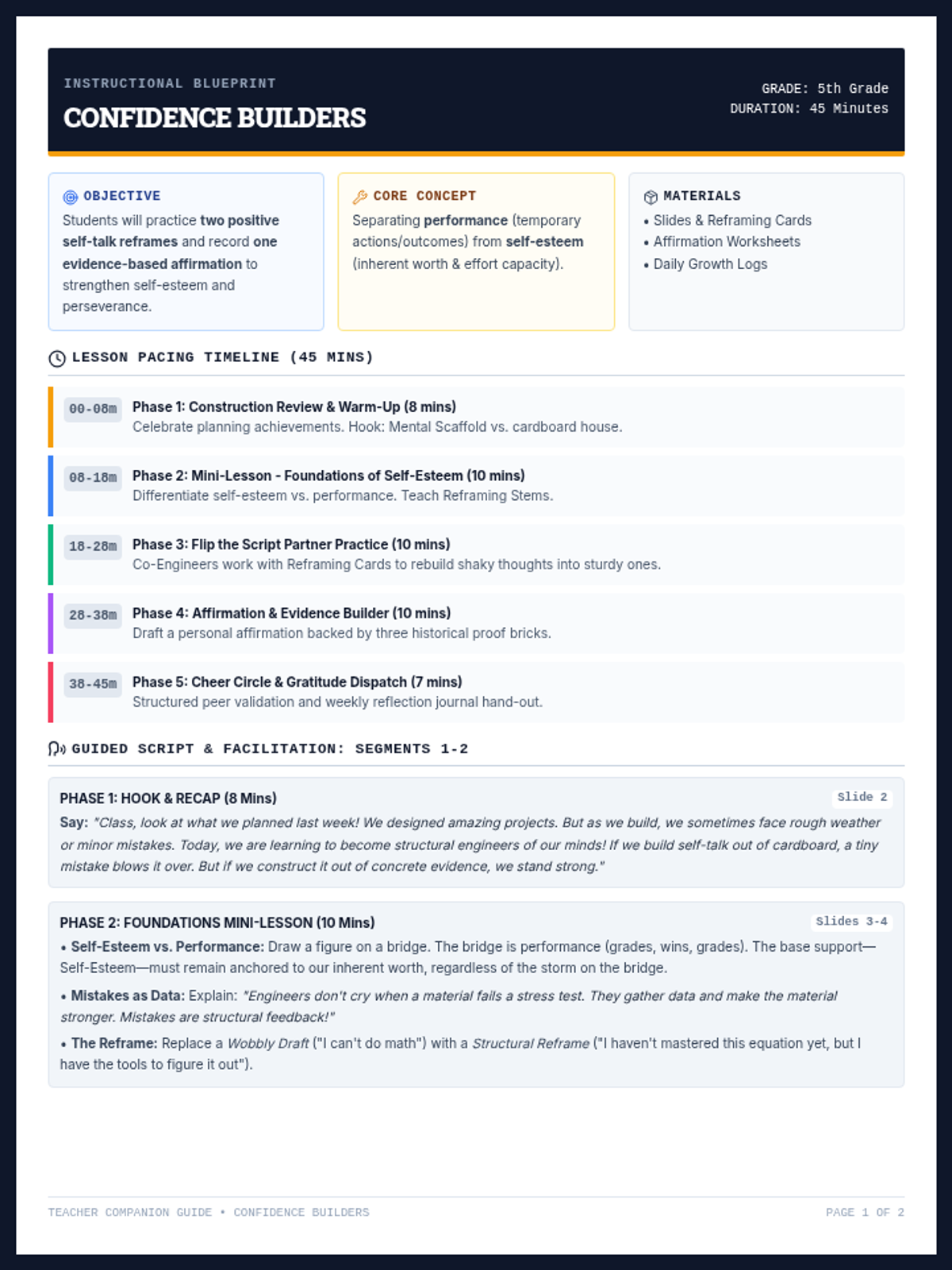
A comprehensive 2-page teacher facilitation guide styled as a technical blueprint. Contains a detailed timeline, word-for-word talking points, troubleshooting tips, and differentiation strategies to guide 5th graders through self-esteem concepts and positive reframing.
A 16:9 slide presentation for interactive instruction. Uses a tech-inspired 'Control Center' theme to teach 5th graders the connections between behavior and consequences, warm up with past goals, analyze scenarios, and introduce the if-then strategy.
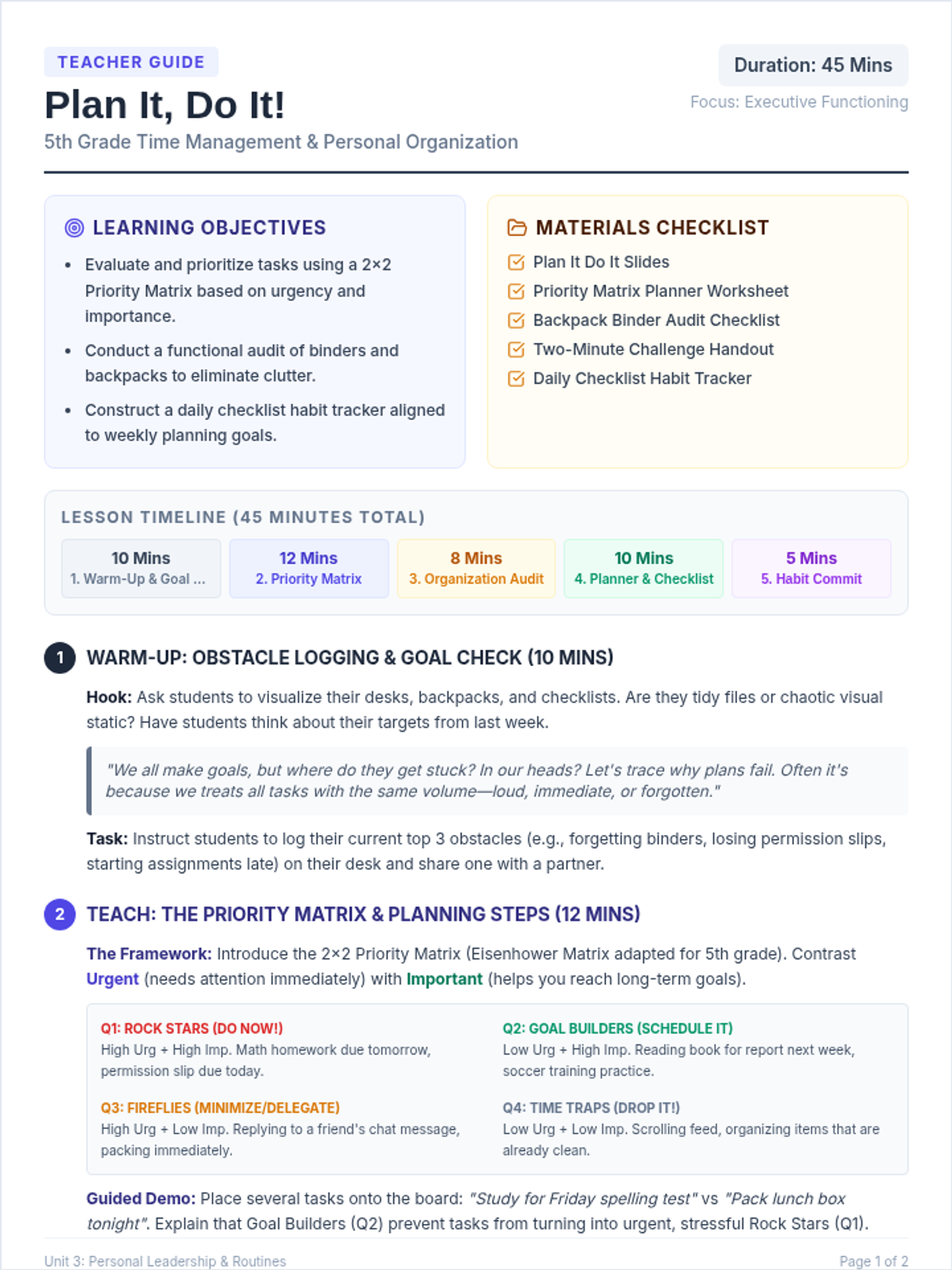
A comprehensive, 2-page teacher facilitation guide outlining the 45-minute lesson plan for 'Plan It Do It'. Includes pacing, scripting, key questions, and student-facing activity alignments.
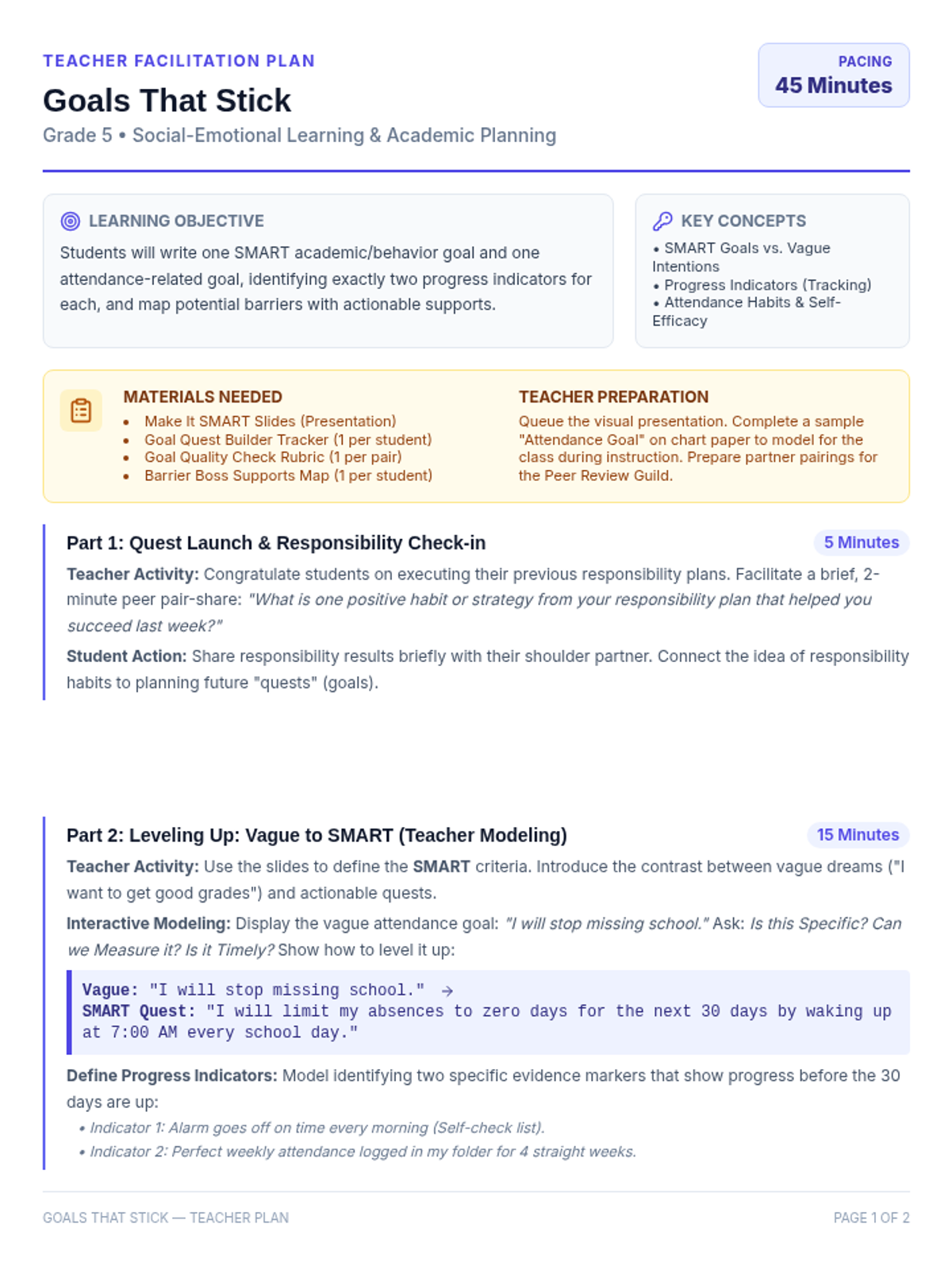
A comprehensive 2-page teacher-facing lesson plan and facilitation guide for the 45-minute SMART goal-setting lesson, featuring pacing, modeling scripts, and differentiation strategies.
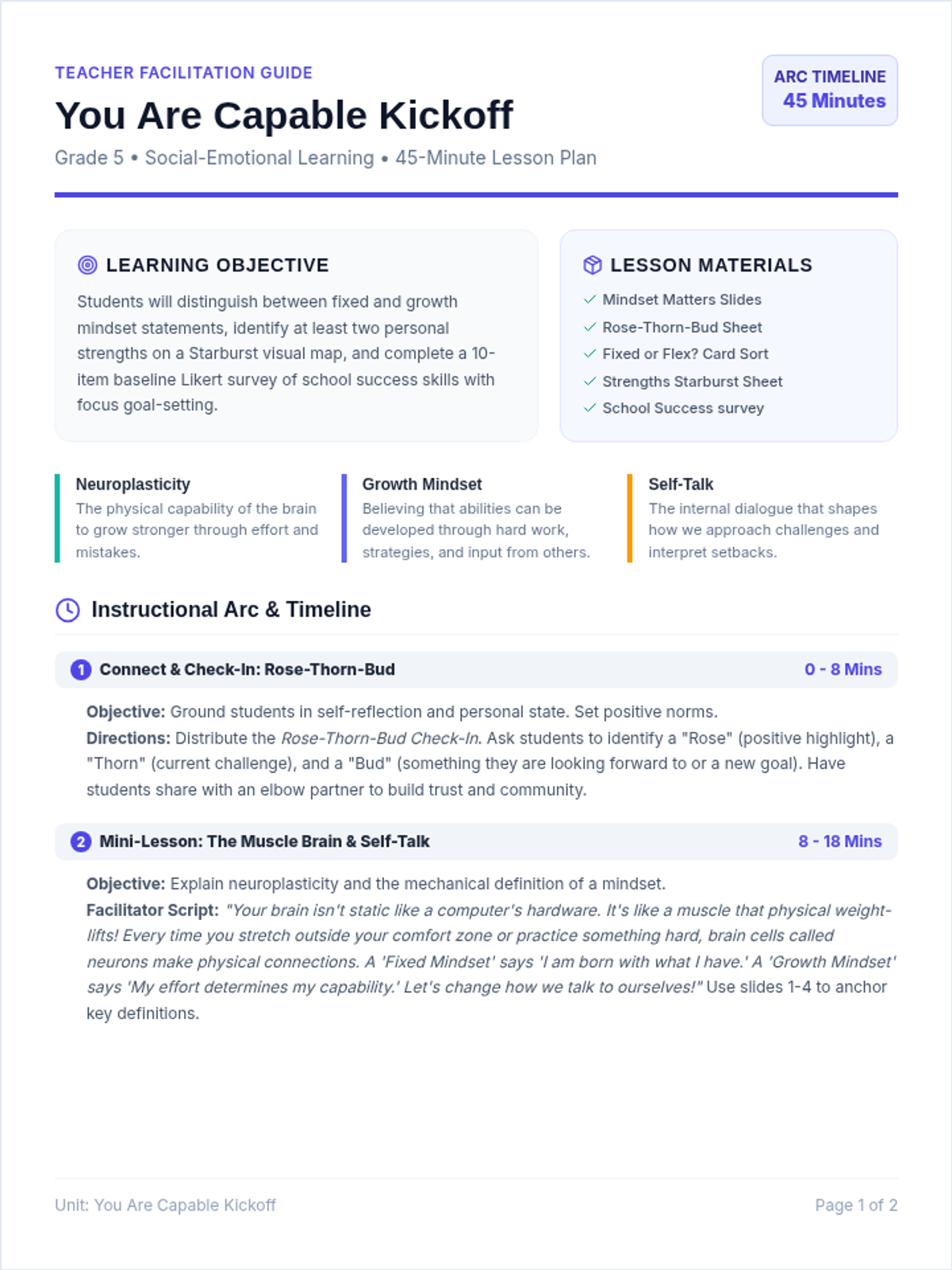
A comprehensive 2-page teacher facilitation guide for the 45-minute lesson, outlining pacing, script guidelines, materials setup, and assessment administration.
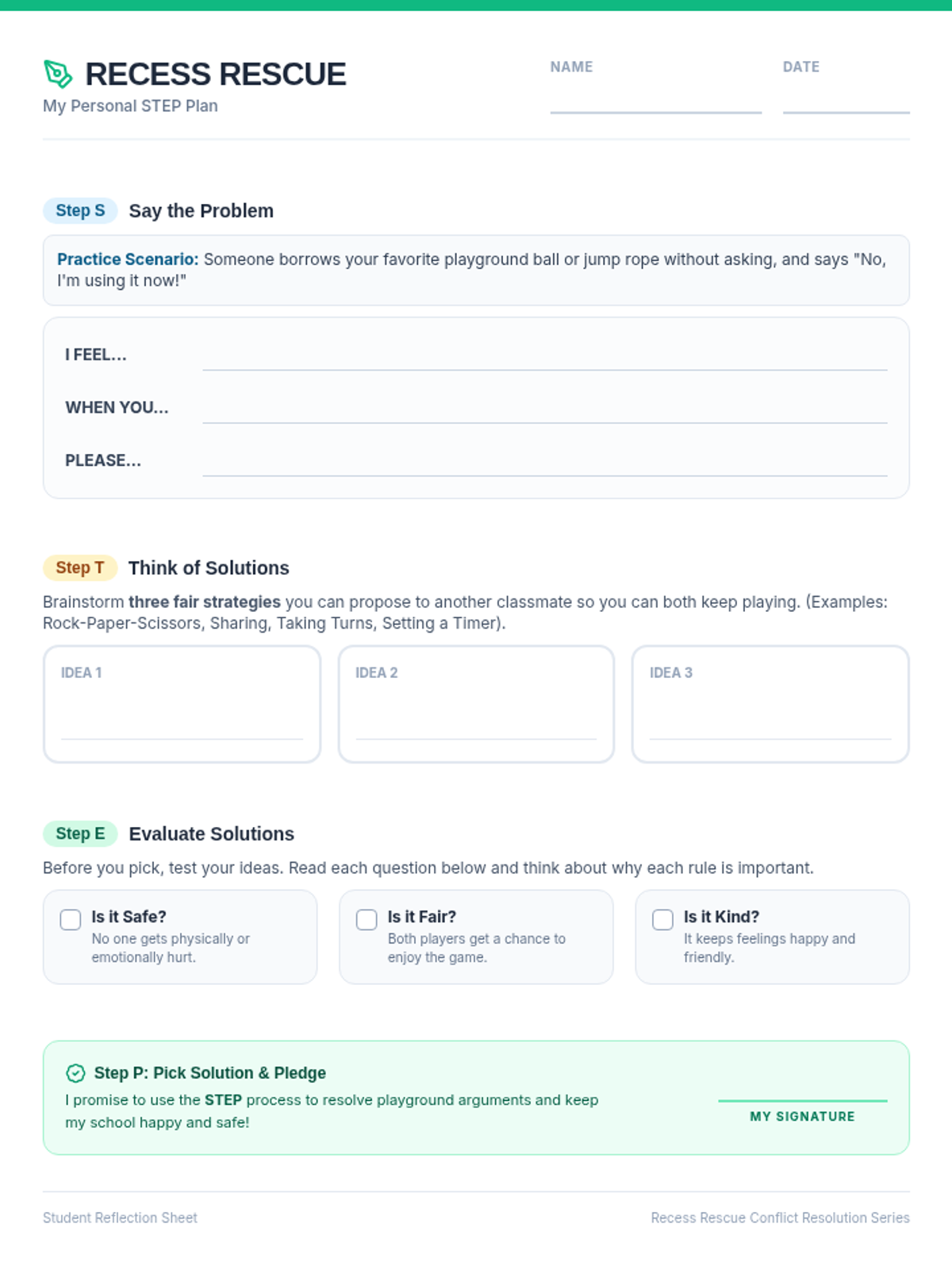
An individual student reflection sheet designed to accompany the Peace Path lesson. Students identify their personal cool-down strategies, practice writing I-Statements, and brainstorm win-win solutions.
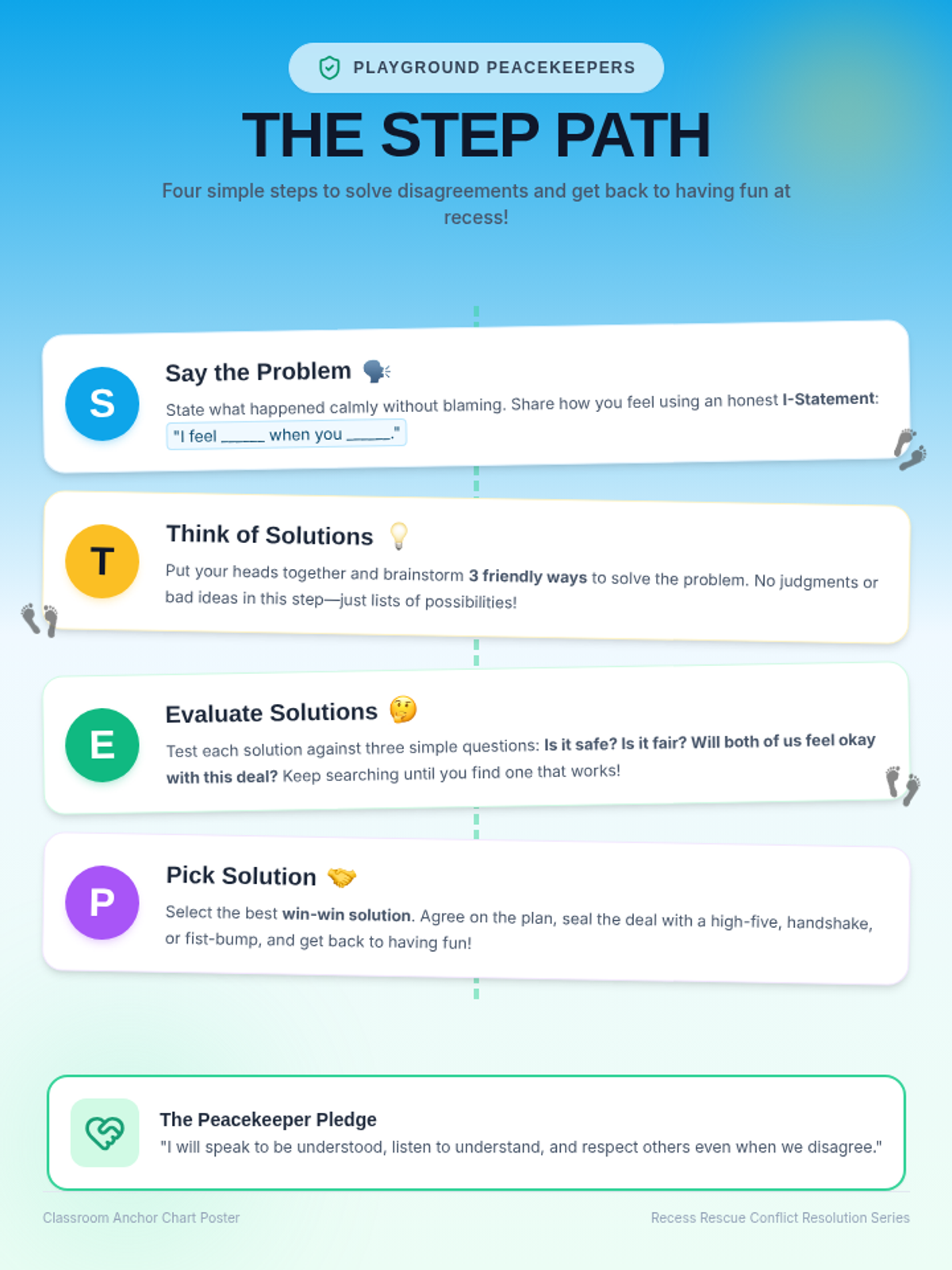
A colorful classroom anchor chart showing the step-by-step 'Peace Path' conflict resolution framework based on the STEP acronym, designed to be printed and displayed on the wall for student reference.
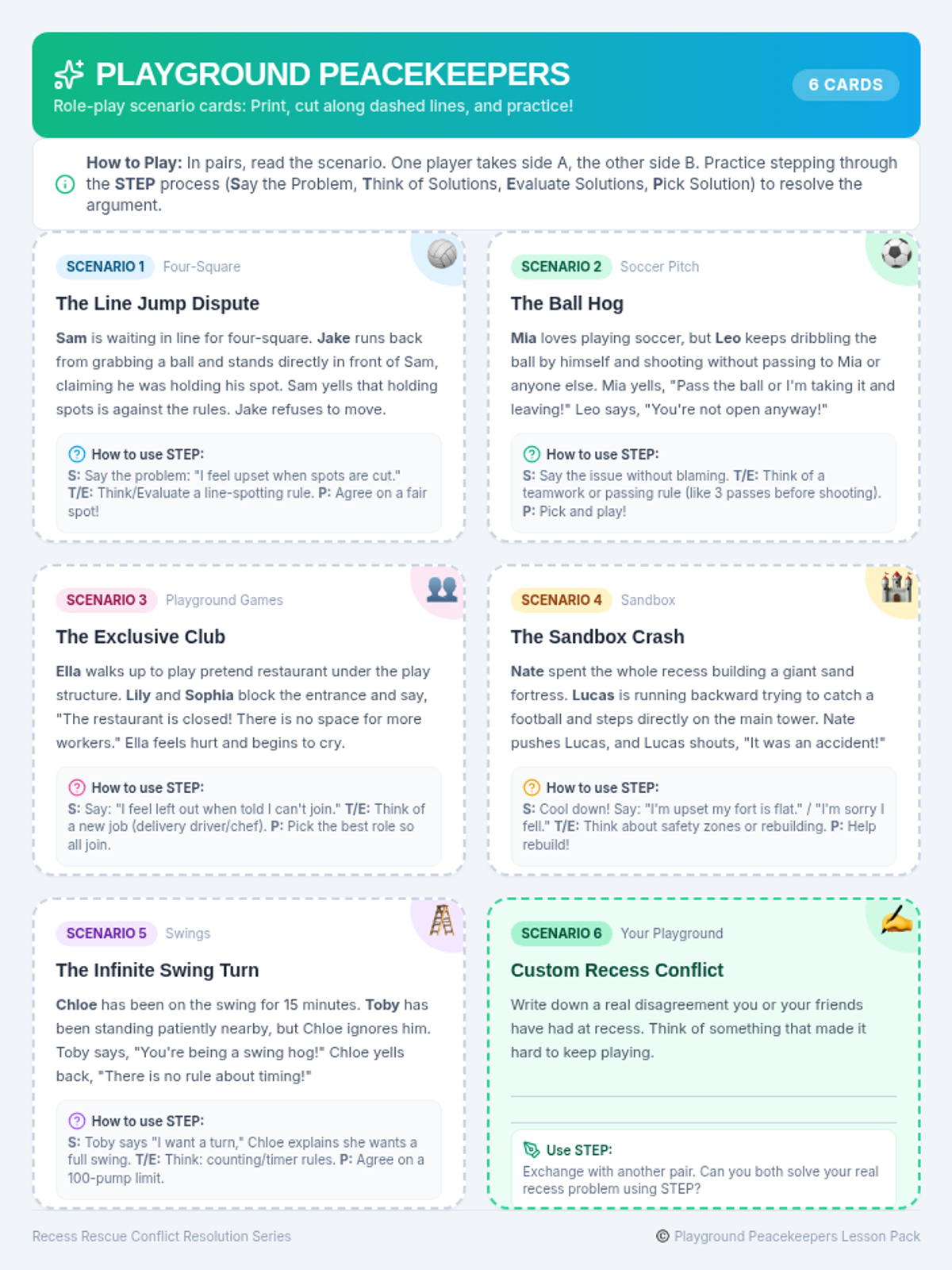
Printable role-play scenario cards designed to help students practice resolving common playground disagreements using the STEP framework. Contains 6 cards (5 realistic scenarios and 1 write-your-own).
An interactive slide deck introducing the 'STEP' conflict resolution model (Say the Problem, Think of Solutions, Evaluate Solutions, Pick Solution). Includes visual steps, reflection prompts, and discussion scenarios for elementary students.