A professional 4-page syllabus for 3rd grade students and parents in North Carolina. It details ELA and Math EOG standards with clear explanations of what each standard means and specific requirements for student success.
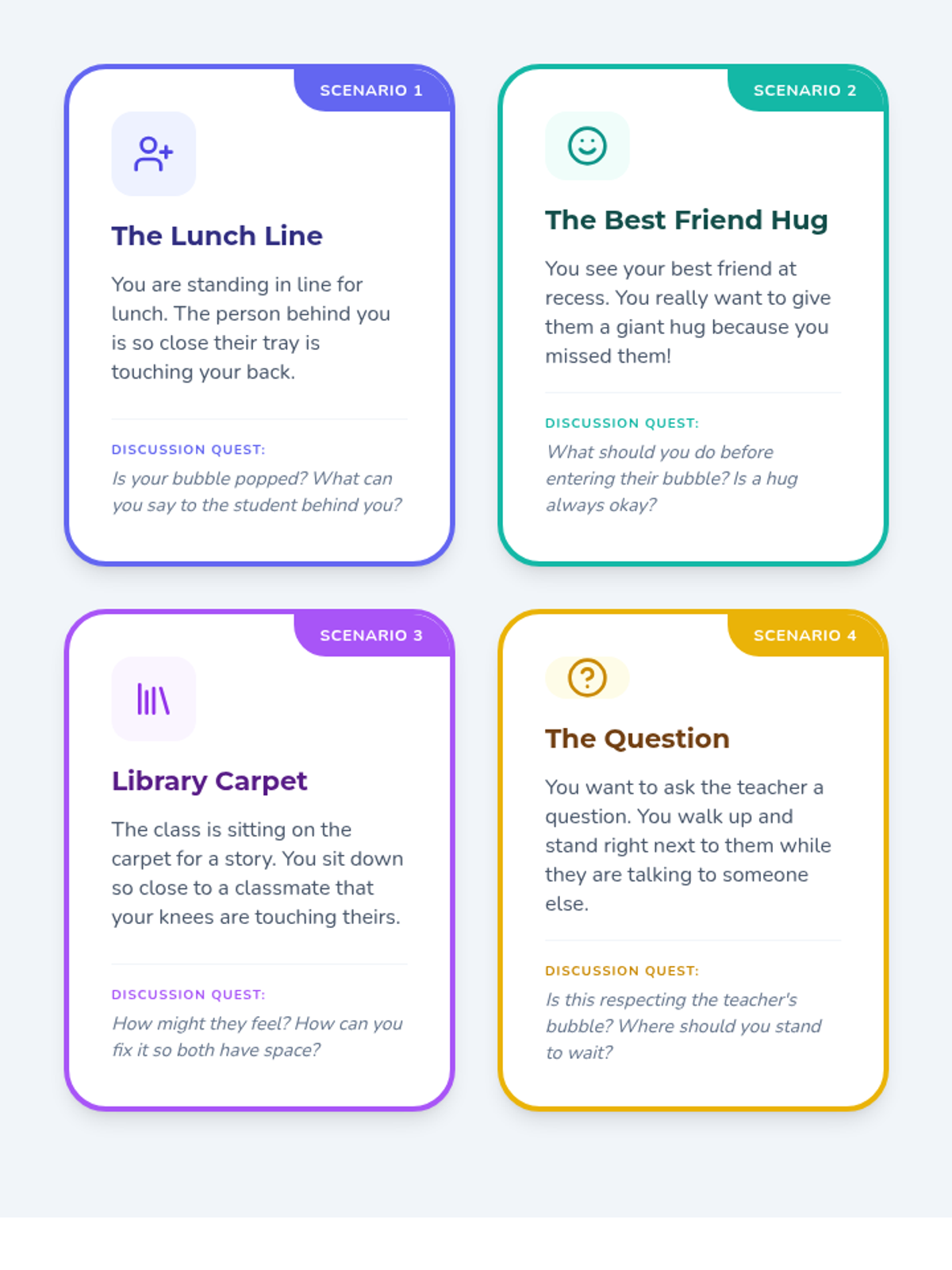
A set of four scenario-based discussion cards to help students practice identifying personal space boundaries. Revised with larger card heights to prevent text cutoff.
A comprehensive teacher's guide for the Bubble Boundary lesson, featuring learning objectives, a detailed instructional sequence, differentiation strategies, and discussion prompts. Revised with a closing ritual and better flow.
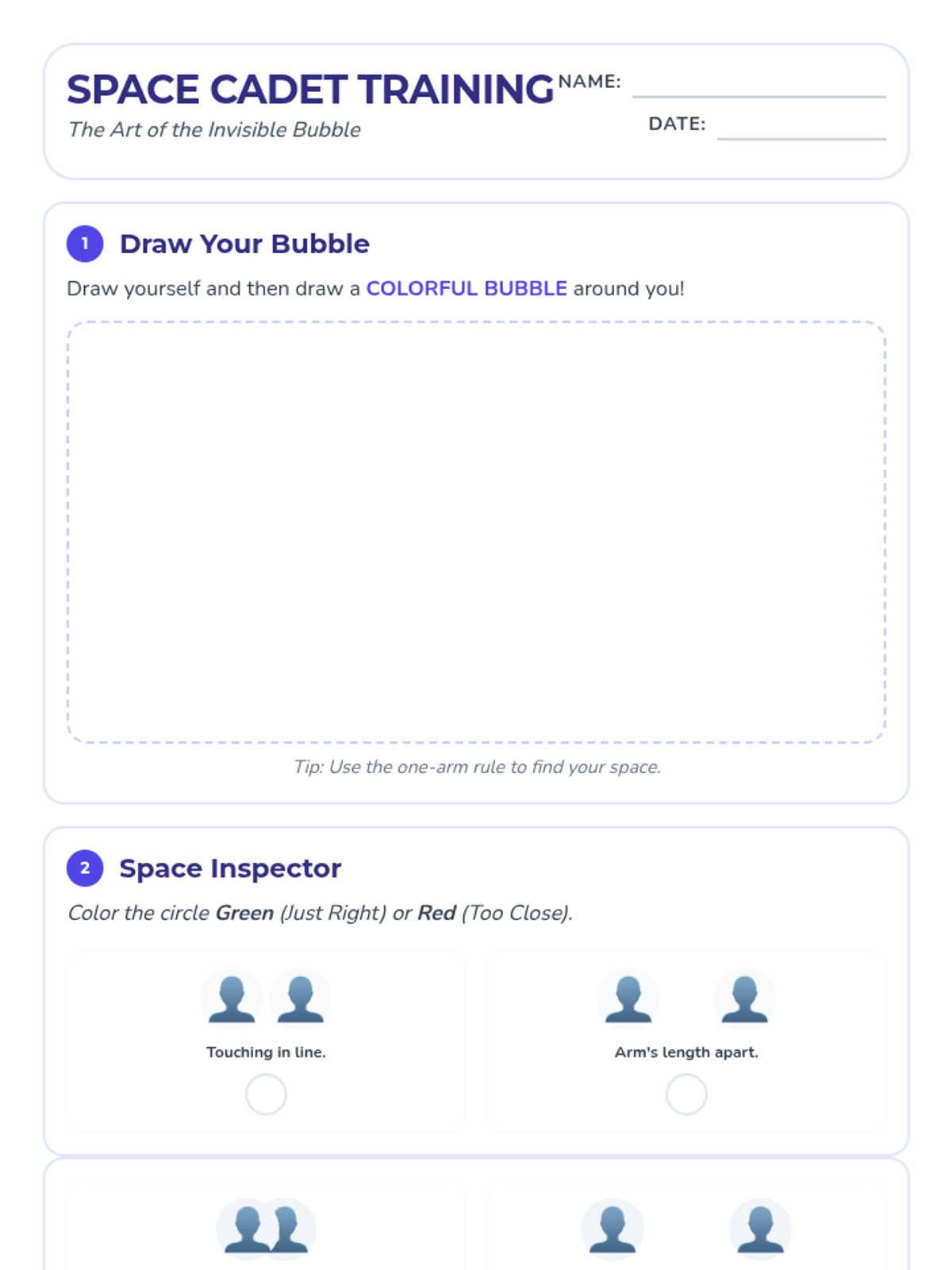
A student worksheet for 1st-3rd graders to practice identifying personal space boundaries. Includes a drawing activity, a scenario identification section, and reflection questions on setting boundaries. Revised for better printability and flow.
A visually engaging slide deck designed for 1st-3rd graders using an 'Invisible Bubble' theme to teach personal space concepts, the one-arm rule, and communication strategies for setting boundaries. Includes practice scenarios.
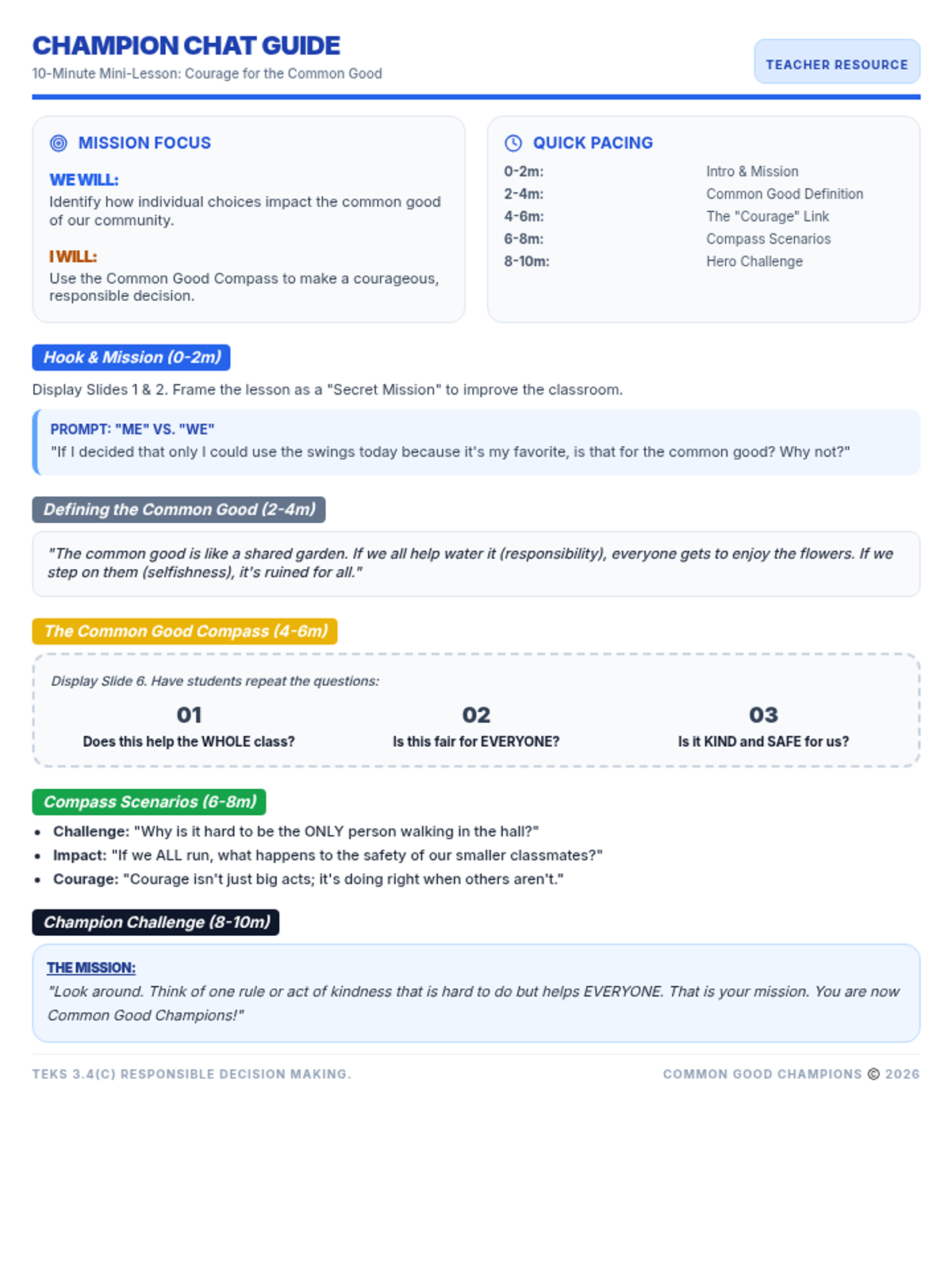
A comprehensive teacher's facilitator guide for the 10-minute Common Good lesson. Includes specific 'We Will' and 'I Will' mission statements, discussion prompts, time-stamped pacing, and deep-dive questions to link responsibility with courage. All content optimized for a single-page view.
A high-energy, 7-slide presentation designed for a 10-minute mini-lesson on courage and the common good. Includes a dedicated slide for 'We Will' and 'I Will' mission statements, interactive scenario challenges, and the 'Common Good Compass' decision-making framework.
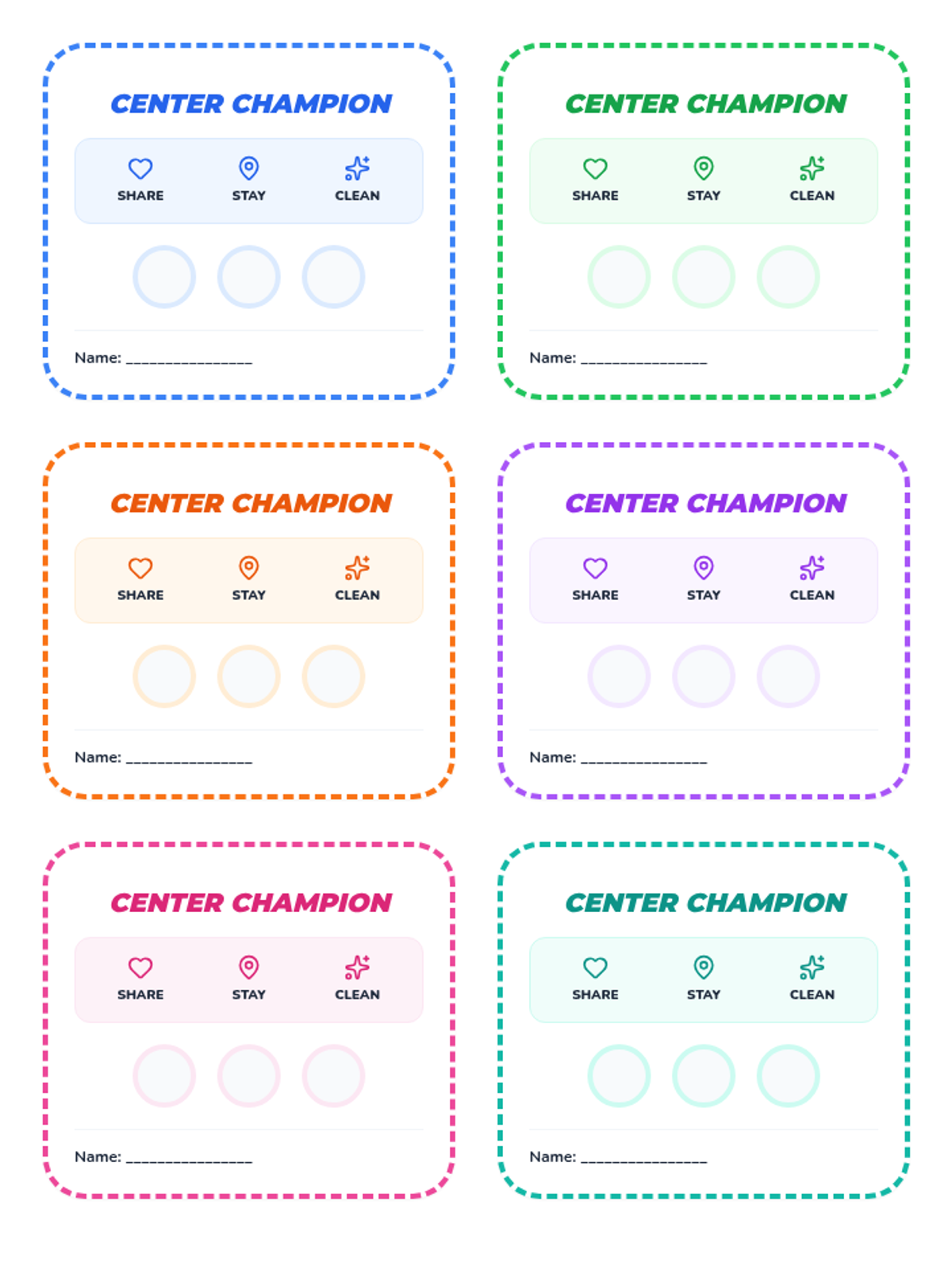
Printable incentive cards for Pre-K students to track their "Center Superstar" behaviors. Each card features space for 3 stickers or stamps, a behavioral checklist, and can be personalized with the student's name.
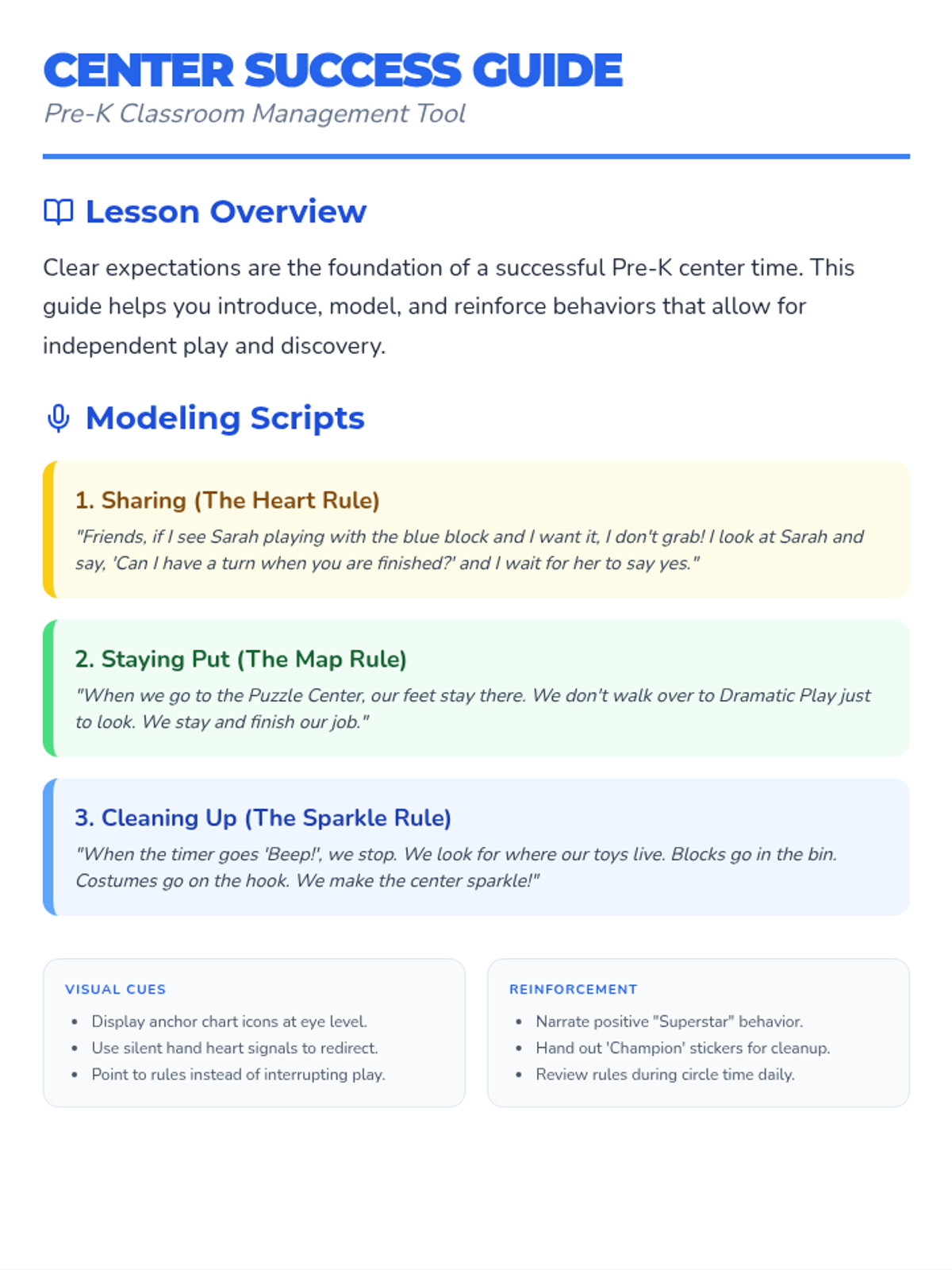
A comprehensive teacher's guide for introducing center expectations to Pre-K students. Includes modeling scripts, instructional tips, and troubleshooting strategies for common classroom challenges.
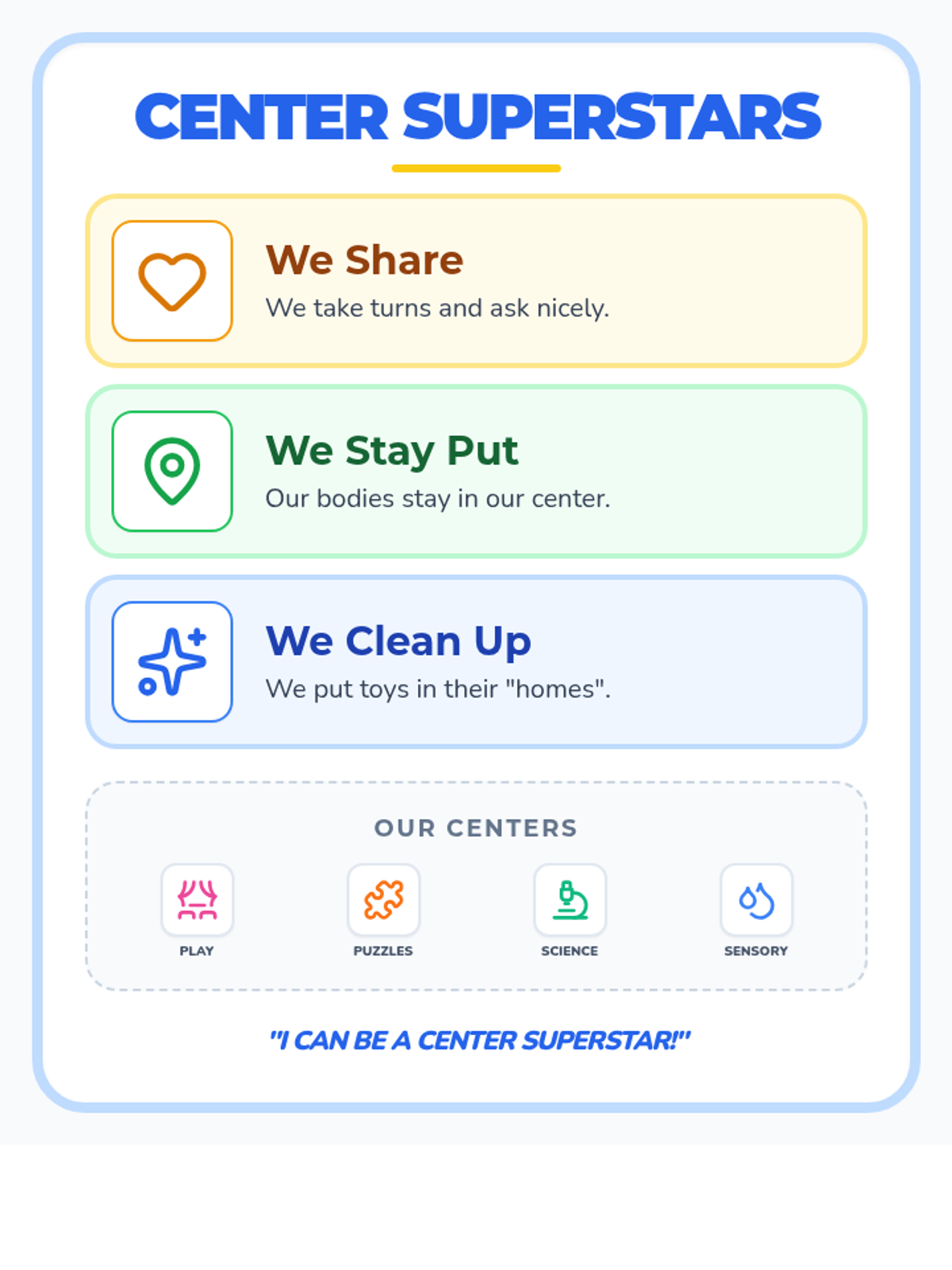
A visually engaging anchor chart for Pre-K classrooms that outlines key expectations for center time: sharing, staying in one area, and cleaning up. Includes simple icons and large text for early learners.
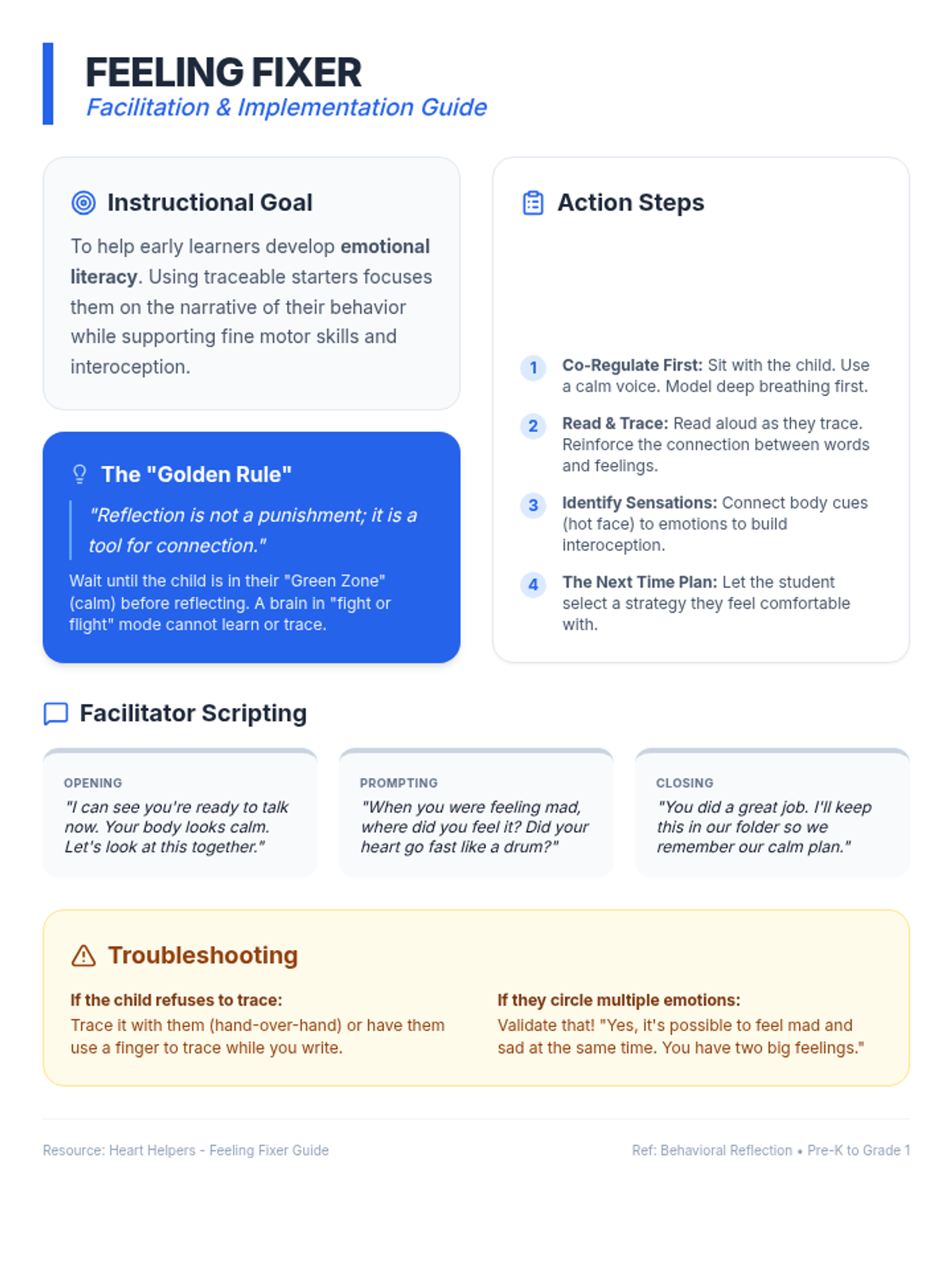
A teacher facilitation guide for using the Feeling Fixer reflection sheet, including implementation steps, instructional goals, and suggested scripts for supporting young children through big emotions.
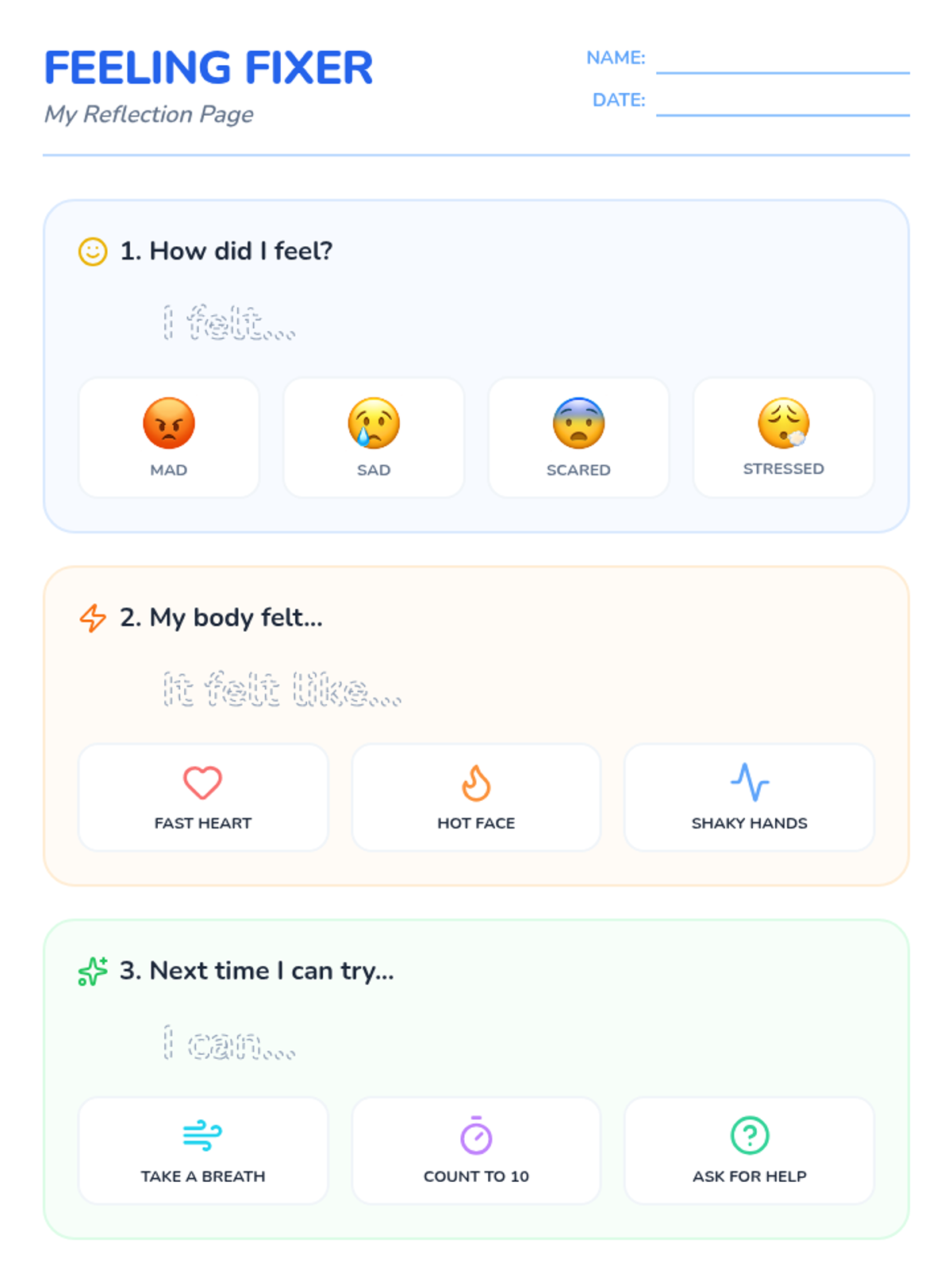
A behavior reflection worksheet designed for young children, featuring traceable sentence starters, emoji feelings indicators, and physical sensation icons to help students process big emotions.
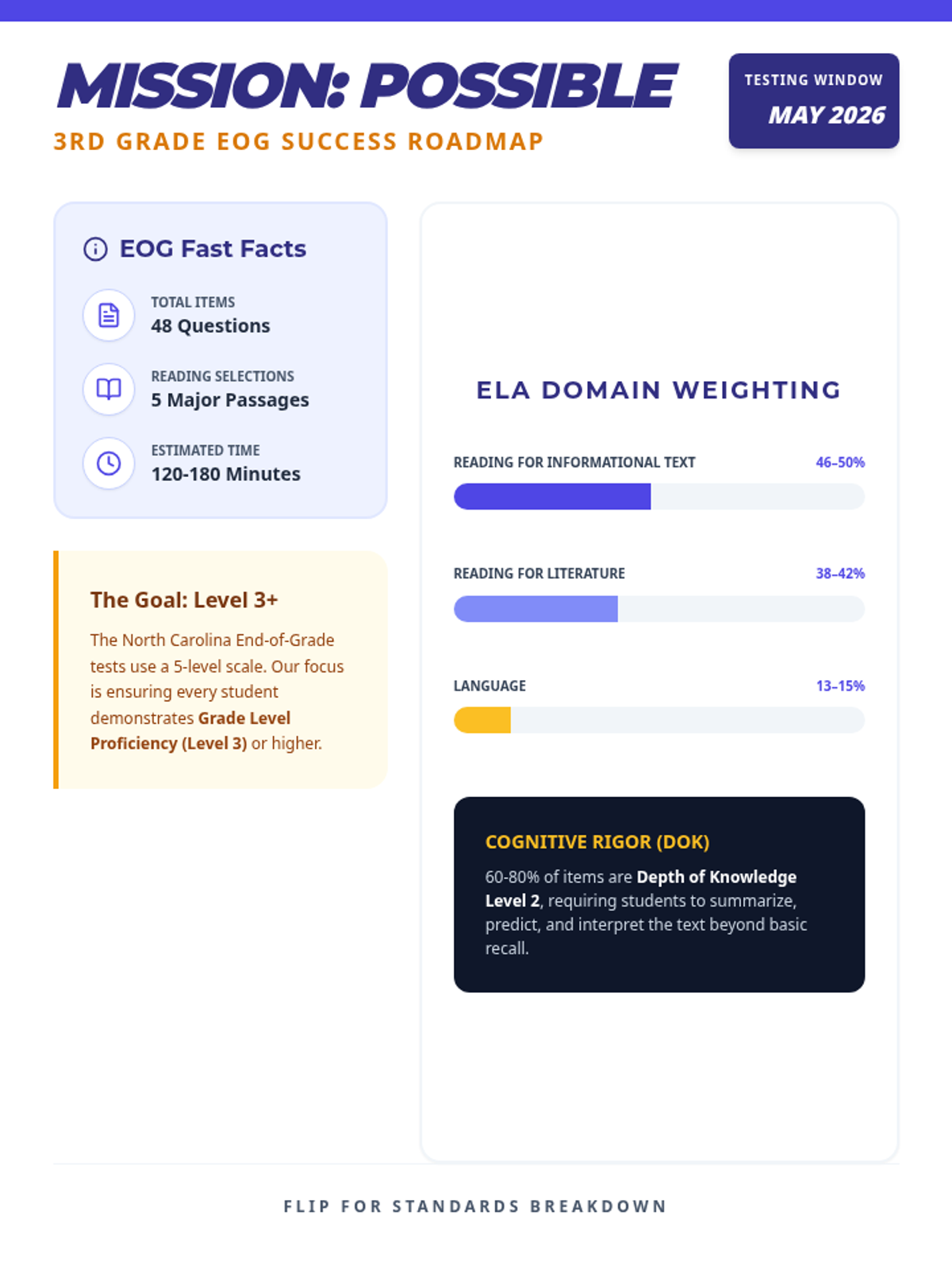
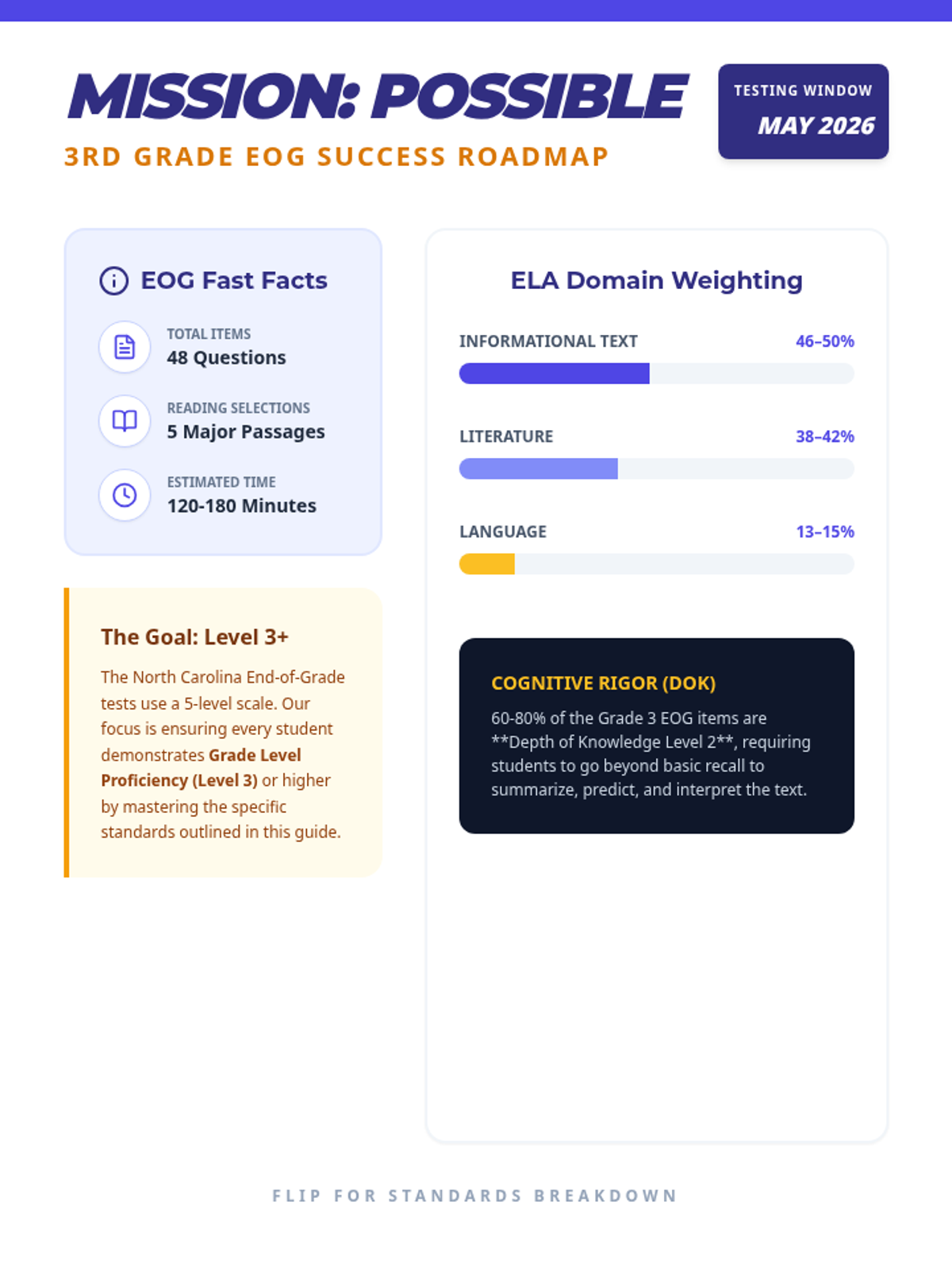
An EOG-focused 3rd Grade Success Roadmap for North Carolina students. It removes beginning-of-year introductions in favor of immediate test specifications, including item counts, domain weighting, and a detailed breakdown of RL, RI, and L standards from the state's official test specifications.
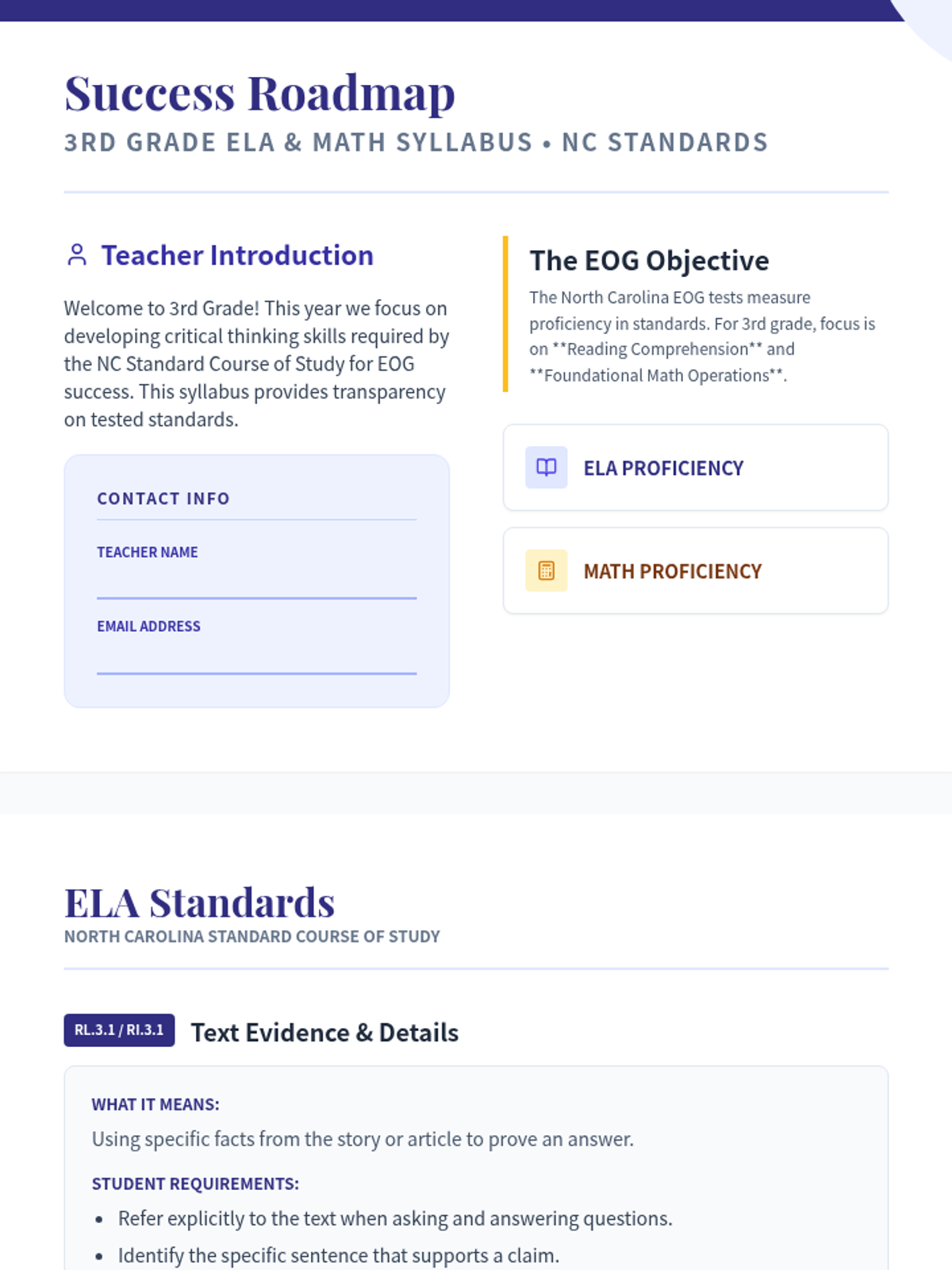
A professional 4-page syllabus for 3rd grade students and parents in North Carolina. It details ELA and Math EOG standards with clear explanations of what each standard means and specific requirements for student success. This version features corrected layout, improved signature areas, and reliable text formatting for math expressions.
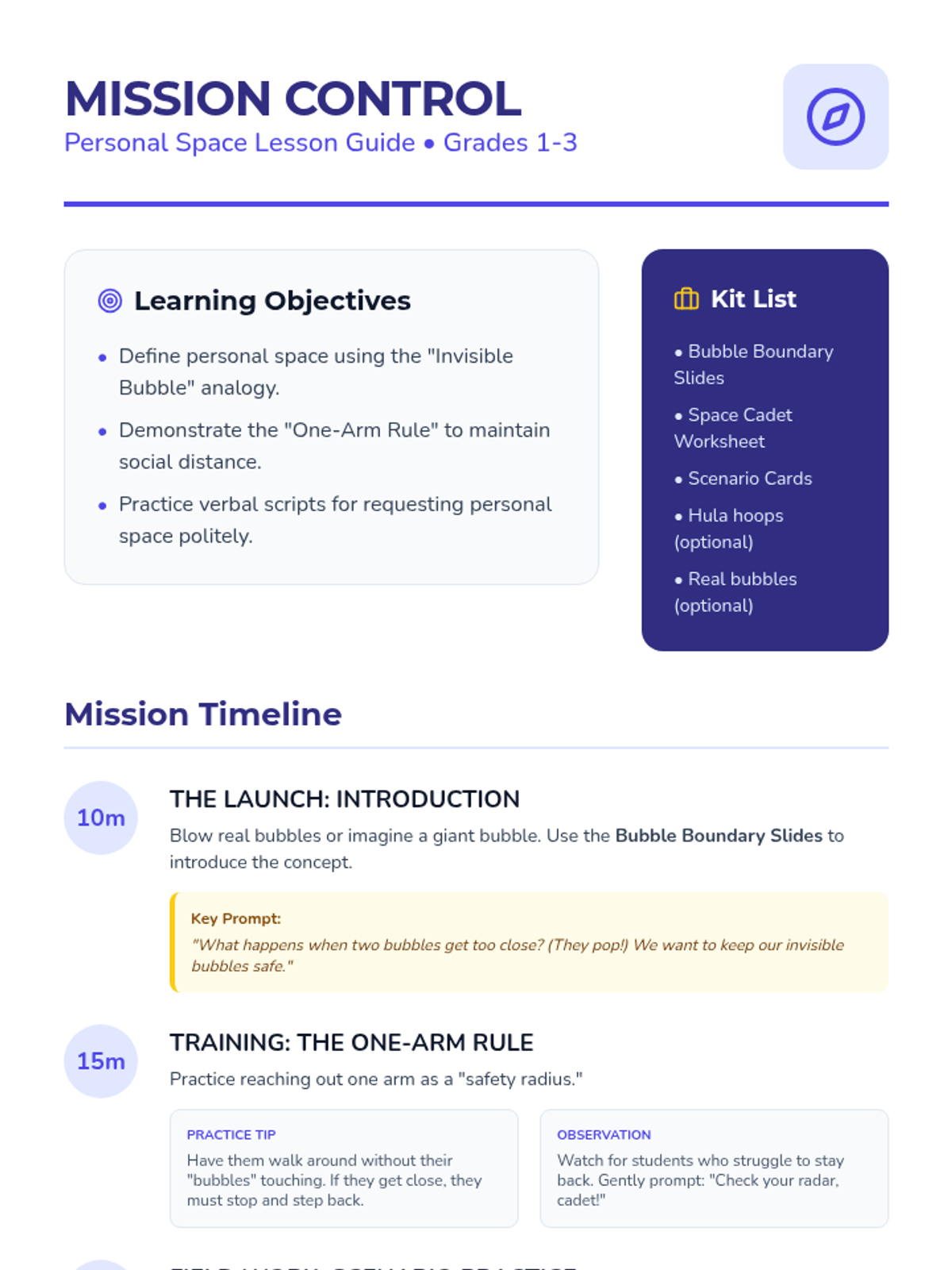
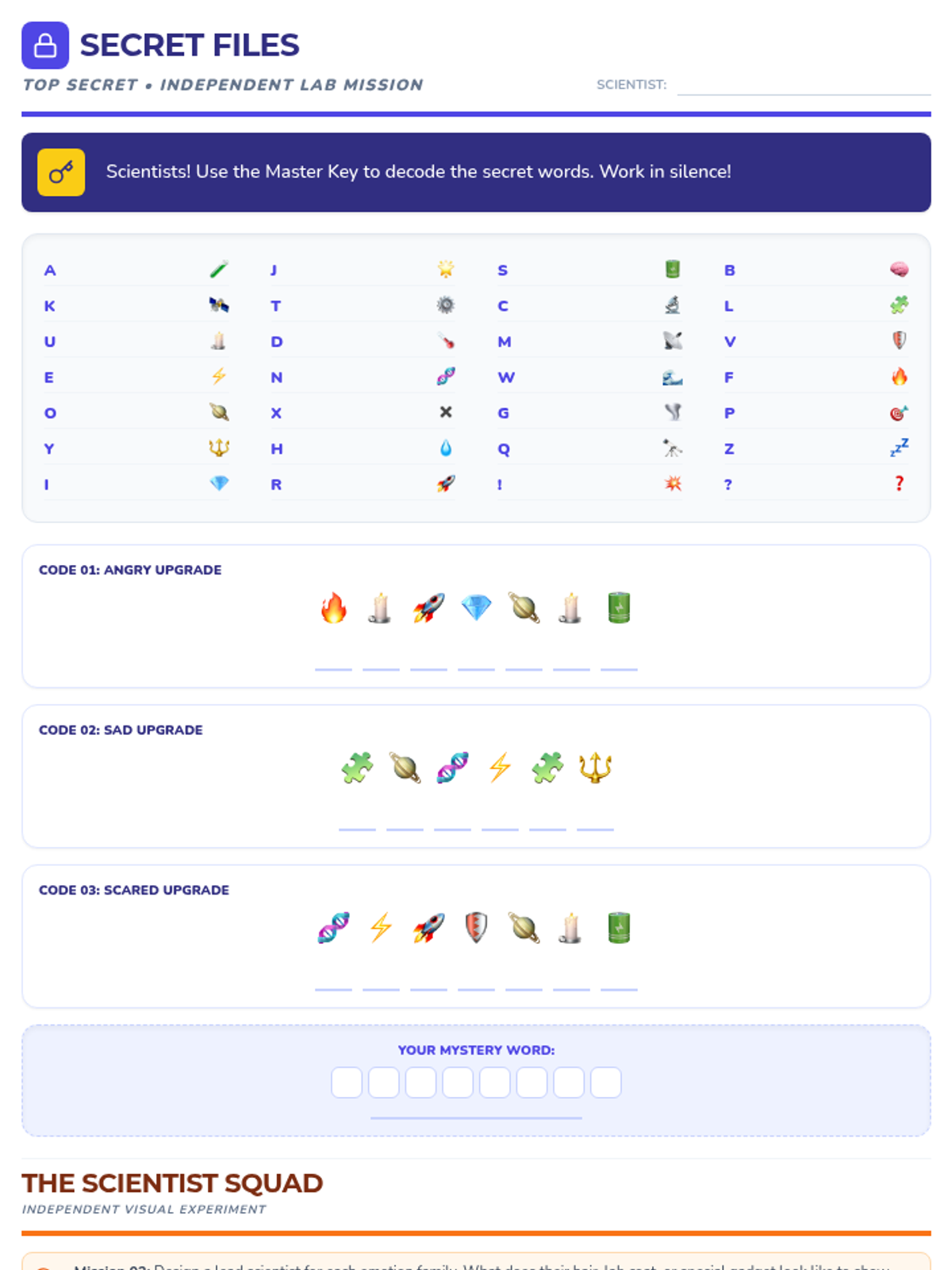
A fun, independent 'fast-finisher' activity set for P4 and P4/5. Features a secret emotion cipher to decode complex vocabulary and a creative drawing task to design 'Emotion Scientists' for each of the five main emotion families. Requires no teacher assistance. Improved layout for single-page cipher use and better contrast in work areas.
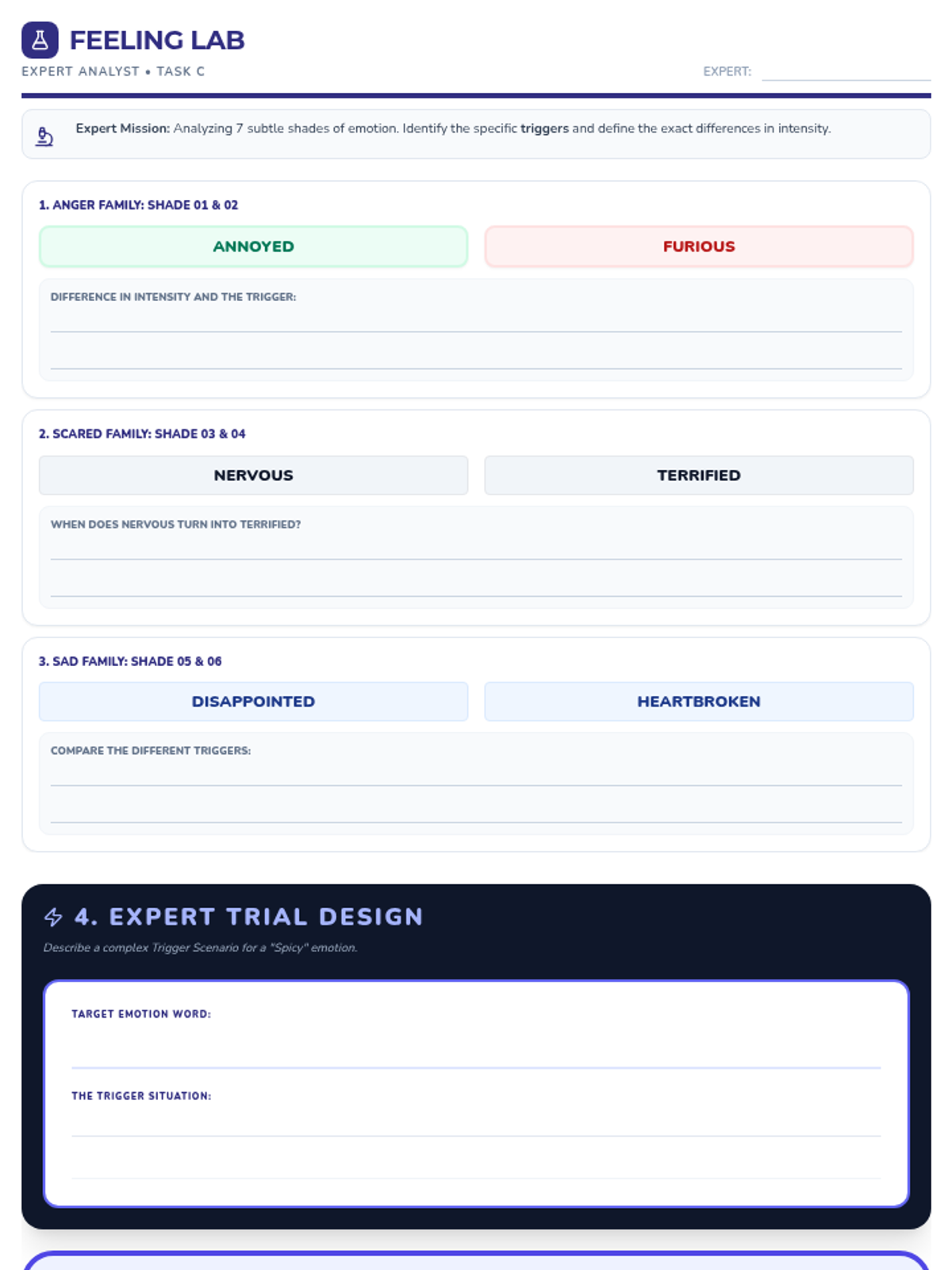
An extension P4/P5 worksheet (Expert Level) focusing on emotional nuance. Students analyze the subtle differences between similar synonyms and design their own scenarios based on specific emotional triggers. High academic challenge for advanced learners. Improved contrast and visual consistency across pages. Includes a blank 7-step ladder for expert analysis.
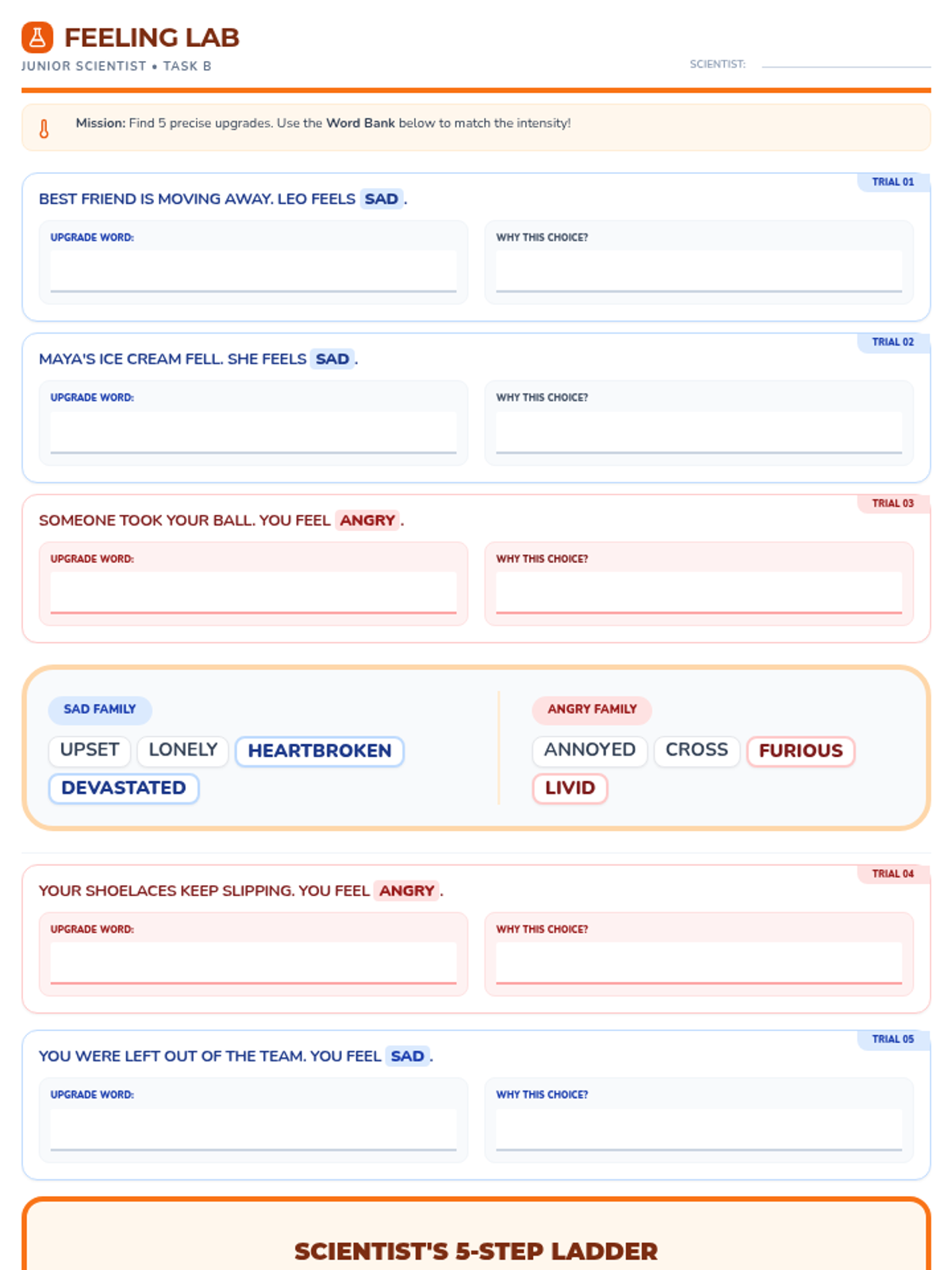
A core P4 worksheet (Junior Level) focused on vocabulary expansion. Features 5 scenarios (on multiple pages in standard print) where students must provide precise emotion upgrades and justifications, supported by a categorized word bank. Improved contrast and visual consistency across pages. Standardized labels and improved work areas. Includes a blank 5-step ladder for custom exploration.
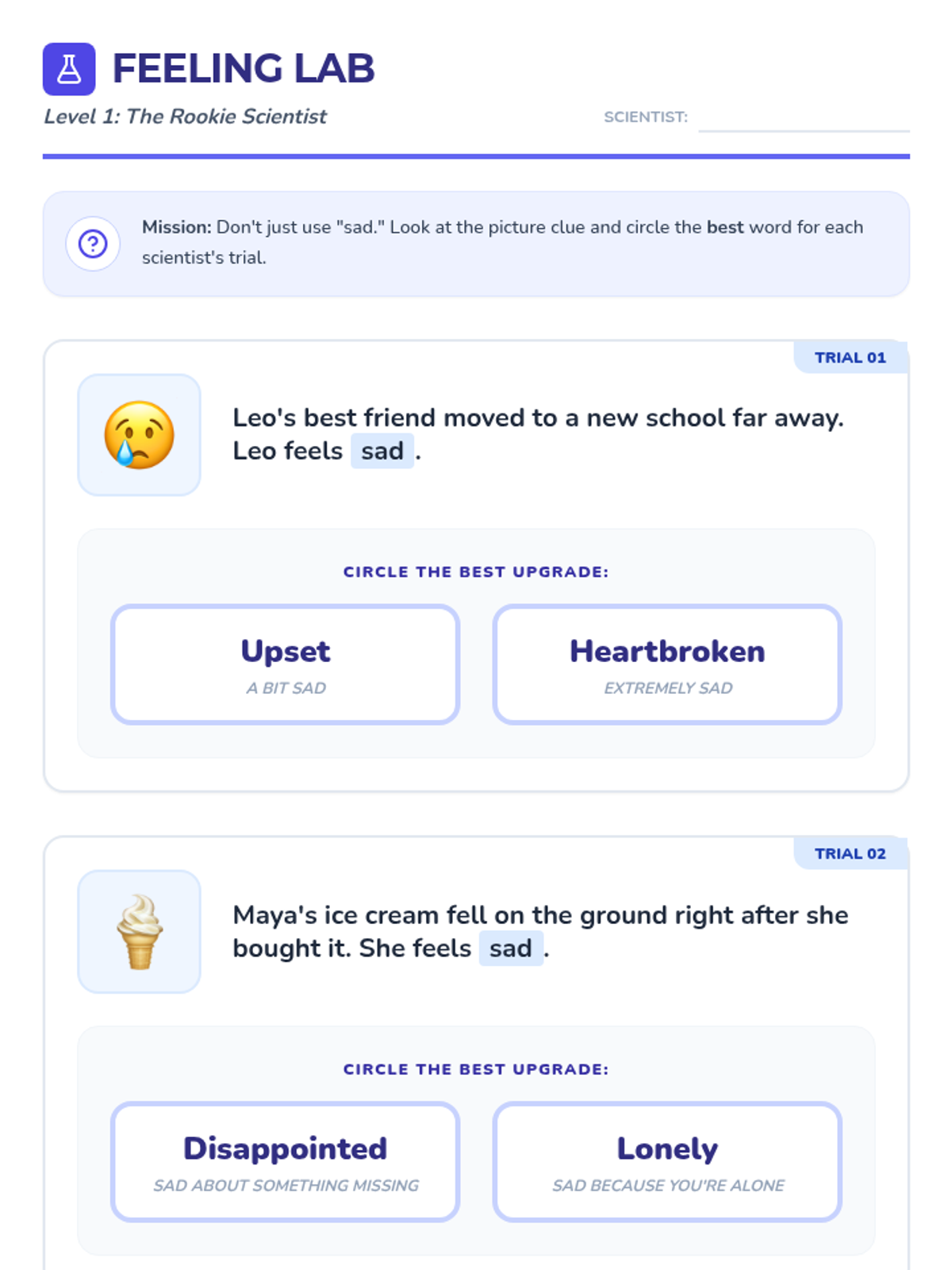
A P4 support worksheet (Rookie Level) designed for students with limited vocabulary or ESL needs. Features high visual scaffolding (emojis), simplified scenarios, and multiple-choice selections for emotion upgrades to lower the language barrier. Improved accessibility and visibility for classroom projection. Includes a blank ladder for student input.
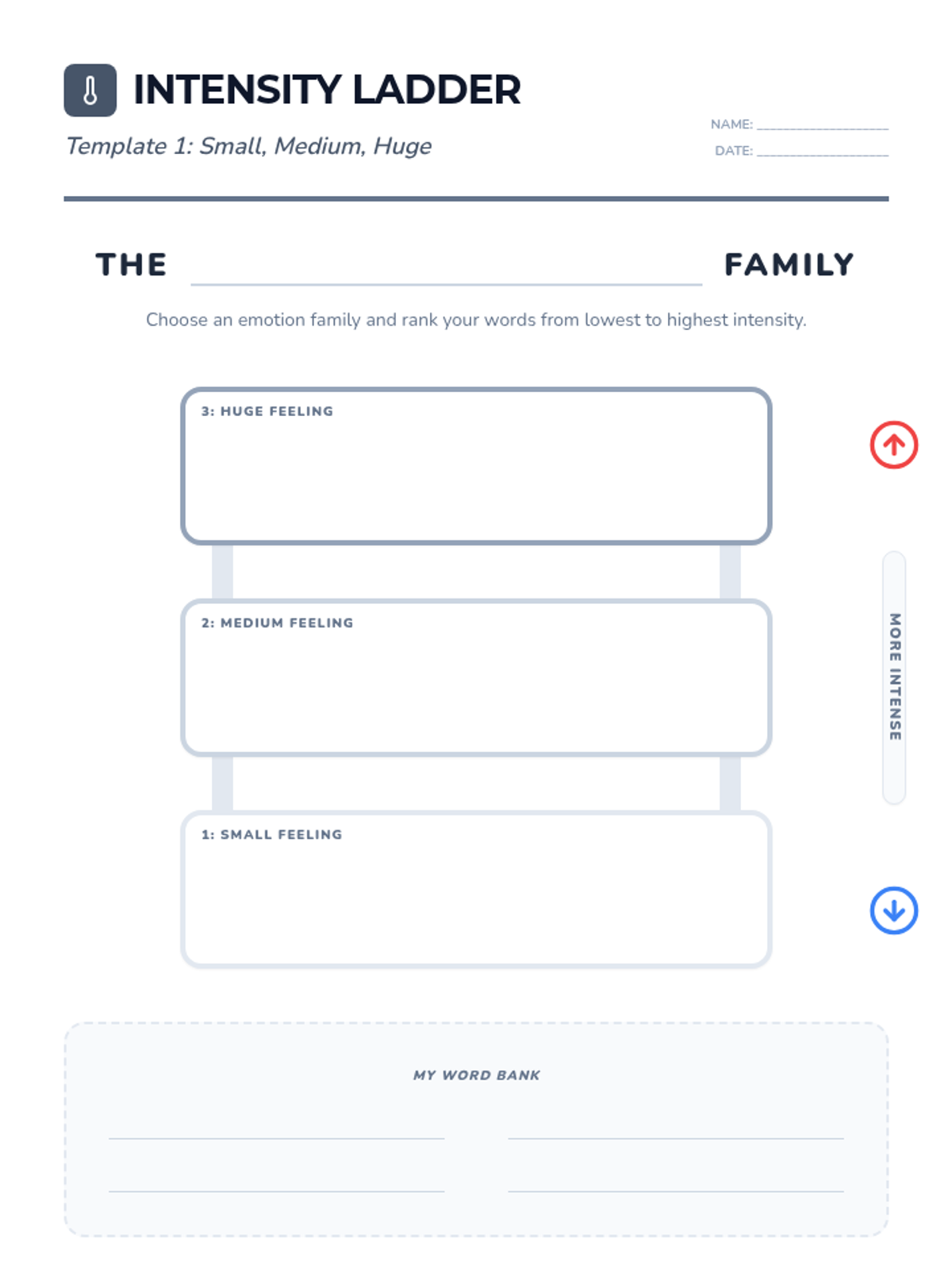
A set of three blank emotion intensity ladder templates (3, 5, and 7 steps). Students can choose their own emotion family, create a word bank, and rank feelings by intensity in the empty rungs.
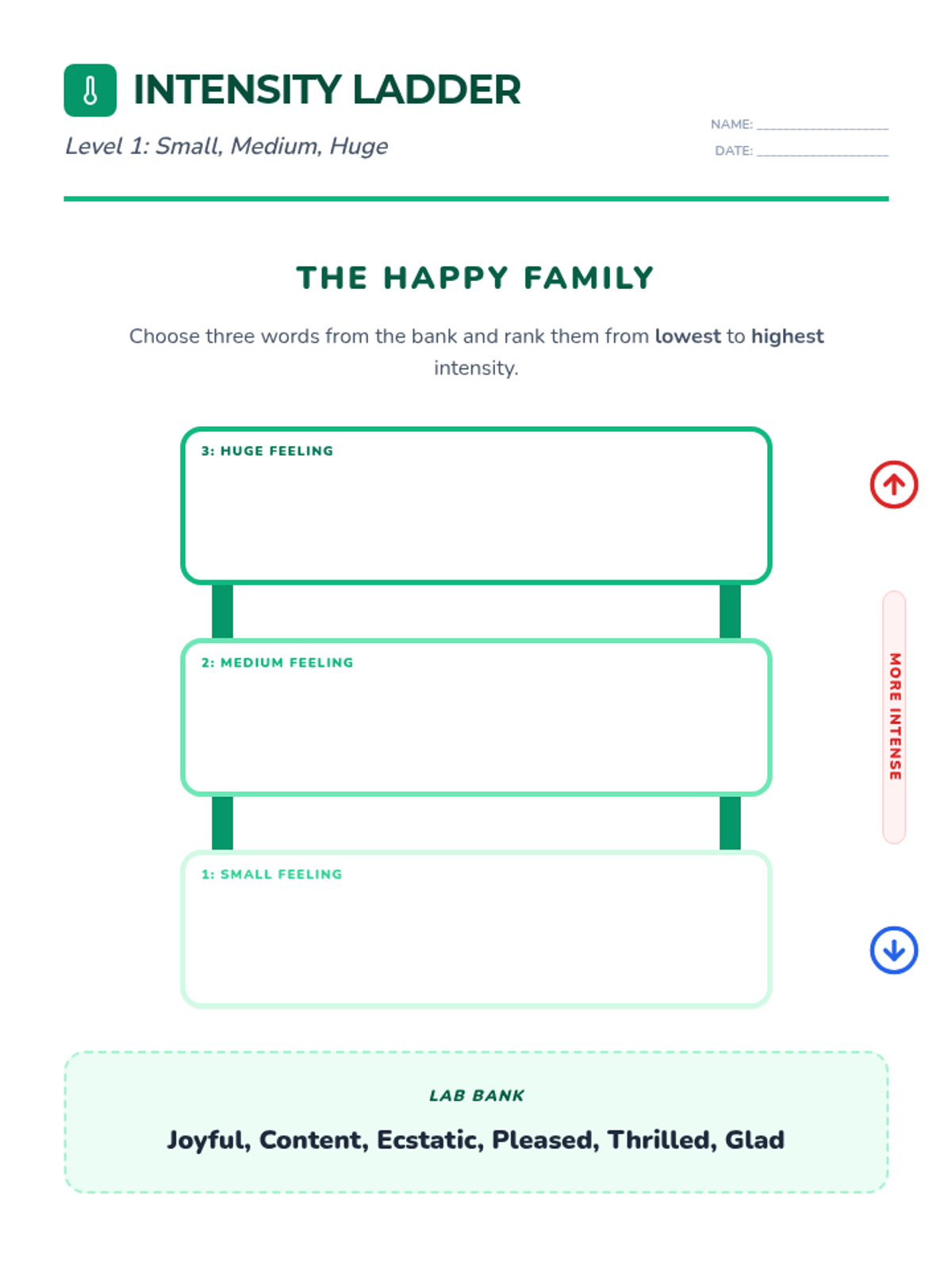
A set of three differentiated emotion intensity ladders (3, 5, and 7 steps). Each level focuses on a different emotion family (Happy, Angry, Scared) and provides a word bank for students to rank feelings by intensity. Improved contrast and visual consistency across pages.
Educational slides introducing the concept of 'emotion families' and emotional intensity. Features visual representations of different feeling categories, practice activities for vocabulary upgrades, and an introduction to differentiated 'Emotion Ladders'. Improved accessibility and visibility for classroom projection.
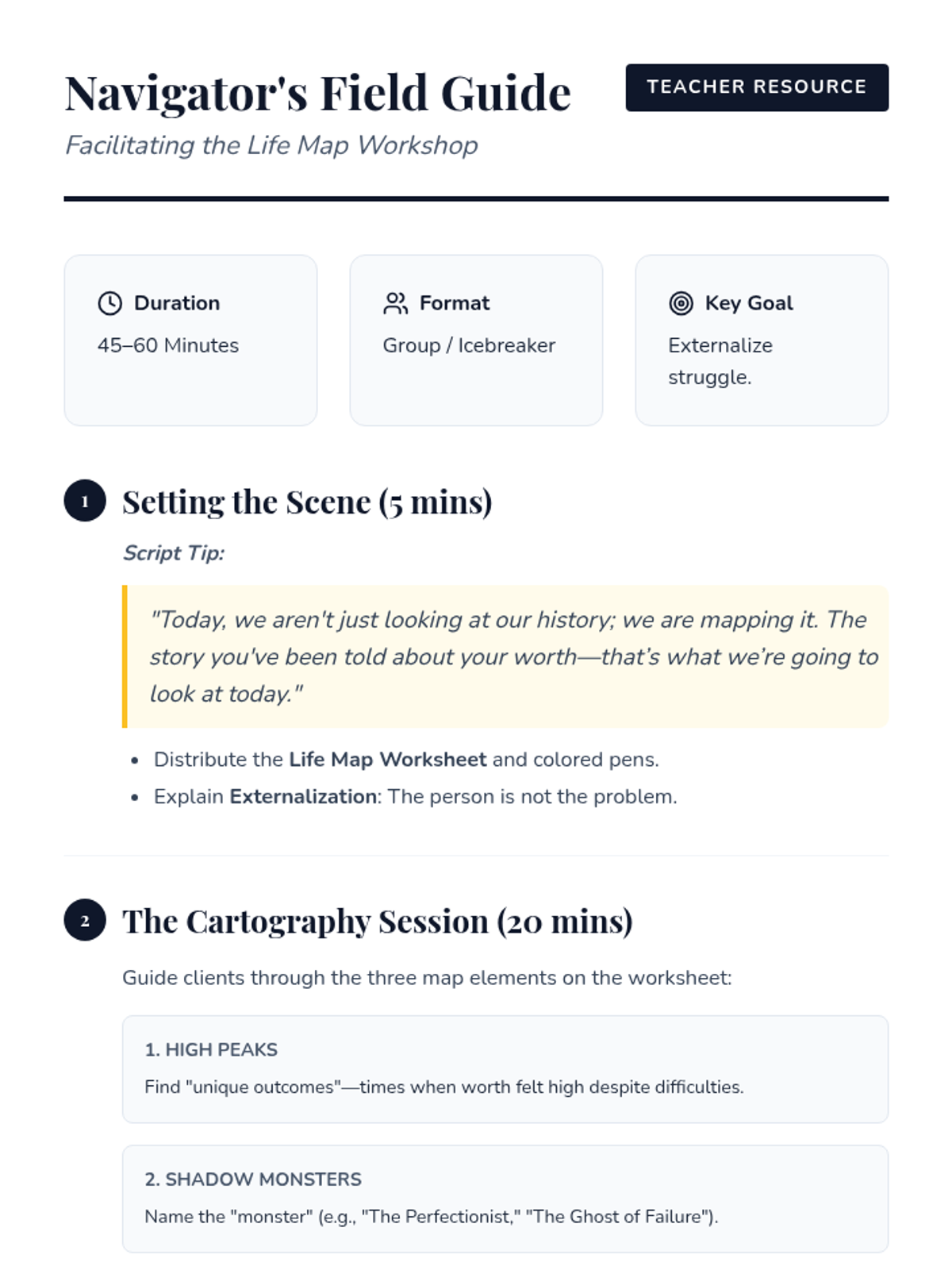
A facilitator guide for practitioners running the Narrative Navigators workshop, including scripts, pacing, and therapeutic de-brief prompts.
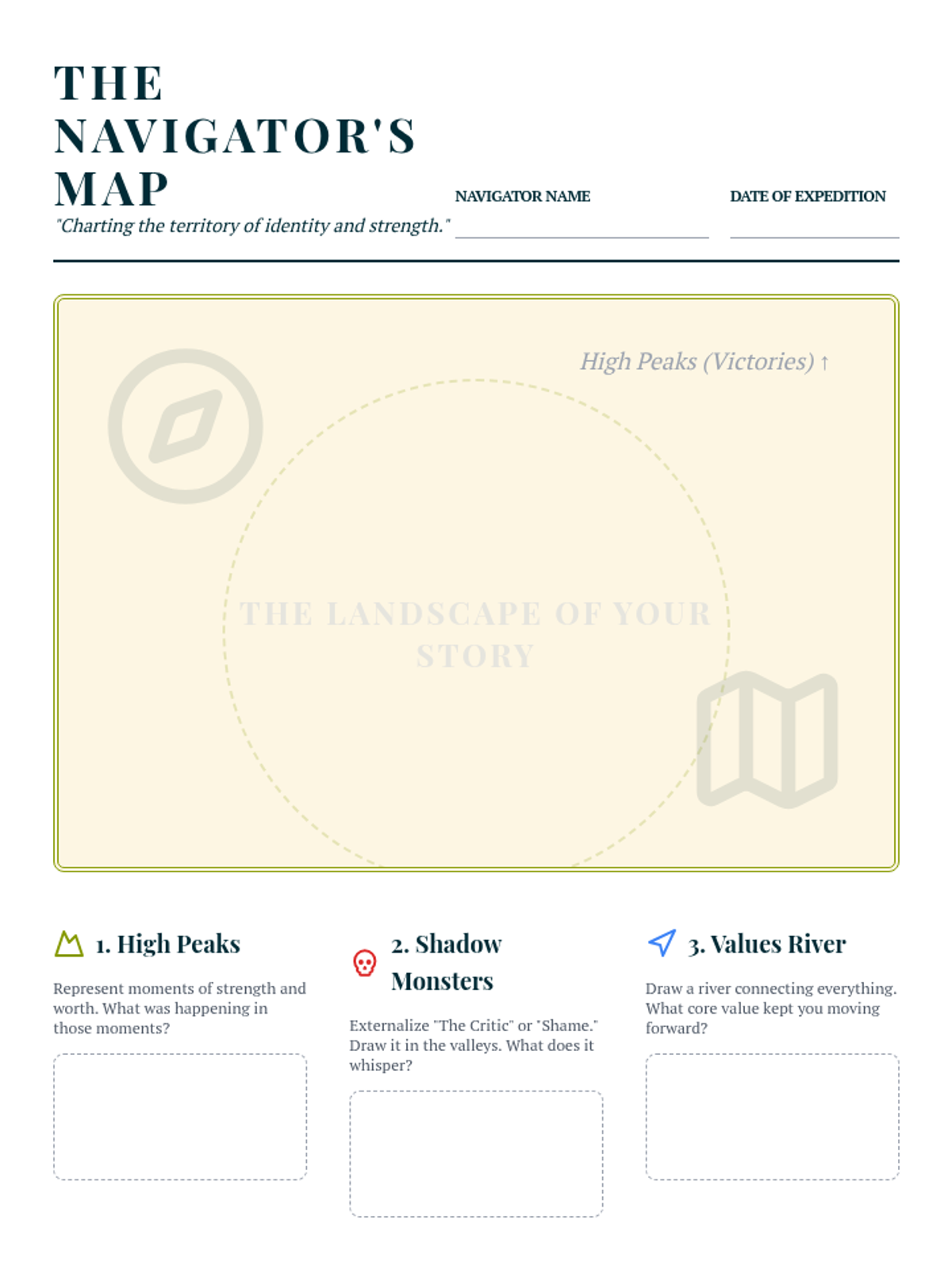
A printable creative worksheet for clients to draw their life journey, externalize self-worth challenges, and identify core values through a cartography-themed exercise.
A presentation to guide clients through the concepts of Narrative Therapy and the Life Map activity, featuring key concepts like externalization and re-authoring.
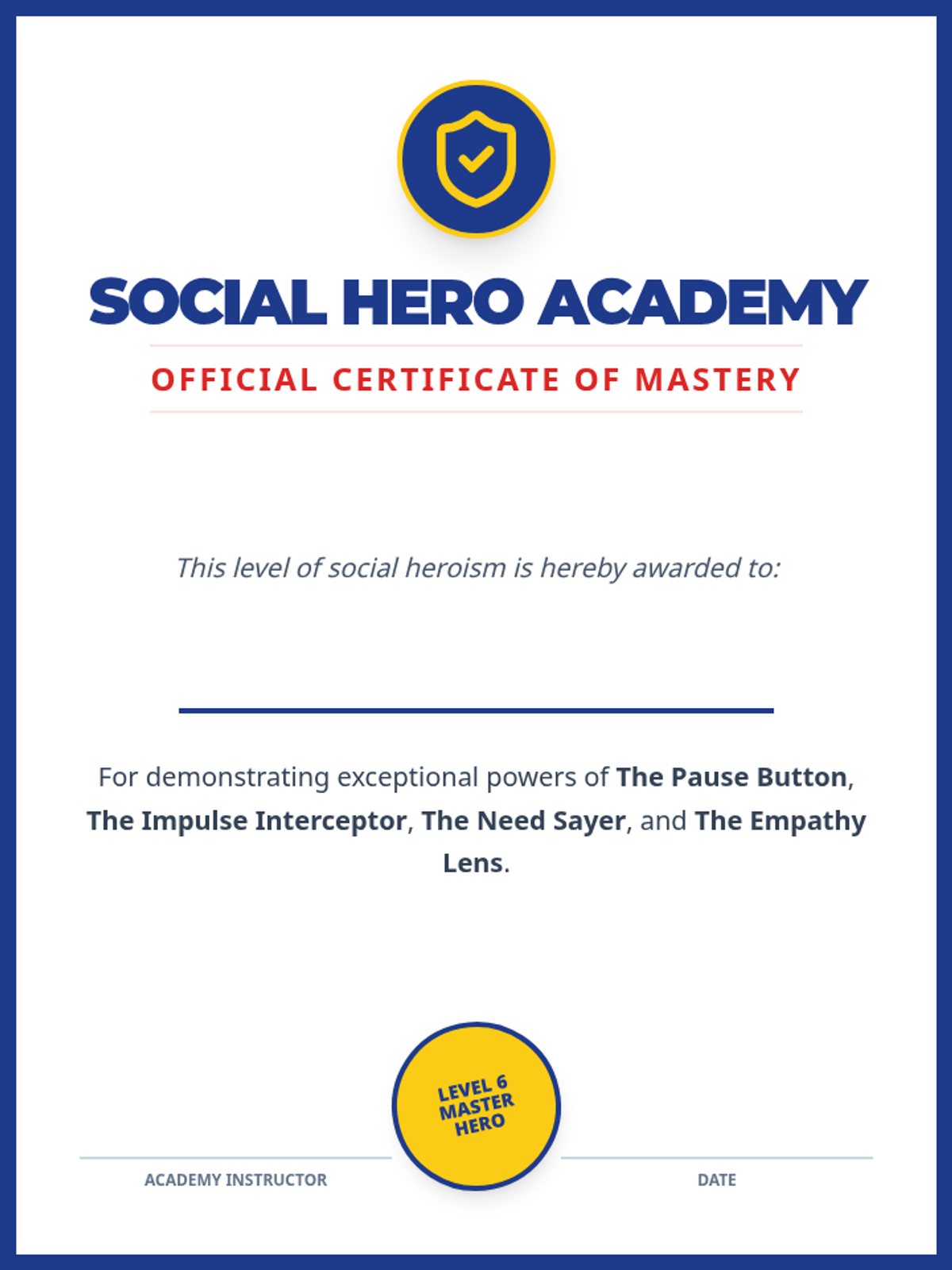
A professional graduation certificate for students who complete the 6-week Social Hero Academy curriculum.
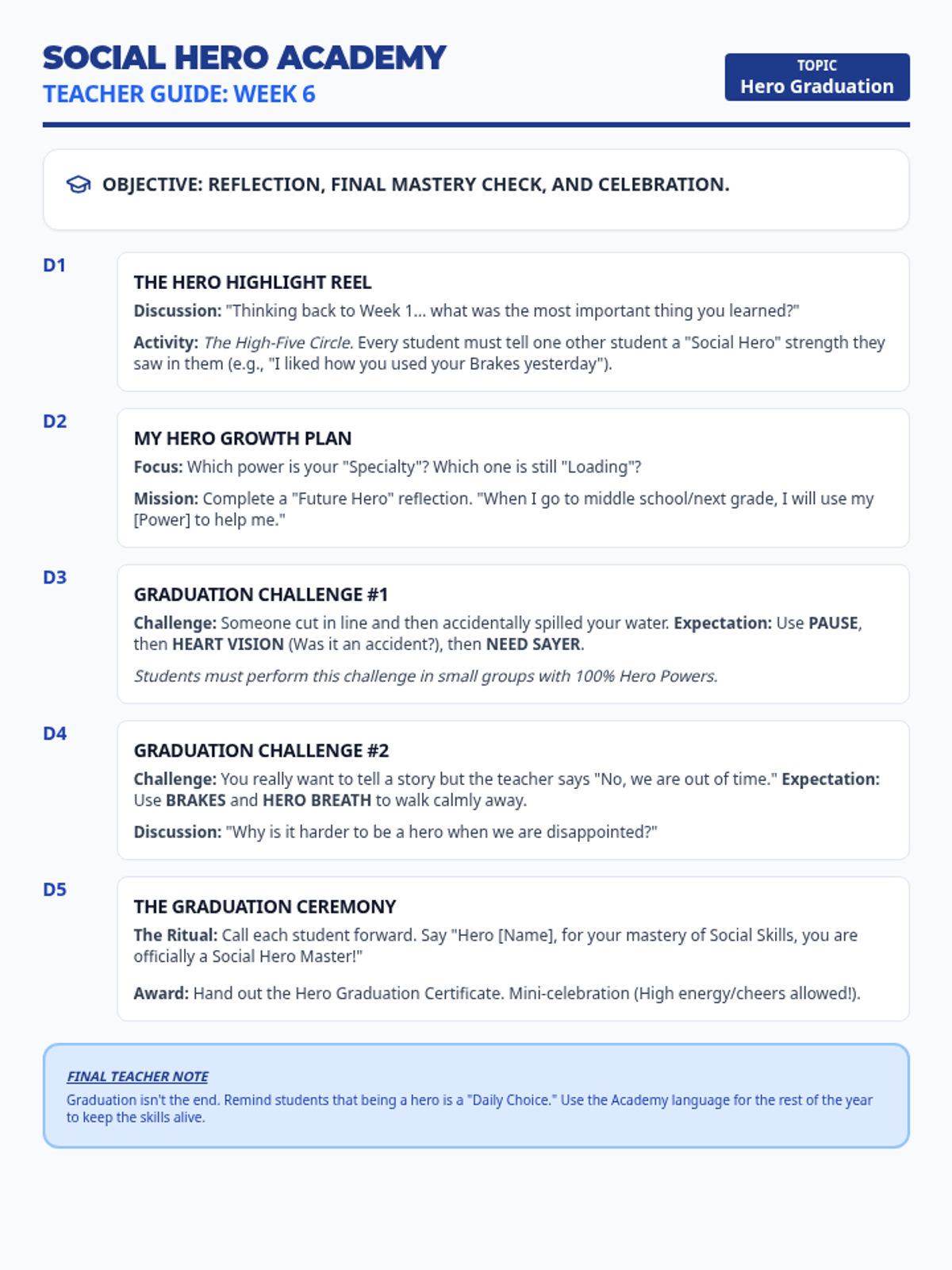
A 15-minute daily pacing guide for the final week of Social Hero Academy, focusing on reflection and graduation.
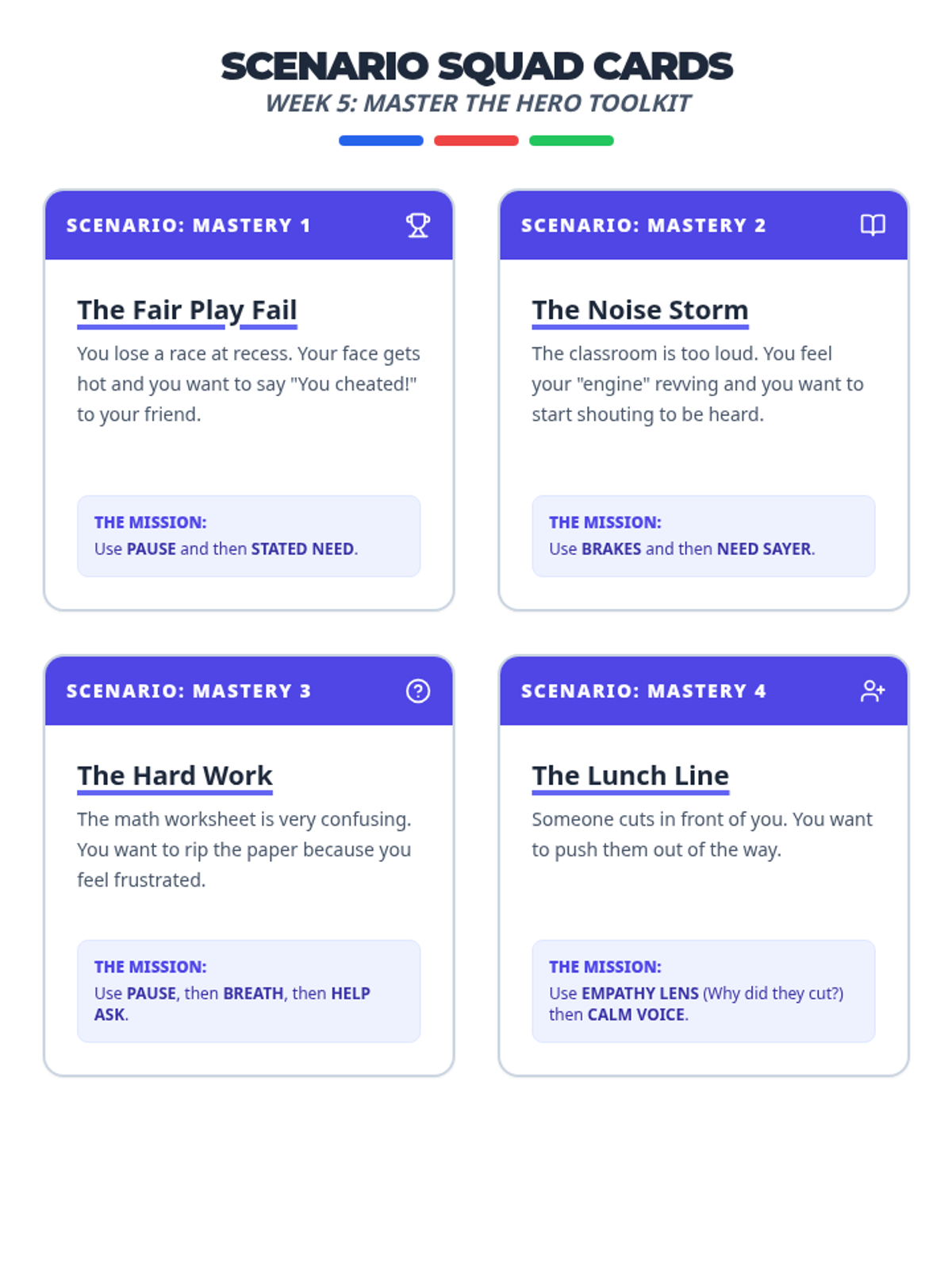
Advanced role-play cards for Week 5, requiring students to integrate multiple social hero skills to solve conflicts.
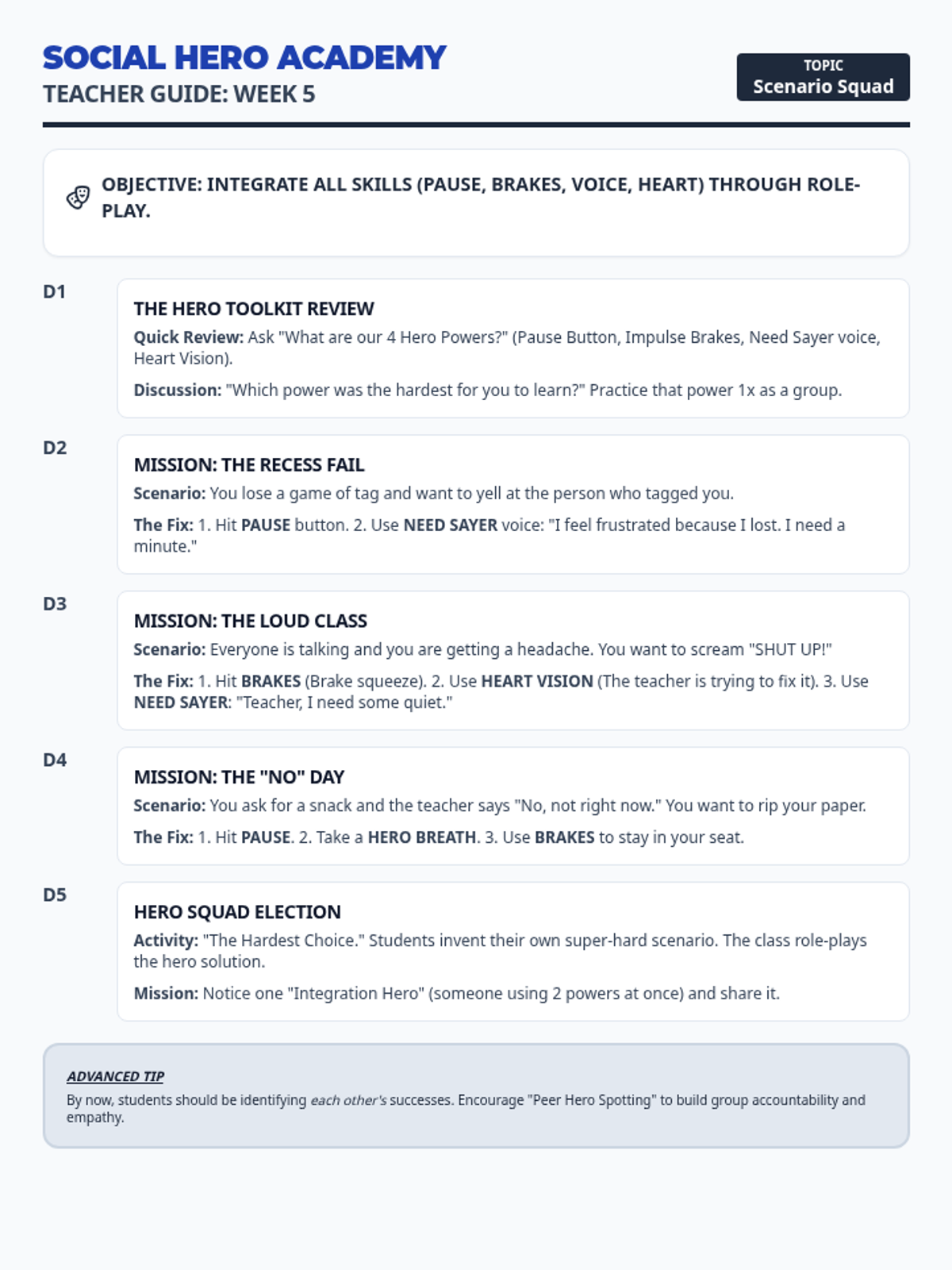
A 15-minute daily pacing guide for the fifth week of Social Hero Academy, focusing on integrated role-play practice.
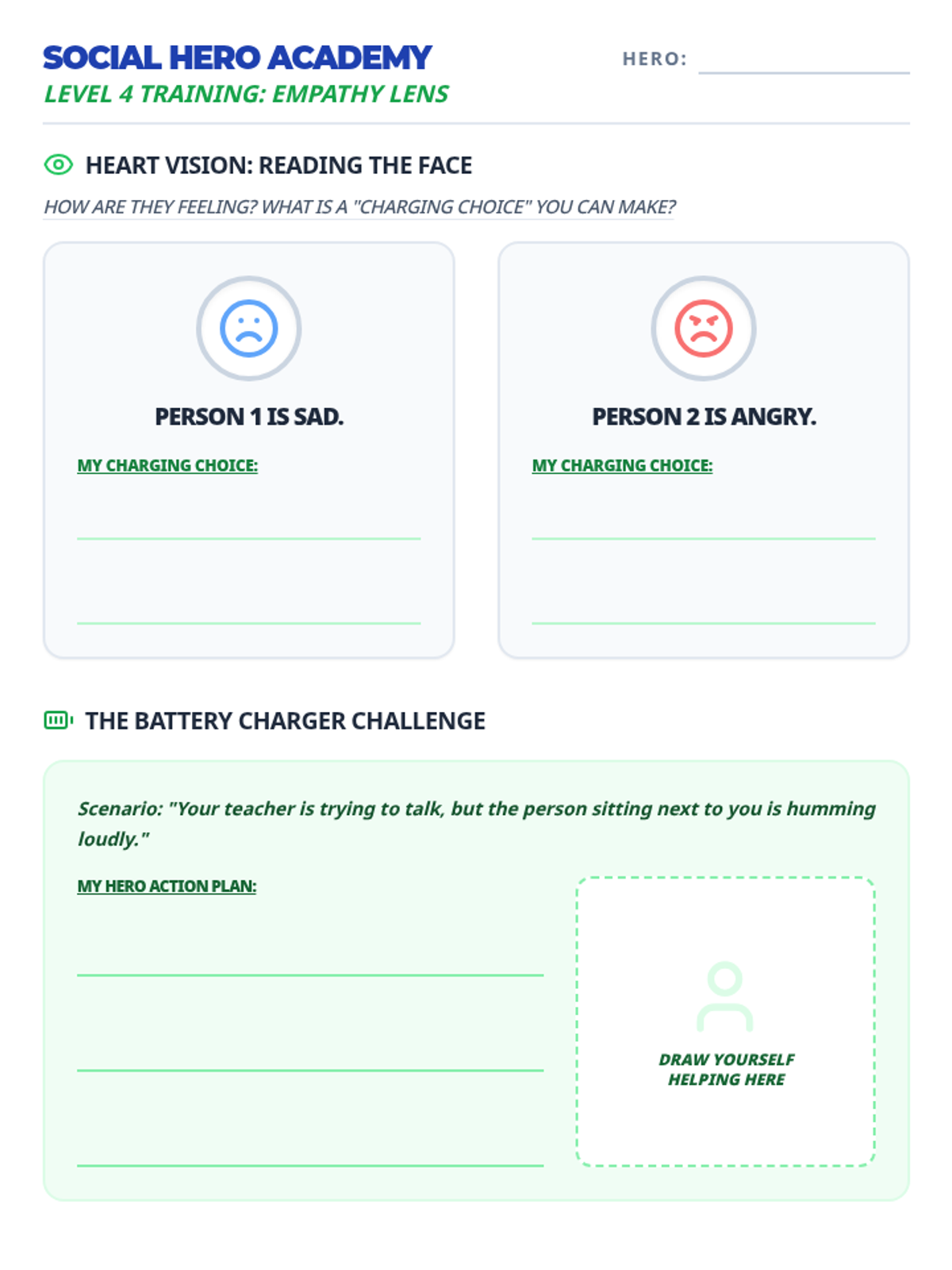
A reflection worksheet for identifying others' feelings and choosing actions that 'charge' their social batteries.
A visual presentation for Week 4 of Social Hero Academy, teaching perspective-taking and the 'Social Battery' concept.
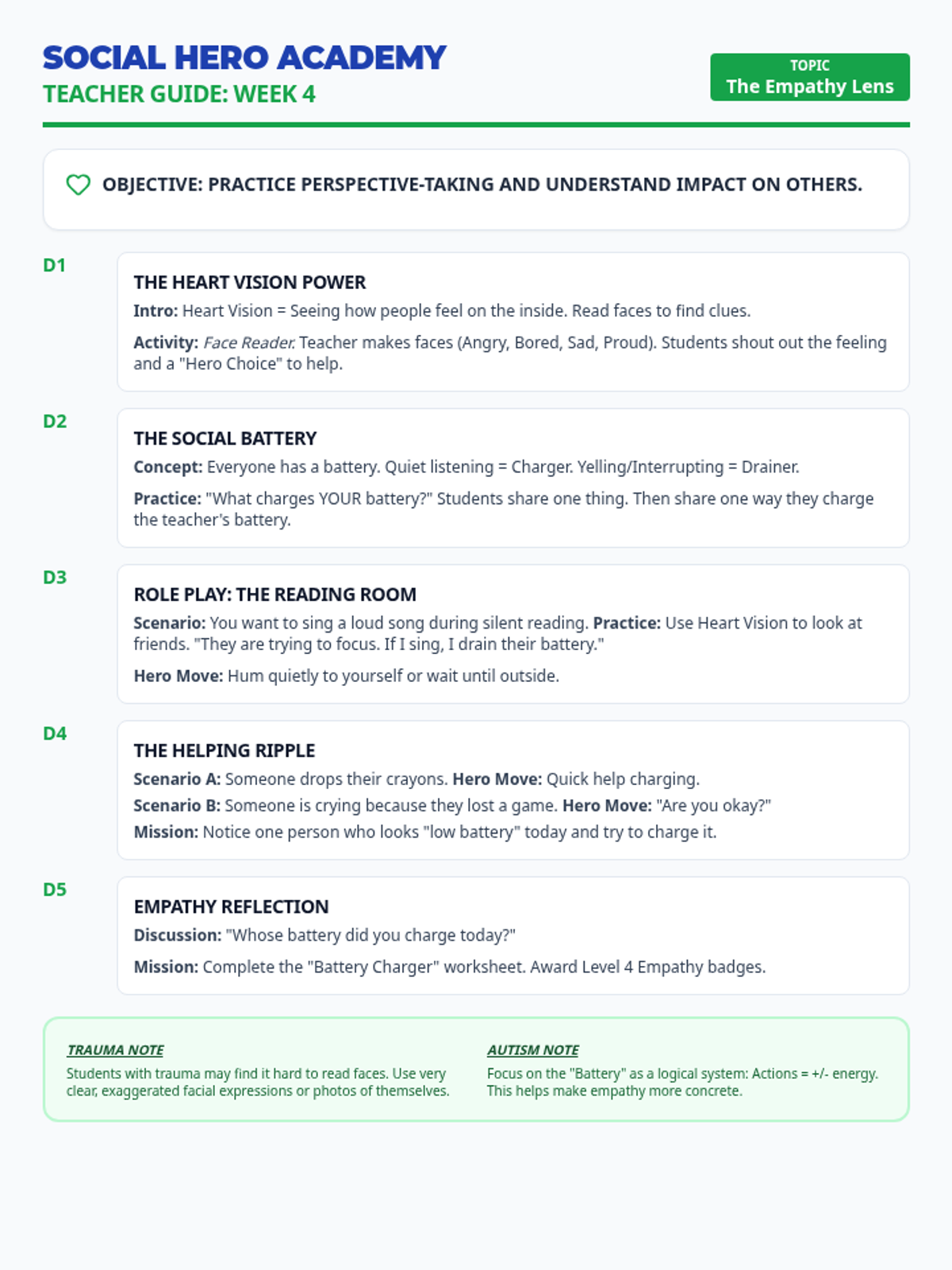
A 15-minute daily pacing guide for teachers to lead the fourth week of the Social Hero Academy, focusing on empathy and perspective-taking.
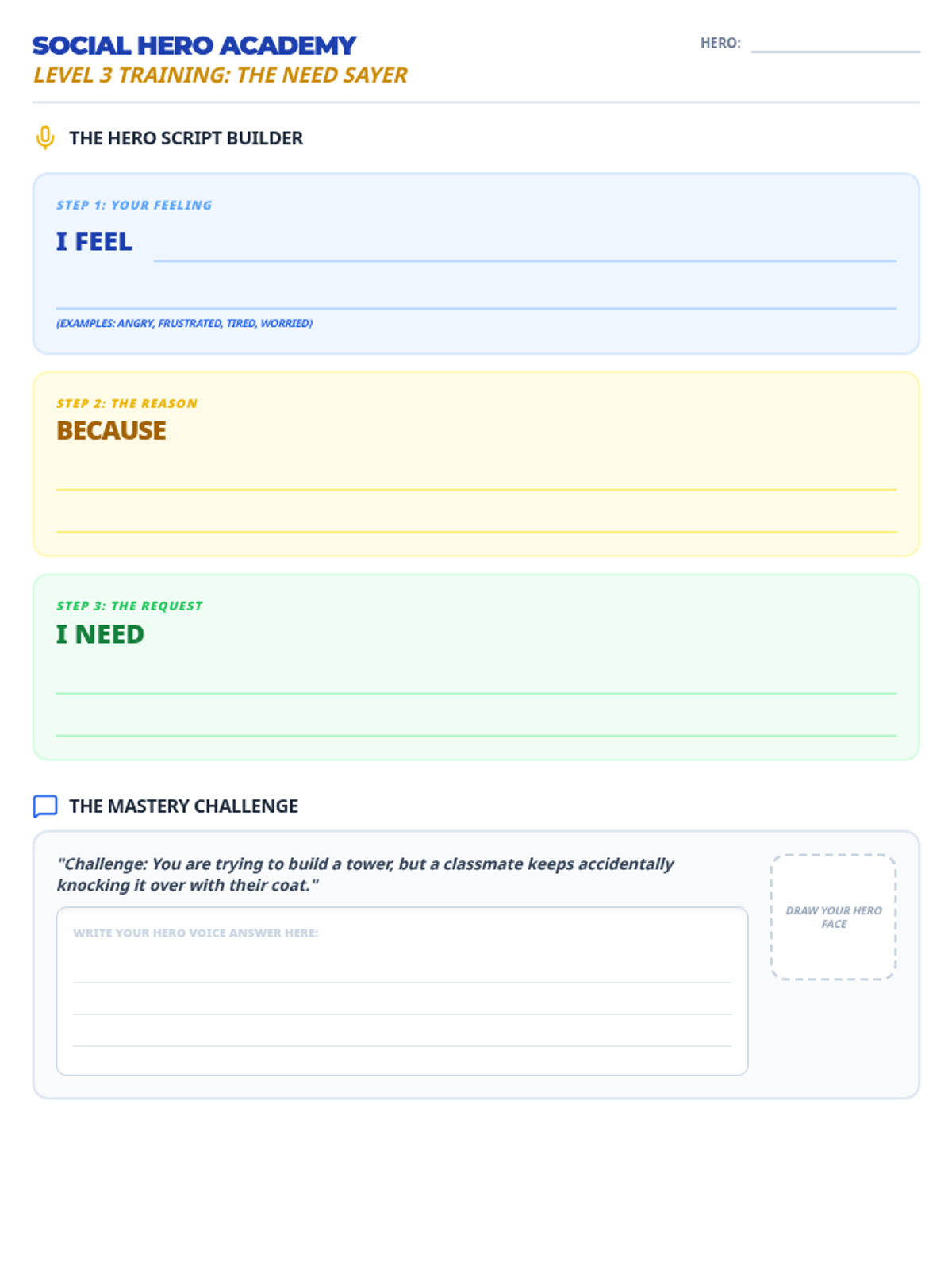
A practice worksheet for building 'I Statements' to express personal needs effectively.
A visual presentation for Week 3 of Social Hero Academy, teaching students the 'I Statement' script to state their needs.
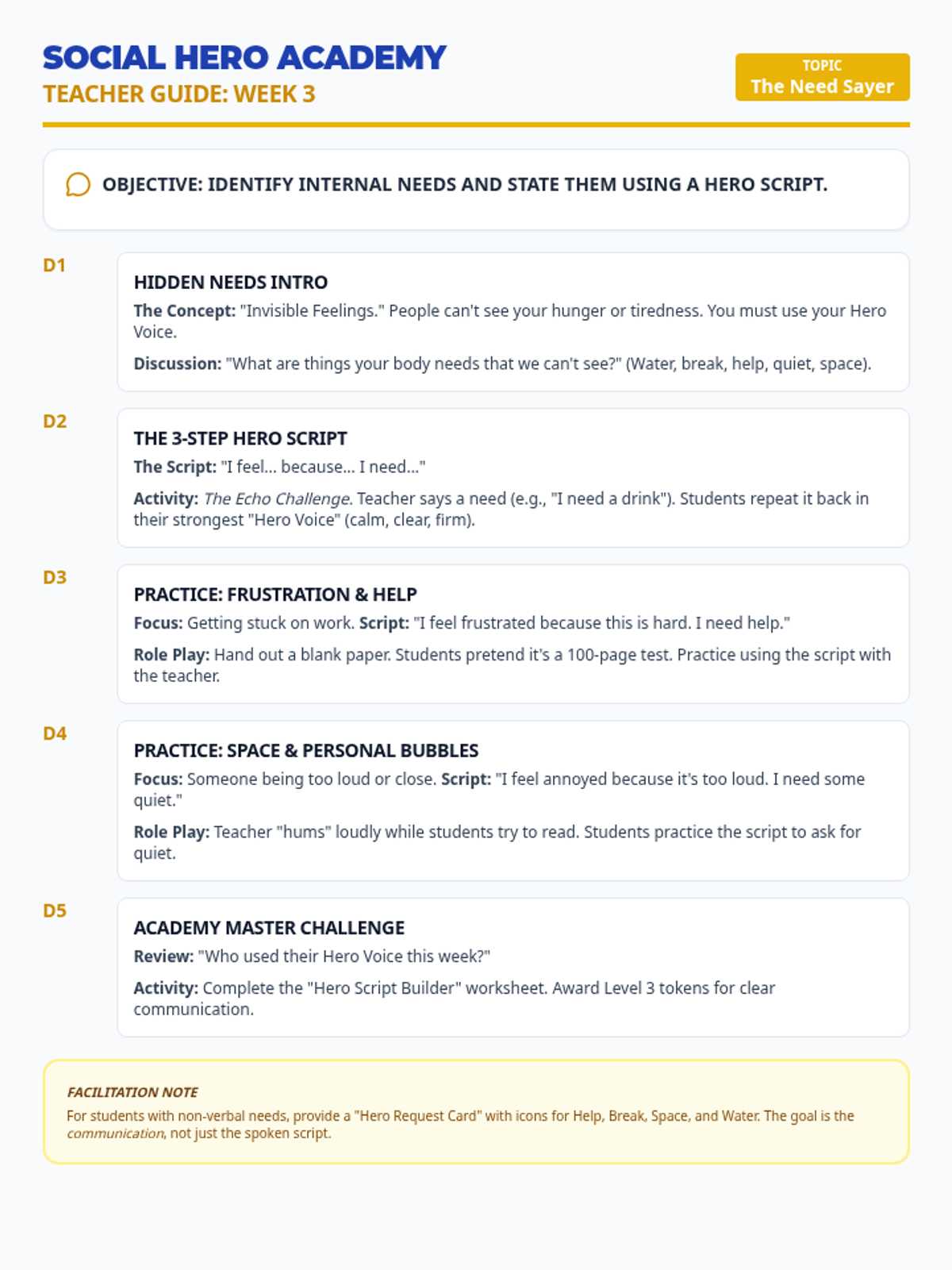
A 15-minute daily pacing guide for teachers to lead the third week of the Social Hero Academy, focusing on identifying and stating personal needs.
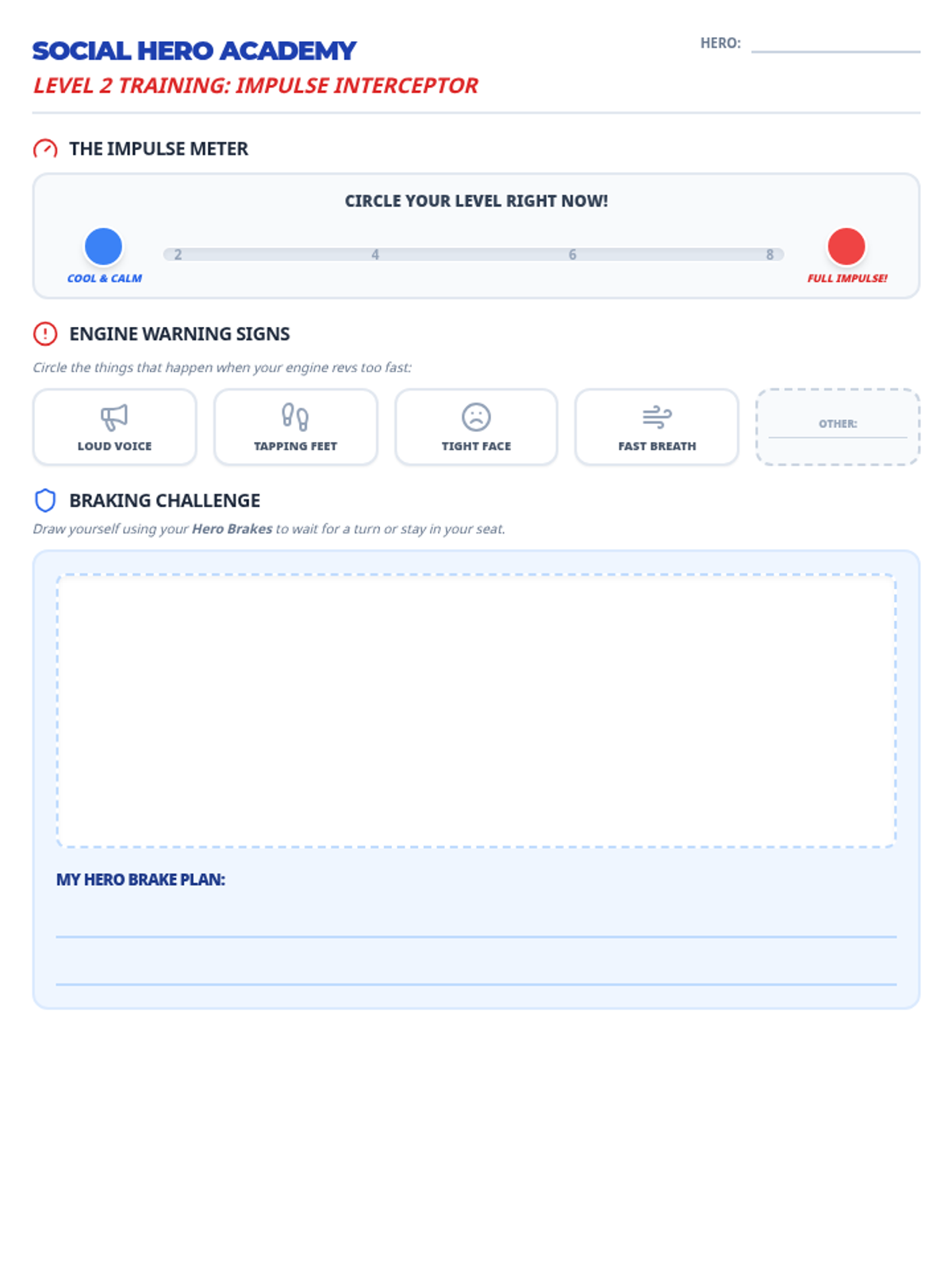
A student worksheet for identifying physical impulse cues ('engine revving') and practicing the 'Brake' strategy.
A visual presentation for Week 2 of Social Hero Academy, teaching the 'Brake vs. Gas' concept for impulse control.
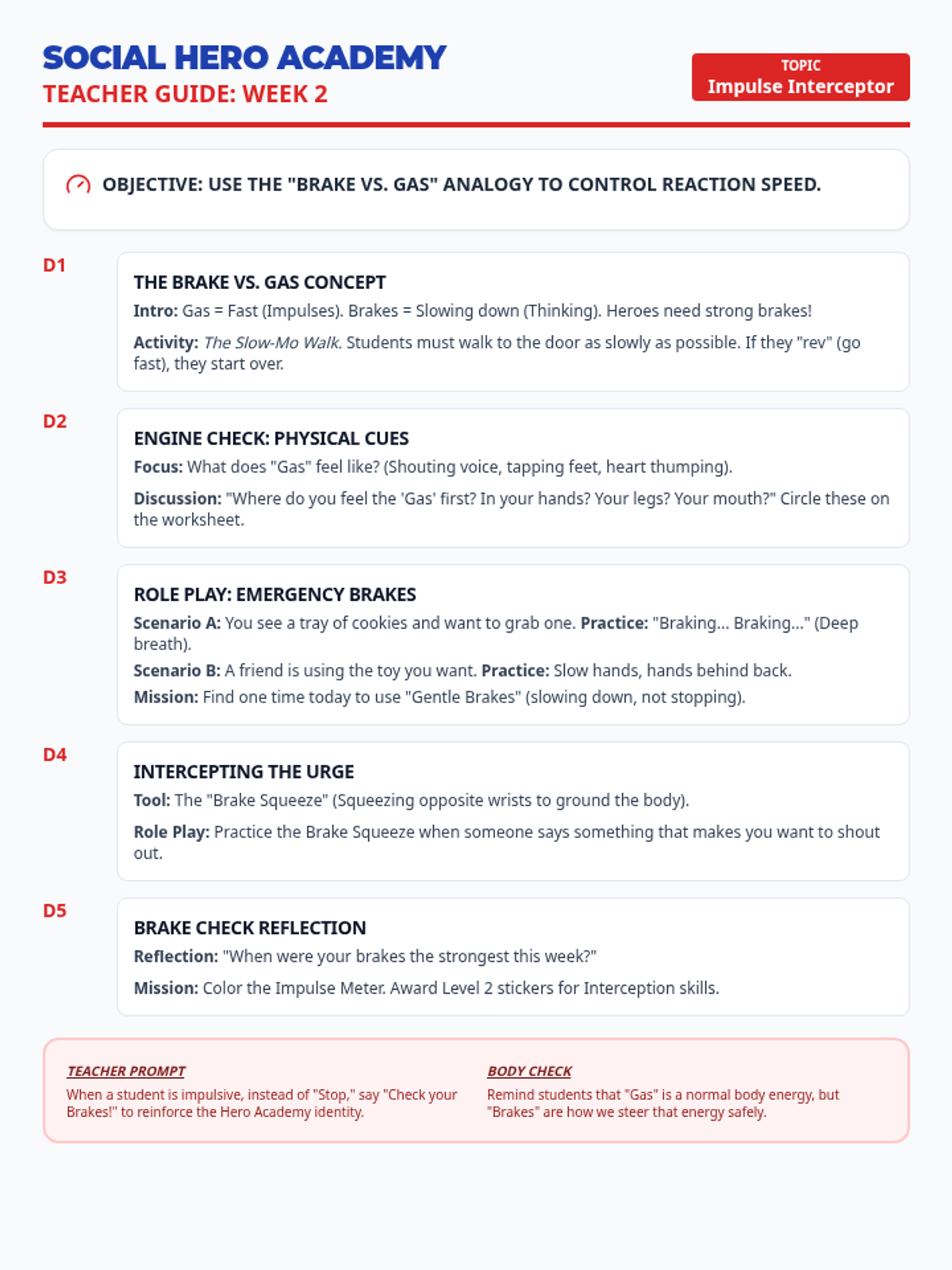
A 15-minute daily pacing guide for teachers to lead the second week of the Social Hero Academy, focusing on the 'Brake vs. Gas' analogy for impulse control.
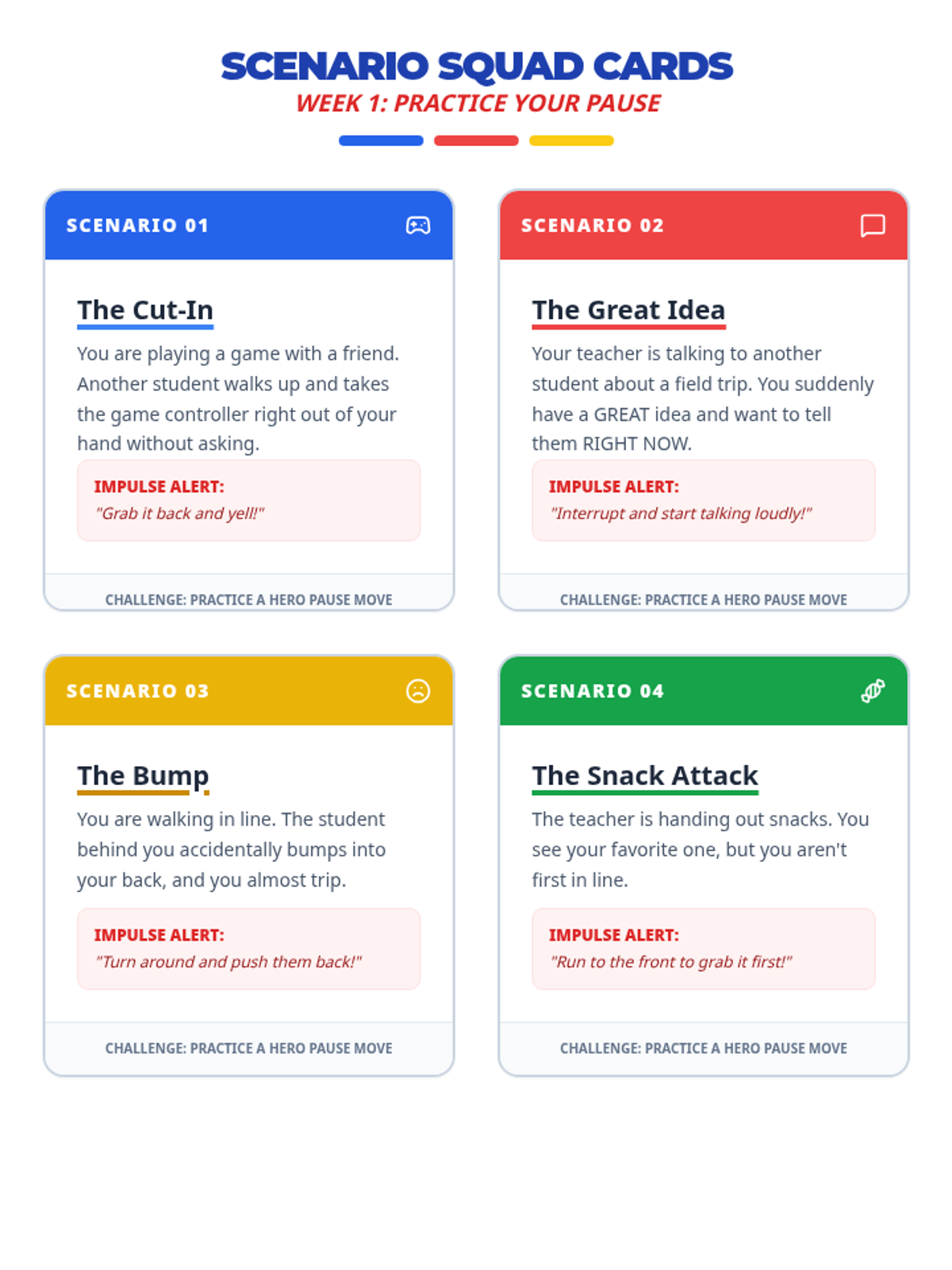
Four role-play scenario cards designed for the Social Hero Academy to help students practice 'Stopping and Thinking' in common social situations.
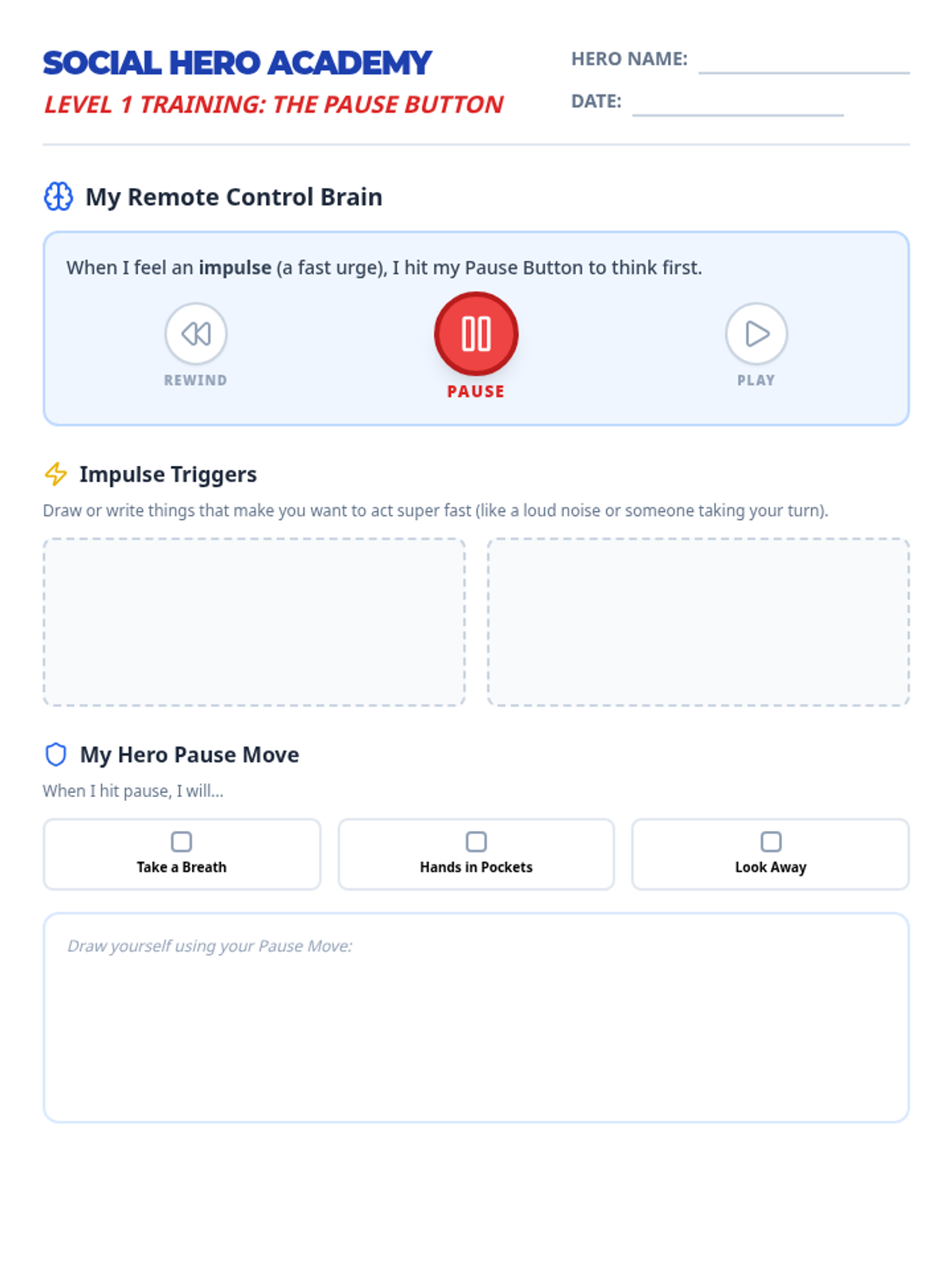
A reflection worksheet for students to identify personal impulse triggers and choose a 'Pause Move' as part of their Social Hero Academy training.
A visual presentation for Week 1 of Social Hero Academy, introducing the 'Remote Control Brain' and 'Pause Button' concepts for impulse control.
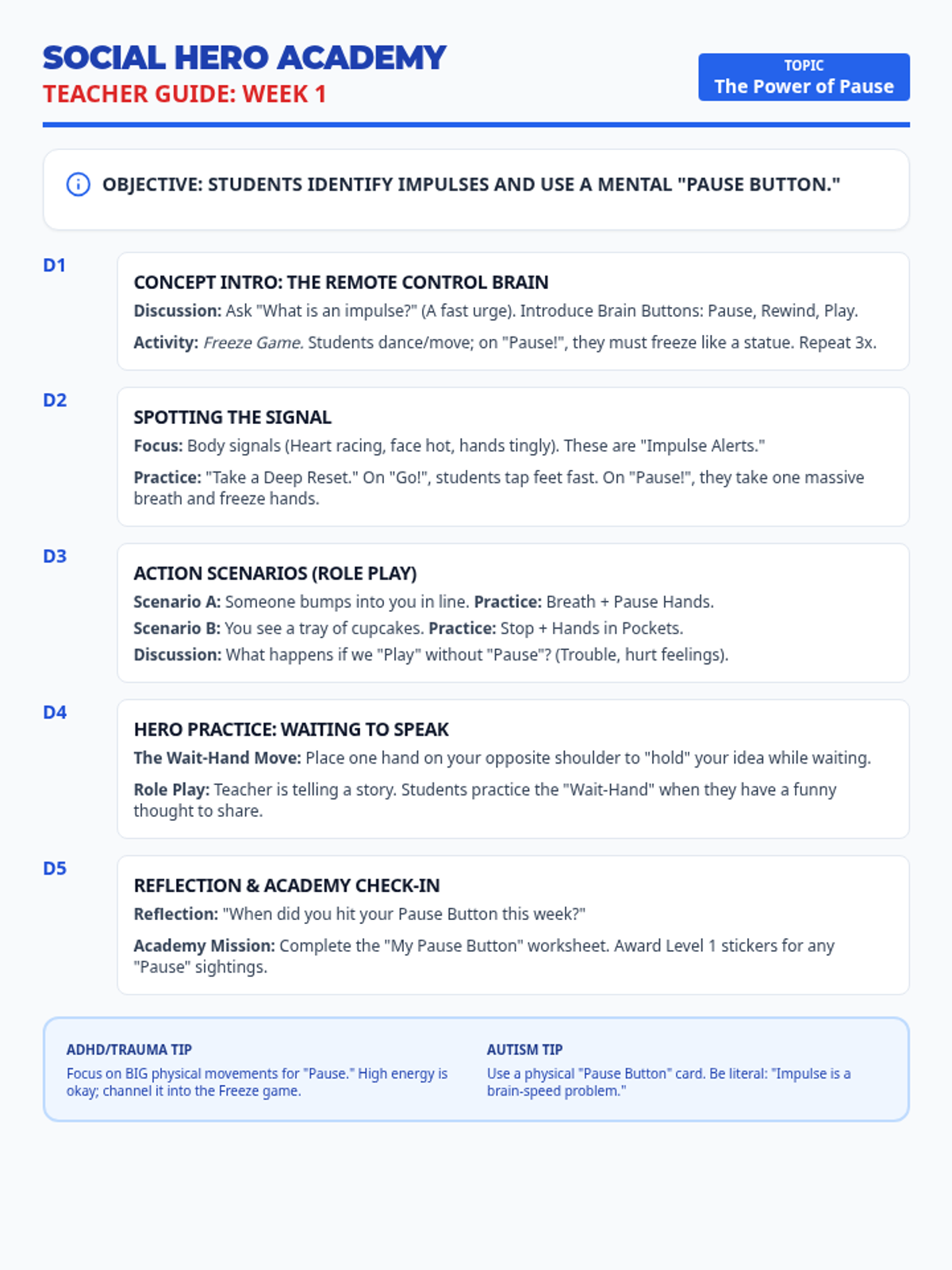
A 15-minute daily pacing guide for teachers to lead the first week of the Social Hero Academy, focusing on the concept of 'Stopping and Thinking'.
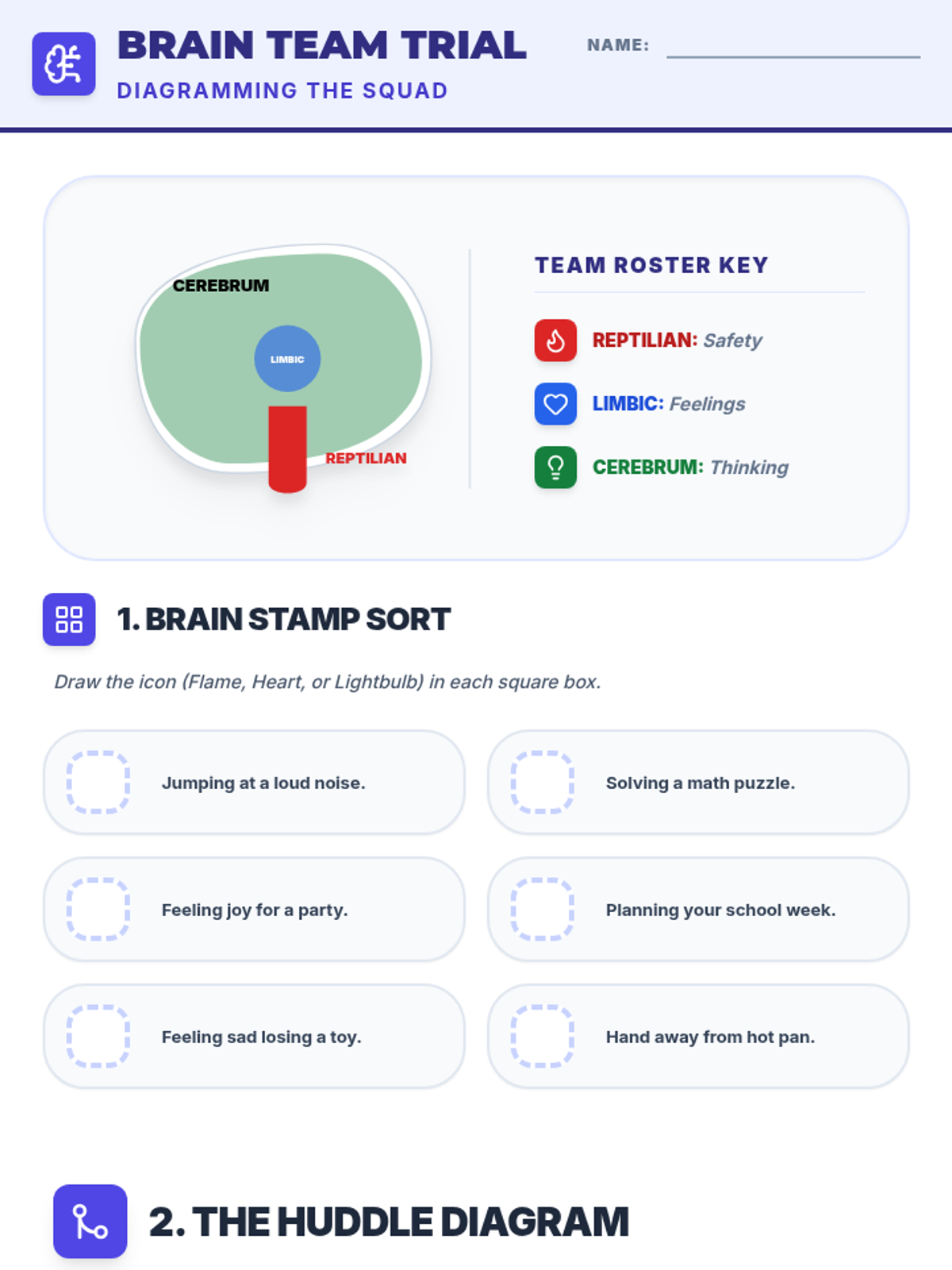
A visual sorting and diagramming activity where students use icons (Flame, Heart, Lightbulb) to categorize brain functions and annotate a realistic brain team map for internal coordination. UK spellings applied. Terminology updated to Neocortex.
A visual presentation introducing the Reptilian Brain, Limbic System, and Neocortex using realistic anatomical diagrams, large icons, and minimal text to explain how these three parts collaborate as a team. Terminology updated to Neocortex with UK English spellings.
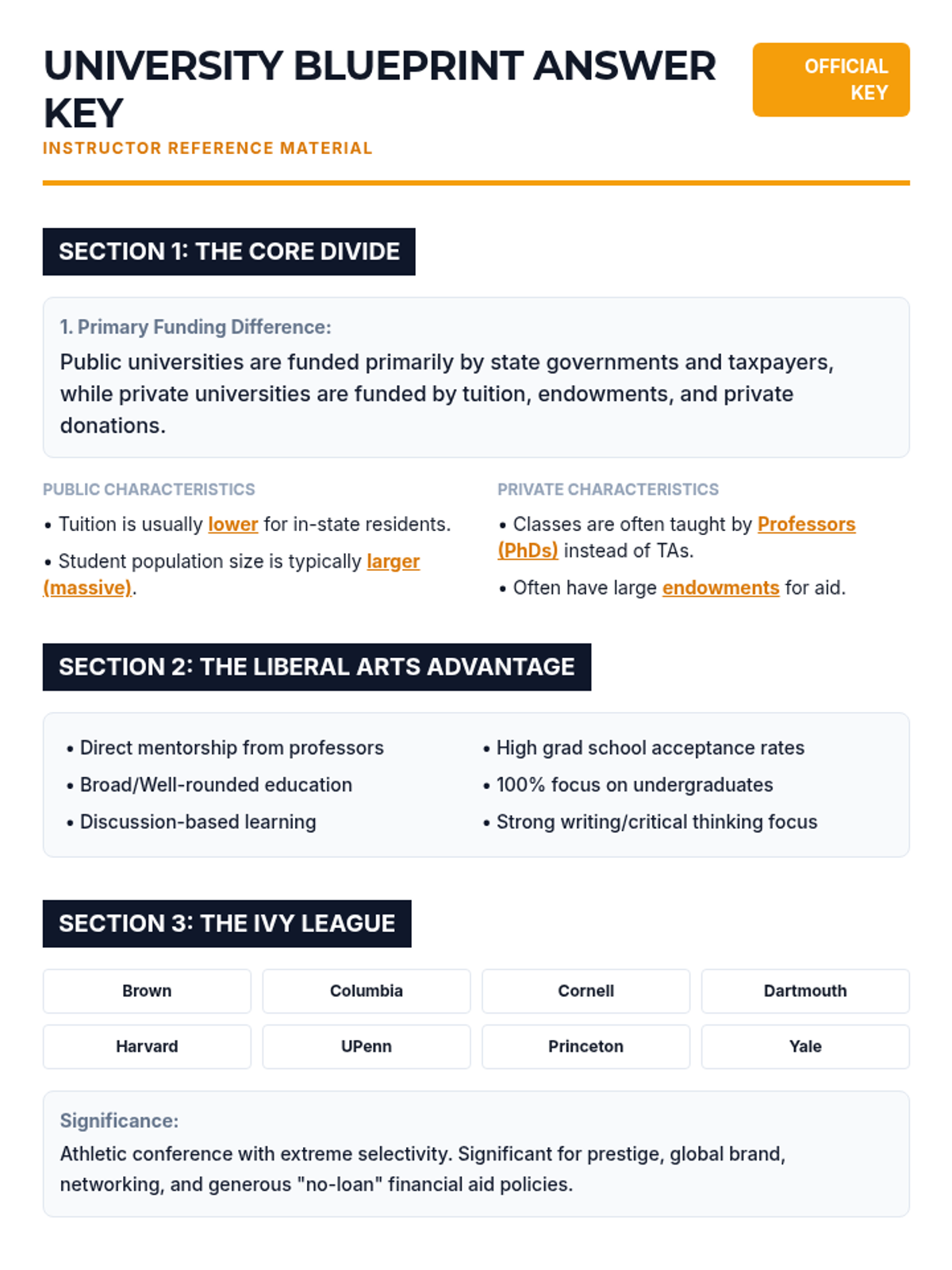
An answer key for the University Blueprint worksheet, providing correct responses for funding differences, Ivy League schools, and a complete list of California's top 20 private institutions.
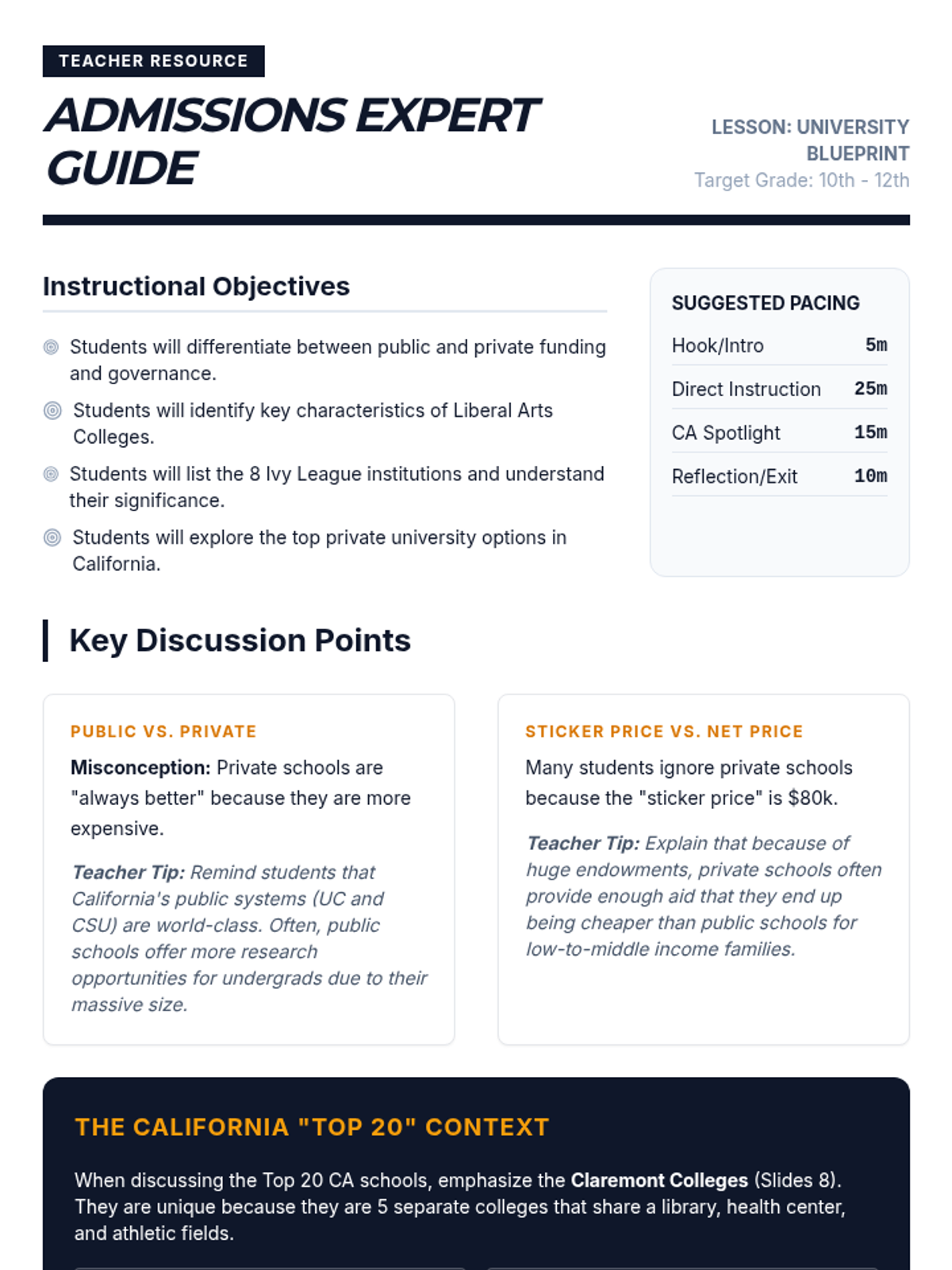
A detailed teacher guide for the University Blueprint lesson, providing instructional objectives, pacing suggestions, discussion prompts, and key insights into college admissions.