The corresponding answer key for the updated Safety Shield Quiz, with full text for questions and detailed scoring guides for teachers.
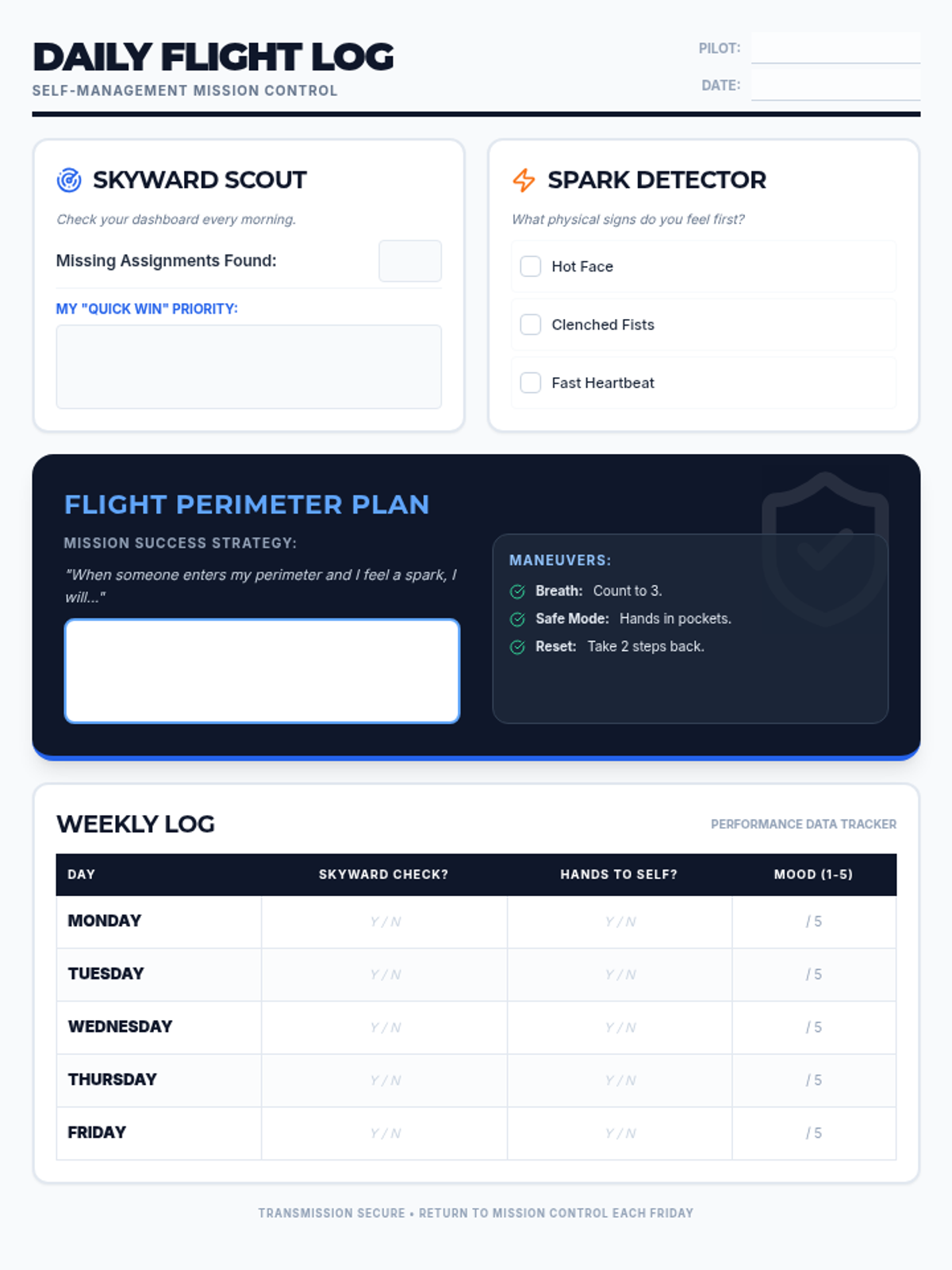
A self-monitoring worksheet and checklist for middle school students to track missing assignments and practice impulse control strategies. Designed with a clear, aviation-themed layout for easy digital or print use.
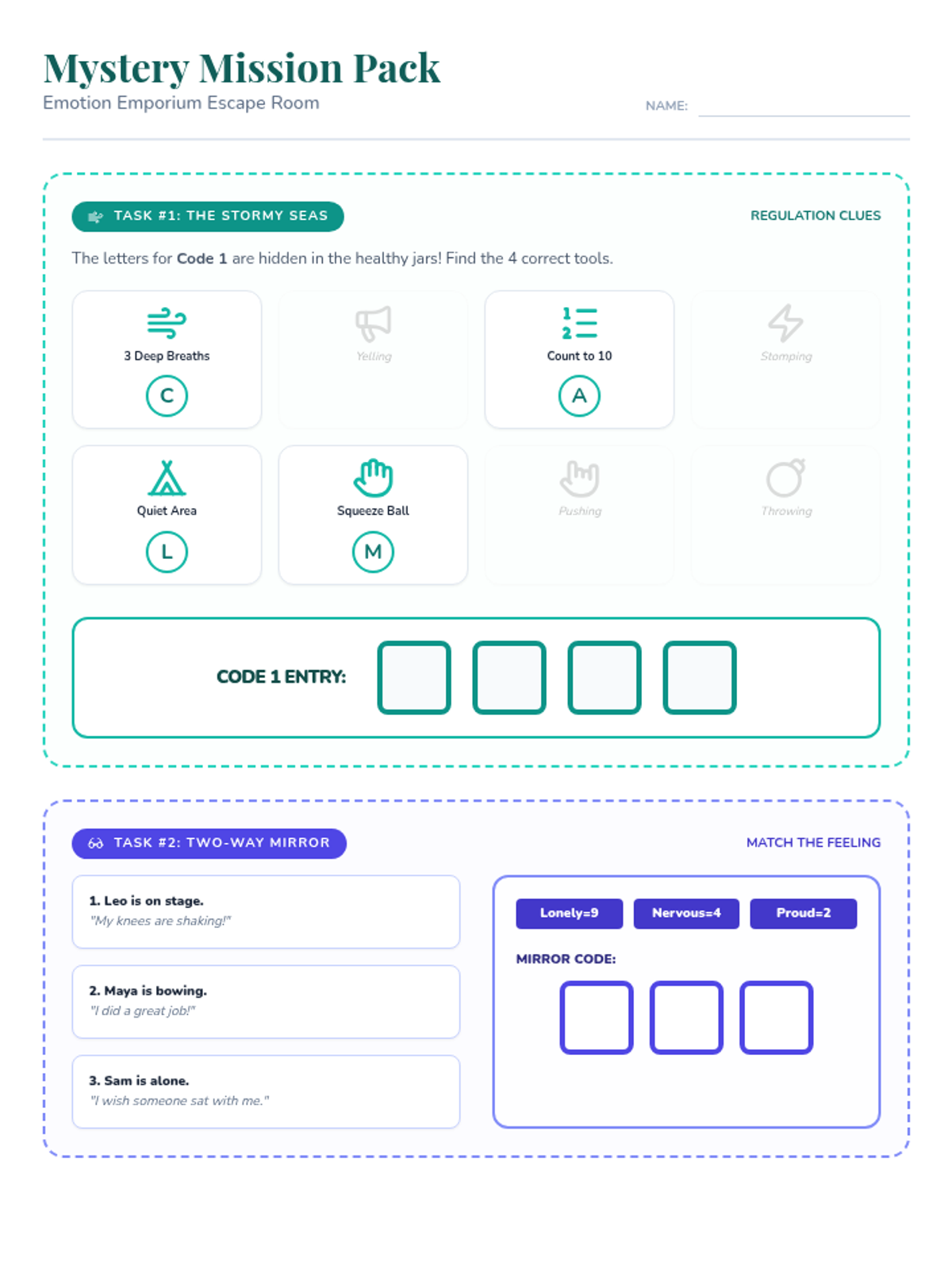
A printable mission pack for students containing visual task cards for the SEL escape room, including self-regulation tool identification, perspective puzzles, and empathy matching.
A high-impact, visual slide presentation for remote social work sessions. Uses an aviation theme to teach middle school students about prefrontal cortex functions, impulse control, and personal boundaries.
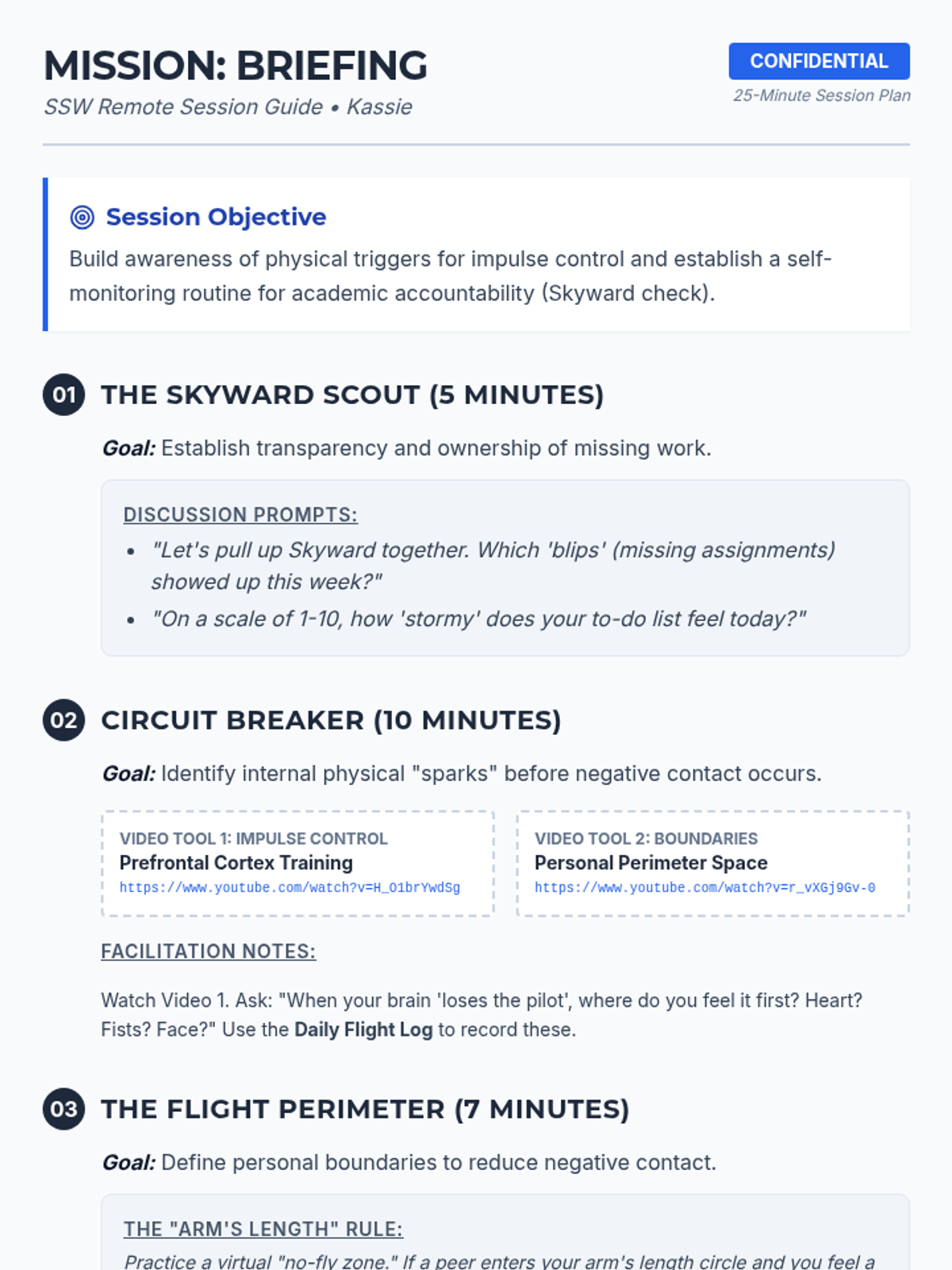
A comprehensive 25-minute remote session facilitator guide for school social workers, featuring an aviation theme, video links for impulse control, and specific scripted prompts for student interaction.
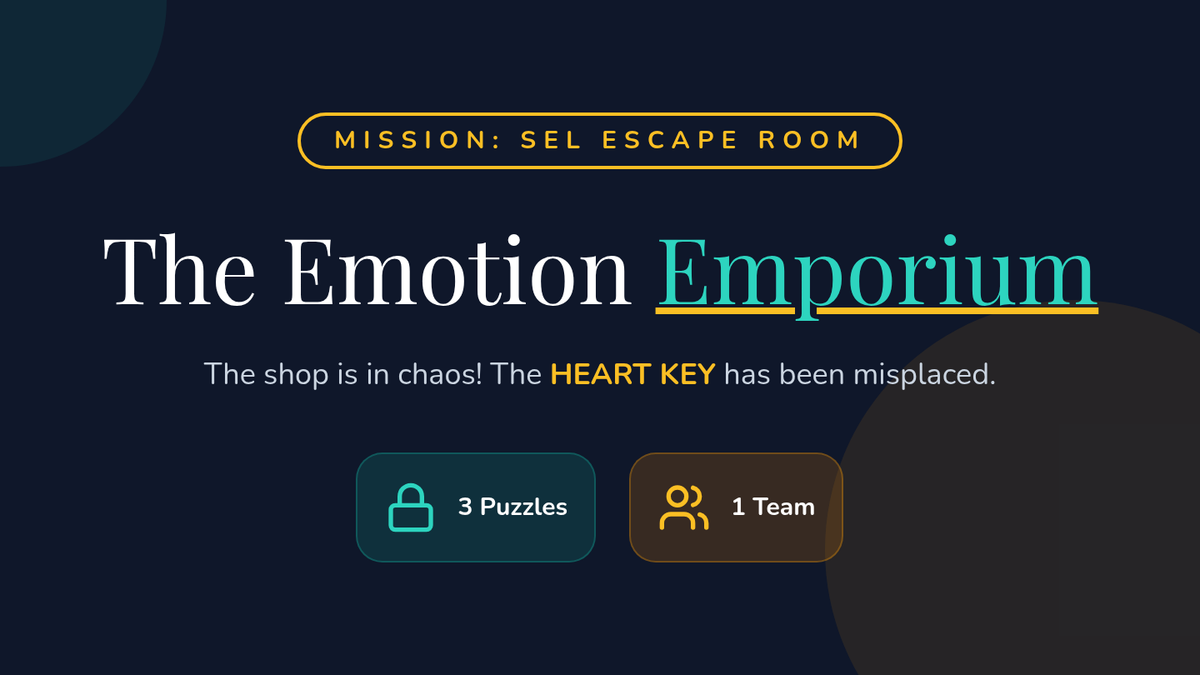
A visually engaging whole-class slide deck to guide students through the Emotion Emporium escape room, featuring challenges for self-regulation, perspective-taking, and empathy.
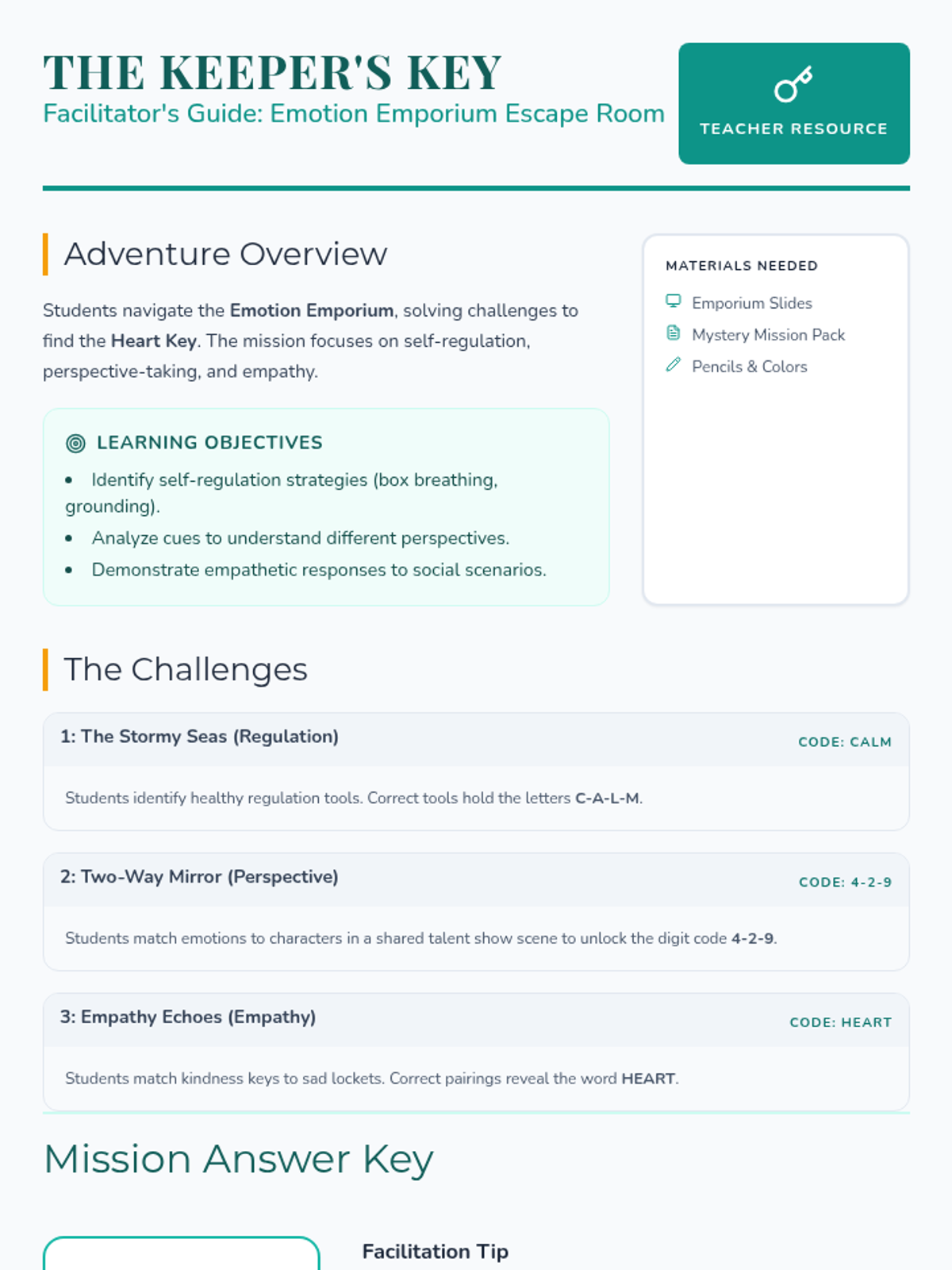
A comprehensive facilitator's guide for the Emotion Emporium SEL escape room, including puzzle breakdowns, secret codes, teaching points, and debrief questions.
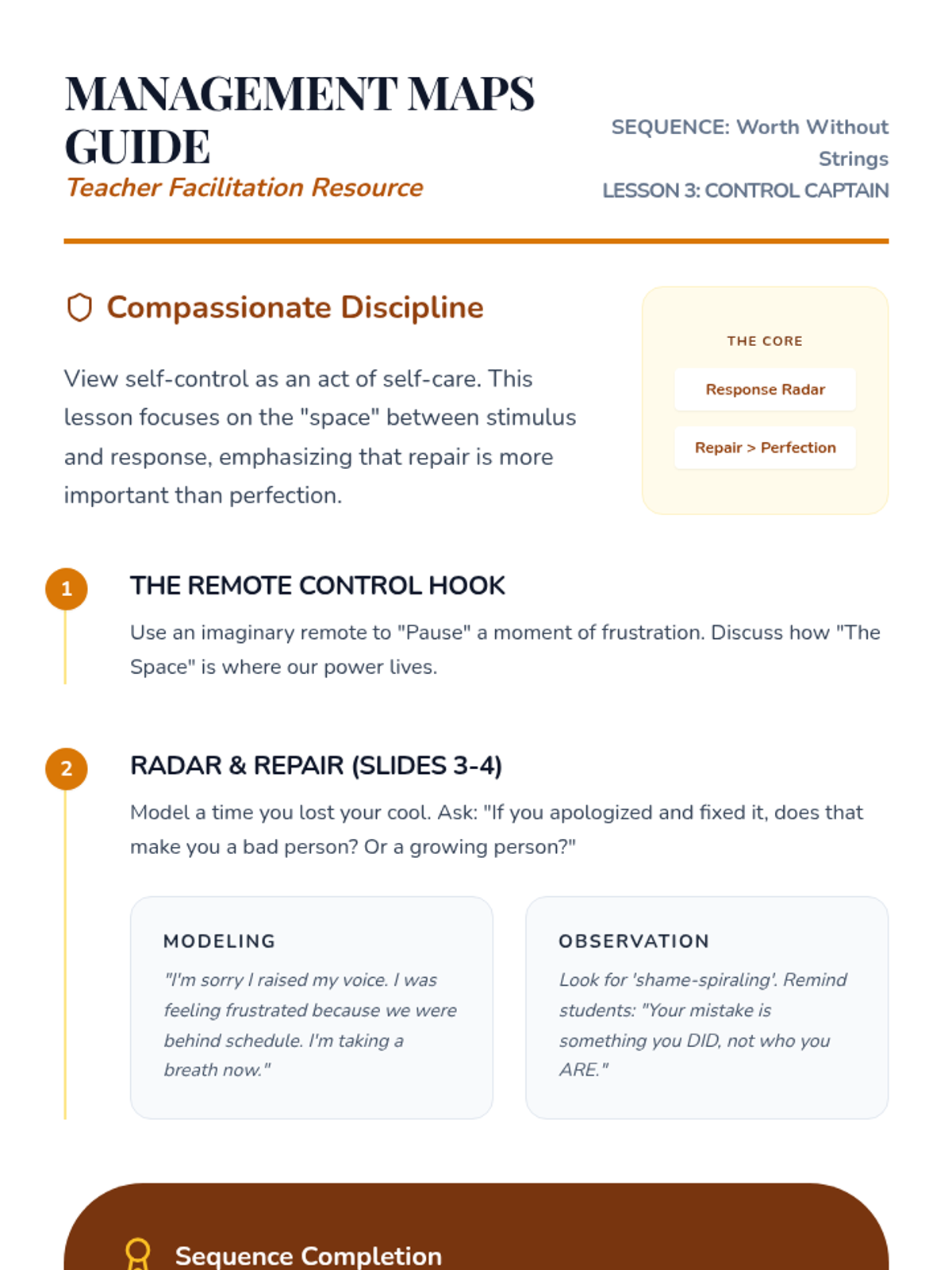
A teacher guide for Lesson 3, providing discussion hooks and the 'Repair Protocol' for teaching self-management with compassion.
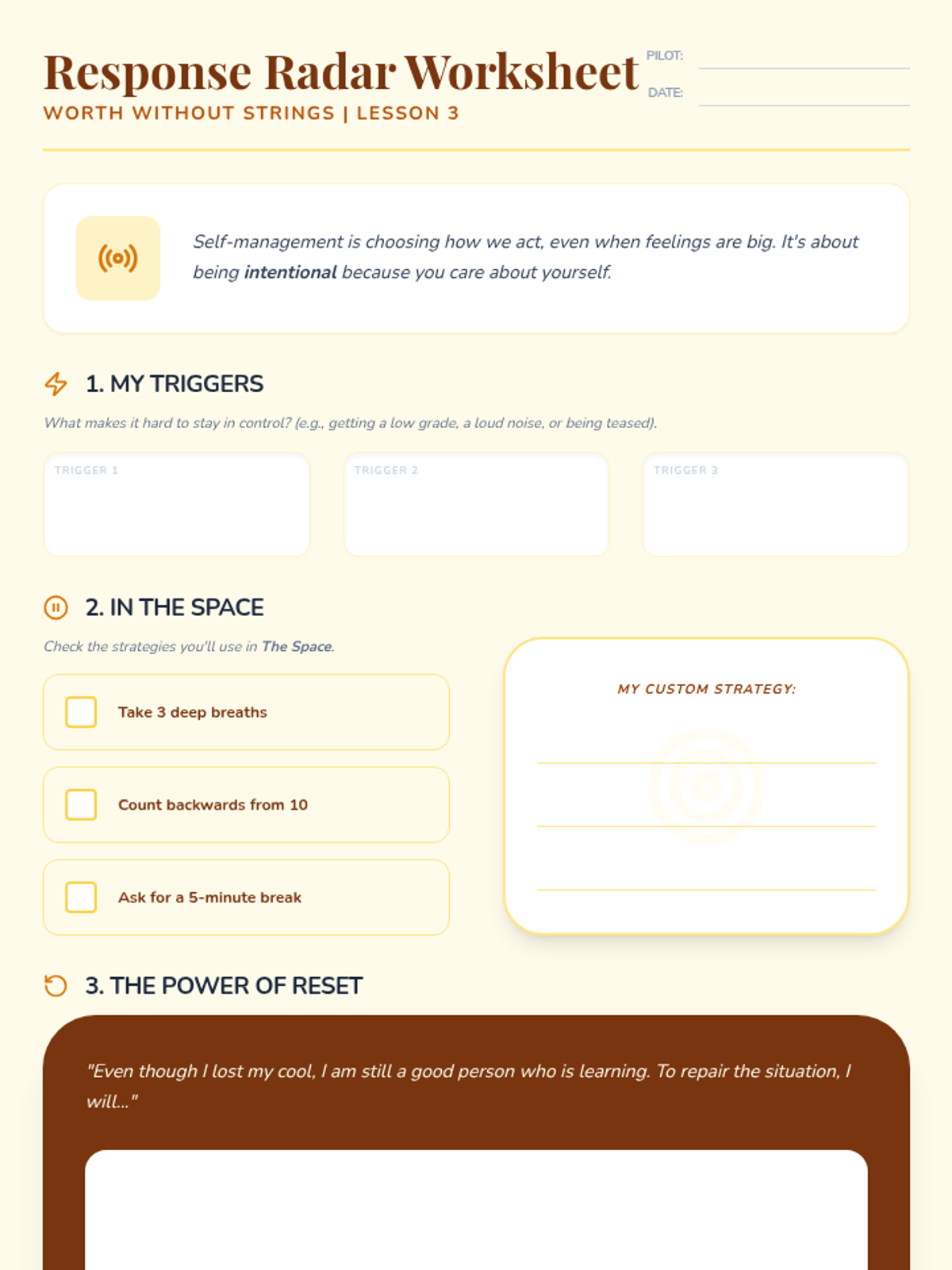
A self-management worksheet for identifying triggers and planning responses, emphasizing the concept of 'The Space' and post-mistake repair.
A slide presentation for the 'Control Captain' lesson, focusing on the 'Response Radar' and reframing self-control as self-care.
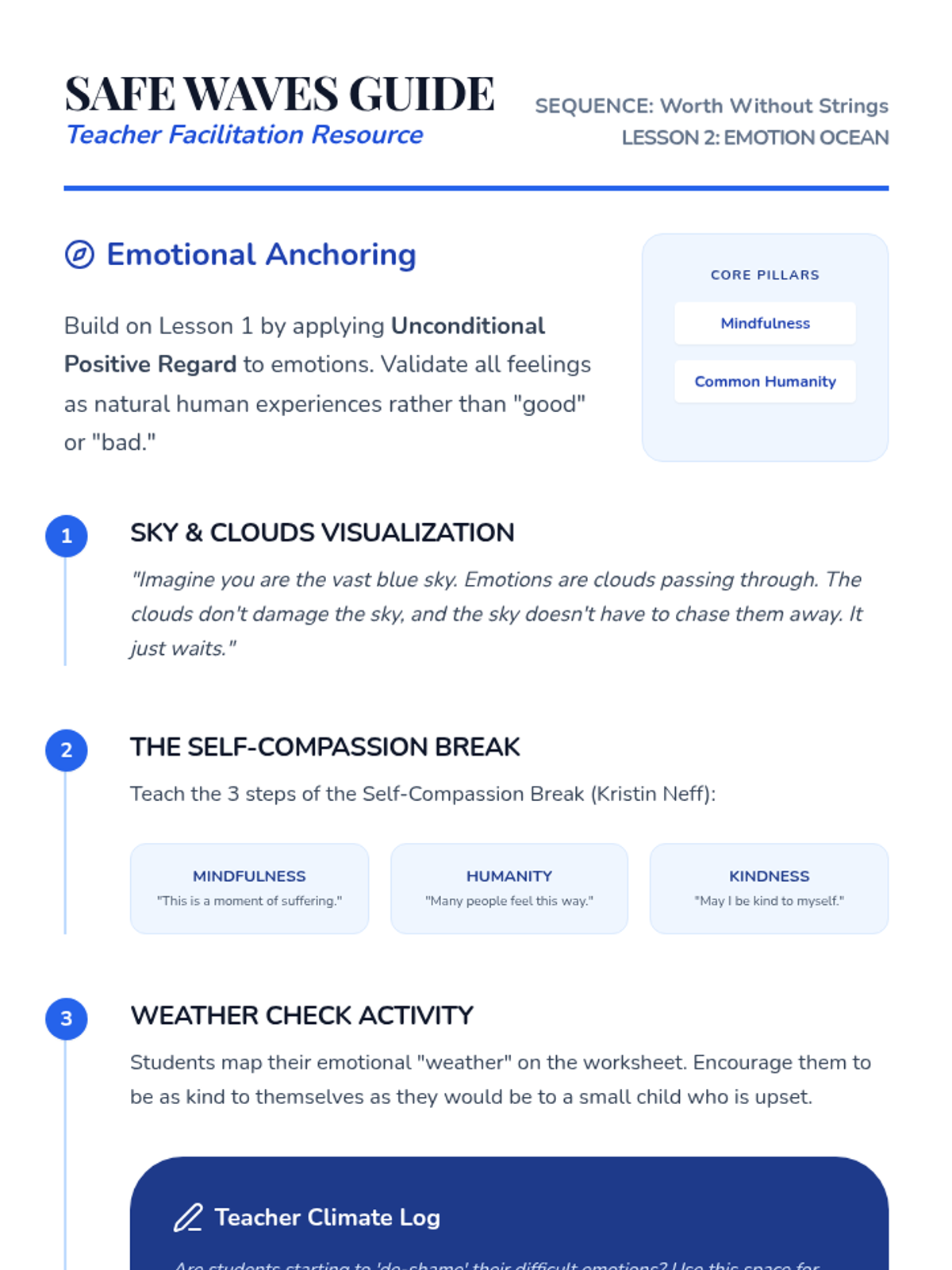
A facilitation guide for teachers on Lesson 2, focusing on the sky/cloud metaphor and teaching the Self-Compassion Break.
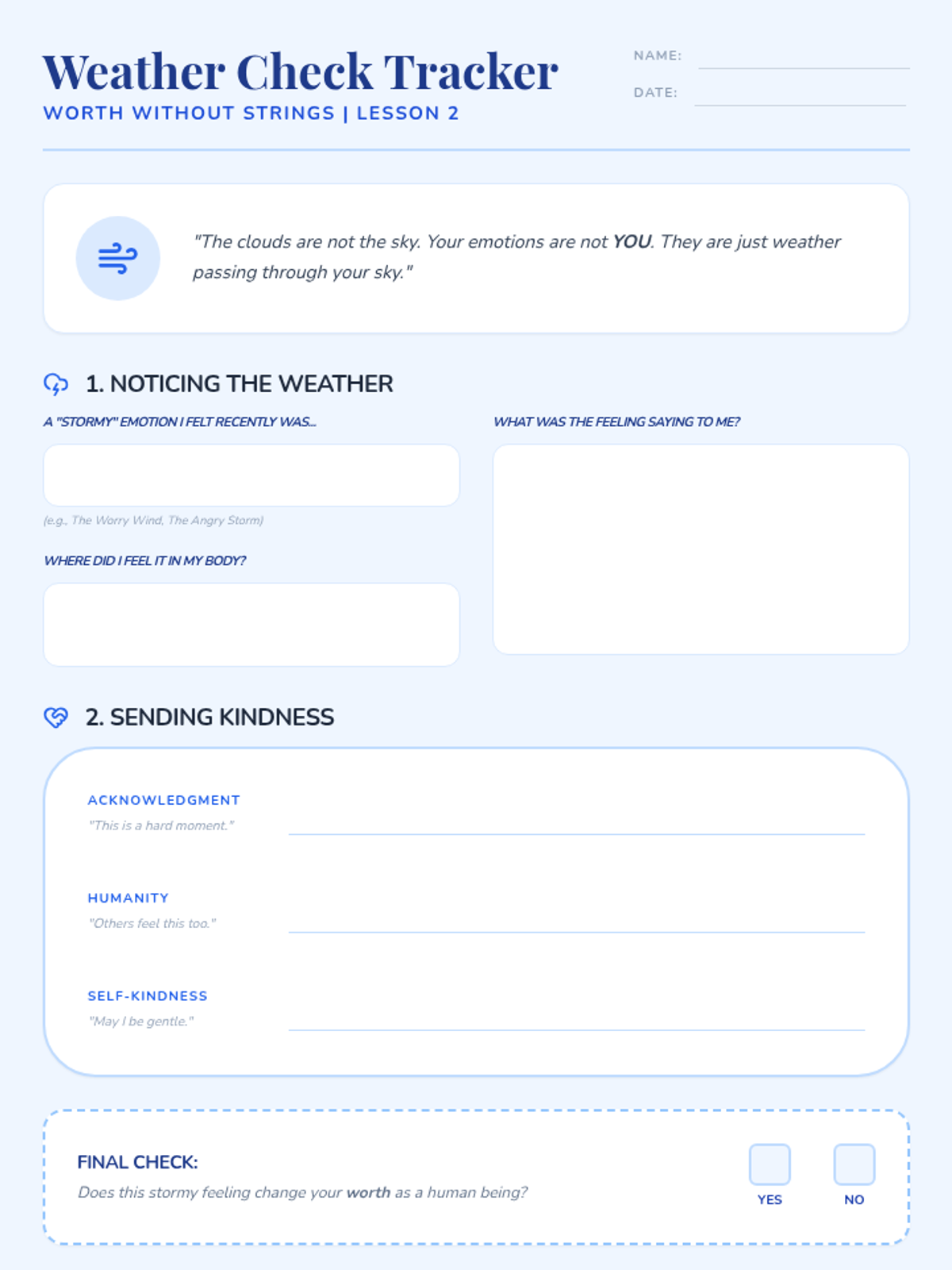
A reflective worksheet for tracking emotional 'weather' and practicing self-compassion scripts, styled with soft blue tones and oceanic motifs.
A slide presentation for the 'Emotion Ocean' lesson, using weather metaphors to teach emotional regulation and self-compassion.
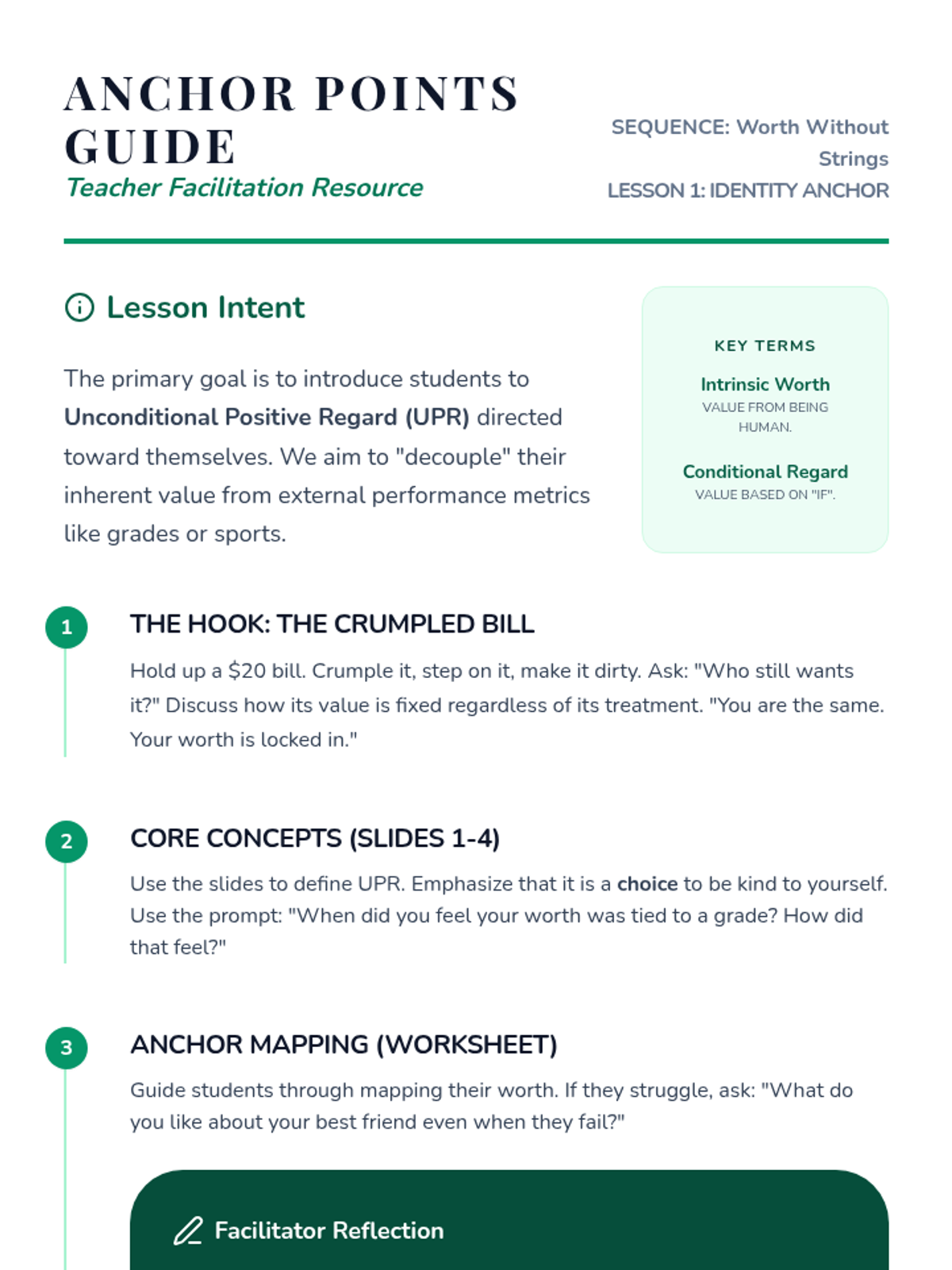
A facilitation guide for teachers to deliver the Identity Anchor lesson, featuring discussion prompts, a 'hook' activity, and support strategies.
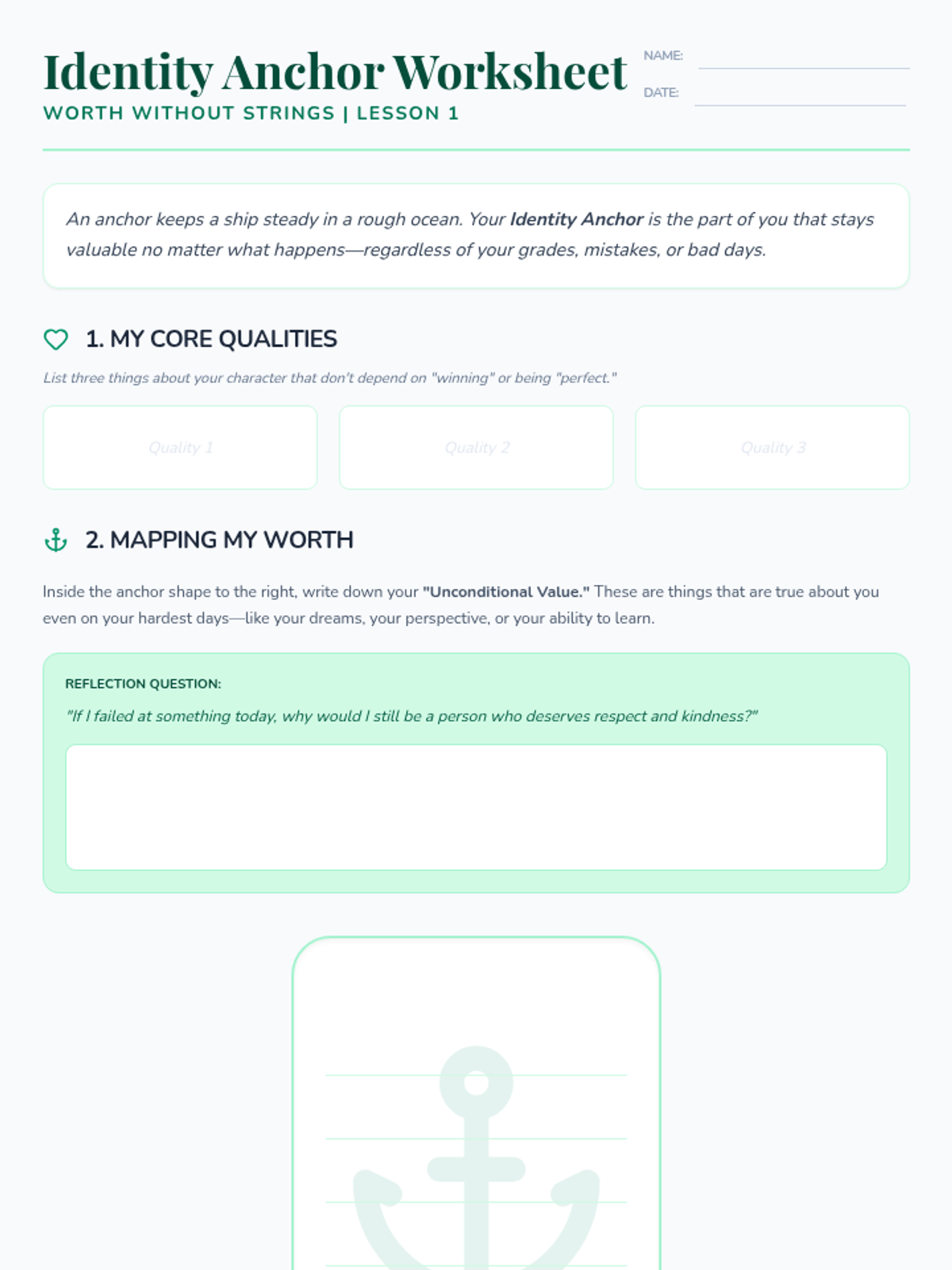
A student worksheet for identifying intrinsic worth and core qualities, designed with a clean botanical aesthetic and ample space for reflection.
An introductory slide deck for the 'Identity Anchor' lesson, explaining the concepts of intrinsic worth and unconditional positive regard through a 'Botanical Sketchbook' aesthetic.
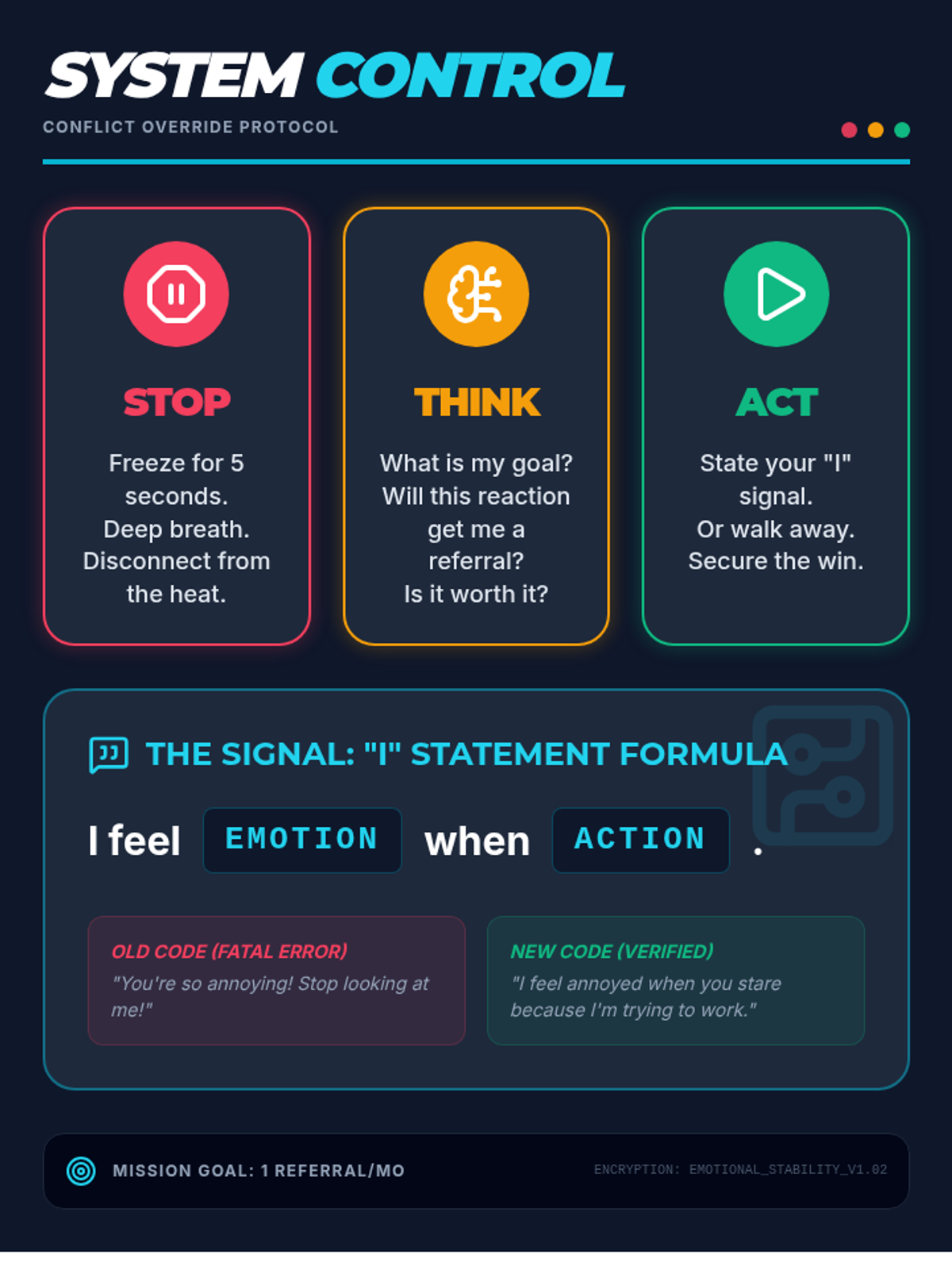
A high-impact visual anchor chart for a student's desk, featuring the Stop-Think-Act circuit breaker and the "I" statement formula in a modern, tech-themed design.
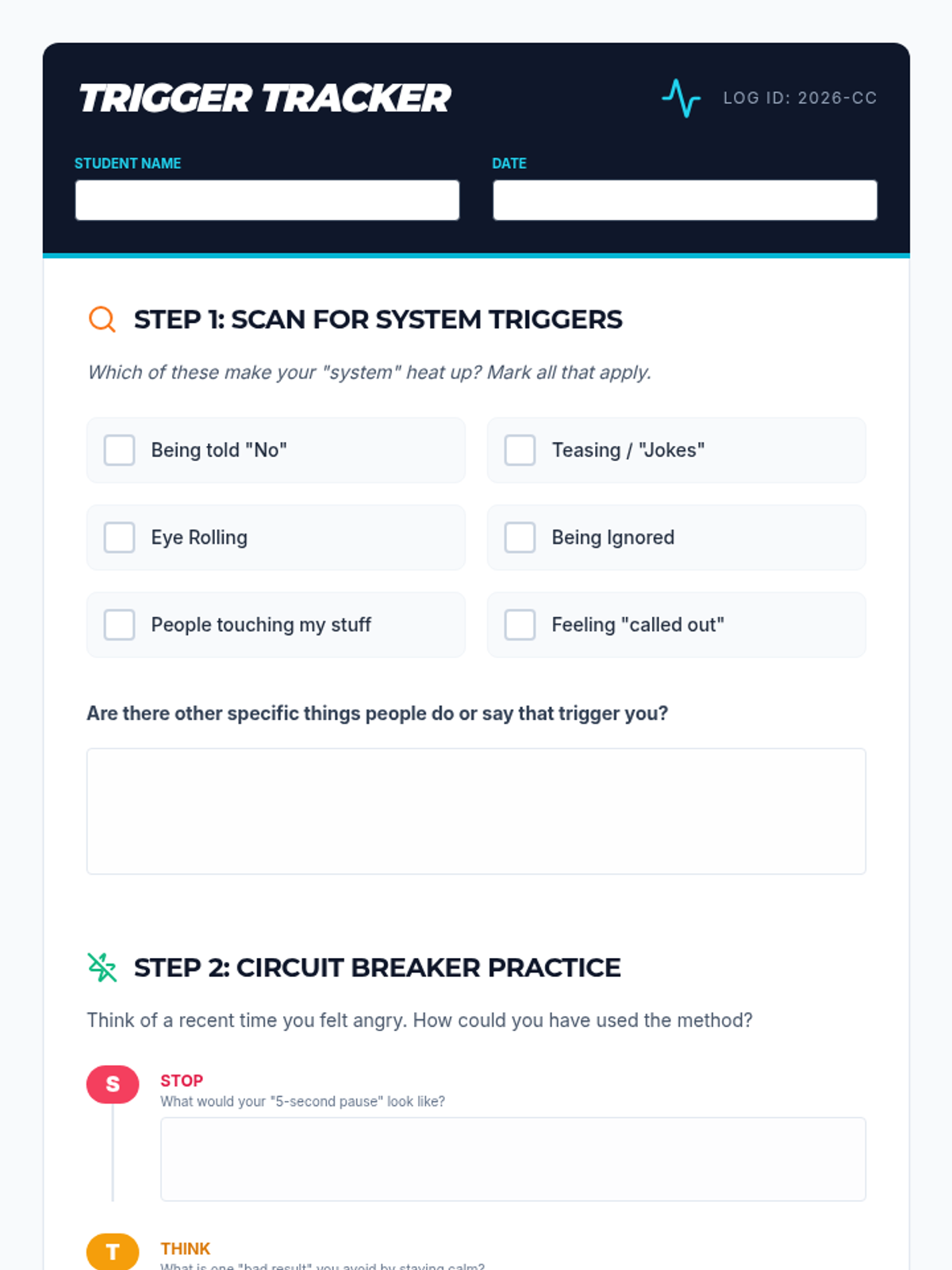
A guided self-reflection worksheet for the student to identify their personal triggers and practice the Stop-Think-Act method and "I" statements in a technical, log-style format.
A modern, tech-themed slide deck designed for remote screen-sharing. It guides a student through identifying emotional triggers, the Stop-Think-Act method, and the mechanics of "I" statements.
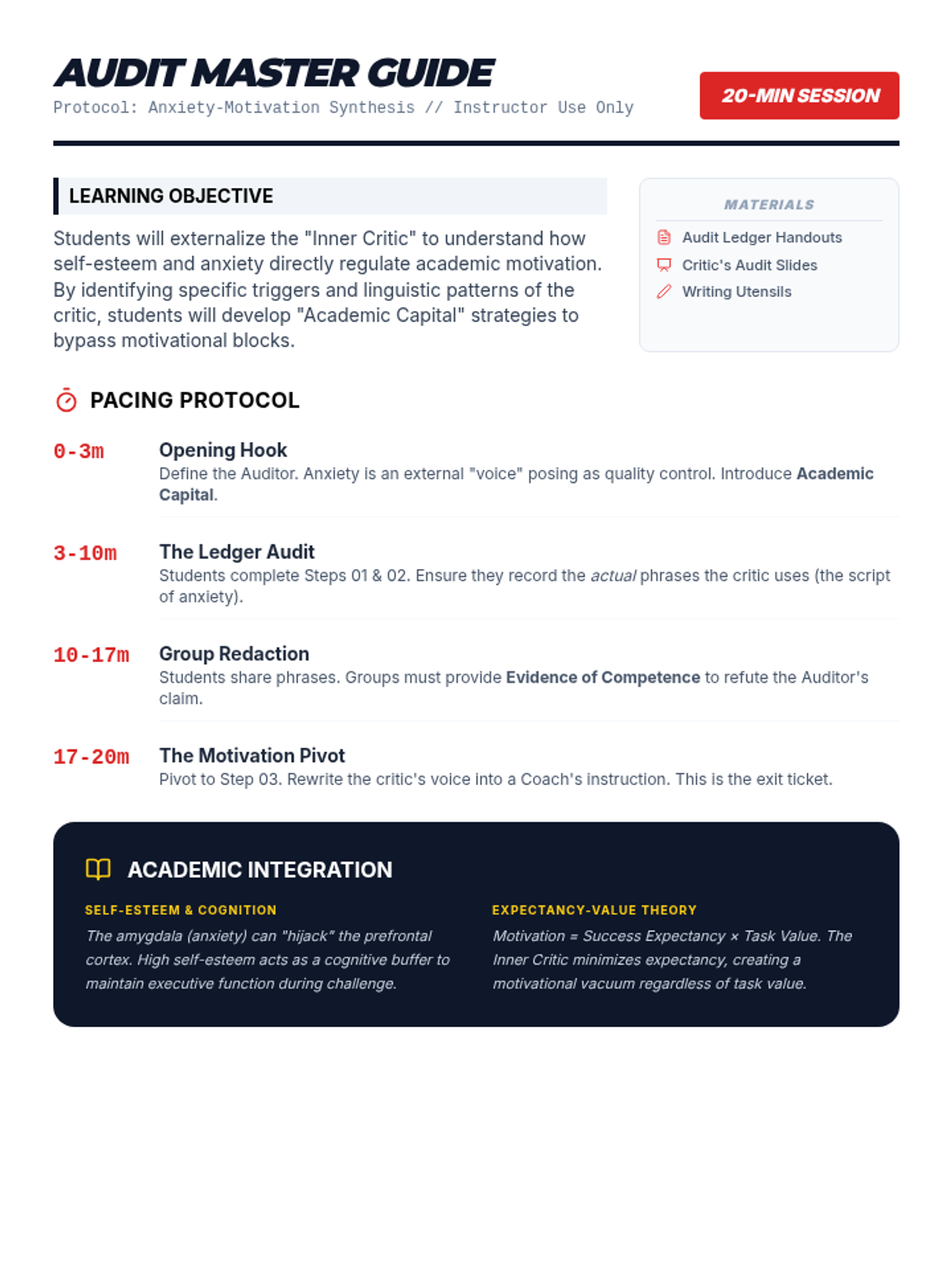
A teacher-facing facilitation guide for the 'Critics Audit' session. Includes a tight 20-minute pacing protocol, discussion prompts for groups, and deep academic background connecting self-esteem to cognitive function and motivation theory.
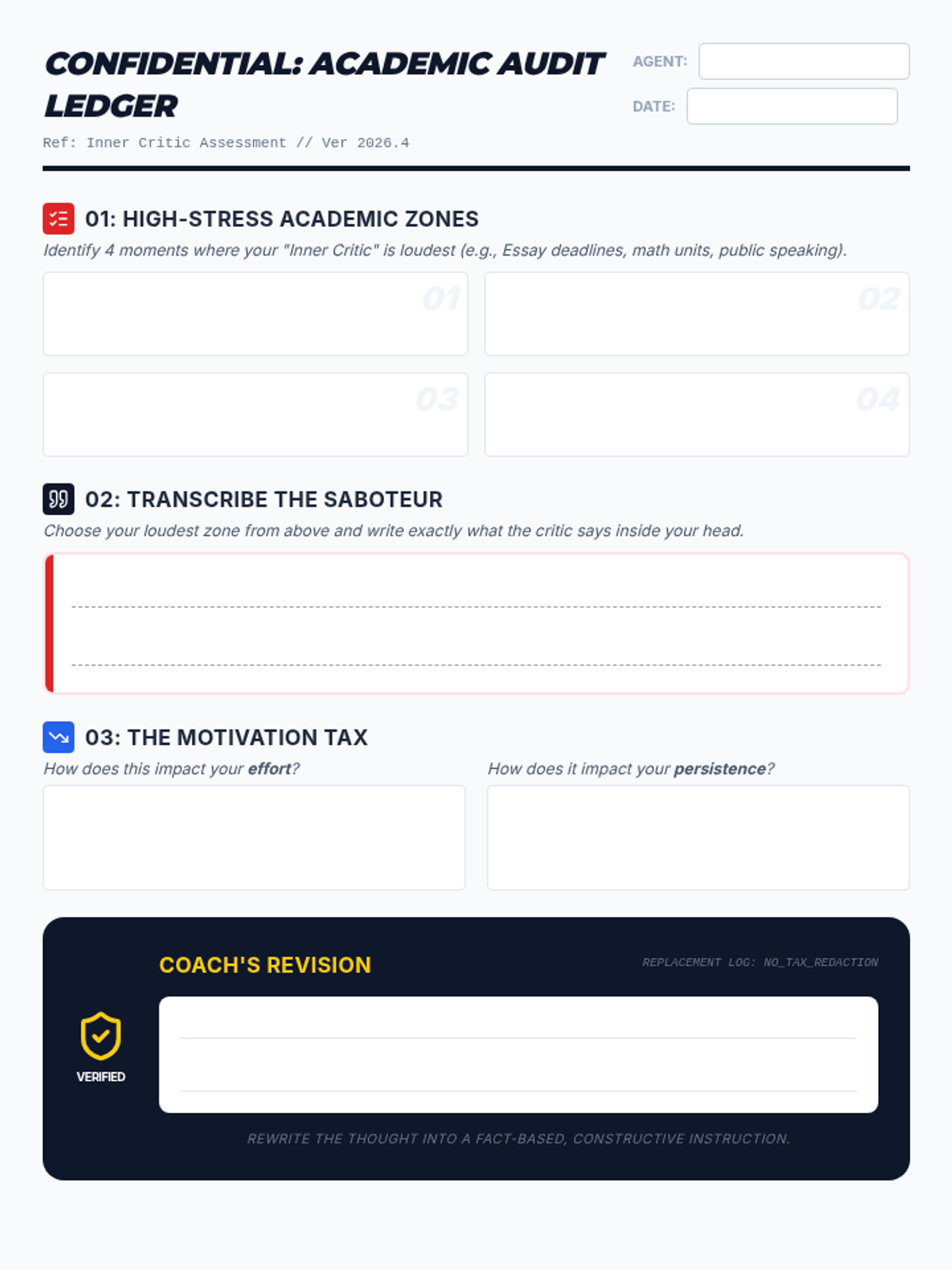
A structured 'Academic Audit Ledger' handout where students list their academic anxiety triggers, transcribe their inner critic's specific messaging, and map out the negative impact on their motivational effort and persistence.
A high-energy, 20-minute slide deck that guides students through an 'Academic Audit' of their inner critic. The presentation frames self-esteem as 'academic capital' and provides a structured flow for identifying and refuting anxious thoughts that hinder school motivation.
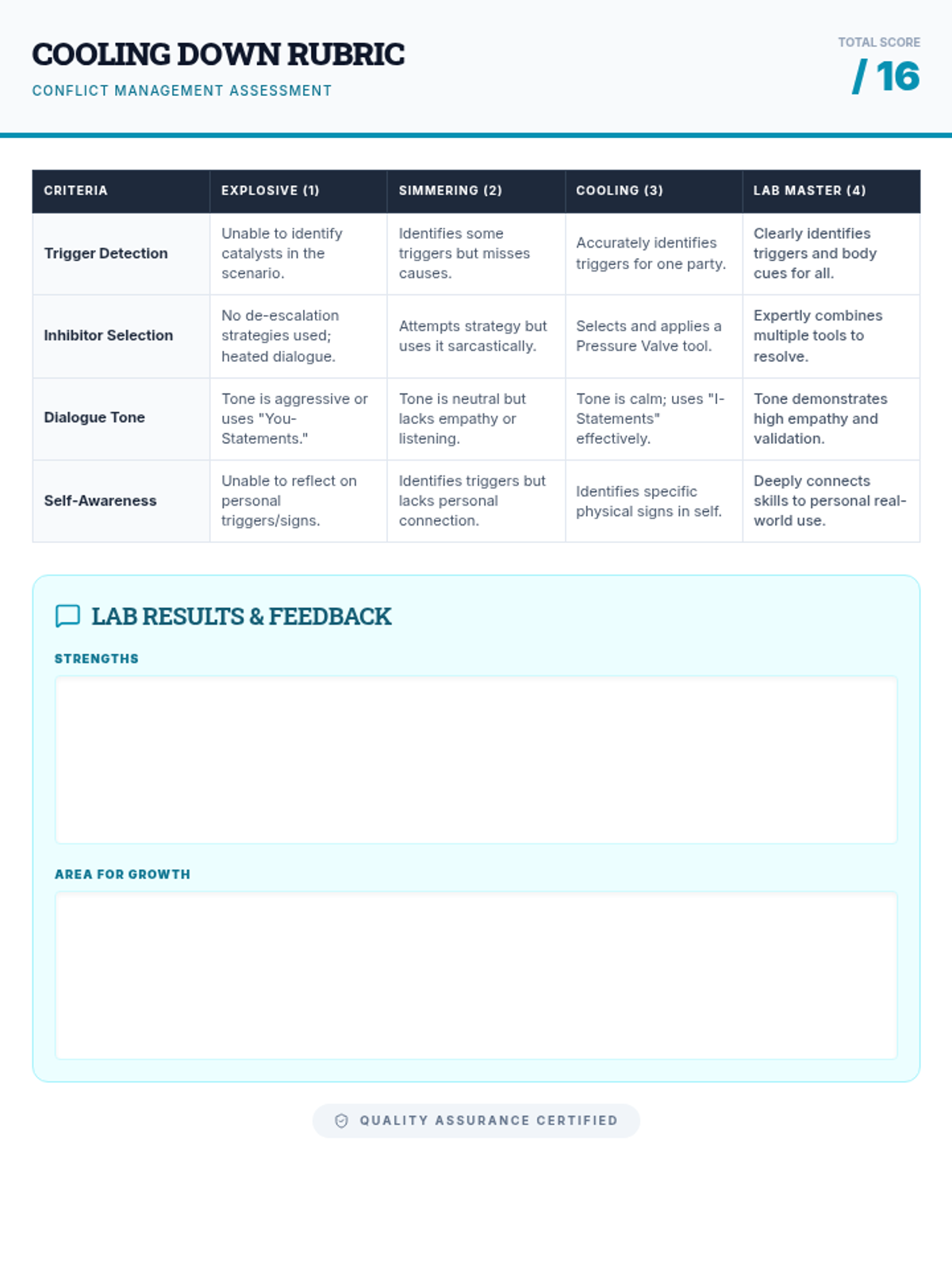
A detailed grading rubric for teachers to assess student work on de-escalation skills, ranging from 'Explosive' to 'Lab Master' levels of proficiency.
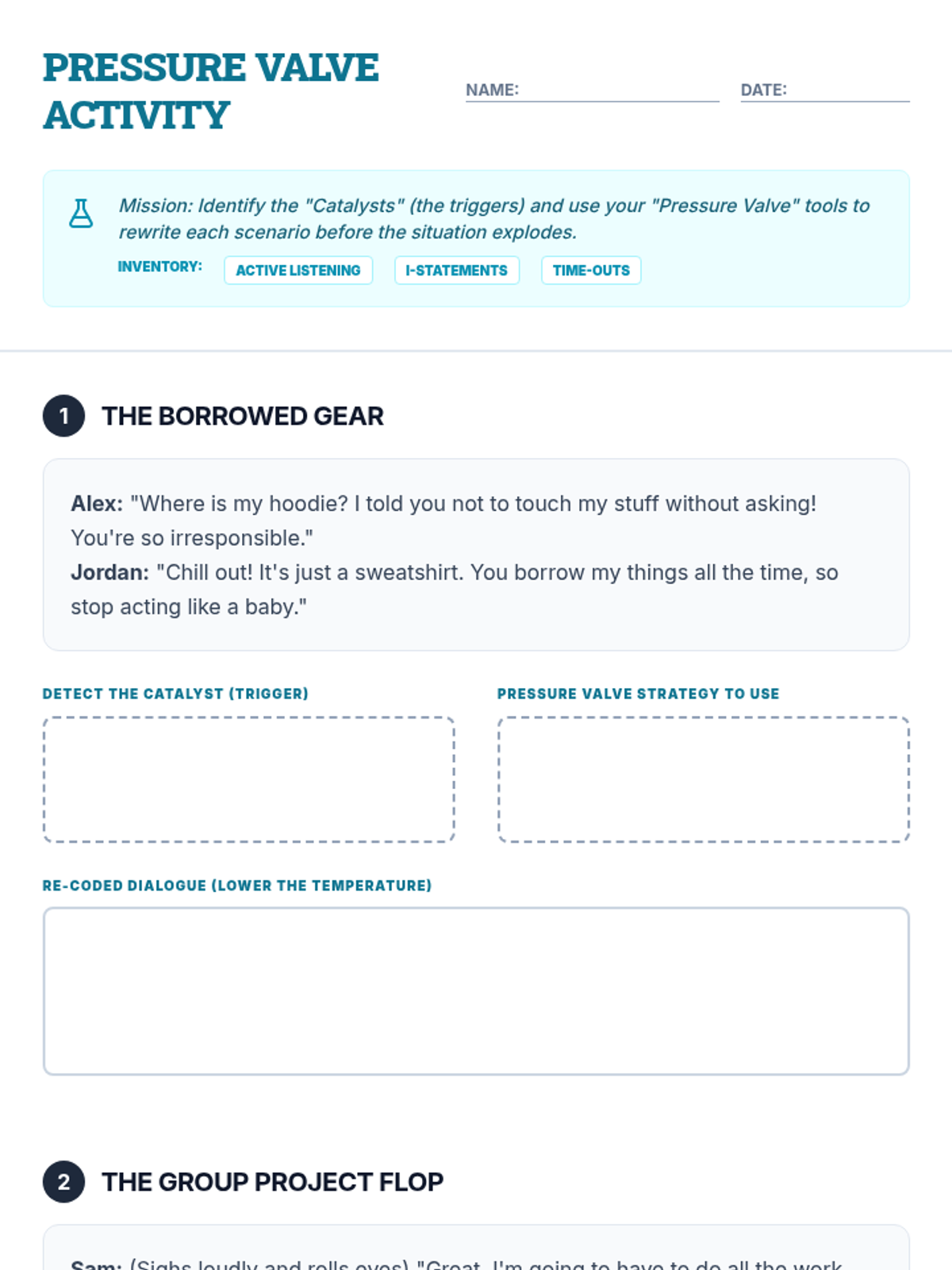
A student worksheet featuring conflict scenarios ('The Borrowed Gear' and 'The Group Project Flop') where students identify triggers and rewrite dialogue using de-escalation techniques.
A visually engaging slide deck titled 'Conflict Chemist' that explains the concepts of catalysts (triggers) and inhibitors (de-escalation tools) using a lab-themed metaphor.
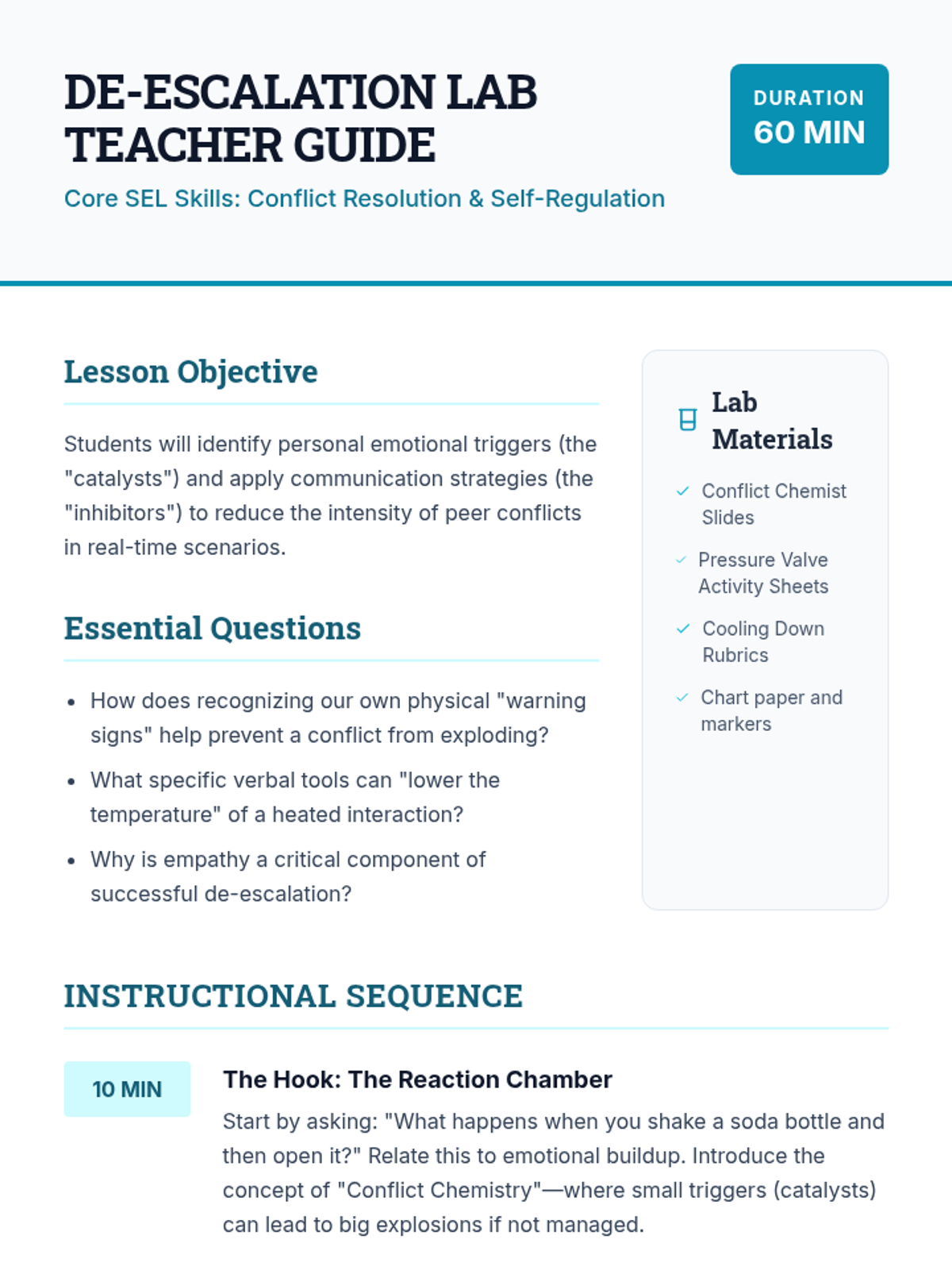
A comprehensive facilitation guide for teachers to lead the De-escalation Lab session, including lesson objectives, timing, step-by-step instructions, and differentiation strategies.
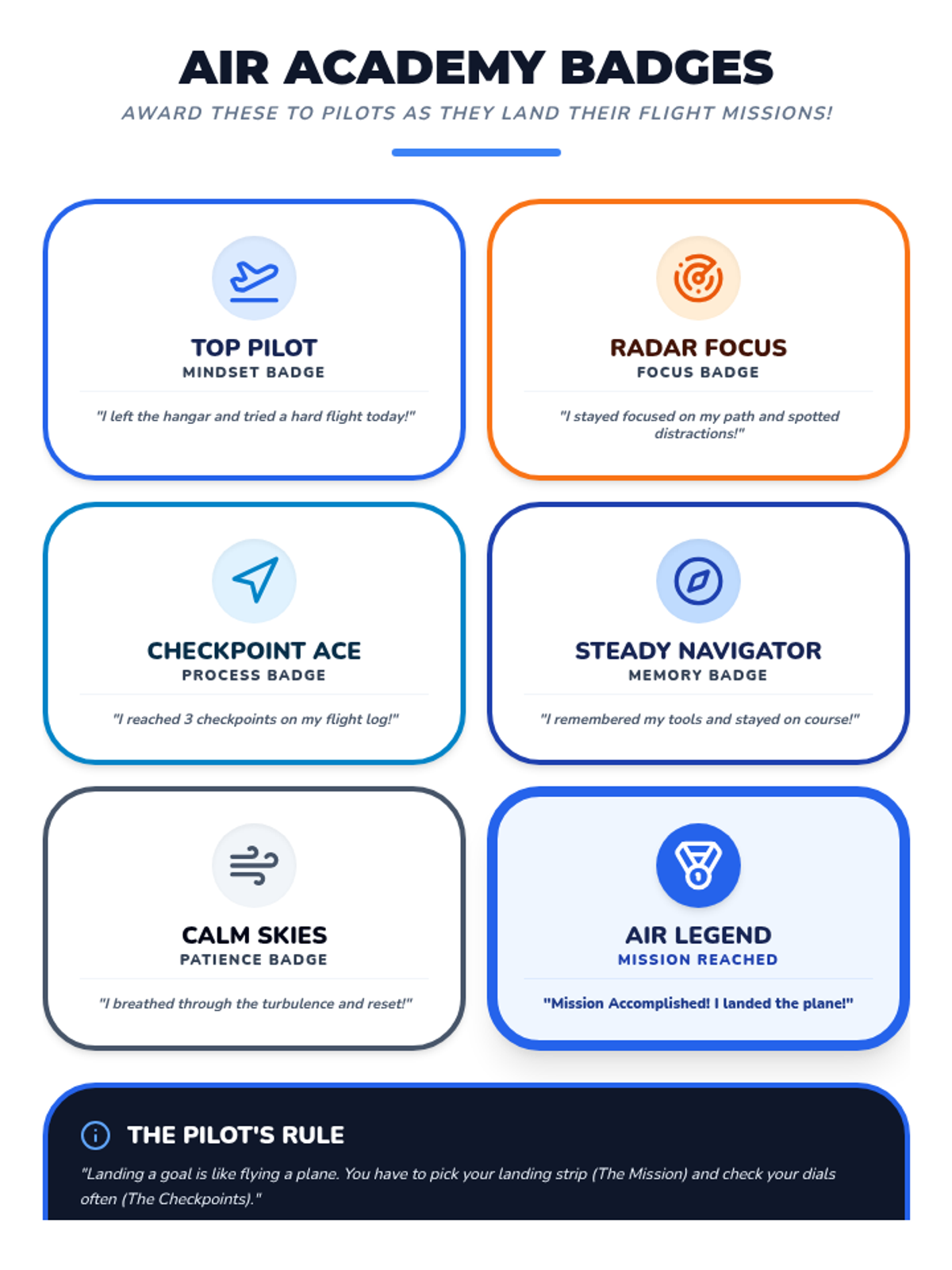
A set of six printable 'Achievement Badges' and a 'Pilot Rule' lesson tip for the Pilot theme. Thematic consistency and icon-alignment improved. Sized for single page.
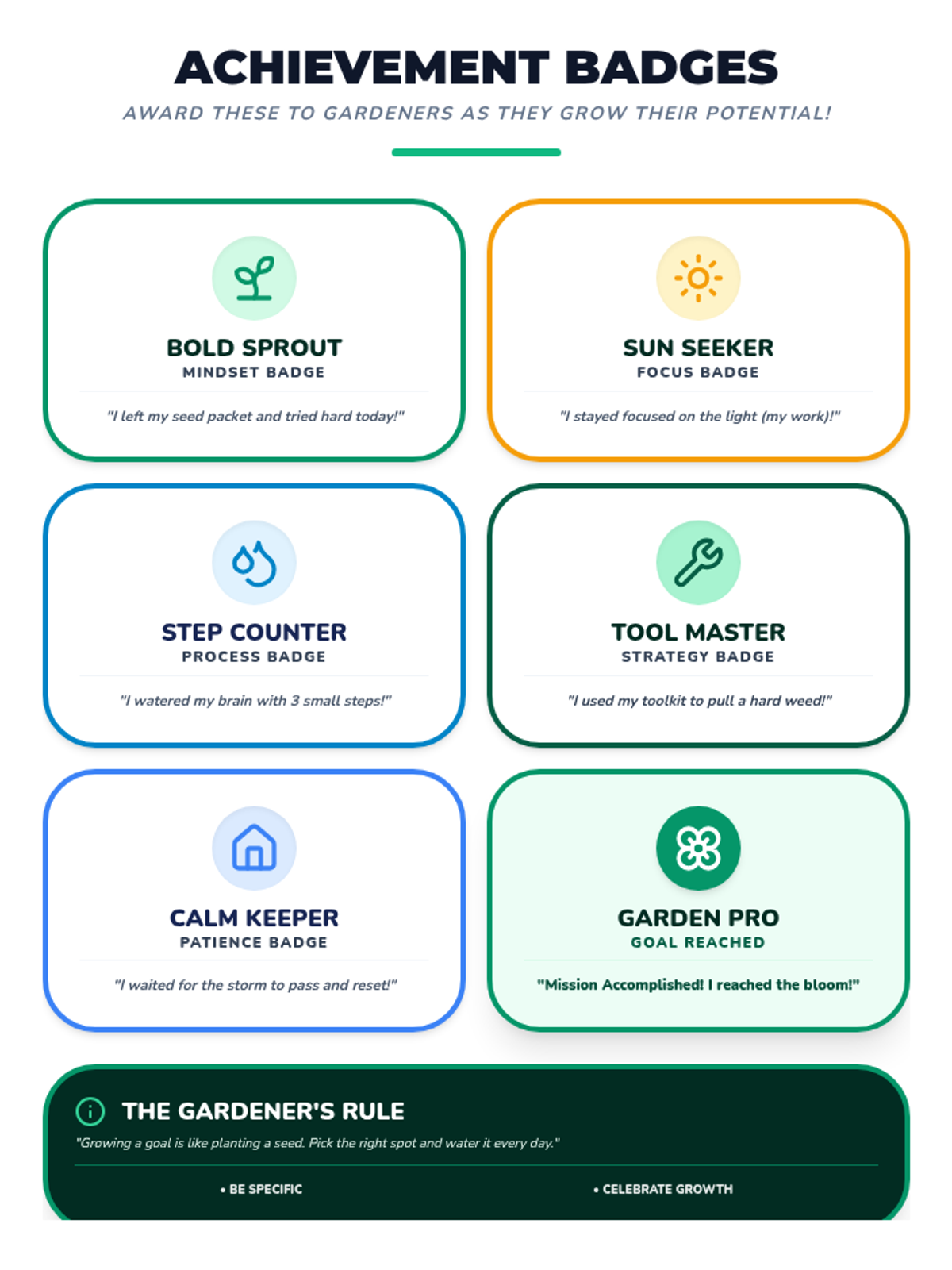
A set of six printable 'Achievement Badges' and a 'Gardener Rule' lesson tip for the Garden theme. Thematic consistency and icon-alignment improved. Sized for single page. Layout fixed for fit. Header layout fixed for fit. Spacing refined. Standardized category labels and rounding.
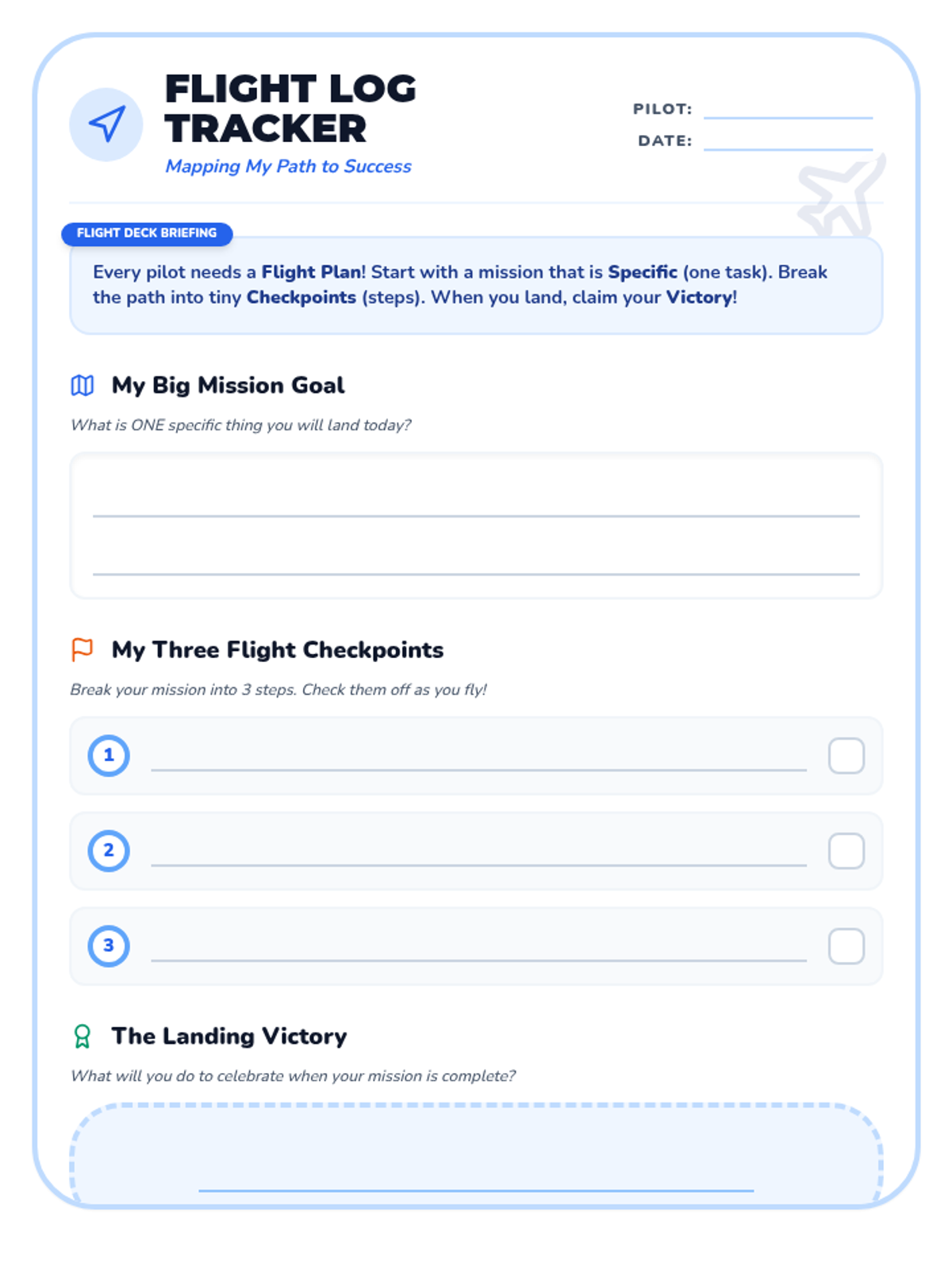
A student goal-setting worksheet for the Pilot theme. Helps students break a task into 3 checkpoints and identify a reward. Sized for 1-page fit. Meta-theme consistent. Header layout fixed for readability. Line contrast improved.
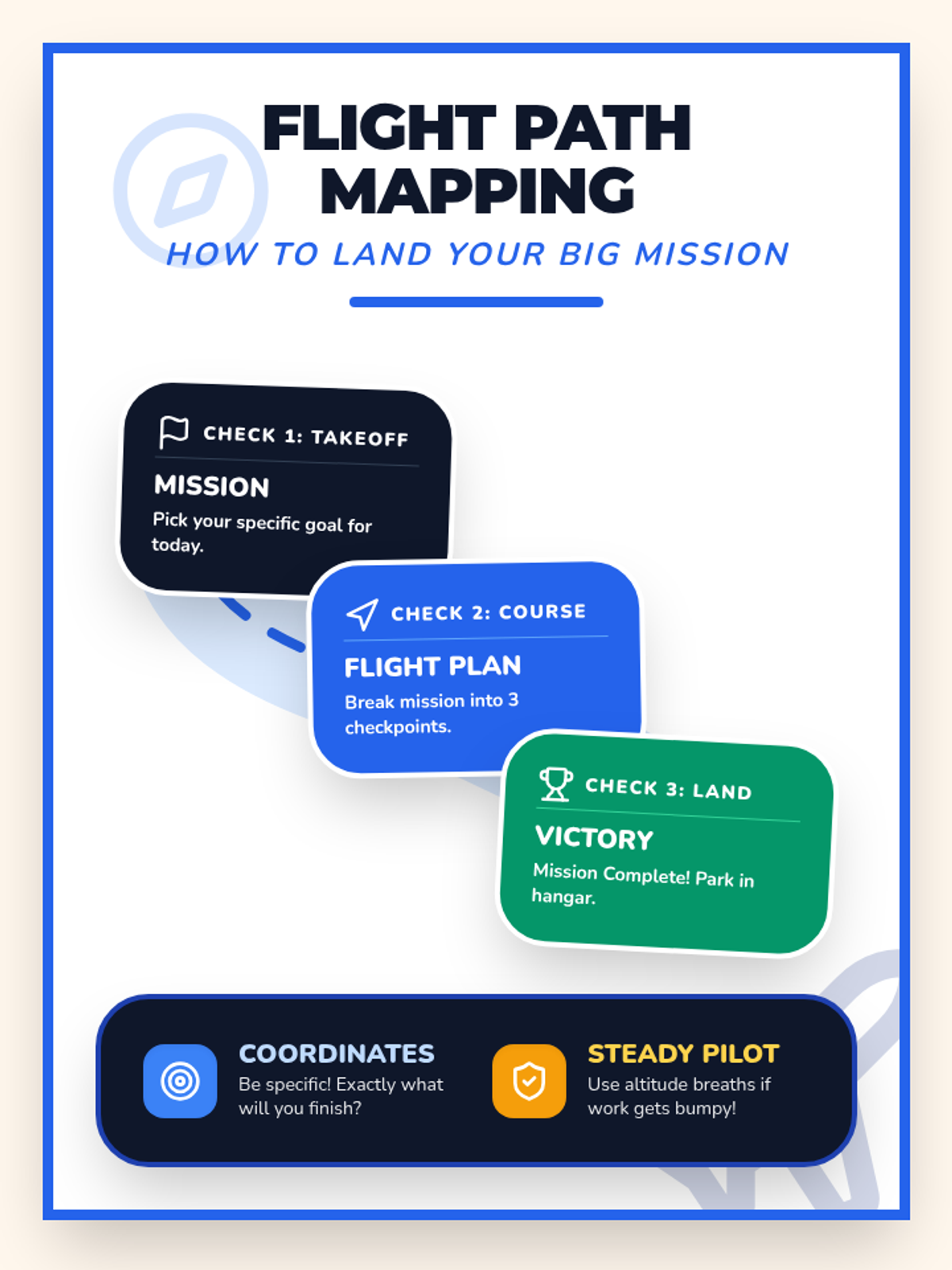
A visual anchor chart for the Pilot theme illustrating the three-step goal-setting process: Takeoff (Goal), Flight Plan (Steps), and Landing (Celebration). Sized for single page. Path fixed. Flow adjusted for standard reading.
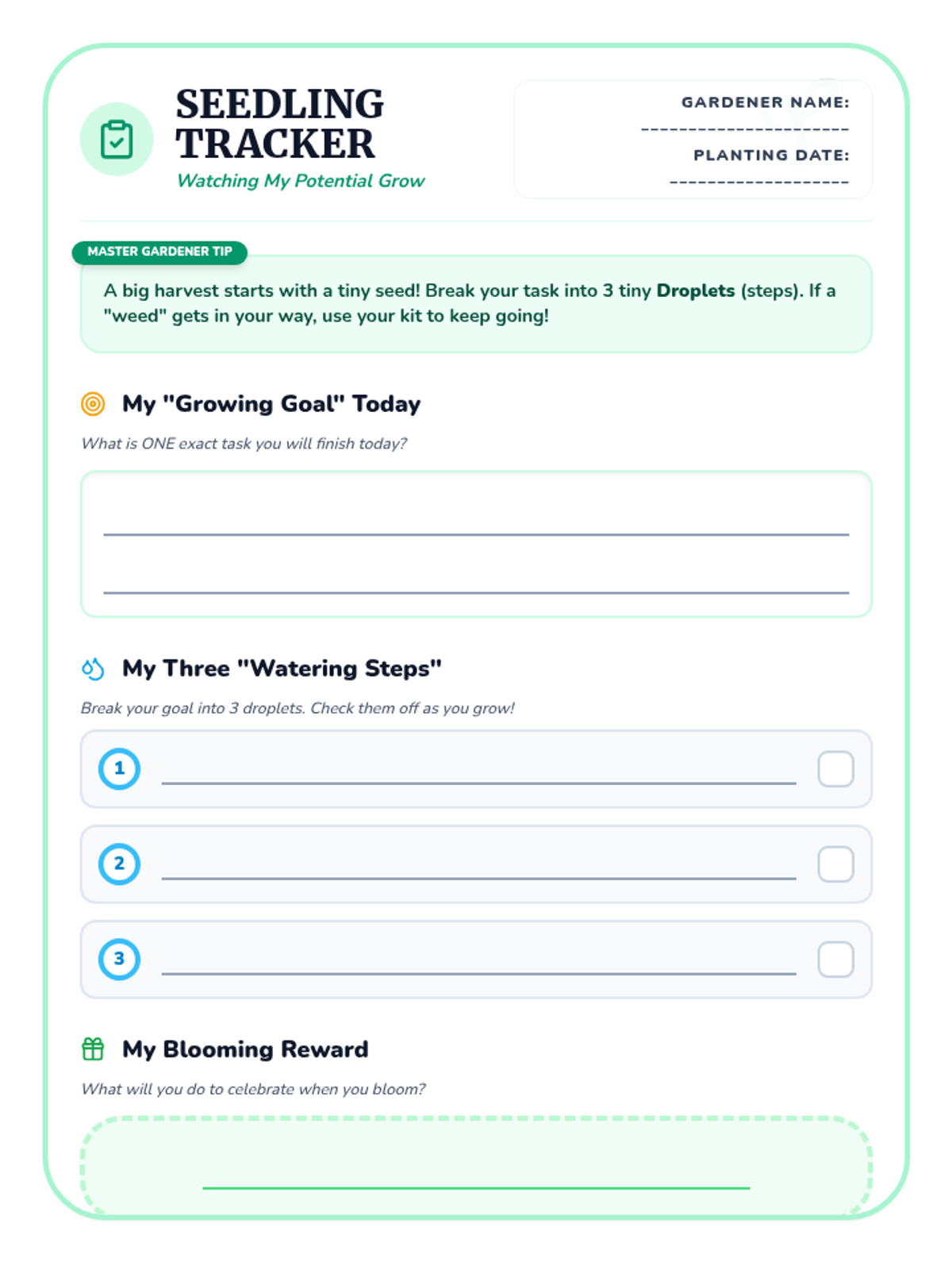
A student goal-setting worksheet for the Garden theme. Helps students break a task into 3 steps and identify a reward. Spacing adjusted for 1-page fit. Meta-theme consistent. Header layout fixed for readability. Line contrast improved. Metaphor placeholder removed.
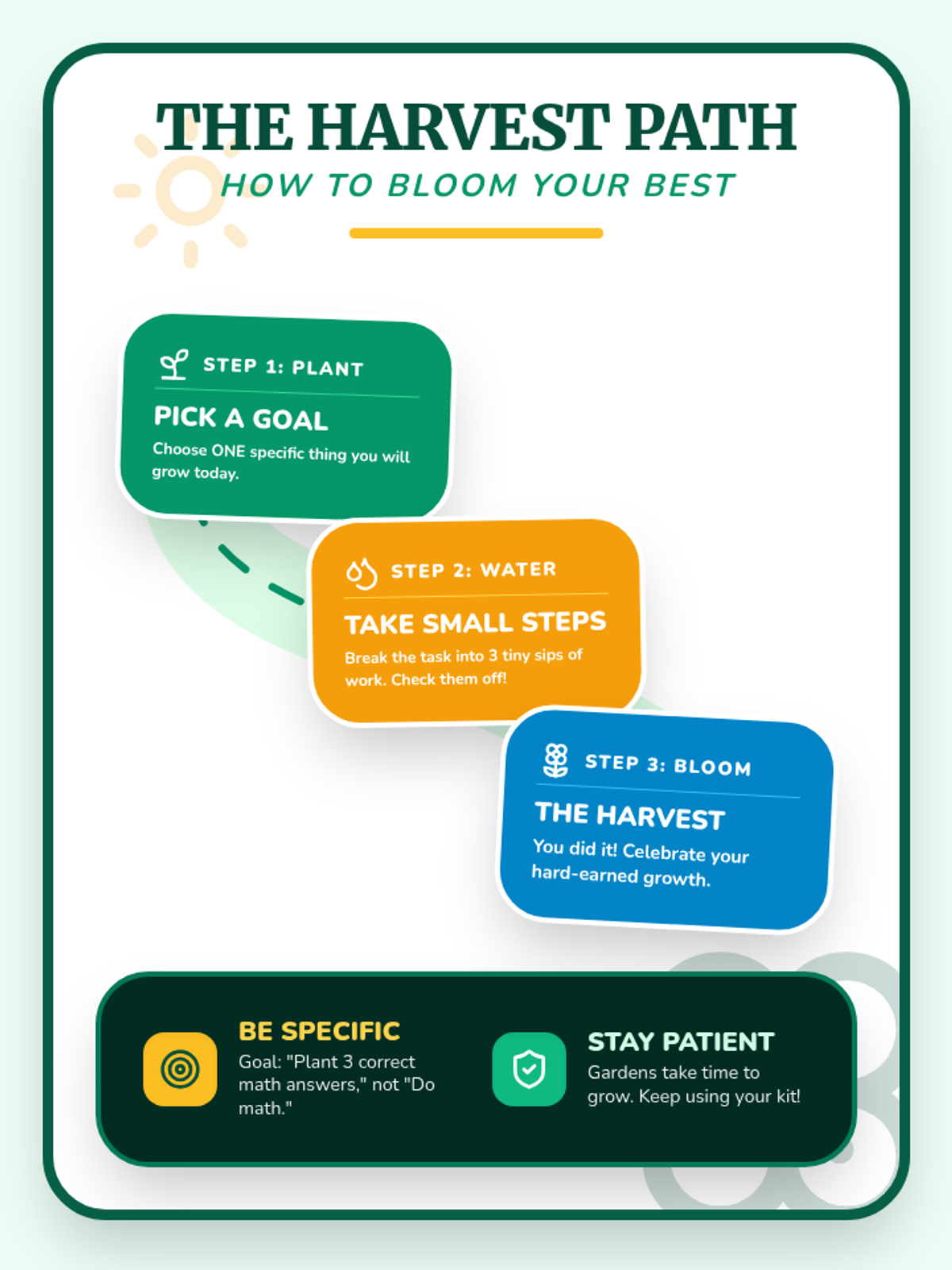
A visual anchor chart for the Garden theme illustrating the three-step goal-setting process: Plant (Goal), Water (Steps), and Bloom (Celebration). Sized for single page.
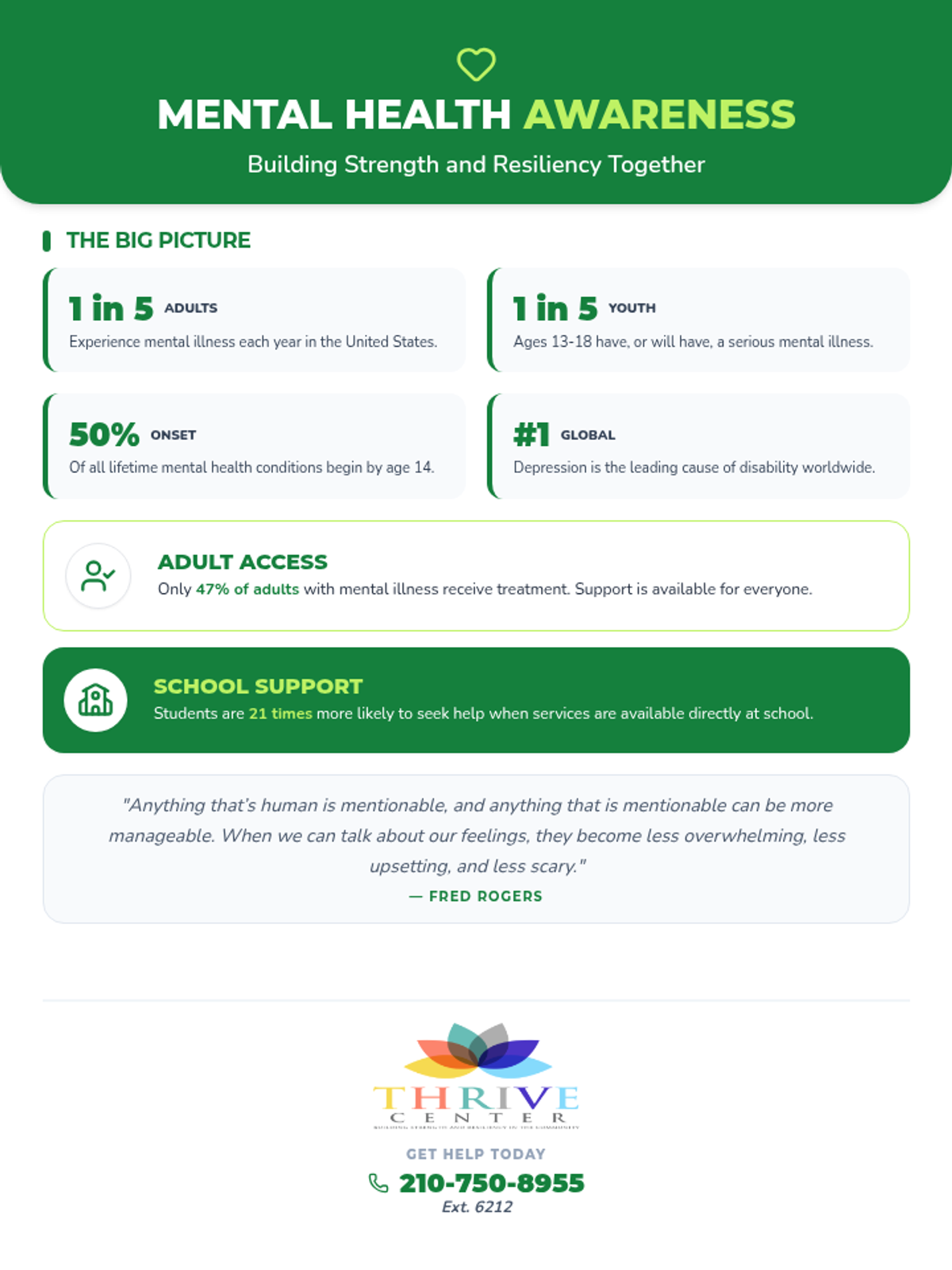
A comprehensive community flyer combining youth and adult mental health statistics, featuring a centered and enlarged Thrive Center logo along with contact information. Includes a powerful closing quote from Fred Rogers.
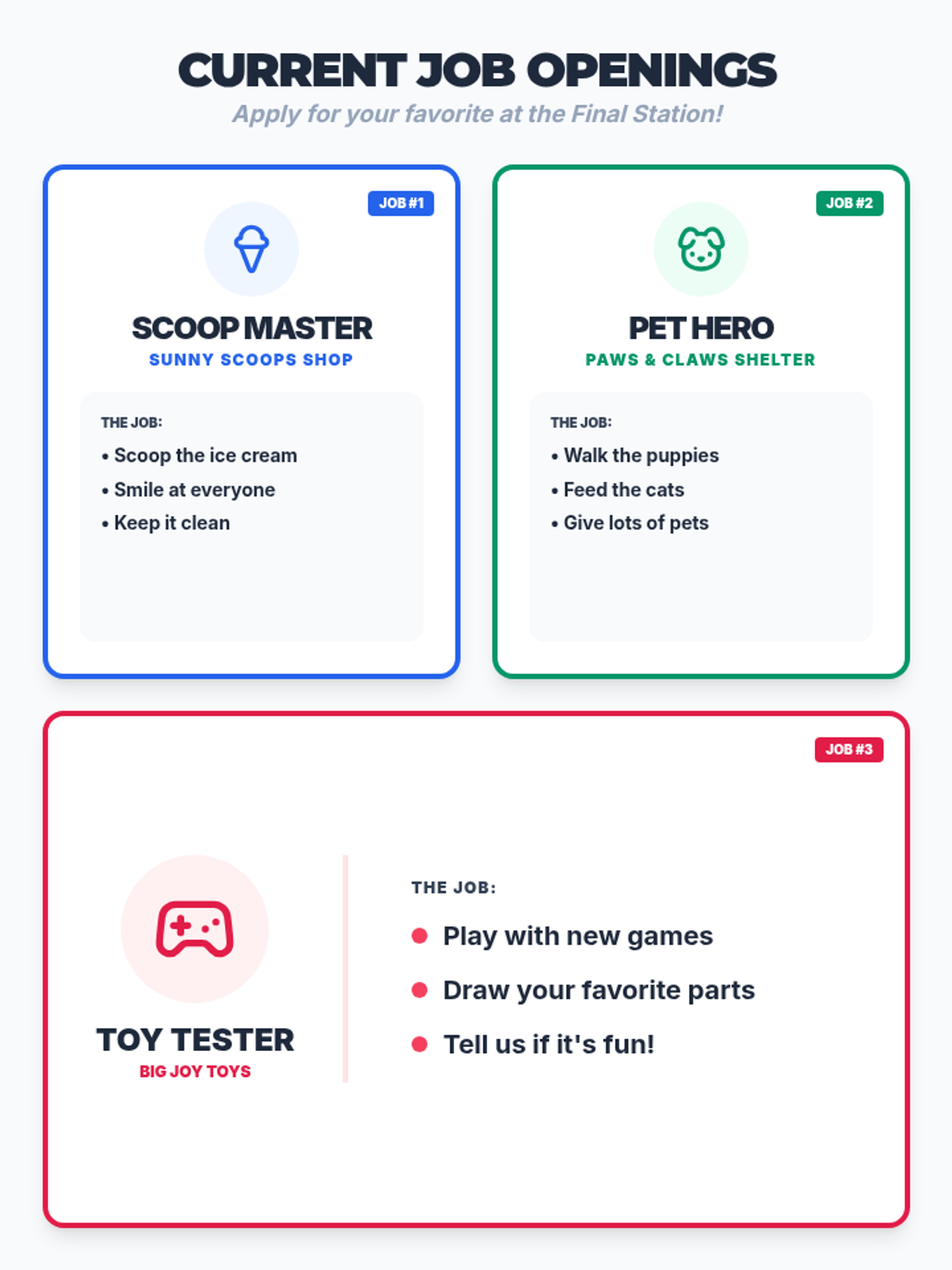
A collection of 3 simplified job posters (Ice Cream Shop, Animal Shelter, Toy Factory) to give students context for their applications. Also includes scenario cards for the Station 3 availability challenge. Updated with improved layout to prevent page break issues.
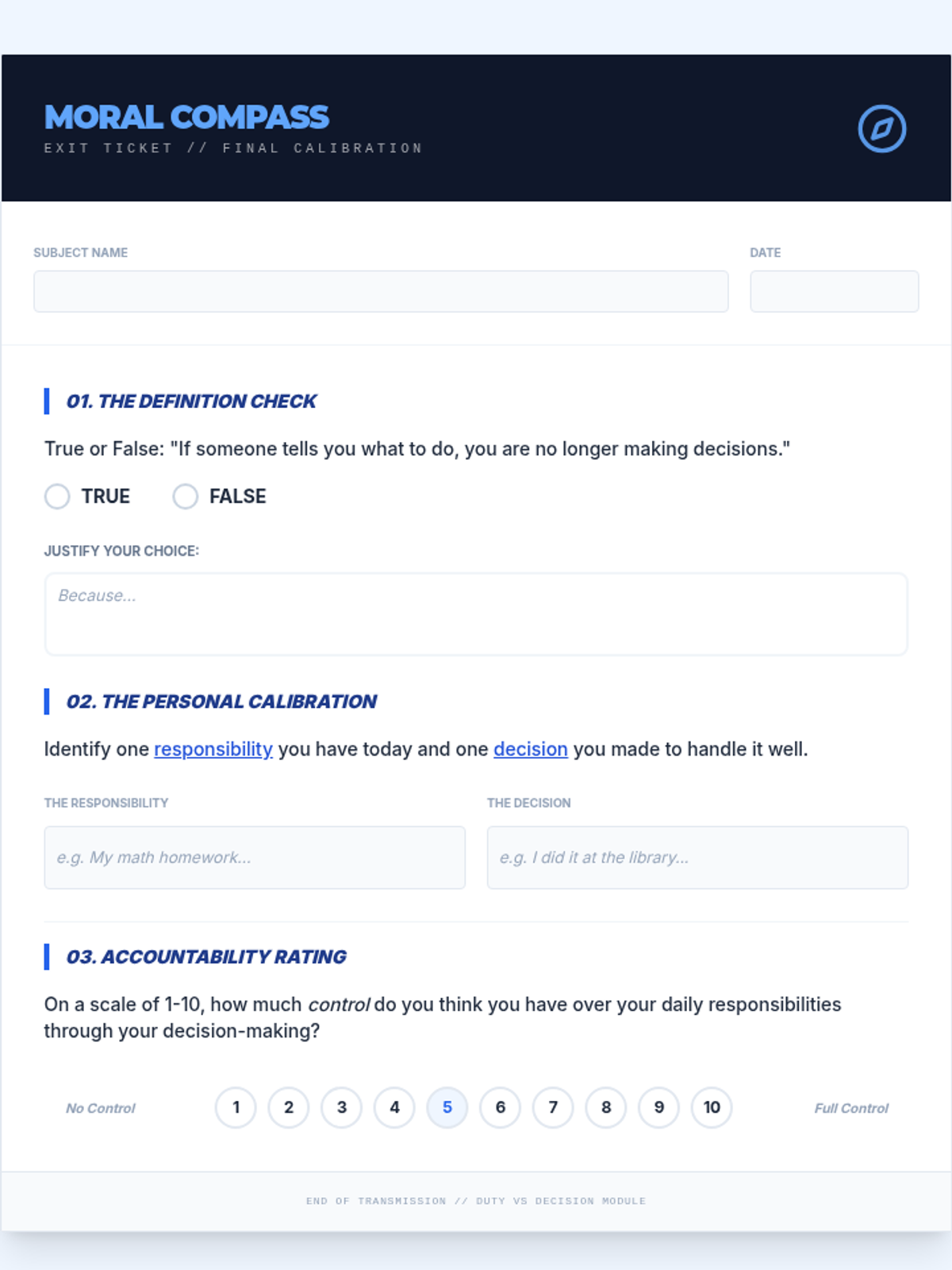
A focused exit ticket designed to assess students' understanding of the relationship between duties and choices, featuring a T/F conceptual check, personal application scenarios, and a self-rating accountability scale.
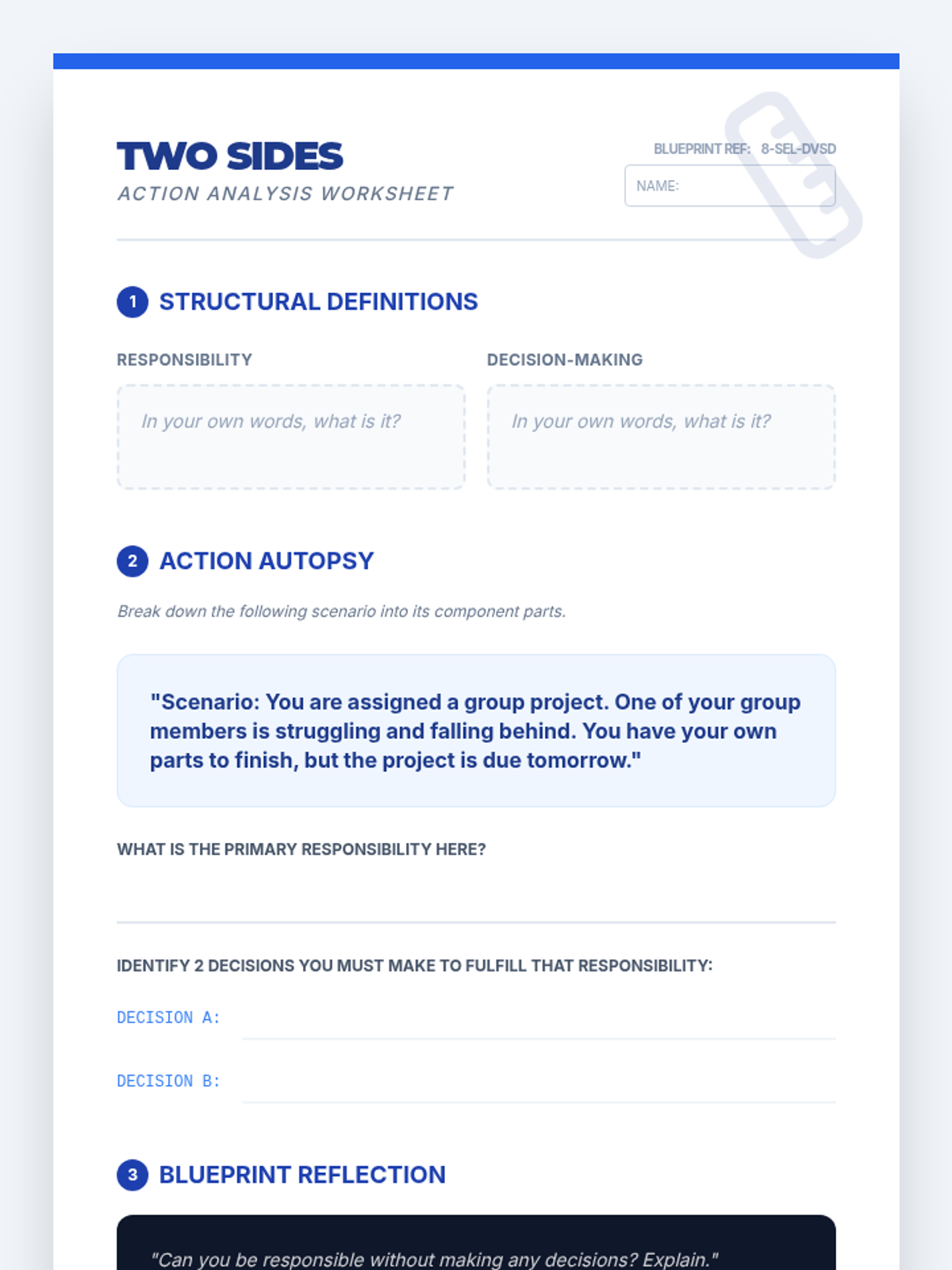
A structured worksheet that challenges students to perform an 'Action Autopsy' on real-world scenarios, breaking them down into primary responsibilities and the specific decisions required to fulfill them.
A high-impact slide deck for teaching the difference between responsibility and decision-making, featuring an 'Architectural Blueprint' theme, definitions, a 'Power Blend' intersection model, and interactive class practice scenarios.
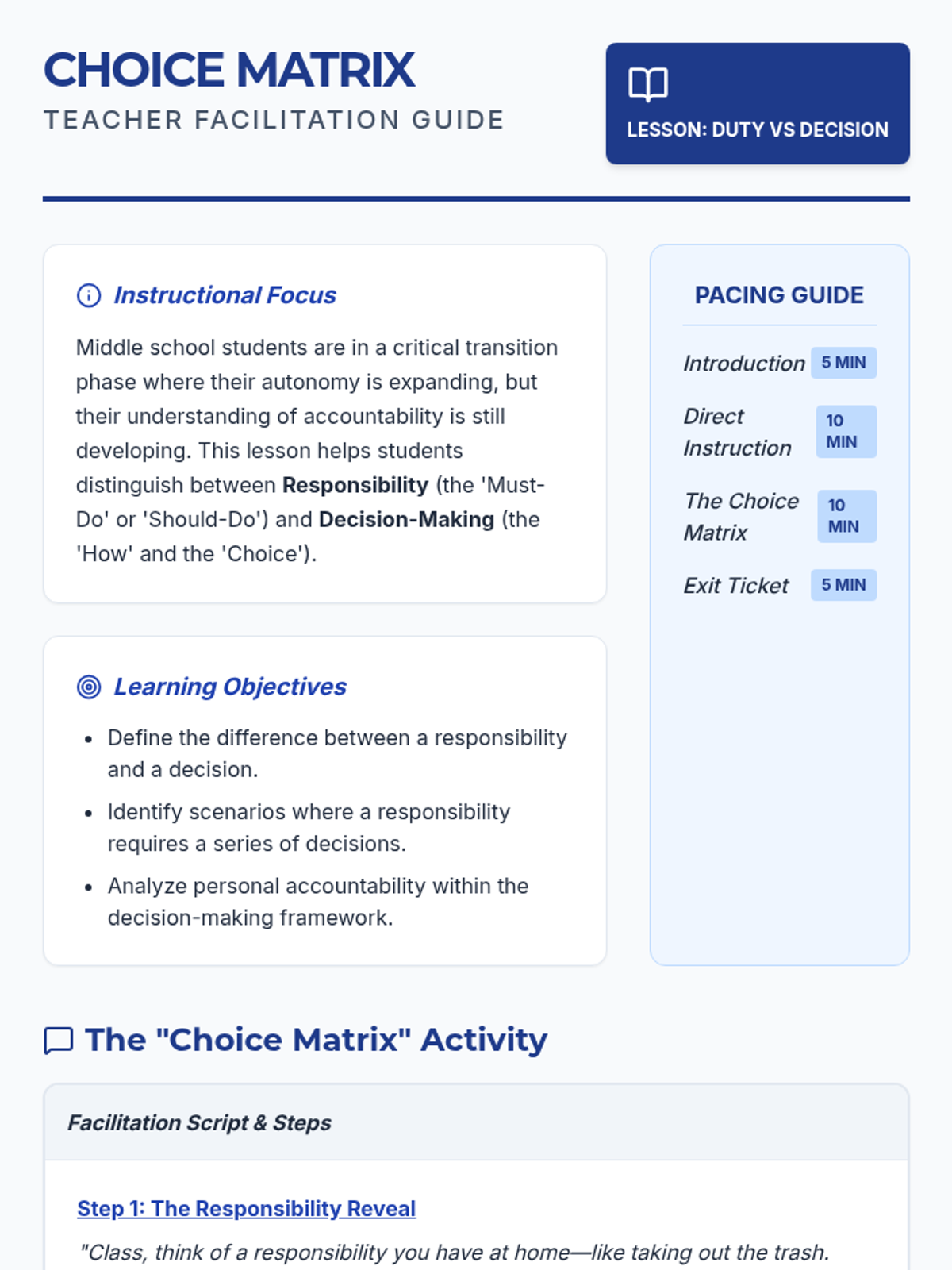
A comprehensive facilitation guide for teachers to lead the 'Choice Matrix' activity, including pacing suggestions, discussion prompts, and strategies for addressing common student misconceptions about accountability.
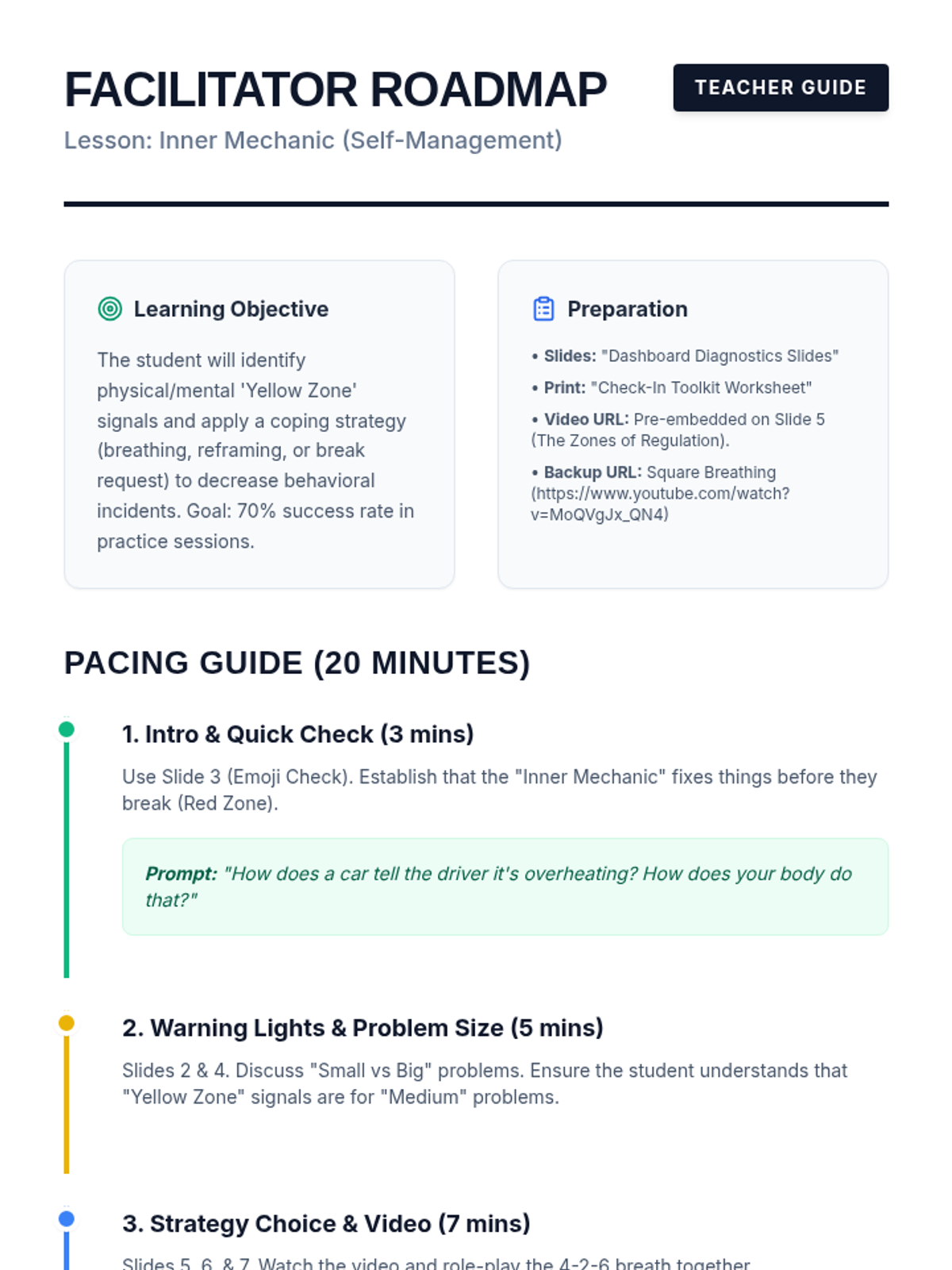
A facilitator guide providing a step-by-step roadmap for teaching the Inner Mechanic lesson. Includes pacing, discussion prompts, preparation tips, and troubleshooting advice. Fixed page breaks and simplified instructions.
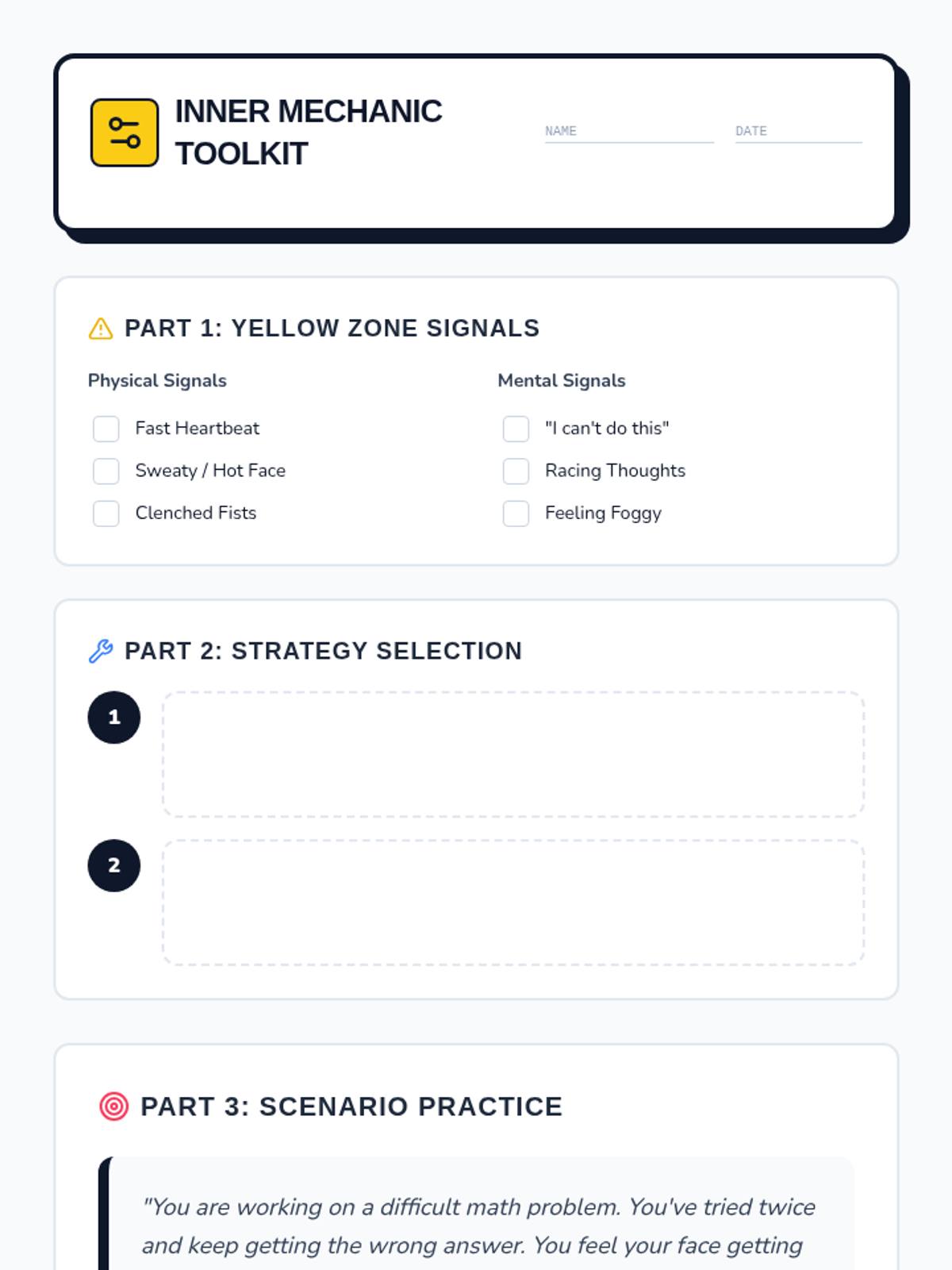
A student-facing toolkit worksheet designed to help students map out their Yellow Zone signals, select preferred coping strategies, and practice applying them to a challenging classroom scenario. Optimized for a 2-page print format.
A slide deck for teaching self-regulation using a 'Dashboard Diagnostics' theme. Includes sections on identifying Yellow Zone signals, 'Size of the Problem', and a visual choice board of coping strategies. Updated with improved contrast and an embedded video.
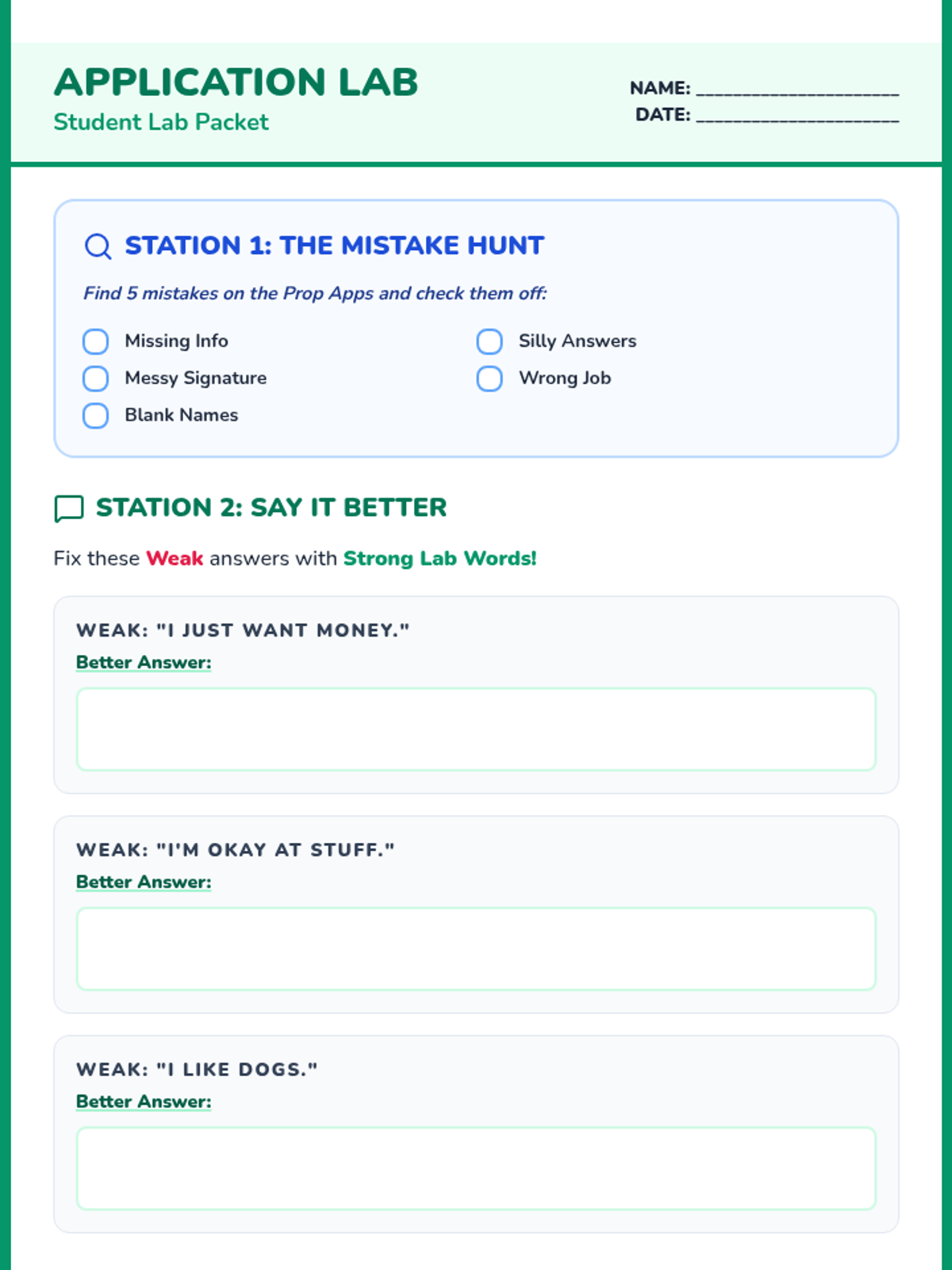
A comprehensive student lab packet. Includes a mistake checklist, expanded 'Say It Better' vocabulary practice, scenario-based availability charting, personal info memory check, and a professional-looking final job application. Updated with corrected station numbering and larger input fields.
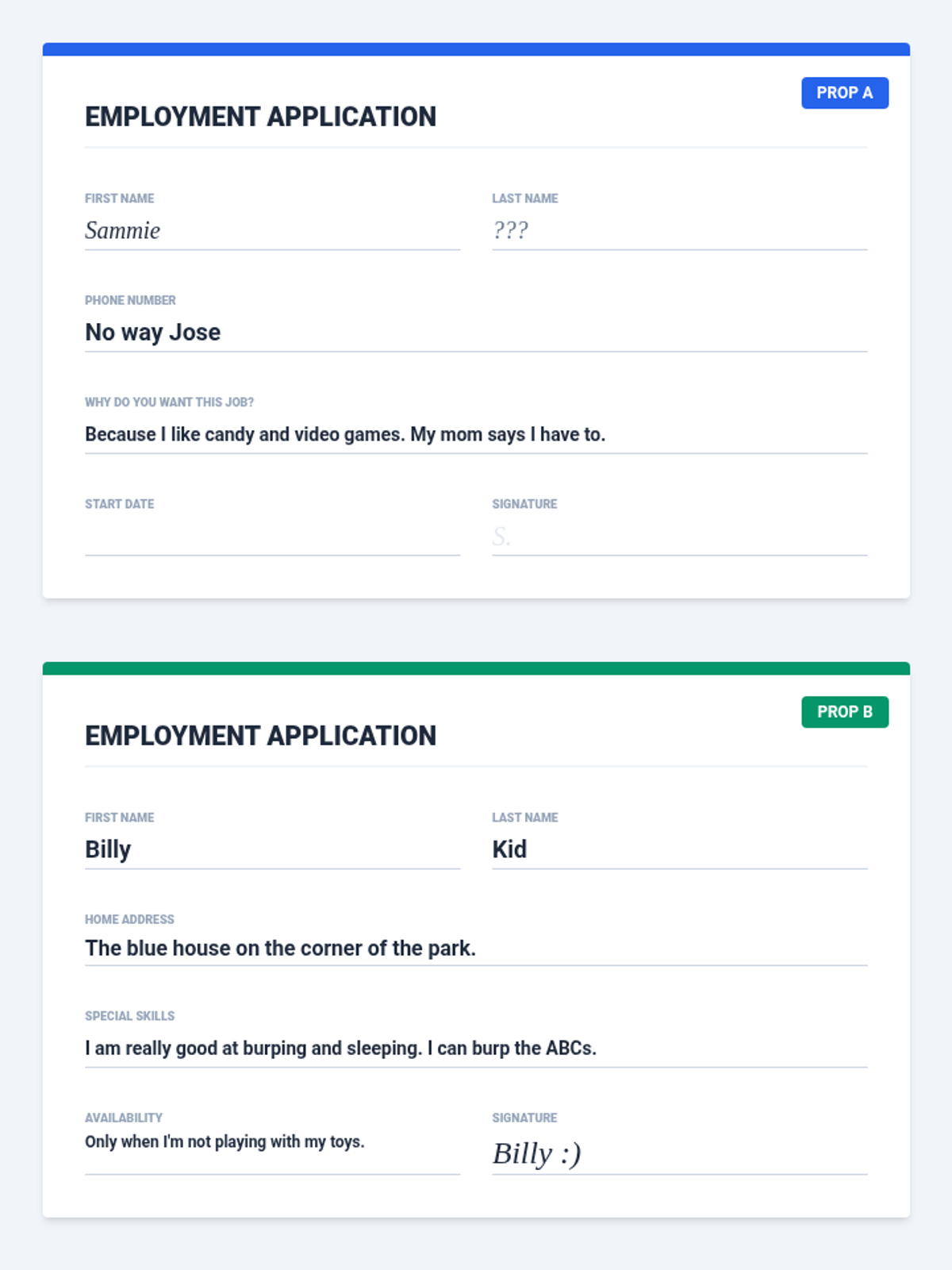
Two "bad" application props designed to look like formal employment forms but filled with 2nd-3rd grade mistakes (missing info, unprofessional answers, messy writing). Includes different samples for group variety.
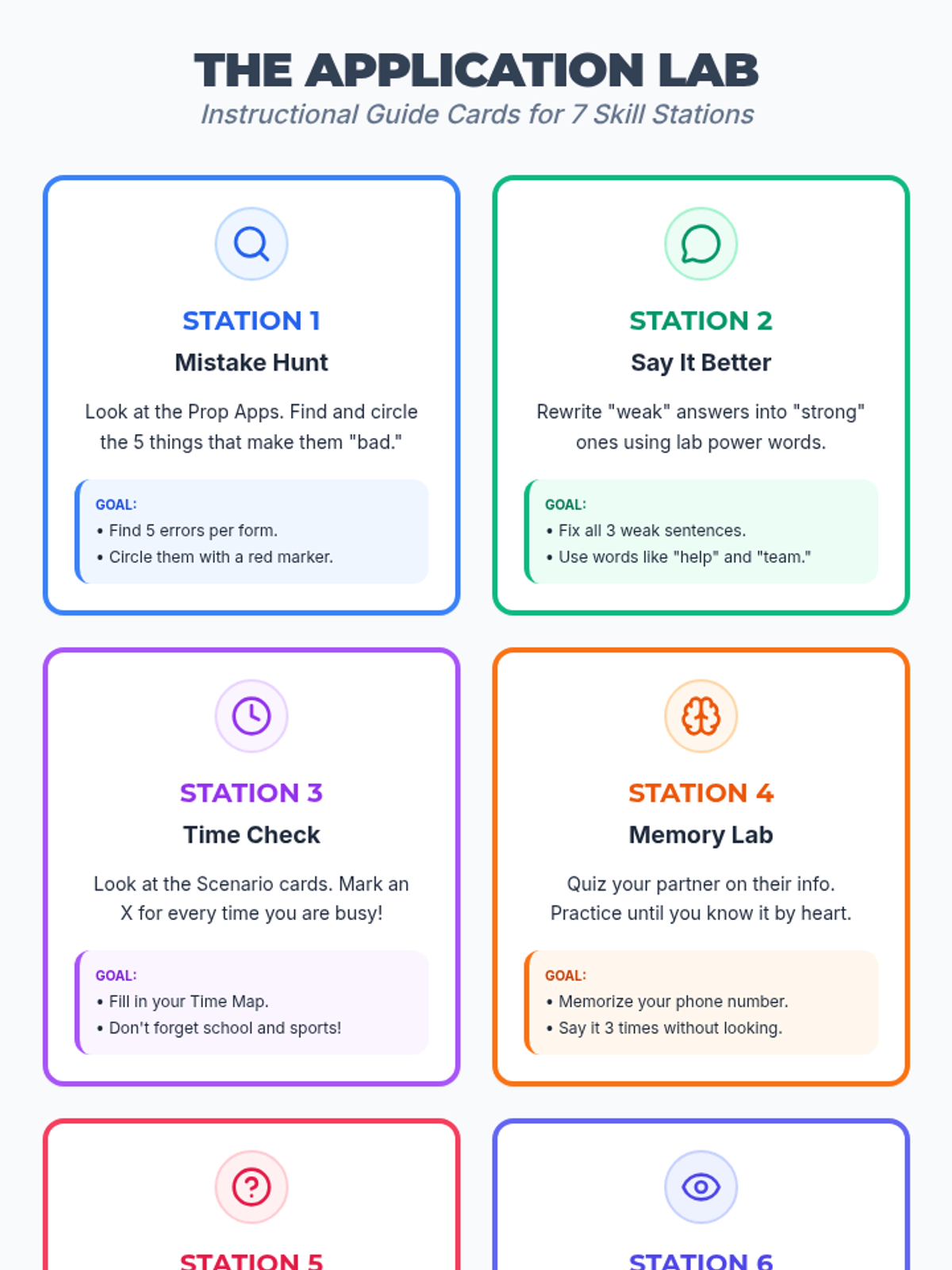
Instruction cards for 5 application skill stations and a final challenge. Updated with improved visual structure and specific goal checklists for 2nd-3rd graders.
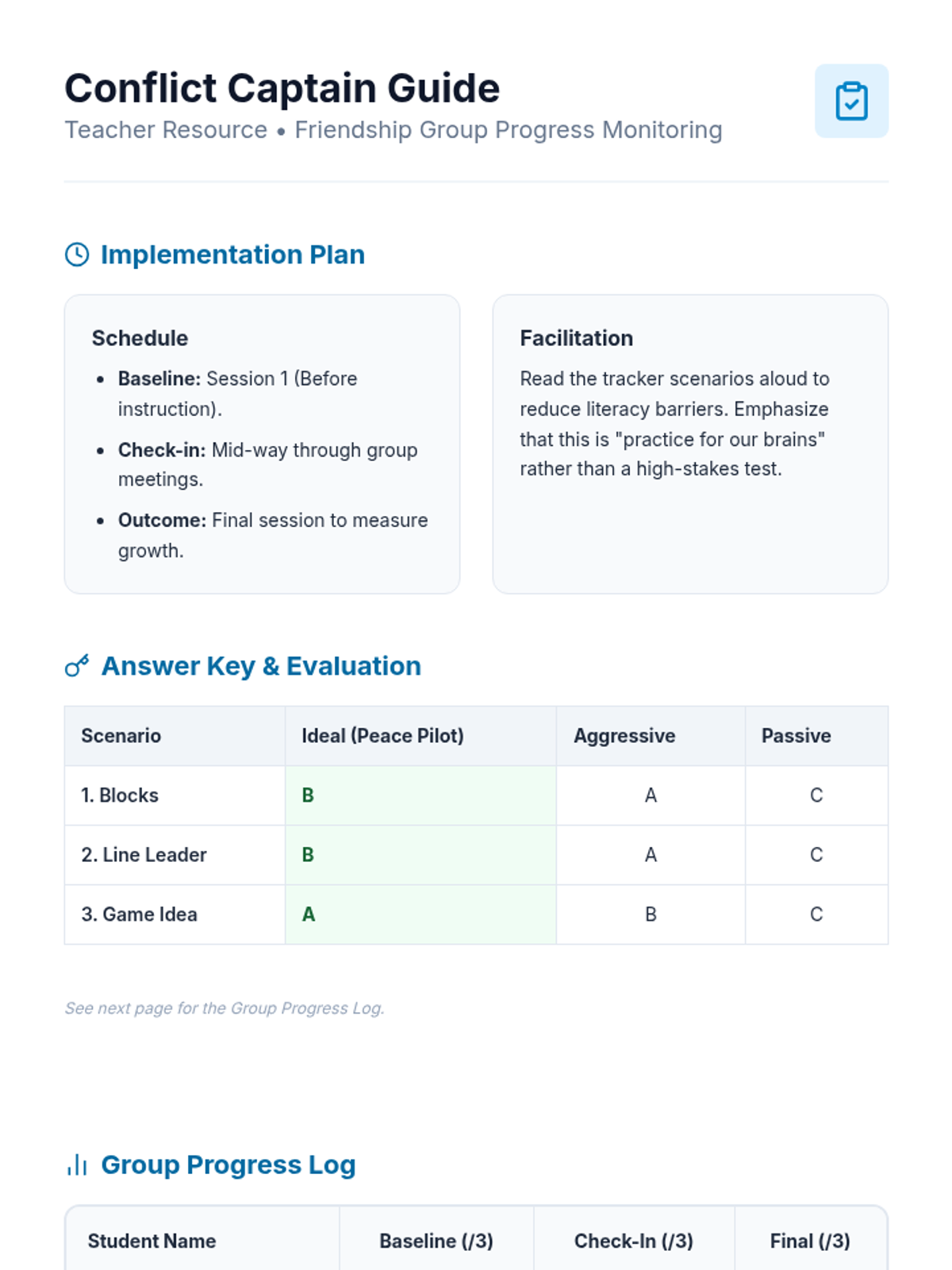
A facilitator guide for teachers or counselors, providing instructions on how to use the progress tracker, a scoring key, and a group log for data collection.
A presentation slide deck for teaching conflict resolution strategies to Grade 2 students, featuring interactive scenarios and "The Peace Pilot Code."
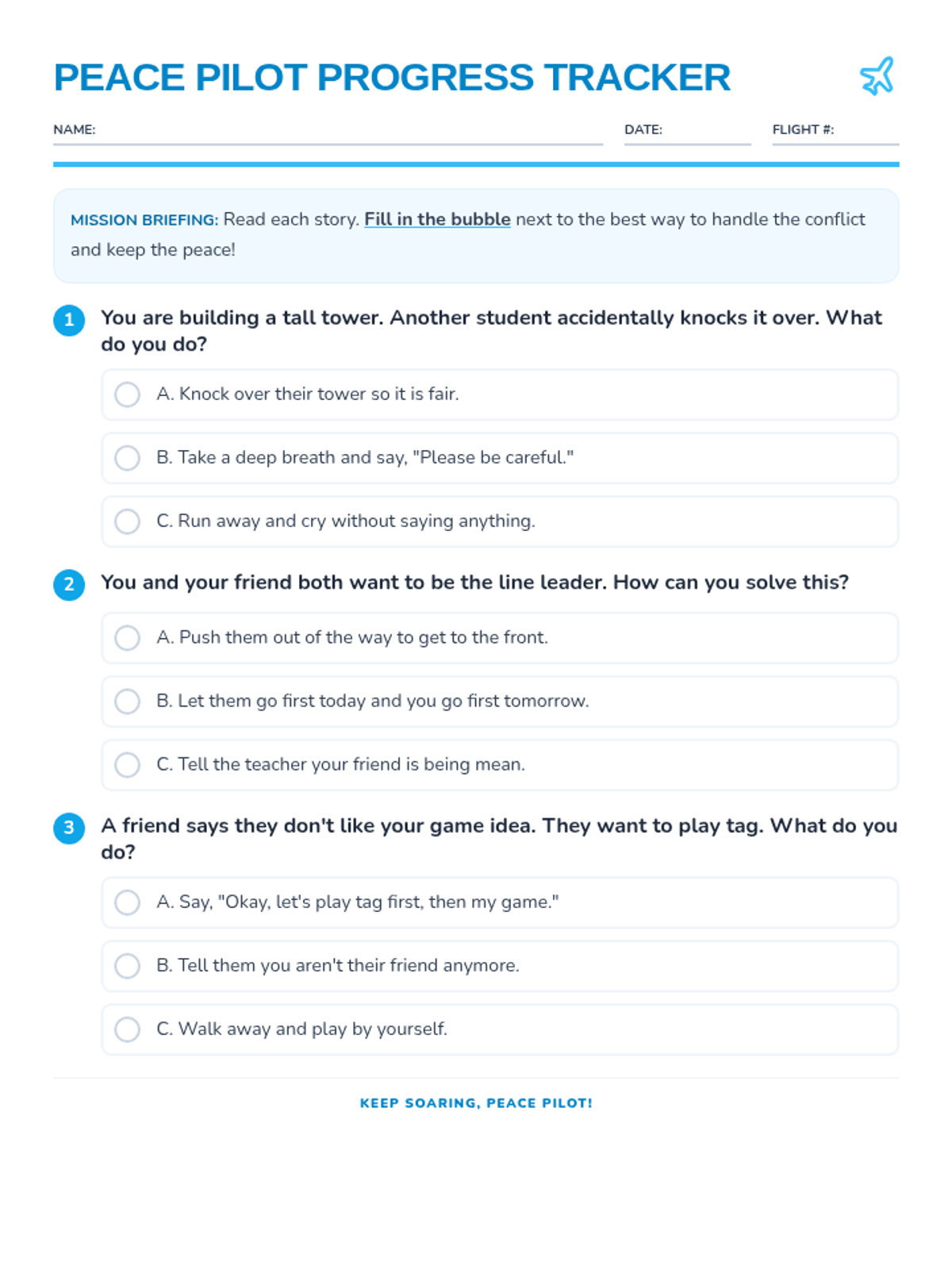
A multiple-choice assessment for 2nd-grade students to track their progress in identifying positive conflict resolution strategies.
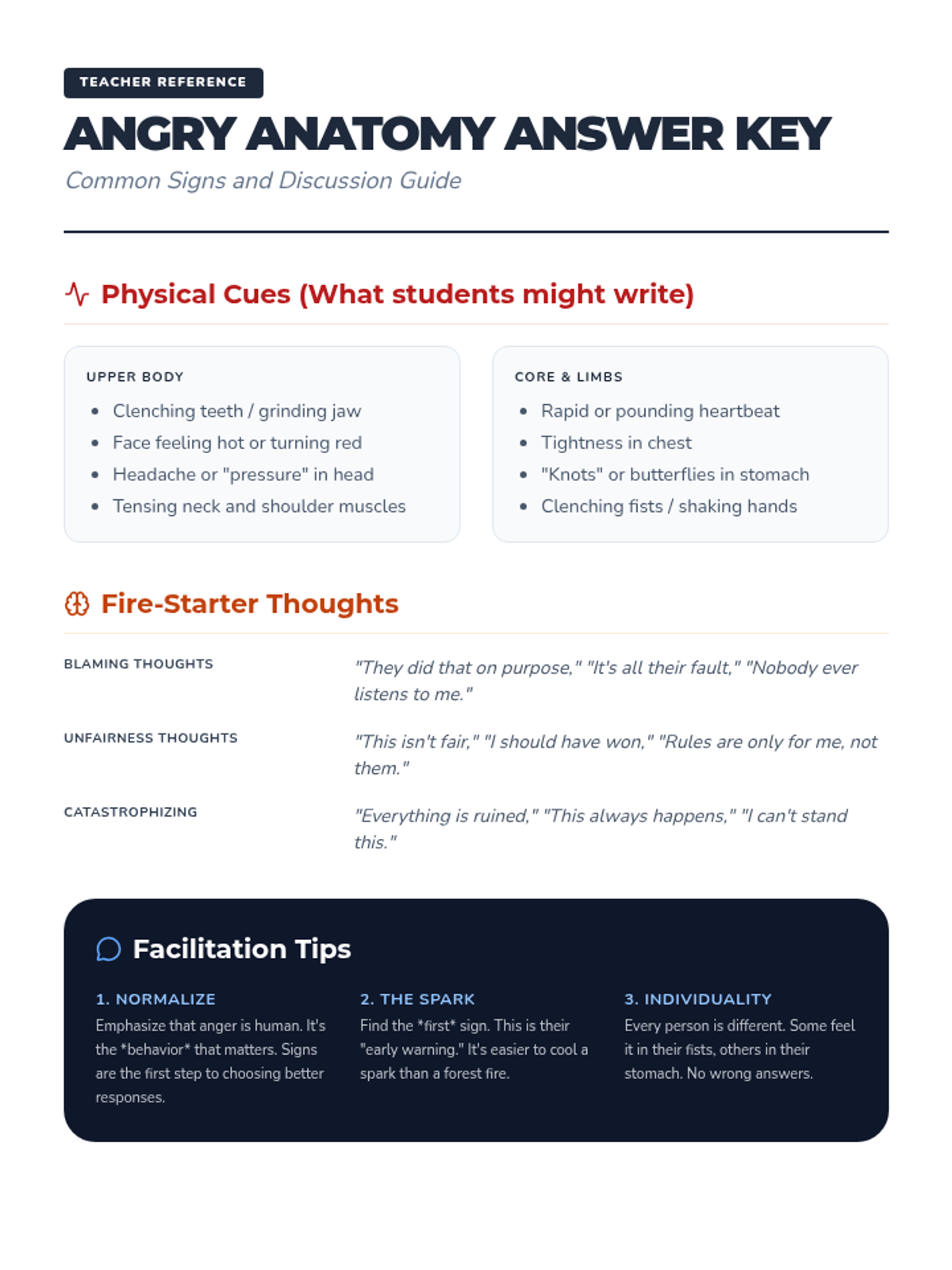
An answer key and teacher guide for the Angry Anatomy worksheet, featuring common student responses and discussion prompts.
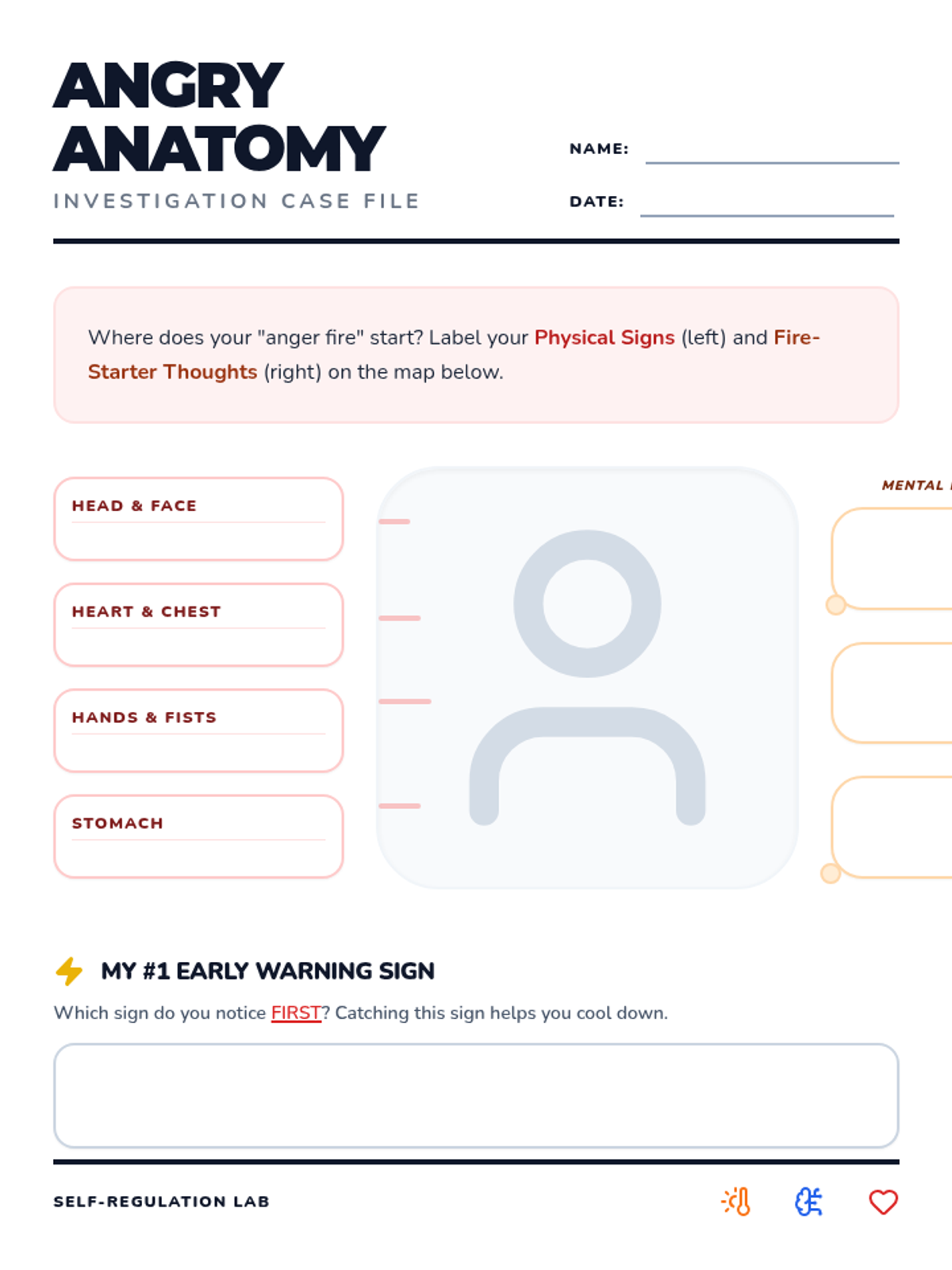
A body map graphic organizer for students to identify and label their physical anger cues and internal thought patterns.
A slide deck explaining the physical and mental signs of anger to prepare students for the Body Map activity.
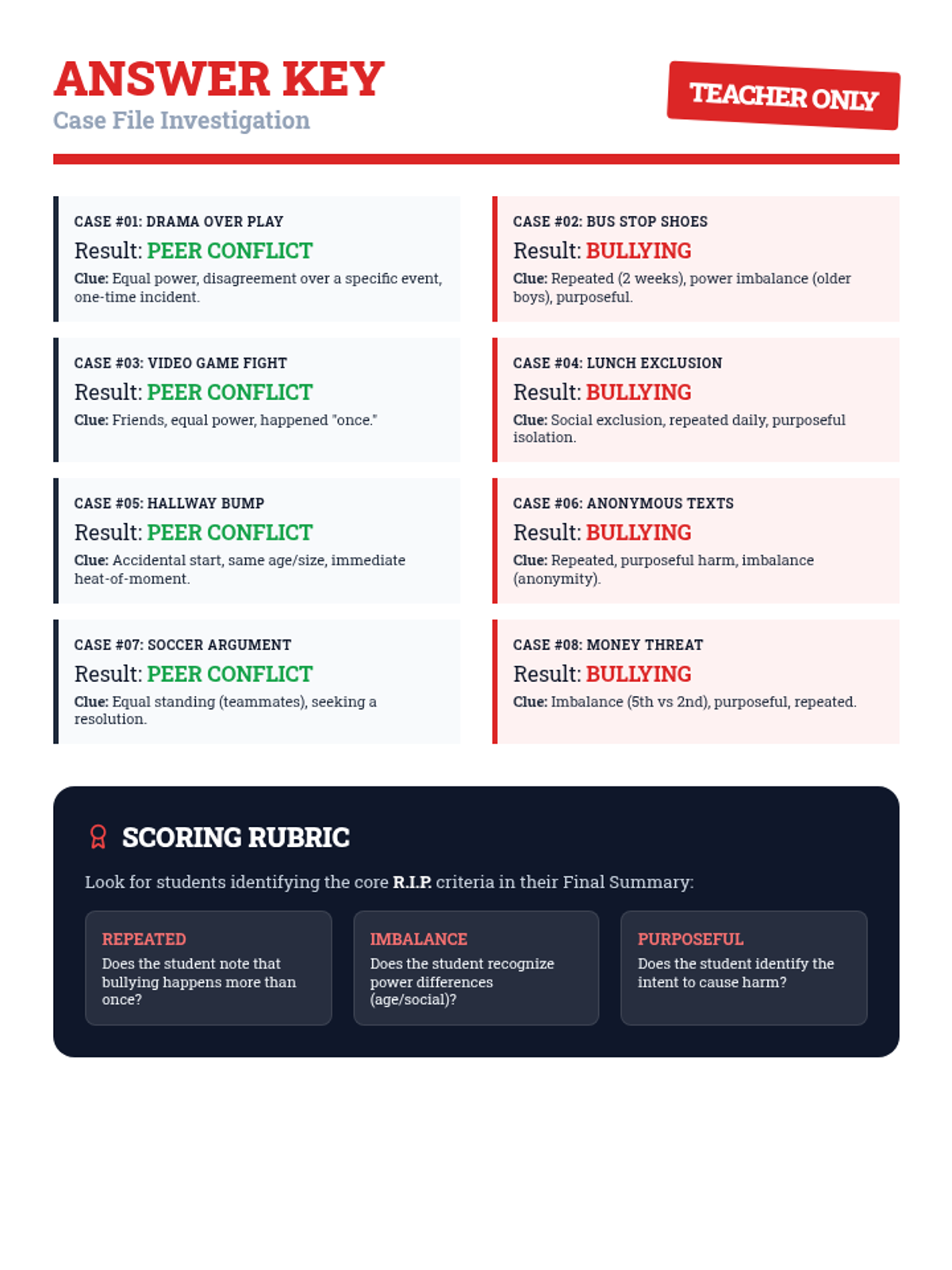
An answer key for the Case File Worksheet, providing the correct categorization for each scenario along with the specific clues related to the RIP criteria.