Five-question assessment for students to demonstrate their understanding of positive self-talk, reframing, and personal confidence strategies.
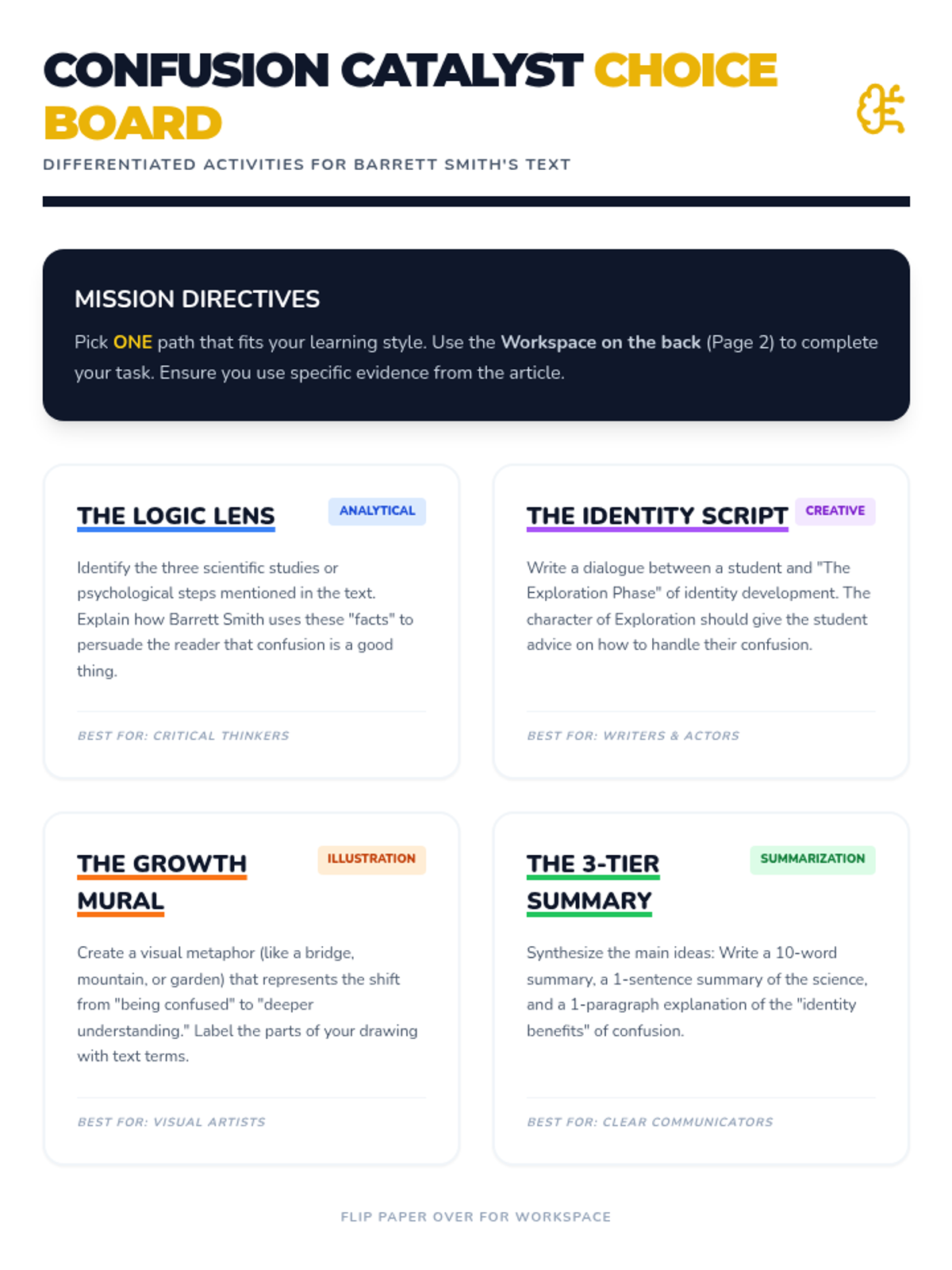
A two-page choice board designed for front-and-back printing. Page 1 contains a menu of four differentiated tasks (Analytical, Creative, Illustration, and Summarization) labeled by learning style. Page 2 provides a dual-zone workspace with a drawing area and an expanded lined section, optimized to fit on a single page for physical printing.
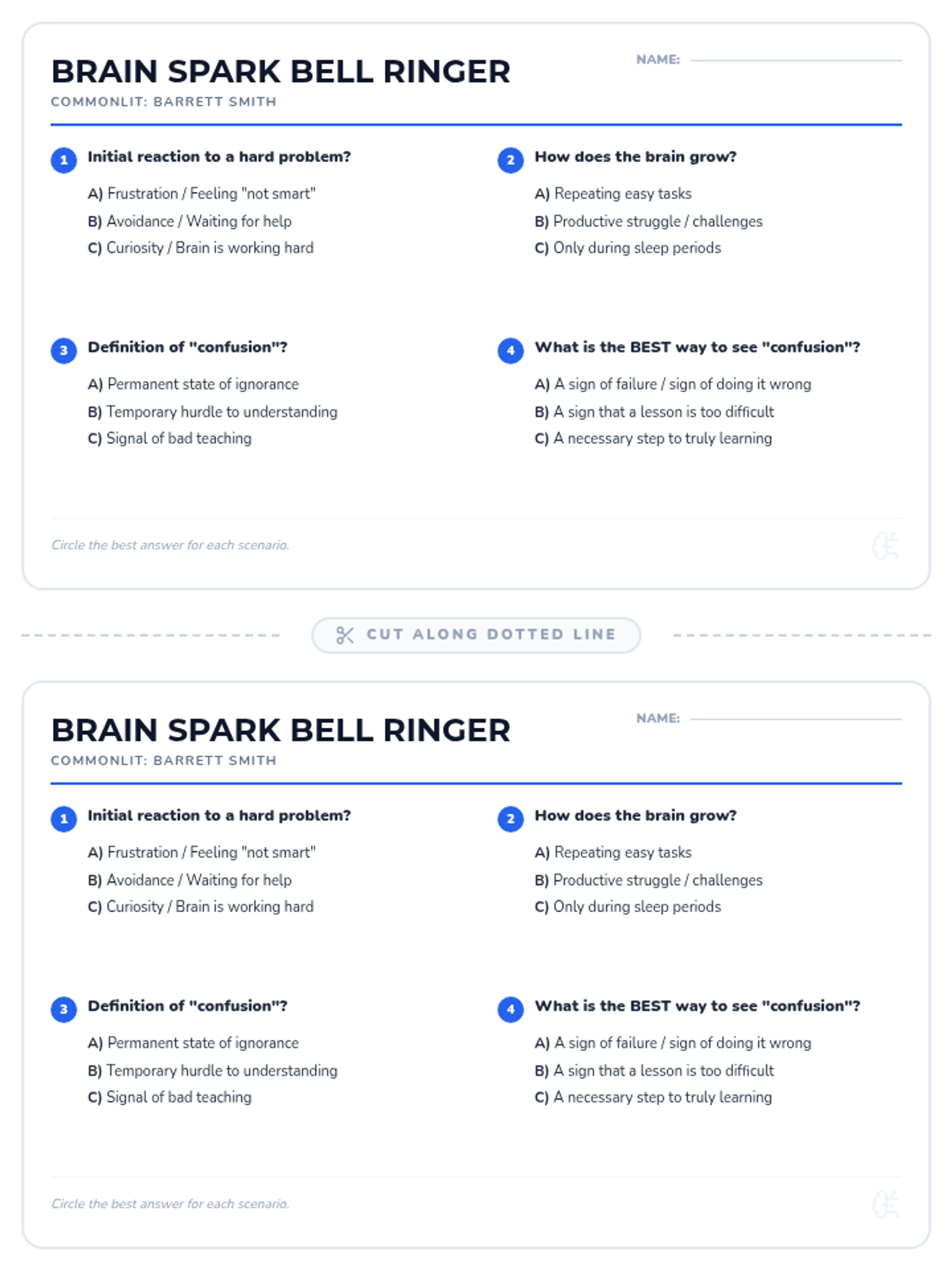
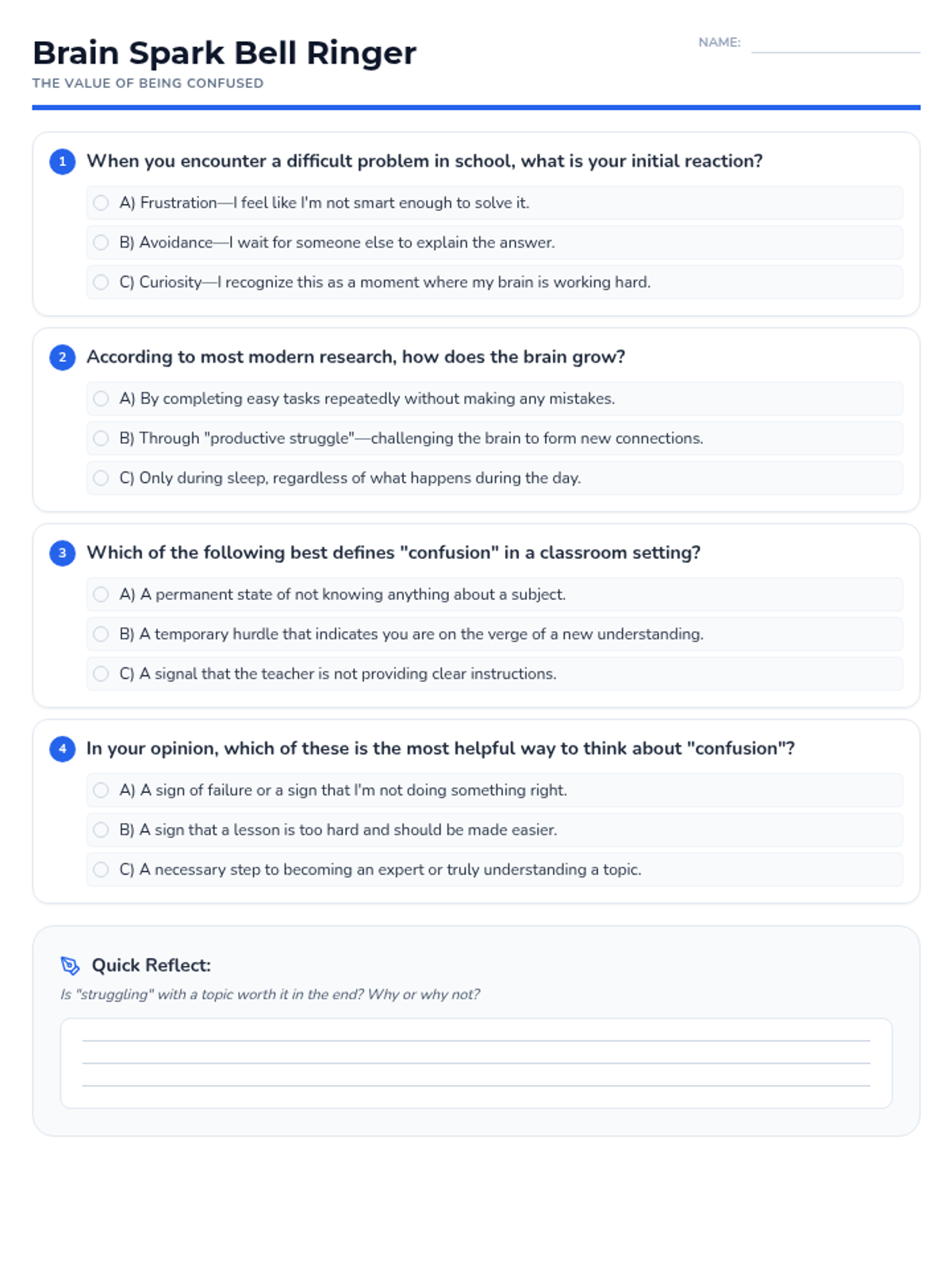
A printable cut-out sheet for the 'Brain Spark' bell ringer. Divides an 8.5x11 sheet into two identical halves, each containing the 4 multiple-choice questions. Question #4 updated to a warm-up opinion prompt. Optimized for teacher preparation and paper efficiency. Fixed page break and styling issues. All answer choices share identical styling.
Updated slide deck for 'The Value of Being Confused' featuring a new video-based activity slide after 'The Big Idea'. Includes interactive Word Splash Quiz Bee pairings, differentiated Choice Board descriptions, and a neural-network theme. Fixed spacing, alignment, and embedded the YouTube video as requested. Includes a workspace preview slide. Improved visual contrast on the workspace preview.
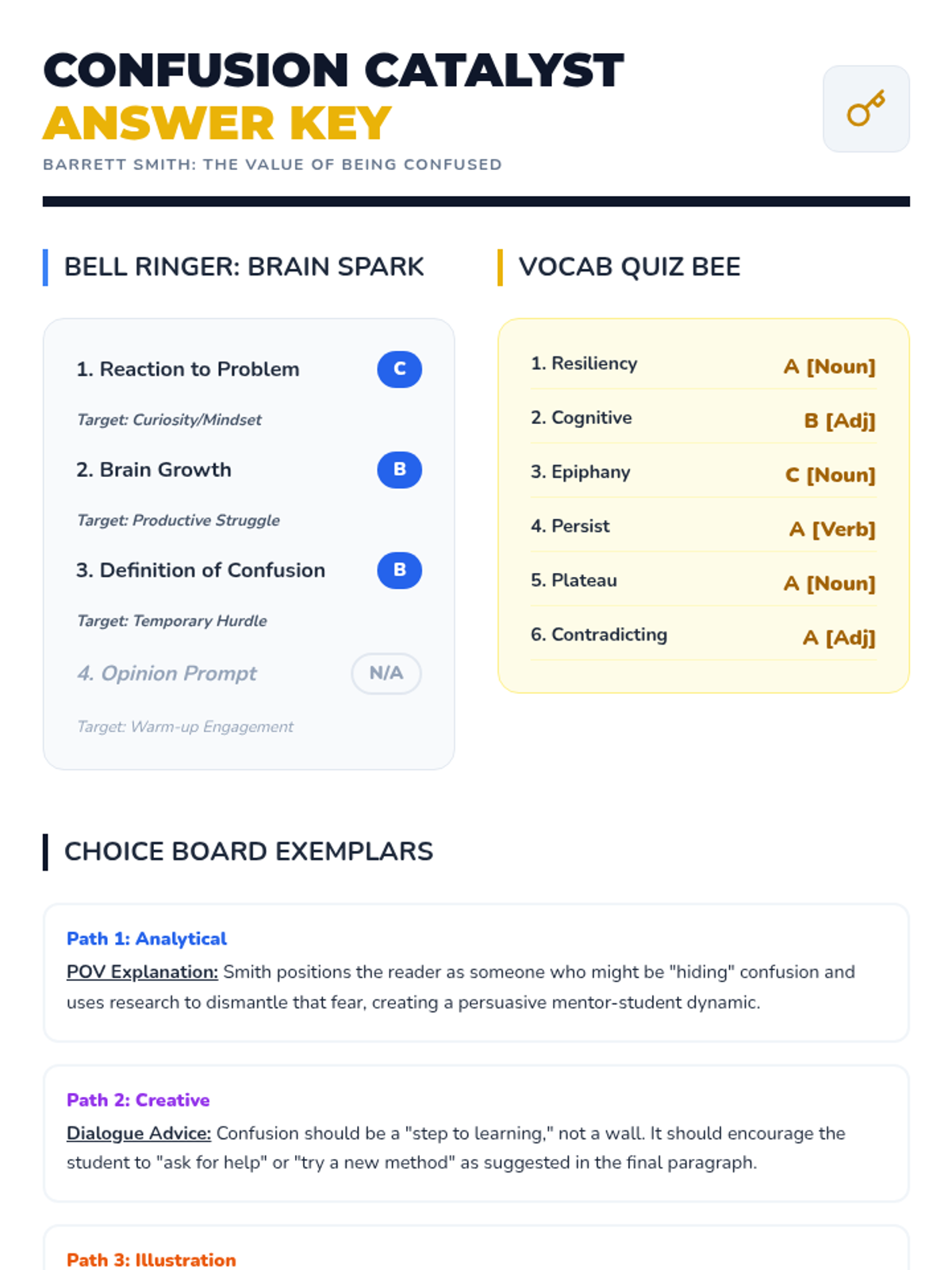
A comprehensive teacher's answer key for the Confusion Catalyst lesson. Updated to reflect the new general warm-up Question #4 on the Bell Ringer. Includes correct answers for the Brain Spark bell ringer and Word Splash vocabulary quiz, along with exemplar responses and grading criteria for the Mind Map choice board paths and the final reflection exit ticket. Darkened text for readability.
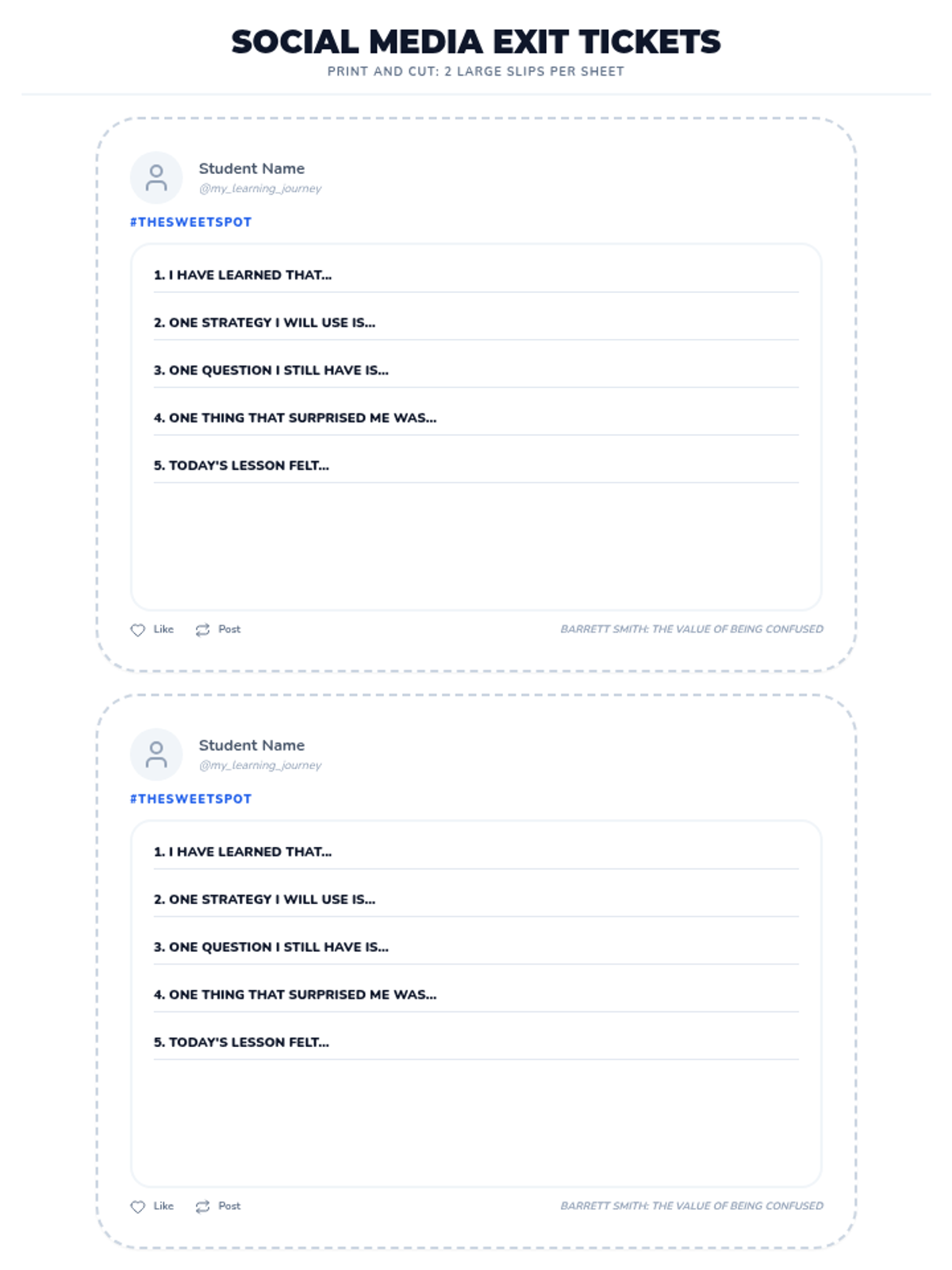
A set of printable exit ticket cut-outs. Page 1 features two large social media themed tickets with five prompts: 'I have learned that...', 'One strategy I will use...', 'One question I still have...', 'One thing that surprised me was...', and 'Today's lesson felt...'. Page 2 contains two comprehensive 3-2-1 reflection slips. Optimized for handwriting and paper efficiency. Fixed page break issues and expanded line spacing.
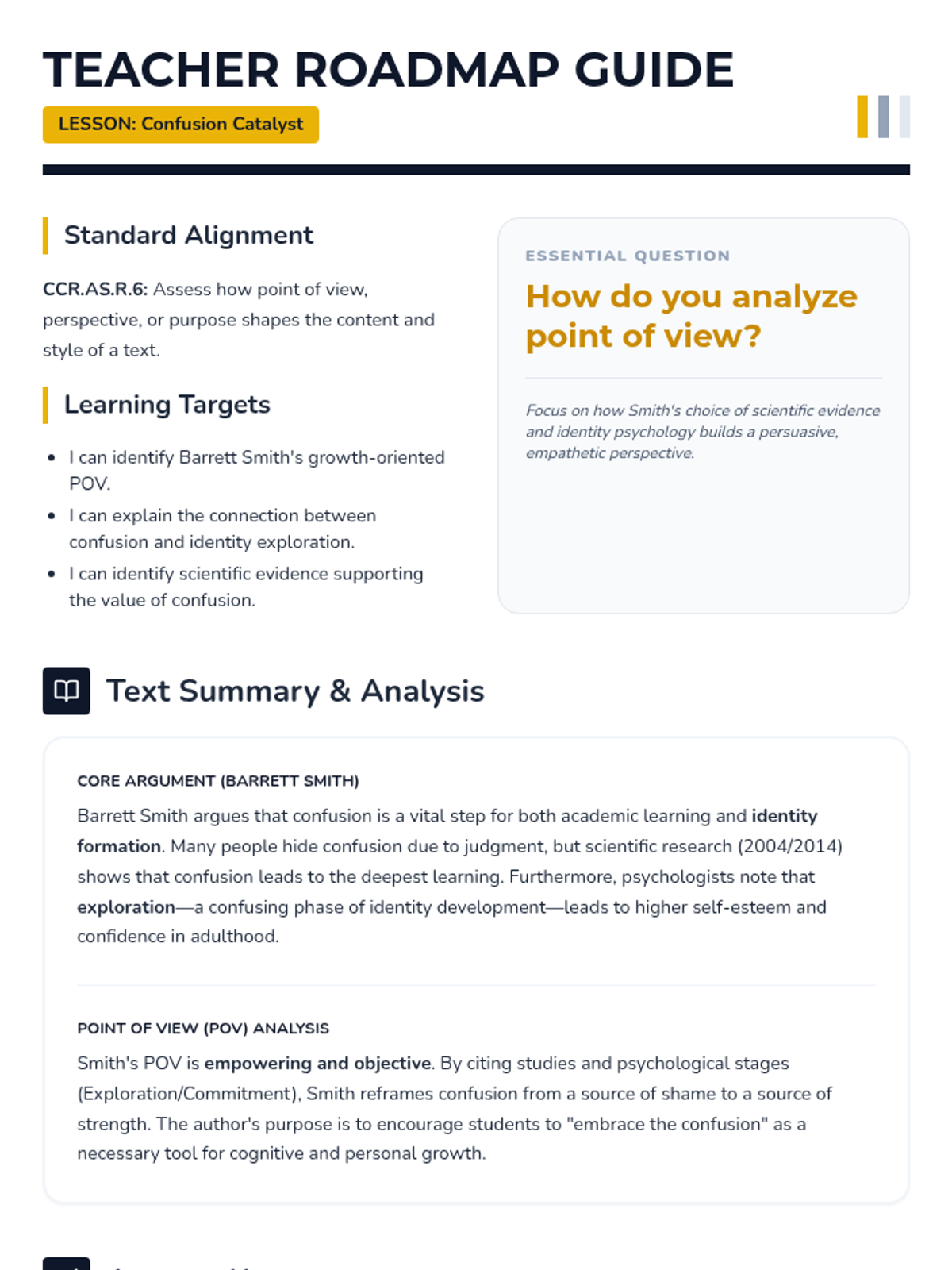
A comprehensive teacher's guide for Barrett Smith's 'The Value of Being Confused.' Features a detailed summary covering both academic and identity benefits, point-of-view analysis, answer keys for all student activities, and a structured instructional flow.
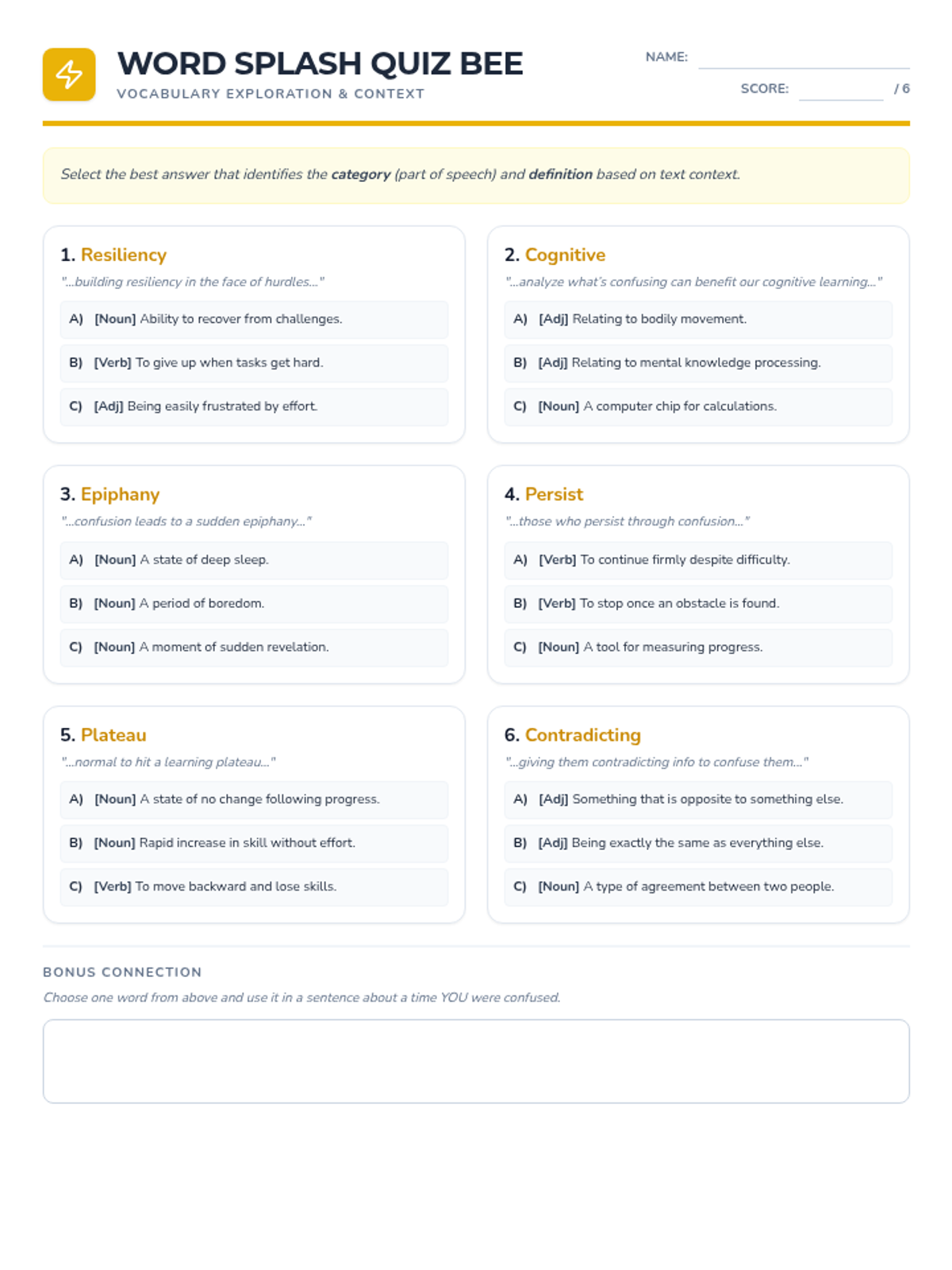
A 6-question multiple-choice vocabulary quiz focused on key terms from 'The Value of Being Confused' by Barrett Smith. Each question includes the word's category and a contextual sentence. Layout improved for consistency and condensed for better printing on a single page with larger text. Fixed question 6 layout and page break issues.
A 4-question multiple-choice bell ringer worksheet with 3 answer choices per question. Question #4 has been updated to an opinion-based warm-up question to better serve students who have not yet read the article. Condensed to a single page for ease of use.
A visually engaging slide deck for 'The Value of Being Confused' lesson by Barrett Smith. Features updated summary content reflecting the text's focus on learning and identity exploration. Includes sections for the Bell Ringer, Word Splash Quiz Bee, and Choice Board instructions with a neural-network theme. Fixed contrast and answer choice uniformity.
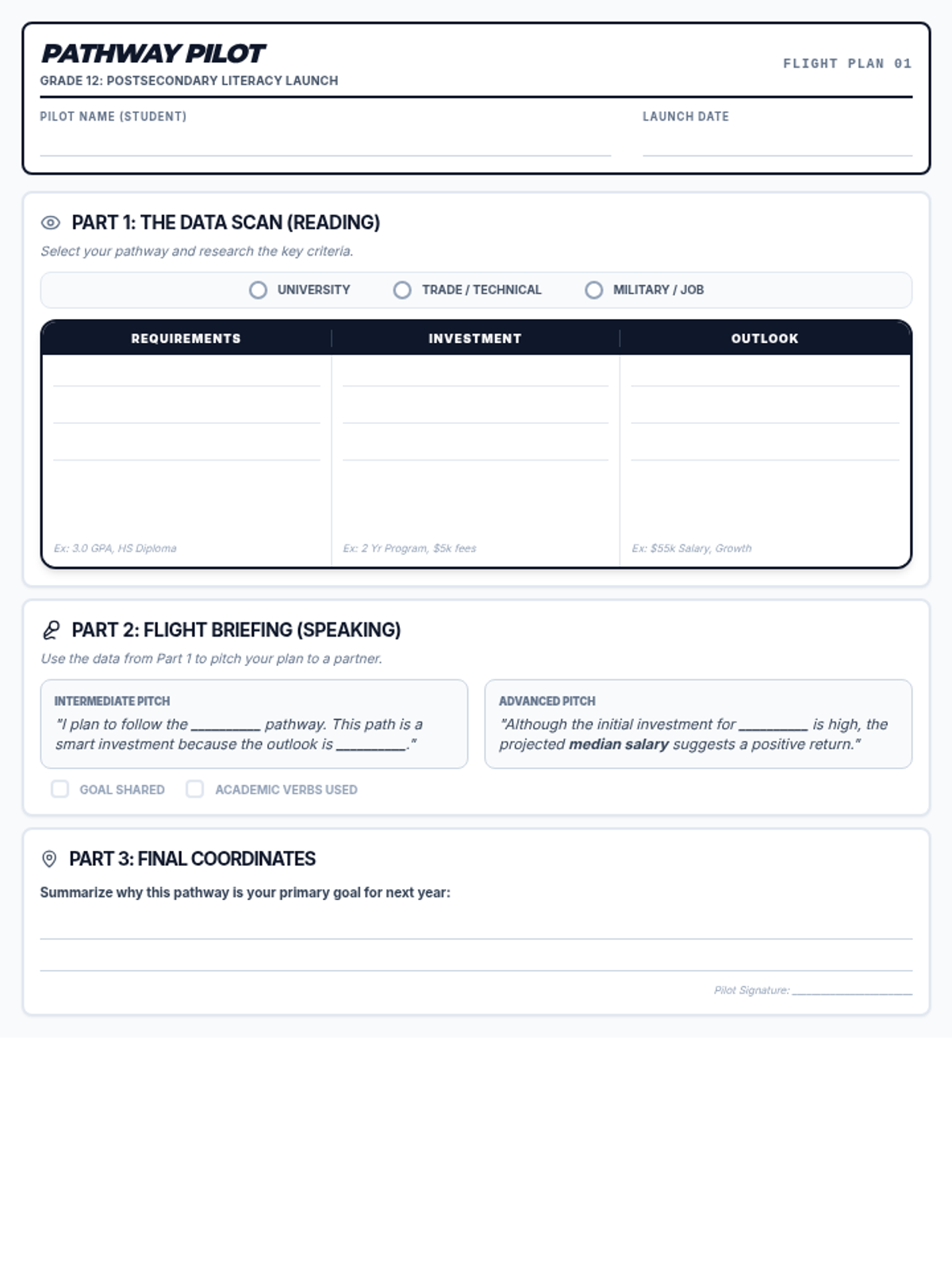
Student worksheet for Grade 12, Lesson 1: College & Career Research. Includes a data-gathering table for Requirements/Cost/Outlook and tiered TELPAS speaking frames for partner pitches. Revised for contrast and layout.
High-impact slide deck for Grade 12, Lesson 1: College & Career Research. Features the "3 Pillars" framework, visual modeling of career profiles, and tiered speaking frames for TELPAS. Revised for contrast and spacing.
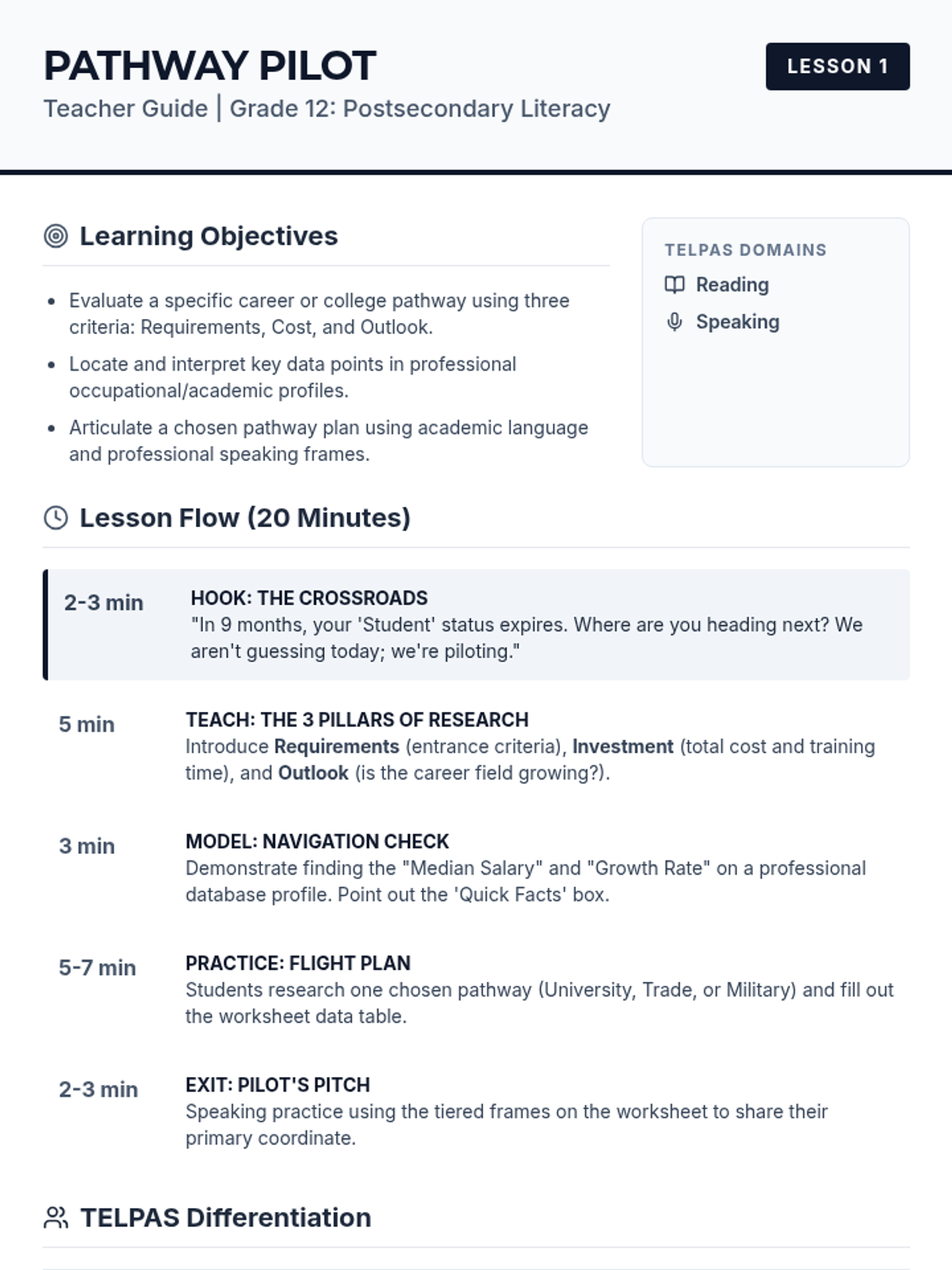
Teacher guide for Grade 12, Lesson 1: College & Career Research. Features 20-min pacing, TELPAS differentiation for reading/speaking, and a professional vocabulary bank. Revised for parallel structure and formatting.
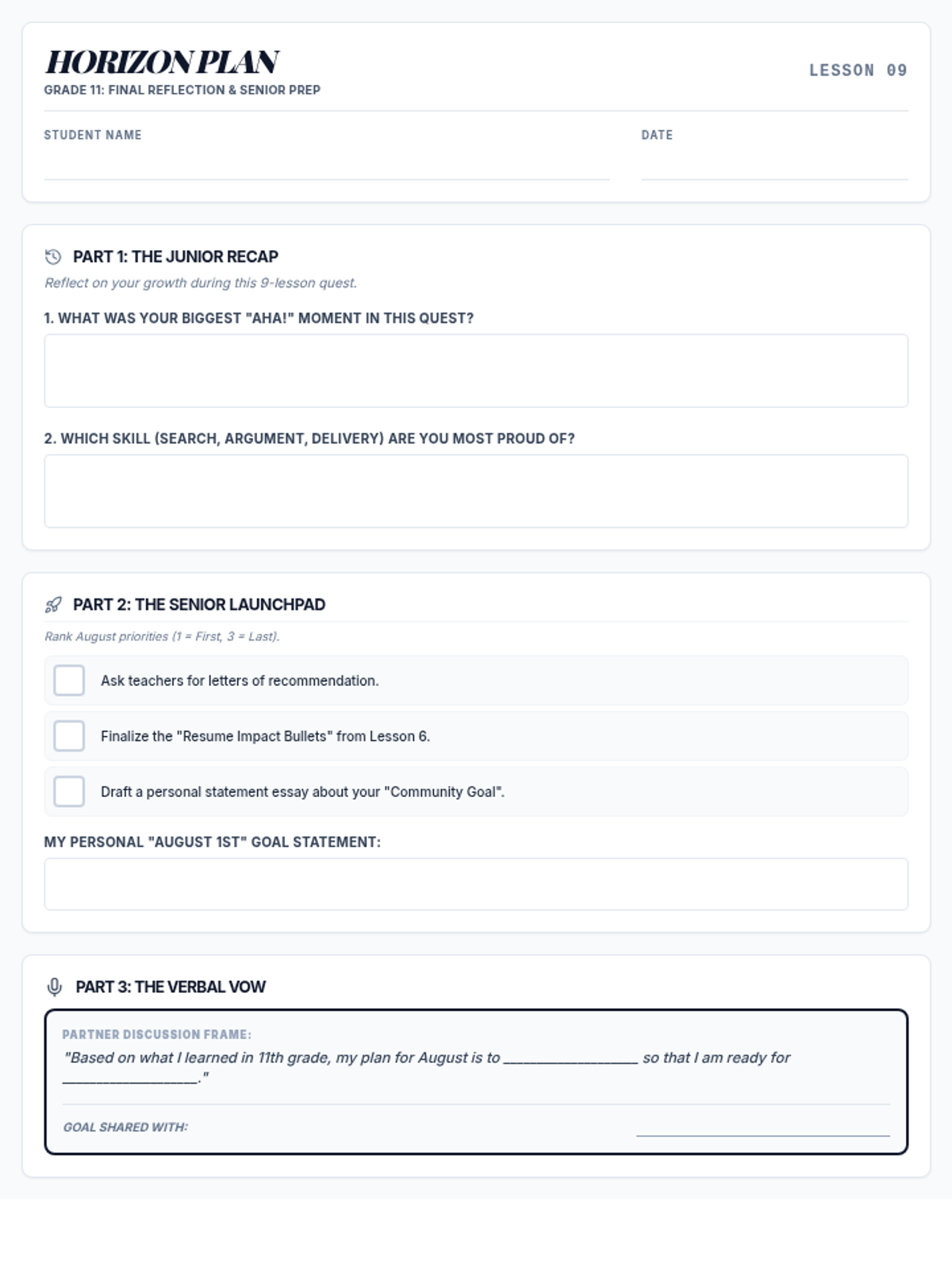
Student worksheet for Grade 11, Lesson 9. Includes reflection questions for Junior year, an August senior year action-priority ranking task, and a verbal goal-sharing frame. Revised for ranking logic and single-page consolidation.
Visual slide deck for Lesson 9: Junior Reflection. Uses a roadmap/timeline theme to guide students through reflecting on Grade 11 and planning for the first 30 days of Senior year. Revised for contrast and spacing.
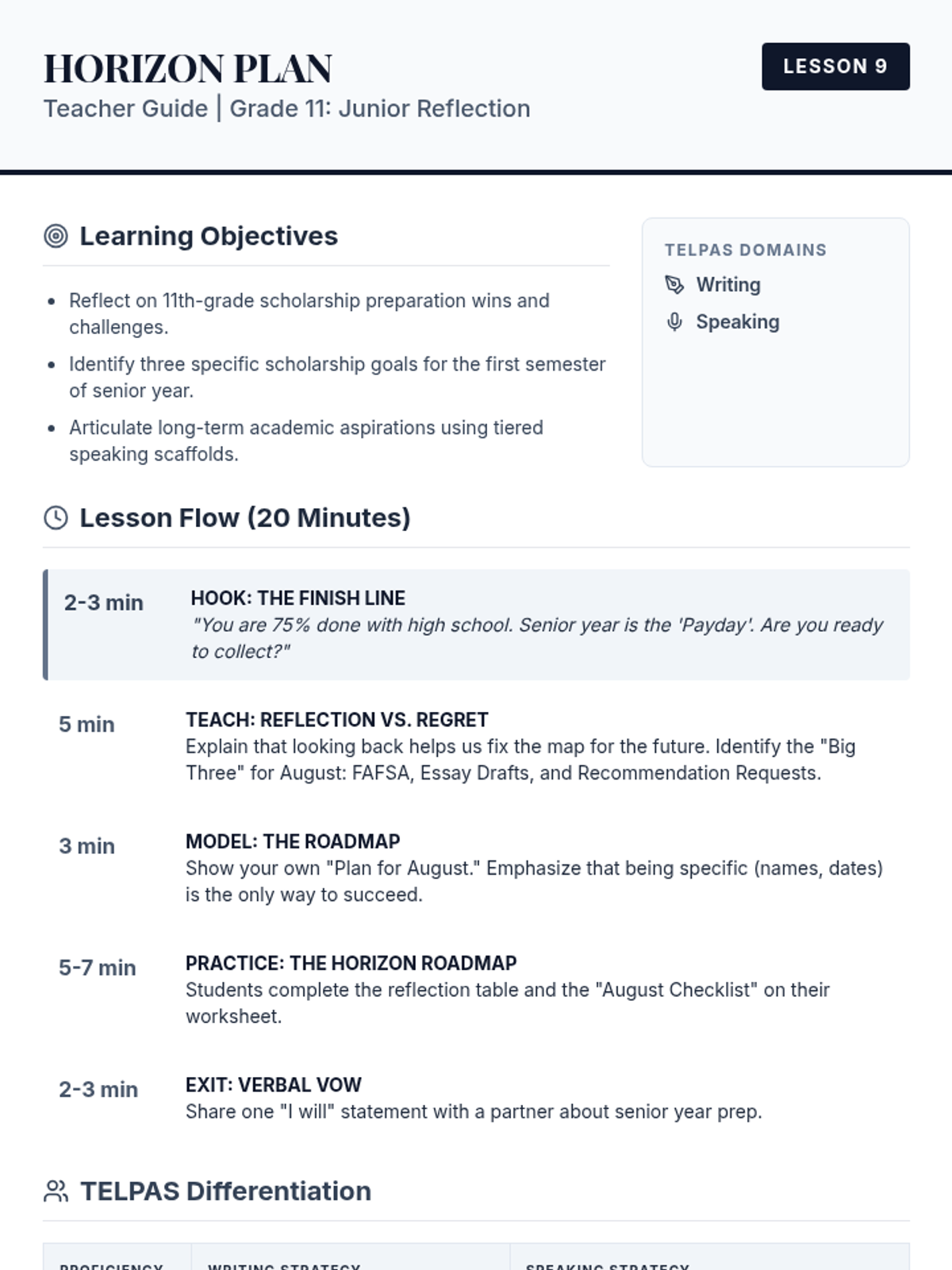
Teacher guide for Grade 11, Lesson 9: Junior Reflection. Features a 20-minute pacing guide, TELPAS differentiation for writing/speaking, and an August action checklist.
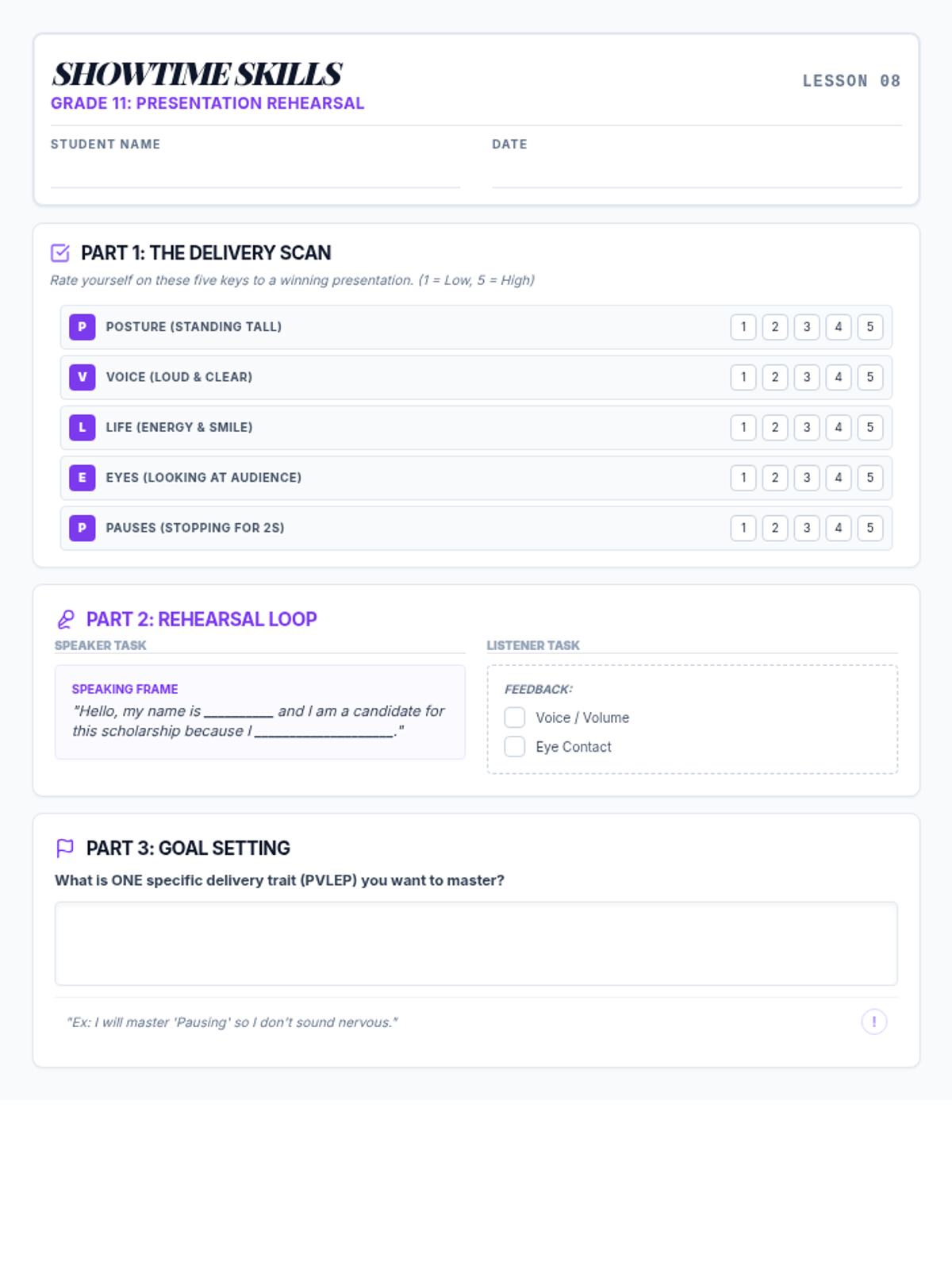
Student worksheet for Grade 11, Lesson 8 on presentation delivery. Includes a PVLEP self-assessment (Posture, Voice, Life, Eye Contact, Pauses), a partner feedback section, and a delivery goal-setting log. Consolidated for single-page printing.
High-impact slide deck for Lesson 8 on presentation delivery. Features the PVLEP framework, visual modeling of good vs. bad delivery, and tiered speaking frames for scholarship pitches.
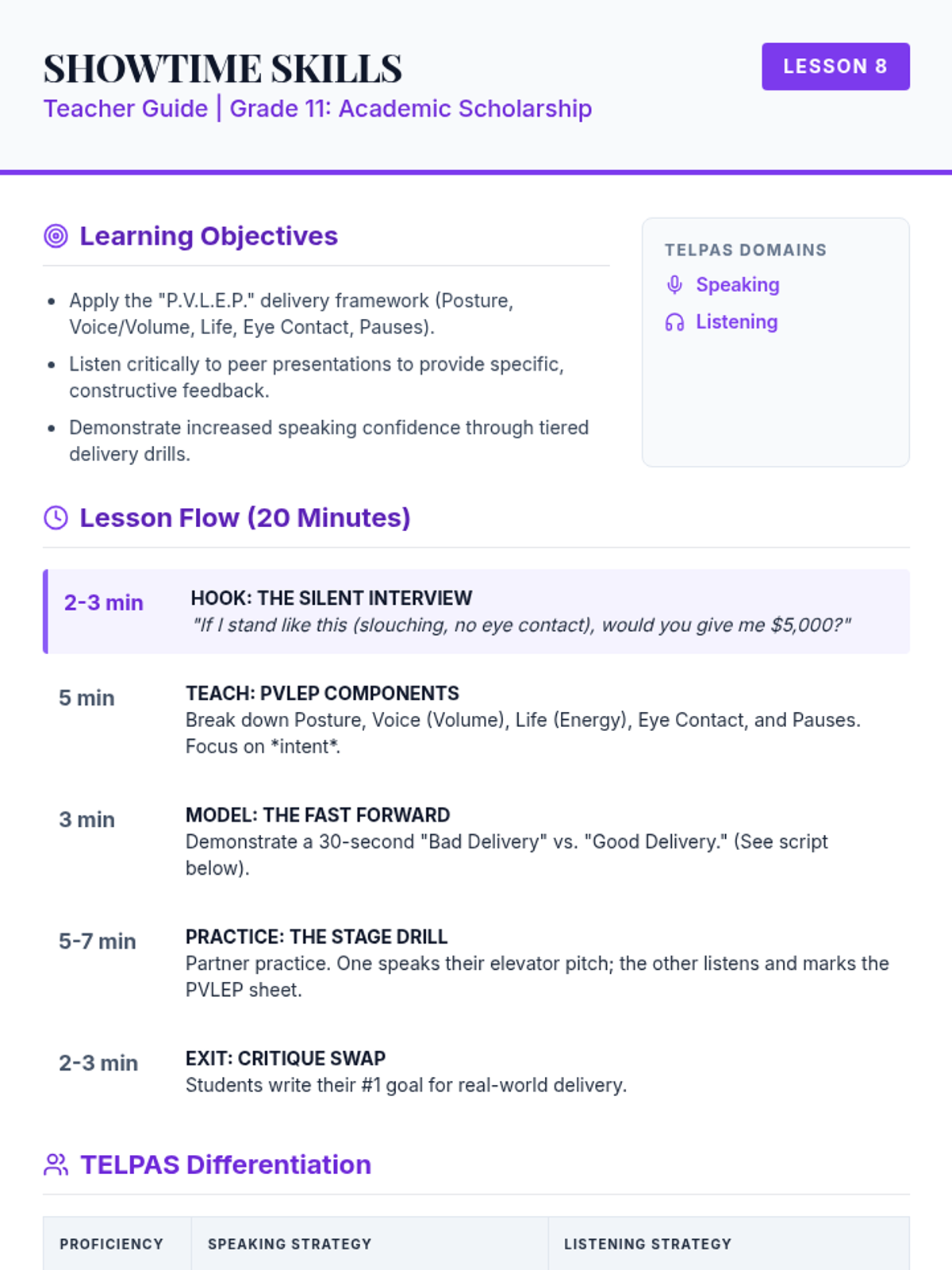
Teacher guide for Grade 11, Lesson 8 on presentation delivery. Features the PVLEP framework, 20-minute pacing, and tiered TELPAS speaking and listening supports. Standardized 'V' to Voice/Volume.
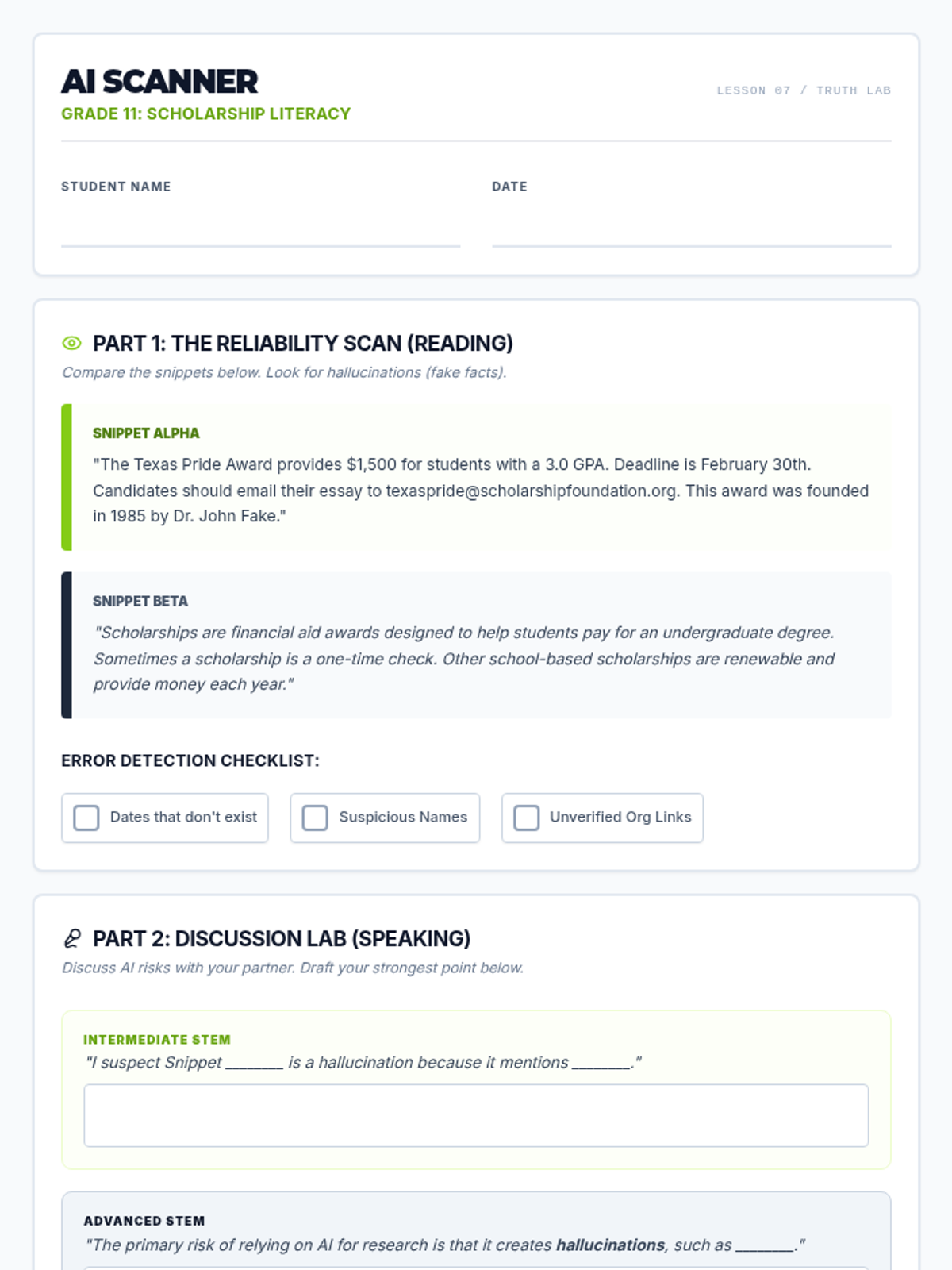
Student worksheet for Grade 11, Lesson 7 on AI evaluation. Includes a reading detection task (Snippet Alpha/Beta), tiered speaking prompts for discussing AI risks, and a "Trust Meter" reflection activity. Revised for contrast and work areas.
Slide deck for Grade 11, Lesson 7: Evaluating AI. Features visual explanations of hallucinations, the "3-Step Scan" for reliability, and tiered TELPAS speaking frames for student debate. Revised for contrast and spacing.
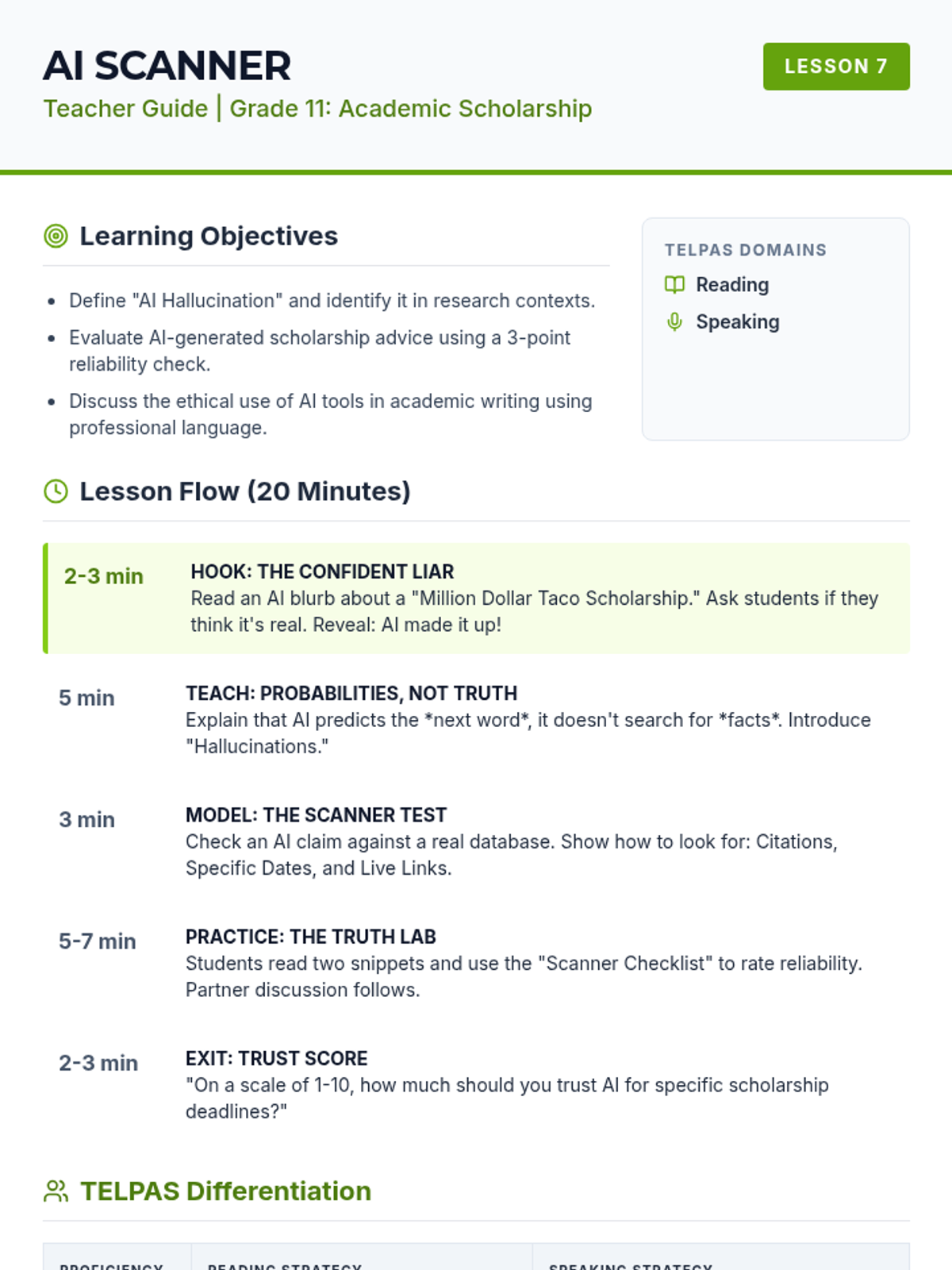
Teacher guide for Grade 11, Lesson 7 on evaluating AI reliability. Features a 20-minute pacing guide, TELPAS differentiation for reading and speaking, and an AI reliability checklist.
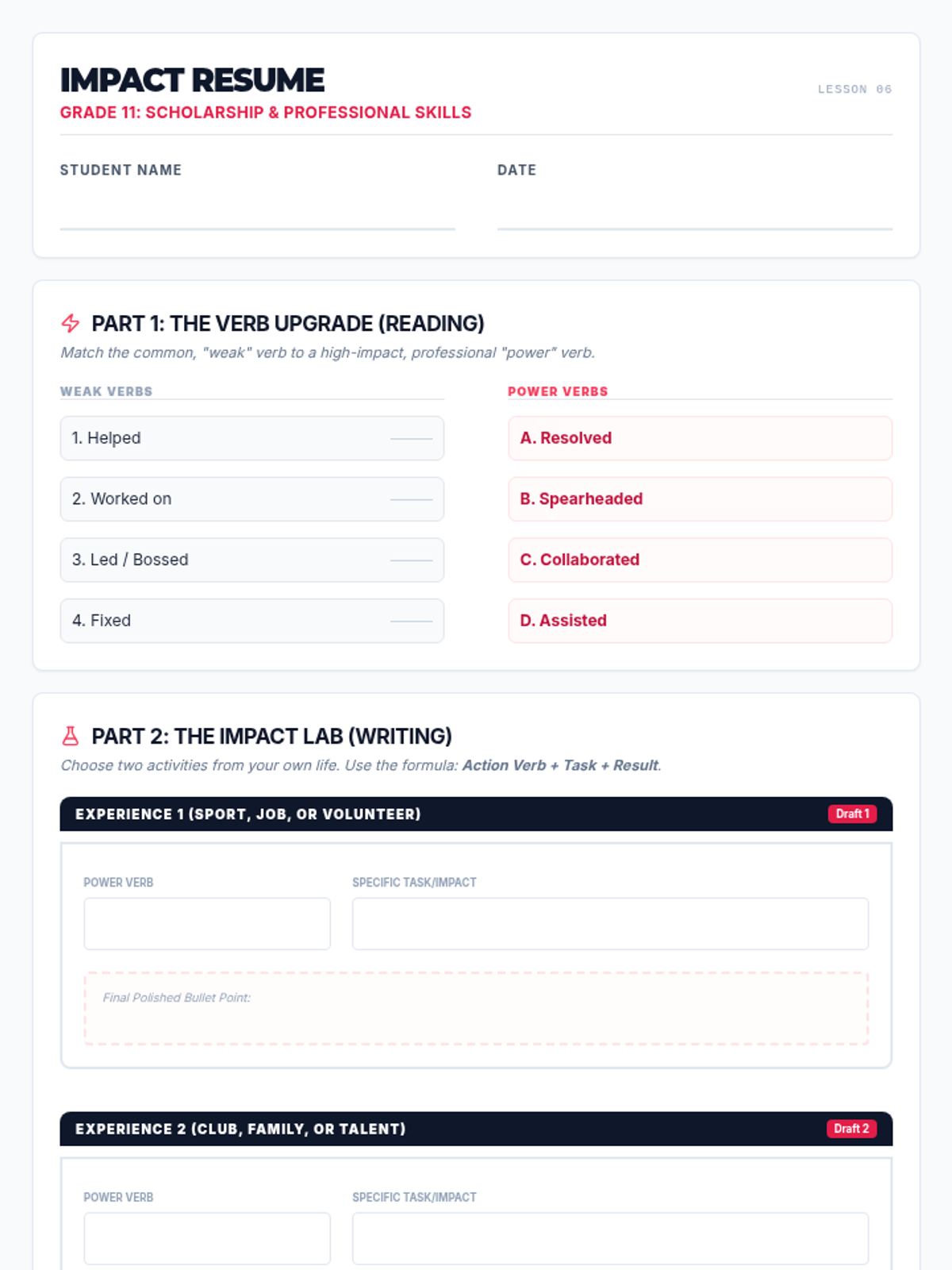
Student worksheet for Grade 11, Lesson 6: Resume Building. Features a power verb matching task, an "Impact Formula" drafting lab for two experiences, and tiered TELPAS speaking prompts for professional pitches.
Slide deck for Grade 11, Lesson 6: Resume Building. Features visual comparisons of weak vs. strong resume verbs, the "Impact Formula" (Action + Task + Result), and tiered speaking frames for peer practice. Revised for better contrast and color consistency.