Mindful Roots Slides Mindful Roots
Mastering the Art of De-Catastrophizing
The "What If" Trap
Catastrophizing is when our brains jump to the worst-case scenario and treat it like an absolute certainty.
"I missed one homework assignment... now I'm going to fail the class, I won't get into college, and I'll never find a job!"
The Brain's Alarm System
The Stress Spiral
High Stress
Our "Thinking Brain" (Prefrontal Cortex) takes a backseat.
Emotional Hijack
The Amygdala starts looking for threats everywhere.
Catastrophe
Small problems look like giant, unsolvable disasters.
The Cortisol Spike
Cortisol is a hormone your body releases during stress. It's meant to help you run from a predator, but it often gets triggered by:
Unexpected Tests
Social Pressure
Presentations
Tight Deadlines
Lower Your Levels
To lower cortisol, we need to tell our bodies it is safe to relax.
Slow, deep exhales
Drink cool water
Shake out your hands
Laughter with a friend
Step 1: Awareness
Catch yourself in the act! Look for these "Catastrophe Clues":
Using words like "Always," "Never," or "Everything."
Physical signs: Tight chest, racing heart, or "butterflies."
Feeling like a situation is completely unfixable.
PAUSE & CHECK
Step 2: The Evidence Test
What my FEAR says:
"Nobody likes me because I wasn't invited to that party. I'll be alone forever."
What the FACTS say:
• I have three close friends I talk to daily.
• I was invited to a movie last weekend.
• Maybe there was a limit on the guest list.
Are you looking at the whole picture, or just the scary part?
Finding the Middle Ground
Worst Case
"I'll fail and everyone will laugh at me."
Most Likely
"It will be challenging, but I'll get through it with some effort."
Best Case
"I'll ace it and feel like a total rockstar!"
Strategy: Aim for the Most Likely scenario.
Grounding Your Roots
1
Box Breathing
Inhale for 4, hold for 4, exhale for 4, hold for 4. Reset your nervous system.
2
5-4-3-2-1 Technique
5 things you see, 4 you can touch, 3 you hear, 2 you smell, 1 you taste.
Why this works?
By focusing on your physical senses or breath, you pull your brain out of the "future catastrophe" and back into the Present Moment.
Quick Practice
The Presentation Panic
"You are about to stand up and give a five-minute presentation in front of the whole class."
CATASTROPHE BRAIN:
"I'm going to mess up my words, everyone will laugh at me, and I'll be the school joke forever!"
MINDFUL BRAIN:
"I've practiced this. Even if I stumble, most people won't notice, and it'll be over soon."
Keep Growing
"Difficulties are just things to overcome, after all." — Ernest Shackleton
Remember:
You have survived 100% of your worst days so far.
You have the tools to handle the next one.
Discussion Garden
What is one situation that usually makes you "catastrophize"?
Which grounding technique (Breathing or 5-4-3-2-1) do you prefer?
How can we help a friend who is stuck in a "What If" trap?
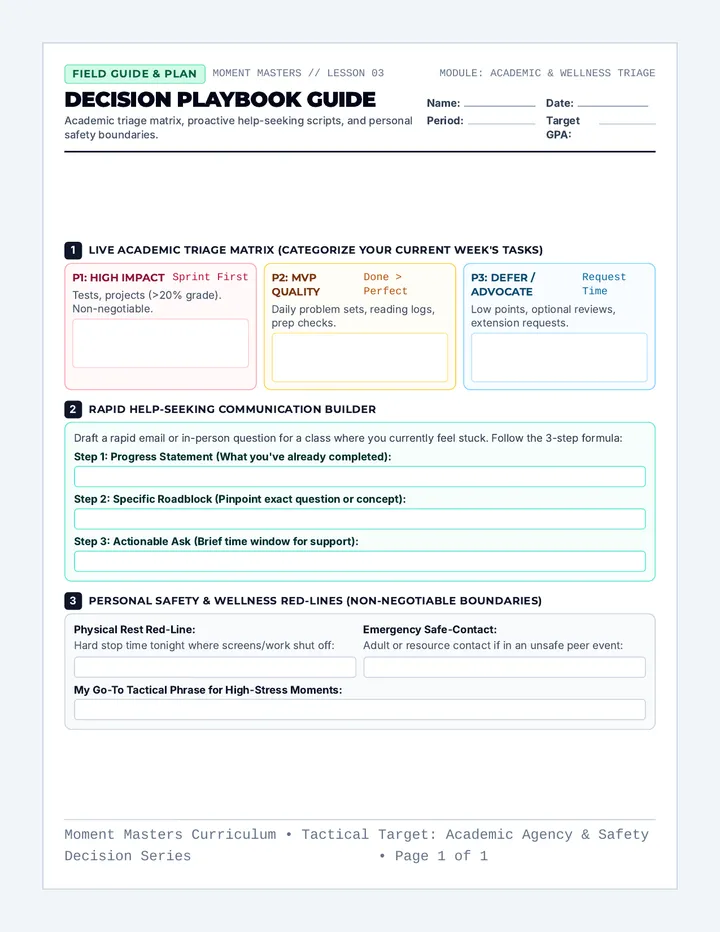
Rooted Reflection Worksheet Rooted Reflection
De-Catastrophizing & Perspective Worksheet
Name:
Date:
What is De-Catastrophizing?
Catastrophizing is a "thinking trap" where we imagine the worst possible outcome of a situation and believe it is likely to happen. De-catastrophizing is the process of looking at the facts and bringing our perspective back to a balanced middle ground.
Part 1: Spot the Catastrophe
Read the scenario below and identify the "Catastrophe Clues" (words like "always," "never," or jumping to conclusions).
"I just realized I made a mistake on the first problem of my math test. Now I'm going to fail the whole test. My grade will drop to a D, my parents will take away my phone for the rest of the semester, and I'll never get into a good college."
List 2-3 "Catastrophe Clues" found in the quote above:
Part 2: The Evidence Test
Think of a situation you are currently worried about. Let's put it to the test.
My Current "What If" Worry:
Evidence FOR the worry
(What facts support this fear?)
Evidence AGAINST the worry
(What facts suggest it might not be that bad?)
Part 3: The Three Outcomes
Using the same worry from Part 2, fill in the three possible paths.
Worst Case
What's the absolute worst that could happen?
Most Likely
What will probably happen?
Best Case
What's the best possible outcome?
Part 4: My Grounding Plan
When I feel myself starting to catastrophize, I will try these two techniques:
Box Breathing
Inhale (4s), Hold (4s), Exhale (4s), Hold (4s). Repeat 4 times.
5-4-3-2-1 Grounding
Find 5 things I see, 4 touch, 3 hear, 2 smell, 1 taste.
Other strategy of my choice:
"Perspective is a skill. The more you practice, the stronger your roots grow."
Mindful Roots Teacher Guide Teacher Resource
Mindful Roots: Facilitator Guide
Instructional strategies for teaching de-catastrophizing and stress management.
Target Audience
Grades 7–10 (Middle/Early High School)
Total Duration
45–60 Minutes
Key Concepts
Cognitive Distortion, Stress Spiral, Evidence-Based Thinking
Learning Objectives
Students will define catastrophizing and identify common linguistic markers.
Students will explain the physiological link between high stress, cortisol , and irrational thinking.
Students will apply the 'Evidence Test' and 'Likely Outcome' strategies to a real-life scenario.
Students will practice two grounding techniques for immediate stress reduction.
Instructional Pacing
10 Mins
Introduction & Hook
Use Slide 2 to introduce the "What If" Trap. Ask students to share (if comfortable) a time they thought something small was going to be a disaster, but it turned out okay. This builds empathy and normalization.
15 Mins
The Science of the Spiral
Use Slides 3-4 to explain the physiological response. Slide 3 shows the logic breakdown, while Slide 4 introduces cortisol . Explain that school stressors (tests, social pressure) trigger the same chemical response as a physical threat.
20 Mins
Skill Building (The Tools)
Walk through Slides 5-9 . Modeling is key here. After teaching the Evidence Test and Outcome paths, use Slide 9 (The Presentation Panic) to practice as a group. Ask: "What are the facts? What is most likely?"
15 Mins
Independent Practice
Distribute the Rooted Reflection Worksheet . Circulate and assist students who might be struggling to find evidence "against" their fear. Ensure they focus on the "Most Likely" outcome.
Deepening the Roots: Discussion Tips
Addressing "Real" Catastrophes:
Sometimes students deal with actual crises. Acknowledge that while we can't always "de-catastrophize" a real loss or tragedy, we can manage our physiological stress response to handle it better. Be sensitive to trauma-exposed students.
The Social Connection:
Ask: "How does our catastrophizing affect the people around us?" Help students see that when we panic, it can create a 'contagion' effect, while staying grounded helps others feel safe too.