Future Map Answer Key Future Map
Answer Key
9th Grade Strategic Blueprint // Exemplar Guide
Teacher Reference Only
1. Success Habits
Organization Tool:
Google Calendar for deadlines; physical planner for daily tasks.
Study Focus Zone:
Desk in bedroom with phone in another room; no music with lyrics.
2. Academics
Target Unweighted GPA
3.8
Target Weighted GPA
4.2
Degree Goal:
Assoc.
Bach.
Mast.
Doct.
3. Career Lab
Elective to "Test Drive":
Intro to Digital Media or Computer Science Principles.
Technical Skill Interest:
Video editing (Premiere Pro) or Python programming.
4. Storytelling
Exemplar STAR Draft: "Tell me about a challenge."
Situation
Mismatched results in Science Fair.
Task
Had to find the error before the deadline.
Action
Re-ran data 3x & found a measurement error.
Result
Finalists at regional fair; learned patience.
5. Money Smarts
Net Price Math:
$60k Sticker - $45k Aid = $15,000
FAFSA applies to trade schools? YES (True)
Grants must be paid back? NO (False)
6. My Spike
Activity to stick with for 4 years:
Robotics Club: Progressing from Builder to Team Captain.
Exemplar response key // for facilitator use
Future Map Digital Workbook Future Map
Digital Strategic Workbook
Student Name
_________________________
Target Grad Year
2029
01. Success Habits
Organization Tool
What app, planner, or system will you use to track every assignment?
Type your plan here...
Focus Zone
Where is your distraction-free zone? What is the "No-Phone" rule?
Type your focus strategy...
02. Academic Launch
GPA Targets
Unweighted (0-4.0)
0.0
Weighted (0-5.0)
0.0
Remember: Honors classes defend your 4.0; AP/Dual Enrollment push it higher.
Degree Ambition
Associate (2 Years)
Bachelor's (4 Years)
Advanced (Master/Doctor)
03. Career Lab
Which Elective will you use to "Test Drive" a career path this year or next?
Ex: Computer Science, Digital Media...
What Technical Skill (software, tool, craft) do you want to master?
Ex: Python, Welding, Photoshop...
Low-Risk
Exploration
"It is better to find out you hate a career now than after 4 years of college."
04. Storytelling
Draft a response for the prompt: "Tell me about a challenge you overcame."
Situation (The Context)
Set the scene...
Task (Your Goal)
What did you need to do?
Action (The Work)
Steps you took...
Result (The Impact)
How did it end? What did you learn?
05. Money Smarts
Net Price Calculation
Sticker Price $60,000
Minus Total Aid -$45,000
Your Net Price $_______
True or False?
FAFSA applies to trade schools?
YES NO
Grants must be paid back?
YES NO
06. My Spike
Admissions value depth over breadth. Identify one activity you commit to pursuing for all four years of high school.
Four-Year Commitment Activity
Type Activity Here
Mission Map Finalized
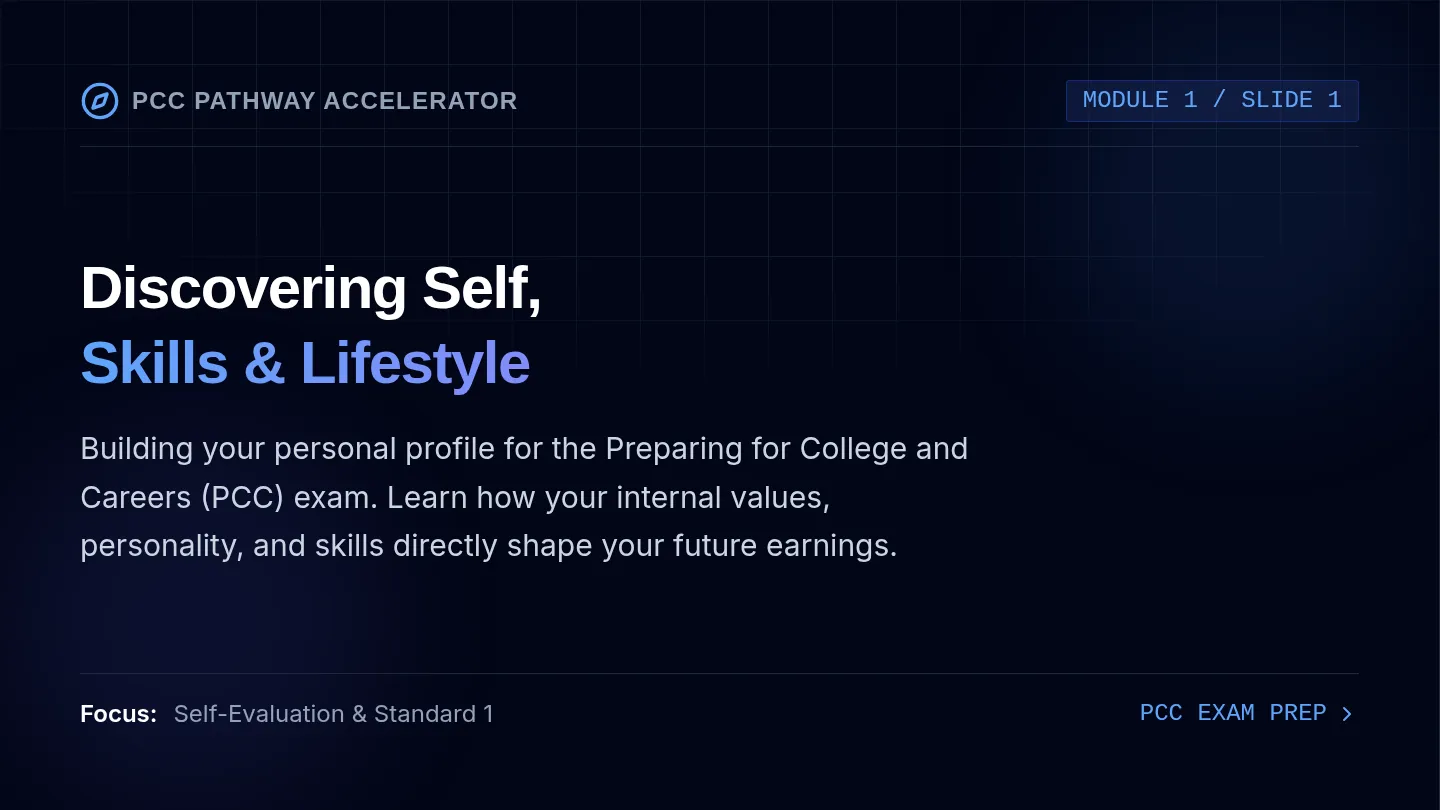
College Launchpad Slides v2 College Launchpad
The Comprehensive 9th Grade Blueprint
Class of 2029
The Long View
Most students wait until 11th grade to plan. By then, 50% of your GPA is already locked in.
The 9th Grade Goal
"Keep every door open. Build a foundation that gives your future self more choices."
Your Blueprint
Strong Academic GPA
Success-Ready Skills
Career Vision
Success Toolkit
Organization
Don't rely on memory. Use a digital calendar for every test and deadline.
Study Spacing
Stop "cramming." 20 mins a night for a week is 10x more effective.
Self-Advocacy
Ask for help the first time you feel confused, not after you fail.
The Transcript
It permanently records your 4-year academic history:
01
Semester Grades
02
GPA Weighting
Upward Trend
"If your grades get better every year, colleges see resilience and growth ."
GPA Decoded
Standard (0.0 - 4.0)
Includes all standard and Honors classes.
Weighted (+0.5/1.0)
College Credit adds +0.5 , AP adds +1.0 .
Rigor Advantage
4.0
Colleges prefer rigor. A "B" in AP = an "A" in Standard.
The Degree Ladder
2 Years
Associate
Technical skills or foundation.
4 Years
Bachelor's
The standard 4-year degree.
6 Years
Master's
Specialized expert knowledge.
8+ Years
Doctorate
Highest level research degree.
Admissions Pie
Holistic Review
Admissions want people with character and a story, not just high numbers.
Hard Data
GPA & RIGOR
Soft Data
ESSAYS & RECS
The Whole
Test Drive Careers
Use high school as your Low-Risk Laboratory .