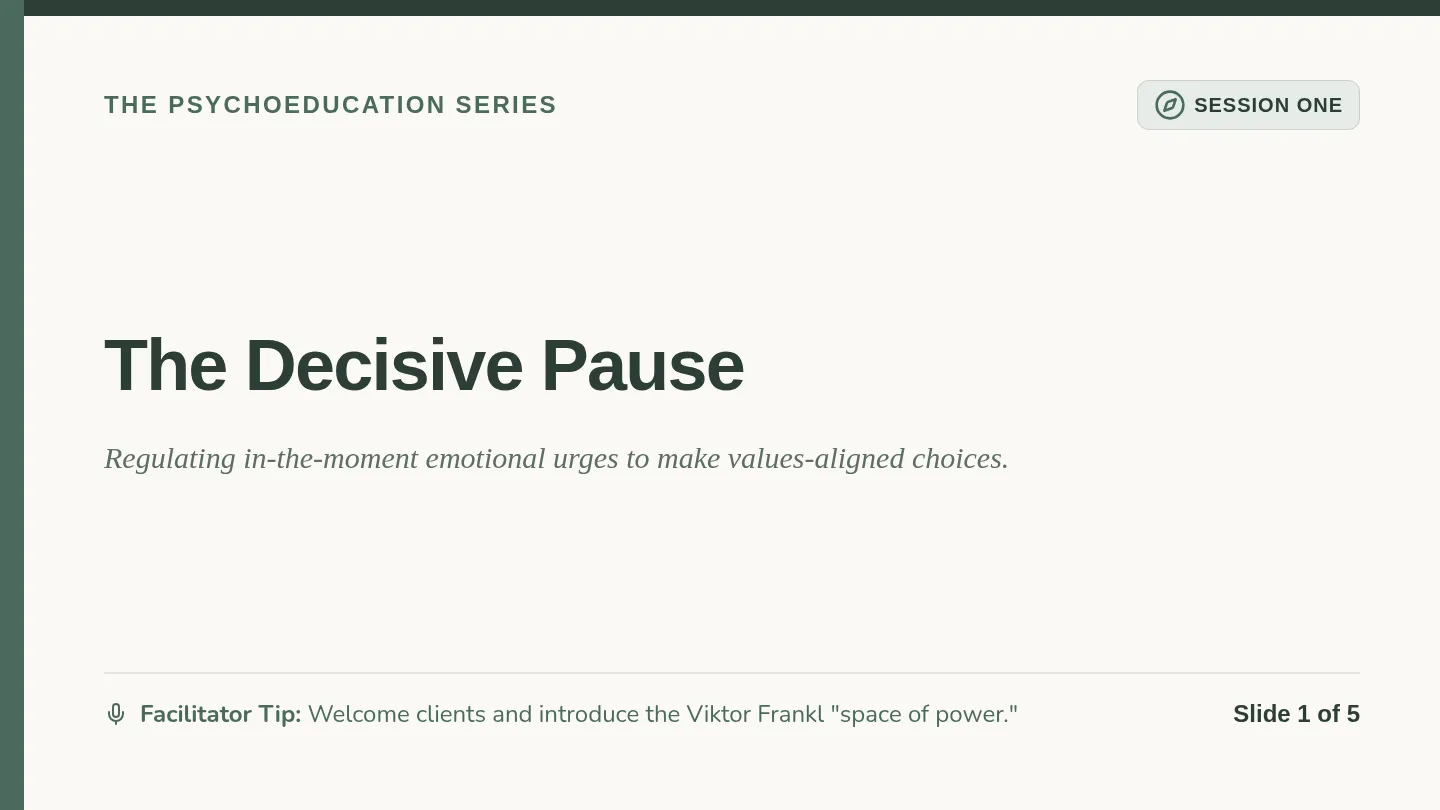
Distortion Detective Slides Lesson 01: Mindset Mechanics
SPOTTING THE GLITCH
Identifying the cognitive distortions that fuel anxiety and distort our reality.
Thought Lab Series
Thought Detective
The "Evidence"
"I got a B- on the midterm. I'm going to fail this whole major and never get a job."
"She didn't text me back immediately. She probably thinks I'm annoying and hates me."
"Everyone else in this seminar is brilliant. I'm the only one who doesn't get it."
The Mission:
Anxiety doesn't just happen; it's often fueled by Cognitive Distortions —faulty ways of thinking that make our problems look bigger and our resources look smaller.
"Our thoughts are not always facts. They are often just stories we tell ourselves to make sense of uncertainty."
What is a Distortion?
Mental Filtering
Focusing exclusively on the negative aspects of a situation while ignoring the positives. Like wearing glasses that only let dark light through.
Catastrophizing
Expecting the worst-case scenario to happen, regardless of how unlikely it is. Transforming a "what if" into an inevitable disaster.
Black & White
Seeing things in extremes. You're either a success or a failure; there is no middle ground or nuance. "All-or-nothing" thinking.
Case Study: The Email
EXHIBIT A
"Your professor sends an email: 'Please come see me during office hours to discuss your recent paper.' You immediately feel a pit in your stomach. You think, 'I definitely failed. She probably wants to tell me my writing is substandard. I'll have to retake the class.'"
Identify the Glitches
Catastrophizing: Jumping to "I failed."
Mind Reading: Assuming her intent is negative.
Fortune Telling: Predicting having to retake the class.
The Reality:
The professor might want to suggest a journal for publication or ask for clarification on a specific (and interesting) point.
THE ANXIETY
FEEDBACK LOOP
💭
Thoughts
"I'm not prepared."
💓
Feelings
Panic, tightness in chest.
By identifying the distortion at the thought level, we can prevent the physical and emotional response from spiraling.
Cognitive Distortion Cheat Sheet Mindset Mechanics
Cognitive Distortion Cheat Sheet // Ref: CBT-L1
Resource Guide
THOUGHT LAB SERIES
Cognitive Distortions are habitual ways of thinking that are often inaccurate and negatively biased. They fuel anxiety by making reality seem more threatening than it actually is. Use this guide to help "label" your thoughts when you feel your stress levels rising.
Mental Filtering
Focusing only on negative details and ignoring the whole picture.
"I got one critique on my presentation, so the whole thing was a disaster."
Catastrophizing
Assuming the absolute worst will happen, even with minimal evidence.
"If I don't get an A on this quiz, I'll fail out and never find a career."
Black & White Thinking
Seeing things in binary extremes (Success/Failure, Good/Bad).
"If I'm not the best student in the room, I'm a total failure."
Personalization
Blaming yourself for things outside your control or taking things personally.
"My roommate is quiet today; I must have done something to upset them."
Mind Reading
Assuming you know what others are thinking (usually something negative).
"They're looking at me because they think my question was stupid."
"Should" Statements
Holding yourself to unrealistic, rigid rules that cause guilt or frustration.
"I should be able to handle this without feeling stressed at all."
The First Step to Change
Naming the distortion takes away its power. When you label a thought as "Catastrophizing," you remind yourself that it's a pattern, not a fact.
Case File Investigations Worksheet NAME: _________________________________________________
DATE: _______________________
Confidential
FILE TYPE: CASE-STUDY-ANALYSIS
Case File Investigations
Identify and label the cognitive glitches within the following student scenarios.
INSTRUCTIONS: Read each scenario carefully. In the space provided, list the specific Cognitive Distortions present and explain how that thought pattern might be exaggerating the student's anxiety.
01
The Social Appraisal
"Jordan walks into the dining hall and sees a group of friends laughing. When they look over at him, the laughter stops for a second. Jordan immediately thinks: 'They were definitely laughing at me. I'm so socially awkward, I shouldn't even have come here. I'm probably going to be alone for the rest of the semester.'"
Primary Distortions Identified:
The "Evidence" Against This Thought:
02
The Internship Rejection
"Maya receives a rejection email for a competitive summer internship. She thinks: 'I'm a complete failure. All my hard work in my classes meant nothing. If I can't even get this internship, I'll never get a job in my field. Everyone else in my program is getting hired and I'm just stuck.'"
Primary Distortions Identified:
The "Evidence" Against This Thought:
Final Reflection
How does labeling these thoughts as "distortions" change the emotional weight of the scenarios?
Emotion Mechanics Slides Lesson 02: Mindset Mechanics
EMOTION BLUEPRINT
Understanding the mechanism of interpretation: The ABC Model of Emotion.
CODE: ABC_CBT_002
Same Event, Different Reaction
Student A
😟
Event:
Receives a "C" on a midterm exam.
Emotion: Intense Anxiety, Shame
Action: Avoids the professor, stops studying.
Student B
🤔
Event:
Receives a "C" on a midterm exam.
Emotion: Disappointment, Curiosity
Action: Schedules office hours to review errors.
IF THE EVENT IS THE SAME, WHY IS THE EMOTION DIFFERENT?
The ABC Model
A
Activating Event
The external trigger. What actually happened? (Facts only)
B
Belief / Interpretation
What you tell yourself about the event. This is where the magic (or misery) happens.
C
Consequence
The resulting emotion and behavior. (Anxiety, Withdrawal, Action)
The interpretation (B) drives the emotion (C).
"People are disturbed not by things, but by the view which they take of them."
— Epictetus
Deconstructing Anxiety
The Process
Identify the Consequence (I feel anxious).
Trace it back to the Activating Event (I have a group project due).
Find the hidden Belief fueling the fire (I'm going to let everyone down and they'll hate me).
Reflection Question:
What is a recurring stressor in your life right now? What "B" (Belief) are you bringing to that situation?
Ready to Blueprint?
ABC Model Blueprint Worksheet ABC MODEL BLUEPRINT
Personal Stressor Deconstruction Worksheet
SESSION 02 // MINDSET MECHANICS
NAME: __________________________________
DATE: ___________________
GOAL: To understand that your anxiety is often not caused by what happens (A), but by what you believe about what happens (B). By identifying the belief, we can begin to change the consequence (C).
1
Step 1: The Consequence (C)
Start with what you're feeling right now. What is the emotional or behavioral result?
Emotions (e.g. Anxiety, Panic, Guilt)
Behaviors (e.g. Procrastination, Avoiding)
2
Step 2: The Activating Event (A)
What was the specific trigger? List only the objective facts (no interpretations).
Objective facts only (e.g., "Received an email from professor about a missing assignment.")
3
Step 3: The Belief (B)
This is the engine. What thoughts occurred between the Event and the Emotion? What did you tell yourself it meant ?
Mindset Mechanics // Thought Lab Series Label the belief, break the cycle
ABC Model Teacher Guide Teacher Resource
REF: TM-02-ABC
Emotion Blueprint Guide
Facilitation strategies for the ABC Model Workshop.
Core Objective
Students often believe emotions are direct reactions to events. The goal of this lesson is to introduce the "mediator"—the Belief or Interpretation—that actually generates the emotional response.
Pacing
Hook (Comparison) 10m
Model Explanation 15m
Personal Blueprint 25m
Group Discussion 10m
Facilitation Prompts
"If you had a different belief about this event, how would your emotion change?"
Encourages students to see beliefs as variables, not fixed truths.
"What is the 'hidden' rule you are applying to yourself in this situation?"
Helps surface "should" statements and core assumptions.
"Can you separate the facts of 'A' from the story you're telling in 'B'?"
Focuses on objective vs. subjective reality.
Common Hurdles
"A" and "B" Blur
Students often put interpretations in the "A" box (e.g., "My friend ignored me"). Correct this by asking: "What would a camera record?" (e.g., "My friend walked past without speaking").
Resistance to Change
Some students may feel their belief is the ONLY logical one. Ask: "Is there anyone on earth who might react differently to this?"
Pro-Tip for Mastery
Use the comparison of two students getting a 'C' grade as your anchor. Refer back to it whenever a student gets stuck on identifying their 'B'. Ask: "Are you thinking more like Student A or Student B right now?"
Thought Trial Slides Lesson 03: Mindset Mechanics
THOUGHT TRIAL
Cross-examining anxious thoughts: Using Socratic questioning and evidence to find the truth.
EVIDENCE-BASED ANALYSIS
Your Thoughts on Trial
In our minds, our anxious thoughts are often prosecutor, judge, and jury .
The Problem:
We accept the prosecution's argument without ever calling a defense witness or examining the evidence.
Today, we are the defense attorneys.
COURT DOCKET #402
The Charge:
"I will never be successful because I missed this one deadline."
The Mission:
Find the evidence for and against this claim.
Socratic Cross-Examination
1
Is this thought a fact or an opinion?
What is the verifiable evidence for this thought?
2
Is there another way to look at this?
What would a friend say about this situation?
3
What is the worst that could happen?
And if it did, could I survive it? (De-catastrophizing)
4
Is this thought actually helpful?
Does thinking this way motivate me or paralyze me?
Weighing the Evidence
Evidence FOR
"I have missed one deadline before."
"I feel really stressed right now."
VERDICT PENDING
Evidence AGAINST
"I have completed 45 other assignments on time."
"Success is defined by more than one task."
"I have a plan to catch up."
The Goal: A Balanced Narrative
"Missing this deadline is frustrating and will require some extra work, but it does not define my intelligence or my future career path."
Not Positive Thinking
Realistic Thinking
Socratic Questioning Toolkit Handout Socratic Toolkit
Techniques for Challenging Automatic Negative Thoughts (ANTs)
REF: TOOL-3.1
When an anxious thought arises, use these "Socratic Questions" to cross-examine it. You aren't trying to force yourself to think "positively"; you are trying to think accurately .
Questioning the Evidence
What is the verifiable evidence that this thought is 100% true?
What is the evidence that this thought might be false or incomplete?
Am I confusing a personal opinion with a cold, hard fact?
Alternative Perspectives
What is another equally likely explanation for this situation?
What would I say to a friend who was having this exact same thought?
If I wasn't feeling anxious right now, how would I view this?
Zooming Out
How much will this matter in 6 months? 2 years? 5 years?
What is the very worst thing that could happen, and could I cope with it?
Am I taking on 100% of the blame for something I only partially control?
Utility Check
Does thinking this way help me solve the problem or just make me suffer?
What are the costs of believing this thought is true?
Is there a more helpful way to frame this that leads to action?
Keep this toolkit in your notebook. When you feel a "thought spiral" starting, pick two questions and answer them in writing.
MINDSET MECHANICS // CBT SERIES
Evidence Log Worksheet THOUGHT LAB // LOG #3.02 LEVEL: DEFENSE ATTORNEY
NAME: _________________________________
Evidence Log
The Case of the Anxious Thought
THE "CHARGED" THOUGHT (The Anxious Belief)
EVIDENCE FOR (Why it might be true)
EVIDENCE AGAINST (Facts/Nuance)
SOCRATIC CROSS-EXAMINATION
Q1:
What's the absolute worst that could happen? (And could I survive it?)
Q2:
What would I say to a friend who had this thought?
THE VERDICT (Balanced Narrative)
Rewrite the original thought into a realistic, balanced perspective based on the evidence above.
Perfectionist Paradox Slides Lesson 04: Mindset Mechanics
PERFECTIONIST PARADOX
Why the pursuit of "perfect" often leads to paralysis and burnout in the undergraduate journey.
< ANALYSIS_MODE: ACADEMIC_ANXIETY >
The 80/20 Rule
The Pareto Principle
Typically, 80% of your results come from 20% of your effort .
The Perfectionist Trap:
Spending 80% more effort just to get that final 5-10% of "perfection."
RESULT QUALITY (%)
80% 20% EFFORT
95% 100% EFFORT
Is that extra 15% worth the 80% increase in stress?
Three Faces of Perfection
Self-Oriented
Setting impossibly high standards for yourself. Your self-worth is tied to your GPA.
Socially-Prescribed
The belief that others (parents, profs) expect you to be perfect and will reject you if you fail.
Other-Oriented
Expecting others around you to be perfect. Leads to frustration in group projects.
The Diminishing Returns of "Perfect"
Time Depletion
Every hour spent over-editing is an hour not spent sleeping, socializing, or resting.
Cognitive Fatigue
High standards trigger the "threat" system in the brain, reducing creativity and logic.
Paralysis
When the goal is "perfect," the fear of failure becomes so high we avoid starting at all.
Reframing the "Shoulds"
The Distortion (The Glitch)
"If I don't get 100%, I have failed and my professor will think I'm lazy."
The Reframing (Balanced)
"Done is better than perfect. A 'B' is a respectable grade that allows me to maintain my health and other commitments."
Discussion Topic:
In your specific major, where do you feel the most pressure to be perfect? Is that pressure internal or external?
Finding the "Good Enough"
The 80/20 Balance Sheet Worksheet The 80/20 Balance Sheet
Auditing Academic Effort vs. Mental Well-being
Analysis Tool
SESSION 04 // PERFECTIONISM AUDIT
NAME: __________________________________
DATE: ___________________
?
Perfectionism tells us that 100% effort always results in the best outcome. The Pareto Principle suggests that 80% of your results come from just 20% of your work. Use this sheet to identify where you are over-investing effort for diminishing returns.
Academic Task Audit
Task / Assignment Current Effort % The "Perfectionist" Belief (B) Example: Weekly Reading Notes 95% (takes 6 hours) "If I don't write down every single word, I'll miss a detail and look stupid in class."
Identifying the "Good Enough" Zone
Pick one task above. What would "Good Enough" (the 80% result) actually look like?
What would you do with the time saved from letting go of perfection?
"Imperfection is a form of efficiency." // Mindset Mechanics
Academic Anxiety Discussion Cards Academic Anxiety
Discussion & Reflection Cards
Thought Lab Series
Card 01: The GPA Identity
"If my GPA drops, I am less valuable as a person."
Prompt:
How did you learn to tie your self-worth to your grades? What are three things you value about yourself that have nothing to do with academics?
Card 02: The Comparison Game
"Everyone else seems to be handling the workload better than I am."
Prompt:
This is called 'Duck Syndrome.' How does social media or campus culture reinforce the idea that we must look 'effortless' while struggling?
Card 03: The Future Panic
"If I'm not perfect now, I'll never get into a good grad school or find a job."
Prompt:
Identify the 'Catastrophizing' in this thought. What is the evidence that career paths are rarely linear or dependent on one single grade?
Card 04: The Productivity Trap
"I don't deserve to rest until all my work is done (which is never)."
Prompt:
How does 'unearned rest' feel to you? What is the physical cost of treating your brain like a machine that never needs to power down?
How to use these cards:
Small Groups: Pass cards out to groups of 3-4 and have them discuss for 10 minutes per card.
Journaling: Pick one card and write a 1-page reflection using the Socratic Toolkit from Lesson 3.
Narrative Shift Slides Lesson 05: Mindset Mechanics
NARRATIVE SHIFT
Synthesizing identification, deconstruction, and evidence to build your personal cognitive reframing guide.
Mastery Workshop
The Anatomy of a Shift
01
Spot
Find the Distortion.
02
Audit
Check the ABCs.
03
Test
Cross-examine facts.
04
Shift
Rewrite the story.
The Power of the Shift
The Anxious Narrative
"I'm totally falling behind in my coursework. Everyone else is way ahead. I'm probably going to lose my scholarship and have to drop out. I'm just not cut out for this university."
The Reframed Narrative
"I have a lot of work right now and feel overwhelmed, but I've handled heavy weeks before. I can focus on one task at a time. It's normal for students to struggle sometimes; it doesn't mean I don't belong here."
THE REFRAMING GUIDE
You will now create a customized response manual for your top three recurring stressors. This is your "Go-To" guide for when the anxiety spiral starts.
Protects your peace
Fast Intervention
Evidence-Based
"Between stimulus and response there is a space. In that space is our power to choose our response. In our response lies our growth and our freedom."
— Viktor Frankl
You are the mechanic of your own mindset.
The Reframing Guide Project Guide The Reframing Guide
Final Capstone Project // CBT Synthesis
Assessment
SESSION 05 // MINDSET MECHANICS
The Objective
Using the skills acquired over the last four lessons—Spotting Distortions, the ABC Model, Socratic Questioning, and the Perfectionist Paradox—you will create a personalized "Narrative Shift" guide for your top three recurring stressors.
Template Structure
Phase 1: The Spiral
Describe the Activating Event and the automatic, distorted belief that usually follows. Name the distortion.
Phase 2: The Trial
Apply two Socratic questions to the thought. List the evidence against the anxious narrative.
Phase 3: The Shift
Construct a final, balanced thought that is realistic and actionable. Describe how you want to feel/act.
Stressor Case #01
Identification & Reframing
The Anxious Narrative (Event + Belief + Distortion)
Socratic Challenge
Evidence Against
The Balanced Narrative (Realistic Rewrite)
Duplicate this structure for Stressors #02 and #03
Reframing Guide Rubric Resource Teacher Resource
REF: RUBRIC-5.01
Assessment Rubric
Evaluation criteria for the Personal Reframing Guide Project.
Criterion Exceptional (3) Developing (2) Emerging (1) Identification of Distortions Accurately identifies and labels technical distortions in all three cases. Identifies distortions in most cases; some labels may be broad or slightly misapplied. Identifies few distortions or uses non-technical/vague terms. Evidence & Questioning Demonstrates deep use of Socratic questioning; provides verifiable, objective evidence against the spiral. Uses basic questioning; evidence is provided but may lean toward "forced positivity" rather than facts. Questioning is superficial or missing; little to no objective evidence presented. Narrative Reframing Final reframes are realistic, balanced, and actionable. Avoids simplistic "just be happy" toxic positivity. Final reframes are mostly realistic but may occasionally over-simplify the stressor. Reframes are unrealistic, dismissive of the stressor, or still contain distortions. Personal Application Selected stressors are specific to the student's life and demonstrate honest introspection. Stressors are relevant but may be somewhat generic (e.g., "school is hard"). Stressors are hypothetical or lack personal depth/specificity.
Evaluation Guidance
Since this is a personal mental health resource, evaluation should focus on the application of the technical framework rather than the content of the stressors themselves.
Focus on Logic: Does the student follow the logical path from Distortion -> Evidence -> Reframed Fact?
Avoid Content Bias: Do not grade based on how "significant" you perceive their stressor to be.
Confidentiality: Ensure students know this is for their benefit, and provide an option for "Privileged Work" if they wish not to share specific details of sensitive stressors.
MINDSET MECHANICS // ACADEMIC RESILIENCE UNIT