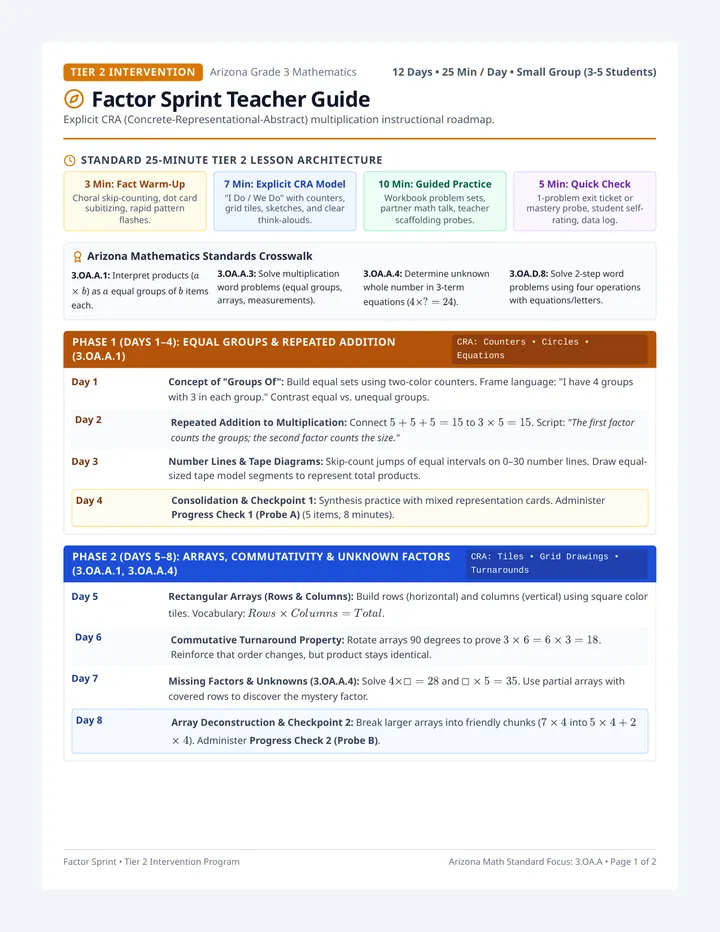
Numeracy Rope Master Plan Guide The Numeracy Rope: 20-Day Master Scope & Sequence
Grades 1–3 • Intertwining Quantitative Structure & Mathematical Reasoning
Teacher Curriculum Guide
Month 1 • 4 Weeks (Days 1–20)
Daily 5-Part Lesson Architecture Predictable 45-minute daily instructional flow
1. Check In
Mindset pulse & readiness gauge (3 min)
2. Warm Up
Subitizing, dot sprint, or choral count (7 min)
3. Review
Spiral anchor & prior strand link (7 min)
4. New Concept
Strand weaving: structure + reasoning (20 min)
5. Vocab
Explicit math term, visual anchor, talk stem (8 min)
Strand 1: Quantitative Structure & Symbols | Strand 2: Mathematical Reasoning
Weeks 1 & 2 Matrix
Day Strands Weaved Warm-Up Routine New Concept Focus New Vocab Target Week 1 • Quantity Sense, Subitizing & Quantitative Situations (Days 1–5) Day 1 Quantity Sense + Quant. Situations Quick-Look Dots (1–5) Magnitude Intuition: More, Less, and Same with counters Magnitude, Quantity Day 2 Subitizing + Problem Formulation Ten-Frame Flash (3–6) Perceptual Subitizing: Recognizing arrangements without counting Subitize, Arrange Day 3 Subitizing + Structure Seeking Dice Pattern Relay Conceptual Subitizing: Seeing 5 as 3+2 or 4+1 instantly Group, Structure Day 4 Number Relations + Quant. Situations Choral Count Forward (to 20) Joining Situations: Linking physical combining to action stories Join, Total Day 5 Symbol Mapping + Modeling Dot-Numeral Quick Match Mapping Quantities to Numerals & the Plus (+) Symbol Numeral, Equation Week 2 • Part-Whole Understanding & Strategic Problem Formulation (Days 6–10) Day 6 Part-Whole + Strategic Thinking Two-Color Counter Drop Composing Numbers to 7: Exploring all two-part combinations Compose, Combine Day 7 Part-Whole + Modeling Snap Cube Break Apart Decomposing to 10: Using number bonds to show parts and wholes Decompose, Number Bond Day 8 Part-Whole + Sense Making Hide-the-Counters Game Missing Part Problems: Finding the unseen part from known whole Missing Part, Unknown Day 9 Situations + Strategic Planning Part-Part-Whole Flash Separating Situations: Connecting subtraction to part-whole action Separate, Difference Day 10 Symbol Mapping + Reflection Fact Family Finger Flash Relational Statements: The equal sign (=) as balance/sameness Equal Sign, Balance
The Numeracy Rope Curriculum Framework • Grade Band: 1st – 3rd Grade Page 1 of 2 (Days 1–10)
The Numeracy Rope: Weeks 3 & 4 (Days 11–20)
Unitizing, Base-Ten Structure, Derived Facts & Relational Thinking
Curriculum Map Pt. 2
Days 11–20 Progression
Day Strands Weaved Warm-Up Routine New Concept Focus New Vocab Target Week 3 • Unitizing, Place Value & Modeling Representations (Days 11–15) Day 11 Unitizing + Modeling Bundling Stick Chant Unitizing: Seeing a bundle of 10 individual items as "one ten" Unitize, Bundle Day 12 Place Value + Representation Quick-Draw Ten Sticks Tens and Ones: Decomposing teen numbers into 10 + n Tens, Ones, Place Value Day 13 Number Relationships + Reasoning Choral Skip Count (10s & 5s) Multi-Unit Patterns: Navigating the 120 chart by tens and ones Row, Column, Decade Day 14 Modeling + Problem Formulation Base-Ten Riddle Flash Open Number Line: Representing 2-digit numbers and jumps of 10 Open Number Line, Landmark Day 15 Quant. Situations + Comparison Which is Greater? Sprint Comparing Magnitudes: Using place value to compare (>, <, =) Greater Than, Less Than Week 4 • Structural Fluency, Relational Strategies & Algebraic Transfer (Days 16–20) Day 16 Fluency + Strategic Thinking Doubles Mirror Game Doubles & Near-Doubles: Deriving facts using 6+7 = (6+6)+1 Derived Fact, Near-Doubles Day 17 Fluency + Sense Making Making 10 Target Sprint Bridge to Ten Strategy: Re-grouping 8+5 into (8+2)+3 = 13 Make-a-Ten, Bridge Day 18 Generalized Structure + Equivalence True/False Balance Check Relational Equivalence: Analyzing statements like 7+5 = 6+6 Equivalence, Balance Scale Day 19 Strategic Choice + Evaluation Strategy Showdown Vote Efficiency & Justification: Comparing strategies for the same problem Efficient, Justify Day 20 Transfer + Problem Formulation Cumulative Rope Riddle Transfer & Celebration: Multi-step real-world problem performance task Persevere, Transfer
The 4 Core Rope Principles
• Both strands are essential: Procedural symbols without reasoning lead to brittle memorization.
• Strands develop together: Never isolate drill from context; meaning drives fluency.
• C-R-A Sequence: Concrete action → visual representation → symbolic notation.
• Mathematical Discourse: Students must explain, justify, and debate strategies daily.
Differentiation & Grade Band Scaling
• Grade 1 Target: Quantities to 20, perceptual subitizing to 5, composing to 10, bundling single tens.
• Grade 2 Target: Quantities to 100, conceptual subitizing to 10, place value to 100, make-a-ten to 20.
• Grade 3 Target: Unitizing tens into hundreds, relational equations with unknowns, multi-digit strategies.
• Intervention: Use concrete ten-frames and bead strings before number lines.
The Numeracy Rope Curriculum Framework • Grade Band: 1st – 3rd Grade Page 2 of 2 (Days 11–20)
Quantity Detectives Student Worksheet Week 1 • Strand 1 & 2 Grades 1–3
Quantity Detectives: Day 3 Practice
Name:
Date:
Step 1: Math Check-In Circle how your math brain feels today:
🌱 Ready to Grow
⚡ Energized
🔍 Curious
🧘 Needs Warm-Up
Step 2: Warm-Up • Quick-Look Dot Sprint Do not count 1-by-1. See the groups instantly!
Total:
Total:
Total:
Step 3: Review • Magnitude Check Compare the quantities. Circle the set with MORE:
Set A: 7 acorns vs Set B: 9 acorns
Set C: 14 counters vs Set D: 11 counters
Step 4: New Concept • Joining Situations & Models Strand 1 (Structure) + Strand 2 (Reasoning)
Story Problem:
Maya saw 5 birds on a branch. Then, 3 more birds flew in to join them. How many birds are on the branch now?
Model It (Draw quick circles/dots in groups):
Number Sentence:
=
Explain how you saw it:
Step 5: New Concept Vocabulary
WORD Subitize
Meaning: Instantly knowing how many without counting one by one.
"I subitized 4 dots because I saw 2 and 2."
WORD Magnitude
Meaning: The size or amount of a number—how big or small it really is.
"9 has a greater magnitude than 7."
The Numeracy Rope Series • Strand 1 (Quantitative Structure) & Strand 2 (Mathematical Reasoning) Quantity Detectives • Worksheet 1.3
Quantity Detectives Presentation Slides The Numeracy Rope Grades 1–3
Week 1 • Lesson Routine
Strand 1 & Strand 2 In Action
Quantity Detectives
Building intuitive number sense, subitizing patterns, and sense-making in quantitative situations.
1. Check In
2. Warm Up
3. Review
4. New Concept
5. Vocab
Step 1 of 5
Math Brain Check-In
3 Minutes
Show with your fingers: How ready is your brain for math today?
🌱
Ready to Grow
Open to new ideas
⚡
Energized
Ready for a challenge
🔍
Curious
Looking for patterns
🧘
Warming Up
Need a deep breath
Teacher Prompt: "Show me 1, 2, 3, or 4 on your chest to share your mindset." Numeracy Rope Routine
Step 2 of 5
Warm-Up: Quick-Look Sprint
7 Minutes
Do not count one by one! How many dots do you see in each flash?
Card A
Card B
Card C
Math Talk Stem: "I saw ______ dots because I noticed a group of ______ and a group of ______." Subitizing Routine
Step 3 of 5
Review: Magnitude Comparison
7 Minutes
Which group has a greater magnitude?
Group Alpha
7 Counters
Group Beta
9 Counters
Justify: "9 is greater than 7 because 9 has 2 extra counters." Magnitude Comparison
Step 4 of 5
New Concept: Joining Situations
20 Minutes
Story Situation
Maya saw 5 birds on a branch. Then, 3 more birds flew in to join them.
Visual Model (Dots in Groups):
5 starting birds + 3 joining birds
Equation & Relational Symbol:
5 + 3 = 8
The total amount of birds is 8 .
Numeracy Rope Weave: We connect the real-world action (joining) to the symbol (+). Strand 1 & 2 Weaved
Step 5 of 5
New Concept Vocabulary
8 Minutes
Focus Word 1
Subitize
Instantly recognizing how many in a group without counting one by one.
Part Whole Power Worksheet Week 2 • Strand 1 & 2 Grades 1–3
Part-Whole Power: Day 7 Practice
Name:
Date:
Step 1: Strategy Check-In What is your favorite way to solve math today?
🧱 Using Blocks
✏️ Drawing Pictures
🧠 Mental Math
🤝 Talking with Partner
Step 2: Warm-Up • Ten-Frame Part Flash How many filled? How many empty to make 10?
7 and make 10
4 and make 10
8 and make 10
Step 3: Review • Dot Decompositions Break 6 into two different pairs of parts:
6 =
6 =
Step 4: New Concept • Number Bonds & Bar Models Decomposing & Finding Missing Parts
Story Challenge:
Leo has a box with 9 crayons in total . 4 crayons are red , and the rest are green. How many crayons are green?
Fill in the Part-Part-Whole Bar Model:
Whole: 9
Part: 4
Part: ?
Missing Part Equation:
4 +
= 9
Green crayons:
Reason: "I started at 4 and counted up..." or "I know 9 take away 4 is..."
Step 5: New Concept Vocabulary
WORD Decompose
Meaning: Breaking a whole number apart into two or more smaller parts.
"I can decompose 10 into 7 and 3."
WORD Part-Whole
Meaning: The relationship showing that pieces (parts) put together create the total (whole).
"Part + Part = Whole."
The Numeracy Rope Series • Strand 1 (Quantitative Structure) & Strand 2 (Mathematical Reasoning) Part-Whole Power • Worksheet 2.2
Part Whole Power Slides The Numeracy Rope Grades 1–3
Week 2 • Lesson Routine
Strand 1: Part-Whole • Strand 2: Strategic Thinking
Part-Whole Power
Composing, decomposing, and mastering missing parts using visual bar models and number bonds.
1. Check In
2. Warm Up
3. Review
4. New Concept
5. Vocab
Step 1 of 5
Strategy Check-In
3 Minutes
Which math tool helps you find missing parts best today?
🧱
Snap Cubes
Building and breaking
✏️
Bar Models
Drawing the parts
🧠
Mental Math
Known fact recall
🤝
Partner Talk
Explaining thinking
Teacher Prompt: "Turn to your partner and name your chosen strategy tool." Readiness Routine
Step 2 of 5
Warm-Up: Ten-Frame Flash
7 Minutes
Look at the filled spaces. How many more empty spaces are needed to make a full 10?
7 + ? = 10
4 + ? = 10
8 + ? = 10
Math Talk Stem: "I know ______ and ______ make 10 because ______ spaces are empty." Combinations to 10
Step 3 of 5
Review: Decomposing Numbers
7 Minutes
How many ways can we split 6 into two parts?
Pair A
1 + 5 = 6
Pair B
2 + 4 = 6
Pair C
3 + 3 = 6
Key Insight: "The whole stays 6, even when the parts change!" Conservation of Quantity
Step 4 of 5
New Concept: Bar Models & Missing Parts
20 Minutes
Story Problem
Leo has a box with 9 crayons in total . 4 are red , and the rest are green. How many are green?
Part-Part-Whole Bar Model:
WHOLE: 9 CRAYONS
PART: 4 RED
PART: ? GREEN
Missing Addend Equations:
4 + 5 = 9
Or as subtraction: 9 - 4 = 5
Answer: Leo has 5 green crayons.
Numeracy Rope Weave: Connecting part-whole structures to strategic thinking. Strand 1 & 2 Weaved
Place Value Units Worksheet Week 3 • Strand 1 & 2 Grades 1–3
Place Value Units: Day 12 Practice
Name:
Date:
Step 1: Tool Selection Check-In Which tool helps you see groups of 10 best? Circle one:
🥢 Bundling Sticks
🟦 Base-Ten Rods
🧮 Double Ten-Frames
📏 100 Bead String
Step 2: Warm-Up • Choral Decade Count Count by tens to fill in the missing numbers on the trail:
10
→
20
→
?
→
40
→
?
→
60
Step 3: Review • The "Ten" Boundary How many loose ones make exactly ONE full group of ten?
10 individual single units =
bundle of TEN
"10 ones becomes 1 ten"
Step 4: New Concept • Unitizing Tens & Ones Nested Units & Place Value Modeling
Modeling Investigation:
Look at the picture. There is 1 full ten-stick and 4 single unit cubes .
Quick-Draw Base-Ten Model:
1 Ten
4 Ones
Fill in the Place Value Chart:
TENS
ONES
Expanded Form Equation:
10 +
=
Step 5: New Concept Vocabulary
WORD Unitize
Meaning: Treating a group of items as a single new unit (10 single cubes become 1 ten-stick).
"I unitized 10 pennies into one dime."
WORD Place Value
Meaning: The value of where a digit sits in a number (the 1 in 14 means 10, not 1).
"In 14, the place value of the 1 is ten."
The Numeracy Rope Series • Strand 1 (Quantitative Structure) & Strand 2 (Mathematical Reasoning) Place Value Units • Worksheet 3.2
Place Value Units Slides The Numeracy Rope Grades 1–3
Week 3 • Lesson Routine
Strand 1: Unitizing • Strand 2: Modeling & Representation
Place Value Units
Bundling groups into single units of ten, exploring place value structure, and modeling multi-digit numbers.
1. Check In
2. Warm Up
3. Review
4. New Concept
5. Vocab
Step 1 of 5
Place Value Tool Check-In
3 Minutes
Which tool makes "groups of ten" easiest to see for you today?
🥢
Bundling Sticks
Popsicle stick ties
🟦
Base-Ten Rods
Blocks of 10 and 1s
🧮
Double Frames
Full ten grid frames
📏
100 Bead String
Groups of 10 colors
Teacher Prompt: "Signal your tool choice with 1, 2, 3, or 4 on your fingers." Tool Selection Routine
Step 2 of 5
Warm-Up: Choral Decade Trail
7 Minutes
Count aloud by tens with the class rhythm! What numbers fill the mystery boxes?
10
→
20
→
?
→
40
→
?
→
60
Choral Chant: "Ten, twenty, thirty, forty, fifty, sixty... each jump is one ten!" Skip Counting by Tens
Step 3 of 5
Review: The "Ten" Boundary
7 Minutes
When does a collection of loose items become ONE new unit?
10 Individual Loose Units
10 Ones
1 Single Solid Unit
1 Ten Rod
Big Idea: "10 ones can be bundled into 1 ten. It represents the exact same quantity!" Bundling Principle
Step 4 of 5
New Concept: Place Value Charts
20 Minutes
Base-Ten Investigation
Representing 14 with Base-Ten Blocks & Expanded Form
Base-Ten Drawing:
1 Ten (10)
4 Ones (4)
Place Value Table:
TENS
ONES
1
4
Expanded Form: 10 + 4 = 14
Numeracy Rope Weave: Combining place value symbols with physical block representations. Strand 1 & 2 Weaved
Fact Strategy Sprint Worksheet Week 4 • Strand 1 & 2 Grades 1–3
Fact Strategy Sprint: Day 16 Practice
Name:
Date:
Step 1: Mental Math Mindset Check Rate your strategy confidence today:
🐢 Still Counting by 1s
🏃 Counting On from Bigger
🚀 Using Known Fact Bridges
Step 2: Warm-Up • Doubles Anchor Sprint Know your doubles in a flash:
4 + 4 =
6 + 6 =
7 + 7 =
8 + 8 =
Step 3: Review • The Plus 1 Pattern What happens when you add 1 more to an existing total?
If 5 + 5 = 10 , then 5 + 6 must be 1 more than 10:
5 + 6 =
Step 4: New Concept • Derived Facts (Near-Doubles) Using Known Facts to Derive Unknowns
Challenge Problem: Solve 6 + 7 without counting on your fingers!
Use your double fact of 6 to bridge the gap.
Step-by-Step Strategic Thinking:
1 Break 7 into: 6 + 1
2 Add the known double: 6 + 6 = 12
3 Add the remaining 1: 12 + 1 =
Relational Equivalence Statement:
6 + 7 = (6 + 6) + 1
Both sides equal the exact same amount!
Try with 7 + 8:
(7 + 7) + 1 = 14 + 1 =
Step 5: New Concept Vocabulary
WORD Derived Fact
Meaning: Figuring out an unknown math fact using a known fact that you already have memorized.
"I derived 6+7 from 6+6."
WORD Equivalence
Meaning: Having the exact same value or amount on both sides of the equal sign.
"6 + 7 and 12 + 1 show equivalence."
The Numeracy Rope Series • Strand 1 (Quantitative Structure) & Strand 2 (Mathematical Reasoning) Fact Strategy Sprint • Worksheet 4.1
Fact Strategy Sprint Slides The Numeracy Rope Grades 1–3
Week 4 • Lesson Routine
Strand 1: Structural Fluency • Strand 2: Generalization
Fact Strategy Sprint
Moving beyond counting on fingers to derived facts, relational equivalence, and algebraic balance.
1. Check In
2. Warm Up
3. Review
4. New Concept
5. Vocab
Step 1 of 5
Mental Math Mindset Check
3 Minutes
Where is your math brain on its journey to structural fluency?
🐢
Counting by 1s
Counting every counter or finger from 1
🏃
Counting On
Locking the bigger number and counting up
🚀
Fact Bridges
Using known facts to derive unknown facts
Teacher Prompt: "Celebrate all stages! Today we practice bridging from what we know." Mindset Calibration
Step 2 of 5
Warm-Up: Doubles Anchor Sprint
7 Minutes
Call out the double total as fast as like lightning!
Double 4
4 + 4
= 8
Double 6
6 + 6
= 12
Double 7
7 + 7
= 14
Double 8
8 + 8
= 16
Memory Anchor: "Doubles are our anchor facts. We will use them to solve nearby facts!" Anchor Fluency
Step 3 of 5
Review: The "+1" Pattern Bridge
7 Minutes
If we know 5 + 5 = 10 , what happens when we add 1 to one part?
Known Anchor
5 + 5 = 10
Balanced twin parts
Near-Double (+1)
5 + 6 = 11
Exactly 1 more than 10!
Relational Rule: When an addend grows by 1, the total sum also grows by 1. Relational Thinking
Step 4 of 5
New Concept: Derived Facts & Equivalence
20 Minutes
Challenge: Solve 6 + 7 with zero finger counting!
Strategic Derivation
The 3-Step Strategy Bridge:
1. Decompose 7 into: 6 + 1
2. Use the anchor double: 6 + 6 = 12
3. Add the leftover 1: 12 + 1 = 13
Relational Equivalence Balance:
6 + 7 = (6 + 6) + 1