Lenny.com
Explore
Create
ActivitiesNewMathEnglish Language ArtsScience & EngineeringSocial StudiesGlobal LanguagesHealth & Physical EducationSpecial EducationCounseling & Life SkillsArts & CreativityESL
Lenny.com
Lenny.com
Explore
Create
ActivitiesNewMathEnglish Language ArtsScience & EngineeringSocial StudiesGlobal LanguagesHealth & Physical EducationSpecial EducationCounseling & Life SkillsArts & CreativityESL
Lenny.com
Lenny.com

Solutions

Lenny for EducatorsLenny for SchoolsLenny for Districts

Product

ExploreSign inCreateSupportAbout

Resources

Getting startedMTSS Acceleration Program

Newsletters

School Funding Newsletter

© 2026 Lenny Learning Inc.

TermsPrivacyAccessibility
LinkedInInstagramX
Lenny
MathNumbers & CountingCounting ObjectsNumber NamesComparing NumbersNumber OperationsCounting SequenceNumbers 0-10Place Value Understanding and SystemAdd and Subtract Within 20Addition and Subtraction ConceptsAddition and Subtraction EquationsAddition and Subtraction ProblemsFoundations for MultiplicationMultiplication and Division PropertiesMultiply and Divide Within 100Multiplication and Division ProblemsFactors and MultiplesProperties of OperationsPatterns and RelationshipsGenerate and Analyze PatternsMulti-Digit ArithmeticPlace Value OperationsMulti-Digit and Decimal OperationsNumerical ExpressionsFour Operations and PatternsFour Operations Problem SolvingMeasurement & DataMeasurable AttributesMeasuring LengthsMeasure and Estimate Lengths in Standard UnitsRelate Addition and Subtraction to LengthClassifying and Counting ObjectsTime and MoneyArea Concepts and MeasurementPerimeter and Area MeasuresAngle Concepts and MeasurementTime, Volume, and MassMeasurement Unit ConversionsGeometryIdentifying ShapesShapes and AttributesShape Attributes and ReasoningShapes and CompositionClassifying 2D FiguresGeometric Figures and RelationshipsLines, Angles, and ShapesAngle, Area, and VolumeGeometric MeasurementVolume of 3D ShapesCoordinate Plane ApplicationsTransformations in the PlaneCongruence and SimilarityUnderstand congruence in terms of rigid motionsSimilarity and TransformationsProve Theorems Involving SimilarityPythagorean TheoremTrigonometry for General TrianglesMake Geometric ConstructionsProve Geometric TheoremsTheorems About CirclesFind Arc Lengths And Areas of Sectors of CirclesVolume FormulasRelationships Between Two-Dimensional and Three-Dimensional ObjectsProve Simple Geometric Theorems AlgebraicallyTranslate Between Geometric Description and Equation for Conic SectionApply Geometric Concepts in Modeling SituationsFractions & DecimalsFractions as NumbersBuilding FractionsFraction Equivalence and OrderingAdding and Subtracting FractionsMultiplying and Dividing FractionsDividing FractionsDecimal FractionsMulti-Digit Computation and FactorsAdd, Subtract, Multiply, and Divide Rational NumbersRational Number SystemIrrational Numbers and ApproximationsRatiosRatios and ProportionsProportional RelationshipsUnit RateAlgebraAlgebraic ExpressionsGenerate Equivalent ExpressionsQuantitative RelationshipsProportional Relationships and Linear EquationsEquations and InequalitiesEquation Solving and ReasoningLinear Equations and SystemsGraph Equations and InequalitiesSystems of EquationsReal-World Algebraic ProblemsQuantitative Reasoning with UnitsExpression StructureEquivalent Expression FormsRadicals and Integer ExponentsRational ExponentsRational and Irrational NumbersPolynomial OperationsPolynomial IdentitiesPolynomial Zeros and FactorsRational ExpressionsComplex Number OperationsComplex Numbers in PolynomialsComplex Numbers on PlaneStatistics & ProbabilityRepresent and Interpret DataData DistributionsStatistical VariabilityProbability ModelsCompound Event ProbabilitiesStatistical SamplingInterpret Categorical and Quantitative DataBivariate Data PatternsInterpret Linear ModelsComparing Two PopulationsRandom Processes in StatisticsIndependence and Conditional ProbabilityExpected ValuesProbability-Based Decision MakingStatistical Inference and ConclusionsFunctionsFunction Concepts and NotationDefine and Compare FunctionsInterpret Functions in ContextAnalyze Function RepresentationsModel Relationships with FunctionsIdentify Linear vs Exponential GrowthDistinguish Between Function TypesCompare Growth RatesInterpret Function ExpressionsBuild Functions from RelationshipsConstruct and Model FunctionsTransform and Combine FunctionsModel Comparison and SelectionSolve Exponential EquationsTrigonometryTrigonometric Ratios Involving Right TrianglesTrigonometric Functions and Unit CircleModel with Trigonometric FunctionsTrigonometric IdentitiesVectors & MatricesIntroduction to Vectors and MatricesVector QuantitiesVector OperationsMatrix OperationsCalculusLimits and ContinuityDerivative Concepts and NotationDerivative Rules and TechniquesApplications of DerivativesOptimization ProblemsRelated RatesCurve Sketching and AnalysisIntegration Concepts and NotationAntiderivatives and Indefinite IntegralsDefinite Integrals and AreaFundamental Theorem of CalculusIntegration TechniquesApplications of IntegrationDifferential EquationsSequences and SeriesParametric and Polar FunctionsVector-Valued Functions

Math Mastery Series

A collection of middle school mathematics assessments and teacher resources covering arithmetic fluency and pre-algebra foundations.

SSteve.Peters
Long Division Sprint

A comprehensive long division assessment and teacher guide featuring 10 core computation problems (single- and double-digit divisors) and 4 applied real-world word problems with complete step-by-step solutions and remainder interpretations.

Distributive Property Power

A 20-problem distributive property unit featuring 10 algebraic expression problems with variables and 10 numerical problems (each with a minimum of 4 terms and no variables), complete with a 40-point teacher answer key.

Math Mastery Series

A collection of middle school mathematics assessments and teacher resources covering arithmetic fluency and pre-algebra foundations.

SSteve.Peters

1.0 pt Answer: Fully correct quotient and remainder explicitly written.

Quick Answers (Part A): 1: 87 • 2: 122 R 3 • 3: 369 • 4: 364 R 1 • 5: 504

Long Division Single and Double Divisor • Key Page 1 of 3 • Part A Solutions (10 pts) →

Teacher Reference

Long Division Single and Double Divisor • Key

Part B: 10 Points

2 Part B Solutions: Two-Digit Divisors

2 pts each: 1 pt complete work • 1 pt correct quotient/remainder (10 pts total)

6 468 ÷ 12

Exact (2 pts)

39

12

468

-36 

108

-108

0

Steps (1 pt work):

• 46 ÷ 12 = 3 R 10

• 108 ÷ 12 = 9 R 0

Check: 39 × 12 = 468 ✓

Answer (1 pt): 39

7 895 ÷ 14

Remainder (2 pts)

63 R 13

14

895

-84 

55

-42

13

Steps (1 pt work):

• 89 ÷ 14 = 6 R 5

• 55 ÷ 14 = 3 R 13

Check: (63 × 14) + 13 = 895 ✓

Answer (1 pt): 63 R 13

8 1,512 ÷ 24

Exact (2 pts)

63

24

1512

-144 

72

-72

0

Steps (1 pt work):

• 151 ÷ 24 = 6 R 7

• 72 ÷ 24 = 3 R 0

Check: 63 × 24 = 1512 ✓

Answer (1 pt): 63

9 3,745 ÷ 15

Remainder (2 pts)

249 R 10

15

3745

-30  

745

-60 

145

-135

10

Steps (1 pt work):

• 37÷15=2, 74÷15=4

• 145÷15=9 R 10

Check: (249 × 15) + 10 = 3745 ✓

Answer (1 pt): 249 R 10

10 6,804 ÷ 27

Exact (2 pts)

252

27

6804

-54  

1404

-135 

54

-54

0

Steps (1 pt work):

• 68÷27=2, 140÷27=5

• 54÷27=2 R 0

Check: 252 × 27 = 6804 ✓

Answer (1 pt): 252

Part B Quick Reference (10 pts)

Q6: 39

Q7: 63 R 13

Q8: 63

Q9: 249 R 10

Q10: 252

Part A (10) + Part B (10) = 20 pts Part C Next →

Long Division Single and Double Divisor • Key Page 2 of 3 • Part B Solutions (10 pts) →

Teacher Reference

Long Division Single and Double Divisor • Key

Part C: 8 Points

3 Part C Solutions: Word Problems

2 pts each: 1 pt equation & work • 1 pt answer with units (8 pts total)

11 School Field Trip

2 Points

Equation (1 pt work): 258 ÷ 8

32 R 2

8

258

-24 

18

-16

2

• 25 ÷ 8 = 3 R 1

• 18 ÷ 8 = 2 R 2

Check: (32×8)+2 = 258 ✓

Remainder Interpretation (1 pt): 32 vans hold 256 people. The 2 extra people require 1 more van, so 33 vans are needed.

Final Answer (1 pt): 33 vans

12 Art Markers Distribution

2 Points

Equation (1 pt work): 1,365 ÷ 5

273

5

1365

-10  

365

-35 

15

-15

0

• 13 ÷ 5 = 2 R 3

• 36 ÷ 5 = 7 R 1

• 15 ÷ 5 = 3 R 0

Check: 273 × 5 = 1365 ✓

Interpretation: The shipment splits completely evenly across all 5 schools with 0 markers remaining.

Final Answer (1 pt): 273 markers

13 Bakery Packaging

2 Points

Equation (1 pt work): 1,520 ÷ 24

63 R 8

24

1520

-144 

80

-72

8

• 152 ÷ 24 = 6 R 8

• 80 ÷ 24 = 3 R 8

Check: (63×24)+8 = 1520 ✓

Remainder Interpretation: 63 represents full boxes (0.5 pt); 8 represents the leftover cookies (0.5 pt).

Final Answer (1 pt): 63 boxes, 8 left over

14 Arena Seating Sections

2 Points

Equation (1 pt work): 3,192 ÷ 14

228

14

3192

-28  

392

-28 

112

-112

0

• 31 ÷ 14 = 2 R 3

• 39 ÷ 14 = 2 R 11

• 112 ÷ 14 = 8 R 0

Check: 228 × 14 = 3192 ✓

Interpretation: Each of the 14 identical sections holds exactly 228 seats with zero remainder.

Final Answer (1 pt): 228 seats

Long Division Single and Double Divisor • Key Page 3 of 3 • Part C: 8 pts • Assessment Total: 28 Points

Numerical Problem Solving

Distributive Property Expressions Quiz

Name:

C Part 3: 4-Term Numerical Distribution (No Variables)

2 pts each: 1 pt for distributing across all terms • 1 pt for evaluated total.

11 (2 pts)

4-Term Sum

4(50 + 30 + 10 + 5)

Calculated Value:

12 (2 pts)

4-Term Mixed

6(40 + 20 - 5 - 3)

Calculated Value:

13 (2 pts)

Double Distribute

5(20 + 6) + 3(40 + 8)

Calculated Value:

14 (2 pts)

Double Distribute

8(30 + 5) - 4(20 + 5)

Calculated Value:

15 (2 pts)

Expanded Form

3(1000 + 400 + 60 + 8)

Calculated Value:

Distributing Across 4+ Terms

The 4-Term Rule:

a(b + c + d + e) = ab + ac + ad + ae

Key Tip: Multiply the factor outside by every single term inside before summing!

Part 3: 10 Points Turn to Page 4 →

Distributive Property Expressions Quiz • Page 3 of 4 (Part 3: 10 pts) Continue to Page 4 for 4-Term Decimals & Applications →

Numerical Problem Solving

Distributive Property Expressions Quiz

Name:

D Part 4: Decimals, Fractions & Real-World 4-Term Problems

2 pts each: Distribute across all terms, show work, and evaluate final total.

16 (2 pts)

4-Term Decimals

4(10 + 5 + 0.5 + 0.25)

Calculated Value:

17 (2 pts)

4-Term Fractions

8(10 + 4 + ½ + ¼)

Calculated Value:

18 (2 pts)

4-Term Expression

7(30 + 8) + 45 + 15

Calculated Value:

19 (2 pts)

4-Item Equipment

A coach buys 5 gear packs. Each pack has 12 basketballs, 8 soccer balls, 6 volleyballs, and 4 dodgeballs. Evaluate using: 5(12 + 8 + 6 + 4)

Total Balls:

20 (2 pts)

4-Item Catering

Caterers prepare food for 8 tables. Each table receives 25 rolls, 15 skewers, 10 mini quiches, and 5 tarts. Evaluate using: 8(25 + 15 + 10 + 5)

Total Food Items:

Checking Multi-Term Work

You can verify your distributed answer by adding inside the parentheses first and multiplying:

• 5(12 + 8 + 6 + 4) = 5(30) = 150 ✓

• 8(25 + 15 + 10 + 5) = 8(55) = 440 ✓

Part 4: 10 Points Total Quiz: 40 Points

Distributive Property Expressions Quiz • Page 4 of 4 (Part 4: 10 pts) End of Assessment • Total: 40 Points

B Part 2 Solutions: Advanced Terms & Combining Like Terms

2 pts each: 1 pt distribution/combining steps • 1 pt simplified expression (10 pts)

6 -3(-4k - 8)

Double Negative

Expanded Steps (1 pt work):

= (-3 • -4k) - (-3 • 8)

= 12k + 24

Teacher Note: Both products result in positive terms because negative × negative = positive.

Answer (1 pt): 12k + 24

7 2x(5x - 3)

Variable Factor

Expanded Steps (1 pt work):

= (2x • 5x) - (2x • 3)

= 10x² - 6x

Teacher Note: \( x \cdot x = x^2 \). Writing \( 10x - 6x \) or \( 4x \) is a major misconception.

Answer (1 pt): 10x² - 6x

8 ⅓(9p - 24)

Fractional

Expanded Steps (1 pt work):

= (⅓ • 9p) - (⅓ • 24)

= 3p - 8

Teacher Note: Dividing both terms by 3 is mathematically equivalent: \( \frac{9p}{3} - \frac{24}{3} = 3p - 8 \).

Answer (1 pt): 3p - 8

9 5(2n + 4) + 3n

Combine Like Terms

Steps (1 pt work):

1. Distribute 5: 10n + 20 + 3n

2. Combine like terms: (10n + 3n) + 20

= 13n + 20

Teacher Note: Do not add 5 and 3n first; distribution has multiplication precedence!

Answer (1 pt): 13n + 20

10 7 - 2(3x - 4) + 5x

Multi-Step

Steps (1 pt work):

1. Distribute -2: 7 - 6x + 8 + 5x

2. Combine: (-6x + 5x) + (7 + 8)

= -x + 15 (or 15 - x)

Key Pitfall: Distributing \(-2\) gives \(+8\), not \(-8\). Do not compute \(7 - 2 = 5\).

Answer (1 pt): -x + 15

Part 2 Quick Reference (10 pts)

Q6: 12k + 24

Q7: 10x² - 6x

Q8: 3p - 8

Q9: 13n + 20

Q10: -x + 15 (or 15 - x)

Part 1 (10) + Part 2 (10) = 20 pts Part 3 Next →

Distributive Property Expressions • Key Page 2 of 4 • Part 2 Solutions (10 pts) →

Teacher Reference

Distributive Property Expressions • Key

Part 3: 10 Points

C Part 3 Solutions: 4-Term Numerical Distribution (No Variables)

2 pts each: 1 pt for expanded distributive products • 1 pt for evaluated total (10 pts)

11 4(50+30+10+5)

2 Points

Distribute to all 4 terms (1 pt):

= (4×50) + (4×30) + (4×10) + (4×5)

= 200 + 120 + 40 + 20

= 380

Check: 4 × (95) = 380 ✓

Calculated Value (1 pt): 380

12 6(40+20-5-3)

2 Points

Distribute to all 4 terms (1 pt):

= (6×40) + (6×20) - (6×5) - (6×3)

= 240 + 120 - 30 - 18

= 312

Check: 6 × (52) = 312 ✓

Calculated Value (1 pt): 312

13 5(20+6)+3(40+8)

2 Points

Double Distribution (1 pt):

= (5×20) + (5×6) + (3×40) + (3×8)

= 100 + 30 + 120 + 24

= 274

Check: (5 × 26) + (3 × 48) = 130 + 144 = 274 ✓

Calculated Value (1 pt): 274

14 8(30+5)-4(20+5)

2 Points

Double Distribution (1 pt):

= (8×30) + (8×5) - (4×20) - (4×5)

= 240 + 40 - 80 - 20

= 180

Check: (8 × 35) - (4 × 25) = 280 - 100 = 180 ✓

Calculated Value (1 pt): 180

15 3(1000+400+60+8)

2 Points

Place-Value Distribution (1 pt):

= (3×1000) + (3×400) + (3×60) + (3×8)

= 3,000 + 1,200 + 180 + 24

= 4,404

Check: 3 × 1,468 = 4,404 ✓

Calculated Value (1 pt): 4,404

Part 3 Quick Reference (10 pts)

Problem 11: 380

Problem 12: 312

Problem 13: 274

Problem 14: 180

Problem 15: 4,404

Parts 1–3 Total: 30 pts Part 4 Next →

Distributive Property Expressions • Key Page 3 of 4 • Part 3 Solutions (10 pts) →

Teacher Reference

Distributive Property Expressions • Key

Part 4: 10 Points

D Part 4 Solutions: 4-Term Decimals, Fractions & Word Problems

2 pts each: 1 pt for numerical steps • 1 pt for final value with units (10 pts)

16 4(10+5+0.5+0.25)

2 Points

Distribute to 4 terms (1 pt):

= (4×10) + (4×5) + (4×0.5) + (4×0.25)

= 40 + 20 + 2 + 1

= 63

Check: 4 × 15.75 = 63 ✓

Calculated Value (1 pt): 63

17 8(10+4+½+¼)

2 Points

Distribute to 4 terms (1 pt):

= (8×10) + (8×4) + (8×½) + (8×¼)

= 80 + 32 + 4 + 2

= 118

Check: 8 × 14.75 = 118 ✓

Calculated Value (1 pt): 118

18 7(30+8)+45+15

2 Points

Distribute & Add (1 pt work):

= (7×30) + (7×8) + 45 + 15

= 210 + 56 + 45 + 15

= 326

Check: (7 × 38) + 60 = 266 + 60 = 326 ✓

Calculated Value (1 pt): 326

19 4-Item Gear Packs

2 Points

Expression: 5(12 + 8 + 6 + 4)

= (5×12) + (5×8) + (5×6) + (5×4)

= 60 + 40 + 30 + 20

= 150 balls

Total Balls (1 pt): 150 balls

20 4-Item Catering

2 Points

Expression: 8(25 + 15 + 10 + 5)

= (8×25) + (8×15) + (8×10) + (8×5)

= 200 + 120 + 80 + 40

= 440 items

Total Items (1 pt): 440 items

Part 4 Quick Matrix

Q16: 63

Q17: 118

Q18: 326

Q19: 150 balls

Q20: 440 items

Part 3 (10) + Part 4 (10) = 20 pts Total Quiz: 40 Points

Distributive Property Expressions • Key Page 4 of 4 • End of Key • 40 Points Total
You might also like

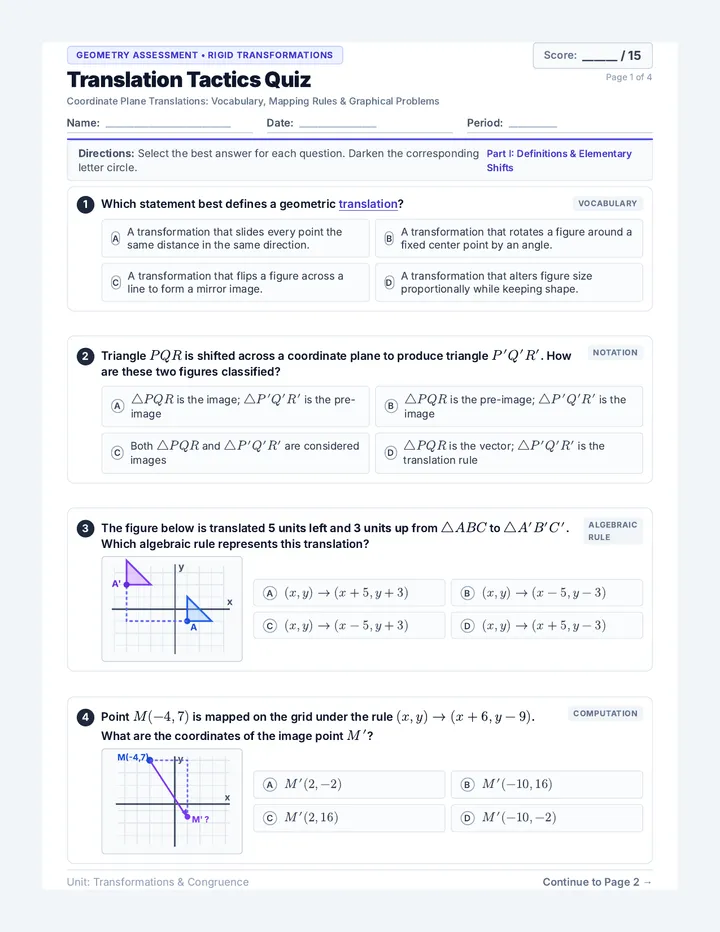
Translation Tactics Quiz

Math Mastery Units

Comprehensive secondary mathematics units covering coordinate geometry transformations and linear functions in slope-intercept form.

FM

Fernando Mancini

4
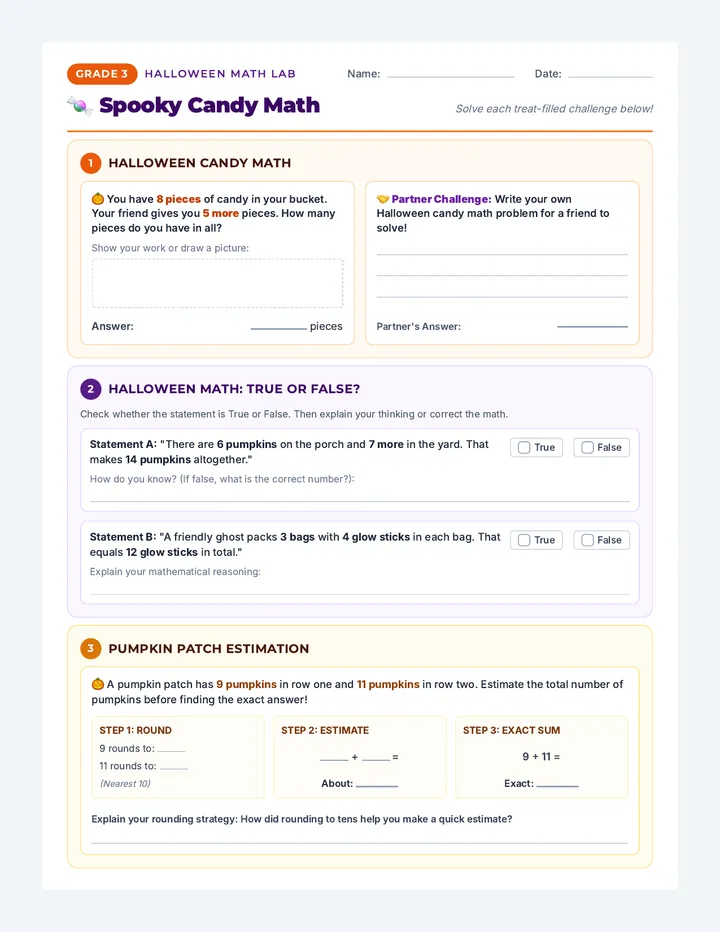
Grade 3 Spooky Math Worksheet

Halloween Math Trio

A grade-differentiated collection of three Halloween math worksheets for 3rd, 4th, and 5th grade learners. Each worksheet explores candy word problems, true-or-false mathematical reasoning, and estimation strategies tailored to grade-level standards.

CW

Carrie Worland

4
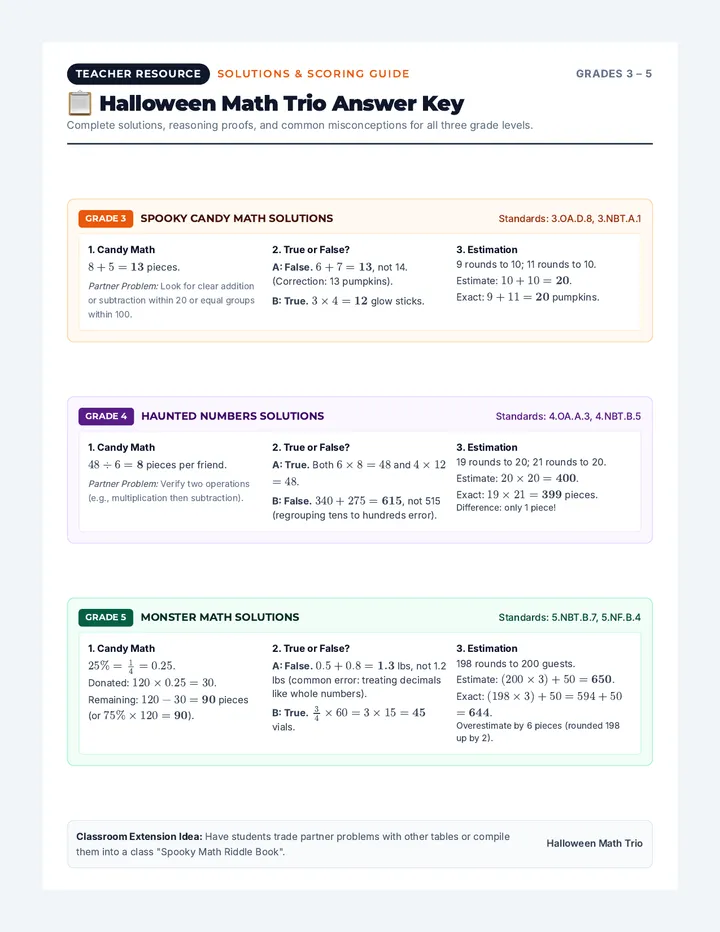
Halloween Math Answer Key

Halloween Math Answer Key

A comprehensive teacher answer key providing solutions, mathematical justifications, and instructional tips for the 3rd, 4th, and 5th-grade Halloween math worksheets.

CW

Carrie Worland

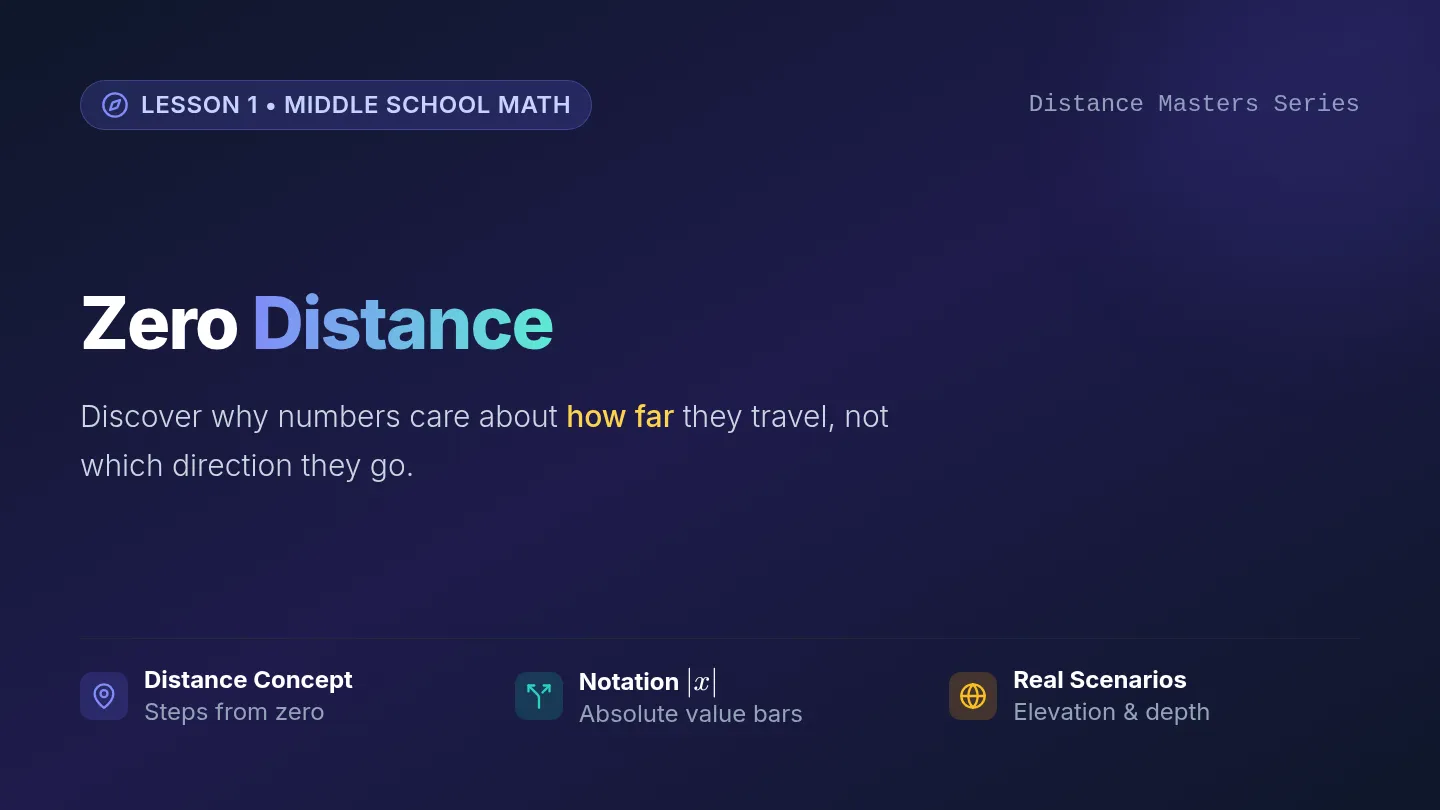
Zero Distance Slides

Distance Masters

A comprehensive middle school mathematics unit introducing absolute value through geometric distance, order of operations with magnitude, and dual-branch linear equations.

Lenny Avatar
Lenny
9
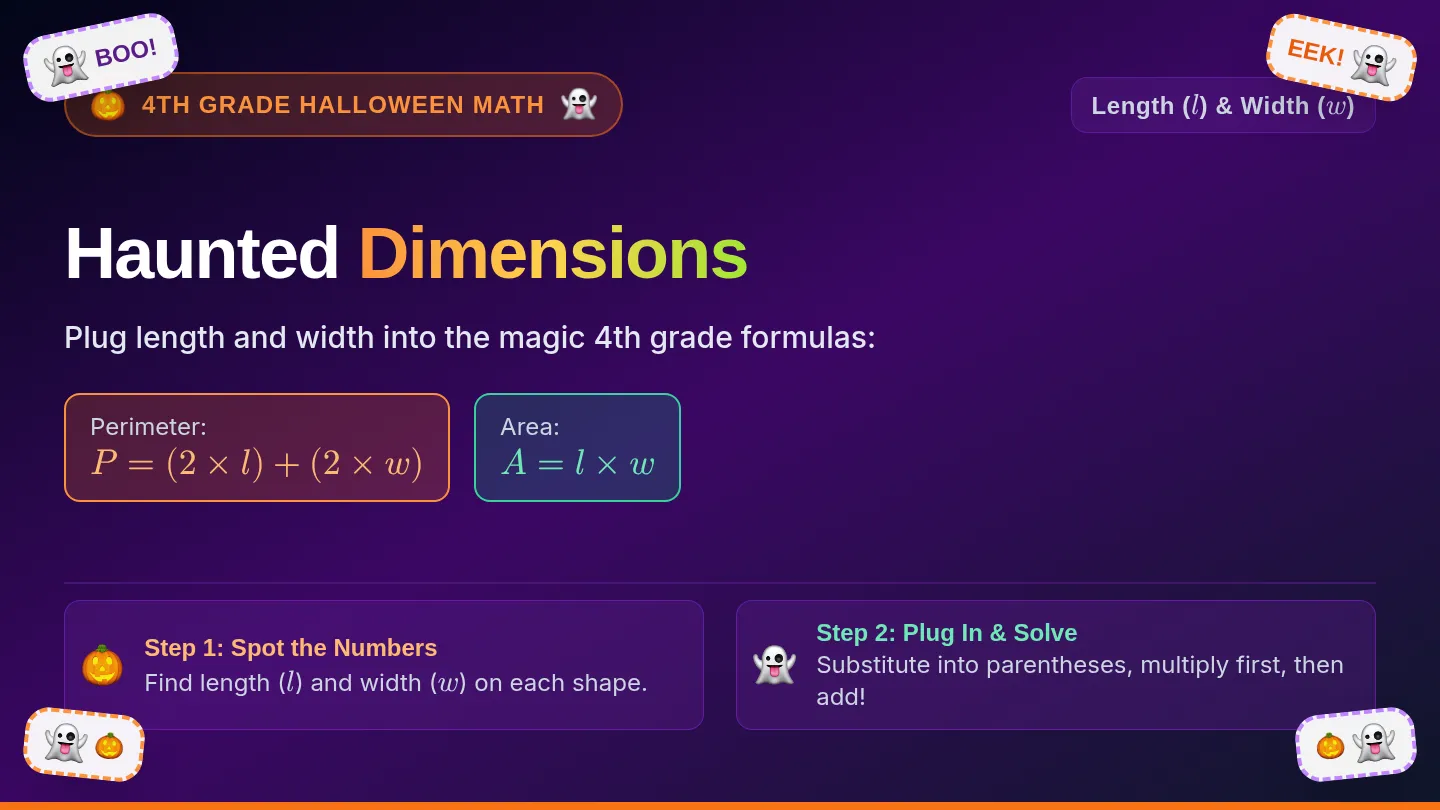
Haunted Dimensions Slides

Haunted Dimensions

A spooky Halloween-themed math lesson where students learn to identify length and width and substitute them into standard formulas to calculate the perimeter and area of squares and rectangles. Includes an instructional slide deck and a guided student practice worksheet.

RK

Rachel Knight

3
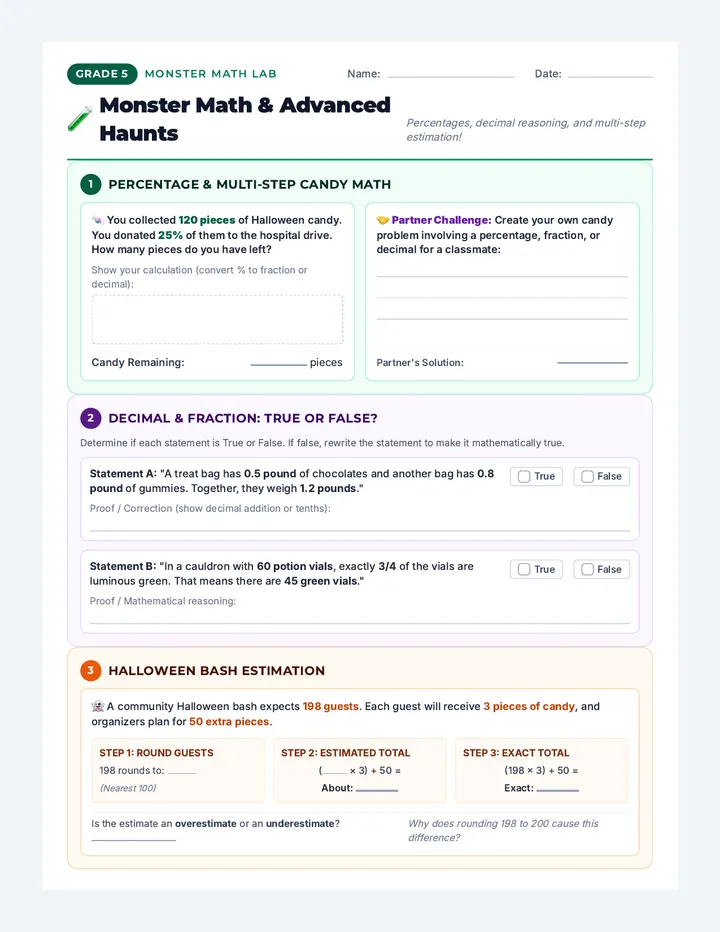
Grade 5 Monster Math Worksheet

Grade 5 Monster Math Worksheet

A 5th-grade Halloween math worksheet exploring percentage candy deductions, decimal addition true-or-false statements, and multi-step party supply estimation with rounding.

CW

Carrie Worland

Equal Groups Slides

Equal Group Explorers

A three-part intervention sequence designed for students struggling with early multiplication concepts. The sequence methodically transitions learners from concrete equal groups to repeated addition, number line skip-counting, and formal multiplication notation.

B

bower

9
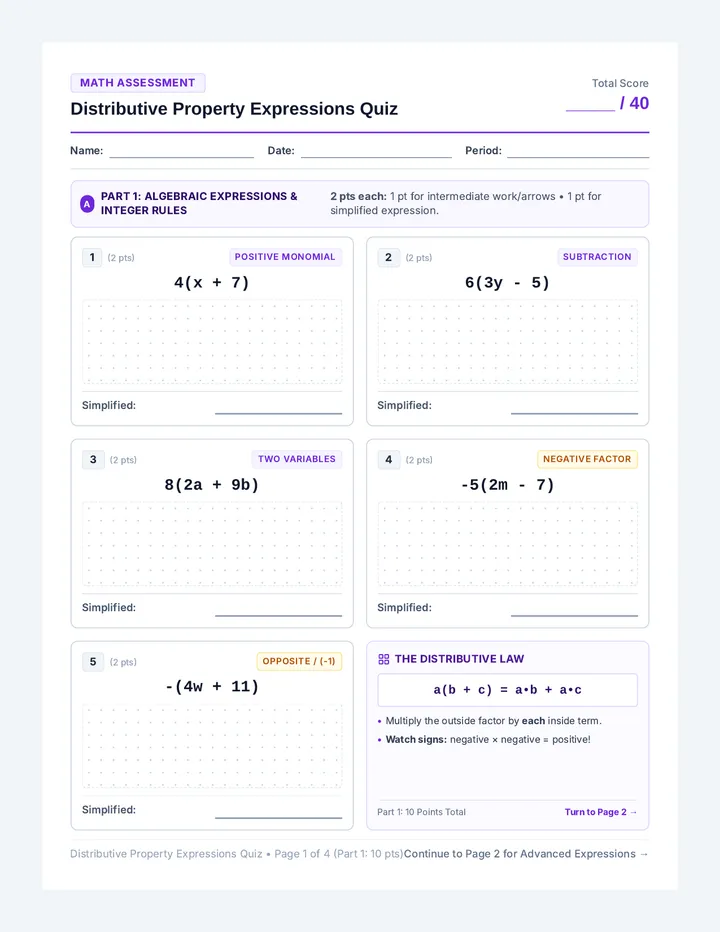
Distributive Property Expressions Quiz

Distributive Property Power

A 20-problem distributive property unit featuring 10 algebraic expression problems with variables and 10 numerical problems (each with a minimum of 4 terms and no variables), complete with a 40-point teacher answer key.

S

Steve.Peters

2
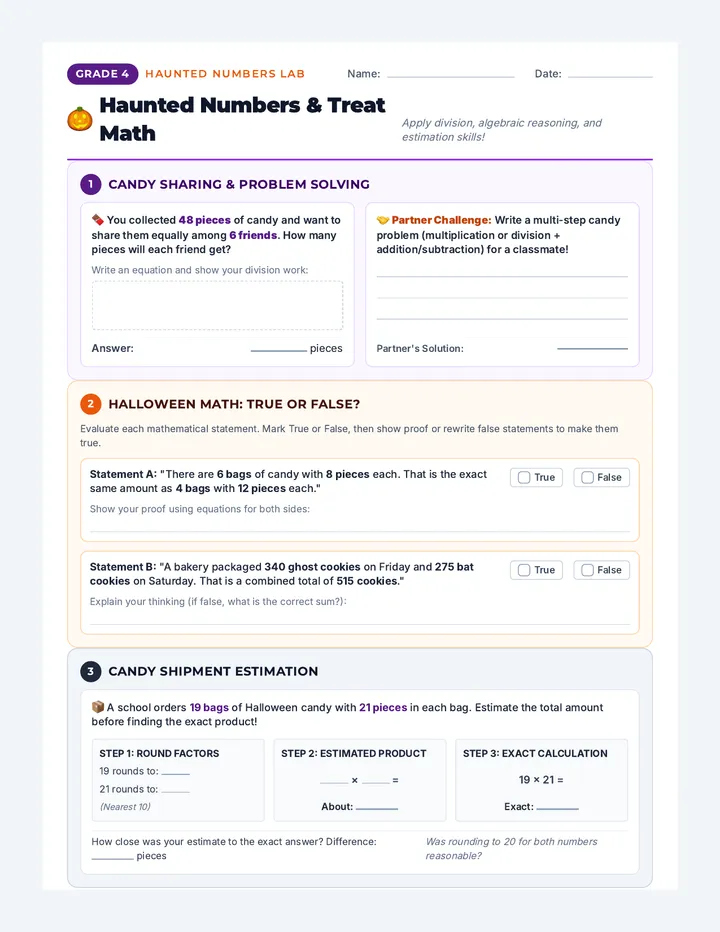
Grade 4 Haunted Numbers Worksheet

Grade 4 Haunted Numbers Worksheet

A 4th-grade Halloween math worksheet covering equal candy sharing division, multi-step word problems, equivalent product true-or-false statements, and two-digit multiplication estimation.

CW

Carrie Worland

Scytale Spartiate Slides

Espionnes Antiques

Une séquence immersive en deux séances pour initier les élèves de 6ème à la cryptographie antique à travers la géométrie de la scytale spartiate et les symétries du chiffrement miroir Atbash.

E

Enseignante

6
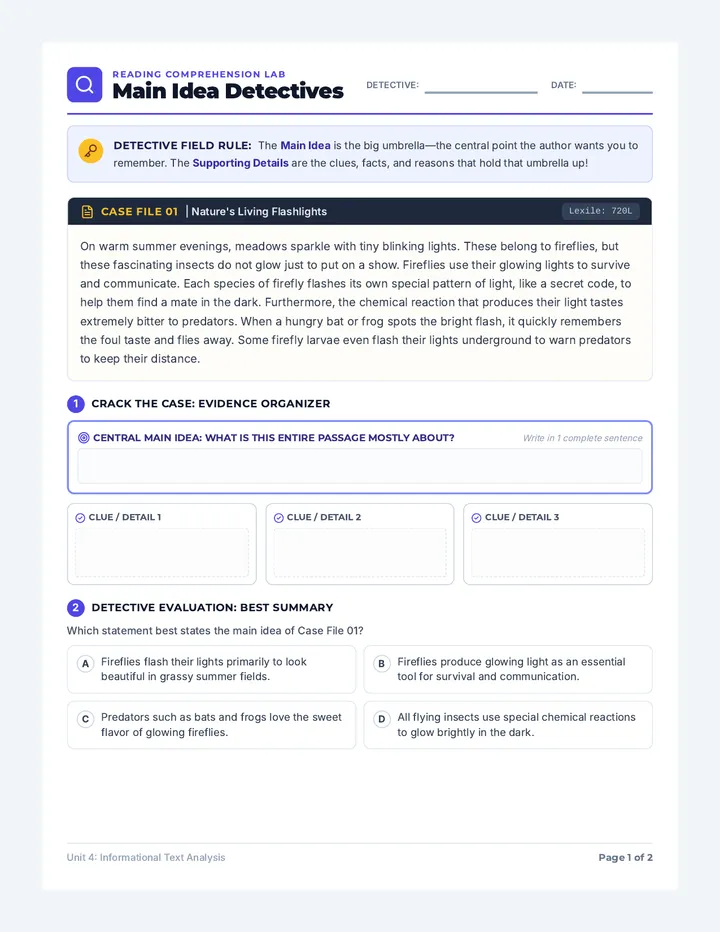
Main Idea Detectives Worksheet

Grade Four Power Skills

An integrated fourth-grade mastery curriculum covering core informational reading comprehension strategies and essential mathematics fluency.

C

cserrano

3