Scytale Spartiate Slides Académie des Espionnes Mathématiciennes
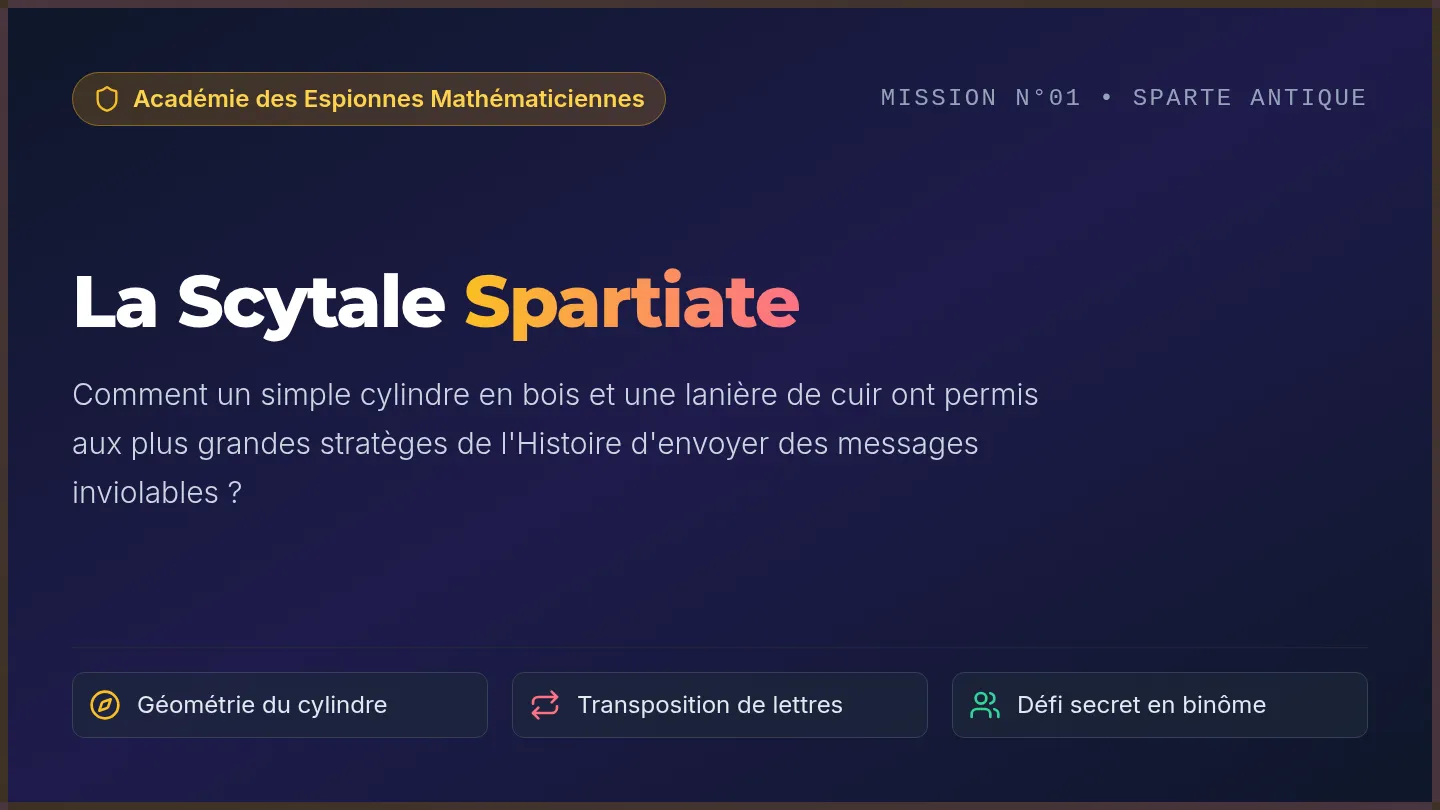
Mission N°01 • Sparte Antique
La Scytale Spartiate
Comment un simple cylindre en bois et une lanière de cuir ont permis aux plus grandes stratèges de l'Histoire d'envoyer des messages inviolables ?
Géométrie du cylindre
Transposition de lettres
Défi secret en binôme
Le Piège des Émissaires Énigme Historique
Ve siècle avant J.-C. Les généraux spartiates doivent transmettre un ordre décisif à leurs troupes.
« Si le messager est capturé en chemin, l'ennemi ne doit lire qu'un mélange incompréhensible de lettres éparpillées ! »
L'astuce de la ceinture :
Le messager porte la longue bande de cuir comme une simple ceinture. Personne ne soupçonne son contenu !
Le ruban déroulé ressemble à ceci :
A T T A Q U E Z
Mais une fois mélangé :
A Q T U T E A Z
Quel est l'outil secret pour tout remettre en ordre ?
Indice mathématique : ce n'est pas un code de remplacement, c'est une transformation géométrique !
La Géométrie Secrète Principe Mathématique
1
Le Bâton Témoin
L'expéditrice et la destinataire possèdent exactement le même bâton cylindrique (même diamètre et même périmètre).
Cylindre = clé secrète !
2
L'Enroulement
On enroule le ruban en spirale serrée le long du cylindre. Chaque tour de bâton contient un nombre fixe de lettres : c'est la circonférence .
Exemple : 4 lettres par tour.
3
La Transposition
On écrit le message dans le sens de la longueur du bâton. Une fois déroulé, les lettres sont séparées par des sauts réguliers !
Lecture : pas à pas de 4.
Si l'intercepteur enroule le ruban sur un bâton trop fin ou trop épais... les lettres ne s'alignent pas !
Modéliser : Du Cylindre au Tableau Méthode Mathématique
Message clair : VICTOIRE
Sur un cylindre de circonférence 4 lettres par tour , on remplit un tableau de 4 lignes :
Étape 1 On écrit en colonnes (sur le bâton).
Étape 2 On déroule le ruban : on lit en lignes !
Le ruban déroulé donnera : V O I I C R T E
Tableau 4 lignes × 2 colonnes
Tour Col. 1 Col. 2 Ruban lu Ligne 1 V O → V - O Ligne 2 I I → I - I Ligne 3 C R → C - R Ligne 4 T E → T - E
Mathématiques au travail : calcul mental, disposition rectangulaire et division euclidienne !
Mission Espionnes : Top Départ
Travail en Duo
1. Découper
Découpez votre bandelette témoin sur votre fiche de mission.
2. Enrouler
Enroulez-la sur votre feutre ou bâton de colle (clé de circonférence).
3. Décoder
Déchiffrez l'ordre spartiate secret et envoyez votre réponse !
Objectif d'équipe : Aucun message ne doit tomber aux mains des espions adverses. À vos bâtons ! ⚡
Enquête Scytale Fiche Mission Scytale : Le Bâton de Sparte
Académie des Espionnes Mathématiciennes • 6ème
Dossier : #SPARTE-01
Séance 1 • Géométrie & Codes
Nom & Prénom :
Agente Binôme :
Classe & Date :
Contexte secret : Tu viens d'intercepter une lanière portée par un émissaire spartiate. À plat, les lettres ne forment aucun mot reconnaissable. Ton outil secret : un bâton cylindrique (ou un gros feutre) autour duquel la bande s'enroule exactement en 3 lettres par tour (circonférence = 3).
1
Énigme Découverte • Le Ruban Intercepté (Circonférence = 3 lettres)
Voici le ruban déroulé trouvé sur le messager (12 lettres). Chaque case contient une lettre :
M
C
S
A
O
P
T
O
Y
H
L
!
Tour 1 (3 lettres) Tour 2 (3 lettres) Tour 3 (3 lettres) Tour 4 (3 lettres)
A. Reconstitue le cylindre (3 lignes) :
Remplis chaque colonne avec un tour du ruban :
Ligne Tour 1 Tour 2 Tour 3 Tour 4 1 2 3
B. Message clair révélé :
Lis les lettres horizontalement (ligne après ligne) :
Ligne 1 : ........................
Ligne 2 : ........................
Ligne 3 : ........................
Phrase secrète complète :
Zone de découpe : Bandelette test pour feutre ou bâton de colle Circonférence = 3 cases
M C S A O P T O Y H L !
Mission Scytale • Volet 2 : Encodage et Géométrie Dossier #SPARTE-01 (Page 2/2)
2
Le Grand Message d'Attaque (Circonférence = 4 lettres par tour)
Le quartier général spartiate veut transmettre le message secret suivant composé de 16 lettres : « SPARTANES FORTES ! »
Étape A : Écris le message en lignes (sens de la lecture) dans la grille : Grille 4 lignes × 4 colonnes = 16 lettres
Ligne sur le cylindre Lettre 1 Lettre 2 Lettre 3 Lettre 4
Scytale Guide Corrigé Guide Pédagogique & Corrigé • Scytale Spartiate
Séance 1 • Géométrie du cylindre & Transposition
Niveau 6ème (11 ans)
Durée : 55 min
Objectifs Mathématiques (6ème)
Cylindre de révolution : circonférence, lien entre diamètre et périmètre.Tableau à double entrée : modélisation de l'enroulement en lignes et colonnes.Calcul & Division : partage équitable (\(12=3\times 4\), \(16=4\times 4\)), nombre de tours.
Matériel & Climat de Classe
1 gros feutre ou bâton de colle par binôme, ciseaux, ruban adhésif.
Fiche élève recto-verso par élève.
Valorisation : binômes d'« agentes secrètes » valorisant la collaboration, l'écoute et l'échange oral mathématique.
Déroulement pas-à-pas (55 minutes)
10 min
Accroche (Slides 1-2) : Histoire de la ceinture militaire en cuir à Sparte. Énigme du texte mélangé.
15 min
Manipulation concrète (Fiche P.1) : Découpe de la bandelette, enroulement sur feutre (3 lettres/tour), remplissage du tableau.
20 min
Défi Encodage 4×4 & Échange duo (Fiche P.2) : Grille de 16 lettres, déroulement du ruban, puis transmission d'un mot secret au binôme.
10 min
Bilan & Institutionnalisation : Notion de transposition (l'ordre des lettres change, pas leur identité). Annonce de la Séance 2 (Atbash).
Corrigé Officiel des Activités
Énigme 1 (Circonférence = 3 lettres) :
Tableau reconstitué par colonnes :
L1 : M - A - T - H
L2 : C - O - O - L
L3 : S - P - Y - !
Message clair : « MATH COOL SPY ! »
Énigme 2 (Encodage 4×4) :
Message clair : « SPARTANES FORTES ! »
Lecture en colonnes (les tours de ruban) :
T1: S-T-S-T | T2: P-A-F-E
T3: A-N-O-S | T4: R-E-R-!
Ruban : « STST PAFE ANOS RER! »
Analyse Géométrique :
Q1. Diamètre doublé : Le périmètre étant proportionnel au diamètre (\(P = \pi \times d\)), il double aussi : le bâton accueillera donc deux fois plus de lettres par tour (ex. 6 lettres au lieu de 3).
Q2. Message de 20 lettres : Avec 5 lettres par tour, \(20 \div 5 = 4\). Il faudra 4 tours complets .
Conseil de gestion : Prévoir 2 ou 3 feutres de diamètres variés pour montrer expérimentalement l'importance du diamètre clé. Séance 1 • Scytale
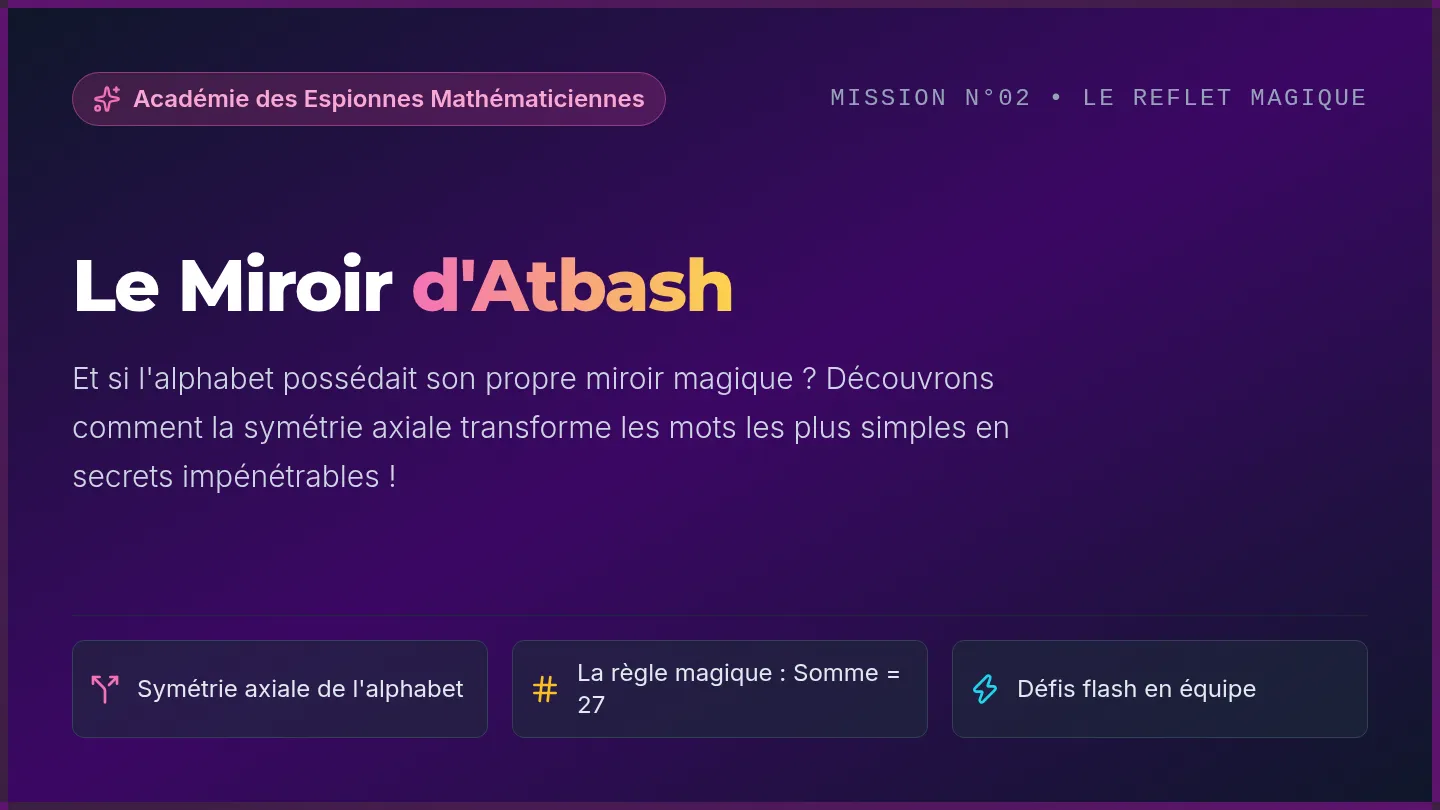
Miroir Atbash Slides Académie des Espionnes Mathématiciennes
Mission N°02 • Le Reflet Magique
Le Miroir d'Atbash
Et si l'alphabet possédait son propre miroir magique ? Découvrons comment la symétrie axiale transforme les mots les plus simples en secrets impénétrables !
Symétrie axiale de l'alphabet
La règle magique : Somme = 27
Défis flash en équipe
Un Secret vieux de 2500 ans Étymologie & Histoire
Le code Atbash a été inventé au Proche-Orient antique. Son nom vient des premières et dernières lettres de l'alphabet hébreu :
1ère lettre Aleph (A) ↔ Tav (T)
2ème lettre Beth (B) ↔ Shin (SH)
En assemblant ces sons : A - T - B - SH = ATBASH !
Le Principe du Miroir :
La 1ère lettre s'échange avec la dernière :
A ⟷ Z
La 2ème lettre s'échange avec l'avant-dernière :
B ⟷ Y
Chaque lettre a son âme-sœur à l'autre bout de l'alphabet !
La Symétrie au Cœur de l'Alphabet Géométrie & Numération
L'alphabet compte 26 lettres . On peut le couper exactement en deux moitiés égales de 13 lettres :
Moitié 1 (1 à 13) : A B C D E F G H I J K L M AXE [M | N] N O P Q R S T U V W X Y Z Moitié 2 (14 à 26)
1A ↕ Z26
2B ↕ Y25
3C ↕ X24
...
13M ↕ N14
La Propriété Magique du 27 :
Pour chaque paire de lettres miroir : Rang + Rang Inversé = 27 !
1 + 26 = 27
Une simple addition permet de vérifier n'importe quelle lettre !
Démonstration en Direct Exemple Clé
Transformons notre mot fétiche :
M • A • T • H
Lettre 1
M
Rang 13
N
Rang 14 (13+14=27)
Lettre 2
A
Rang 1
Z
Rang 26 (1+26=27)
Lettre 3
T
Rang 20
G
Rang 7 (20+7=27)
Lettre 4
H
Rang 8
S
Rang 19 (8+19=27)
Résultat Secret : « NZGS »
Question bonus : Que devient « NZGS » si on lui réapplique le miroir Atbash ? Réponse : il redevient « MATH » !
Mission Atbash Fiche Mission Atbash : Le Miroir Antique
Académie des Espionnes Mathématiciennes • 6ème
Dossier : #ATBASH-02
Séance 2 • Symétrie & Substitution
Nom & Prénom :
Agente Binôme :
Classe & Date :
1
Outil d'Espionne • La Réglette Miroir
Règle d'or : Rang A + Rang B = 27
L'alphabet de 26 lettres est plié en deux moitiés égales de 13 lettres. L'axe rouge sépare M (13) et N (14).
1 2 3 4 5 6 7 8 9 10 11 12 13 A B C D E F G H I J K L M ⟵ Axe de Symétrie Axiale ⟶ Z Y X W V U T S R Q P O N 26 25 24 23 22 21 20 19 18 17 16 15 14
2
Déchiffrement Immédiat • Les Messages Interceptés
Énigme 1 • Le Mot de Passe Antique : Code : NZGS
Remplace chaque lettre par son vis-à-vis dans la réglette miroir :
N donne :
Z donne :
G donne :
S donne :
Mot clair reconstitué :
Énigme 2 • Le Signal des Espionnes : Code : YLMTLFI
Déchiffre chaque lettre (Y - L - M - T - L - F - I) :
Énigme 3 • La Consigne Militaire : Code : ZTRHHVA VM HVXIVG
Astuce : les espaces entre les mots restent identiques !
Académie des Espionnes Mathématiciennes • Mission Atbash (Page 1/2)
Mission Atbash • Volet 2 : Encodage & Magie Mathématique Dossier #ATBASH-02 (Page 2/2)
3
À Toi de Coder • L'Atelier d'Écriture Secrète
Atbash Guide Corrigé Guide Pédagogique & Corrigé • Miroir d'Atbash
Séance 2 • Symétrie Axiale & Substitution Réciproque
Niveau 6ème (11 ans)
Durée : 55 min
Notions Mathématiques (6ème)
Symétrie axiale : Axe de symétrie entre les 13e et 14e lettres (M|N), notion de reflet et de conservation des distances.Arithmétique & Compléments : La somme invariante \(Rang_1 + Rang_2 = 27\) consolide le calcul mental et les compléments à une dizaine.Propriété d'involution : Comprendre que \(Reflet(Reflet(X)) = X\) (chiffrement et déchiffrement identiques).
Dynamique Pédagogique (Élèves 11 ans)
Approche valorisante : Rôle d'agentes cryptologues, valorisation de la rigueur et de l'entraide mutuelle.Matérialisation : Possibilité de plier la feuille le long de l'axe rouge pour superposer physiquement M sur N et A sur Z.Rituel d'échange : Défi de transmission de messages bienveillants entre camarades.
Déroulement pas-à-pas (55 minutes)
10 min
Accroche & Énigme flash (Slides 1-2) : Histoire d'Atbash, analogie du miroir magique. Comparaison avec la Scytale (changement de lettres vs changement d'ordre).
15 min
Axe de symétrie & Démonstration « MATH » (Slides 3-4 + Fiche P.1) : Observation de l'axe central M|N et vérification de la somme 27. Décodage de NZGS en direct au tableau.
20 min
Entraînement & Défi combiné (Fiche P.1 & P.2) : Décodage des ordres antiques, encodage d'ESPIONNE, découverte du double miroir et du grand défi combiné.
10 min
Bilan & Diplôme d'Espionne : Débat réflexif : pourquoi chiffrer et déchiffrer utilise exactement la même clé ? Clôture de la séquence en célébrant la persévérance mathématique.
Corrigé Officiel des Activités
Page 1 • Décodages Immédiats :
Énigme 1 (NZGS) : N→M, Z→A, G→T, S→H. Mot clair : MATH .
Énigme 2 (YLMTLFI) : Y→B, L→O, M→N, T→G, L→O, F→U, I→R. Mot clair : BONJOUR .
Énigme 3 (ZTRHHVA VM HVXIVG) : ZTRHHVA→AGISSEZ, VM→EN, HVXIVG→SECRET. Message : AGISSEZ EN SECRET .
Page 2 • Encodages & Paradoxe :
A. « ESPIONNE » : E→V, S→H, P→K, I→R, O→L, N→M, N→M, E→V. Code :