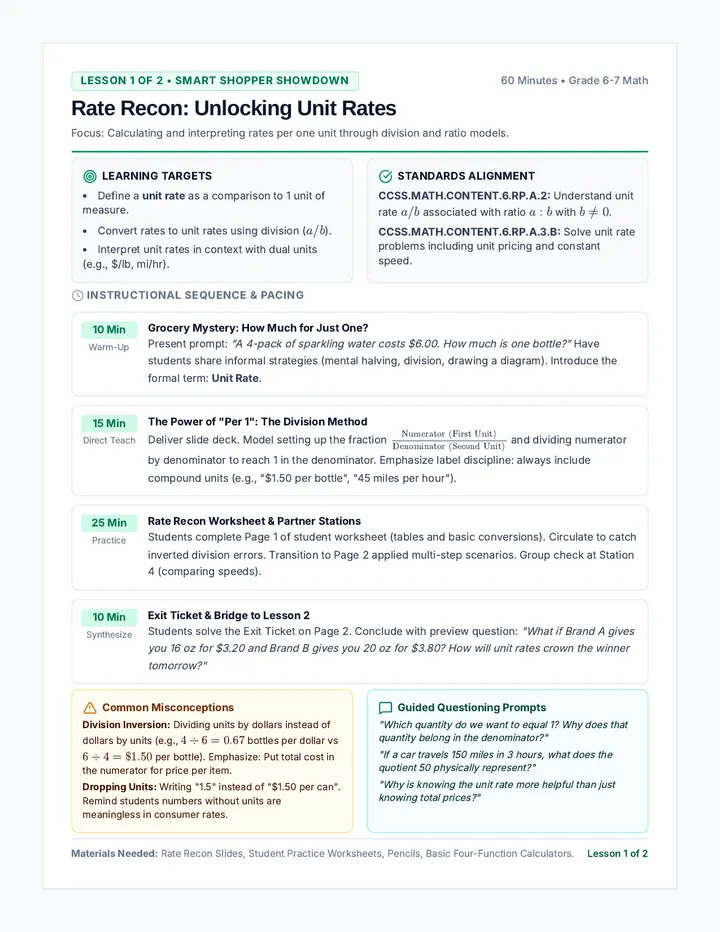
Rate Recon Lesson Plan Lesson 1 of 2 • Smart Shopper Showdown 60 Minutes • Grade 6-7 Math
Rate Recon: Unlocking Unit Rates
Focus: Calculating and interpreting rates per one unit through division and ratio models.
Learning Targets
Define a unit rate as a comparison to 1 unit of measure.
Convert rates to unit rates using division (\(a/b\)).
Interpret unit rates in context with dual units (e.g., $/lb, mi/hr).
Standards Alignment
CCSS.MATH.CONTENT.6.RP.A.2: Understand unit rate \(a/b\) associated with ratio \(a:b\) with \(b \neq 0\).
CCSS.MATH.CONTENT.6.RP.A.3.B: Solve unit rate problems including unit pricing and constant speed.
Instructional Sequence & Pacing
10 Min Warm-Up
Grocery Mystery: How Much for Just One?
Present prompt: "A 4-pack of sparkling water costs $6.00. How much is one bottle?" Have students share informal strategies (mental halving, division, drawing a diagram). Introduce the formal term: Unit Rate .
15 Min Direct Teach
The Power of "Per 1": The Division Method
Deliver slide deck. Model setting up the fraction \(\frac{\text{Numerator (First Unit)}}{\text{Denominator (Second Unit)}}\) and dividing numerator by denominator to reach 1 in the denominator. Emphasize label discipline: always include compound units (e.g., "$1.50 per bottle", "45 miles per hour").
25 Min Practice
Rate Recon Worksheet & Partner Stations
Students complete Page 1 of student worksheet (tables and basic conversions). Circulate to catch inverted division errors. Transition to Page 2 applied multi-step scenarios. Group check at Station 4 (comparing speeds).
10 Min Synthesize
Exit Ticket & Bridge to Lesson 2
Students solve the Exit Ticket on Page 2. Conclude with preview question: "What if Brand A gives you 16 oz for $3.20 and Brand B gives you 20 oz for $3.80? How will unit rates crown the winner tomorrow?"
Common Misconceptions
Division Inversion: Dividing units by dollars instead of dollars by units (e.g., \(4 \div 6 = 0.67\) bottles per dollar vs \(6 \div 4 = \$1.50\) per bottle). Emphasize: Put total cost in the numerator for price per item.Dropping Units: Writing "1.5" instead of "$1.50 per can". Remind students numbers without units are meaningless in consumer rates.
Guided Questioning Prompts
"Which quantity do we want to equal 1? Why does that quantity belong in the denominator?" "If a car travels 150 miles in 3 hours, what does the quotient 50 physically represent?" "Why is knowing the unit rate more helpful than just knowing total prices?"
Materials Needed: Rate Recon Slides, Student Practice Worksheets, Pencils, Basic Four-Function Calculators. Lesson 1 of 2
Rate Recon Slides Smart Shopper Showdown • Day 1
Math 6/7 • Ratios & Proportions
Mastering Rates & Proportions
Rate Recon:
Unlocking the Unit Rate
Discover the power of "how much for one" to compare speeds, measure efficiency, and master smart pricing.
What is a Unit Rate? The Division Strategy Real-World Meaning
Core Concepts
Rate vs. Unit Rate
What makes a unit rate uniquely powerful in everyday math?
Regular Rate
A comparison of two quantities with different units .
180 miles in 3 hours
$12.00 for 4 notebooks
Useful, but hard to compare quickly.
Unit Rate Per 1 Unit
A rate simplified so the denominator is exactly 1 .
60 miles per 1 hour (mph)
$3.00 per 1 notebook
Instant clarity for fair comparisons!
Key Word: "PER" means "for every single 1".
The Strategy
How to Find the Unit Rate
Two reliable steps to calculate "how much for one".
1
Set Up as a Fraction
Put the measured quantity on top , and the unit you want one of on the bottom .
\[ \text{Unit Rate} = \frac{\text{Total Quantity}}{\text{Number of Units}} \]
Example: Total Dollars ÷ Total Cans
2
Divide to Reach 1
Divide numerator by denominator. Always attach your compound label!
\[ \frac{\$18.00}{6\text{ shirts}} = \frac{\$3.00}{1\text{ shirt}} \]
Result: $3.00 per shirt
Caution: When looking for the price per item, always divide Dollars ÷ Items , never items ÷ dollars!
Step-by-Step Walkthrough
Scenario: The Juice Jolt
A 12-pack of organic juice boxes costs $9.00 total.
Step 1: Write Rate
\[ \frac{\$9.00}{12\text{ boxes}} \]
Total cost over total items
Step 2: Divide
\[ 9.00 \div 12 = 0.75 \]
Numerator ÷ denominator
Step 3: Interpret
\[ \frac{\$0.75}{1\text{ box}} \]
Each juice box costs $0.75
1 box = $0.75 • 4 boxes = $3.00 • 12 boxes = $9.00
The unit rate works like a master key to calculate the cost for
Rate Recon Student Worksheet Math Practice • Lesson 1 of 2
Rate Recon: Unlocking Unit Rates
Name:
Date: Period:
Unit Rate Anchor: A comparison showing how much of quantity \(A\) corresponds to 1 unit of quantity \(B\).
\(\text{Unit Rate} = \frac{\text{Numerator}}{\text{Denominator}} = \frac{\text{Total Quantity}}{\text{Number of Units}}\)
A Concept Check: Rate or Unit Rate?
Determine whether each statement is a standard Rate or a Unit Rate . Explain your reasoning briefly.
1. "240 miles traveled in 4 hours"
Type:
2. "$1.45 per single pound of apples"
Type:
B Rate Table Calculations
Complete each row by writing the division expression and the simplified unit rate with correct units.
Given Rate Division Setup Unit Rate (with Units) 3. 180 words typed in 4 minutes \(180 \div 4\) 4. $15.00 for 5 movie tickets 5. 320 miles on 10 gallons of gas 6. $7.20 for 12 organic eggs
C Guided Application Problems
Show your division setup in the box. Write your final answer with complete units on the line.
7. Bakery Delight
A baker uses 18 cups of flour to make 6 loaves of artisan bread. How much flour is in one loaf?
Show Work:
Unit Rate:
8. Running Practice
Marcus ran 4.5 miles in 36 minutes at a constant pace. What was his pace in minutes per mile?
Show Work:
Unit Rate:
Smart Shopper Showdown • Unit Rate Foundations Page 1 of 2 • Continue on Page 2 ➔
Rate Recon • Page 2: Applied Analysis
Student Name:
D Real-World Scenarios
Calculate each unit rate. Pay special attention to which quantity belongs in the denominator.
9. Summer Job Earnings: Talia earned $162.00 for working 12 hours at a bookstore. Leo earned $195.00 for working 15 hours at a café.
Talia's Hourly Wage (Show Work):
Rate:
Leo's Hourly Wage (Show Work):
Rate:
Comparison: Who has the higher hourly rate, and by how much?
10. School Fundraiser T-Shirts: The spirit club paid $340.00 for an order of 40 screen-printed T-shirts.
Rate Recon Answer Key Teacher Resource • Answer Key
Rate Recon: Answer Key & Solutions
Lesson 1 Solutions (Page 1)
Grade 6-7 Math • 6.RP.A.2
Grading Note: Full credit requires both the correct numerical quotient AND the correct compound unit label (e.g., "$3.00 per ticket", not just "3").
A Section A: Concept Check Solutions
1. "240 miles traveled in 4 hours"
Type: Regular Rate
Reason: The second quantity has 4 hours, not 1 single unit.
2. "$1.45 per single pound of apples"
Type: Unit Rate
Reason: The price is stated explicitly for 1 single pound.
B Section B: Rate Table Calculations Solutions
Given Rate Division Setup Unit Rate Solution 3. 180 words in 4 mins \(180 \div 4\) 45 words per minute (wpm) 4. $15.00 for 5 movie tickets \(15.00 \div 5\) $3.00 per ticket 5. 320 miles on 10 gallons \(320 \div 10\) 32 miles per gallon (mpg) 6. $7.20 for 12 organic eggs \(7.20 \div 12\) $0.60 per egg (60¢/egg)
C Section C: Guided Application Solutions
7. Bakery Delight
Full Solution:
\(\text{Rate} = \frac{18\text{ cups}}{6\text{ loaves}}\)
\(18 \div 6 = 3\)
Answer: 3 cups of flour per loaf
8. Running Practice (Marcus)
Full Solution:
\(\text{Rate} = \frac{36\text{ minutes}}{4.5\text{ miles}}\)
\(36 \div 4.5 = 8\)
Answer: 8 minutes per mile
Teacher Answer Key • Lesson 1 Rate Recon Page 1 of 2
Rate Recon Answer Key • Page 2 Solutions Teacher Resource
D Section D: Real-World Scenarios Solutions
9. Summer Job Earnings
Talia's Hourly Wage:
\(\frac{\$162.00}{12\text{ hours}} = 162 \div 12 = \$13.50\)
Answer: $13.50 per hour
Leo's Hourly Wage:
\(\frac{\$195.00}{15\text{ hours}} = 195 \div 15 = \$13.00\)
Answer: $13.00 per hour
Comparison: Talia earns more per hour than Leo by $0.50 per hour ($13.50 - $13.00 = $0.50/hr).
10. School Fundraiser T-Shirts
Unit Price per Shirt:
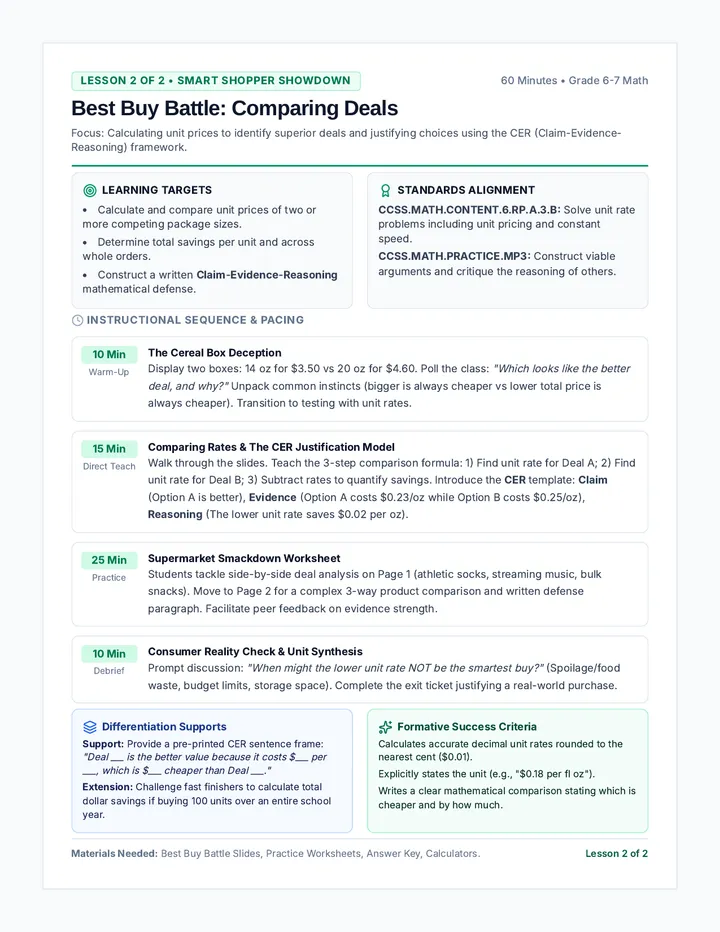
Best Buy Battle Lesson Plan Lesson 2 of 2 • Smart Shopper Showdown 60 Minutes • Grade 6-7 Math
Best Buy Battle: Comparing Deals
Focus: Calculating unit prices to identify superior deals and justifying choices using the CER (Claim-Evidence-Reasoning) framework.
Learning Targets
Calculate and compare unit prices of two or more competing package sizes.
Determine total savings per unit and across whole orders.
Construct a written Claim-Evidence-Reasoning mathematical defense.
Standards Alignment
CCSS.MATH.CONTENT.6.RP.A.3.B: Solve unit rate problems including unit pricing and constant speed.
CCSS.MATH.PRACTICE.MP3: Construct viable arguments and critique the reasoning of others.
Instructional Sequence & Pacing
10 Min Warm-Up
The Cereal Box Deception
Display two boxes: 14 oz for $3.50 vs 20 oz for $4.60. Poll the class: "Which looks like the better deal, and why?" Unpack common instincts (bigger is always cheaper vs lower total price is always cheaper). Transition to testing with unit rates.
15 Min Direct Teach
Comparing Rates & The CER Justification Model
Walk through the slides. Teach the 3-step comparison formula: 1) Find unit rate for Deal A; 2) Find unit rate for Deal B; 3) Subtract rates to quantify savings. Introduce the CER template: Claim (Option A is better), Evidence (Option A costs $0.23/oz while Option B costs $0.25/oz), Reasoning (The lower unit rate saves $0.02 per oz).
25 Min Practice
Supermarket Smackdown Worksheet
Students tackle side-by-side deal analysis on Page 1 (athletic socks, streaming music, bulk snacks). Move to Page 2 for a complex 3-way product comparison and written defense paragraph. Facilitate peer feedback on evidence strength.
10 Min Debrief
Consumer Reality Check & Unit Synthesis
Prompt discussion: "When might the lower unit rate NOT be the smartest buy?" (Spoilage/food waste, budget limits, storage space). Complete the exit ticket justifying a real-world purchase.
Differentiation Supports
Support: Provide a pre-printed CER sentence frame: "Deal ___ is the better value because it costs $___ per ___, which is $___ cheaper than Deal ___." Extension: Challenge fast finishers to calculate total dollar savings if buying 100 units over an entire school year.
Best Buy Battle Slides Smart Shopper Showdown • Day 2
Math 6/7 • Comparative Reasoning
Consumer Mathematics
Best Buy Battle:
Comparing Real Deals
Don't let sneaky packaging fool you! Use unit prices to uncover true bargains and defend your choices with rock-solid math.
Compare Unit Prices Quantify Real Savings Claim-Evidence-Reasoning
The Problem
The Snack Pack Showdown
Which box offers the better deal? Can you tell just by looking?
Option A: The Mini-Box 12 Bags
$6.00 Total
"It costs less money upfront! Only $6 out of my pocket!"
Unit Price:
\[ \frac{\$6.00}{12\text{ bags}} = \$0.50\text{ / bag} \]
Option B: The Mega-Box 18 Bags
$8.10 Total
"More bags inside, but it has a higher total price tag!"
Unit Price:
\[ \frac{\$8.10}{18\text{ bags}} = \$0.45\text{ / bag} \]
Winner: Mega-Box! You save $0.05 per bag (50¢ vs 45¢).
Methodology
The 3-Step Best Buy Strategy
Always follow these three steps for any deal comparison.
1
Find Unit Price for Deal A
Divide total cost by quantity. Include the compound unit.
Price ÷ Quantity
2
Find Unit Price for Deal B
Calculate the exact same unit of measure (ounces, items, etc.).
Match the Units!
3
Subtract & Compare
Lower unit price wins. Subtract to prove exact savings.
Rate 1 - Rate 2 = Savings
Rule of Thumb: Lower unit price means you get more product for every dollar spent.
Smart Shopper Insights
Is Cheaper Per Unit ALWAYS Better?
Real life adds extra factors to consider beyond raw math.
Spoilage Risk
A gallon of milk at $0.03/oz isn't a good deal if half of it spoils before you can drink it!
Consider expiration dates!
Upfront Budget
Buying 48 rolls of paper towels for $40 is a great unit rate, but what if you only have $10 today?
Respect your total wallet!
Storage Space
Bulk buying saves pennies, but do you have the shelf space in your pantry or home?
Space is a hidden cost!
Unit rates provide the mathematical truth ; smart shoppers apply the context !
Best Buy Battle Student Worksheet Math Practice • Lesson 2 of 2
Best Buy Battle: Comparing Deals
Name:
Date: Period:
Best Buy Protocol: 1) Find Unit Price A • 2) Find Unit Price B • 3) Compare: Lower unit rate = better financial value. Formula: Total $ ÷ Quantity
A Head-to-Head Deal Battles
Calculate the unit price for both options. Identify the better deal and state the savings per unit.
1. Athletic Running Socks
Option A: 3-Pair Pack for $7.50 Show calculation:
Unit Price:
Option B: 8-Pair Pack for $18.00 Show calculation:
Unit Price:
Better Deal:
Savings per Pair:
2. Honey Granola Crunch
Option A: 16-oz Bag for $5.12 Show calculation:
Unit Price:
Option B: 24-oz Bag for $7.20 Show calculation:
Unit Price:
Better Deal:
Savings per Ounce:
3. Music Streaming Plans
Plan 1: 3-month pass for $28.50
Monthly Rate:
Plan 2: 12-month pass for $102.00
Monthly Rate:
Which plan saves more money each month?
Smart Shopper Showdown • Deal Comparisons Page 1 of 2 • Continue on Page 2 ➔
Best Buy Battle • Page 2: Three-Way Analysis & CER Justification
Student Name:
B Three-Way Supermarket Smackdown: Olive Oil
Compare three brands of extra virgin olive oil. Compute each unit price rounded to the nearest cent ($0.01).
Brand A: Tuscan Gold 16 fl oz for $6.40
Calculation:
Unit Price:
Brand B: Mediterranean 24 fl oz for $8.40
Calculation:
Unit Price:
Brand C: Value Harvest 32 fl oz for $11.84
Calculation:
Unit Price:
Rank from best to worst value: 1st: _________ ➔ 2nd: _________ ➔ 3rd: _________
C Written Justification: The Claim-Evidence-Reasoning (CER) Defense
The school cafeteria manager must choose between two yogurt snack distributors for the sports banquet:Distributor X: 30 individual yogurt cups for $22.50Distributor Y: 48 individual yogurt cups for $31.20
Claim (State clearly which distributor offers the better buy):
Evidence (Cite both calculated unit rates with explicit units):
Reasoning (Explain mathematically how much the school saves per cup and why this justifies the purchase):
Best Buy Battle Answer Key Teacher Resource • Answer Key
Best Buy Battle: Answer Key & Solutions
Lesson 2 Solutions (Page 1)
Grade 6-7 Math • 6.RP.A.3.B & MP3
Pedagogical Standard: Emphasize that comparing unit rates requires calculating to identical units ($/pair, $/oz, $/month) and calculating the exact dollar or cent difference.
A Section A: Head-to-Head Deal Solutions
1. Athletic Running Socks Solutions
Option A (3 pairs for $7.50):
\(\frac{\$7.50}{3\text{ pairs}} = 7.50 \div 3 = \$2.50\)
Unit Price: $2.50 per pair
Option B (8 pairs for $18.00):
\(\frac{\$18.00}{8\text{ pairs}} = 18.00 \div 8 = \$2.25\)
Unit Price: $2.25 per pair
Winner: Option B (8-Pair Pack) Savings: $2.50 - $2.25 = $0.25 (25¢) per pair
2. Honey Granola Crunch Solutions
Option A (16 oz for $5.12):
\(\frac{\$5.12}{16\text{ oz}} = 5.12 \div 16 = \$0.32\)
Unit Price: $0.32 per ounce
Option B (24 oz for $7.20):
\(\frac{\$7.20}{24\text{ oz}} = 7.20 \div 24 = \$0.30\)
Unit Price: $0.30 per ounce
Winner: Option B (24-oz Bag) Savings: $0.32 - $0.30 = $0.02 (2¢) per ounce
3. Music Streaming Plans Solutions
Plan 1 (3 months for $28.50):
\(28.50 \div 3 = \$9.50\text{ / month}\)
Plan 2 (12 months for $102.00):
\(102.00 \div 12 = \$8.50\text{ / month}\)
Decision: Plan 2 saves $1.00 per month ($9.50 - $8.50 = $1.00/month or $12.00 annually).
Teacher Answer Key • Lesson 2 Best Buy Battle Page 1 of 2
Best Buy Battle Answer Key • Page 2 Solutions Teacher Resource
B Section B: Three-Way Smackdown Solutions
Brand A: Tuscan Gold
\(6.40 \div 16 = \$0.40\)
Unit: $0.40 / fl oz
Brand B: Mediterranean
\(8.40 \div 24 = \$0.35\)
Unit: $0.35 / fl oz
Brand C: Value Harvest
\(11.84 \div 32 = \$0.37\)
Unit: $0.37 / fl oz
Ranking from Best to Worst Value:
1st Place (Best Buy): Brand B ($0.35/oz) ➔ 2nd Place: Brand C ($0.37/oz) ➔ 3rd Place: Brand A ($0.40/oz)
Notice: The biggest bottle (Brand C) was NOT the best deal! Brand B beat it by $0.02 per fluid ounce.