Double Digit Division Guide
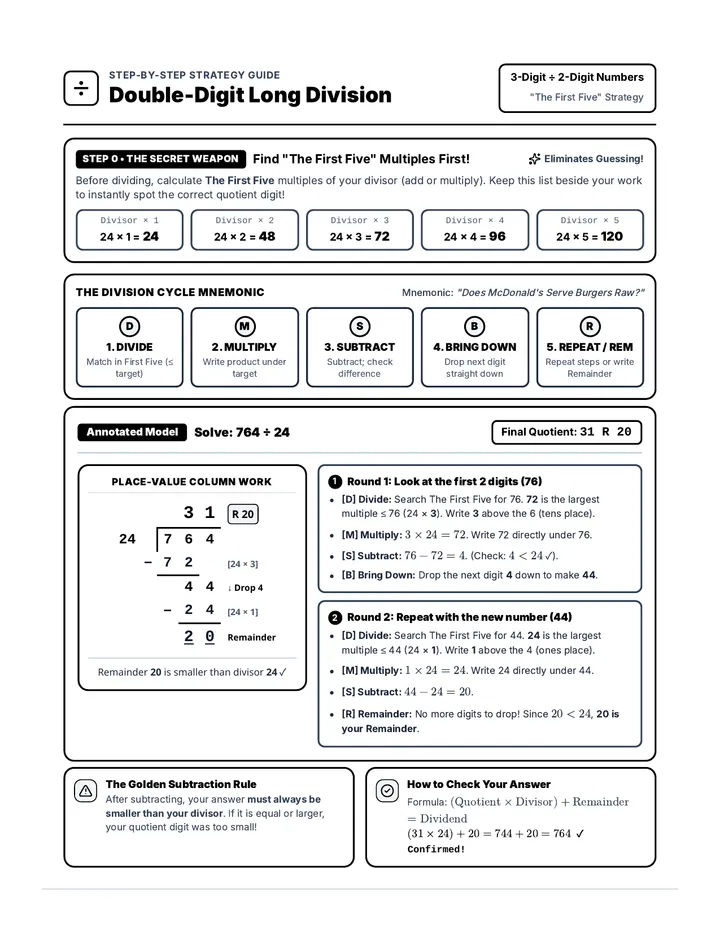
Step-by-Step Strategy Guide
Double-Digit Long Division
3-Digit ÷ 2-Digit Numbers "The First Five" Strategy
Step 0 • The Secret Weapon
Find "The First Five" Multiples First!
Eliminates Guessing!
Before dividing, calculate The First Five multiples of your divisor (add or multiply). Keep this list beside your work to instantly spot the correct quotient digit!
Divisor × 1 24 × 1 = 24
Divisor × 2 24 × 2 = 48
Divisor × 3 24 × 3 = 72
Divisor × 4 24 × 4 = 96
Divisor × 5 24 × 5 = 120
The Division Cycle Mnemonic Mnemonic: "Does McDonald's Serve Burgers Raw?"
D
1. DIVIDE Match in First Five (≤ target)
M
2. MULTIPLY Write product under target
S
3. SUBTRACT Subtract; check difference
B
4. BRING DOWN Drop next digit straight down
R
5. REPEAT / REM Repeat steps or write Remainder
Annotated Model
Solve: 764 ÷ 24
Final Quotient: 31 R 20
Place-Value Column Work
<table class="font-mono text-base border-collapse mx-auto leading-tight"><tbody><tr><td class="w-9 text-right pr-1"></td><td class="w-5 text-center"></td><td class="w-6 text-center text-slate-300"></td><td class="w-6 text-center font-black text-xl text-black">3</td><td class="w-6 text-center font-black text-xl text-black">1</td><td class="pl-2 font-sans text-xs font-black text-black whitespace-nowrap"><span class="bg-slate-100 px-1 py-0.5 border border-black rounded">R 20</span></td></tr><tr><td class="w-9 text-right pr-1 font-black text-black text-base">24</td><td class="w-5 text-center"></td><td class="w-6 text-center font-black text-black text-base border-t-2 border-l-2 border-black">7</td><td class="w-6 text-center font-black text-black text-base border-t-2 border-black">6</td><td class="w-6 text-center font-black text-black text-base border-t-2 border-black">4</td><td class="pl-2"></td></tr><tr><td class="w-9 text-right pr-1"></td><td class="w-5 text-center font-black text-base">−</td><td class="w-6 text-center font-black text-base border-b-2 border-black">7</td><td class="w-6 text-center font-black text-base border-b-2 border-black">2</td><td class="w-6 text-center"></td><td class="pl-2 font-sans text-[10px] text-slate-600 font-semibold whitespace-nowrap">[24 × 3]</td></tr><tr><td class="w-9 text-right pr-1"></td><td class="w-5 text-center"></td><td class="w-6 text-center"></td><td class="w-6 text-center font-black text-base text-black">4</td><td class="w-6 text-center font-black text-base text-black">4</td><td class="pl-2 font-sans text-[10px] text-black font-bold whitespace-nowrap">↓ Drop 4</td></tr><tr><td class="w-9 text-right pr-1"></td><td class="w-5 text-center"></td><td class="w-6 text-center font-black text-base">−</td><td class="w-6 text-center font-black text-base border-b-2 border-black">2</td><td class="w-6 text-center font-black text-base border-b-2 border-black">4</td><td class="pl-2 font-sans text-[10px] text-slate-600 font-semibold whitespace-nowrap">[24 × 1]</td></tr><tr><td class="w-9 text-right pr-1"></td><td class="w-5 text-center"></td><td class="w-6 text-center"></td><td class="w-6 text-center font-black text-lg underline underline-offset-2">2</td><td class="w-6 text-center font-black text-lg underline underline-offset-2">0</td><td class="pl-2 font-sans text-[10px] text-black font-bold whitespace-nowrap">Remainder</td></tr></tbody></table>
Remainder 20 is smaller than divisor 24 ✓
1
Round 1: Look at the first 2 digits (76)
- [D] Divide: Search The First Five for 76. 72 is the largest multiple ≤ 76 (24 × 3). Write 3 above the 6 (tens place).
- [M] Multiply: \(3 \times 24 = 72\). Write 72 directly under 76.
- [S] Subtract: \(76 - 72 = 4\). (Check: \(4 < 24\) ✓).
- [B] Bring Down: Drop the next digit 4 down to make 44.
2
Round 2: Repeat with the new number (44)
- [D] Divide: Search The First Five for 44. 24 is the largest multiple ≤ 44 (24 × 1). Write 1 above the 4 (ones place).
- [M] Multiply: \(1 \times 24 = 24\). Write 24 directly under 44.
- [S] Subtract: \(44 - 24 = 20\).
- [R] Remainder: No more digits to drop! Since \(20 < 24\), 20 is your Remainder.
The Golden Subtraction Rule
After subtracting, your answer must always be smaller than your divisor. If it is equal or larger, your quotient digit was too small!
How to Check Your Answer
Formula: \(( \text{Quotient} \times \text{Divisor} ) + \text{Remainder} = \text{Dividend}\)
\( (31 \times 24) + 20 = 744 + 20 = 764 \) ✓ Confirmed!
Double-Digit Division Practice
Use The First Five to divide, show long division work, and verify with multiplication.
Name:
Date:
Steps: 0. The First Five (×1 to ×5) → 1. Divide → 2. Multiply → 3. Subtract → 4. Bring Down → 5. Repeat
1
Solve: 638 ÷ 15
Answer: ______ R ______
The First Five (15)
15 × 1 = 15
15 × 2 =
15 × 3 =
15 × 4 =
15 × 5 =
Multiples Scratchwork (+15):
Long Division Work
<table class="font-mono text-base border-collapse mx-auto my-auto leading-tight"><tbody><tr><td class="w-8 text-right pr-1"></td><td class="w-3 text-center"></td><td class="w-5 text-center text-slate-300"></td><td class="w-5 text-center text-slate-400 font-bold">__</td><td class="w-5 text-center text-slate-400 font-bold">__</td><td class="pl-1.5 font-sans text-xs text-slate-600 font-bold">R ___</td></tr><tr><td class="w-8 text-right pr-1 font-black text-black text-base">15</td><td class="w-3 text-center"></td><td class="w-5 text-center font-black text-black text-base border-t-2 border-l-2 border-black">6</td><td class="w-5 text-center font-black text-black text-base border-t-2 border-black">3</td><td class="w-5 text-center font-black text-black text-base border-t-2 border-black">8</td><td class="pl-1.5"></td></tr><tr class="h-5"><td></td><td class="text-center font-bold text-slate-400 text-xs">−</td><td class="border-b border-dotted border-slate-300"></td><td class="border-b border-dotted border-slate-300"></td><td></td><td></td></tr><tr class="h-5"><td></td><td></td><td></td><td class="border-b border-dotted border-slate-300"></td><td class="border-b border-dotted border-slate-300"></td><td></td></tr><tr class="h-5"><td></td><td class="text-center font-bold text-slate-400 text-xs">−</td><td></td><td class="border-b border-dotted border-slate-300"></td><td class="border-b border-dotted border-slate-300"></td><td></td></tr><tr class="h-5"><td></td><td></td><td></td><td class="border-b-2 border-black"></td><td class="border-b-2 border-black"></td><td class="pl-1.5 font-sans text-[9px] text-slate-600">Remainder</td></tr></tbody></table>
Check Work Workspace (Q × D) + R
Show vertical multiplication:
Set up: (Quotient) × 15 + Remainder
Target = 638
Matches 638? Yes!
2
Solve: 749 ÷ 23
Answer: ______ R ______
The First Five (23)
23 × 1 = 23
23 × 2 =
23 × 3 =
23 × 4 =
23 × 5 =
Multiples Scratchwork (+23):
Long Division Work
<table class="font-mono text-base border-collapse mx-auto my-auto leading-tight"><tbody><tr><td class="w-8 text-right pr-1"></td><td class="w-3 text-center"></td><td class="w-5 text-center text-slate-300"></td><td class="w-5 text-center text-slate-400 font-bold">__</td><td class="w-5 text-center text-slate-400 font-bold">__</td><td class="pl-1.5 font-sans text-xs text-slate-600 font-bold">R ___</td></tr><tr><td class="w-8 text-right pr-1 font-black text-black text-base">23</td><td class="w-3 text-center"></td><td class="w-5 text-center font-black text-black text-base border-t-2 border-l-2 border-black">7</td><td class="w-5 text-center font-black text-black text-base border-t-2 border-black">4</td><td class="w-5 text-center font-black text-black text-base border-t-2 border-black">9</td><td class="pl-1.5"></td></tr><tr class="h-5"><td></td><td class="text-center font-bold text-slate-400 text-xs">−</td><td class="border-b border-dotted border-slate-300"></td><td class="border-b border-dotted border-slate-300"></td><td></td><td></td></tr><tr class="h-5"><td></td><td></td><td></td><td class="border-b border-dotted border-slate-300"></td><td class="border-b border-dotted border-slate-300"></td><td></td></tr><tr class="h-5"><td></td><td class="text-center font-bold text-slate-400 text-xs">−</td><td></td><td class="border-b border-dotted border-slate-300"></td><td class="border-b border-dotted border-slate-300"></td><td></td></tr><tr class="h-5"><td></td><td></td><td></td><td class="border-b-2 border-black"></td><td class="border-b-2 border-black"></td><td class="pl-1.5 font-sans text-[9px] text-slate-600">Remainder</td></tr></tbody></table>
Check Work Workspace (Q × D) + R
Show vertical multiplication:
Set up: (Quotient) × 23 + Remainder
Target = 749
Matches 749? Yes!
Self-Correction Tip
Is your final remainder smaller than your divisor? If yes, complete your multiplication check in the box above!
Self-Rating: Got it! | Need practice
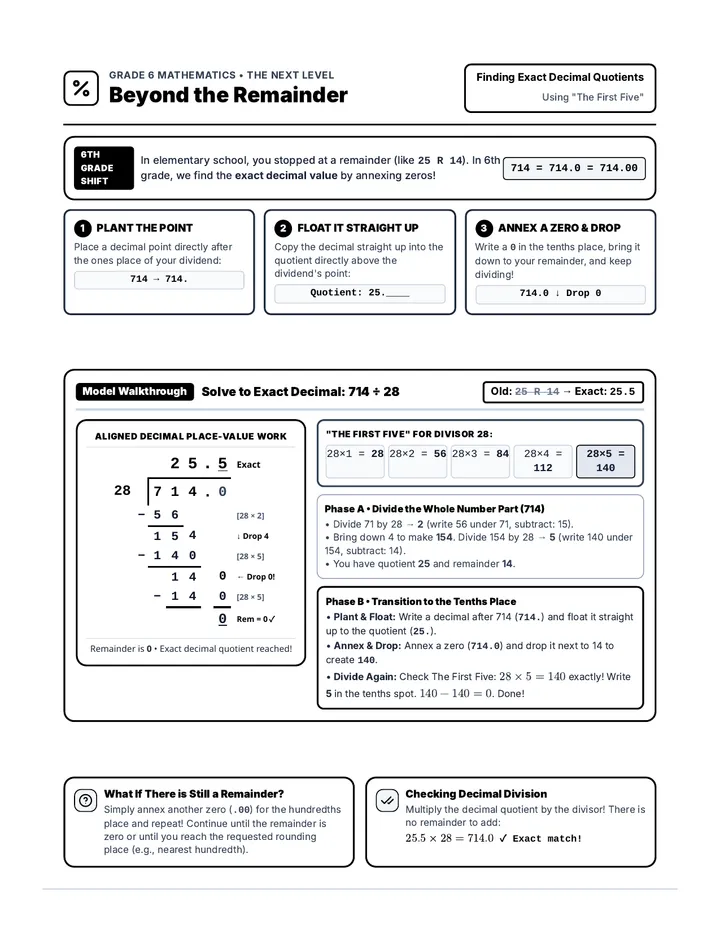
Decimal Division Guide
Grade 6 Mathematics • The Next Level
Beyond the Remainder
Finding Exact Decimal Quotients Using "The First Five"
6th Grade Shift
In elementary school, you stopped at a remainder (like 25 R 14). In 6th grade, we find the exact decimal value by annexing zeros!
714 = 714.0 = 714.00
1
Plant the Point
Place a decimal point directly after the ones place of your dividend: 714 → 714.
2
Float It Straight Up
Copy the decimal straight up into the quotient directly above the dividend's point: Quotient: 25.____
3
Annex a Zero & Drop
Write a 0 in the tenths place, bring it down to your remainder, and keep dividing! 714.0 ↓ Drop 0
Model Walkthrough
Solve to Exact Decimal: 714 ÷ 28
Old: 25 R 14 → Exact: 25.5
Aligned Decimal Place-Value Work
<table class="font-mono text-base border-collapse mx-auto leading-tight"><tbody><tr><td class="w-8 text-right pr-1"></td><td class="w-4 text-center"></td><td class="w-5 text-center"></td><td class="w-5 text-center font-black text-lg text-black">2</td><td class="w-5 text-center font-black text-lg text-black">5</td><td class="w-2.5 text-center font-black text-xl leading-none text-black">.</td><td class="w-5 text-center font-black text-lg text-black underline underline-offset-2">5</td><td class="pl-1.5 font-sans text-[10px] font-black text-black whitespace-nowrap">Exact</td></tr><tr><td class="w-8 text-right pr-1 font-black text-black text-base">28</td><td class="w-4 text-center"></td><td class="w-5 text-center font-black text-black text-base border-t-2 border-l-2 border-black">7</td><td class="w-5 text-center font-black text-black text-base border-t-2 border-black">1</td><td class="w-5 text-center font-black text-black text-base border-t-2 border-black">4</td><td class="w-2.5 text-center font-black text-black text-lg border-t-2 border-black">.</td><td class="w-5 text-center font-black text-slate-700 text-base border-t-2 border-black">0</td><td class="pl-1.5"></td></tr><tr><td class="w-8 text-right pr-1"></td><td class="w-4 text-center font-black text-sm">−</td><td class="w-5 text-center font-black text-sm border-b-2 border-black">5</td><td class="w-5 text-center font-black text-sm border-b-2 border-black">6</td><td class="w-5 text-center"></td><td class="w-2.5 text-center"></td><td class="w-5 text-center"></td><td class="pl-1.5 font-sans text-[9px] text-slate-600 font-semibold whitespace-nowrap">[28 × 2]</td></tr><tr><td class="w-8 text-right pr-1"></td><td class="w-4 text-center"></td><td class="w-5 text-center font-black text-sm">1</td><td class="w-5 text-center font-black text-sm">5</td><td class="w-5 text-center font-black text-sm">4</td><td class="w-2.5 text-center"></td><td class="w-5 text-center"></td><td class="pl-1.5 font-sans text-[9px] text-black font-bold whitespace-nowrap">↓ Drop 4</td></tr><tr><td class="w-8 text-right pr-1"></td><td class="w-4 text-center font-black text-sm">−</td><td class="w-5 text-center font-black text-sm border-b-2 border-black">1</td><td class="w-5 text-center font-black text-sm border-b-2 border-black">4</td><td class="w-5 text-center font-black text-sm border-b-2 border-black">0</td><td class="w-2.5 text-center"></td><td class="w-5 text-center"></td><td class="pl-1.5 font-sans text-[9px] text-slate-600 font-semibold whitespace-nowrap">[28 × 5]</td></tr><tr><td class="w-8 text-right pr-1"></td><td class="w-4 text-center"></td><td class="w-5 text-center"></td><td class="w-5 text-center font-black text-sm">1</td><td class="w-5 text-center font-black text-sm">4</td><td class="w-2.5 text-center"></td><td class="w-5 text-center font-black text-sm text-black">0</td><td class="pl-1.5 font-sans text-[9px] text-black font-black whitespace-nowrap">← Drop 0!</td></tr><tr><td class="w-8 text-right pr-1"></td><td class="w-4 text-center"></td><td class="w-5 text-center font-black text-sm">−</td><td class="w-5 text-center font-black text-sm border-b-2 border-black">1</td><td class="w-5 text-center font-black text-sm border-b-2 border-black">4</td><td class="w-2.5 text-center"></td><td class="w-5 text-center font-black text-sm border-b-2 border-black">0</td><td class="pl-1.5 font-sans text-[9px] text-slate-600 font-semibold whitespace-nowrap">[28 × 5]</td></tr><tr><td class="w-8 text-right pr-1"></td><td class="w-4 text-center"></td><td class="w-5 text-center"></td><td class="w-5 text-center"></td><td class="w-5 text-center"></td><td class="w-2.5 text-center"></td><td class="w-5 text-center font-black text-base underline underline-offset-2">0</td><td class="pl-1.5 font-sans text-[9px] text-black font-bold whitespace-nowrap">Rem = 0 ✓</td></tr></tbody></table>
Remainder is 0 • Exact decimal quotient reached!
"The First Five" for Divisor 28:
28×1 = 28 28×2 = 56 28×3 = 84 28×4 = 112 28×5 = 140
Phase A • Divide the Whole Number Part (714)
• Divide 71 by 28 → 2 (write 56 under 71, subtract: 15).
• Bring down 4 to make 154. Divide 154 by 28 → 5 (write 140 under 154, subtract: 14).
• You have quotient 25 and remainder 14.
Phase B • Transition to the Tenths Place
• Plant & Float: Write a decimal after 714 (714.) and float it straight up to the quotient (25.).
• Annex & Drop: Annex a zero (714.0) and drop it next to 14 to create 140.
• Divide Again: Check The First Five: \(28 \times 5 = 140\) exactly! Write 5 in the tenths spot. \(140 - 140 = 0\). Done!
What If There is Still a Remainder?
Simply annex another zero (.00) for the hundredths place and repeat! Continue until the remainder is zero or until you reach the requested rounding place (e.g., nearest hundredth).
Checking Decimal Division
Multiply the decimal quotient by the divisor! There is no remainder to add: \( 25.5 \times 28 = 714.0 \) ✓ Exact match!
Decimal Division Practice
Use The First Five, annex zeros to divide until remainder is 0, and verify with multiplication.
Name:
Date:
Protocol: 0. The First Five → 1. Divide Whole Part → 2. Plant & Float Decimal (.) → 3. Annex Zero (.0) → 4. Finish
1
Solve to Exact Decimal: 534 ÷ 15
Final Quotient: __________.____
The First Five (15)
15 × 1 = 15
15 × 2 =
15 × 3 =
15 × 4 =
15 × 5 =
Multiples Scratchwork (+15):
Aligned Division Work
<table class="font-mono text-base border-collapse mx-auto my-auto leading-tight"><tbody><tr><td class="w-8 text-right pr-1"></td><td class="w-3 text-center"></td><td class="w-4.5 text-center text-slate-300"></td><td class="w-4.5 text-center text-slate-400 font-bold">__</td><td class="w-4.5 text-center text-slate-400 font-bold">__</td><td class="w-2.5 text-center font-black text-xl text-black">.</td><td class="w-4.5 text-center text-slate-400 font-bold">__</td></tr><tr><td class="w-8 text-right pr-1 font-black text-black text-base">15</td><td class="w-3 text-center"></td><td class="w-4.5 text-center font-black text-black text-base border-t-2 border-l-2 border-black">5</td><td class="w-4.5 text-center font-black text-black text-base border-t-2 border-black">3</td><td class="w-4.5 text-center font-black text-black text-base border-t-2 border-black">4</td><td class="w-2.5 text-center font-black text-black text-lg border-t-2 border-black">.</td><td class="w-4.5 text-center font-black text-slate-400 text-base border-t-2 border-black">0</td></tr><tr class="h-5"><td></td><td class="text-center font-bold text-slate-400 text-xs">−</td><td class="border-b border-dotted border-slate-300"></td><td class="border-b border-dotted border-slate-300"></td><td></td><td></td><td></td></tr><tr class="h-5"><td></td><td></td><td></td><td class="border-b border-dotted border-slate-300"></td><td class="border-b border-dotted border-slate-300"></td><td></td><td></td></tr><tr class="h-5"><td></td><td class="text-center font-bold text-slate-400 text-xs">−</td><td></td><td class="border-b border-dotted border-slate-300"></td><td class="border-b border-dotted border-slate-300"></td><td></td><td class="border-b border-dotted border-slate-300"></td></tr><tr class="h-5"><td></td><td></td><td></td><td></td><td></td><td></td><td class="border-b-2 border-black"></td></tr></tbody></table>
Check Work Workspace Quotient × Divisor
Show vertical multiplication:
Multiply: (Quotient) × 15
Target = 534.0
Matches 534.0? Yes!
2
Solve to Exact Decimal: 582 ÷ 24 (Annex Two Zeros!)
Final Quotient: __________.____
The First Five (24)
24 × 1 = 24
24 × 2 =
24 × 3 =
24 × 4 =
24 × 5 =
Multiples Scratchwork (+24):
Aligned Division Work
<table class="font-mono text-base border-collapse mx-auto my-auto leading-tight"><tbody><tr><td class="w-8 text-right pr-1"></td><td class="w-3 text-center"></td><td class="w-4.5 text-center text-slate-300"></td><td class="w-4.5 text-center text-slate-400 font-bold">__</td><td class="w-4.5 text-center text-slate-400 font-bold">__</td><td class="w-2 text-center font-black text-xl text-black">.</td><td class="w-4.5 text-center text-slate-400 font-bold">__</td><td class="w-4.5 text-center text-slate-400 font-bold">__</td></tr><tr><td class="w-8 text-right pr-1 font-black text-black text-base">24</td><td class="w-3 text-center"></td><td class="w-4.5 text-center font-black text-black text-base border-t-2 border-l-2 border-black">5</td><td class="w-4.5 text-center font-black text-black text-base border-t-2 border-black">8</td><td class="w-4.5 text-center font-black text-black text-base border-t-2 border-black">2</td><td class="w-2 text-center font-black text-black text-lg border-t-2 border-black">.</td><td class="w-4.5 text-center font-black text-slate-400 text-base border-t-2 border-black">0</td><td class="w-4.5 text-center font-black text-slate-400 text-base border-t-2 border-black">0</td></tr><tr class="h-5"><td></td><td class="text-center font-bold text-slate-400 text-xs">−</td><td class="border-b border-dotted border-slate-300"></td><td class="border-b border-dotted border-slate-300"></td><td></td><td></td><td></td><td></td></tr><tr class="h-5"><td></td><td></td><td></td><td class="border-b border-dotted border-slate-300"></td><td class="border-b border-dotted border-slate-300"></td><td></td><td></td><td></td></tr><tr class="h-5"><td></td><td class="text-center font-bold text-slate-400 text-xs">−</td><td></td><td class="border-b border-dotted border-slate-300"></td><td class="border-b border-dotted border-slate-300"></td><td></td><td class="border-b border-dotted border-slate-300"></td><td></td></tr><tr class="h-5"><td></td><td></td><td></td><td></td><td></td><td></td><td class="border-b-2 border-black"></td><td class="border-b-2 border-black"></td></tr></tbody></table>
Check Work Workspace Quotient × Divisor
Show vertical multiplication:
Multiply: (Quotient) × 24
Target = 582.00
Matches 582.00? Yes!
Real-World Connection: Money & Measurement
When dividing money (e.g. sharing $582 among 24 people), decimals tell you the exact cents ($24.25 each)!
Understanding: Clear | Practicing