Rainbow Ratios A hands-on, sweet introduction to ratio concepts where students sort Skittles candies, determine part-to-part and part-to-whole relationships, simplify ratios, and solve real-world proportion challenges.
CS Chynna Smith
Candy Count Activity
A hands-on candy lab activity where students sort and count their Skittles by color, record data in a structured frequency table, write part-to-part and part-to-whole ratios in three distinct notations, simplify to lowest terms, and compare distributions with a classmate.
Rainbow Ratios Worksheet
A comprehensive 2-page printable worksheet covering part-to-part and part-to-whole ratios, simplifying, ratio tables, tape diagram modeling, multi-step proportion word problems, and an error analysis challenge based on Skittles batch data.
Rainbow Ratios Answer Key
A complete teacher answer key and grading guide for the Rainbow Ratios Worksheet, featuring fully worked step-by-step solutions, visual tape diagram keys, scaling multipliers, and teacher pedagogical notes on common misconceptions.
Rainbow Ratios A hands-on, sweet introduction to ratio concepts where students sort Skittles candies, determine part-to-part and part-to-whole relationships, simplify ratios, and solve real-world proportion challenges.
CS Chynna Smith
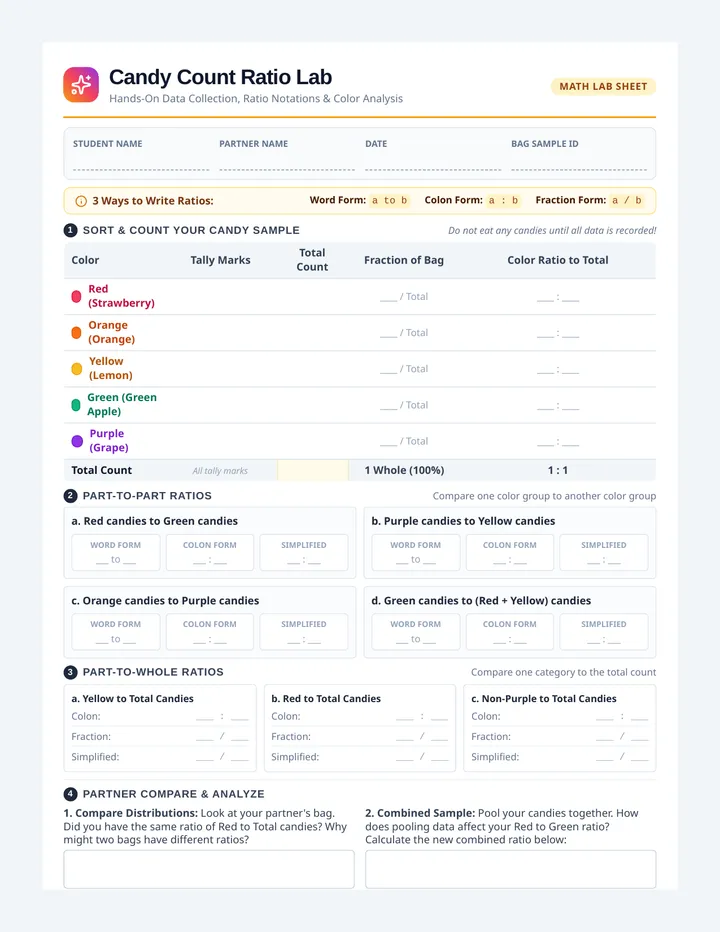
Candy Count Activity Candy Count Ratio Lab
Hands-On Data Collection, Ratio Notations & Color Analysis
Math Lab Sheet
Student Name
Partner Name
Date
Bag Sample ID
3 Ways to Write Ratios:
Word Form: a to b Colon Form: a : b Fraction Form: a / b
1 Sort & Count Your Candy Sample
Do not eat any candies until all data is recorded!
Color Tally Marks Total Count Fraction of Bag Color Ratio to Total Red (Strawberry) ____ / Total ____ : ____ Orange (Orange) ____ / Total ____ : ____ Yellow (Lemon) ____ / Total ____ : ____ Green (Green Apple) ____ / Total ____ : ____ Purple (Grape) ____ / Total ____ : ____ Total Count All tally marks 1 Whole (100%) 1 : 1
2 Part-to-Part Ratios
Compare one color group to another color group
a. Red candies to Green candies
Word Form ___ to ___
Colon Form ___ : ___
Simplified ___ : ___
b. Purple candies to Yellow candies
Word Form ___ to ___
Colon Form ___ : ___
Simplified ___ : ___
c. Orange candies to Purple candies
Word Form ___ to ___
Colon Form ___ : ___
Simplified ___ : ___
d. Green candies to (Red + Yellow) candies
Word Form ___ to ___
Colon Form ___ : ___
Simplified ___ : ___
3 Part-to-Whole Ratios
Compare one category to the total count
a. Yellow to Total Candies
Colon: ___ : ___
Fraction: ___ / ___
Simplified: ___ / ___
b. Red to Total Candies
Colon: ___ : ___
Fraction: ___ / ___
Simplified: ___ / ___
c. Non-Purple to Total Candies
Colon: ___ : ___
Fraction: ___ / ___
Simplified: ___ / ___
4 Partner Compare & Analyze
1. Compare Distributions: Look at your partner's bag. Did you have the same ratio of Red to Total candies? Why might two bags have different ratios?
2. Combined Sample: Pool your candies together. How does pooling data affect your Red to Green ratio? Calculate the new combined ratio below:
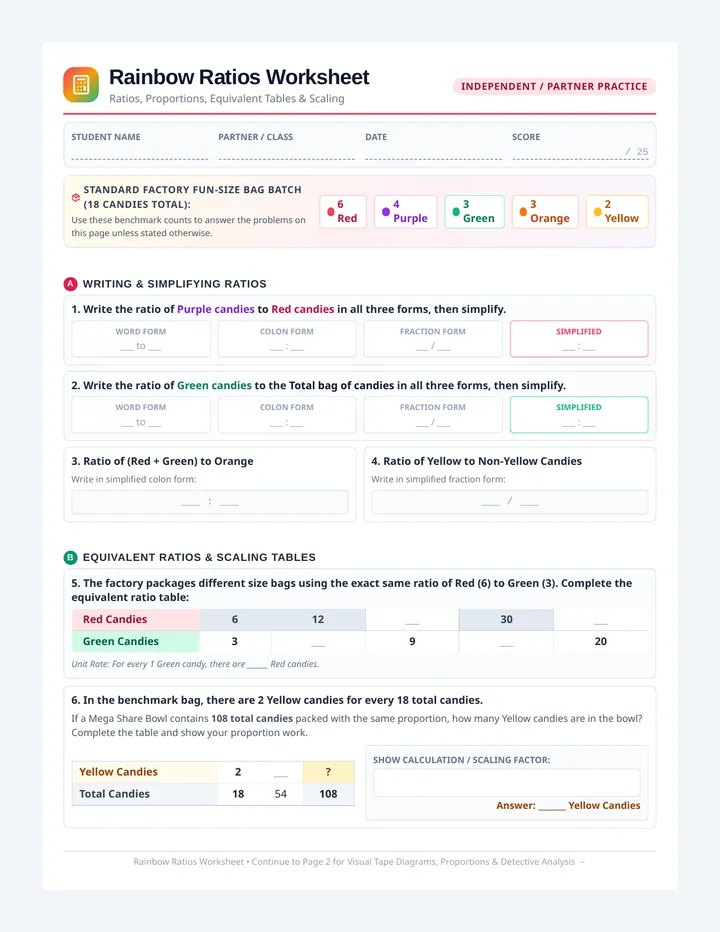
Rainbow Ratios Worksheet Rainbow Ratios Worksheet
Ratios, Proportions, Equivalent Tables & Scaling
Independent / Partner Practice
Student Name
Partner / Class
Date
Score
/ 25
Standard Factory Fun-Size Bag Batch (18 Candies Total):
Use these benchmark counts to answer the problems on this page unless stated otherwise.
6 Red 4 Purple 3 Green 3 Orange 2 Yellow
A Writing & Simplifying Ratios
1. Write the ratio of Purple candies to Red candies in all three forms, then simplify.
Word Form ___ to ___
Colon Form ___ : ___
Fraction Form ___ / ___
Simplified ___ : ___
2. Write the ratio of Green candies to the Total bag of candies in all three forms, then simplify.
Word Form ___ to ___
Colon Form ___ : ___
Fraction Form ___ / ___
Simplified ___ : ___
3. Ratio of (Red + Green) to Orange
Write in simplified colon form:
___ : ___
4. Ratio of Yellow to Non-Yellow Candies
Write in simplified fraction form:
___ / ___
B Equivalent Ratios & Scaling Tables
5. The factory packages different size bags using the exact same ratio of Red (6) to Green (3) . Complete the equivalent ratio table:
Red Candies 6 12 ___ 30 ___ Green Candies 3 ___ 9 ___ 20
Unit Rate: For every 1 Green candy, there are ______ Red candies.
6. In the benchmark bag, there are 2 Yellow candies for every 18 total candies .
If a Mega Share Bowl contains 108 total candies packed with the same proportion, how many Yellow candies are in the bowl? Complete the table and show your proportion work.
<table class="w-full text-center border border-slate-300 rounded text-xs"><tbody><tr class="border-b border-slate-200"><td class="py-1 px-2 text-left bg-amber-50 font-bold text-amber-800">Yellow Candies</td><td class="py-1 px-2 font-bold">2</td><td class="py-1 px-2 text-slate-400">___</td><td class="py-1 px-2 font-bold bg-amber-100 text-amber-900">?</td></tr><tr><td class="py-1 px-2 text-left bg-slate-100 font-bold text-slate-700">Total Candies</td><td class="py-1 px-2 font-bold">18</td><td class="py-1 px-2">54</td><td class="py-1 px-2 font-bold bg-slate-100">108</td></tr></tbody></table>
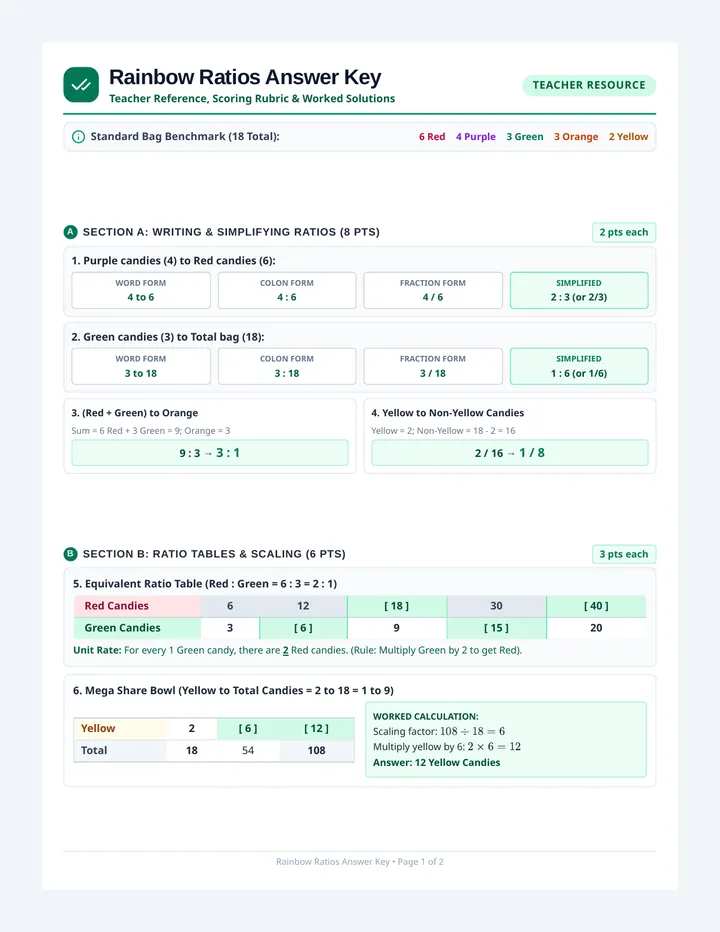
Rainbow Ratios Answer Key Rainbow Ratios Answer Key
Teacher Reference, Scoring Rubric & Worked Solutions
Teacher Resource
Standard Bag Benchmark (18 Total):
6 Red 4 Purple 3 Green 3 Orange 2 Yellow
A Section A: Writing & Simplifying Ratios (8 pts)
2 pts each
1. Purple candies (4) to Red candies (6):
Word Form 4 to 6
Colon Form 4 : 6
Fraction Form 4 / 6
Simplified 2 : 3 (or 2/3)
2. Green candies (3) to Total bag (18):
Word Form 3 to 18
Colon Form 3 : 18
Fraction Form 3 / 18
Simplified 1 : 6 (or 1/6)
3. (Red + Green) to Orange
Sum = 6 Red + 3 Green = 9; Orange = 3
9 : 3 → 3 : 1
4. Yellow to Non-Yellow Candies
Yellow = 2; Non-Yellow = 18 - 2 = 16
2 / 16 → 1 / 8
B Section B: Ratio Tables & Scaling (6 pts)
3 pts each
5. Equivalent Ratio Table (Red : Green = 6 : 3 = 2 : 1)
Red Candies 6 12 [ 18 ] 30 [ 40 ] Green Candies 3 [ 6 ] 9 [ 15 ] 20
Unit Rate: For every 1 Green candy, there are 2 Red candies. (Rule: Multiply Green by 2 to get Red).
6. Mega Share Bowl (Yellow to Total Candies = 2 to 18 = 1 to 9)
<table class="w-full text-center border border-slate-300 rounded"><tbody><tr class="border-b border-slate-200"><td class="py-1 px-2 text-left bg-amber-50 font-bold text-amber-800">Yellow</td><td class="py-1 px-2 font-bold">2</td><td class="py-1 px-2 bg-emerald-100 text-emerald-900 font-black">[ 6 ]</td><td class="py-1 px-2 font-black bg-emerald-100 text-emerald-900">[ 12 ]</td></tr><tr><td class="py-1 px-2 text-left bg-slate-100 font-bold text-slate-700">Total</td><td class="py-1 px-2 font-bold">18</td><td class="py-1 px-2">54</td><td class="py-1 px-2 font-bold bg-slate-100">108</td></tr></tbody></table>
Worked Calculation:
Scaling factor: \( 108 \div 18 = 6 \)
Multiply yellow by 6: \( 2 \times 6 = 12 \)
Answer: 12 Yellow Candies
Rainbow Ratios Answer Key • Page 1 of 2
Page 2 Key
Rainbow Ratios: Modeling & Word Problem Solutions
Show Calculation / Scaling Factor:
Answer: _______ Yellow Candies
Rainbow Ratios Worksheet • Continue to Page 2 for Visual Tape Diagrams, Proportions & Detective Analysis →
Rainbow Ratios: Modeling & Problem Solving
C Tape Diagram & Bar Model Reasoning 7. Custom Blend: Maya mixes Red and Purple candies in a ratio of 3 Red to 2 Purple. If she uses 24 Red candies , how many Purple candies does she need?
Red (3 units = 24 total):
Purple (2 units = _____ total):
24 ÷ 3 units = _______ candies per unit
Step 2: Calculate Purple Candies
2 units × _______ = _______ Purple candies
8. Party Bowl: A bowl has 45 total candies consisting only of Orange and Green candies in a ratio of 2 : 3 . How many of each color are in the bowl?
Draw or Label the Tape Units:
Total units = 2 (Orange) + 3 (Green) = 5 units
Value of 1 unit: 45 ÷ 5 = _______
Orange Candies: _______ Green Candies: _______
D Real-World Proportions & Unit Rates 9. Cupcake Bakery: Sweet Delights bakery decorates each batch of cupcakes with candies. They use 5 Red candies for every 2 cupcakes .
a. How many Red candies are needed to decorate 24 cupcakes ?
Answer: _______ Red candies
b. If the baker has 65 Red candies , how many full cupcakes can be decorated?
10. Comparison Challenge: Which bag gives you a higher proportion of Yellow candies?
Contains 4 Yellow out of 20 total candies .
Fraction & Decimal: _______ = _______
Contains 7 Yellow out of 28 total candies .
Fraction & Decimal: _______ = _______
Circle the winner: [ Sample Bag A ] or [ Sample Bag B ]
E Math Detective: Error Analysis 11. Liam inspected a candy bag and found 4 Red candies and 6 Green candies . He argued:
“Since the ratio of Red to Green is 4 to 6, exactly 4/6 (or 2/3) of the candies in the bag are Red!”
Explain Liam's error. What mistake did he make between part-to-part and part-to-whole? What is the actual fraction of Red candies in the bag?
Rainbow Ratios Worksheet • End of Problem Set
C Section C: Tape Diagram Reasoning (6 pts) 7. Custom Blend (3 Red : 2 Purple with 24 Red candies):
1. Find unit value: \( 24 \div 3 = 8 \) candies per unit.
2. Calculate Purple: \( 2 \text{ units} \times 8 = 16 \) Purple candies.
Answer: 16 Purple Candies
8. Party Bowl (Orange : Green = 2 : 3; 45 total candies):
Total units = \( 2 + 3 = 5 \) equal units.
Value of each unit = \( 45 \div 5 = 9 \) candies.
Orange: \( 2 \times 9 = \) 18 candies
Green: \( 3 \times 9 = \) 27 candies
Check: \( 18 + 27 = 45 \) total candies ✓
D Section D: Word Problems & Unit Rates (4 pts) 9. Cupcake Bakery (Rate: 5 Red candies per 2 cupcakes = 2.5 candies/cupcake):
Part a: Red for 24 cupcakes
\( 24 \div 2 = 12 \) groups of two cupcakes.
\( 12 \times 5 = 60 \) Red candies (or \( 24 \times 2.5 = 60 \)).
Part b: Cupcakes from 65 Red candies
\( 65 \div 5 = 13 \) batches of two cupcakes.
\( 13 \times 2 = 26 \) cupcakes (or \( 65 \div 2.5 = 26 \)).
10. Comparison Challenge (Proportion of Yellow candies):
\( \frac{4}{20} = \frac{1}{5} = 0.20 \) (or 20%)
\( \frac{7}{28} = \frac{1}{4} = 0.25 \) (or 25%)
Winner: Sample Bag B (25% > 20%, or \( \frac{5}{20} > \frac{4}{20} \))
E Section E: Detective Error Analysis (3 pts) 11. Explanation of Liam's Error:
The Misconception: Liam confused a part-to-part ratio with a part-to-whole ratio . The number 6 in the ratio 4 : 6 represents only the Green candies (a part), not the total number of candies in the bag (the whole).
Total candies = \( 4 \text{ (Red)} + 6 \text{ (Green)} = 10 \text{ total candies} \).
Part-to-Whole Ratio = \( \frac{4}{10} \) which simplifies to \( \frac{2}{5} \) (or 40%) , not \( \frac{4}{6} \) (66.7%).
Rainbow Ratios Answer Key • End of Teacher Scoring Guide