Lenny.com
Explore
Create
ActivitiesNewMathEnglish Language ArtsScience & EngineeringSocial StudiesGlobal LanguagesHealth & Physical EducationSpecial EducationCounseling & Life SkillsArts & CreativityESL
Lenny.com
Lenny.com
Explore
Create
ActivitiesNewMathEnglish Language ArtsScience & EngineeringSocial StudiesGlobal LanguagesHealth & Physical EducationSpecial EducationCounseling & Life SkillsArts & CreativityESL
Lenny.com
Lenny.com

Solutions

Lenny for EducatorsLenny for SchoolsLenny for Districts

Product

ExploreSign inCreateSupportAbout

Resources

Getting startedMTSS Acceleration Program

© 2026 Lenny Learning Inc.

TermsPrivacyAccessibility
LinkedInInstagramX
Lenny
MathNumbers & CountingCounting ObjectsNumber NamesComparing NumbersNumber OperationsCounting SequenceNumbers 0-10Place Value Understanding and SystemAdd and Subtract Within 20Addition and Subtraction ConceptsAddition and Subtraction EquationsAddition and Subtraction ProblemsFoundations for MultiplicationMultiplication and Division PropertiesMultiply and Divide Within 100Multiplication and Division ProblemsFactors and MultiplesProperties of OperationsPatterns and RelationshipsGenerate and Analyze PatternsMulti-Digit ArithmeticPlace Value OperationsMulti-Digit and Decimal OperationsNumerical ExpressionsFour Operations and PatternsFour Operations Problem SolvingMeasurement & DataMeasurable AttributesMeasuring LengthsMeasure and Estimate Lengths in Standard UnitsRelate Addition and Subtraction to LengthClassifying and Counting ObjectsTime and MoneyArea Concepts and MeasurementPerimeter and Area MeasuresAngle Concepts and MeasurementTime, Volume, and MassMeasurement Unit ConversionsGeometryIdentifying ShapesShapes and AttributesShape Attributes and ReasoningShapes and CompositionClassifying 2D FiguresGeometric Figures and RelationshipsLines, Angles, and ShapesAngle, Area, and VolumeGeometric MeasurementVolume of 3D ShapesCoordinate Plane ApplicationsTransformations in the PlaneCongruence and SimilarityUnderstand congruence in terms of rigid motionsSimilarity and TransformationsProve Theorems Involving SimilarityPythagorean TheoremTrigonometry for General TrianglesMake Geometric ConstructionsProve Geometric TheoremsTheorems About CirclesFind Arc Lengths And Areas of Sectors of CirclesVolume FormulasRelationships Between Two-Dimensional and Three-Dimensional ObjectsProve Simple Geometric Theorems AlgebraicallyTranslate Between Geometric Description and Equation for Conic SectionApply Geometric Concepts in Modeling SituationsFractions & DecimalsFractions as NumbersBuilding FractionsFraction Equivalence and OrderingAdding and Subtracting FractionsMultiplying and Dividing FractionsDividing FractionsDecimal FractionsMulti-Digit Computation and FactorsAdd, Subtract, Multiply, and Divide Rational NumbersRational Number SystemIrrational Numbers and ApproximationsRatiosRatios and ProportionsProportional RelationshipsUnit RateAlgebraAlgebraic ExpressionsGenerate Equivalent ExpressionsQuantitative RelationshipsProportional Relationships and Linear EquationsEquations and InequalitiesEquation Solving and ReasoningLinear Equations and SystemsGraph Equations and InequalitiesSystems of EquationsReal-World Algebraic ProblemsQuantitative Reasoning with UnitsExpression StructureEquivalent Expression FormsRadicals and Integer ExponentsRational ExponentsRational and Irrational NumbersPolynomial OperationsPolynomial IdentitiesPolynomial Zeros and FactorsRational ExpressionsComplex Number OperationsComplex Numbers in PolynomialsComplex Numbers on PlaneStatistics & ProbabilityRepresent and Interpret DataData DistributionsStatistical VariabilityProbability ModelsCompound Event ProbabilitiesStatistical SamplingInterpret Categorical and Quantitative DataBivariate Data PatternsInterpret Linear ModelsComparing Two PopulationsRandom Processes in StatisticsIndependence and Conditional ProbabilityExpected ValuesProbability-Based Decision MakingStatistical Inference and ConclusionsFunctionsFunction Concepts and NotationDefine and Compare FunctionsInterpret Functions in ContextAnalyze Function RepresentationsModel Relationships with FunctionsIdentify Linear vs Exponential GrowthDistinguish Between Function TypesCompare Growth RatesInterpret Function ExpressionsBuild Functions from RelationshipsConstruct and Model FunctionsTransform and Combine FunctionsModel Comparison and SelectionSolve Exponential EquationsTrigonometryTrigonometric Ratios Involving Right TrianglesTrigonometric Functions and Unit CircleModel with Trigonometric FunctionsTrigonometric IdentitiesVectors & MatricesIntroduction to Vectors and MatricesVector QuantitiesVector OperationsMatrix OperationsCalculusLimits and ContinuityDerivative Concepts and NotationDerivative Rules and TechniquesApplications of DerivativesOptimization ProblemsRelated RatesCurve Sketching and AnalysisIntegration Concepts and NotationAntiderivatives and Indefinite IntegralsDefinite Integrals and AreaFundamental Theorem of CalculusIntegration TechniquesApplications of IntegrationDifferential EquationsSequences and SeriesParametric and Polar FunctionsVector-Valued Functions

Slope Shifters

A focused pre-algebra and algebra unit on understanding and graphing direct variation equations of the form y = mx. Students explore positive, negative, and fractional slopes using both structured tables of values and the rise-over-run method.

CKCatherine Kio

Slope Shifters

A focused pre-algebra and algebra unit on understanding and graphing direct variation equations of the form y = mx. Students explore positive, negative, and fractional slopes using both structured tables of values and the rise-over-run method.

CKCatherine Kio

Instructor Reference

Key Takeaway: Negative slopes always fall from left to right (\(\searrow\)) and pass through the origin \((0,0)\).

Form: \(y = mx\) where \(m < 0\)

3 Solution: \(y = -2x\)

Slope: \(m = \frac{-2}{1}\)

Slope (\(m\))

\(-2\) or \(\frac{-2}{1}\)

Rise / Fall

\(-2\) (Down 2)

Run (\(\Delta x\))

\(+1\) (Right 1)

Completed Table:

\(x\)Work: \(y = -2x\)\(y\)Point \((x, y)\)
-2\(-2(-2) = 4\)4(-2, 4)
-1\(-2(-1) = 2\)2(-1, 2)
0\(-2(0) = 0\)0(0, 0)
1\(-2(1) = -2\)-2(1, -2)
2\(-2(2) = -4\)-4(2, -4)

From left to right, this line is: Falling (\(\searrow\))

Line: \(y = -2x\)

-6 -4 -2 2 4 6 6 4 2 -2 -4 -6 x y

4 Solution: \(y = -\frac{3}{4}x\)

Slope: \(m = \frac{-3}{4}\)

Slope (\(m\))

\(-\frac{3}{4}\)

Rise / Fall

\(-3\) (Down 3)

Run (\(\Delta x\))

\(+4\) (Right 4)

Completed Table:

\(x\)Work: \(y = -\frac{3}{4}x\)\(y\)Point \((x, y)\)
-4\(-\frac{3}{4}(-4) = 3\)3(-4, 3)
0\(-\frac{3}{4}(0) = 0\)0(0, 0)
4\(-\frac{3}{4}(4) = -3\)-3(4, -3)

Starting at \((0,0)\), to find the next point go: Down 3, Right 4

Line: \(y = -\frac{3}{4}x\)

-6 -4 -2 2 4 6 6 4 2 -2 -4 -6 x y

Slope Pattern Synthesis: Answer Guide

1. Direction Rule: When \(m > 0\), the line slants upward (\(\nearrow\)). When \(m < 0\), it slants downward (\(\searrow\)).

2. The Origin: Why do ALL graphs of \(y = mx\) pass through \((0,0)\)?

When \(x = 0\), \(y = m(0) = 0\). Since there is no constant \(b\) added, \((0,0)\) is always a true solution.

Teacher Answer Key Page 3 Solutions

Slope Shifters: Rise Over Run Method

Instructor Reference

Key Takeaway: Rise over Run uses slope triangles directly from \((0,0)\). Dashed lines illustrate the \(\frac{\text{Rise}}{\text{Run}}\) steps.

Technique: Point Chaining

5 Solution: \(y = \frac{3}{2}x\)

Rise = +3, Run = +2

Vertical Rise (\(\Delta y\)) Move 3 Up

Horizontal Run (\(\Delta x\)) Move 2 Right

Completed Point Chain:

Point 1 (Start): Origin \((0, 0)\)

Point 2: From \((0,0)\), count Up 3, Right 2 \(\to\) (2, 3)

Point 3: From Point 2, count Up 3, Right 2 \(\to\) (4, 6)

Point 4 (Reverse): From \((0,0)\), count Down 3, Left 2 \(\to\) (-2, -3)

Slope triangle connects \((0,0) \to (2,0) \to (2,3)\).

Line & Slope Triangle: \(y = \frac{3}{2}x\)

+2 +3 -6 -4 -2 2 4 6 6 4 2 -2 -4 -6 x y

6 Solution: \(y = -\frac{1}{3}x\)

Fall = 1, Run = 3

Vertical Fall (\(\Delta y\)) Move 1 Down

Horizontal Run (\(\Delta x\)) Move 3 Right

Completed Point Chain:

Point 1 (Start): Origin \((0, 0)\)

Point 2: From \((0,0)\), count Down 1, Right 3 \(\to\) (3, -1)

Point 3: From Point 2, count Down 1, Right 3 \(\to\) (6, -2)

Point 4 (Reverse): From \((0,0)\), count Up 1, Left 3 \(\to\) (-3, 1)

Slope triangle connects \((0,0) \to (3,0) \to (3,-1)\).

Line & Slope Triangle: \(y = -\frac{1}{3}x\)

+3 -1 -6 -4 -2 2 4 6 6 4 2 -2 -4 -6 x y

Quick Check Answer Key

A. If \(m = \frac{5}{1}\), count UP 5 and RIGHT 1.

B. If \(m = -\frac{3}{5}\), count DOWN 3 and RIGHT 5.
You might also like

Checkpoint Prep Review Booklet

ILEARN Checkpoint Mastery

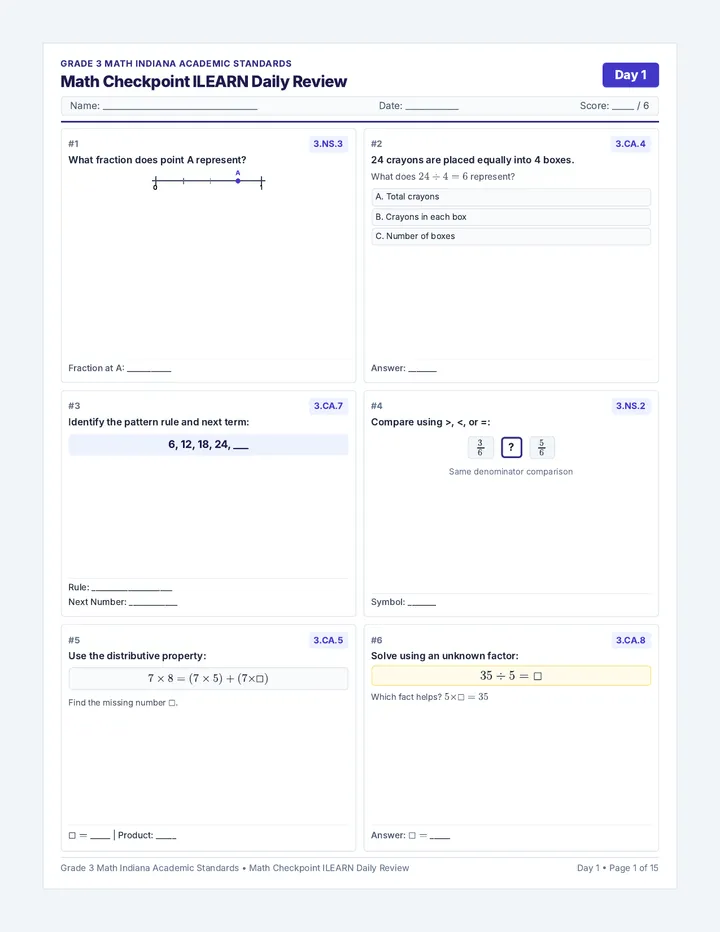
A multi-part Indiana Academic Standards Grade 3 Math ILEARN checkpoint preparation sequence featuring comprehensive 15-day daily spiral reviews and teacher answer keys for Checkpoints 2 and 3.

JQ

Janelle Quinn

4
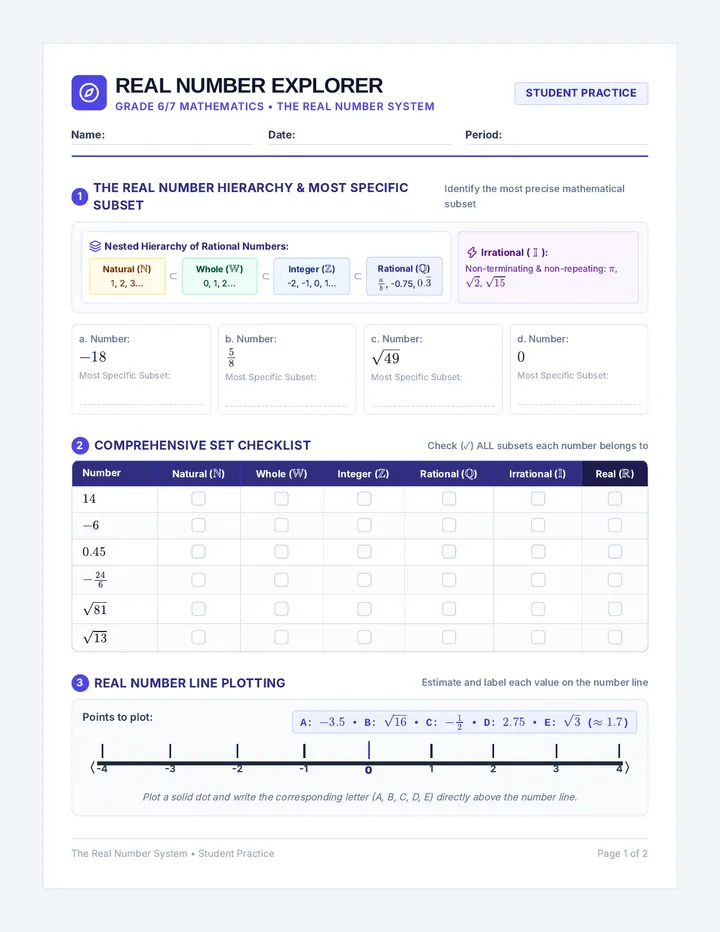
Real Number Explorer Worksheet

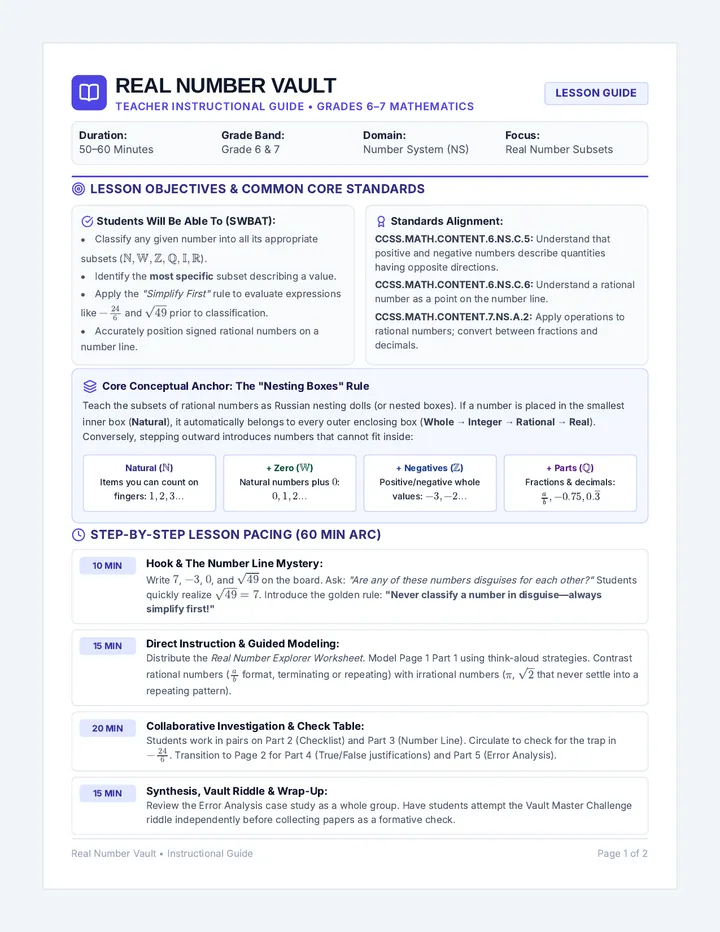
Real Number Vault

A comprehensive middle school mathematics lesson focused on classifying, comparing, and understanding the subsets of the real number system for 6th and 7th graders.

KJ

Kathryne Judd

3
Real Number Teacher Guide

Real Number Teacher Guide

A two-page instructional lesson guide for educators detailing learning targets, lesson pacing, the 'Simplification First' anchor framework, common misconceptions, targeted questioning stems, and tiered differentiation strategies.

KJ

Kathryne Judd

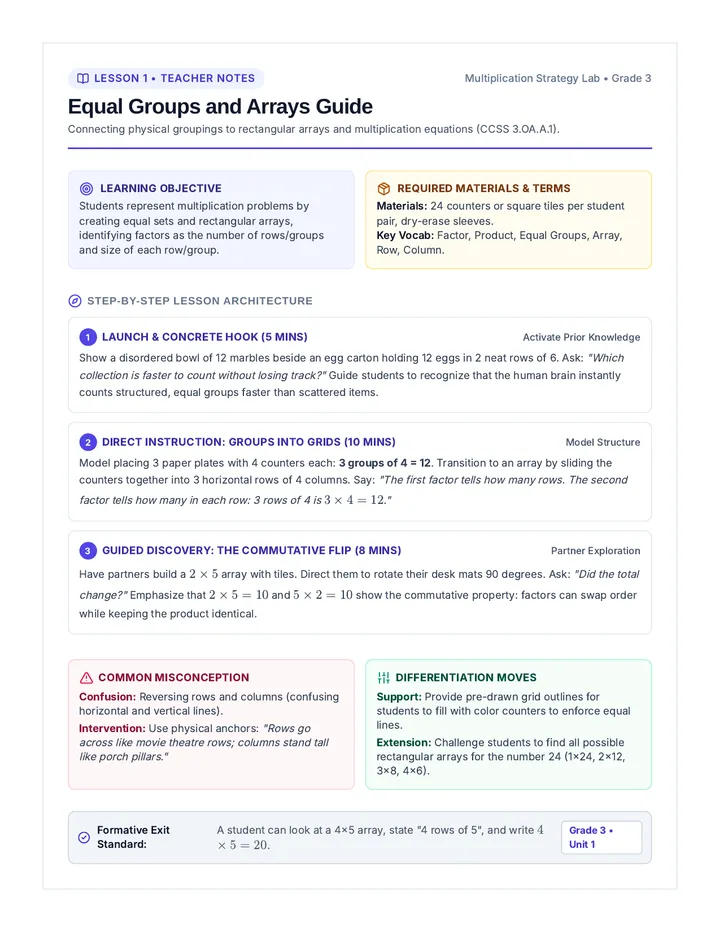
Groups and Arrays Teacher Guide

Multiplication Strategy Lab

A comprehensive third-grade instructional sequence focusing on four foundational multiplication strategies: equal groups and arrays, repeated addition, skip counting patterns, and breaking apart factors. Each lesson pairs an actionable teacher guide with a targeted student practice worksheet.

JS

Jami Sharp

8
Smart Shopper Slides

Smart Shopper Showdown

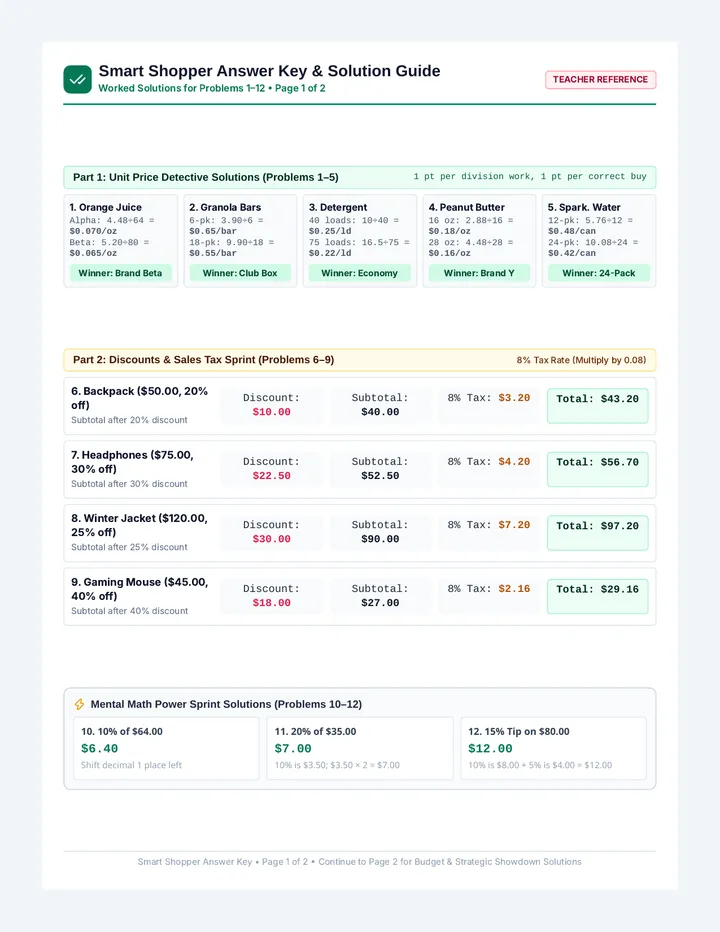
An engaging consumer math lesson where students calculate unit rates, determine percentage discounts, calculate sales tax, and optimize shopping carts under a strict budget. Includes a grocery store simulation and practical financial literacy applications.

CD

Cheri Donahoe

4
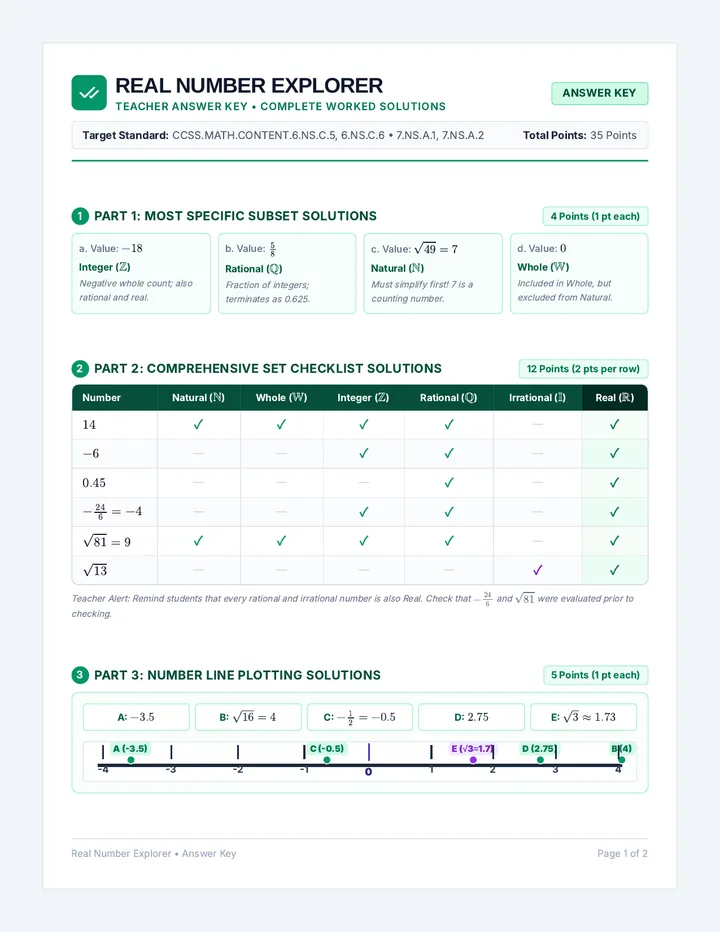
Real Number Explorer Key

Real Number Explorer Key

A complete teacher answer key and scoring guide corresponding to the Real Number Explorer Worksheet. Features step-by-step explanations, filled classification tables, number line plotting keys, and pedagogical misconception callouts.

KJ

Kathryne Judd

Slope Review Practice Worksheet

Pre-Algebra Concepts

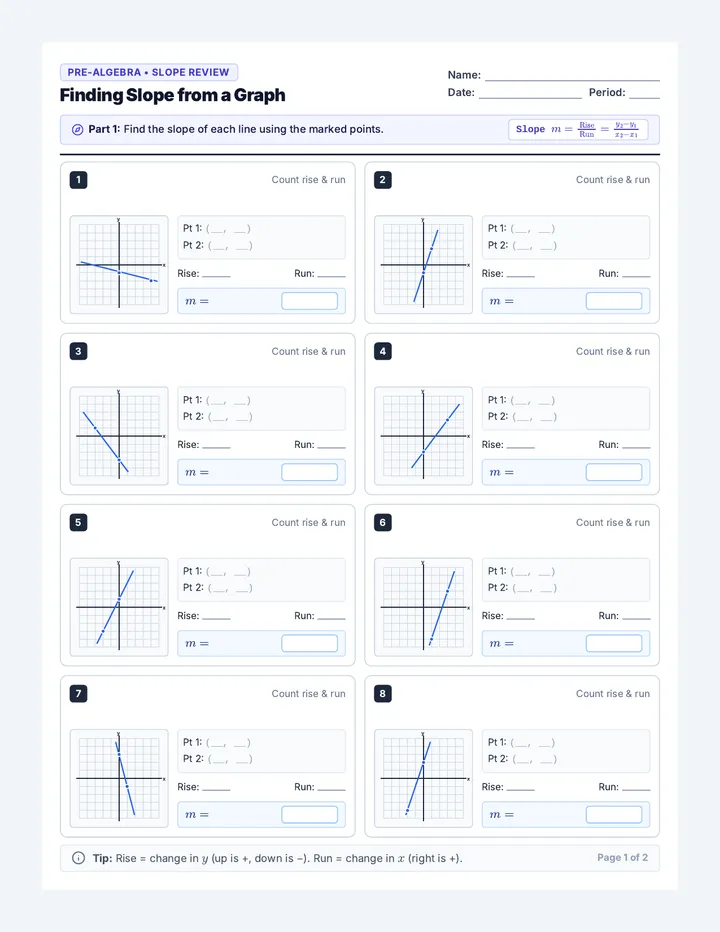
A comprehensive pre-algebra and introductory geometry sequence covering linear equations, slope analysis, and coordinate plane transformations.

FM

Fernando Mancini

10
Thanksgiving Feast Problems Worksheet

Thanksgiving Math Feast

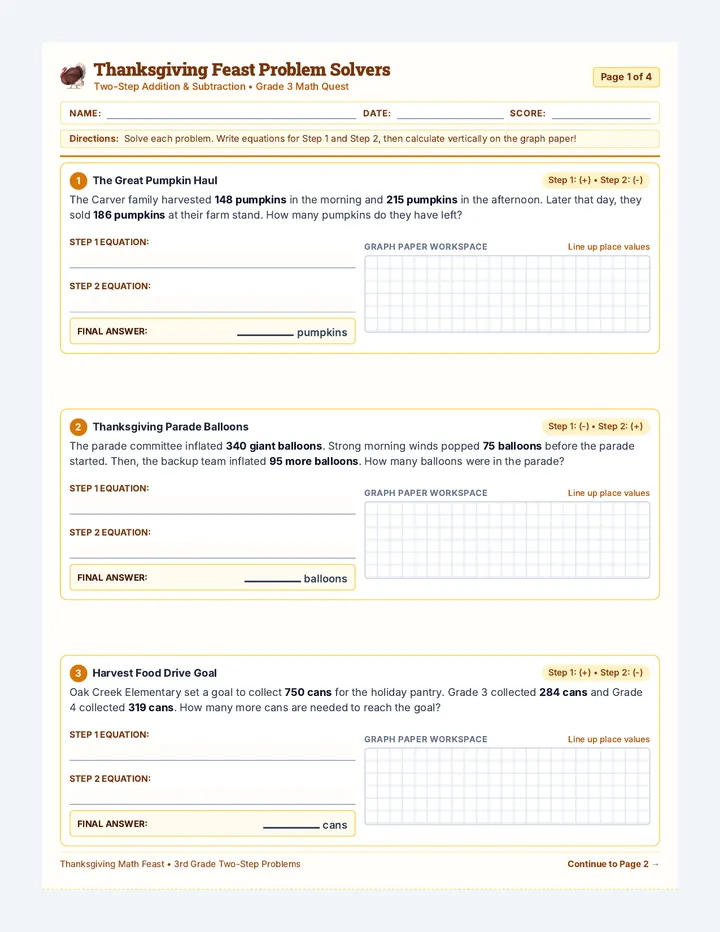
A 3rd-grade math lesson centered on solving two-step addition and subtraction word problems in a festive Thanksgiving context. Students unpack real-world harvest scenarios using equations and grid workspaces, supported by a structured paraprofessional intervention guide.

SW

Stephanie Wooten

2
Real Number Explorer Worksheet

Real Number Explorer Worksheet

A print-ready two-page student worksheet guiding 6th and 7th grade students through identifying, classifying, and placing subsets of the real number system. Features a visual hierarchy, multi-category checklist, number line positioning, error analysis, and real-world application challenges.

KJ

Kathryne Judd

Ten Hop Week One Teacher Guide

Ten Leap Intervention

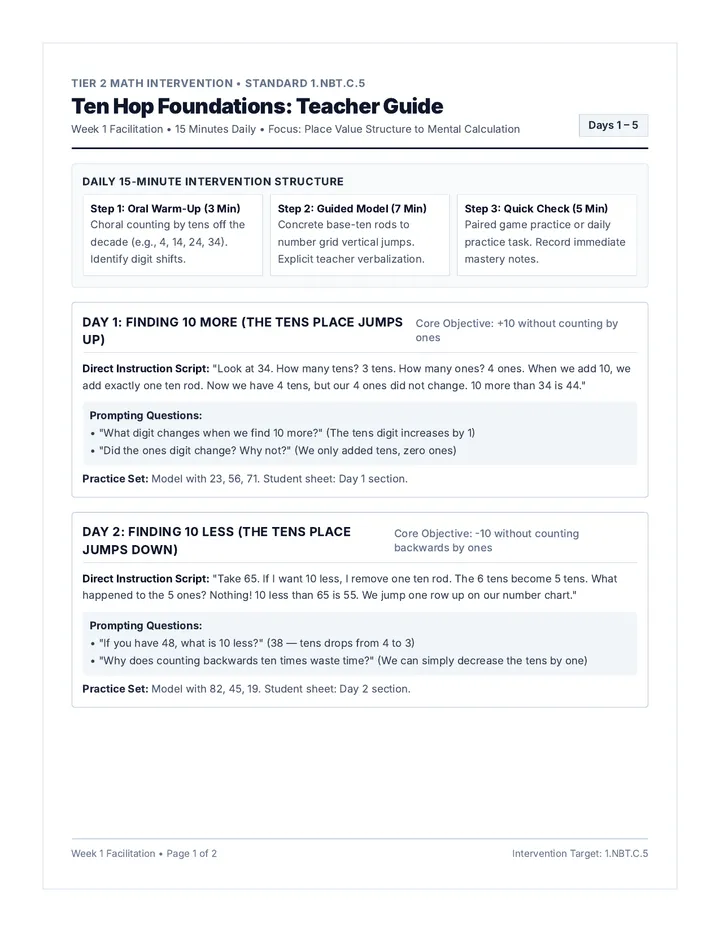
A targeted two-week Tier 2 mathematics intervention focusing on standard 1.NBT.C.5. Students develop conceptual understanding and mental fluency finding ten more and ten less than any two-digit number.

K

kkipperman

7
Slope Sprint Worksheet

Slope Sprint Launch

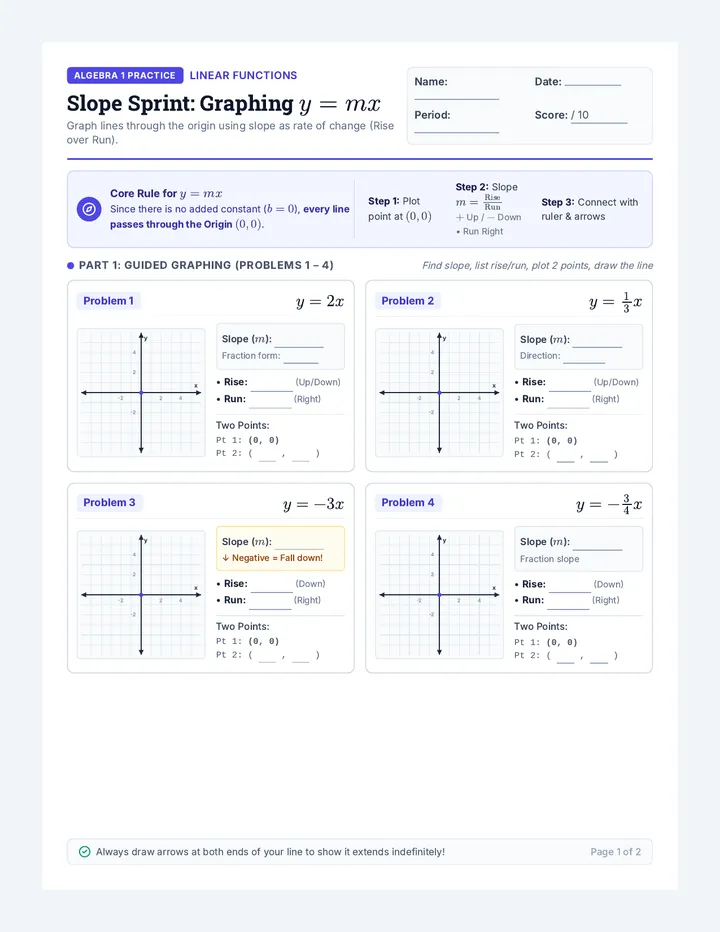
A focused algebra lesson on graphing linear equations of the form y = mx through the origin using slope as rise over run. Includes student guided practice and a complete teacher reference answer key.

CK

Catherine Kio

2
Smart Shopper Answer Key

Smart Shopper Answer Key

Updated comprehensive teacher answer key providing step-by-step arithmetic solutions, mental math benchmarks, budget simulation exemplars, deal showdown breakdowns, and rubric criteria for all 18 worksheet problems.

CD

Cheri Donahoe