D: \(2.75\)
E: \(\sqrt{3} \approx 1.73\)
A (-3.5)
C (-0.5)
E (√3≈1.7)
D (2.75)
B (4)
-4
-3
-2
-1
0
1
2
3
4
Real Number Explorer • Answer Key Page 1 of 2
P2
Section Score: 14 Points
4 Points (1 pt each)
1. All whole numbers are integers. TRUE
Key Explanation: The set of integers includes all whole numbers \(\{0, 1, 2, ...\}\) plus their negative opposites \(\{-1, -2, ...\}\).
2. Every rational number is an integer. FALSE
Counterexample: \(\frac{1}{2}\) or \(0.75\) are rational numbers, but neither is an integer because they represent non-whole parts.
3. The number \(0\) is a rational number. TRUE
Key Explanation: \(0\) can be expressed as a fraction of two integers with a non-zero denominator: \(\frac{0}{1}\) or \(\frac{0}{5}\).
4. Square roots are always irrational. FALSE
Counterexample: The square root of any perfect square is rational: \(\sqrt{25} = 5\) or \(\sqrt{0.36} = 0.6\).
4 Points (2 pts per prompt)
1. The Student's Misconception:
The student judges numbers strictly by their outward notation format rather than their evaluated quantitative value. They assume any fraction can't be an integer and any radical symbol must be irrational.
2. Fully Corrected Proof:
• \(-\frac{30}{6} = -5\), which is both an Integer and a Rational number.
• \(\sqrt{64} = 8\), which is a Natural, Whole, Integer, and Rational number (not irrational!).
3 Points (1 pt each)
Winter Chill
Value: \(-8\) or \(-8^\circ\)F
Most Specific: Integer (\(\mathbb{Z}\))
Below zero indicates negative whole units.
Baking Slices
Value: \(2\frac{3}{4}\) or \(2.75\) or \(\frac{11}{4}\)
Most Specific: Rational (\(\mathbb{Q}\))
Contains a non-integer fractional part.
Class Roll Call
Value: \(28\)
Most Specific: Natural (\(\mathbb{N}\))
A positive counting number of people.
The unique number is 0 (Zero). Zero is in Whole (\(\mathbb{W}\)), Integer (\(\mathbb{Z}\)), and Rational (\(\mathbb{Q}\)), but was excluded when natural numbers were defined as counting objects starting at 1.
0
Real Number Explorer • Answer Key Page 2 of 2
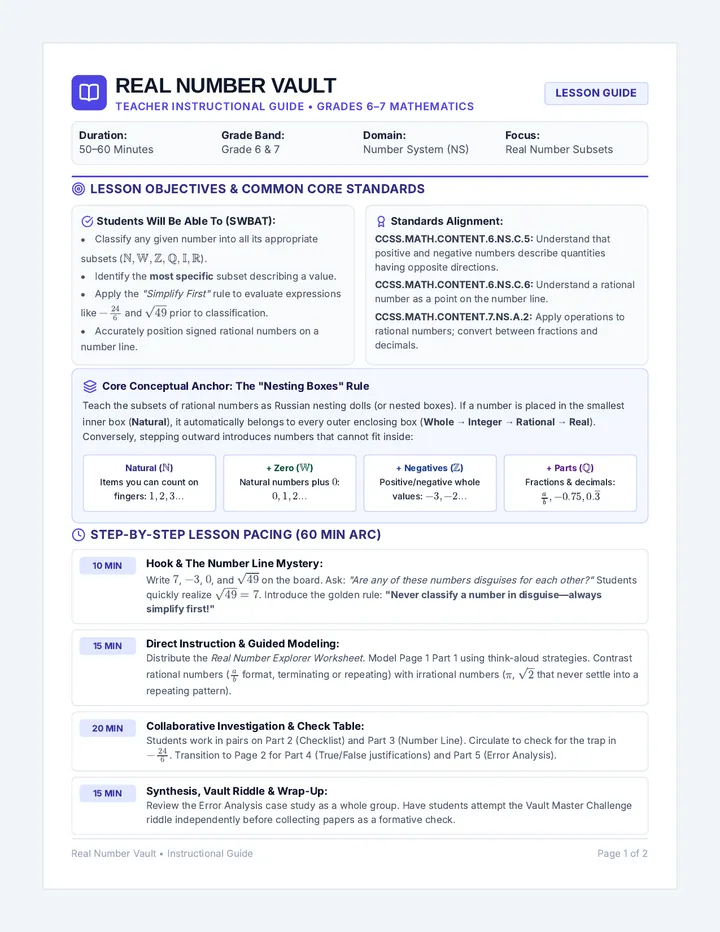
Distribute the Real Number Explorer Worksheet. Model Page 1 Part 1 using think-aloud strategies. Contrast rational numbers (\(\frac{a}{b}\) format, terminating or repeating) with irrational numbers (\(\pi\), \(\sqrt{2}\) that never settle into a repeating pattern).
20 MIN
Collaborative Investigation & Check Table:
Students work in pairs on Part 2 (Checklist) and Part 3 (Number Line). Circulate to check for the trap in \(-\frac{24}{6}\). Transition to Page 2 for Part 4 (True/False justifications) and Part 5 (Error Analysis).
15 MIN
Synthesis, Vault Riddle & Wrap-Up:
Review the Error Analysis case study as a whole group. Have students attempt the Vault Master Challenge riddle independently before collecting papers as a formative check.
Real Number Vault • Instructional Guide Page 1 of 2
P2
Real Number System • Grades 6–7
| Student Misconception | How It Manifests | Targeted Instructional Intervention |
|---|---|---|
| Format over Value Bias | Thinking \(-\frac{20}{4}\) cannot be an integer simply because it is typed with a fraction bar. | Ask: "What operation does a fraction bar represent?" Have the student divide \(-20 \div 4 = -5\) before making any classification decision. |
| The Radical = Irrational Myth | Believing \(\sqrt{36}\) or \(\sqrt{100}\) are irrational because they have a radical symbol. | Clarify that the radical is an operation symbol (like \(+\)), not part of the final number. Evaluate first: \(\sqrt{36} = 6\), which is a counting number. |
| The "Zero is Nothing" Trap | Excluding \(0\) from rational numbers because "you can't write zero as a fraction." | Emphasize the definition: \(b \neq 0\). The denominator cannot be zero, but \(\frac{0}{1} = 0\), which is completely valid and rational! |
To Prompt Simplification:
• "Is that number wearing a disguise? How can we evaluate it first?"
• "What integer or whole number does that expression simplify to?"
To Check Nested Logic:
• "If a number is in the Integer box, what other outer boxes MUST hold it?"
• "Can you provide a counterexample to prove that statement is false?"
Support & ELL
On-Grade Level
Extension & Challenge
"Classify \(-\frac{18}{3}\) and \(\sqrt{20}\). Explain why \(-\frac{18}{3}\) belongs in the integer subset even though it is written as a fraction."
Check For: Simplification to -6
Real Number Vault • Instructional Guide Page 2 of 2