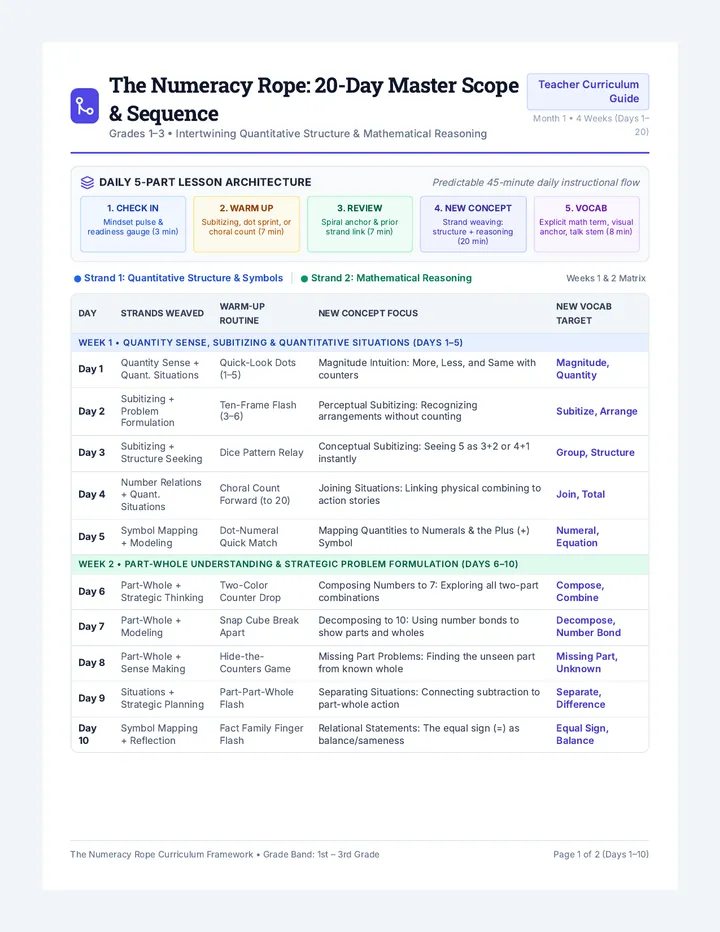
Translation Tactics Quiz Document
Geometry Assessment • Rigid Transformations
Translation Tactics Quiz
Coordinate Plane Translations: Vocabulary, Mapping Rules & Graphical Problems
Score: / 15
Page 1 of 4
Name:
Date:
Period:
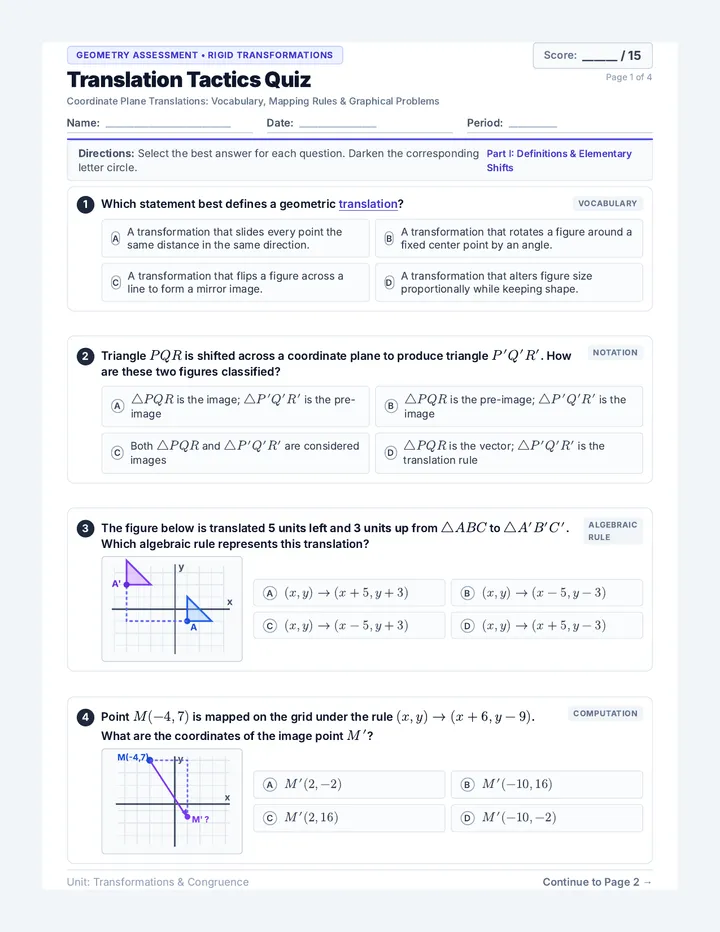
Directions: Select the best answer for each question. Darken the corresponding letter circle.
Part I: Definitions & Elementary Shifts
1
Which statement best defines a geometric translation?
Vocabulary
A A transformation that slides every point the same distance in the same direction.
B A transformation that rotates a figure around a fixed center point by an angle.
C A transformation that flips a figure across a line to form a mirror image.
D A transformation that alters figure size proportionally while keeping shape.
2
Triangle \(PQR\) is shifted across a coordinate plane to produce triangle \(P'Q'R'\). How are these two figures classified?
Notation
A \(\triangle PQR\) is the image; \(\triangle P'Q'R'\) is the pre-image
B \(\triangle PQR\) is the pre-image; \(\triangle P'Q'R'\) is the image
C Both \(\triangle PQR\) and \(\triangle P'Q'R'\) are considered images
D \(\triangle PQR\) is the vector; \(\triangle P'Q'R'\) is the translation rule
3
The figure below is translated 5 units left and 3 units up from \(\triangle ABC\) to \(\triangle A'B'C'\). Which algebraic rule represents this translation?
Algebraic Rule
x y -5-4-3-2-1 12345 -1-2-3 12345 A A'
A \((x, y) \rightarrow (x + 5, y + 3)\)
B \((x, y) \rightarrow (x - 5, y - 3)\)
C \((x, y) \rightarrow (x - 5, y + 3)\)
D \((x, y) \rightarrow (x + 5, y - 3)\)
4
Point \(M(-4, 7)\) is mapped on the grid under the rule \((x, y) \rightarrow (x + 6, y - 9)\). What are the coordinates of the image point \(M'\)?
Computation
x y -6-5-4-3-2-1 1234 -1-2-3-4 12345678 M(-4,7) M' ?
A \(M'(2, -2)\)
B \(M'(-10, 16)\)
C \(M'(2, 16)\)
D \(M'(-10, -2)\)
Unit: Transformations & Congruence Continue to Page 2 →
Translation Tactics Quiz
Part II: Intermediate Coordinate Translations & Inverse Shifts
Name:
Page 2 of 4
5
The image of vertex \(K\) following translation \((x, y) \rightarrow (x - 3, y + 8)\) arrives at \(K'(1, 5)\). What were the coordinates of pre-image \(K\)?
Inverse Shift
x y -3-2-1 123456 -1-2-3-4-5 1234567 K'(1, 5) K ? shift
A \(K(-2, 13)\)
B \(K(4, -3)\)
C \(K(-2, -3)\)
D \(K(4, 13)\)
6
Which algebraic rule correctly maps pre-image \(\triangle ABC\) to image \(\triangle A'B'C'\) on the grid?
Find Rule
x y -5-4-3-2-1 1234567 -1-2-3-4 123456 A B C A' B' C'
A \((x, y) \rightarrow (x + 6, y - 3)\)
B \((x, y) \rightarrow (x - 6, y + 3)\)
C \((x, y) \rightarrow (x + 3, y - 6)\)
D \((x, y) \rightarrow (x + 6, y + 3)\)
7
Point \(P(3, 4)\) is plotted on the grid and translated under \((x, y) \rightarrow (x - 7, y - 6)\). What are the coordinates of image \(P'\)?
Map Point
x y -6-5-4-3-2-1 12345 -1-2-3-4 123456 P(3, 4) P' ?
A \(P'(-4, -2)\)
B \(P'(10, 10)\)
C \(P'(-4, 10)\)
D \(P'(10, -2)\)
8
The image vertex \(H'(-2, 3)\) is shown after translation \((x, y) \rightarrow (x + 5, y - 4)\). What were the coordinates of pre-image \(H\)?
Inverse Shift
x y -9-8-7-6-5-4-3-2-1 12 -1-2 123456789 H'(-2, 3) H ? shift
A \(H(3, -1)\)
B \(H(-7, 7)\)
C \(H(-7, -1)\)
D \(H(3, 7)\)
Unit: Transformations & Congruence Continue to Page 3 →
Translation Tactics Quiz
Part III: Advanced Polygon Translations & Coordinate Mapping
Name:
Page 3 of 4
9
Segment \(\overline{CD}\) is translated to \(\overline{C'D'}\) on the coordinate plane below. Which algebraic rule describes this translation?
Find Rule
x y -6-5-4-3-2-1 123456 -1-2-3-4-5 123456 C D C' D'
A \((x, y) \rightarrow (x - 6, y - 5)\)
B \((x, y) \rightarrow (x + 5, y + 6)\)
C \((x, y) \rightarrow (x + 6, y + 5)\)
D \((x, y) \rightarrow (x + 6, y - 5)\)
10
Rectangle \(JKLM\) is translated under \((x, y) \rightarrow (x - 4, y + 5)\). What are the coordinates of translated vertex \(L'\)?
Map Vertex
x y -3-2-1 1234567 -1-2-3-4-5 123456 J K M L(5,-1) L' ?
A \(L'(1, 4)\)
B \(L'(9, -6)\)
C \(L'(-1, 4)\)
D \(L'(1, -6)\)
11
\(\triangle EFG\) is shown on the coordinate plane. If the figure is translated under \((x, y) \rightarrow (x + 4, y - 3)\), what are the coordinates of image vertex \(E'\)?
Map Vertex
x y -6-5-4-3-2-1 1234 -1-2-3-4-5-6-7 123 F G E(-3,-2) E' ?
A \(E'(-7, 1)\)
B \(E'(1, -5)\)
C \(E'(1, 1)\)
D \(E'(-7, -5)\)
12
Parallelogram \(PQRS\) is translated to \(P'Q'R'S'\) on the grid. Which algebraic rule maps the pre-image to the image?
Find Rule
x y -6-5-4-3-2-1 123456 -1-2-3-4-5 12345 S(2,-1) S'(-3,3)
A \((x, y) \rightarrow (x + 5, y - 4)\)
B \((x, y) \rightarrow (x - 4, y + 5)\)
C \((x, y) \rightarrow (x - 5, y - 4)\)
D \((x, y) \rightarrow (x - 5, y + 4)\)
Unit: Transformations & Congruence Continue to Page 4 →
Translation Tactics Quiz
Part IV: Comprehensive Visual Synthesis & Multi-Step Mapping
Name:
Page 4 of 4
13
Triangle \(\triangle TUV\) is shown on the coordinate grid. If the triangle is translated under the rule \((x, y) \rightarrow (x - 6, y + 2)\), what are the coordinates of vertex \(T'\)?
Map Vertex
x y -5-4-3-2-1 123456 -1-2-3 12345 U V T(4,1) T' ?
A \(T'(-2, 3)\)
B \(T'(10, -1)\)
C \(T'(-2, -1)\)
D \(T'(10, 3)\)
14
Point \(W'\) is the image of point \(W\) following a translation by \((x, y) \rightarrow (x - 5, y - 4)\). Using the plotted point \(W'(1, -2)\), what were the coordinates of pre-image \(W\)?
Inverse Shift
x y -3-2-1 12345678 -1-2-3-4-5 1234 W'(1, -2) W ? shift
A \(W(-4, -6)\)
B \(W(6, 2)\)
C \(W(-4, 2)\)
D \(W(6, -6)\)
15
Right triangle \(\triangle XYZ\) is mapped to \(\triangle X'Y'Z'\) on the coordinate plane below. Which algebraic rule describes this translation?
Find Rule
x y -7-6-5-4-3-2-1 1234567 -1-2-3-4-5-6 12345 X Y Z X' Y' Z'
A \((x, y) \rightarrow (x - 7, y + 5)\)
B \((x, y) \rightarrow (x + 5, y - 7)\)
C \((x, y) \rightarrow (x + 7, y - 5)\)
D \((x, y) \rightarrow (x + 7, y + 5)\)
Assessment Verification Checklist
Check that all 15 questions have exactly one darkened response and that signs on coordinates are double-checked.
End of Assessment • 15 Total Questions • Translation Tactics Quiz •
Translation Tactics Answer Key
Teacher Resource • Answer Key Geometry / Rigid Motions
Translation Tactics Quiz — Answer Key
Full Scoring Matrix, Worked Solutions, and Diagnostic Guide (15 Questions Total)
Total Score: 15 Pts
Page 1 of 2
Quick Reference Answer Key 1 point per question
| Q1 | Q2 | Q3 | Q4 | Q5 | Q6 | Q7 | Q8 | Q9 | Q10 | Q11 | Q12 | Q13 | Q14 | Q15 |
|---|
| A | B | C | A | B | A | A | B | C | A | B | D | A | B | C |
Part I: Definitions & Elementary Shifts (Questions 1–4) Foundational Concepts
1
Correct Answer: A — Transformation sliding every point same distance & direction Vocabulary
Rationale: A translation is a rigid motion (isometry) that moves every point along a vector. Distance, shape, size, and orientation are preserved.
2
Correct Answer: B — \(\triangle PQR\) is pre-image; \(\triangle P'Q'R'\) is image Notation
Rationale: The starting figure is the pre-image; the transformed result is the image, marked by prime symbols (\('\)).
3
Correct Answer: C — \((x, y) \rightarrow (x - 5, y + 3)\) Algebraic Rule
Worked Math: Left 5 units corresponds to \(x - 5\). Up 3 units corresponds to \(y + 3\). Checking vertex \(A(2, -1) \rightarrow A'(2 - 5, -1 + 3) = A'(-3, 2)\), matching the graph.
4
Correct Answer: A — \(M'(2, -2)\) Computation
Worked Math: Apply \((x + 6, y - 9)\) to \(M(-4, 7)\): \(x' = -4 + 6 = 2\); \(y' = 7 - 9 = -2\). Result: \(M'(2, -2)\).
Part II: Intermediate Translations & Inverse Shifts (Questions 5–8) Inverse Operations
5
Correct Answer: B — \(K(4, -3)\) Inverse Shift
Worked Math: Reverse transformation on \(K'(1, 5)\): \(x - 3 = 1 \implies x = 4\); \(y + 8 = 5 \implies y = -3\). Pre-image is \(K(4, -3)\).
Misconception Alert: Option A applies the forward rule instead of reversing it.
6
Correct Answer: A — \((x, y) \rightarrow (x + 6, y - 3)\) Find Rule