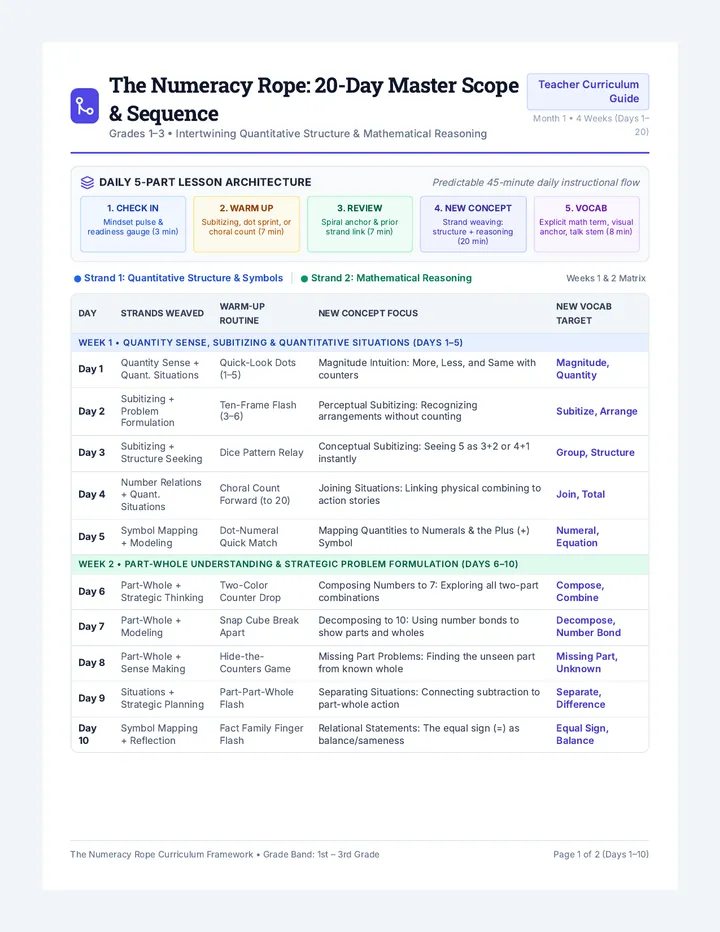
Factor Sprint Teacher Guide Tier 2 Intervention Arizona Grade 3 Mathematics
12 Days • 25 Min / Day • Small Group (3-5 Students)
Factor Sprint Teacher Guide
Explicit CRA (Concrete-Representational-Abstract) multiplication instructional roadmap.
Standard 25-Minute Tier 2 Lesson Architecture
3 Min: Fact Warm-Up
Choral skip-counting, dot card subitizing, rapid pattern flashes.
7 Min: Explicit CRA Model
"I Do / We Do" with counters, grid tiles, sketches, and clear think-alouds.
10 Min: Guided Practice
Workbook problem sets, partner math talk, teacher scaffolding probes.
5 Min: Quick Check
1-problem exit ticket or mastery probe, student self-rating, data log.
Arizona Mathematics Standards Crosswalk
3.OA.A.1: Interpret products (\(a \times b\)) as \(a\) equal groups of \(b\) items each.
3.OA.A.3: Solve multiplication word problems (equal groups, arrays, measurements).
3.OA.A.4: Determine unknown whole number in 3-term equations (\(4 \times ? = 24\)).
3.OA.D.8: Solve 2-step word problems using four operations with equations/letters.
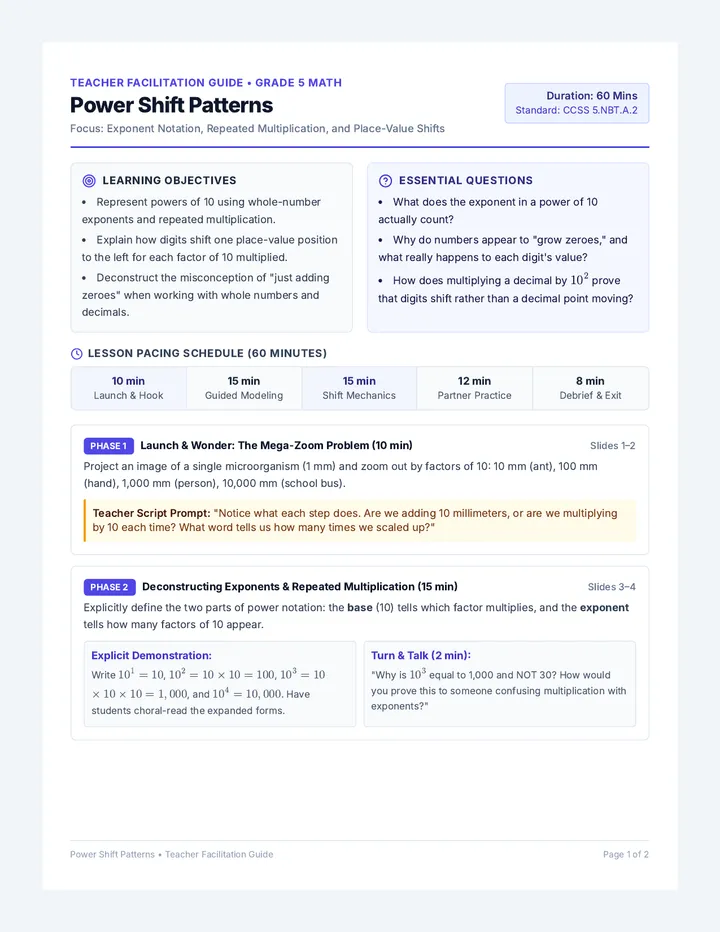
Phase 1 (Days 1–4): Equal Groups & Repeated Addition (3.OA.A.1) CRA: Counters • Circles • Equations
Day 1 Concept of "Groups Of": Build equal sets using two-color counters. Frame language: "I have 4 groups with 3 in each group." Contrast equal vs. unequal groups.
Day 2 Repeated Addition to Multiplication: Connect \(5 + 5 + 5 = 15\) to \(3 \times 5 = 15\). Script: "The first factor counts the groups; the second factor counts the size."
Day 3 Number Lines & Tape Diagrams: Skip-count jumps of equal intervals on 0–30 number lines. Draw equal-sized tape model segments to represent total products.
Day 4 Consolidation & Checkpoint 1: Synthesis practice with mixed representation cards. Administer Progress Check 1 (Probe A) (5 items, 8 minutes).
Phase 2 (Days 5–8): Arrays, Commutativity & Unknown Factors (3.OA.A.1, 3.OA.A.4) CRA: Tiles • Grid Drawings • Turnarounds
Day 5 Rectangular Arrays (Rows & Columns): Build rows (horizontal) and columns (vertical) using square color tiles. Vocabulary: \(Rows \times Columns = Total\).
Day 6 Commutative Turnaround Property: Rotate arrays 90 degrees to prove \(3 \times 6 = 6 \times 3 = 18\). Reinforce that order changes, but product stays identical.
Day 7 Missing Factors & Unknowns (3.OA.A.4): Solve \(4 \times \Box = 28\) and \(\Box \times 5 = 35\). Use partial arrays with covered rows to discover the mystery factor.
Day 8 Array Deconstruction & Checkpoint 2: Break larger arrays into friendly chunks (\(7 \times 4\) into \(5 \times 4 + 2 \times 4\)). Administer Progress Check 2 (Probe B) .
Factor Sprint • Tier 2 Intervention Program Arizona Math Standard Focus: 3.OA.A • Page 1 of 2
Teacher Implementation Tier 2 Diagnostic Strategies & Pacing
Word Problems, Error Correction & Data Protocols
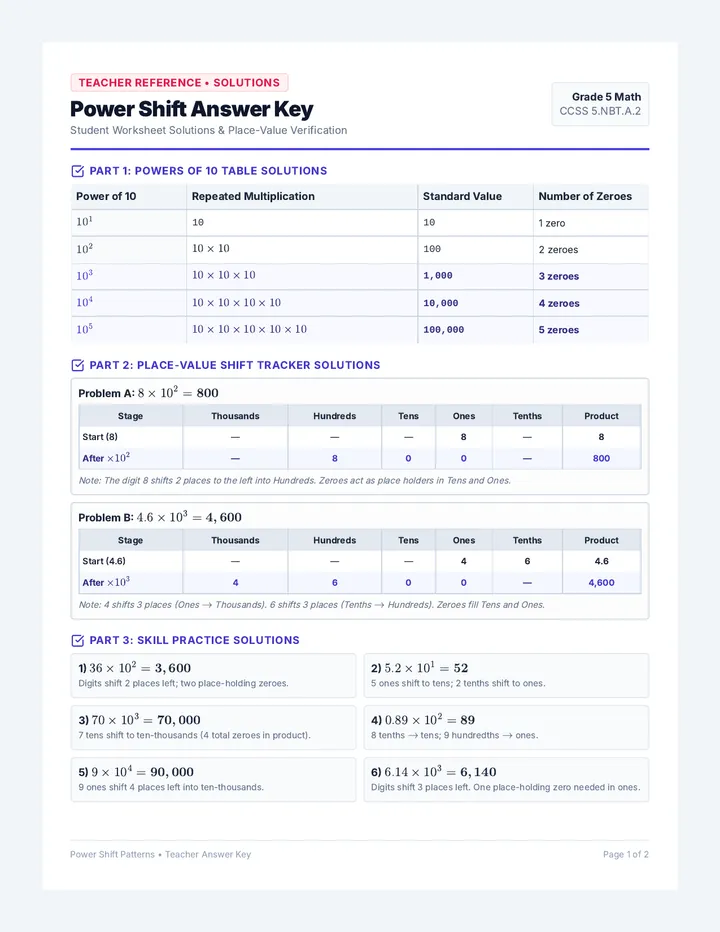
Phase 3 (Days 9–12): One-Step & Two-Step Word Problems (3.OA.A.3, 3.OA.D.8) Routine: Read • Draw • Write (RDW)
Day 9 One-Step Equal Group Stories: Introduce RDW anchor chart (Read carefully, Draw equal groups/tape diagram, Write equation with label). Identify "each" and "per".
Day 10 Array & Measurement Stories: Solve garden row, chair arrangement, and fabric meter problems. Model drawing neat bounding boxes before computing.
Day 11 Two-Step Scenarios (3.OA.D.8): Multiply first, then add or subtract (e.g., "Maya bought 4 packs of 6 stickers and had 5 extra. How many in total?"). Teach hidden questions.
Day 12 Cumulative Review & Checkpoint 3: Mixed application station. Administer Progress Check 3 (Probe C) . Graph student growth on the mastery tracking sheet.
Targeted Tier 2 Error Analysis & Scripted Reteach Prompts
Error 1: Adding Factors (\(4 \times 3 = 7\))
Student sees the multiplication symbol and defaults to addition.
Script: "Look at the sign. That means 'groups of'. Make 4 cups. Put 3 cubes in each cup. Did we just combine 4 and 3, or do we count 3 four times?"
Error 2: Unequal Groups Formation
Student draws circles but puts varying counts in each.
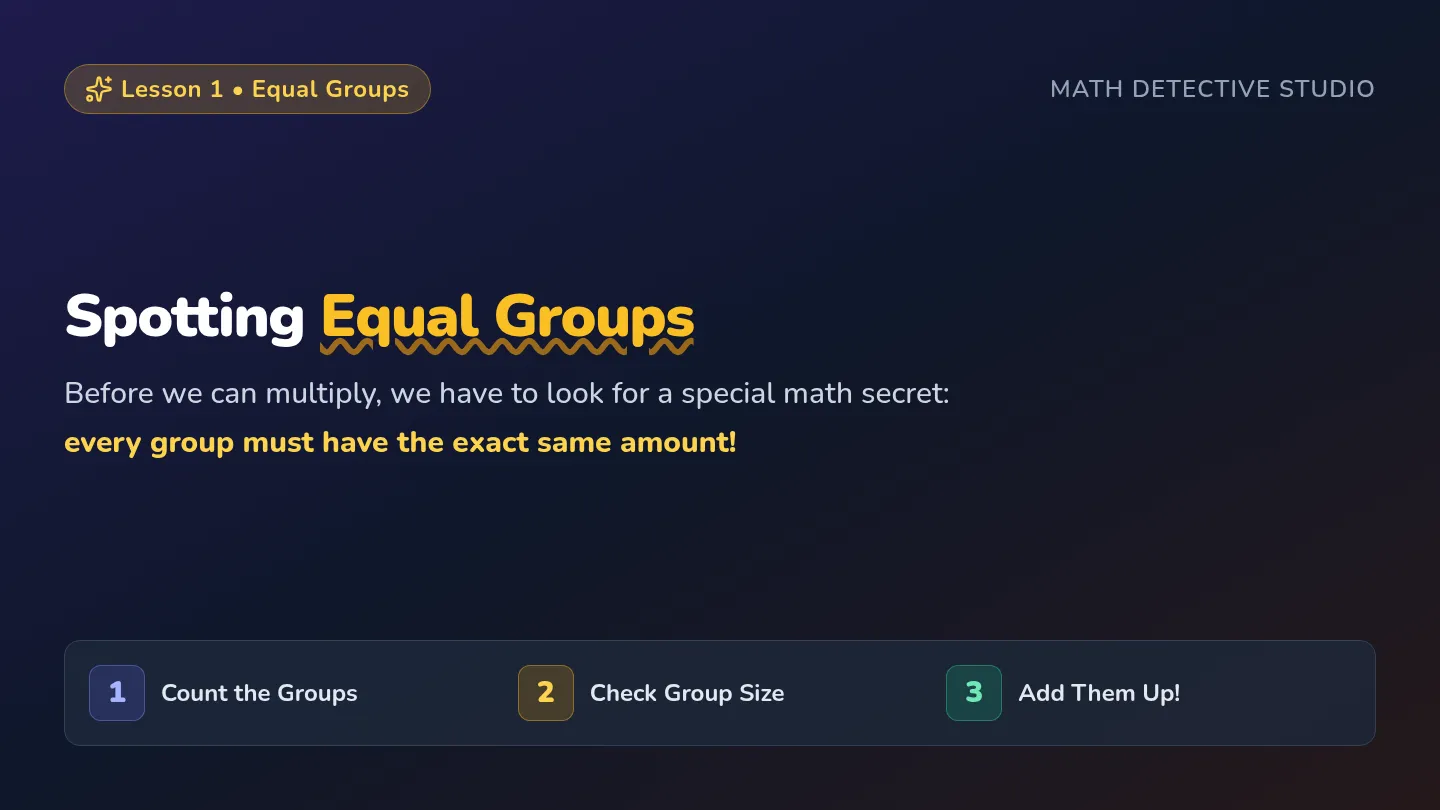
Script: "Can we multiply if groups are not twins? Touch and count each group. Every group must have the exact same amount before we multiply."
Error 3: Confusing Rows vs. Columns
Student struggles to write the correct dimension equation.
Script: "Swipe your finger across left-to-right: that's a row (like bleachers). Point up and down: that's a column (like building pillars)."
Error 4: Stopping After Step 1 in 2-Step Problems
Calculates product but forgets addition/subtraction.
Script: "Check your target question! Does your answer tell what the question asked, or just what Maya bought at the first store?"
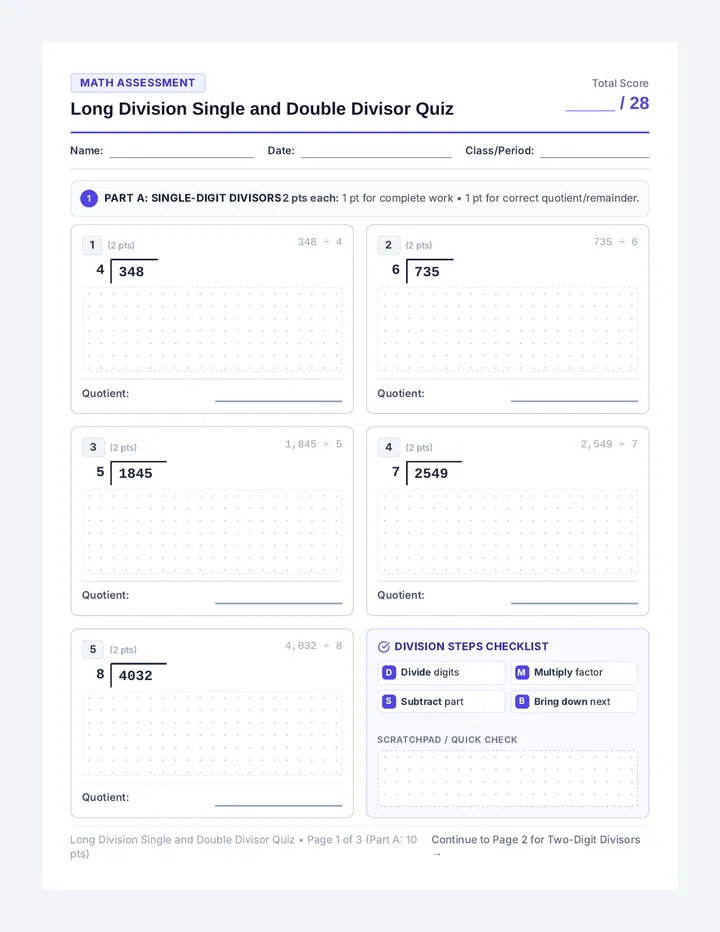
Tier 2 MTSS Progress Decision Protocol
≥ 80% (4/5 or 5/5 Correct)
Mastery Achieved: Transition to abstract equation solving. Introduce fast peer coaching and challenge extensions.
60% – 79% (3/5 Correct)
Emerging Skill: Maintain 25-minute intervention. Add 2 minutes of concrete manipulative modeling during warm-up.
< 60% (≤ 2/5 Correct)
Intensification Needed: Move to 1:1 or 1:2 micro-burst (10 extra min). Reinforce prerequisite skip-counting and equal sharing.
Factor Sprint • Tier 2 Intervention Program Arizona Math Standard Focus: 3.OA.A • Page 2 of 2
Multiplication Sprint Student Workbook Student Workbook Phase 1: Days 1–4
AZ Standard: 3.OA.A.1
Equal Groups & Repeated Addition
Name:
Date:
Day 1: Draw Equal Groups & Language Example: 3 groups with 4 in each group
1. Draw 4 groups with 3 dots in each group:
There are groups of dots. Total =
2. Draw 3 groups with 5 stars in each group:
There are groups of stars. Total =
Day 2: Repeated Addition to Multiplication Equations Match repeated addition with factor × factor
4 + 4 + 4 + 4 + 4 = 20 → groups of → × = 20
6 + 6 + 6 = 18 → groups of → × = 18
Day 3: Number Lines & Tape Diagrams Skip count jumps and bar models
Draw 5 jumps of 4 on the number line below:
024681012141618202224
Equation: × =
Fill in the tape diagram to show 4 equal parts of 6 :
6
Repeated Addition: • Equation:
Day 4: Equal Groups Synthesis Challenge Checkpoint 1 Prep
Circle groups of 3 to make equal sets:
• • • • • • • • • • • •
Equation: × =
Draw your own equal groups for 2 × 8 = 16:
Explanation: I have groups with in each.
Factor Sprint Intervention Workbook • Grade 3 Mathematics Page 1 of 3
Student Workbook Phase 2: Days 5–8
AZ Standards: 3.OA.A.1, 3.OA.A.4
Arrays, Turnarounds & Unknown Factors
Name:
Date:
Day 5: Rectangular Arrays (Rows & Columns) Remember: Rows go across (→), Columns go down (↓)
1. Identify the array dimensions:
◼ ◼ ◼ ◼ ◼
Number of rows:
Columns in each row:
Equation: × =
2. Draw an array for 4 rows of 3 :
Equation: × =
Day 6: Commutative Turnaround Property Rotate the array: order changes, total stays the same
Turnaround Pair 1
2 × 6 = 12
× = 12
Turnaround Pair 2
5 × 3 = 15
× = 15
Turnaround Pair 3
4 × 7 = 28
× = 28
Day 7: Unknown Factor Equations (3.OA.A.4) Find the mystery factor to make the equation true
4 × = 24
Skip count by 4:
Checkpoint Probes Assessment Progress Checks Arizona Grade 3 Tier 2 Mastery Probes
Mastery Target: 80% (4/5 or 3/4)
Tier 2 Quick Progress Probes
Name:
Date:
CHECKPOINT 1 • Day 4 Mastery Probe: Equal Groups (3.OA.A.1) Score: ____ / 4 pts
1. Complete the equal groups sentence:
(• • • •) (• • • •) (• • • •)
There are groups of dots.
2. Write the multiplication equation:
5 + 5 + 5 + 5 + 5 + 5 = 30
× = 30
3. Draw equal groups for 4 × 2:
Total product =
4. Skip-count jumps on number line:
0369121518
Show 4 jumps of 3. What number do you land on?
CHECKPOINT 2 • Day 8 Mastery Probe: Arrays & Unknown Factors (3.OA.A.1, 3.OA.A.4) Score: ____ / 4 pts
1. Write equation for the array:
◼ ◼ ◼ ◼
× =
2. Complete the turnaround fact:
If 4 × 6 = 24 , then:
× = 24
3. Find the missing unknown factor:
3 × = 27
The unknown factor is:
4. Find the missing factor:
× 5 = 40
The unknown factor is:
Factor Sprint Progress Monitoring • Probes A & B Page 1 of 2
Cumulative Check Phase 3 Probe & Tier 2 Growth Log
AZ Standards: 3.OA.A.3, 3.OA.D.8
Word Problems Probe & Mastery Tracker
Name:
Date:
CHECKPOINT 3 • Day 12 Mastery Probe: Multiplication Situations (3.OA.A.3, 3.OA.D.8) Score: ____ / 3 pts
1. One-Step Equal Groups (3.OA.A.3): 1 pt
A desert nursery has 6 trays of young saguaro cactus plants. Each tray holds 4 plants . How many plants are there altogether?
Equation:
Answer: cactus plants
2. One-Step Array Context (3.OA.A.3): 1 pt
A student tile mosaic in Phoenix has 3 rows with 8 turquoise stones in each row. How many stones were used?
Equation:
Answer: turquoise stones
3. Two-Step Story Problem (3.OA.D.8): 1 pt
Mateo packed 5 bags of oranges with 6 oranges in each bag. He gave 8 oranges to his neighbors. How many oranges does Mateo have left?
Step 1 (Multiply):
Step 2 (Subtract):
Final Answer: Mateo has oranges left.
Intervention Solutions Answer Key Teacher Master Key Intervention Solutions & Rubrics
Full 12-Day Workbook Solutions
Student Workbook Master Solutions (Days 1–12)
Phase 1 Solutions: Equal Groups & Repeated Addition (Days 1–4) AZ: 3.OA.A.1
Day 1:
1. 4 groups of 3 dots = 12 total. (4 circles with 3 dots each).
2. 3 groups of 5 stars = 15 total. (3 circles with 5 stars each).
Day 2:
4+4+4+4+4 = 20 → 5 groups of 4 → 5 × 4 = 20
6+6+6 = 18 → 3 groups of 6 → 3 × 6 = 18
Day 3:
Number Line: 5 jumps of 4 land on 20 • 5 × 4 = 20
Tape Diagram: 4 parts of 6: 6+6+6+6 = 24 • 4 × 6 = 24
Day 4:
Equal sets: 4 groups of 3 dots circled • 4 × 3 = 12
Draw 2 × 8: 2 groups with 8 items each = 16 total.
Phase 2 Solutions: Arrays, Turnarounds & Unknown Factors (Days 5–8) AZ: 3.OA.A.1, 3.OA.A.4
Day 5:
1. 3 rows, 5 columns → 3 × 5 = 15
2. Array of 4 rows of 3: grid of 4 rows × 3 cols → 4 × 3 = 12
Day 6 (Turnaround Facts):
Pair 1: 2 × 6 = 12 → 6 × 2 = 12
Pair 2: 5 × 3 = 15 → 3 × 5 = 15
Pair 3: 4 × 7 = 28 → 7 × 4 = 28
Day 7 (Unknown Factors):
4 × [6 ] = 24 • [7 ] × 5 = 35
3 × [7 ] = 21 • [3 ] × 6 = 18
Day 8 (Array Splitting 7 × 3):
Chunk A: 5 × 3 = 15; Chunk B: 2 × 3 = 6
Add chunks: 15 + 6 = 21. So 7 × 3 = 21.
Phase 3 Solutions: One-Step & Two-Step Word Problems (Days 9–12) AZ: 3.OA.A.3, 3.OA.D.8
Day 9 (One-Step Equal Groups): Leo's crayons: Model 4 boxes with 6 crayons in each • Equation: 4 × 6 = 24 • Answer: 24 crayons
Day 10 (One-Step Array Context): Gym chairs: Array of 5 rows and 7 columns • Equation: 5 × 7 = 35 • Answer: 35 chairs
Day 11 (Two-Step Addition): Amira's stickers • Step 1: 3 × 6 = 18 stickers • Step 2: 18 + 5 = 23 • Answer: 23 stickers
Day 12 (Two-Step Subtraction): Carlos's muffins • Step 1: 4 × 5 = 20 muffins • Step 2: 20 - 7 = 13 • Answer: 13 muffins left
Factor Sprint Intervention • Teacher Solutions Page 1 of 2
Assessment Scoring Checkpoint Probes 1, 2 & 3 Key
Tier 2 Diagnostic Rubrics