Lenny.com
Explore
Create
ActivitiesNewMathEnglish Language ArtsScience & EngineeringSocial StudiesGlobal LanguagesHealth & Physical EducationSpecial EducationCounseling & Life SkillsArts & CreativityESL
Lenny.com
Lenny.com
Explore
Create
ActivitiesNewMathEnglish Language ArtsScience & EngineeringSocial StudiesGlobal LanguagesHealth & Physical EducationSpecial EducationCounseling & Life SkillsArts & CreativityESL
Lenny.com
Lenny.com

Solutions

Lenny for EducatorsLenny for SchoolsLenny for Districts

Product

ExploreSign inCreateSupportAbout

Resources

Getting startedMTSS Acceleration Program

Newsletters

School Funding Newsletter

© 2026 Lenny Learning Inc.

TermsPrivacyAccessibility
LinkedInInstagramX
Lenny
MathNumbers & CountingCounting ObjectsNumber NamesComparing NumbersNumber OperationsCounting SequenceNumbers 0-10Place Value Understanding and SystemAdd and Subtract Within 20Addition and Subtraction ConceptsAddition and Subtraction EquationsAddition and Subtraction ProblemsFoundations for MultiplicationMultiplication and Division PropertiesMultiply and Divide Within 100Multiplication and Division ProblemsFactors and MultiplesProperties of OperationsPatterns and RelationshipsGenerate and Analyze PatternsMulti-Digit ArithmeticPlace Value OperationsMulti-Digit and Decimal OperationsNumerical ExpressionsFour Operations and PatternsFour Operations Problem SolvingMeasurement & DataMeasurable AttributesMeasuring LengthsMeasure and Estimate Lengths in Standard UnitsRelate Addition and Subtraction to LengthClassifying and Counting ObjectsTime and MoneyArea Concepts and MeasurementPerimeter and Area MeasuresAngle Concepts and MeasurementTime, Volume, and MassMeasurement Unit ConversionsGeometryIdentifying ShapesShapes and AttributesShape Attributes and ReasoningShapes and CompositionClassifying 2D FiguresGeometric Figures and RelationshipsLines, Angles, and ShapesAngle, Area, and VolumeGeometric MeasurementVolume of 3D ShapesCoordinate Plane ApplicationsTransformations in the PlaneCongruence and SimilarityUnderstand congruence in terms of rigid motionsSimilarity and TransformationsProve Theorems Involving SimilarityPythagorean TheoremTrigonometry for General TrianglesMake Geometric ConstructionsProve Geometric TheoremsTheorems About CirclesFind Arc Lengths And Areas of Sectors of CirclesVolume FormulasRelationships Between Two-Dimensional and Three-Dimensional ObjectsProve Simple Geometric Theorems AlgebraicallyTranslate Between Geometric Description and Equation for Conic SectionApply Geometric Concepts in Modeling SituationsFractions & DecimalsFractions as NumbersBuilding FractionsFraction Equivalence and OrderingAdding and Subtracting FractionsMultiplying and Dividing FractionsDividing FractionsDecimal FractionsMulti-Digit Computation and FactorsAdd, Subtract, Multiply, and Divide Rational NumbersRational Number SystemIrrational Numbers and ApproximationsRatiosRatios and ProportionsProportional RelationshipsUnit RateAlgebraAlgebraic ExpressionsGenerate Equivalent ExpressionsQuantitative RelationshipsProportional Relationships and Linear EquationsEquations and InequalitiesEquation Solving and ReasoningLinear Equations and SystemsGraph Equations and InequalitiesSystems of EquationsReal-World Algebraic ProblemsQuantitative Reasoning with UnitsExpression StructureEquivalent Expression FormsRadicals and Integer ExponentsRational ExponentsRational and Irrational NumbersPolynomial OperationsPolynomial IdentitiesPolynomial Zeros and FactorsRational ExpressionsComplex Number OperationsComplex Numbers in PolynomialsComplex Numbers on PlaneStatistics & ProbabilityRepresent and Interpret DataData DistributionsStatistical VariabilityProbability ModelsCompound Event ProbabilitiesStatistical SamplingInterpret Categorical and Quantitative DataBivariate Data PatternsInterpret Linear ModelsComparing Two PopulationsRandom Processes in StatisticsIndependence and Conditional ProbabilityExpected ValuesProbability-Based Decision MakingStatistical Inference and ConclusionsFunctionsFunction Concepts and NotationDefine and Compare FunctionsInterpret Functions in ContextAnalyze Function RepresentationsModel Relationships with FunctionsIdentify Linear vs Exponential GrowthDistinguish Between Function TypesCompare Growth RatesInterpret Function ExpressionsBuild Functions from RelationshipsConstruct and Model FunctionsTransform and Combine FunctionsModel Comparison and SelectionSolve Exponential EquationsTrigonometryTrigonometric Ratios Involving Right TrianglesTrigonometric Functions and Unit CircleModel with Trigonometric FunctionsTrigonometric IdentitiesVectors & MatricesIntroduction to Vectors and MatricesVector QuantitiesVector OperationsMatrix OperationsCalculusLimits and ContinuityDerivative Concepts and NotationDerivative Rules and TechniquesApplications of DerivativesOptimization ProblemsRelated RatesCurve Sketching and AnalysisIntegration Concepts and NotationAntiderivatives and Indefinite IntegralsDefinite Integrals and AreaFundamental Theorem of CalculusIntegration TechniquesApplications of IntegrationDifferential EquationsSequences and SeriesParametric and Polar FunctionsVector-Valued Functions

Power Shift Patterns

A foundational mathematics lesson exploring exponents as repeated multiplication and analyzing place-value shifts when multiplying numbers by powers of 10.

SNShanna Noonan

Power Shift Patterns

A foundational mathematics lesson exploring exponents as repeated multiplication and analyzing place-value shifts when multiplying numbers by powers of 10.

SNShanna Noonan

The True Mathematical Rule

"Digits shift one place left!"

Watch the place values change:

\(3.5 \times 10 = 35\)

3 ones shift to 3 tens. 5 tenths shift to 5 ones. The value increased 10 times!

The decimal point stays locked. The digits do all the moving!


Shift Challenge: Rapid Fire

Ready for Worksheet Practice

Challenge 1

\(10^4 = \ ?\)

Write the repeated multiplication and standard value.

Answer: 10,000

Challenge 2

\(48 \times 10^3 = \ ?\)

How many places do the digits shift to the left?

Answer: 3 places (48,000)

Challenge 3

\(2.7 \times 10^2 = \ ?\)

Explain where the digit 2 and digit 7 end up.

Answer: 270 (2 hundreds, 7 tens)

Next Step: Grab your Power Shift Worksheet! Test your skills on the place-value grid

3 Skill Practice: Multiplying by Powers of 10

Find each product. Write your answer clearly in the box.

  1. \(36 \times 10^2 =\)

  2. \(5.2 \times 10^1 =\)

  3. \(70 \times 10^3 =\)

  4. \(0.89 \times 10^2 =\)

  5. \(9 \times 10^4 =\)

  6. \(6.14 \times 10^3 =\)

4 Detective Challenge: Error Analysis

Maya claims: "To solve \(4.7 \times 10^2\), I just add two zeroes to the end because the exponent is 2. So my answer is \(4.700\)."

A) Why is Maya's mathematical thinking incorrect? (What happened to the value of \(4.700\)?)

B) What is the correct product of \(4.7 \times 10^2\), and how did the digits actually shift?

5 Real-World Scientific Scale Challenge

A high-powered digital microscope magnifies a tiny amoeba by a factor of \(10^3\). The amoeba's actual length is \(0.35\text{ mm}\).

What is the magnified image length in millimeters?

mm

Show your thinking or explain the digit movement below:

Power Shift Patterns • Student Investigation Sheet Page 2 of 2

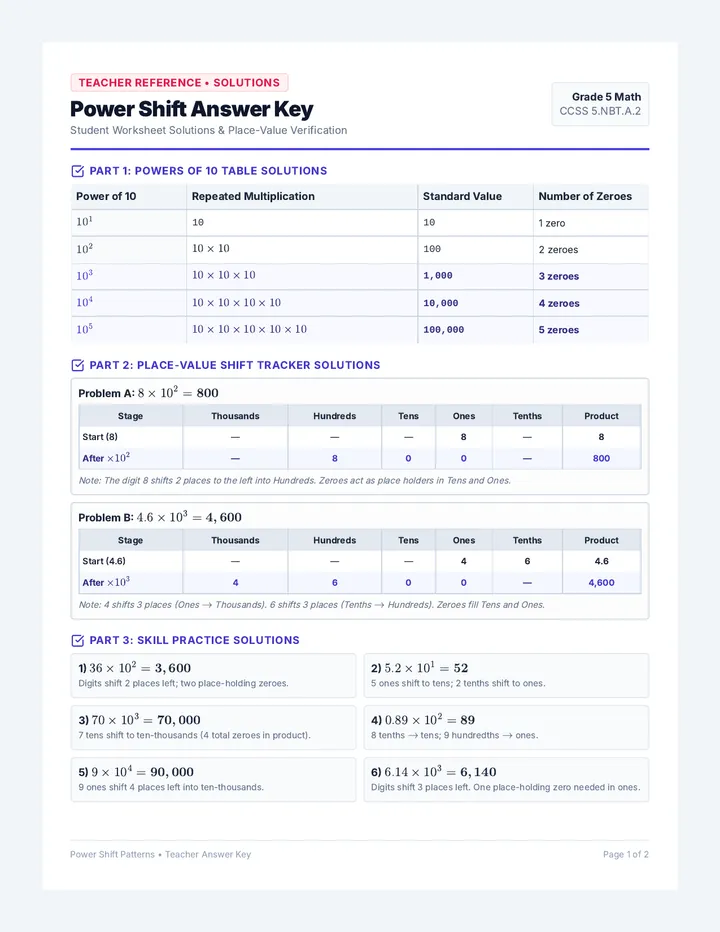
  • \(5.2 \times 10^1 = \mathbf{52}\) 5 ones shift to tens; 2 tenths shift to ones.

  • \(70 \times 10^3 = \mathbf{70,000}\) 7 tens shift to ten-thousands (4 total zeroes in product).

  • \(0.89 \times 10^2 = \mathbf{89}\) 8 tenths \(\to\) tens; 9 hundredths \(\to\) ones.

  • \(9 \times 10^4 = \mathbf{90,000}\) 9 ones shift 4 places left into ten-thousands.

  • \(6.14 \times 10^3 = \mathbf{6,140}\) Digits shift 3 places left. One place-holding zero needed in ones.

  • Power Shift Patterns • Teacher Answer Key Page 1 of 2

    Answer Key & Scoring Guide

    Reasoning Tasks & Exit Ticket Key

    CCSS 5.NBT.A.2

    Part 4: Error Analysis Model Response

    A) Why Maya's reasoning is incorrect:

    Exemplar Answer: Maya simply placed zeroes after the decimal point (\(4.700\)). Adding zeroes to the end of a decimal does not change its value at all—\(4.700\) is still equal to \(4.7\). Multiplying by \(10^2\) means multiplying by 100, which must make the number 100 times larger, not keep it the same.

    B) Correct product & digit shift:

    Correct Product: \(\mathbf{470}\). Each digit shifts 2 places to the left: 4 ones shift to 4 hundreds, and 7 tenths shift to 7 tens. A place-holding zero is needed in the ones place.

    Part 5: Real-World Microscope Challenge

    Magnified Length: \(0.35 \times 10^3 = \mathbf{350\text{ mm}}\) Full Credit = 350 mm

    Thinking: \(10^3 = 1,000\). Multiplying by \(10^3\) shifts all digits 3 places to the left: the 3 tenths shift to 3 hundreds, 5 hundredths shift to 5 tens, and a zero is placed in the ones place.

    Exit Ticket Scoring Criteria (3 Points Total)

    Quick Diagnostic

    ItemCorrect Response / Look-ForsRemediation Look-Fors (Common Error)
    Q1 (\(10^4\))Repeated: \(10 \times 10 \times 10 \times 10\)
    Standard: \(\mathbf{10,000}\)If student writes \(10 \times 4 = 40\), review exponent vs. factor meaning immediately.
    Q2 (Digit Shift)Digits shifted 3 places to the LEFT (value increased by 1,000).If student says "shifted right" or just says "added 3 zeroes," prompt with place value names.
    Q3 (\(5.4 \times 10^2\))Product: \(\mathbf{540}\). Reason: \(5.400 = 5.4\) (no value change). Digits must shift 2 places left.If student wrote \(5.400\), pull for small group place-value slider intervention.

    Mastery (3/3): Ready for independent decimal operations and multi-digit division by powers of 10.

    Needs Support (0–2/3): Target specifically whether error is in exponent expansion or place-value shifting.

    Power Shift Patterns • Teacher Answer Key Page 2 of 2
    You might also like

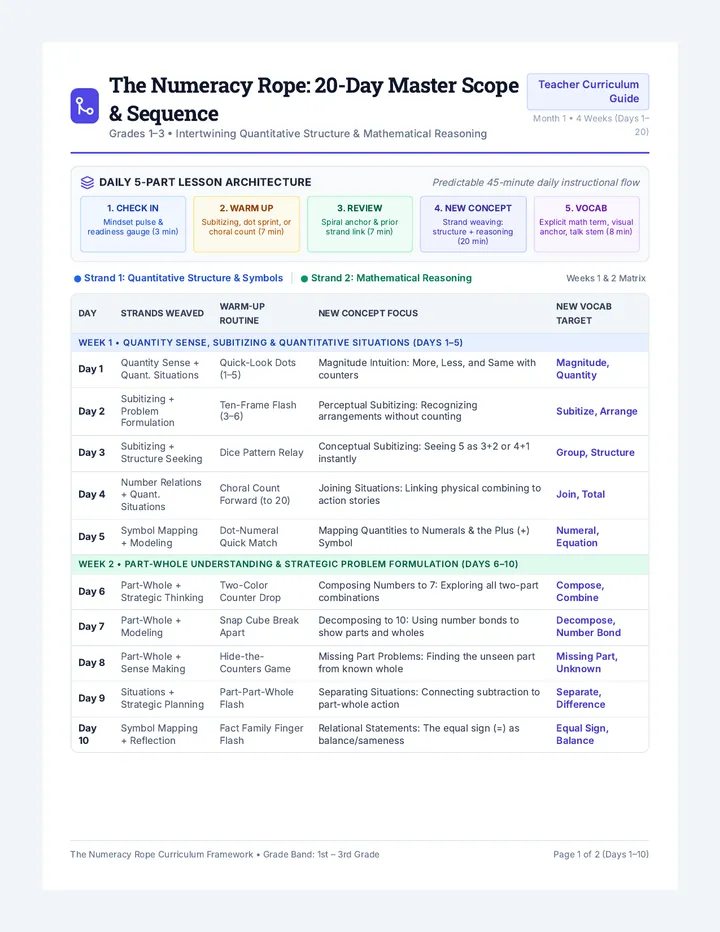
    Numeracy Rope Master Plan Guide

    Numeracy Rope Sequence

    A comprehensive four-week foundational numeracy sequence for Grades 1–3, systematically intertwining quantitative structure with mathematical reasoning. Spanning twenty lessons, it guides students from intuitive subitizing and part-whole thinking to unitizing and structural fact fluency.

    AR

    Amanda Ramirez

    9
    Number Hunt Quick Checks

    Number Detectives

    A comprehensive kindergarten counting and cardinality formative assessment suite featuring targeted student quick-check sheets, an observational interview protocol, and diagnostic warm-up slides.

    Lenny Avatar
    Lenny
    2
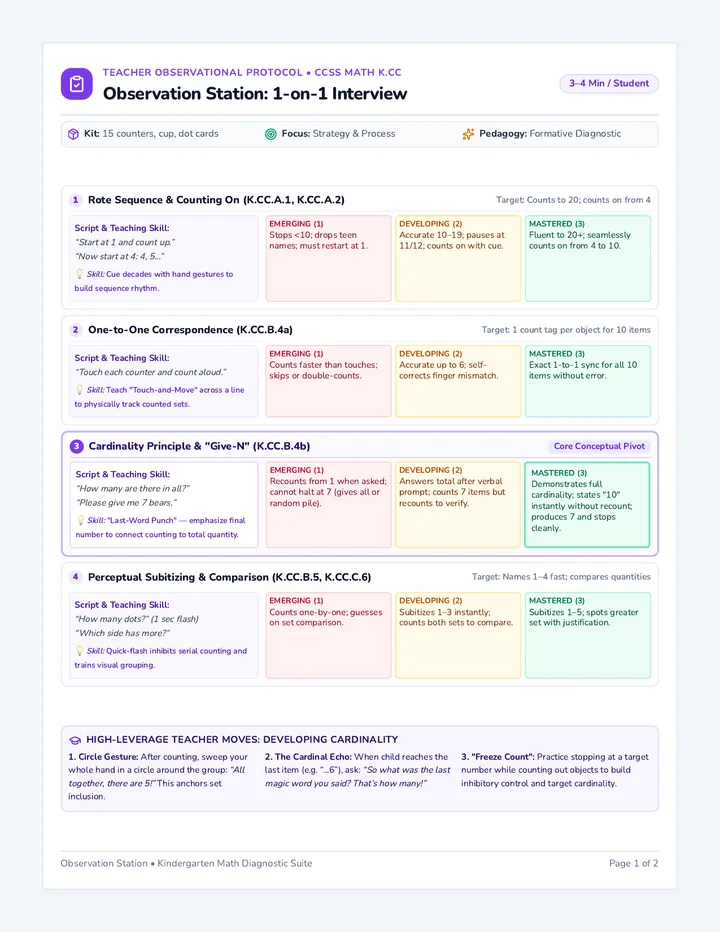
    Observation Station Teacher Guide

    Observation Station Teacher Guide

    A 2-page teacher interview protocol and diagnostic assessment tracker containing observational scripts, 3-level mastery rubrics, a class roster grid, and targeted mini-interventions for counting and cardinality.

    Lenny Avatar
    Lenny
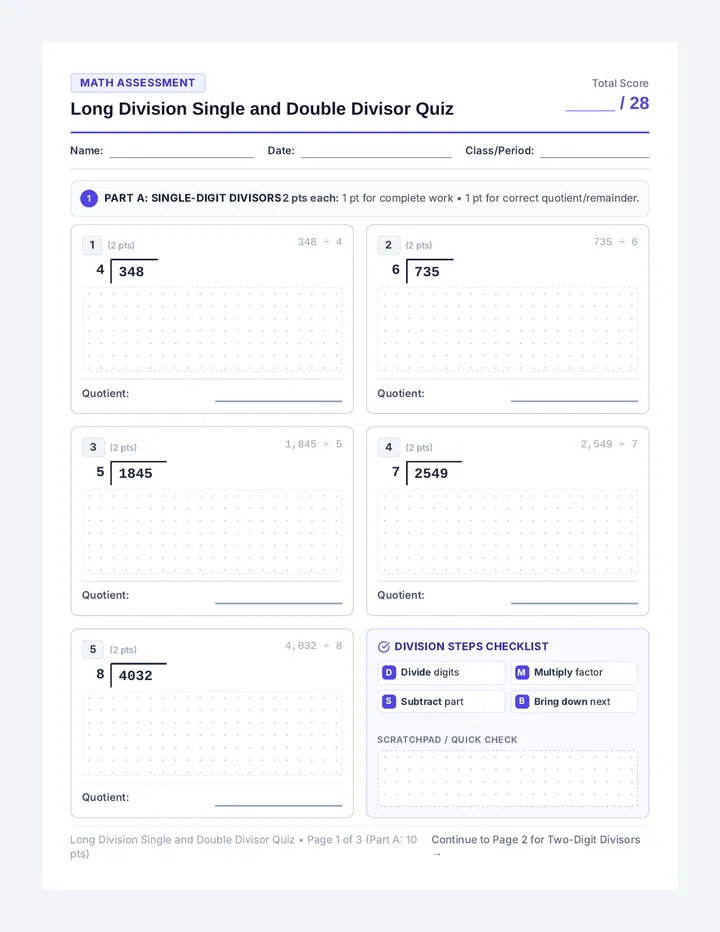
    Long Division Single and Double Divisor Quiz

    Math Mastery Series

    A collection of middle school mathematics assessments and teacher resources covering arithmetic fluency and pre-algebra foundations.

    S

    Steve.Peters

    4
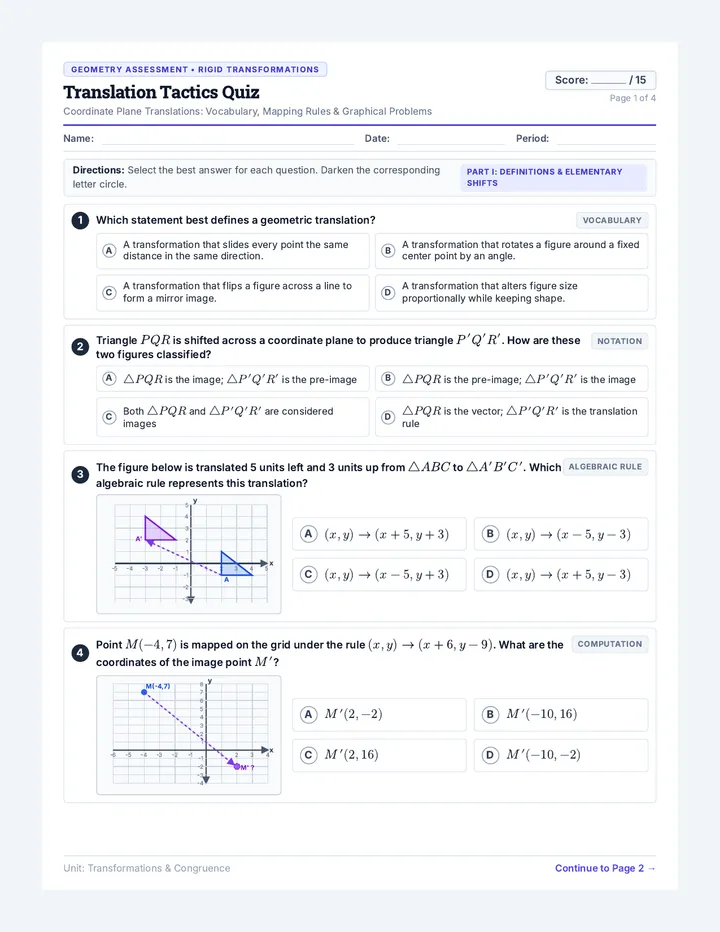
    Translation Tactics Quiz Document

    Translation Tactics

    A geometry lesson focused on rigid transformations and coordinate plane translations, featuring vocabulary, algebraic mapping rules, coordinate computations, and inverse shift problem-solving.

    FM

    Fernando Mancini

    2
    Number Hunt Quick Checks

    Number Hunt Quick Checks

    A 2-page printable formative assessment worksheet for kindergarteners assessing counting objects up to 10, ten-frame representation, counting forward from numbers other than 1, and comparing quantities.

    Lenny Avatar
    Lenny
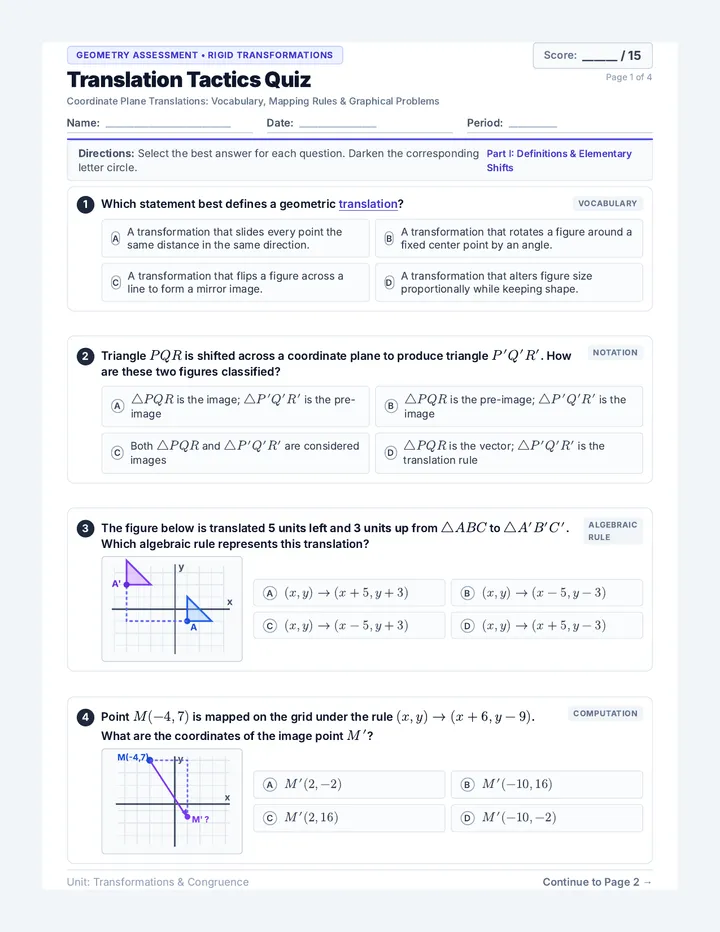
    Translation Tactics Quiz

    Math Mastery Units

    Comprehensive secondary mathematics units covering coordinate geometry transformations and linear functions in slope-intercept form.

    FM

    Fernando Mancini

    4
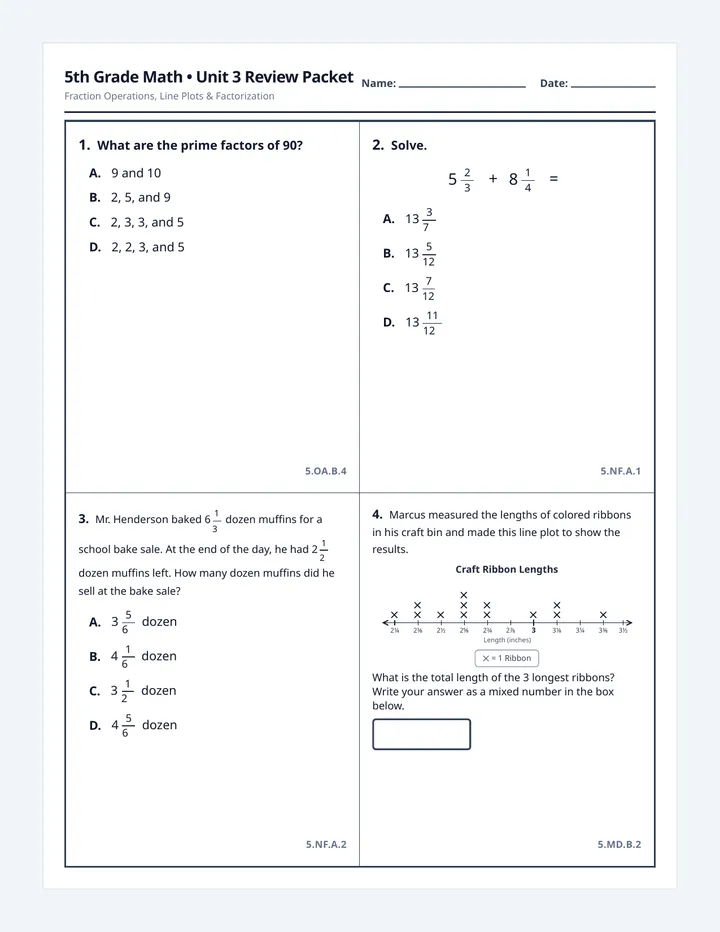
    Fraction Review Packet

    Fraction Operations Review

    A comprehensive 5th grade review unit covering operations with fractions, mixed numbers, line plots, and prime and composite numbers. Includes a student review packet mirroring unit test formats and a complete teacher answer key with step-by-step solutions.

    MN

    Monica Nava

    3
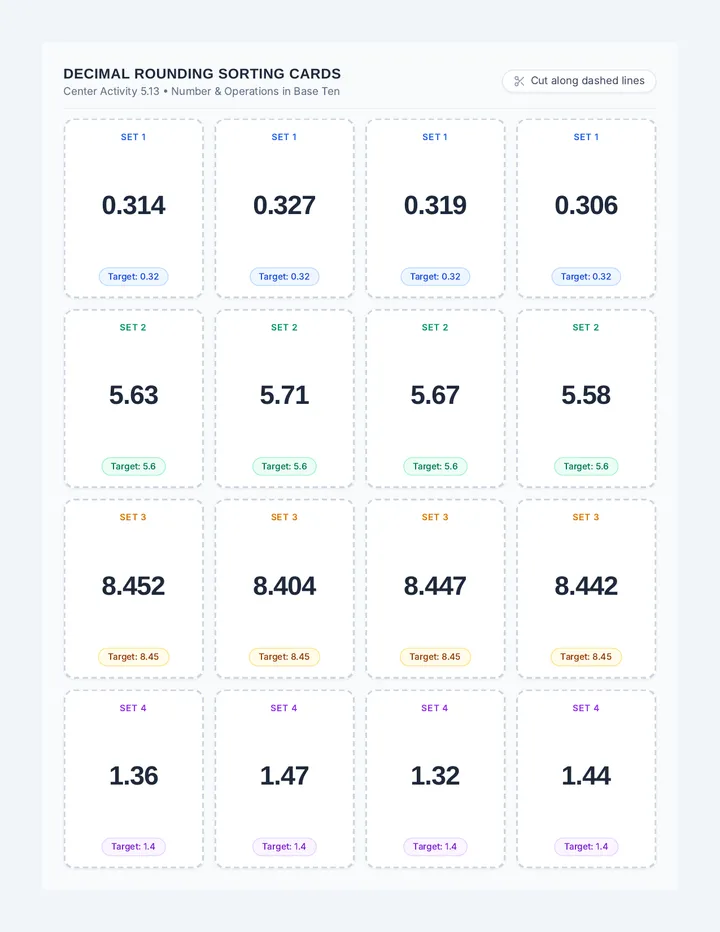
    Lesson 9 -Decimal Rounding Sorting Cards

    Lesson 9 -Decimal Rounding Sorting Cards

    A printable set of 16 decimal sorting cards extracted from the rounding game recording sheet, formatted in a clean 4-by-4 cuttable grid with clear guidelines.

    KS

    Kaila Strubhart

    Equal Groups Slides

    Equal Group Explorers

    A three-part intervention sequence designed for students struggling with early multiplication concepts. The sequence methodically transitions learners from concrete equal groups to repeated addition, number line skip-counting, and formal multiplication notation.

    B

    bower

    9
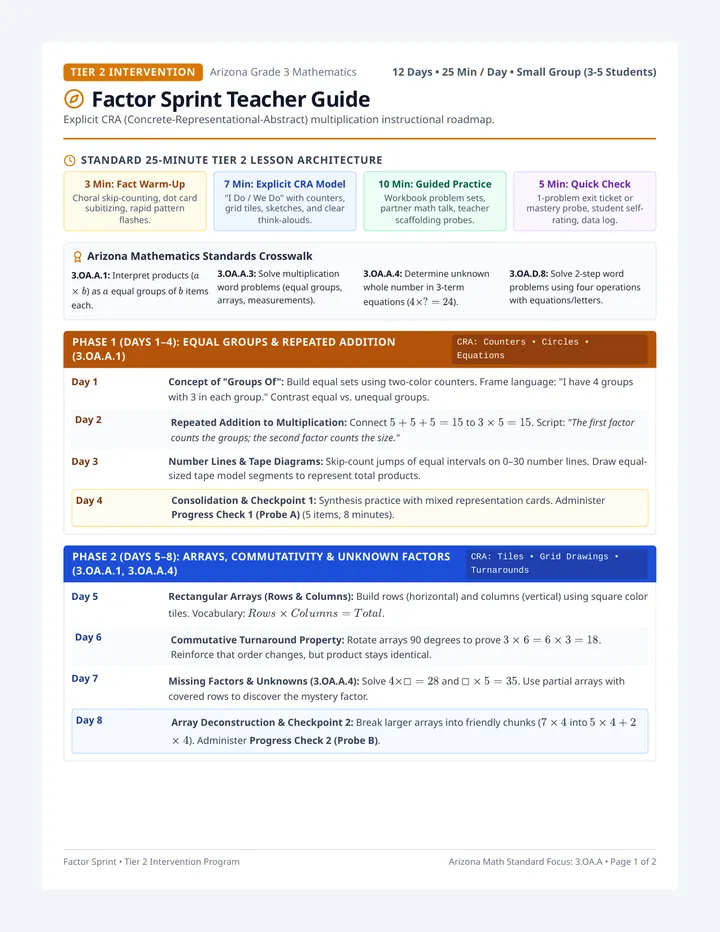
    Factor Sprint Teacher Guide

    Factor Sprint Intervention

    A 12-day targeted Tier 2 multiplication intervention program designed for 25-minute small-group instructional blocks, aligning with Arizona 3rd Grade Mathematics Standards (3.OA.A.1, 3.OA.A.3, 3.OA.A.4, and 3.OA.D.8). The unit systematically moves students through concrete-representational-abstract stages across equal groups, arrays with unknown factors, and one- and two-step multiplication word problems.

    TD

    Taylor Doucet

    4
    Power Shift Answer Key

    Power Shift Answer Key

    A comprehensive answer key and diagnostic scoring rubric covering the student worksheet and exit ticket with teacher annotations.

    SN

    Shanna Noonan