Fraction Operations Review A comprehensive 5th grade review unit covering operations with fractions, mixed numbers, line plots, and prime and composite numbers. Includes a student review packet mirroring unit test formats and a complete teacher answer key with step-by-step solutions.
MN Monica Nava
Fraction Review Packet
A 4-page review packet mirroring the 5th Grade Unit 3 math assessment. Features 16 parallel questions with fresh numbers and contexts, covering fraction operations, line plots, and prime/composite factorization with identical standards alignment.
Fraction Review Answer Key
A comprehensive 2-page teacher answer key and instructional guide. Contains a quick-scan scoring matrix, detailed step-by-step solutions for all 16 questions, CCSS standard alignments, and common student misconception notes.
Fraction Strategy Guided Notes
A 4-page step-by-step guided notes packet with fill-in-the-blank strategies and procedural scaffolds for all 16 questions from the Unit 3 review. Aligns 1-to-1 with packet questions to build problem-solving confidence.
Fraction Operations Review A comprehensive 5th grade review unit covering operations with fractions, mixed numbers, line plots, and prime and composite numbers. Includes a student review packet mirroring unit test formats and a complete teacher answer key with step-by-step solutions.
MN Monica Nava
Fraction Review Packet 5th Grade Math • Unit 3 Review Packet
Fraction Operations, Line Plots & Factorization
Name:
Date:
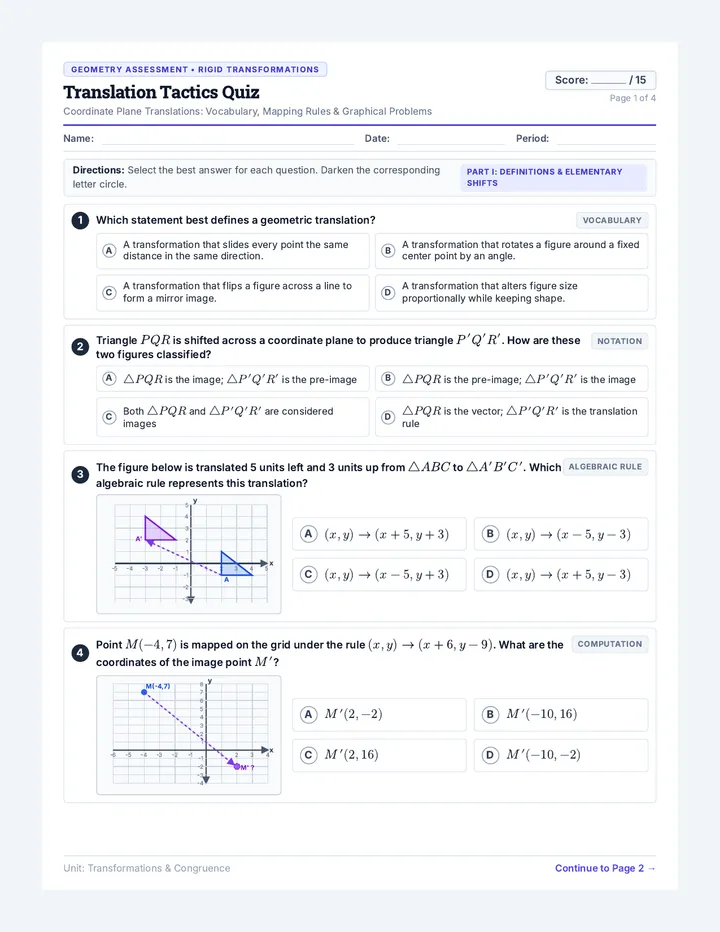
What are the prime factors of 90?
A. 9 and 10
B. 2, 5, and 9
C. 2, 3, 3, and 5
D. 2, 2, 3, and 5
5.OA.B.4
Solve.
523 + 814 =
A. 1337
B. 13512
C. 13712
D. 131112
5.NF.A.1
Mr. Henderson baked 613 dozen muffins for a school bake sale. At the end of the day, he had 212 dozen muffins left. How many dozen muffins did he sell at the bake sale?
A. 356 dozen
B. 416 dozen
C. 312 dozen
D. 456 dozen
5.NF.A.2
Marcus measured the lengths of colored ribbons in his craft bin and made this line plot to show the results.
Craft Ribbon Lengths ✕ ✕ ✕ ✕ ✕ ✕ ✕ ✕ ✕ ✕ ✕ ✕ ✕ 2¼ 2⅜ 2½ 2⅝ 2¾ 2⅞ 3 3⅛ 3¼ 3⅜ 3½ Length (inches)
✕ = 1 Ribbon
What is the total length of the 3 longest ribbons? Write your answer as a mixed number in the box below.
5.MD.B.2
5th Grade Math • Unit 3 Review Packet
Page 2
Name:
Karen measured her study desk below. She multiplied the measurements to find the area of the top of her desk.
Desk Top
Width = 214 ft
Length = 312 ft
What is the area of her desk?
A. 534 ft²
B. 618 ft²
C. 778 ft²
D. 1414 ft²
5.NF.B.6
Is the number 28 a prime or composite number?
The number 28 is a number because it has two factors.
Circle one option in each row to complete the statement:
<table class="w-full text-xs border border-slate-400 mb-2"><tbody><tr class="border-b border-slate-300"><td class="p-1.5 font-bold bg-slate-50 w-24 border-r border-slate-300 text-[11px]">Blank One:</td><td class="p-1.5 text-center border-r border-slate-300"><span class="px-2 py-0.5 border border-slate-400 rounded text-[11px]">prime</span></td><td class="p-1.5 text-center"><span class="px-2 py-0.5 border border-slate-400 rounded text-[11px]">composite</span></td></tr><tr><td class="p-1.5 font-bold bg-slate-50 border-r border-slate-300 text-[11px]">Blank Two:</td><td class="p-1.5 text-center border-r border-slate-300"><span class="px-2 py-0.5 border border-slate-400 rounded text-[11px]">exactly</span></td><td class="p-1.5 text-center"><span class="px-2 py-0.5 border border-slate-400 rounded text-[11px]">more than</span></td></tr></tbody></table>
5.OA.B.4
Frankie visited a park that has a rectangular trail around its outer edge. The dimensions of the trail are shown below.
35 mile
14 mi
14 mi
35 mile
Frankie walked around the trail one time. How many miles did she walk? Write your response as a fraction or mixed number in the box below.
5.NF.A.2
At a track meet, a relay race with a total distance of 13 mile is run by a team of 4 runners. Each runner completed the same distance.
Which models find the distance run by each runner? Choose THREE correct answers.
A.
0 ⅓ 1 R1 R2 R3 R4
B. 13 ÷ 4
C.
0 2 4 R1 R2
D. 13 × 4
E. 13 × 14
5.NF.B.7.a
5th Grade Math • Unit 3 Review Packet
Page 3
Name:
Coach McCarthy recorded the distance each member of the 10-person track team ran in 6 minutes.
¼, ¼, ²/₄, ²/₄, ²/₄, ¾, ¾, ¾, ¾, ⁴/₄
Which line plot represents the recorded data?
A. ✕ ✕ ✕ ✕ ✕ ✕ ✕ ✕ ✕ ✕ 0 ¼ ²/₄ ¾ 1
B. ✕ ✕ ✕ ✕ ✕ ✕ ✕ ✕ ✕ ✕ 0 ¼ ²/₄ ¾ 1
C. ✕ ✕ ✕ ✕ ✕ ✕ ✕ ✕ ✕ ✕ 0 ¼ ²/₄ ¾ 1
D. ✕ ✕ ✕ ✕ ✕ ✕ ✕ ✕ ✕ 0 ¼ ²/₄ ¾ 1
5.MD.B.2
A box of granola bars weighs 425 ounces. A shipping carton holds 15 boxes. How many total ounces does a shipping carton weigh?
Write your response in the box below.
5.NF.B.6
Blake and his brother are participating in their school's food drive. Blake has collected 513 pounds of food and his brother has collected 434 pounds of food. Their goal is to collect 1312 pounds of food by the end of the month.
How many more pounds of food do they still need to collect to reach their goal?
A. 512
B. 2512
C. 3512
D. 10112
5.NF.A.2
Mrs. Corallo is using 45 of her garden for planting vegetables. She uses 12 of the area for vegetables to plant carrots, as modeled.
Carrots Other Veggies
What fraction of the total garden is planted with carrots?
A. 25
B. 47
C. 12
D. 510
5.NF.B.6
5th Grade Math • Unit 3 Review Packet
Page 4
Name:
Solve.
14 − 613 =
A. 813
B. 823
C. 713
D. 723
5.NF.A.1
Mr. Turner measures the amount of candy, in pounds, in 6 bags. He plots each amount on a line plot as shown below.
Bags of Candy ✕ ✕ ✕ ✕ ✕ ✕ 0 ⅛ ¼ ⅜ ½ ⅝ ¾ ⅞ 1 Weight (pounds)
✕ = 1 bag
He combines all of the candy and then divides it equally into the 6 bags. How much candy does he put in each bag?
Write your answer in the box below.
5.MD.B.2
Tamara’s rabbit eats 14 cup of rabbit food each day. Tamara’s bag of rabbit food contains 14 cups of food. For how many days can Tamara feed her rabbit with the bag of food?
A. 312 days
B. 14 days
C. 42 days
D. 56 days
5.NF.B.7.b
At the City Zoo, 18 of the zoo is set aside for aquatic birds. There are 3 different kinds of birds: penguins, pelicans, and puffins, each with an equal-sized area. What fraction of the zoo is set aside for puffins?
penguins
pelicans
puffins
A. 111
B. 324
C. 124
D. 311
5.NF.B.7.c
Fraction Review Answer Key Teacher Resource
Unit 3 Review • Answer Key & Diagnostic Guide
5th Grade Mathematics • Operations with Fractions & Data Line Plots
Total Points: 16 pts
Quick-Scan Grading Matrix Standards: 5.OA.B.4 • 5.NF.A.1 • 5.NF.A.2 • 5.NF.B.6 • 5.NF.B.7 • 5.MD.B.2
Q1C
Q2D
Q3A
Q49 ⅝ in
Q5C
Q6comp. / >2
Q71 ⁷/₁₀ mi
Q8A, B, E
Item 1 • 5.OA.B.4 Correct: C
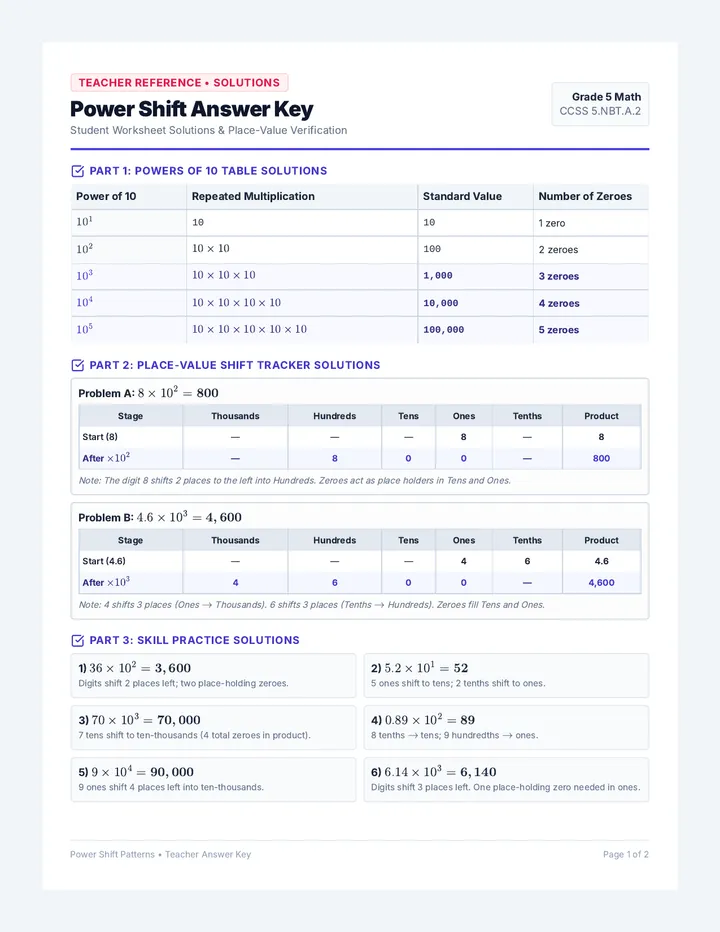
Solution: Factor tree for 90: \(90 = 9 \times 10 = (3 \times 3) \times (2 \times 5) = 2 \times 3 \times 3 \times 5\).
Misconception: Choice A uses composite factors (9 & 10). Choice B leaves 9 un-factored.
Item 2 • 5.NF.A.1 Correct: D
Solution: LCD of 3 & 4 is 12. \(5\frac{8}{12} + 8\frac{3}{12} = 13\frac{11}{12}\).
Misconception: Choice A adds numerators & denominators across (\(3/7\)). Choice B forgets to scale numerators.
Item 3 • 5.NF.A.2 Correct: A
Solution: \(6\frac{1}{3} - 2\frac{1}{2} = 6\frac{2}{6} - 2\frac{3}{6}\). Regroup whole number: \(5\frac{8}{6} - 2\frac{3}{6} = 3\frac{5}{6}\) dozen.
Misconception: Choice B results from subtracting smaller from larger fraction without regrouping (\(3/6 - 2/6 = 1/6\)).
Item 4 • 5.MD.B.2 Correct: 9 ⅝ in
Solution: The 3 longest ribbons are at \(3\frac{3}{8}\) (1) and \(3\frac{1}{8}\) (2). Sum = \(3\frac{3}{8} + 3\frac{1}{8} + 3\frac{1}{8} = 9\frac{5}{8}\) inches (or \(\frac{77}{8}\)).
Watch for: Students who pick the 3 highest stacks instead of the 3 greatest values.
Item 5 • 5.NF.B.6 Correct: C
Solution: \(A = 3\frac{1}{2} \times 2\frac{1}{4} = \frac{7}{2} \times \frac{9}{4} = \frac{63}{8} = 7\frac{7}{8}\text{ ft}^2\).
Misconception: Choice A adds dimensions (perimeter error). Choice B only multiplies whole numbers and fractions separately (\(6\frac{1}{8}\)).
Item 6 • 5.OA.B.4 composite / more than
Solution: Factors of 28 are 1, 2, 4, 7, 14, 28 (6 factors). Since it has more than 2 factors, it is composite.
Note: Prime numbers have exactly two distinct factors (1 and itself).
Item 7 • 5.NF.A.2 Correct: 1 ⁷/₁₀ mi
Solution: \(P = 2(\frac{3}{5}) + 2(\frac{1}{4}) = \frac{6}{5} + \frac{2}{4} = \frac{12}{10} + \frac{5}{10} = \frac{17}{10} = 1\frac{7}{10}\) miles (accept \(\frac{17}{10}\) or \(1.7\)).
Misconception: Only adding two sides (\(\frac{3}{5} + \frac{1}{4} = \frac{17}{20}\)) instead of all 4 sides.
Fraction Strategy Guided Notes Guided Notes
Unit 3 Step-by-Step Strategy & Notes
Fill in the blanks to master each question format • Page 1 (Q1 – Q4)
Name:
Date:
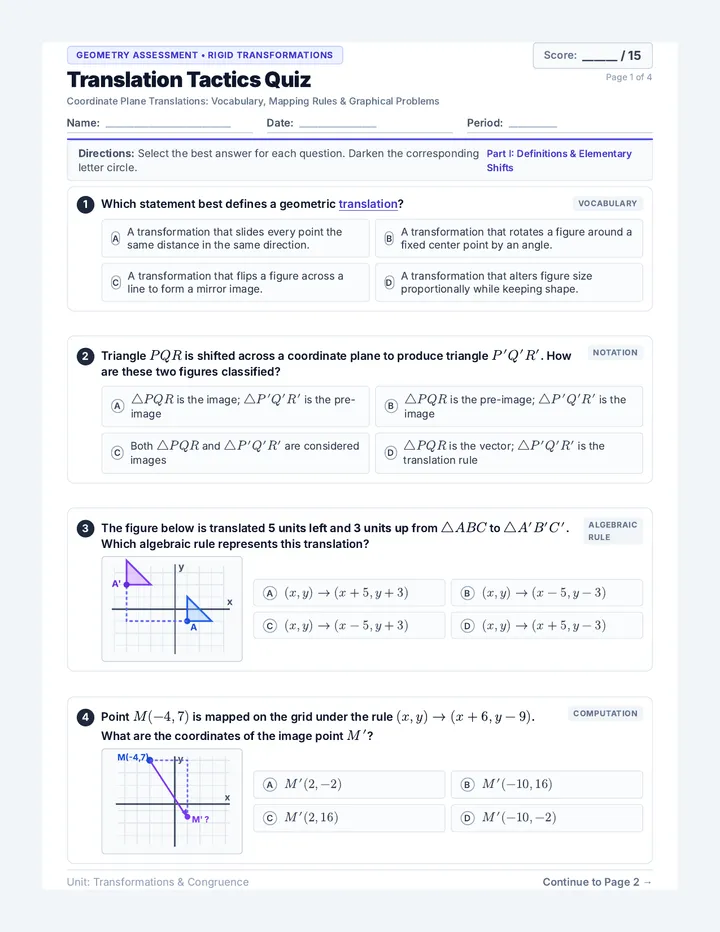
Question 1 Strategy • Prime Factorization 5.OA.B.4
Core Rule: A prime number has exactly factors (1 and itself). A composite number has more than factors.
Step 1: Start a factor tree for 90 . Pick any factor pair:
Step 2: Factor each number until only prime numbers remain:
Step 3: Write all prime factors in order from least to greatest:
Tip: 9 and 10 cannot be in the answer because 9 is not prime (3×3)!
Question 2 Strategy • Adding Mixed Numbers 5.NF.A.1
Problem: 523 + 814 = ?
Step 1: Find the Least Common Denominator (LCD) of 3 and 4:12 ... LCD =
Step 2: Rename both fractions with the LCD:
Step 3: Add whole numbers: 5 + 8 = .
Step 4: Put it together: 12
Warning: Never add denominators! (3 + 4 = 7 is incorrect).
Question 3 Strategy • Subtracting with Regrouping 5.NF.A.2
Problem: 613 − 212 = ?
Step 1: Find the LCD of 3 and 2: LCD = .
Step 2: Can you do ²/₆ − ³/₆? (Yes/No).regroup 1 whole from 6:
Step 3: Now subtract: 586 − 236
Final Answer: 6 dozen muffins
Check: Remember to reduce 6 to 5 when you borrow ⁶/₆!
Question 4 Strategy • Sum of Longest Data 5.MD.B.2
Goal: Find total length of the 3 longest ribbons .
Step 1: "Longest" means looking at the values furthest to the (left/right) on the number line.
Step 2: List the 3 greatest ribbon lengths marked with ✕:
Step 3: Add whole numbers: 3 + 3 + 3 = .
Item 8 • 5.NF.B.7.a Correct: A, B, E
Solution: Dividing \(\frac{1}{3}\) mile into 4 equal segments is represented by \(\frac{1}{3} \div 4\) (B), the partitioned number line from 0 to \(\frac{1}{3}\) (A), and multiplying by the reciprocal \(\frac{1}{3} \times \frac{1}{4}\) (E).
Misconception: Choosing C (number line up to 4) or D (multiplying by 4).
Unit 3 Assessment Review • Teacher Answer Key Page 1 of 2
Unit 3 Review • Solutions (Items 9 – 16) Diagnostic Explanations & Instructional Strategies
Quick-Scan Key: Items 9 to 16 Item 9 • 5.MD.B.2 Correct: A
Solution: Frequency table from data: \(\frac{1}{4}\) (2), \(\frac{2}{4}\) (3), \(\frac{3}{4}\) (4), \(\frac{4}{4}=1\) (1). Total = 10 runners. Plot A matches precisely.
Distractors: B swaps counts of \(\frac{1}{4}\) and 1; C shows uniform counts; D misses one mark on \(\frac{3}{4}\).
Item 10 • 5.NF.B.6 Correct: 66 oz
Solution: \(4\frac{2}{5} \times 15 = \frac{22}{5} \times 15 = 22 \times 3 = 66\) ounces. Alternatively: \((4 \times 15) + (\frac{2}{5} \times 15) = 60 + 6 = 66\).
Item 11 • 5.NF.A.2 Correct: C
Solution: Collected: \(5\frac{4}{12} + 4\frac{9}{12} = 9\frac{13}{12} = 10\frac{1}{12}\) lbs. Needed: \(13\frac{6}{12} - 10\frac{1}{12} = 3\frac{5}{12}\) lbs.
Distractor D: Student found the total collected (\(10\frac{1}{12}\)) but omitted the subtraction step.
Item 12 • 5.NF.B.6 Correct: A
Solution: \(\frac{1}{2} \times \frac{4}{5} = \frac{4}{10} = \frac{2}{5}\). The area model has 10 total cells with 4 cells shaded for carrots (\(\frac{4}{10}=\frac{2}{5}\)).
Misconception: Choice B adds numerators and denominators (\(5/7\)); Choice C ignores the \(\frac{4}{5}\) boundary.
Item 13 • 5.NF.A.1 Correct: D
Solution: Rename 14 as \(13\frac{3}{3}\). \(13\frac{3}{3} - 6\frac{1}{3} = 7\frac{2}{3}\).
Misconception: Choices A & B calculate \(14 - 6 = 8\) without regrouping to create a fractional part.
Item 14 • 5.MD.B.2 Correct: ½ lb
Solution: Total weight = \(\frac{2}{8} + \frac{3}{8} + \frac{3}{8} + \frac{5}{8} + \frac{5}{8} + \frac{6}{8} = \frac{24}{8} = 3\) lbs. Divide by 6 bags: \(3 \div 6 = \frac{3}{6} = \frac{1}{2}\) lb.
Common error: Finding the sum (3 lbs) but forgetting to redistribute by dividing by 6.
Item 15 • 5.NF.B.7.b Correct: D
Solution: Number of days = \(14 \div \frac{1}{4} = 14 \times 4 = 56\) days.
Distractor A: Divided \(14 \div 4 = 3.5\) instead of dividing by unit fraction \(\frac{1}{4}\).
Item 16 • 5.NF.B.7.c Correct: C
Solution: \(\frac{1}{8} \div 3 = \frac{1}{8} \times \frac{1}{3} = \frac{1}{24}\). Puffins occupy 1 equal share of 3 within \(\frac{1}{8}\) of the total zoo.
Distractor A: Added denominators \(8 + 3 = 11\) (\(1/11\)).
Targeted Review & Remediation Plan Mixed Number Subtraction Practice renaming whole numbers (e.g. \(14 = 13\frac{3}{3}\)) and regrouping with fraction tiles before using purely abstract algorithms.
Unit Fraction Division Reinforce that whole ÷ unit fraction yields a larger count (\(14 \div \frac{1}{4} = 56\)), whereas unit fraction ÷ whole yields a smaller slice (\(\frac{1}{8} \div 3 = \frac{1}{24}\)).
Line Plot Equal Sharing Review the two-step routine: (1) calculate the total sum by multiplying each value by its frequency, (2) divide total sum by total count of items.
Unit 3 Assessment Review • Teacher Answer Key Page 2 of 2
Step 4: Combine into a mixed number:
Key: Do not pick the tallest stack (most frequent); pick the greatest lengths!
Unit 3 Review Step-by-Step Guided Notes Page 1 of 4
Unit 3 Step-by-Step Strategy & Notes Page 2 (Q5 – Q8) • Area, Prime/Composite, Perimeter, Models
Question 5 Strategy • Fractional Area 5.NF.B.6
Formula: Area = Length × Width
Step 1: Convert both mixed numbers to improper fractions:
Step 2: Multiply numerators: 7 × 9 = .
Step 3: Convert improper fraction back to a mixed number:
Never just multiply whole numbers (3×2=6 is wrong because parts are missing!).
Question 6 Strategy • Prime vs. Composite 5.OA.B.4
Definition: Prime = exactly 2 factors. Composite = more than 2 factors.
Step 1: List all factor pairs of 28 :
Step 2: Count the total number of factors of 28:
Step 3: Fill in the completion sentence:
Options to circle: Blank 1 = composite; Blank 2 = more than.
Question 7 Strategy • Perimeter of a Rectangle 5.NF.A.2
Formula: Perimeter = sum of ALL 4 sides
Step 1: Write down all 4 sides:
Step 2: Note that ²/₄ simplifies to ½. Find the LCD of 5 and 2:
Step 3: Convert to equivalent fractions:
Step 4: Add numerators: 12 + 5 = .
Careful: Don't just add 2 sides! A rectangle has 4 sides in total.
Question 8 Strategy • Fraction Division Models 5.NF.B.7.a
Scenario: ⅓ mile is shared equally by 4 runners.
Model 1 (Division Expression):
Model 2 (Multiplication by Reciprocal):
Model 3 (Visual Number Line): ⅓ is divided into equal parts (Choice A).
The 3 correct models are: A (visual partition of ⅓), B (⅓ ÷ 4), and E (⅓ × ¼).
Unit 3 Review Step-by-Step Guided Notes Page 2 of 4
Unit 3 Step-by-Step Strategy & Notes Page 3 (Q9 – Q12) • Line Plotting, Scaling Fractions, Multi-Step Problems
Question 9 Strategy • Frequency on Line Plots 5.MD.B.2
Data: ¼, ¼, ²/₄, ²/₄, ²/₄, ¾, ¾, ¾, ¾, ⁴/₄
Step 1: Count tally for each fraction value:
Step 2: Check total count:
Step 3: Match to the options. Plot shows exactly 2 Xs at ¼, 3 Xs at ²/₄, 4 Xs at ¾, and 1 X at 1.
Tip: Cross off numbers one-by-one as you count to prevent errors!
Question 10 Strategy • Mixed Number × Whole 5.NF.B.6
Problem: 425 ounces × 15 boxes = ?
Method A (Improper Fraction):
Method B (Distributive Property):
Both methods give the exact same answer: 66 ounces!
Question 11 Strategy • Multi-Step Goal Problem 5.NF.A.2
Blake: 5⅓ lbs | Brother: 4¾ lbs | Goal: 13½ lbs
Step 1: Find LCD for denominators 3, 4, 2: LCD = .
Step 2: Add what they already collected:
Step 3: Rename goal with LCD: 13½ = 1312.
Step 4: Subtract: 13⁶/₁₂ − 10¹/₁₂:
Don't stop after adding! The question asks for how much is STILL needed.
Question 12 Strategy • Fraction Area Model 5.NF.B.6
Scenario: ⁴/₅ for veggies. ½ of veggies for carrots.
Step 1: Count total grid squares in model:
Step 2: Count the dark shaded squares (carrots):
Step 3: Multiply fractions:
Step 4: Simplify ⁴/₁₀ by dividing top & bottom by 2:
"Of" in mathematics usually means multiplication! (½ of ⁴/₅ = ½ × ⁴/₅).
Unit 3 Review Step-by-Step Guided Notes Page 3 of 4
Unit 3 Step-by-Step Strategy & Notes Page 4 (Q13 – Q16) • Whole Subtraction, Equal Sharing, Unit Fractions
Question 13 Strategy • Subtracting from a Whole 5.NF.A.1
Step 1: 14 has no fraction part. You must rename 1 whole as a fraction with denominator 3:
Step 2: Set up the subtraction vertically:
Step 3: Subtract whole numbers: 13 − 6 = .
Final Answer: 3 (Choice D)
Common Trap: Doing 14 − 6 = 8 and keeping ⅓ to get 8⅓ is incorrect!
Question 14 Strategy • Fair Share / Redistribution 5.MD.B.2
Combine all candy and divide equally into 6 bags.
Step 1: Find the total pounds by adding all 6 bags:
Step 2: Add all eighths:
Step 3: Divide total weight by 6 bags:
Fair share problems always have 2 steps: (1) Find sum, (2) Divide by count.
Question 15 Strategy • Whole ÷ Unit Fraction 5.NF.B.7.b
Tamara has 14 cups of food. Rabbit eats ¼ cup daily.
Key Question: "How many ¼ cups are inside 14 cups?"
Step 1: Think about 1 single cup:
Step 2: Multiply by 14 cups:
Equation Rule:
When dividing by a unit fraction, your answer will be LARGER than the starting whole!
Question 16 Strategy • Unit Fraction ÷ Whole 5.NF.B.7.c
⅛ of the zoo is shared equally by 3 kinds of birds.
Step 1: Write the division expression:
Step 2: Rewrite dividing by 3 as multiplying by ⅓:
Step 3: Visual check with the diagram:
Final Answer: 1 of the zoo (Choice C)
When dividing a fraction by a whole number, each piece gets SMALLER (¹/₂₄ < ⅛).
Unit 3 Review Step-by-Step Guided Notes Page 4 of 4