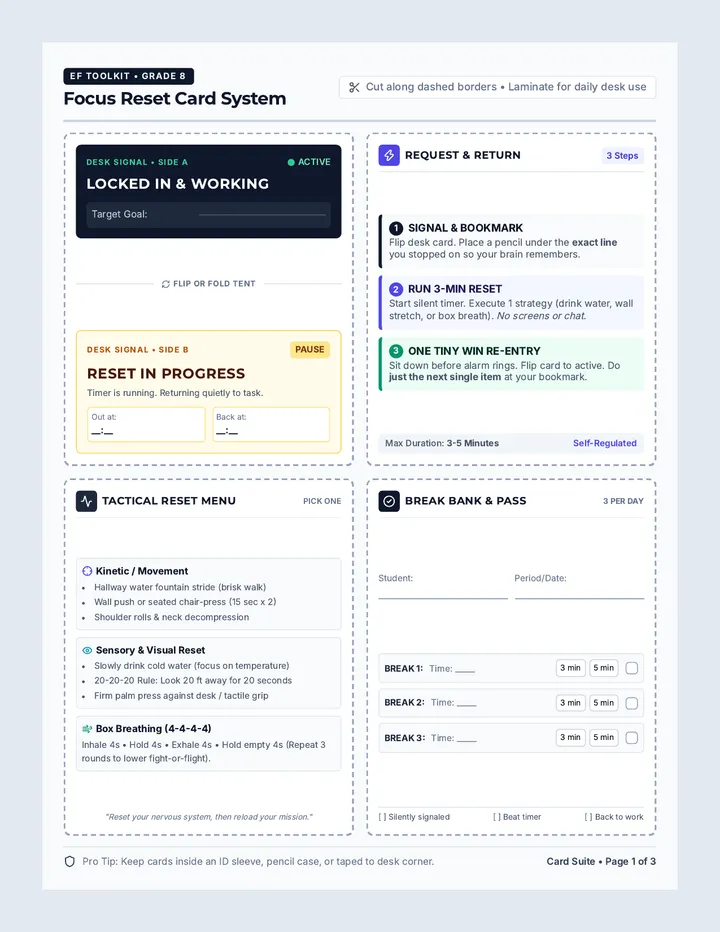
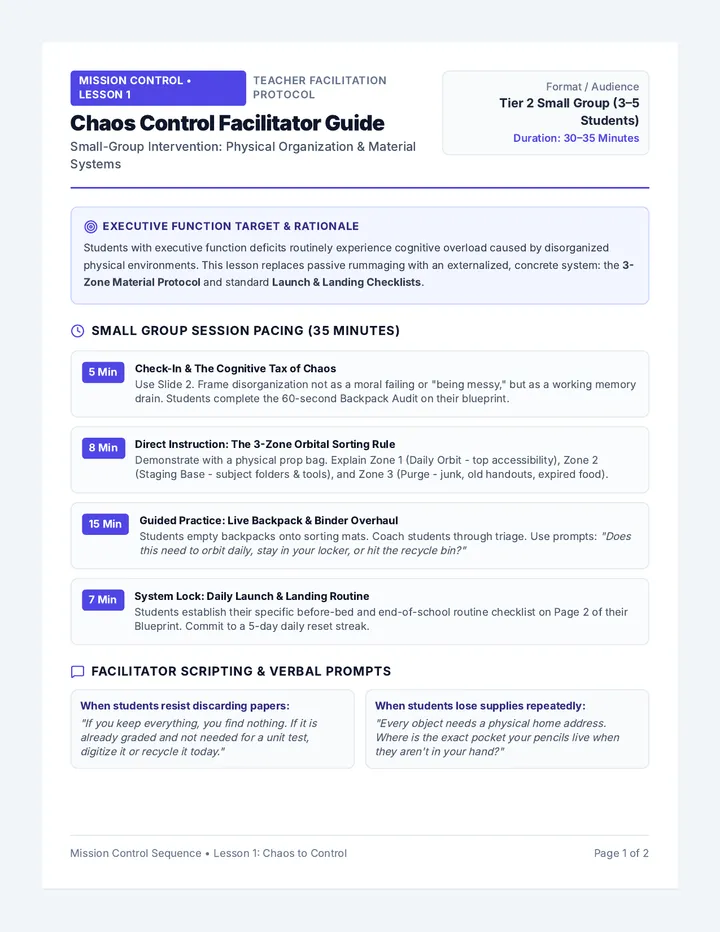
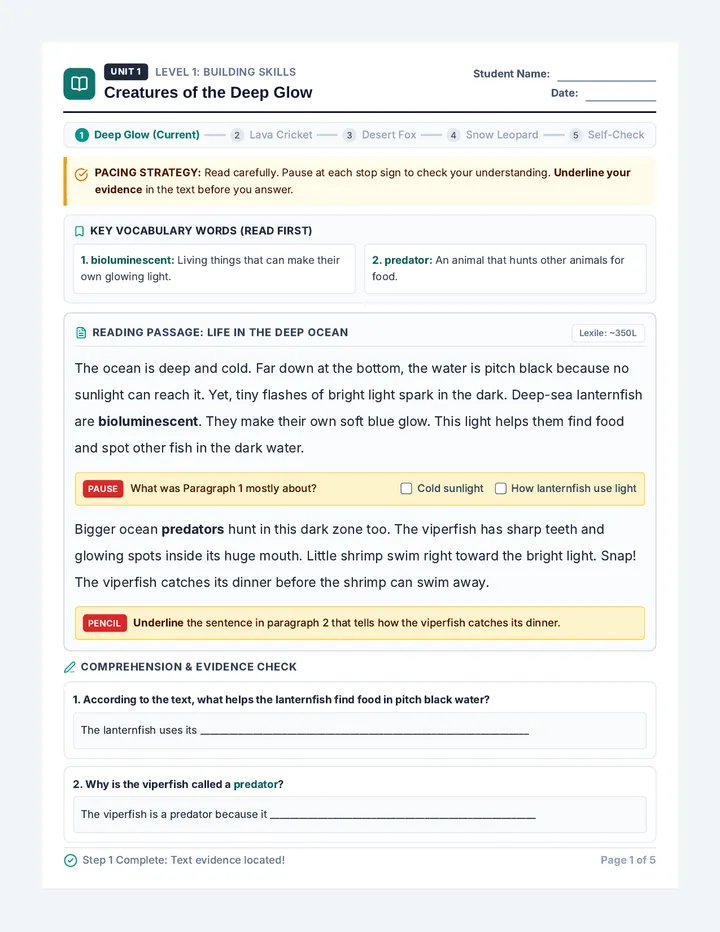
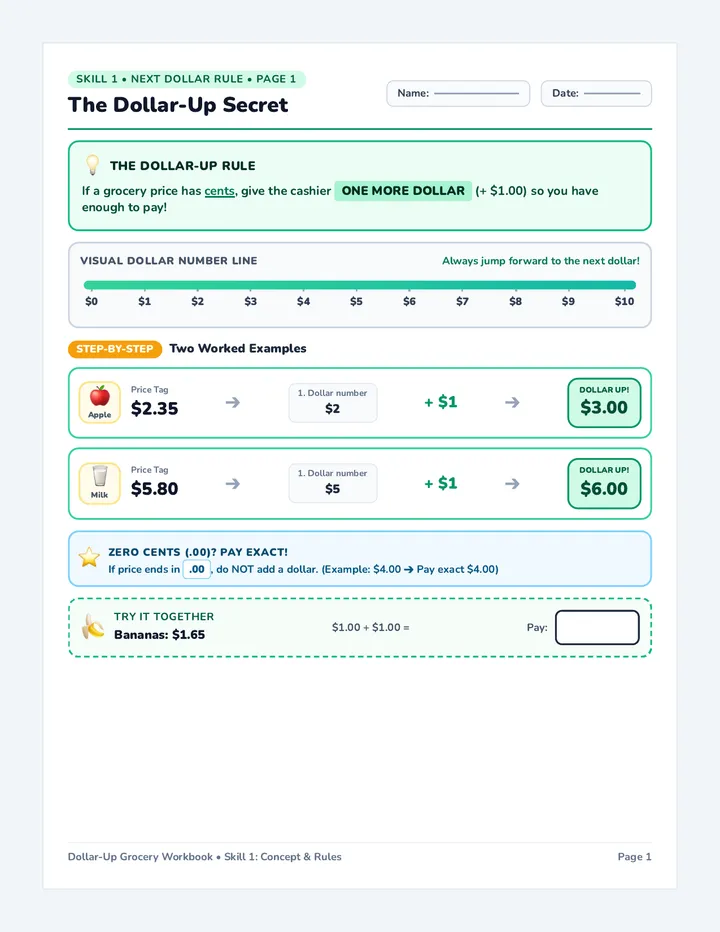
Memory Loop Slides THE VERBAL REHEARSAL LOOP
Memory Lab: Experiment 01
MEMORY CHALLENGE: THE TELEPHONE
How many times can a message travel before it breaks?
Round 1
Listen once. Pass it on. No repeats allowed.
Round 2
The "Loop" Round: Repeat the message 3 times to yourself before passing it on.
BRAIN SCIENCE: THE SCRATCHPAD
Temporary Storage
Your brain's "Mental Scratchpad." It only holds information for 15-30 seconds.
Limited Capacity
Like a battery that drains. If we don't recharge the info, it disappears!
The Problem
"When an instruction goes in one ear and out the other, the scratchpad was likely too full or erased too fast."
THE "LISTEN, REPEAT, DO" LOOP
1. LISTEN
Total focus on the speaker. No talking yet.
2. REPEAT
"Sub-vocalize." Whisper the step 3 times to yourself.
3. DO
Wait until the loop is locked in, then execute.
"Don't move your feet until you've moved your lips!"
THE POWER OF WHISPERING
LAB TIP
Sub-vocalization is quietly saying words to yourself. When you do this, your brain processes the info in two ways:
AUDITORY
Your ears "hear" your internal voice.
MOTOR
Your mouth muscles feel the movement.
It shouldn't be loud. Just a tiny hum of data.
COMMENCE EXPERIMENTATION
Get your Memory Loop Worksheets ready.
"I will give you ONE direction. You must loop it (repeat it) three times silently before you pick up your pencil."
Memory Loop Worksheet THE MEMORY LOOP
Experiment 01: Listen • Repeat • Do
Subject Name:
Date:
The Loop Technique
When you hear an instruction, don't just "store" it. Repeat it silently 3 times in your head or whisper it (sub-vocalize). This keeps the "Scratchpad" from erasing.
1
Calibration: Single Commands
Wait for the teacher to give a command. Repeat it 3 times silently, then check the box once you've completed the action on the page.
2
Self-Monitoring: "Loop Locked?"
After each command, how did your "internal loop" feel? Circle the icon that matches your experience.
Step # Difficulty Loop Status Command 04 Easy Medium Hard Locked in! / Erased? Command 05 Easy Medium Hard Locked in! / Erased?
Post-Experiment Reflection
Did sub-vocalizing (whispering to yourself) help you remember the step better? Why or why not?
Loop Commander Teacher Guide LOOP COMMANDER
Teacher Facilitation Guide • Lesson 01
Instructional Goal
The goal is to bridge the gap between "hearing" and "doing" by inserting a verbal rehearsal step. Students with working memory challenges often lose the directive during the transition from auditory input to motor output.
Key Terms
• Sub-vocalization: Internal/whispered speech.
• Auditory Loop: The "echo" in our mind.
• Cognitive Load: Total brain effort.
Experiment Commands
01
"Draw a square with a small X inside of it."
Focus: Basic spatial instruction.
02
"Write your last name using only capital letters."
Focus: Multi-attribute instruction (who + how).
03
"Draw a lightning bolt next to the page header."
Focus: Relative positioning.
04
"Write the word 'LOOP' backwards in the bottom corner."
Complexity Level: High (requires mental manipulation).
Prompting & Scaffolding
If a student freezes, prompt with: "Loop it—what did I say?" Encourage them to whisper it before picking up the pencil.
Wait 5-10 seconds after speaking before allowing students to start. This forces the rehearsal period.
Observation Checklist
Lip movement (sub-vocalization) observed.
Pauses before execution.
Accuracy of the instruction executed.
Barrier Game Slides BARRIER GAMES
Memory Lab: Experiment 02 • Precision Engineering
THE BLIND BUILD
"Your partner is your eyes. You have the blocks, but you can't see the blueprint."
THE CHALLENGE
10 MINUTES
Precise Words Only
The Loop Still Counts
WHAT IS PRECISION?
Low Precision
"Put that thing near the corner of the paper."
Vague, confusing, too many options.
High Precision
"Place the red square in the top-left grid box."
Specific object, specific action, specific location.
LAB PROTOCOL: BARRIER GRID
1
Set up your barrier (folder/book).
2
"Commander" arranges 3 pieces on their grid.
3
Give ONE single-step direction at a time.
The Rule of the Receiver
"You cannot move a piece until you have looped the command back to the Commander."
DATA COLLECTION START
Open your Barrier Activity Pack. Cut out your objects. Construct your grid. Let's see how precise you can be.
Barrier Activity Pack BARRIER GRID PACK
Experiment 02: Precision Mapping
Subject A:
Subject B:
The Coordinate Grid
Scale: 1:1 Memory Map
1234
ABCD
Cutout Objects Area
Instructions: Cut out these 6 objects carefully. If you are the Commander, arrange them on your secret grid. If you are the Receiver, wait for the verbal command to place them.
Object: Sphere
Object: Cube
Object: Prism
A
Object: Alpha
Object: Nova
Object: Bolt
Post-Game Debrief
Commander: What was the hardest piece to describe?
Receiver: When did the "Loop" help you most?
Precision Checklist Rubric PRECISION CHECKLIST
Teacher Observation & Rubric • Lesson 02
Use this tool to track pair performance during the Barrier Game. Focus on the interplay between clear instructional language and active rehearsal loops.
Skill Category Level 1 (Novice) Level 2 (Developing) Level 3 (Master) Instructional Precision Vague language ("put it over there"). Multiple steps given at once. Single-step focus, but occasional vague terms ("near", "around"). Highly specific. Uses grid coordinates (A1, B3) and clear object names. Rehearsal Consistency Receiver acts immediately without repeating the loop. Receiver repeats loop only when prompted by teacher or partner. Receiver automatically sub-vocalizes/loops every command before acting. Error Correction Frustration or silence when a mismatch occurs. Recognizes errors, but struggles to find "the right words" to fix them. Calmly asks for clarification or re-explains using different words.
Real-Time Data Log
Pair Name: _____________________
Precision
Looping
Success
Pair Name: _____________________
Precision
Looping
Success
Pair Name: _____________________
Precision
Looping
Success
Pair Name: _____________________
Precision
Looping
Success
Filtering Slides SIGNAL VS. NOISE
Memory Lab: Experiment 03 • Auditory Filtering
THE CHAOS CHALLENGE
"I am going to read 5 instructions while upbeat music plays. Your job: Catch the Signal and ignore the noise."
Music (Noise)
Teacher (Signal)
SELECTIVE ATTENTION
Your brain has a Volume Knob. In a loud room, you have to turn UP the voice you want to hear and turn DOWN everything else.
The Hard Truth
Distractions don't just "bother" you—they literally kick information out of your working memory scratchpad.
THE ADVOCACY TOOLBOX
The Pause
"Could you please wait one second so I can loop that?"
The Reset
"I missed that because of the noise. Can you say it one more time?"
The Signal
Use a non-verbal hand signal to show you need a repeat.
Active Phase
LOCK IN FOCUS
Get your Focus Trackers ready. We are moving into a simulated noisy environment. Remember: The Loop is your shield against the noise.
Focus Tracker Worksheet FOCUS TRACKER
Experiment 03: Signal-to-Noise Ratio
Subject ID:
Distraction Level:
Success
Needed Repeat
Erased
Experiment Log: Noisy Environment
01
Result Box
Self-Assessment
Easy
Mid
Hard
02
Result Box
Self-Assessment
Easy
Mid
Hard
03
Result Box
Self-Assessment
Easy
Mid
Hard
Advocacy Protocol Check
I used the following tools during this experiment:
Requested a Pause
Requested a Repeat
Used a Hand Signal
Closed my eyes to focus
Chaos Script Guide CHAOS SCRIPT
Teacher Simulation Guide • Lesson 03
Required Audio Environment
Upbeat, high-tempo music (70-80% volume)
Ambient "classroom chatter" background track (optional)
The Simulation Goal
This is not a test of silence, but a test of auditory filtering. We want students to experience "cognitive overload" and then apply self-advocacy to manage it.
Auditory Trials Script
Trial The Command (Read clearly but naturally) Complexity Note 01 "Draw three small circles in a vertical line on the left side of Trial Box 1." Spatial + Quantitative 02 "Write the number 42 and then circle it with a dashed line." Multi-step visual action 03 "Find Trial Box 3 and write your first name using only lowercase letters." Attribute specific (case) 04* "Draw a triangle, but make sure the top point is touching the bottom of the Trial 4 header." Intentionally Complex
*Wait for someone to advocate (ask for a repeat/pause) before continuing for Trial 4.
Common Misconceptions
Students often feel "stupid" for needing silence. Reframe silence as "Signal Optimization." Just like a radio needs to be on the right frequency, the brain needs the right conditions to process data.
Teacher Coaching Phrase
"I noticed you didn't pick up your pen when the music got louder. Great job waiting for the repeat."
Translation Slides THE TRANSLATOR
Memory Lab: Experiment 04 • Internal Encoding
THE UPGRADE
Old Method
"Listen and repeat exactly like a parrot."
New Method
"Translate the meaning into YOUR language."
Parrots repeat sounds. Translators repeat ideas.
WHY "TRANSLATE"?
"It forces your brain to actually think about the step, not just hear the noise."
Deep Processing
"Shortening a long sentence makes it smaller and easier for your memory to hold."
Chunking Data
WORKSHOP: THE 3-WORD RULE
Teacher Sentence:
"I'd like you to take your blue marker and draw a circle around the third paragraph of the text."
Your Translation:
"BLUE CIRCLE P.3"
ENCODING PHASE
Open your Translator Worksheets. We are going to take complex directives and shrink them down to their core meaning.
The Translator Worksheet THE TRANSLATOR
Experiment 04: Cognitive Encoding
Subject:
Day:
The Encoding Rule
Don't parrot the words. Simplify the action. Turn long sentences into short, 3-word commands that your brain can easily store.
Part 1: The Shrink Test
Complex Instruction
"Go ahead and underline the first sentence of the second paragraph using your yellow highlighter."
Your Translation (3 Words)
Complex Instruction
"Once you finish your work, please place your paper face down in the blue bin at the front of the room."
Your Translation (3 Words)
Part 2: Real-Time Encoding
Wait for the teacher to speak. Translate the command instantly into the box below before performing the action.
01
02
03
Pro Tip: When you shorten a sentence, you leave more room in your "Scratchpad" for other things. Less words = More memory space!
Translator Teacher Key ENCODING KEY
Teacher Guide & Answer Key • Lesson 04
The Science of Paraphrasing
This lesson targets Semantic Encoding. While Lessons 1-3 focused on the *sound* of the instructions (phonological loop), this lesson moves students toward *meaning*. This is more durable in long-term memory and reduces the "parroting" effect where students can repeat words but don't know what they mean.
Part 1: Key Examples
01
Complex Source:
"Go ahead and underline the first sentence of the second paragraph using your yellow highlighter."
Suggested Keys:
Yellow underline p.2
02
Complex Source:
"Once you finish your work, please place your paper face down in the blue bin at the front of the room."
Suggested Keys:
Finish - Blue Bin
Part 2: Reading Scripts
Script 01
"Open your science journal and write today's date in the top right margin."
Key: Science Date Top
Script 02
"Find the third question on the page and put a big question mark next to it."
Key: Q3 Question Mark
Script 03
"I want you to take out your laptop and go to the classroom website home page."
Key: Laptop - Website
Synthesis Slides MEMORY MASTERY
Final Experiment: Contextual Synthesis
THE TRIVIA GAUNTLET
Today, we aren't just practicing loops. We are winning with them.
The Mission
Listen to a rapid-fire story. Extract the HIDDEN instruction. Perform the action perfectly.
The Prize
Points for every instruction correctly "Translated" and "Executed."
REAL WORLD: THE LECTURE LOOP
Capture
The teacher is talking fast. Pick out the one thing they want you to DO.
Translate
Loop it. Shrink it. Write it down in your notes.
"Successful students don't remember everything. They remember the Single Step that matters right now."
Mastery Mindset
GAUNTLET RULES
01
Teacher reads a 60-second "Mission Story."
02
One secret instruction is hidden inside.
03
Use "The Translator" to catch the step.
04
Perform the action only after the story ends.
FINAL DATA ENTRY
Ready your Synthesis Logs. Your memory is now a lab-tested tool. Let's prove it.
Synthesis Log Worksheet SYNTHESIS LOG
Experiment 05: Final Data Capture
Agent ID:
Day 05:
Phase 1: The Gauntlet
1
The "Translated" Command
Execution Area (Draw/Write Action)
2
The "Translated" Command
Execution Area (Draw/Write Action)
Phase 2: Lecture Capture
Listen to the short lecture about "Working Memory." When the teacher gives an embedded instruction (e.g., "Look at the diagram" or "Note this date"), translate it instantly and execute.
Lecture Note Area Instruction Translation Column
Step 1 Translation
Step 2 Translation
Step 3 Translation
Memory Lab Graduation
I have mastered the Loop, I have optimized my Signal, and I am a Translator of data. I am ready to apply these tools in all my classes.
Mastery Script Assessment Guide MASTERY SCRIPT
Final Assessment Facilitation Guide • Lesson 05
Phase 1: The Gauntlet Scripts
Trial 01 Story
"Once upon a time, a deep-sea diver named Leo was looking for a lost treasure chest at the bottom of the Atlantic Ocean. He swam past a giant blue whale and saw a colorful coral reef. Before you forget, draw a small anchor in the first results box of your log. Leo eventually found the chest, but it was guarded by a friendly octopus with eight arms."
Key: Draw anchor
Trial 02 Story
"The mission to Mars was set to launch in the year 2045. The astronauts were busy checking their oxygen levels and making sure the fuel tanks were full. If you are listening carefully, write the word 'MARS' in all capital letters in the second box. They knew the journey would take several months, but they were excited to explore the red planet and look for signs of water."
Key: Write MARS (Caps)
Phase 2: The Mock Lecture
Lecture Topic: The Memory Scratchpad
"Welcome to today's talk on the human brain. Specifically, we're looking at Working Memory. Think of it like a mental whiteboard that gets erased every few seconds."
Step 1: "I want everyone to take a moment and draw a small brain icon in your first translation box on the right."
"Scientists have found that we can only hold about 7 items in this scratchpad at once. If we try to add an 8th item, something else falls off."
Step 2: "Now, write the number 7 in the second translation box and put a circle around it."
"To keep information longer, we have to move it to Long-Term Memory. This is where the strategies we've learned this week—like the Loop and the Translator—really come into play."
Step 3: "Finally, write the word 'LOOP' in your third translation box and then double underline it."
Mastery Indicators
• Student waited until the instruction ended before acting.
• Sub-vocalization/Lip movement was evident.
• Translation was concise (not a full sentence).
• Final execution was 100% accurate.
Congratulations!