Tactical Reset Cards
The Circuit Breaker
Objective: Full System Release
1
Stand tall. Reach both hands toward the ceiling as high as possible. Imagine you are reaching for a target overhead.
2
Exhale slowly and drop your upper body down toward your toes. Let your arms hang heavy like dead weight.
3
Hold for 10 seconds. Shake your head "no" and "yes" slowly to release neck tension.
"Breaks the loop of impulsive energy by grounding your physical center."
The Gyroscope
Objective: Sensory Calibration
1
Sit or stand straight. Roll your shoulders back and down, locking them into a neutral position.
2
Slowly trace a large circle with your nose in the air. Imagine your head is a precision instrument rotating on an axis.
3
Complete 3 rotations clockwise, then 3 counter-clockwise. Move so slowly that you can feel every muscle shift.
"Smooths out internal 'noise' and improves spatial awareness."
Target Lock
Objective: Maximum Stability
1
Find a fixed point on the wall or floor. This is your "focus anchor." Keep your eyes locked on it.
2
Lift one foot slightly off the floor. Keep your standing leg strong but not rigid.
3
Count to 15 in your head. If you wobble, just reset your focus and try again. Switch legs.
"Forces the brain to prioritize balance over impulsive thoughts."
Latency Check
Objective: Inhibitory Control
1
Rest your hand on your desk or thigh. Spread your fingers wide.
2
Lift your thumb as slowly as possible. Try to take 5 full seconds just to raise it one inch.
3
Lower it just as slowly. Repeat with each finger. Focus exclusively on the sensation of movement.
"Teaches your motor cortex to delay reactions and improve precision."
Midline Alignment
Objective: Internal Re-centering
1
Sit tall. Place your right hand on your left knee and your left hand behind you.
2
Inhale to get taller. On the exhale, slowly twist to look over your left shoulder.
3
Hold for 3 deep breaths. Imagine wringing out stress like water from a sponge. Repeat on the other side.
"Resets the spine and forces a 'perspective shift' through movement."
Pressure Override
Objective: Proprioceptive Input
1
Bring your palms together in front of your chest (prayer position).
2
Press your hands together as hard as you can. Feel the tension in your arms, chest, and back.
3
Hold for 5 seconds, then suddenly release and let your hands drop. Feel the "ghost" sensation of the energy leaving.
"Provides deep pressure that helps 'quiet' an overactive nervous system."
Signal Scan
Objective: Muscle Awareness
1
Sit on the edge of your chair or stand against a wall. Lower into a squat until you feel your leg muscles work.
2
Notice exactly where the heat is. Is it in your thighs? Your calves? Your ankles?
3
Hold for 10 seconds. Focus only on the "burn." When you stand back up, notice how your legs feel light.
"Distracts the mind from impulses by sending high-priority signals from the legs."
The Final Sync
Objective: Rhythm & Flow
1
Sweep your arms out to the sides and up over your head as you take a deep, slow inhale.
2
Lower your arms back down slowly as you exhale. Try to time it so your hands touch your sides at the exact moment your breath ends.
3
Repeat 3 times. Your body and breath are now synced for the next task.
"Finalizes the reset by aligning physical motion with respiratory rhythm."
Pulse Protocol Slides
Pulse Protocol
Tactical Focus Training
System Overload
Sometimes your brain's "alert system" stays on High Alert for no reason. This leads to:
- Impulsive statements before you've thought them through.
- Feeling restless or "jittery" in your chair.
- Losing "Target Lock" on your work.
Signal Noise Detected
The Tactical Reset
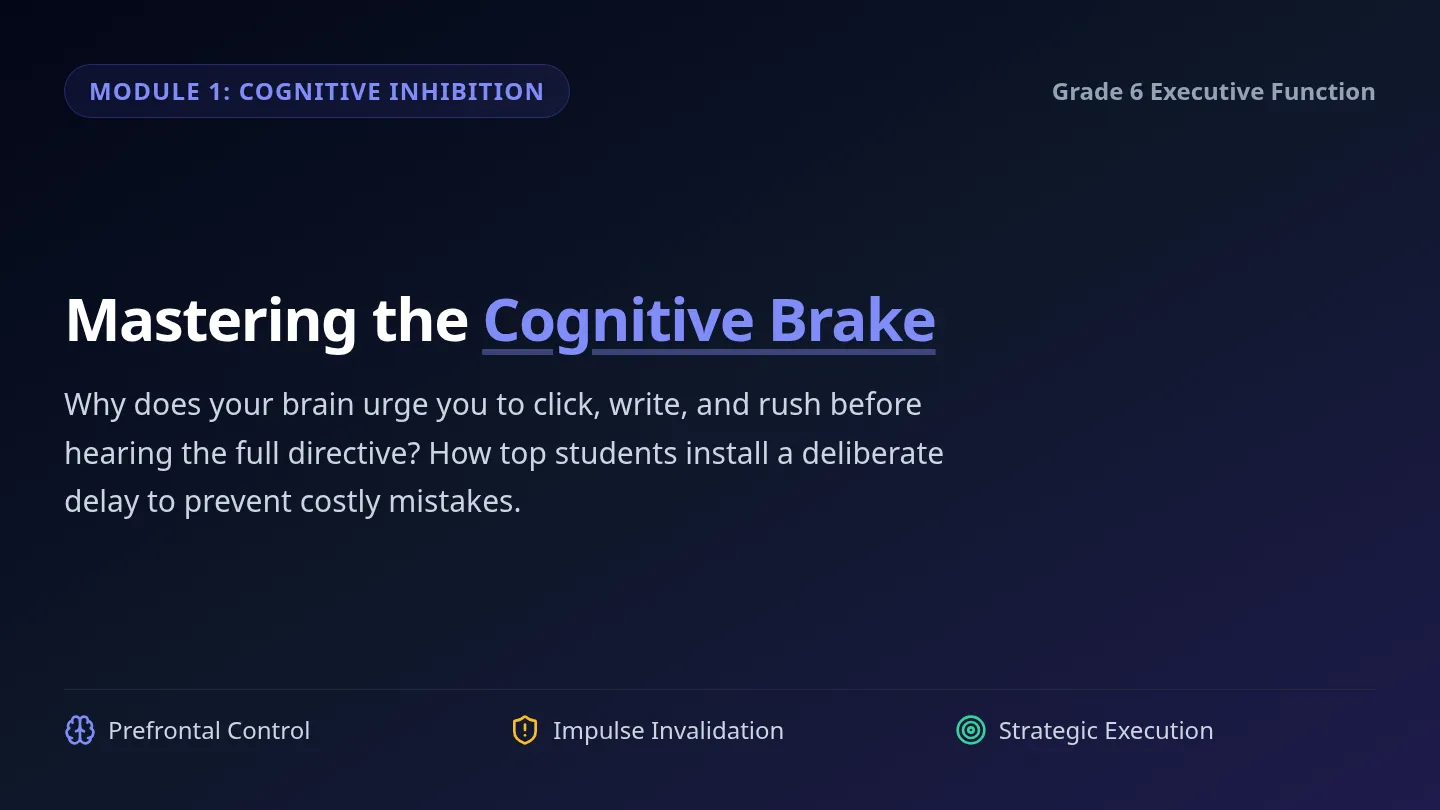
A **Tactical Reset** is a physical movement designed to "cut the power" to impulsive energy and re-route it into focus.
Inhibit
Stop the impulsive "reflex" before it happens.
Recalibrate
Use movement to tell your brain "I am in control."
Engage
Return to your mission with 100% focus.
When to Deploy
Scenario Alpha
You feel a funny comment coming, but you know it might get you in trouble.
DEPLOY: Latency Check
Scenario Bravo
The classroom is loud and you can't focus on your reading.
DEPLOY: Pressure Override
Mission Ready
You are about to receive your Tactical Reset Cards. Keep them on your desk or in your bag as a technical manual for your focus.
Protocol Engaged
Tactical Reset Guide
Tactical Reset Guide
Facilitator Protocol | Pulse Protocol Sequence
Lesson: TR-01
Target: Focus & Impulse Control
Concept Overview
Students with ADHD often experience impulsivity as a "reflexive" response to internal or external stimuli. The Tactical Reset framework rebrands mindfulness as a high-performance technical skill used by elite operators (pilots, athletes, specialized units) to maintain "system stability" under pressure.
"We aren't 'calming down'—we are recalibrating the motor cortex to ensure peak performance."
Key Goals
- Increase latency between impulse and action.
- Provide heavy proprioceptive input to ground the student.
- Standardize "focus anchors" using technical language.
Deployment Strategy
1. The "Pre-Flight" Check
Introduce the cards during a calm period, not during a crisis. Walk through each movement together. Ensure the student understands the Tactical Framing (e.g., using words like "calibrate," "latency," and "override").
2. Stealth Prompting
Instead of saying "Calm down," use tactical cues:
- > "Unit 1, initiate Latency Check."
- > "System noise detected. Requesting a Circuit Breaker."
- > "Check your Target Lock before starting this task."
Troubleshooting Protocol
Obstacle: Resistance to "Boring" Stretches
Solution: Lean harder into the technical side. Use a stopwatch to time the "Latency Check." Make it a challenge of precision rather than a "relaxing" activity.
Obstacle: Disruptive During Class
Solution: Highlight the "Low-Profile" cards (Latency Check, Pressure Override) which can be done seated and almost invisibly.
Obstacle: Forgetting to use them
Solution: Laminate the cards and tape them directly to the corner of the desk or the inside of a folder.
Exercise Deep-Dive
| Exercise Name | Neurological Purpose | Visual/Physical Cue |
|---|
| The Circuit Breaker | Resets the nervous system through full-body inversion and stretch. | "Head below heart, heavy arms." |
| Latency Check | Directly trains inhibitory control in the motor cortex. | "Slowest lift possible." |
| Pressure Override | Proprioceptive input to dampen sensory over-stimulation. | "Max force, then total release." |