Toolkit Exploration Slides Toolkit Exploration Slides
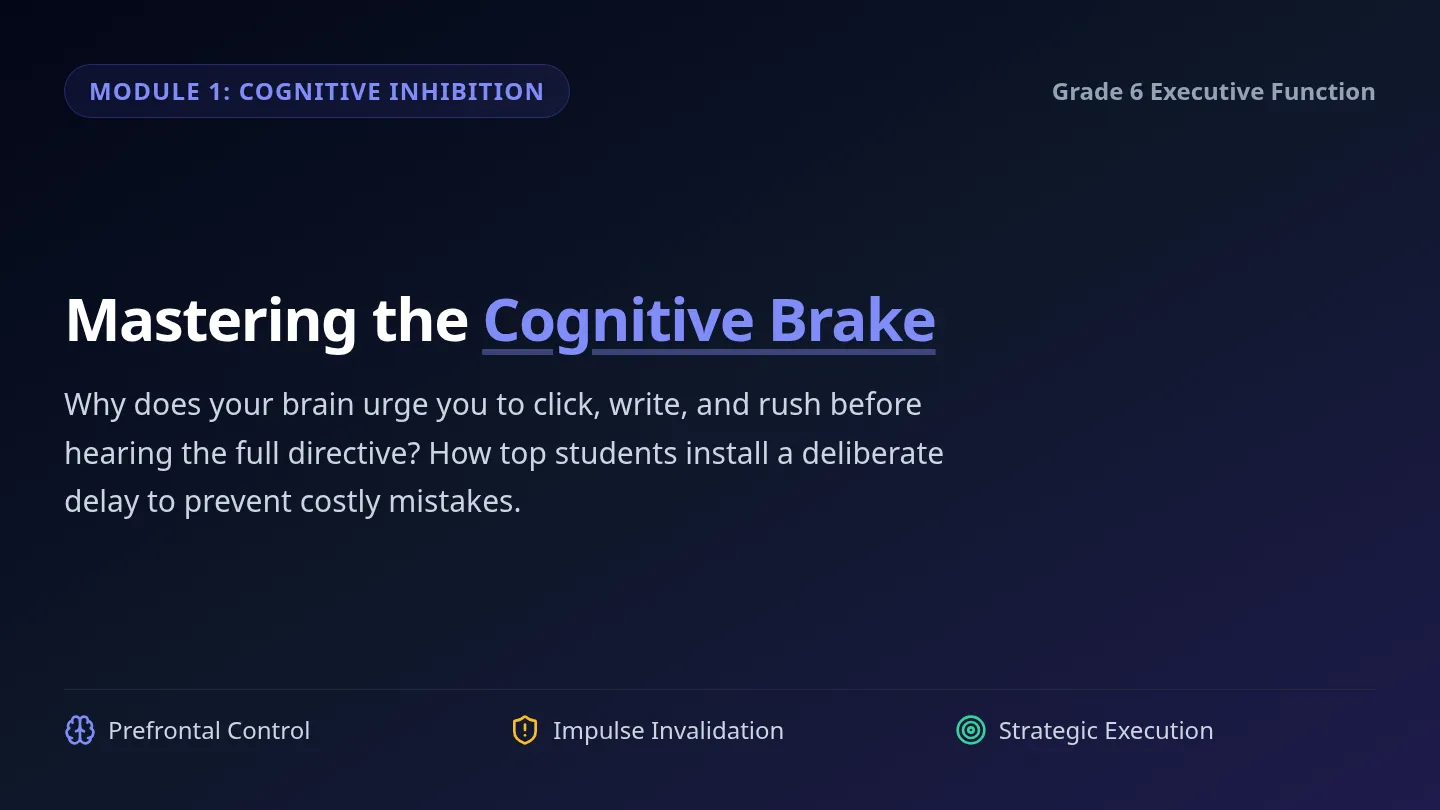
Unlocking Your Writing Superpowers
Dictation
Prediction
Organization
The One-Minute Challenge
Round 1: Handwriting
Write about your favorite food by hand for exactly 60 seconds. Don't stop until the buzzer sounds!
Round 2: Speech-to-Text
Talk to your computer about your favorite food for exactly 60 seconds. Let the tool do the typing!
Which way felt faster? Which way felt easier for your brain?
Your 3 Secret Weapons
Speech-to-Text
Think it, say it, see it. Great for when your hand gets tired but your head is full of ideas.
Word Prediction
The computer guesses what you're typing. Helps with spelling and finding "fancy" words.
Digital Organizers
Move ideas around like blocks. No erasing needed—just drag and drop to fix your plan.
It’s Not a "Cheat Code"...
It’s a Tool for Pros.
Just like a builder uses a nail gun instead of a hammer to work faster, these tools help you get your brilliant ideas out without the mechanics slowing you down.
Efficiency Race Tracker Worksheet Efficiency Race Tracker
Lesson 1: Tech vs. Tradition
NAME: __________________________
DATE: ___________________________
The Challenge
Today we are testing how your brain and body work with different writing tools. For each round, you will have exactly one minute to write about the prompt.
PROMPT: What is your favorite food and why?
ROUND 1
Handwriting (Pencil & Paper)
WRITE HERE
Words written in 1 minute:
ROUND 2
Speech-to-Text (Dictation)
DICTATE INTO DEVICE
Words dictated in 1 minute:
The Verdict
1. Which tool produced MORE words?
Handwriting
Speech-to-Text
2. How did your hand feel after handwriting vs. dictating?
3. One thing that was tricky about using speech-to-text was:
Tech Rotation Teacher Guide Tech Rotation Guide
Teacher Facilitation Resource • Lesson 1
Rotation Setup
1
Station A: Speech-to-Text (STT)
Devices with built-in dictation (Google Docs Voice Typing, Siri, or Windows Dictation). Ensure noise-canceling headsets are available to reduce background interference.
2
Station B: Word Prediction
Devices with prediction software enabled (Co:Writer, Read&Write, or iPad prediction). Provide a list of "challenging" words for students to attempt typing.
3
Station C: Digital Outlining
Mind-mapping tools like Inspiration, MindMeister, or Google Drawings. Pre-load a template with movable blocks for students to experiment with drag-and-drop.
Quick Troubleshooting
STT Accuracy: Encourage students to speak "like a newscaster"—slowly and clearly.
Prediction Lag: Remind students that prediction works best when they type the first 2-3 letters first.
Background Noise: Use a "quiet zone" for the STT station or move students apart.
Mindset Shifts
Focus on framing these tools as "Power-Ups" rather than "Fix-Its."
The Building Metaphor
"If we are building a house of ideas, handwriting is like a manual screwdriver. It works, but it's slow. Using these tools is like having a power drill. You're still the architect, but you're working faster and stronger."
Observation Checklist
Student identifies a clear efficiency gap (STT > Hand).
Student can activate the STT microphone independently.
Student shows curiosity about prediction synonym lists.
Student manages frustration when STT mishears them.
Closing Reflection Questions
Discovery
"Which tool made you feel the most 'independent' today?"
Self-Assessment
"How does your hand feel compared to a normal writing class?"
Growth
"What is one thing you want to get better at with these tools?"
Visual Mapping Slides The Narrative Blueprint
Planning Without the Pen
Drag & Drop
Visual Mapping
Color Coding
The "Mixed Up" Challenge
How would you fix this plan for making a peanut butter sandwich? Imagine dragging these into order:
? Eat the sandwich!
? Spread peanut butter on bread.
? Get two slices of bread.
? Put the slices together.
"Digital tools let us fix mistakes instantly without starting over."
Executive Function Hacks
Grouping
Put similar ideas together using colors or proximity. Seeing it helps you organize it.
Flow
Easily move an event from the end of your story to the middle. Change your mind? No problem.
Checklist
Mark details as "finished" or "needs more" visually. Know exactly where you are in the plan.
The Color Strategy
Assign a color to each part of your Narrative Blueprint:
BEGINNING: Setting & Characters
MIDDLE: The Problem & Action
END: The Solution & Lesson
Narrative Blueprint Organizer Planning Tool
Narrative Blueprint
Project: Personal Narrative
ARCHITECT: _____________________
MY STORY TOPIC:
Phase 1: The Set-Up
Characters & Setting
Who is in the story?
Where/When does it happen?
Phase 2: The Rising Action
The Problem
Drag and Order Your Key Events Here
1
2
3
Phase 3: The Resolution
Solution & Lesson
How does it end?
What did you learn?
Tip: If using a digital tool, remember to use Color Coding to match this blueprint!
Voice Writing Slides The Voice Writer
Mastering the Art of Dictation
Punctuation "Simon Says"
Listen to your teacher read a sentence. When they pause, you must shout the correct Dictation Command to make it appear on screen!
.
"Period"
,
"Comma"
↵
"New Line"
!
"Exclamation Point"
Rules for Voice Writing
1
Channel Your Inner Newscaster
Speak slowly, clearly, and at a steady volume. Don't rush!
2
Speak the Symbols
The computer only types what you say. If you want a period, say "Period" out loud.
3
Ignore the Mistakes (For Now)
Keep your flow going. We will fix spelling and "silly" words in Lesson 4!
When it goes wrong...
Problem / Solution Guide
It’s typing gibberish!
Check your mic. Is it close to your mouth? Try speaking deeper and slower.
It’s typing every "UMM" and "UHH"
Take a breath before you speak. Plan your sentence in your head, then say the whole thing.
Pro Tip: "Scratch That"
Most STT tools have a command to delete the last thing you said. Learn yours!
Voice Command Cheat Sheet Reference Guide 101
STT COMMANDER
Voice Command Cheat Sheet
Keep this next to your computer while you draft. Speak these commands clearly to control your document with your voice.
Punctuation
. "Period"
, "Comma"
? "Question Mark"
! "Exclamation Point"
" " "Open Quote / Close Quote"
Formatting
"New Line"
"New Paragraph"
"Delete"
"Undo" / "Scratch That"
Pro Speaker Tip:
"Wait for the microphone icon to pulse or turn blue before you start talking. If you're not sure it heard you, wait 2 seconds before repeating yourself."
Thinking Pause
It's okay to stay silent while you think. Just turn off the mic!
Keep the Mic Open
Precision Typing Slides Precision Power-Ups
Vocabulary & Editing with AI
The Mystery Word Game
Can you find the sophisticated word using just the first few letters?
Type these letters:
EN...
Prediction List:
1. enormous adj.
2. energy
3. envelope
How many times could we swap "big" for "enormous"?
How to Use Word Prediction
1
Start Strong
Type the first 2 or 3 letters of your word. Give the tool a hint!
2
Scan the List
Look at the numbered list. Don't see your word? Keep typing letters!
3
Select & Blast Off
Use your mouse or a number key to pick the right word and keep moving.
Brain + AI
It's not doing the work for you—it's helping you choose the best words.
Text-to-Speech: The Ear Test
Listen to Your Own Voice
Have the computer read your draft back to you. Your ears will hear mistakes your eyes might miss!
Did the computer pause?
If it didn't, you probably forgot a period.
Does it sound robotic?
If it sounds weird, maybe you used the wrong word.
Word Power-Up Worksheet Word Power-Up
Level: Advanced Vocab
Lesson 4: Prediction & Upgrading
Mission
Let's replace "boring" words in your story with Power-Up words. Use your Word Prediction software to help you spell these sophisticated synonyms!
The Basic Word Prediction Hint (Type these) The Power-Up Result
HAPPY
EX...
SAD
MI...
BIG
EN...
SCARY
TE...
Find Your Own Upgrades
Look at your draft. Find three words you want to "Power Up." Use your prediction list to find a better version!
Type it. Predict it. Perfect it.
Toolkit Reflection Slides The Toolkit
Reflection
Owning Your Writing Independence
The Proof is in the Work
Traditional Draft
Tired hands. Simple words. Hard to read.
Tech-Assisted Final
Complex ideas. Clear voice. Powerful words.
Becoming Your Own Advocate
Speak Up
"I have great ideas, but my hand gets tired or I struggle to find the right spelling. Using speech-to-text helps me show what I actually know."
Know Your Tool
"I work best when I use my Personal Tech Plan. I need word prediction to help me use high-level vocabulary."
The Future of Writing
From now on, you don't have to wait for someone to tell you to use your tools. You are the boss of your writing process.
PUBLISH & PROUD!
Personal Tech Plan Card Advocacy Tool
My Personal
Tech Plan
Use this card to explain to your teachers how you work best as a writer.
Writer Name:
My Recommended Tools
Speech-to-Text (Dictation)
Word Prediction
Digital Outlining
Why I Use These Tools:
"Using these tools allows me to focus on my _______________________ instead of _______________________."
"When I am allowed to use _______________________, my writing becomes _______________________."
To my future teachers:
Please allow me to use these accommodations for independent writing tasks. I am trained in their use and they are essential for my academic independence.
Quiet Workspace
Headphones
Device Access
Narrative Success Rubric Narrative Success Rubric
Focus: Using Assistive Tools for Independence
GRADE: ____
This rubric rewards you for using your digital tools to overcome barriers and express your best ideas!
CATEGORY MASTER ARCHITECT (4) SKILLED BUILDER (3) APPRENTICE (2) Planning
| Used a digital map to organize a clear beginning, middle, and end with color coding. | Used a digital map to plan most of the story events in order. | Planned some parts of the story but missed key sections. |
|
Dictation
| Used Speech-to-Text with full punctuation (periods, commas) to create a clear draft. | Used Speech-to-Text to draft the story, using some verbal punctuation. | Used Speech-to-Text but forgot most punctuation commands. |
|
Vocabulary
| Used Word Prediction to find and spell 3+ sophisticated "Power-Up" words. | Used Word Prediction to help with spelling difficult words. | Relied on simple words and did not use prediction tools. |
|
Ear Test
| Used Text-to-Speech to listen to the draft and fixed 2+ awkward sentences. | Listened to the draft once to check for general flow. | Turned in the draft without listening for errors. |
Teacher’s Observation Notes:
Independent?
Yes
Mostly
With Help