Lenny.com
Explore
Create
ActivitiesNewMathEnglish Language ArtsScience & EngineeringSocial StudiesGlobal LanguagesHealth & Physical EducationSpecial EducationCounseling & Life SkillsArts & CreativityESL
Lenny.com
Lenny.com
Explore
Create
ActivitiesNewMathEnglish Language ArtsScience & EngineeringSocial StudiesGlobal LanguagesHealth & Physical EducationSpecial EducationCounseling & Life SkillsArts & CreativityESL
Lenny.com
Lenny.com

Solutions

Lenny for EducatorsLenny for SchoolsLenny for Districts

Product

ExploreSign inCreateSupportAbout

Resources

Getting startedMTSS Acceleration Program

Newsletters

School Funding Newsletter

© 2026 Lenny Learning Inc.

TermsPrivacyAccessibility
LinkedInInstagramX
Lenny
MathNumbers & CountingCounting ObjectsNumber NamesComparing NumbersNumber OperationsCounting SequenceNumbers 0-10Place Value Understanding and SystemAdd and Subtract Within 20Addition and Subtraction ConceptsAddition and Subtraction EquationsAddition and Subtraction ProblemsFoundations for MultiplicationMultiplication and Division PropertiesMultiply and Divide Within 100Multiplication and Division ProblemsFactors and MultiplesProperties of OperationsPatterns and RelationshipsGenerate and Analyze PatternsMulti-Digit ArithmeticPlace Value OperationsMulti-Digit and Decimal OperationsNumerical ExpressionsFour Operations and PatternsFour Operations Problem SolvingMeasurement & DataMeasurable AttributesMeasuring LengthsMeasure and Estimate Lengths in Standard UnitsRelate Addition and Subtraction to LengthClassifying and Counting ObjectsTime and MoneyArea Concepts and MeasurementPerimeter and Area MeasuresAngle Concepts and MeasurementTime, Volume, and MassMeasurement Unit ConversionsGeometryIdentifying ShapesShapes and AttributesShape Attributes and ReasoningShapes and CompositionClassifying 2D FiguresGeometric Figures and RelationshipsLines, Angles, and ShapesAngle, Area, and VolumeGeometric MeasurementVolume of 3D ShapesCoordinate Plane ApplicationsTransformations in the PlaneCongruence and SimilarityUnderstand congruence in terms of rigid motionsSimilarity and TransformationsProve Theorems Involving SimilarityPythagorean TheoremTrigonometry for General TrianglesMake Geometric ConstructionsProve Geometric TheoremsTheorems About CirclesFind Arc Lengths And Areas of Sectors of CirclesVolume FormulasRelationships Between Two-Dimensional and Three-Dimensional ObjectsProve Simple Geometric Theorems AlgebraicallyTranslate Between Geometric Description and Equation for Conic SectionApply Geometric Concepts in Modeling SituationsFractions & DecimalsFractions as NumbersBuilding FractionsFraction Equivalence and OrderingAdding and Subtracting FractionsMultiplying and Dividing FractionsDividing FractionsDecimal FractionsMulti-Digit Computation and FactorsAdd, Subtract, Multiply, and Divide Rational NumbersRational Number SystemIrrational Numbers and ApproximationsRatiosRatios and ProportionsProportional RelationshipsUnit RateAlgebraAlgebraic ExpressionsGenerate Equivalent ExpressionsQuantitative RelationshipsProportional Relationships and Linear EquationsEquations and InequalitiesEquation Solving and ReasoningLinear Equations and SystemsGraph Equations and InequalitiesSystems of EquationsReal-World Algebraic ProblemsQuantitative Reasoning with UnitsExpression StructureEquivalent Expression FormsRadicals and Integer ExponentsRational ExponentsRational and Irrational NumbersPolynomial OperationsPolynomial IdentitiesPolynomial Zeros and FactorsRational ExpressionsComplex Number OperationsComplex Numbers in PolynomialsComplex Numbers on PlaneStatistics & ProbabilityRepresent and Interpret DataData DistributionsStatistical VariabilityProbability ModelsCompound Event ProbabilitiesStatistical SamplingInterpret Categorical and Quantitative DataBivariate Data PatternsInterpret Linear ModelsComparing Two PopulationsRandom Processes in StatisticsIndependence and Conditional ProbabilityExpected ValuesProbability-Based Decision MakingStatistical Inference and ConclusionsFunctionsFunction Concepts and NotationDefine and Compare FunctionsInterpret Functions in ContextAnalyze Function RepresentationsModel Relationships with FunctionsIdentify Linear vs Exponential GrowthDistinguish Between Function TypesCompare Growth RatesInterpret Function ExpressionsBuild Functions from RelationshipsConstruct and Model FunctionsTransform and Combine FunctionsModel Comparison and SelectionSolve Exponential EquationsTrigonometryTrigonometric Ratios Involving Right TrianglesTrigonometric Functions and Unit CircleModel with Trigonometric FunctionsTrigonometric IdentitiesVectors & MatricesIntroduction to Vectors and MatricesVector QuantitiesVector OperationsMatrix OperationsCalculusLimits and ContinuityDerivative Concepts and NotationDerivative Rules and TechniquesApplications of DerivativesOptimization ProblemsRelated RatesCurve Sketching and AnalysisIntegration Concepts and NotationAntiderivatives and Indefinite IntegralsDefinite Integrals and AreaFundamental Theorem of CalculusIntegration TechniquesApplications of IntegrationDifferential EquationsSequences and SeriesParametric and Polar FunctionsVector-Valued Functions

Math Strategy Playbook

A comprehensive middle school mathematics lesson equipping students with concrete metacognitive strategies, visual heuristics, and systematic routines to unpack, attack, and conquer unfamiliar math problems.

Math Strategy Playbook

A comprehensive middle school mathematics lesson equipping students with concrete metacognitive strategies, visual heuristics, and systematic routines to unpack, attack, and conquer unfamiliar math problems.

The Brain Freeze:

"There are decimals and pounds and melon dollars... do I divide 5 by 3.50?"

Action: Friendly Numbers

"What if cherries were $2 and he bought 4 lbs? \(2 \times 4 = \$8\). Then add the melon! Multiply price by lbs, then add."

Execute Real Numbers

Total = $19.00

\(4 \times 3.50 = 14\); \(14 + 5 = 19\) ✓

Pólya's Insight: Friendly numbers took 5 seconds, but completely eliminated the confusion!


Universal Actions 3 & 4

Break Into Chunks & Rewind

Action 03 Any Multi-Step Problem

Break Into Chunks

Don't try to find the final answer in one leap. Ask: "What is ONE intermediate number I can calculate right now?"

Self-Question: "What is one small fact I can find first before the main question?"

Action 04 Any Mystery Starting Value

Rewind / Work Backwards

When you are told the ending result, start at the finish line. Do the opposite operations in reverse order to rewind to the start.

Self-Question: "What was the last step? How do I undo it?"

Chunking turns a giant 3-step MCAS challenge into three easy 1-step calculations.


Live Action Modeling

Using "Chunking" on a Discount Problem

"A sweatshirt costs $40. It is on sale for 25% off. After the discount, a $2 sales tax is added. What is the final total?"

Chunk 1: Find Discount

$10 off

\(0.25 \times 40 = 10\)

Chunk 2: Sale Price

$30.00

\(40 - 10 = 30\)

Chunk 3: Add Tax

$32.00 total

\(30 + 2 = \$32\) ✓

Pólya's Rule: Never rush. Solve Chunk 1, then Chunk 2, then Chunk 3. You get 100% accuracy every time.


Pólya's Principle 4

The 3 "Look Back" Self-Questions

1

"Did I answer the actual question?"

Did they ask for the discount amount ($10) or the final cost ($32)? Always re-read the last sentence!

Prevents answering the wrong thing.

2

"Does it make physical sense?"

If a $40 shirt is on sale, could the answer be $320? Could a distance be negative? Common sense is math!

Catches decimal and sign slips.

3

"Can I test it backwards?"

Plug your final answer back into the question statement. Does everything check out perfectly?

Guarantees earned points.

Pólya's Rule: A problem is not solved until you have looked back and verified it.


MCAS Practice Mission

Questions & Actions Lab

Your Turn: Put Actions into Practice

1

Read the Self-Question prompt: Listen to the internal dialogue before you start calculating.

2

Take the Action: Sketch it, try friendly numbers, break it into chunks, or rewind from the end.

3

Complete the Look Back check: Check the box to verify your answer makes total sense!

8th Grade MCAS Mathematics • Metacognitive Toolkit George Pólya Principles in Practice

multiplied it by 4
subtracted 6
26

🗣️ Self-Question: "If it ended at 26, what opposite operations undo subtraction and multiplication?"

Rewind: Add 6, then divide by 4

Show your reverse steps from 26 back to the start:

Starting number:

Look Back: Test forwards: Does \((4 \times \text{number}) - 6 = 26\)?

05

Estimating Square Roots on a Number Line (8.NS.2)

Action: Test Known Benchmarks

Between which two consecutive whole numbers does \(\sqrt{45}\) lie on a number line? Explain using perfect squares.

🗣️ Self-Question: "What simple perfect squares do I know that are just below and just above 45?"

Test: \(5^2=25, 6^2=36, 7^2=49\)

Write the two perfect squares that trap 45:

\(\sqrt{45}\) is between: and

Look Back: Is 45 strictly between \(6^2\) (36) and \(7^2\) (49)?

06

Comparing Two Monthly Plans (8.EE.7b)

Action: Estimate First

Streaming Plan A costs $12 per month. Streaming Plan B costs $8 per month plus a one-time $16 fee. After how many months will both plans cost the exact same amount?

🗣️ Self-Question: "Should it take 4 months or 40 months? How do I set both costs equal?"

Equation: \(12m = 8m + 16\)

Solve the equation step-by-step:

Equal after: months

Look Back: Plan A: \(12(m) = \$48\). Plan B: \(8(m) + 16 = \$48\) ✓

Pólya's Universal Reflection:

When an unfamiliar problem looks confusing on a test, which action will you try first: Sketching it, using friendly numbers, or breaking it into chunks? Why?

Pólya's Thinking Lab • Universal Questions & Actions Page 2 of 2 • Universal Problem Solving for MCAS

George Pólya's Thinking Guide • Teacher Manual Page 1 of 2 • Solutions & Action Analysis on Page 2

Solutions & Action Breakdown

MCAS Questions & Actions Answer Key

Universal Actions Key

1 Challenge 01: Triangle Angle Sum (Action: Sketch It) Answer: 60 degrees

Question & Action: "What does this look like?" Sketch a triangle and label angles 50°, 70°, and \(\angle C\).
Execution: Three angles sum to \(180^\circ \implies 50 + 70 + \angle C = 180 \implies 120 + \angle C = 180 \implies \angle C = \mathbf{60^\circ}\).
Look Back: Check: \(50^\circ + 70^\circ + 60^\circ = 180^\circ\) ✓.

2 Challenge 02: Total Purchase (Action: Friendly Numbers) Answer: $19.00

Question & Action: "What if cherries were $3/lb?" Reveals: Multiply rate by pounds, then add the melon.
Execution: Cherries: \(4\text{ lbs} \times \$3.50 = \$14.00\). Total: \(\$14.00 + \$5.00 = \mathbf{\$19.00}\).
Look Back: Estimate: \(4 \times 3.5 = 14\); \(14 + 5 = 19\) ✓. Reasonable for fruit shopping!

3 Challenge 03: Multi-Step Discount (Action: Break Into Chunks) Answer: $32.00

Question & Action: "What is ONE number I can find first?" Chunk 1: Discount amount.
Execution: Chunk 1: \(25\% \text{ of } \$40 = \frac{1}{4}(40) = \$10\) discount. Chunk 2: \(\$40 - \$10 = \$30\) sale price. Chunk 3: \(\$30 + \$2\text{ tax} = \mathbf{\$32.00}\).
Look Back: Common error avoided: Did not subtract $2 tax; added tax to discounted price.

4 Challenge 04: Mystery Starting Number (Action: Rewind) Answer: 8

Question & Action: "If it ended at 26, how do I undo the last step?" Invert operations in reverse order.
Execution: End \(= 26\). Undo subtracting 6: \(26 + 6 = 32\). Undo multiplying by 4: \(32 \div 4 = \mathbf{8}\).
Look Back: Test forward: \((8 \times 4) - 6 = 32 - 6 = 26\) ✓.

5 Challenge 05: Square Root Number Line (Action: Known Benchmarks) Answer: Between 6 and 7

Question & Action: "What simple squares trap 45?" Test nearby integers.
Execution: \(6^2 = 36\) and \(7^2 = 49\). Since \(36 < 45 < 49\), then \(\sqrt{36} < \sqrt{45} < \sqrt{49} \implies \mathbf{6\text{ and }7}\).
Look Back: Verified: 45 is closer to 49, so \(\sqrt{45} \approx 6.7\), safely between 6 and 7.

6 Challenge 06: Comparing Monthly Plans (Action: Estimate First & Solve) Answer: 4 months

Question & Action: "Ballpark estimate first?" Estimate around 4 months. Set costs equal: \(\text{Cost A} = \text{Cost B}\).
Execution: \(12m = 8m + 16 \implies 4m = 16 \implies m = \mathbf{4\text{ months}}\).
Look Back: Plan A: \(12(4) = \$48\). Plan B: \(8(4) + 16 = \$48\). Both cost exactly $48 ✓.

Formative Evaluation Rubric: Metacognitive Actions

Stuck / Passive (1 pt): Stares blankly; writes isolated random operations without taking an action (no sketch, no chunking).

Action-Oriented (2 pts): Takes a physical action (sketches, tests friendly numbers, or chunks); minor arithmetic slip.

Metacognitive Master (3 pts): Seamlessly asks self-questions; executes actions cleanly; independently verifies in Step 4.

George Pólya's Thinking Guide • Teacher Manual Page 2 of 2 • Universal Problem-Solving Mastery
You might also like

Numeracy Rope Master Plan Guide

Numeracy Rope Sequence

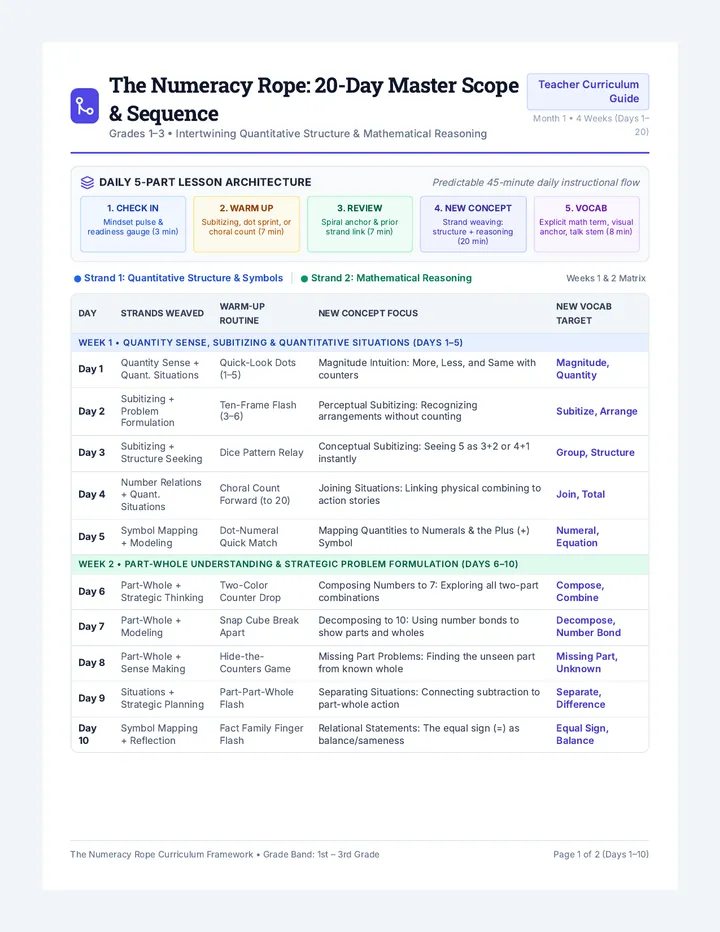
A comprehensive four-week foundational numeracy sequence for Grades 1–3, systematically intertwining quantitative structure with mathematical reasoning. Spanning twenty lessons, it guides students from intuitive subitizing and part-whole thinking to unitizing and structural fact fluency.

AR

Amanda Ramirez

9
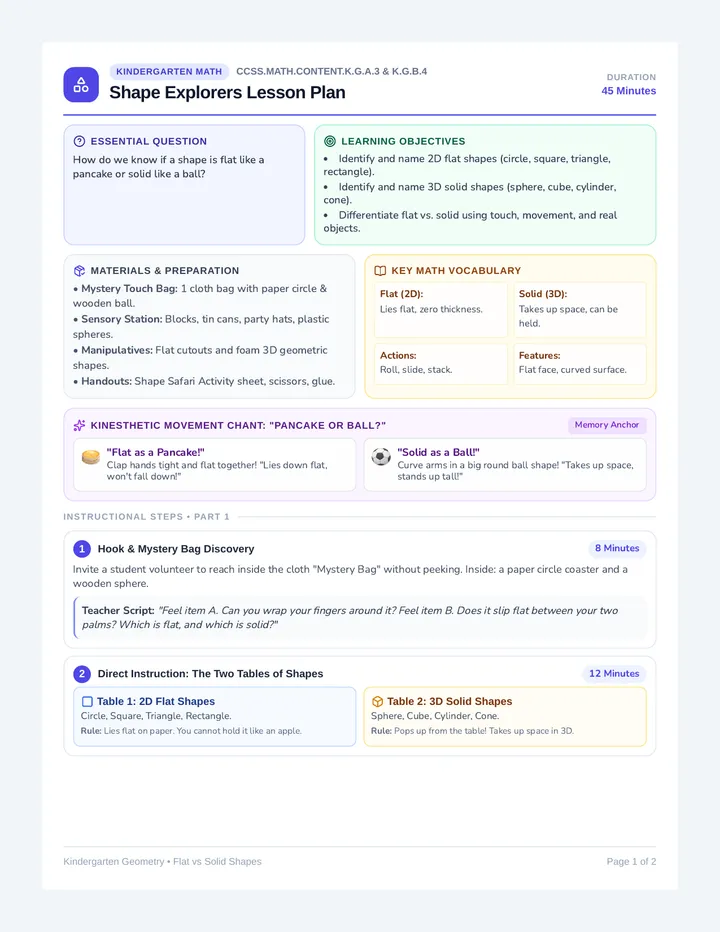
Shape Explorers Lesson Plan

Shape Explorers

A comprehensive kindergarten geometry lesson exploring two-dimensional flat shapes and three-dimensional solid shapes through hands-on tactile investigation, movement chants, and real-world object sorting.

Lenny Avatar
Lenny
3
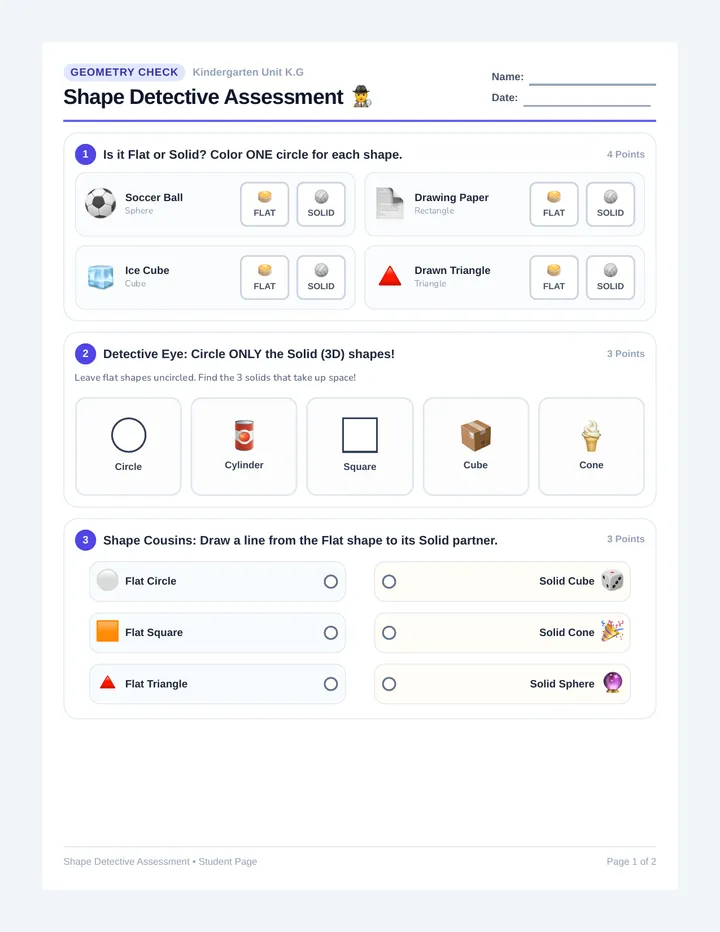
Shape Detective Assessment

Shape Detective Assessment

A kindergarten formative assessment and scoring guide evaluating flat versus solid shape identification, real-world object classification, and shape properties.

Lenny Avatar
Lenny
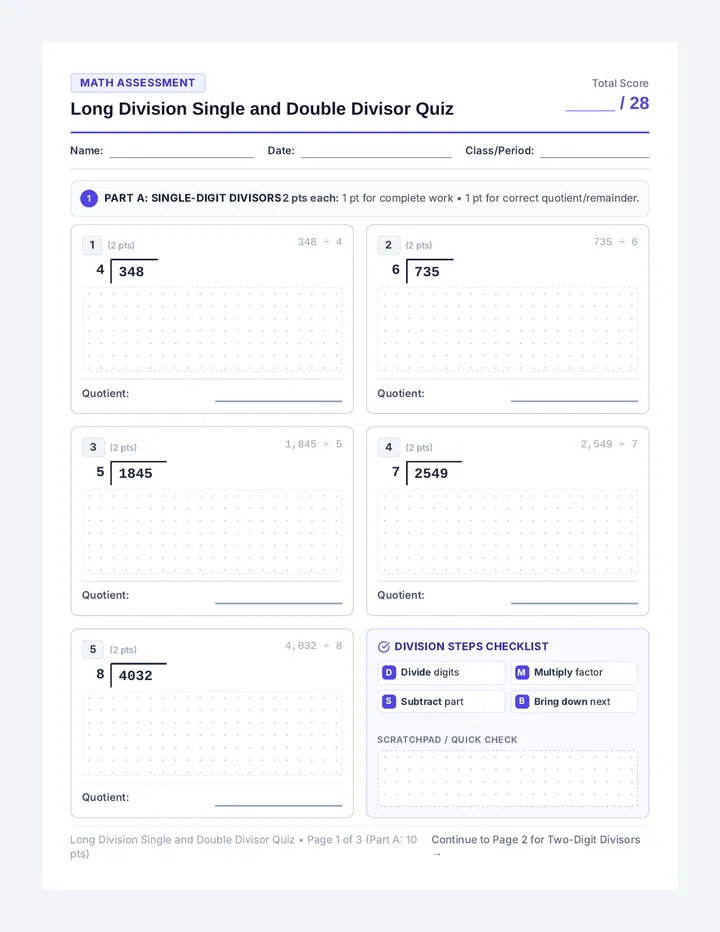
Long Division Single and Double Divisor Quiz

Math Mastery Series

A collection of middle school mathematics assessments and teacher resources covering arithmetic fluency and pre-algebra foundations.

S

Steve.Peters

4
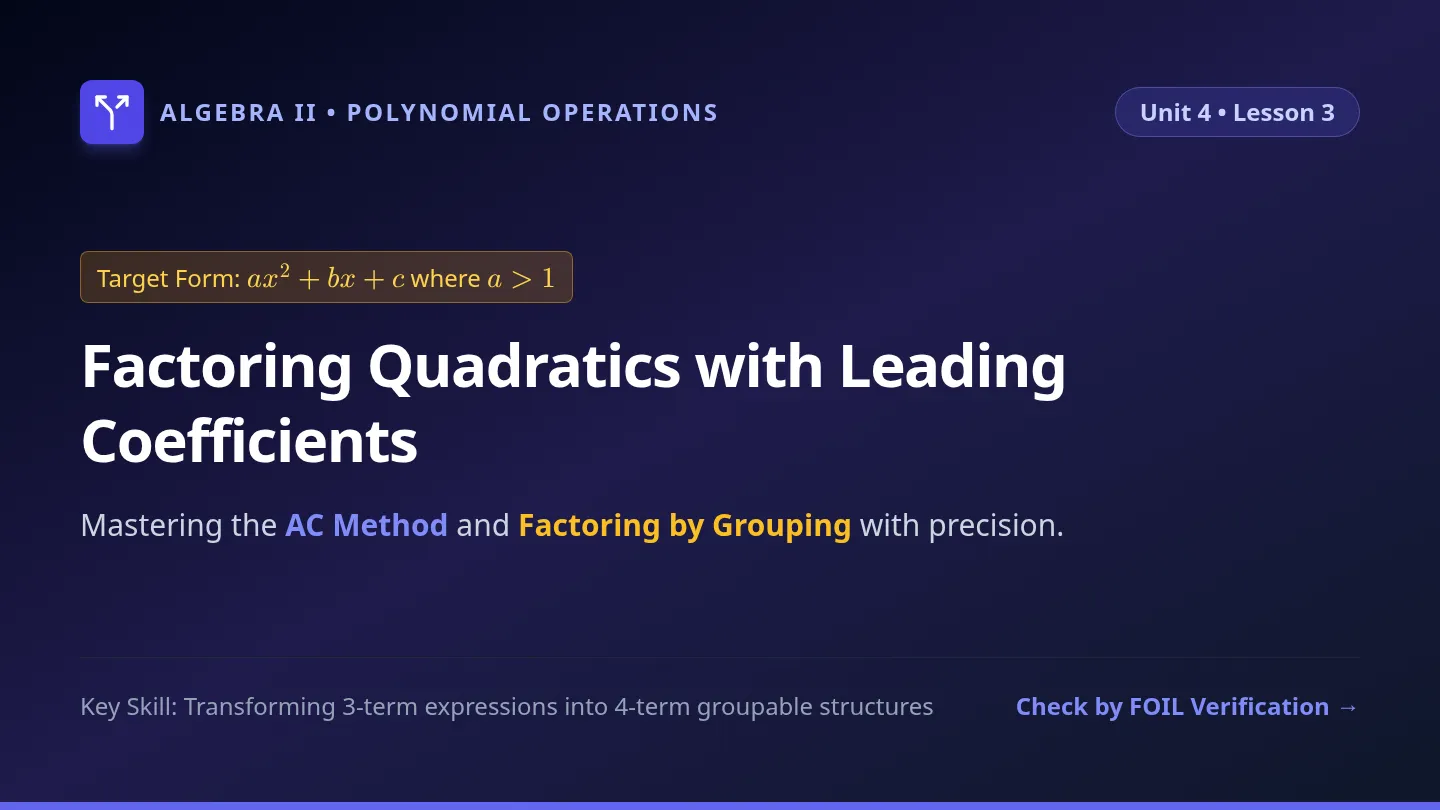
Master Product Slides

Leading Coefficient Factor Quest

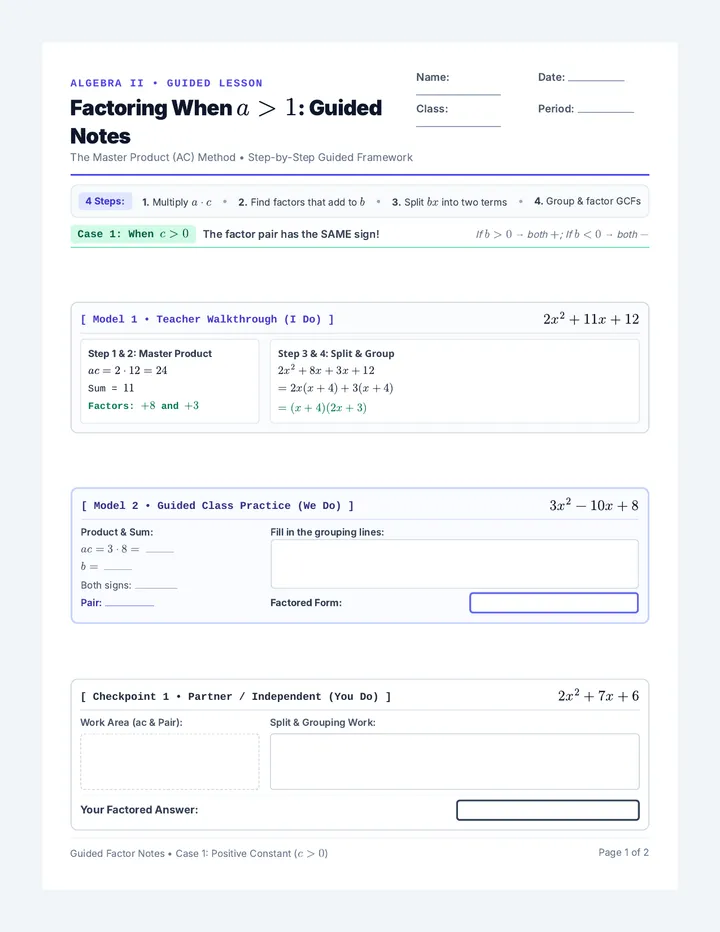
A comprehensive algebra lesson on factoring quadratic expressions where the leading coefficient is greater than 1 ($ax^2 + bx + c$, $a > 1$). Includes instructional slides, a structured student practice worksheet with dedicated workspace, and a complete step-by-step teacher answer key.

MR

Mahuya Roy Chowdhury

6
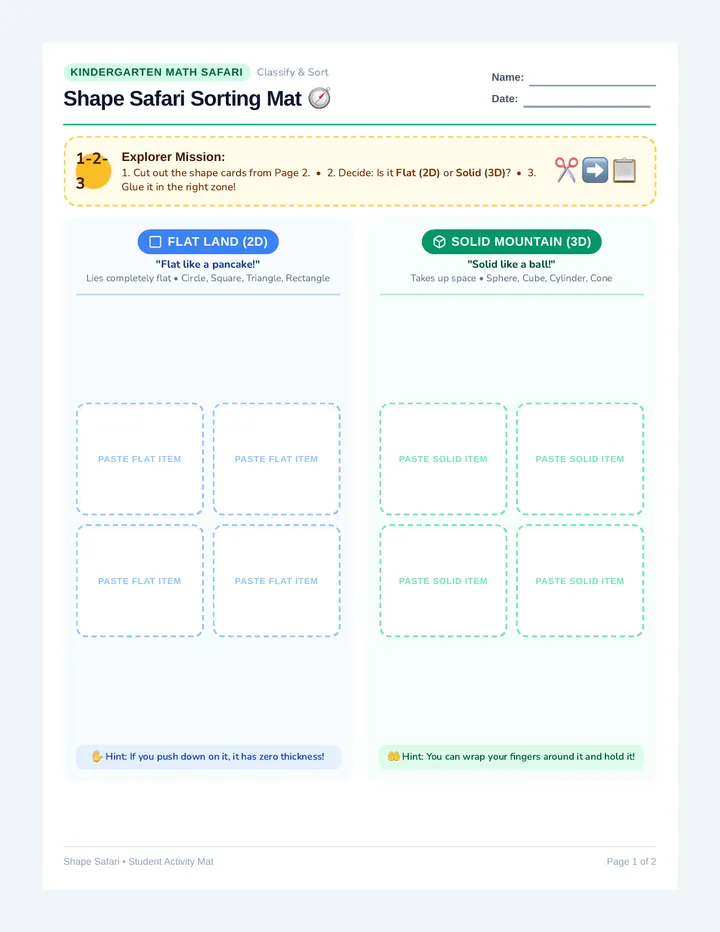
Shape Safari Student Activity

Shape Safari Student Activity

A hands-on kindergarten sorting activity featuring a two-column Flat Island vs. Solid Mountain sorting mat and scissors-ready shape tokens with real-world object illustrations.

Lenny Avatar
Lenny
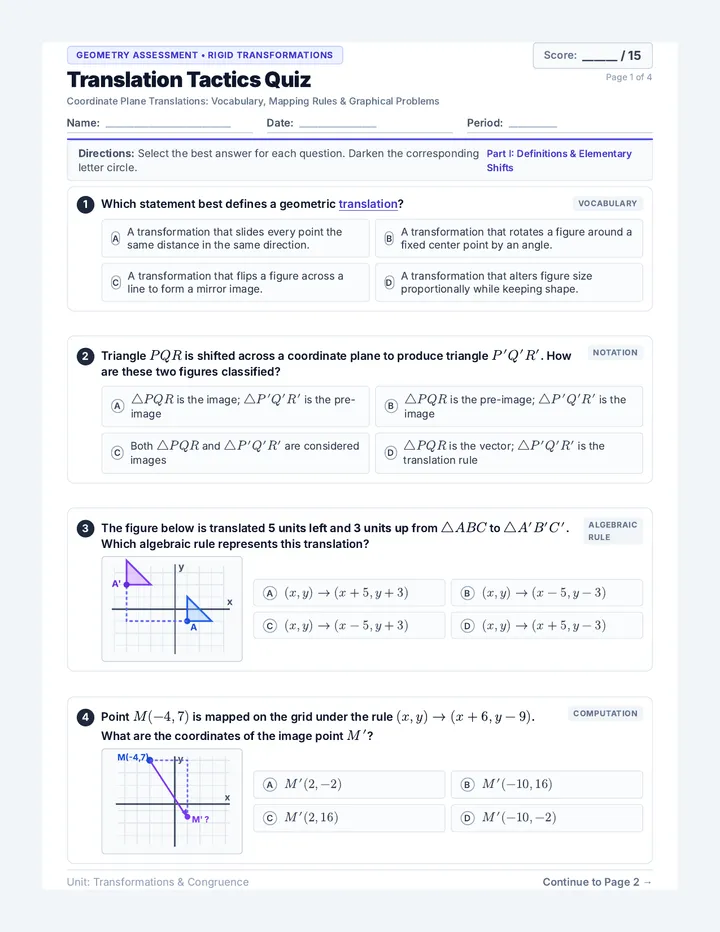
Translation Tactics Quiz

Math Mastery Units

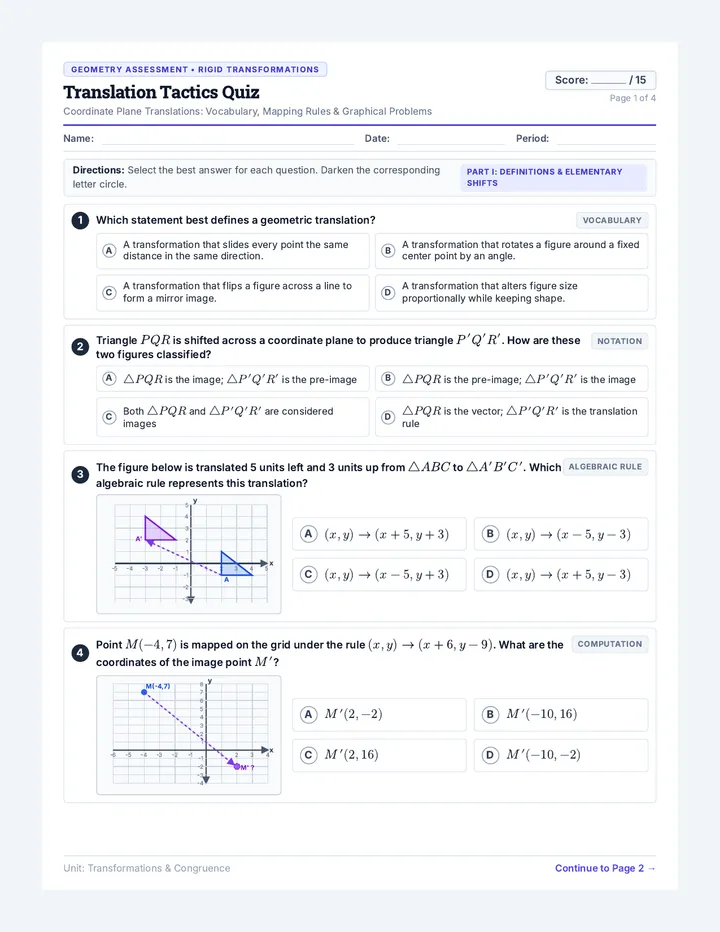
Comprehensive secondary mathematics units covering coordinate geometry transformations and linear functions in slope-intercept form.

FM

Fernando Mancini

4
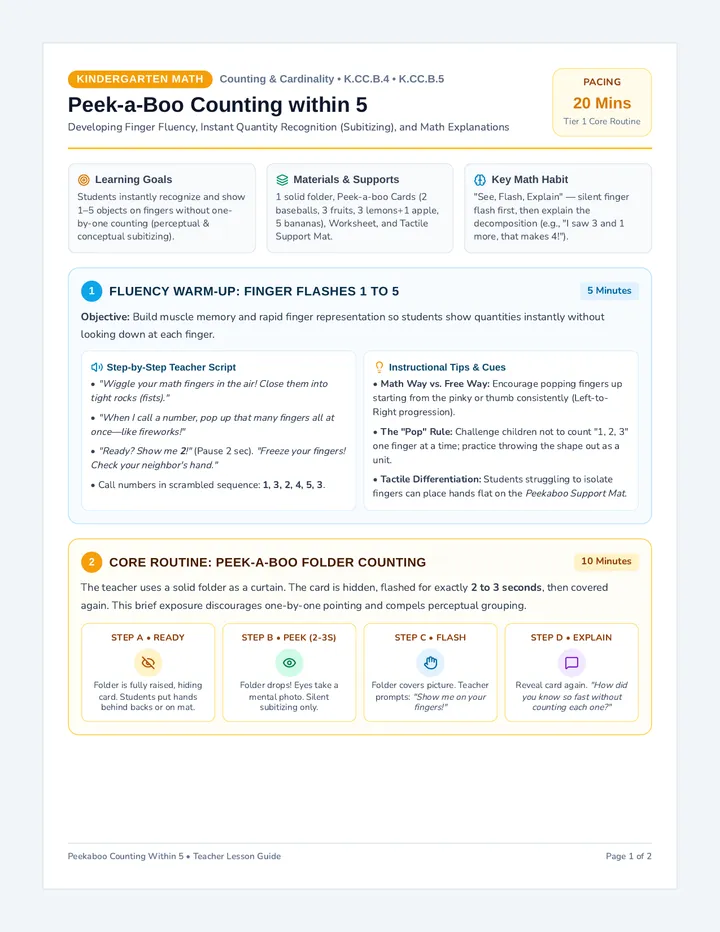
Peekaboo Counting Lesson Plan

Peekaboo Counting Five

A foundational Kindergarten math lesson focused on perceptual and conceptual subitizing within 5 using a peek-a-boo folder reveal routine. Students develop fluency in finger-counting, instant quantity recognition, and explaining their mathematical thinking.

KH

kesha heath

5
Shape Explorers Lesson Plan

Shape Explorers Lesson Plan

A comprehensive 45-minute kindergarten lesson plan featuring kinesthetic chants, tactile mystery bag hooks, guided exploration of roll-slide-stack properties, and targeted differentiation strategies.

Lenny Avatar
Lenny
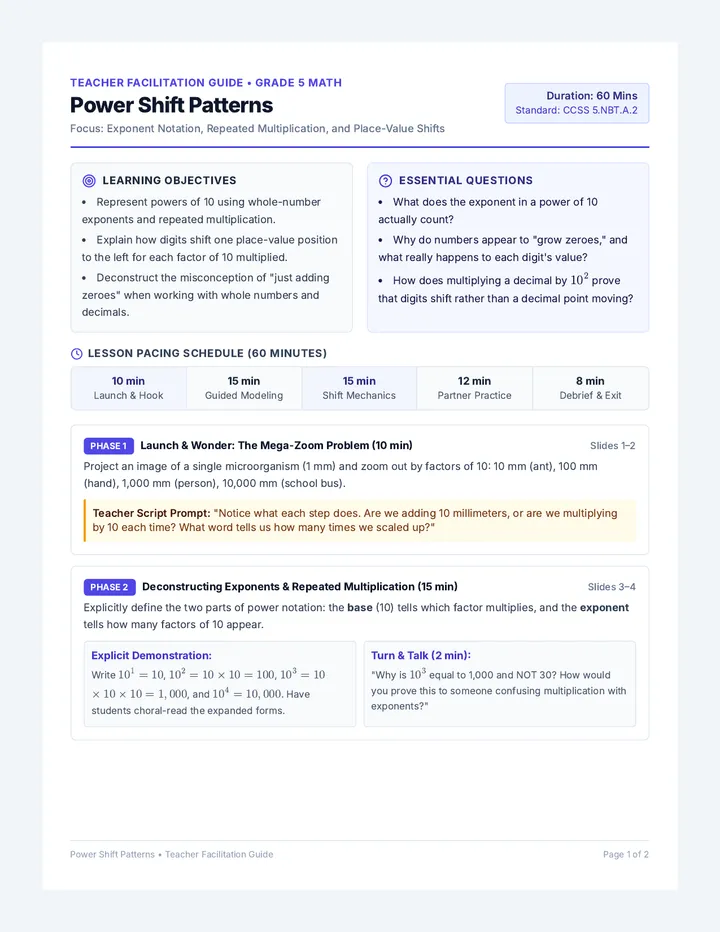
Power Shift Teacher Guide

Power Shift Patterns

A foundational mathematics lesson exploring exponents as repeated multiplication and analyzing place-value shifts when multiplying numbers by powers of 10.

SN

Shanna Noonan

5
Guided Factor Notes Handout

Guided Factor Notes Handout

A two-page printable guided notes handout following an 'I Do, We Do, You Do' instructional model. Directly contrasts quadratic factoring when c > 0 versus when c < 0, with structured X-diagrams, guided prompts, and an exit ticket.

MR

Mahuya Roy Chowdhury

Translation Tactics Quiz Document

Translation Tactics

A geometry lesson focused on rigid transformations and coordinate plane translations, featuring vocabulary, algebraic mapping rules, coordinate computations, and inverse shift problem-solving.

FM

Fernando Mancini

2