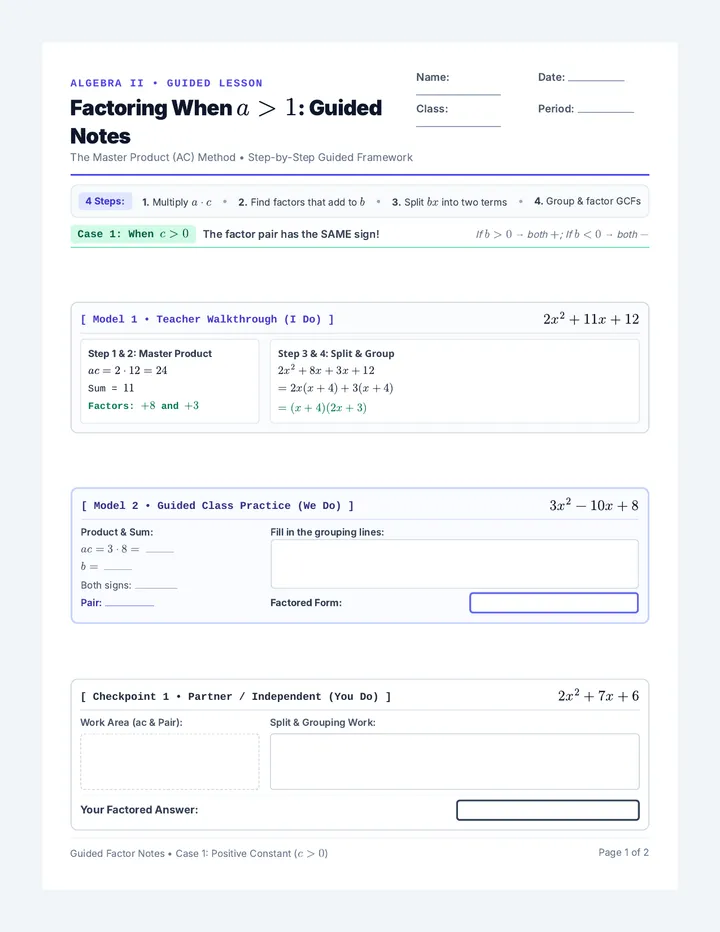
A comprehensive algebra lesson on factoring quadratic expressions where the leading coefficient is greater than 1 ($ax^2 + bx + c$, $a > 1$). Includes instructional slides, a structured student practice worksheet with dedicated workspace, and a complete step-by-step teacher answer key.
Part 4: Spot the Error Key • Complete Analysis 4 Points
Location of Error: Line 3: Marcus factored out \( -1 \) instead of \( +1 \).
Explanation: In Line 2, the second pair is \( +1x - 3 \). If you factor out \( -1 \), the expression becomes \( -1(-x + 3) \), which is NOT \( -1(x - 3) \). Since \( +1x - 3 \) already matches \( (x - 3) \), the GCF is positive \( +1 \): \( +1(x - 3) \).
Correct Factored Form: \( (x - 3)(2x + 1) \)
Teacher Answer Key • Leading Coefficient Factoring Page 2 of 2
The 4-Letter Word:
Factor Mix & Match Laboratory • Positive vs Negative \( c \) Page 1 of 2
Part 2: Sign Sorting & Proof Workspaces
Sort expressions by their constant sign, then formally prove two matches from Page 1.
Prove with 4-Term Grouping
A. Sign Sorting: Write the Roman Numeral under the correct column
i. \( 3x^2 + 5x - 2 \)
ii. \( 2x^2 - 11x + 12 \)
iii. \( 5x^2 - 7x - 6 \)
iv. \( 4x^2 + 16x + 15 \)
v. \( 6x^2 + x - 12 \)
vi. \( 7x^2 - 15x + 2 \)
Category 1: Same Sign Factors (\( c > 0 \))
Category 2: Opposite Sign Factors (\( c < 0 \))
B. Prove Your Matches (Show full middle-term split and grouping steps)
Proof 1: Problem with \( c > 0 \) Select Prob 1, 2, 6, or 8
Chosen Problem #: Trinomial:
AC Product & Factor Pair:
Split Middle Term & Factor by Grouping:
Final Factored Form:
Proof 2: Problem with \( c < 0 \) Select Prob 3, 4, 5, or 7
Chosen Problem #: Trinomial:
AC Product & Factor Pair:
Split Middle Term & Factor by Grouping:
Final Factored Form:
Sign Detective Reflection:
Compare \( 2x^2 + 5x - 3 \) and \( 2x^2 - 5x - 3 \). Both have \( ac = -6 \) and use factors \( 6 \) and \( 1 \). How does the sign of \( b \) dictate which factor must receive the negative sign?
Factor Mix & Match Laboratory • Positive vs Negative \( c \) Page 2 of 2
Core Principle: In both expressions, \( ac = 2(-3) = -6 \), so the factor pair must have opposite signs and multiply to \( -6 \). The factors \( 6 \) and \( 1 \) have a difference of \( 5 \).
For \( 2x^2 + 5x - 3 \): Since the middle term is \( +5 \), the larger factor must be positive: \( +6 \) and \( -1 \), splitting as \( 2x^2 + 6x - 1x - 3 = (x + 3)(2x - 1) \).
For \( 2x^2 - 5x - 3 \): Since the middle term is \( -5 \), the larger factor must be negative: \( -6 \) and \( +1 \), splitting as \( 2x^2 - 6x + 1x - 3 = (x - 3)(2x + 1) \).
Teacher Answer Key • Factor Mix & Match Laboratory Page 1 of 1
Your Factored Answer:
Exit Ticket: The Master Sign Decision Matrix Fill in the blanks
1. If \( c > 0 \): The two factors have the sign.
• Look directly at the sign of \( b \) to know what both signs are.
2. If \( c < 0 \): The two factors have signs.
• The larger factor gets the sign of .
Guided Factor Notes • Case 2: Negative Constant (\( c < 0 \)) Page 2 of 2