Calm Keys Handout Calm Keys Handout
Daily Strategies for Sibling Harmony, Focus & Calm
Weekly Focus
Morning Mastery
Bag Ready Zone: Have everything at the door by 7 PM the night before.
First-Then Logic: "First shoes, then favorite cereal."
Morning Movement: 5 wall-pushes before breakfast to burn early energy.
Evening Ease
The Dimming: Lower lights 1 hour before bed to signal the brain to slow down.
Heavy Work: Let them carry the laundry basket to help "ground" their body.
Low-Stakes Choices: "Blue or red pajamas?" gives them control without stress.
Directing Flow
Eye Contact First: Place your hand on their shoulder before speaking.
One-Step Only: Instead of "Clean your room," say "Pick up the blue truck."
Repeat Back: Ask them to whisper what you just said back to you.
Sibling Harmony
Special Body Space: Use a rug or hula hoop for each child to define "my space."
Side-by-Side Play: Encourage different toys in the same room vs. sharing the same toy.
Praise "Being Gentle": Explicitly notice when they walk past a sibling without touching.
Homework & Focus Zones
The Environment
Remove toys and screens. Use a "Focus Shield" (a trifold board) if they are easily distracted by the room.
The Timing
Work in 5-10 minute blocks. Use a visual timer. Let them stand or sit on a wiggle cushion while working.
My Commitment This Week
One Morning Change
One Sibling Win
Strategy Spotlight Cards Strategy Spotlight Cards
Cut along the dotted lines. Keep these in key spots around your home.
Whisper & Wait
When giving a direction, whisper it. Then wait 5 full seconds before asking if they heard you. This gives their brain time to process.
Following Directions
The Bubble Shield
If play gets rough, say "Bubble Check!" Each child steps back into their "bubble" (an arm's length away) to reset their body space.
Sibling Harmony
The Focus Sprint
Set a timer for 5 minutes of "Super Focus." If they work the whole time, they get a 2-minute "Movement Break" (frog jumps!).
Homework Focus
The Dim Down
30 minutes before bed, turn off big lights and use only lamps. This signals their "sleepy brain" that it's time to slow down.
Evening Routine
Hand on Heart
When they feel an "impulse" to grab or run, have them put their hand on their heart and feel 3 heartbeats before moving.
Impulse Control
The Clothing Race
Put socks/shoes on a specific rug. Use a "sand timer" and see if they can finish before the sand runs out.
Morning Routine
Kindness Catcher
When you see them use a gentle hand or share a toy with a sibling, give them a "Kindness Token" (a button or sticker).
Sibling Harmony
The Echo Rule
Ask: "What did I just ask you to do?" They echo the direction back to you before they are allowed to start.
Following Directions
Home Harmony Slides Home Harmony
Supporting Your Active Kindergartener
Winning the Bookends
Morning
Visual Checklists: Use icons for dressing & teeth.
Heavy Work: 5 wall-pushes to "wake up" the brain.
Evening
The Dim Down: Low lights 1 hour before bed.
Tactile Calming: Weighted blankets or firm hugs.
Directing the Flow
Connect First
Get at eye level. Use a gentle touch on the shoulder before speaking.
The Echo
Ask them to repeat the instruction back to you before they move.
One & Done
Give only ONE instruction at a time. No multi-step commands yet.
Sibling Harmony
Create "Defined Play Zones." Use rugs or tape on the floor to show exactly where "my space" ends and "your space" begins.
"Praise the absence of conflict—not just the resolution of it."
Homework Focus
Use the "Work-Sprint" method. 5 minutes of focused effort followed by 2 minutes of vigorous movement.
Clear desk policy
Standing is allowed!
Connection Over Correction
When they can't regulate their own bodies, they use ours.
Staying calm is your most powerful tool.
You are doing a great job.
Power of Patience Guide Informational Guide
The Power of Patience
Advanced Strategies for Routine, Siblings & Focus
The Daily Bookends
The start and end of the day are often the most difficult for hyperactive children. Their transition from sleep to activity and back again requires a "slow ramp."
The Evening Wind-Down
Avoid high-energy screens or rough-housing within 90 minutes of bedtime. Use "heavy work"—like pushing the laundry basket or doing "wall sits"—to help their sensory system ground itself before they hit the sheets.
Mastering Directions
Hyperactive brains often have "auditory processing lag." By the time you finish a three-step direction, they've already lost step one.
The Echo Rule: Have them repeat the direction back. If they can't repeat it, they didn't hear it.
One Instruction at a Time: Instead of "Go upstairs, get your shoes, and grab your coat," give one task, wait for completion, then give the next.
Sibling Harmony
Impulsivity often looks like "bothering" a younger sibling. They may not mean to be rough, but they don't know how to stop.
Strategy: Set up "zones" for play where they aren't forced to share every toy in the same immediate space.
Homework Success
Standing desks or wiggle cushions are your best friend. Many active kids focus better when their bodies are in motion.
Try this:
5 mins work / 2 mins jumps.
Sibling Interaction
Teaching "Gentle Hands" is easier when practiced during calm moments, not in the middle of a fight.
The "Stop Light" System
Teach them a hand signal for "Stop" that the younger sibling can also use. Practice this game-style so it's a reflex, not a struggle.
Homework Habits
The "homework battle" is usually a struggle of low focus vs. high demand.
Environment Shielding
Use a trifold board or even a "special hat" that means "I am focusing." Reducing peripheral vision can drastically improve attention span.
Connection First
Correction without connection leads to rejection. Before you fix a behavior, ensure the relationship is solid.
Document Version
Parental Resource v1.2
Daily Flow Schedule Daily Flow Schedule
My Road Map for a Great Day!
Date: ___________
Morning: Getting Ready
Wake Up & Stretch
Get Dressed
Breakfast Fuel
Brush Teeth
Afternoon: Focus & Play
Home Work (10m)
Outside Play
Write Task
Write Task
Evening: Winding Down
Dinner Time
Bath/Shower
Story Time
Bedtime
Win of the Day!
What did you do great today?
Sticker Box
Focus & Feel Activity Guide Focus & Feel Guide
Activities for Sitting Still & Refocusing Together
The Cool Down Toolkit
The "Squeeze & Release"
Have your child squeeze their fists as tight as a lemon for 5 seconds, then "drop the lemons" and shake their hands. Repeat 3 times. This releases physical tension quickly.
The "Deep Pressure" Hug
Sit behind your child and give a firm, steady "bear hug" (avoiding the neck/face). The sensory input helps ground an over-stimulated nervous system.
"Sit Still" Activity Games
Sitting still is easier when it is a game with you, rather than a command.
The Mirror Game
Sit face-to-face. You move your hands or head very slowly, and they must "mirror" you exactly. This builds intense shared focus.
Statue Listening
Set a timer for 1 minute. Both sit like "statues" and see how many sounds you can hear (clock ticking, car outside). Compare lists after.
Hand Press Challenge
Press your palms against theirs. Try to press firmly without moving your bodies. It provides "heavy work" while sitting.
Sticky Seat Story
Tell a story where they "interact" with the words while staying in their seat (e.g., "The bird flapped wings" = they move only arms).
The Refocus Reset
The "5-4-3-2-1" Reset
When they lose focus on a task, stop and find:
5
See
4
Touch
3
Hear
2
Smell
1
Breath
"A child who can't sit still isn't being difficult; their body is looking for input. Give them the input through you."
Regulation Road Map Chart Regulation Road Map
Checking in with My Body's "Engine"
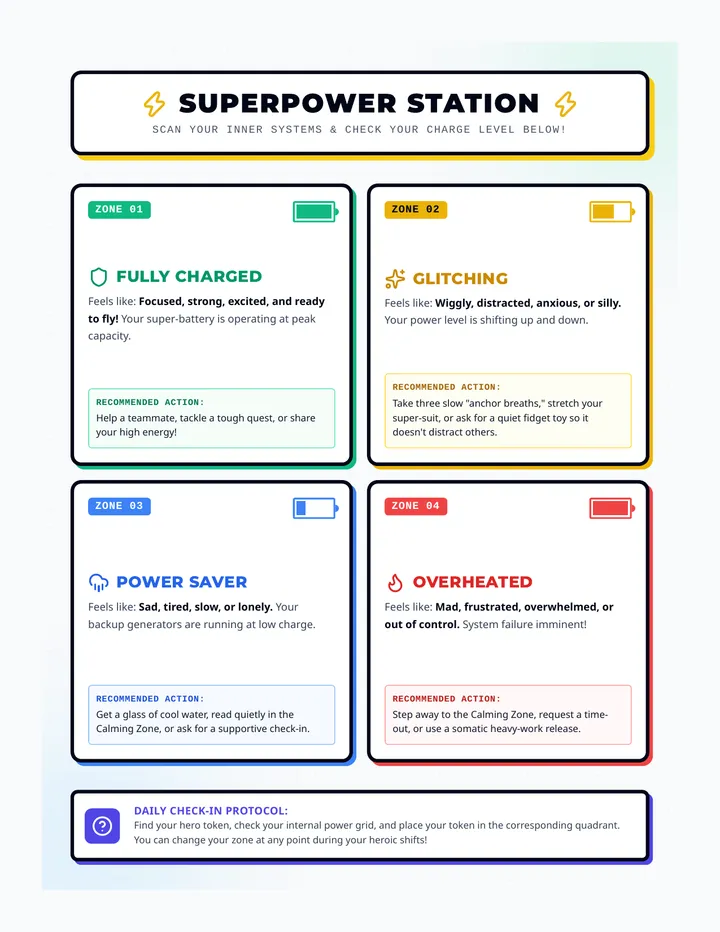
The Blue Zone
Sad
Tired
Sick
Engine is Slow
"I need a rest or a hug to get back to green."
The Green Zone
Happy
Focused
Ready
Engine is Just Right
"I am ready to learn, play, and listen!"
The Yellow Zone
Silly
Worried
Frustrated
Engine is Fast
"I need a tool to slow my engine down."
The Red Zone
Mad
Yelling
Out of Control
Engine is Too Fast
"I need to STOP and find a safe spot to calm."
Helping Your Child Notice
1. Name the Zone
Instead of saying "Stop being silly," try: "I see your engine is in the Yellow Zone right now. What tool can we use to get back to Green?"
2. The "Body Scan" Check-In
Ask: "Is your heart beating fast (Yellow)? Or slow (Blue)? Is your tummy tight (Red)?" Linking feelings to body sensations is the first step to awareness.
Print and post this at eye-level for your child to point to.
Star Success Chart Star Success Chart
I can do it! One star at a time.
Name: ___________
Week: ___________
My Goals Mon Tue Wed Thu Fri Sat Sun Morning Hero
Ready for school on time
|
|
|
|
|
|
|
|
|
Focus Legend
Stayed on task / Homework
|
|
|
|
|
|
|
|
|
Gentle Buddy
Kind words & hands with siblings
|
|
|
|
|
|
|
|
|
Listening Leader
Following directions / Echo rule
|
|
|
|
|
|
|
|
My Prize Goal
Stars needed: ___________
Parent Tip
"Focus on immediate rewards. If they have a hard day, remind them that tomorrow is a fresh start for a new star!"
Calm Crew Mission Sheet The Calm Crew Mission
TEAM: Parent + Child Collaboration
Child Captain:
Parent Partner:
1
Feeling the "Flash"
When your body feels like it's going too fast, what happens? Circle the ones you feel:
Bouncy Feet
Hot Face
Fast Heart
Loud Voice
2
The "Stop & Think" Power
PRACTICE 3 TIMES!
Parent and Child: Practice this 3 times right now! Check the box when done.
STOP
Hands on knees.
Deep breath.
LOOK
Find 3 blue things in the room.
PLAN
Pick a calm next move.
#1
#2
#3
3
Our Cool-Down HQ
Where is our quiet spot? Draw or list 3 things that live there (like a pillow or book):
Draw Here
"When I practice my 'Stop & Think' power, I earn tokens toward our next big reward!"
Child Badge