A lesson focused on identifying US coins (penny, nickel, dime, quarter) through visual identification and value matching, designed for students requiring visual support or modified materials.
A foundational lesson for students with intellectual disabilities to identify and practice appropriate classroom behaviors like personal space, kind language, and turn-taking through a social story and interactive sorting.
A sophisticated, technical approach to distress tolerance for 2e students, focusing on emotional systems, logical analysis of impulsive vs. regulated behavior, and radical acceptance as a data-driven strategy.
A professional development session for teachers focused on de-escalation strategies and understanding behavioral manifestations of various disability classifications. This lesson aims to shift teacher response from reactive referrals to proactive support using the CPI model and emotional constancy.
This lesson introduces middle school students in therapeutic settings to the concept of working memory using the 'Mental Workbench' analogy. Students will practice auditory and visual-spatial memory tasks and learn strategies to manage 'cognitive overload' in a supportive environment.
A comprehensive guide on scoring Correct Writing Sequences (CWS) in Writing Curriculum-Based Measurement, focusing on calculating accuracy percentages to monitor student progress.
A culminating project where students reflect on the 8-week journey and create a 'Value Vault' for themselves or Gregor.
Analyzes the end of the novella, Gregor's death, and the family's disturbing relief and new-found 'value'.
Focuses on Part III, the arrival of the boarders, and Gregor becoming a 'nuisance' in his own home.
Analyzes the climax of Part II, the father's return to work, and the symbolic 'apple' attack on Gregor.
Explores the changing relationship between Gregor and Grete, the moving of the furniture, and the concept of 'pity' vs 'value'.
Covers the transition to Part II, focusing on Gregor's physical changes, his new diet, and the loss of his human voice.
A focus on Part I of the novella, exploring the theme of work as identity and the manager's visit as a symbol of surveillance.
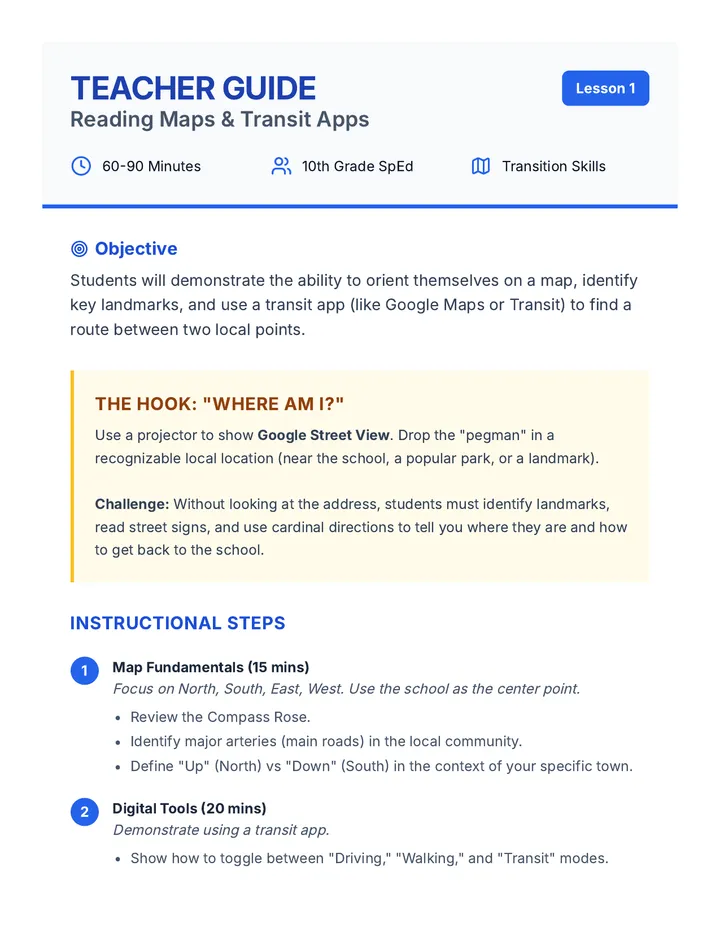
A visually-focused lesson for students with ASD to learn about personal space and keeping hands to themselves through picture-based scenarios.
A structured lunch bunch session designed to foster social rapport through collaborative LEGO building and tech-themed problem-solving challenges.
A social skills lesson focused on listening to full instructions, handling multi-step tasks, and beginning work immediately using a detective theme.
A comprehensive implementation framework for high school teams managing 18-21 transition programs for students in out-of-district placements, focusing on NJ quality indicators for assessment, services, and partnerships.
A 50-minute introductory lesson on Kafka's Metamorphosis, focusing on the shift from literal to abstract value through the lens of Gregor's transformation. Designed for special education students with high-engagement whiteboard activities.
A comprehensive set of tools designed to help kindergarten students with ADHD manage impulsivity through visual cues, self-regulation strategies, and positive reinforcement.
A modified introductory lesson on unit fractions (1/2 and 1/4) specifically designed for students with Down Syndrome, using high-visual pizza models and the Concrete-Representational-Abstract (CRA) approach.
Covers short 'e' and mixed vowel review, synthesizing comprehension skills, and celebrating fluency progress with a final reading challenge.
Targets short 'o' and 'u' CVC words, identifying the main idea of short passages, and increasing reading rate with sight word phrases.
Focuses on short 'a' and 'i' decoding, sequencing three-part stories, and mastering initial high-frequency 'trail words'.
An introductory station-based lesson for preschool and kindergarten SDC students to explore the beginning sound /t/ through tactile manipulatives and simplified worksheets.