Lenny.com
Explore
Create
ActivitiesNewMathEnglish Language ArtsScience & EngineeringSocial StudiesGlobal LanguagesHealth & Physical EducationSpecial EducationCounseling & Life SkillsArts & CreativityESL
Lenny.com
Lenny.com
Explore
Create
ActivitiesNewMathEnglish Language ArtsScience & EngineeringSocial StudiesGlobal LanguagesHealth & Physical EducationSpecial EducationCounseling & Life SkillsArts & CreativityESL
Lenny.com
Lenny.com

Solutions

Lenny for EducatorsLenny for SchoolsLenny for Districts

Product

ExploreSign inCreateSupportAbout

Resources

Getting startedMTSS Acceleration Program

© 2026 Lenny Learning Inc.

TermsPrivacyAccessibility
LinkedInInstagramX
Lenny

Four Operations and Patterns

Multi-digit addition, subtraction, multiplication, and division strategies paired with identifying numerical patterns. Strengthens algebraic thinking through analysis of sequence rules and arithmetic relationships.

MathNumbers & CountingCounting ObjectsNumber NamesComparing NumbersNumber OperationsCounting SequenceNumbers 0-10Place Value Understanding and SystemAdd and Subtract Within 20Addition and Subtraction ConceptsAddition and Subtraction EquationsAddition and Subtraction ProblemsFoundations for MultiplicationMultiplication and Division PropertiesMultiply and Divide Within 100Multiplication and Division ProblemsFactors and MultiplesProperties of OperationsPatterns and RelationshipsGenerate and Analyze PatternsMulti-Digit ArithmeticPlace Value OperationsMulti-Digit and Decimal OperationsNumerical ExpressionsFour Operations and PatternsFour Operations Problem SolvingMeasurement & DataMeasurable AttributesMeasuring LengthsMeasure and Estimate Lengths in Standard UnitsRelate Addition and Subtraction to LengthClassifying and Counting ObjectsTime and MoneyArea Concepts and MeasurementPerimeter and Area MeasuresAngle Concepts and MeasurementTime, Volume, and MassMeasurement Unit ConversionsGeometryIdentifying ShapesShapes and AttributesShape Attributes and ReasoningShapes and CompositionClassifying 2D FiguresGeometric Figures and RelationshipsLines, Angles, and ShapesAngle, Area, and VolumeGeometric MeasurementVolume of 3D ShapesCoordinate Plane ApplicationsTransformations in the PlaneCongruence and SimilarityUnderstand congruence in terms of rigid motionsSimilarity and TransformationsProve Theorems Involving SimilarityPythagorean TheoremTrigonometry for General TrianglesMake Geometric ConstructionsProve Geometric TheoremsTheorems About CirclesFind Arc Lengths And Areas of Sectors of CirclesVolume FormulasRelationships Between Two-Dimensional and Three-Dimensional ObjectsProve Simple Geometric Theorems AlgebraicallyTranslate Between Geometric Description and Equation for Conic SectionApply Geometric Concepts in Modeling SituationsFractions & DecimalsFractions as NumbersBuilding FractionsFraction Equivalence and OrderingAdding and Subtracting FractionsMultiplying and Dividing FractionsDividing FractionsDecimal FractionsMulti-Digit Computation and FactorsAdd, Subtract, Multiply, and Divide Rational NumbersRational Number SystemIrrational Numbers and ApproximationsRatiosRatios and ProportionsProportional RelationshipsUnit RateAlgebraAlgebraic ExpressionsGenerate Equivalent ExpressionsQuantitative RelationshipsProportional Relationships and Linear EquationsEquations and InequalitiesEquation Solving and ReasoningLinear Equations and SystemsGraph Equations and InequalitiesSystems of EquationsReal-World Algebraic ProblemsQuantitative Reasoning with UnitsExpression StructureEquivalent Expression FormsRadicals and Integer ExponentsRational ExponentsRational and Irrational NumbersPolynomial OperationsPolynomial IdentitiesPolynomial Zeros and FactorsRational ExpressionsComplex Number OperationsComplex Numbers in PolynomialsComplex Numbers on PlaneStatistics & ProbabilityRepresent and Interpret DataData DistributionsStatistical VariabilityProbability ModelsCompound Event ProbabilitiesStatistical SamplingInterpret Categorical and Quantitative DataBivariate Data PatternsInterpret Linear ModelsComparing Two PopulationsRandom Processes in StatisticsIndependence and Conditional ProbabilityExpected ValuesProbability-Based Decision MakingStatistical Inference and ConclusionsFunctionsFunction Concepts and NotationDefine and Compare FunctionsInterpret Functions in ContextAnalyze Function RepresentationsModel Relationships with FunctionsIdentify Linear vs Exponential GrowthDistinguish Between Function TypesCompare Growth RatesInterpret Function ExpressionsBuild Functions from RelationshipsConstruct and Model FunctionsTransform and Combine FunctionsModel Comparison and SelectionSolve Exponential EquationsTrigonometryTrigonometric Ratios Involving Right TrianglesTrigonometric Functions and Unit CircleModel with Trigonometric FunctionsTrigonometric IdentitiesVectors & MatricesIntroduction to Vectors and MatricesVector QuantitiesVector OperationsMatrix OperationsCalculusLimits and ContinuityDerivative Concepts and NotationDerivative Rules and TechniquesApplications of DerivativesOptimization ProblemsRelated RatesCurve Sketching and AnalysisIntegration Concepts and NotationAntiderivatives and Indefinite IntegralsDefinite Integrals and AreaFundamental Theorem of CalculusIntegration TechniquesApplications of IntegrationDifferential EquationsSequences and SeriesParametric and Polar FunctionsVector-Valued Functions

Videos

Completing Number Patterns Within 10,000

Completing Number Patterns Within 10,000

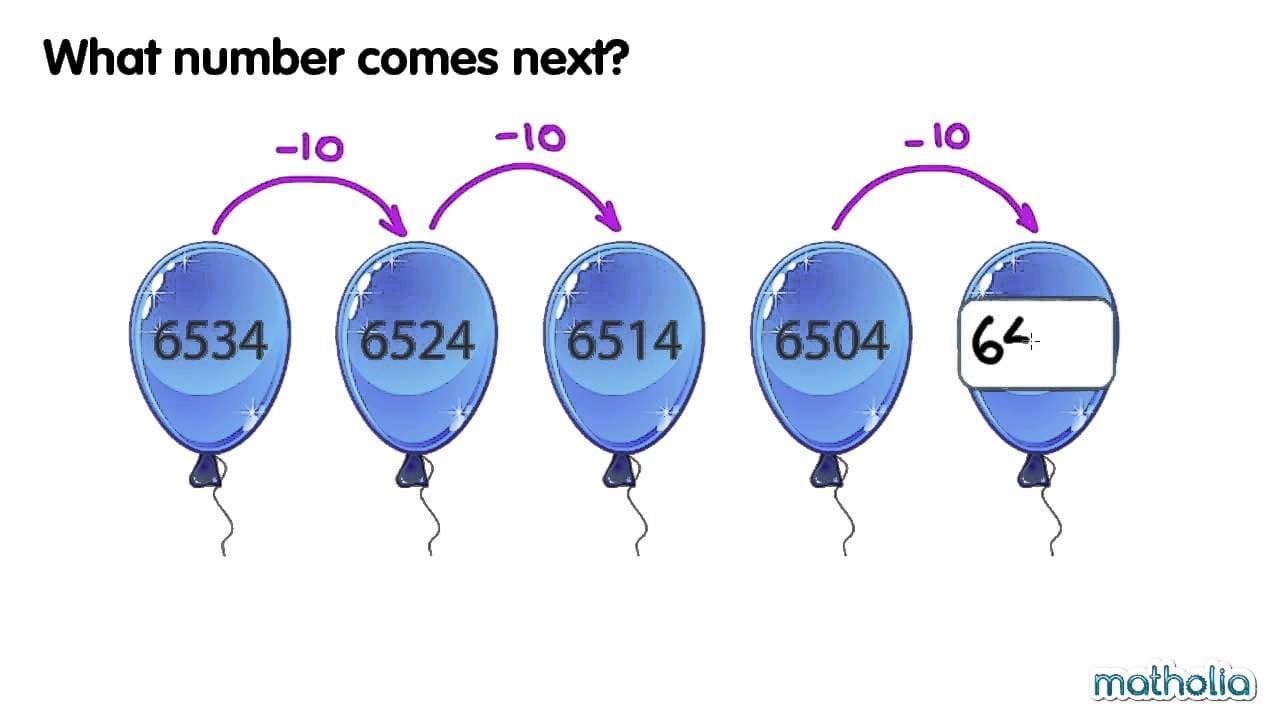
This educational video guides students through the process of identifying and completing number patterns with four-digit numbers up to 10,000. Using clear animations and varied visual themes like balloons and soccer balls, the narrator demonstrates how to determine the rule governing a sequence—such as adding 2, subtracting 10, or subtracting 100—and applies that rule to find the missing term. The video explores key mathematical concepts including skip counting, mental addition and subtraction, and place value relationships. It specifically addresses challenging transitions where place value boundaries are crossed, such as subtracting 10 from 6,504 to reach 6,494, or subtracting 100 from 6,073 to reach 5,973. These examples help students visualize how changing one place value can affect neighboring digits. For educators, this resource serves as an excellent tool for introducing or reinforcing algebra readiness skills related to pattern recognition. It provides clear, step-by-step modeling of how to check the difference between consecutive terms to verify a rule. The visual cues, such as arrows indicating the operation between numbers, support diverse learners in connecting the abstract concept of a numerical sequence with the concrete operation needed to extend it.

MatholiaChannelMatholiaChannel

3mins 11s

How to Count Forward by 10s, 100s, and 1000s

How to Count Forward by 10s, 100s, and 1000s

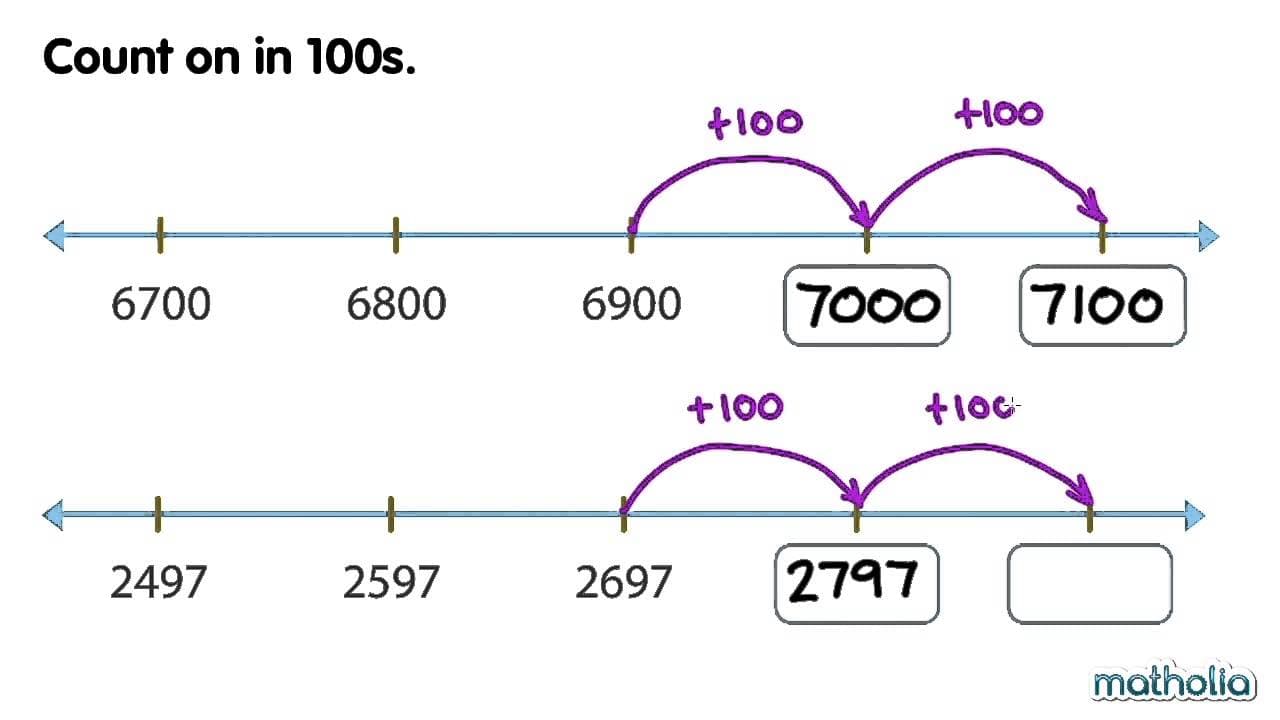
This educational video from Matholia provides a clear, step-by-step demonstration of counting on by 10s, 100s, and 1000s using four-digit numbers. Through the use of animated number lines, the video visually represents the concept of skip counting, showing how adding specific values affects the digits in a number. It breaks the process down into three distinct sections, allowing learners to focus on one place value change at a time.

MatholiaChannelMatholiaChannel

2mins 50s

Reviewing the Four Operations with Whole Numbers

Reviewing the Four Operations with Whole Numbers

This video serves as a comprehensive review of the four basic arithmetic operations with whole numbers: addition, subtraction, multiplication, and division. The instructor, Mr. J, walks viewers through one example problem for each operation, demonstrating the standard algorithms step-by-step. The video focuses on procedural fluency, emphasizing critical mechanical details like aligning place values, regrouping (carrying and borrowing), using placeholders in multi-digit multiplication, and estimating quotients in long division. The content covers multi-digit addition with regrouping, subtraction across zeros and borrowing, 3-digit by 2-digit multiplication using partial products, and long division with a 2-digit divisor. The instructor uses a digital chalkboard format to write out the problems in real-time, allowing students to follow the handwriting and placement of numbers as he narrates the process. He explicitly addresses common pitfalls, such as misalignment of digits and forgetting placeholder zeros. For educators, this resource is an excellent refresher for students in upper elementary or middle school who have already learned these concepts but need to solidify their skills. It works well as a review station, a homework support tool, or a 'flipped classroom' resource before starting a unit that requires mastery of these prerequisites. The clear, isolated examples allow teachers to assign specific segments of the video depending on student needs.
Math with Mr. JMath with Mr. J

7mins 29s

Introduction to Bases and Exponents

Introduction to Bases and Exponents

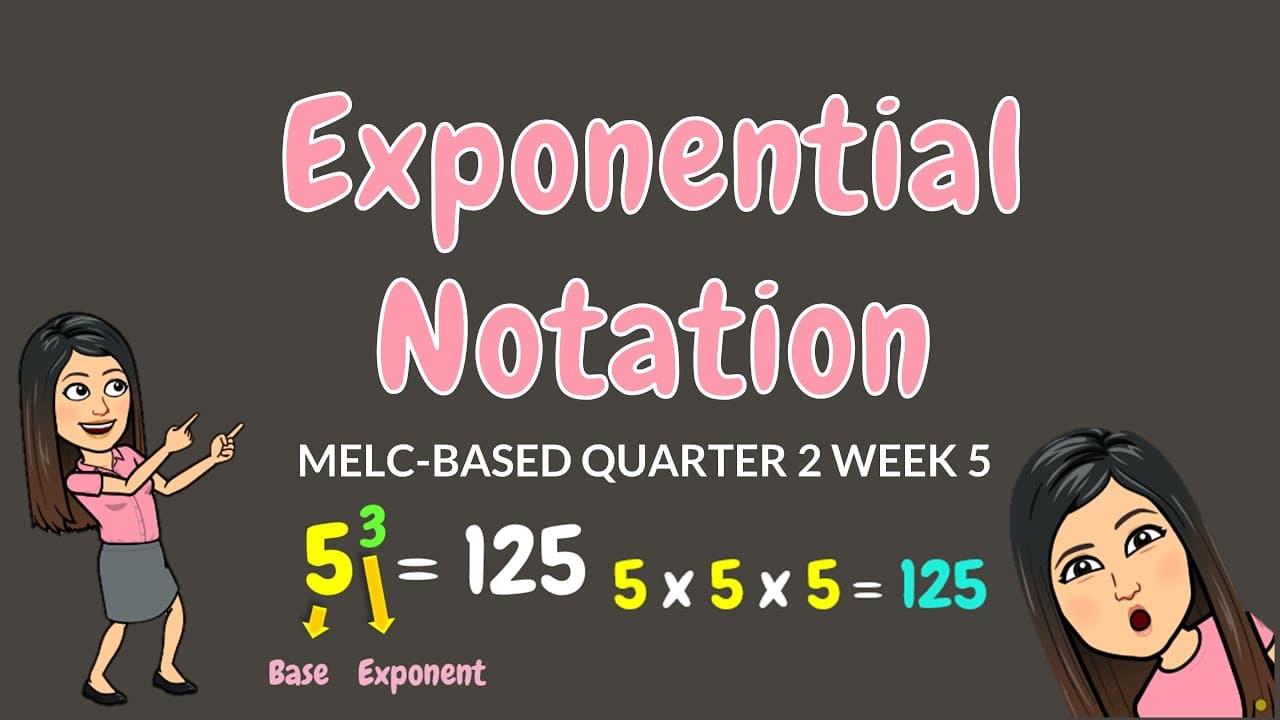
This comprehensive math video introduces students to the fundamentals of exponential notation, transforming repeated multiplication into a compact and powerful mathematical tool. Starting with a relatable real-world word problem about buying bread at a bakery, the video clearly distinguishes between the "base" (the number being multiplied) and the "exponent" (how many times it is multiplied). It uses clear, color-coded visuals to break down the anatomy of an exponential expression, making abstract concepts concrete for learners transitioning into pre-algebra. The content covers several critical sub-topics including identifying base and exponent from expanded form, reading exponential notation aloud (e.g., "squared," "cubed," "to the power of"), and calculating standard form values. It specifically addresses common stumbling blocks and special rules, such as the "invisible exponent" of 1, the zero exponent rule (anything to the power of 0 equals 1), and the pattern-based shortcut for powers of 10. The video concludes with applied practice problems involving word problems and arithmetic with exponents. For educators, this resource serves as an excellent primary instruction tool or review for upper elementary and middle school math. The clear progression from concrete examples to abstract rules, combined with specific "trivia" sections that address edge cases, makes it highly effective for scaffolding. The inclusion of word problems at the end allows teachers to check for understanding and move students from simple identification to application and calculation.

Sheena DoriaSheena Doria

11mins 19s

Mastering Order of Operations Using PEMDAS

Mastering Order of Operations Using PEMDAS

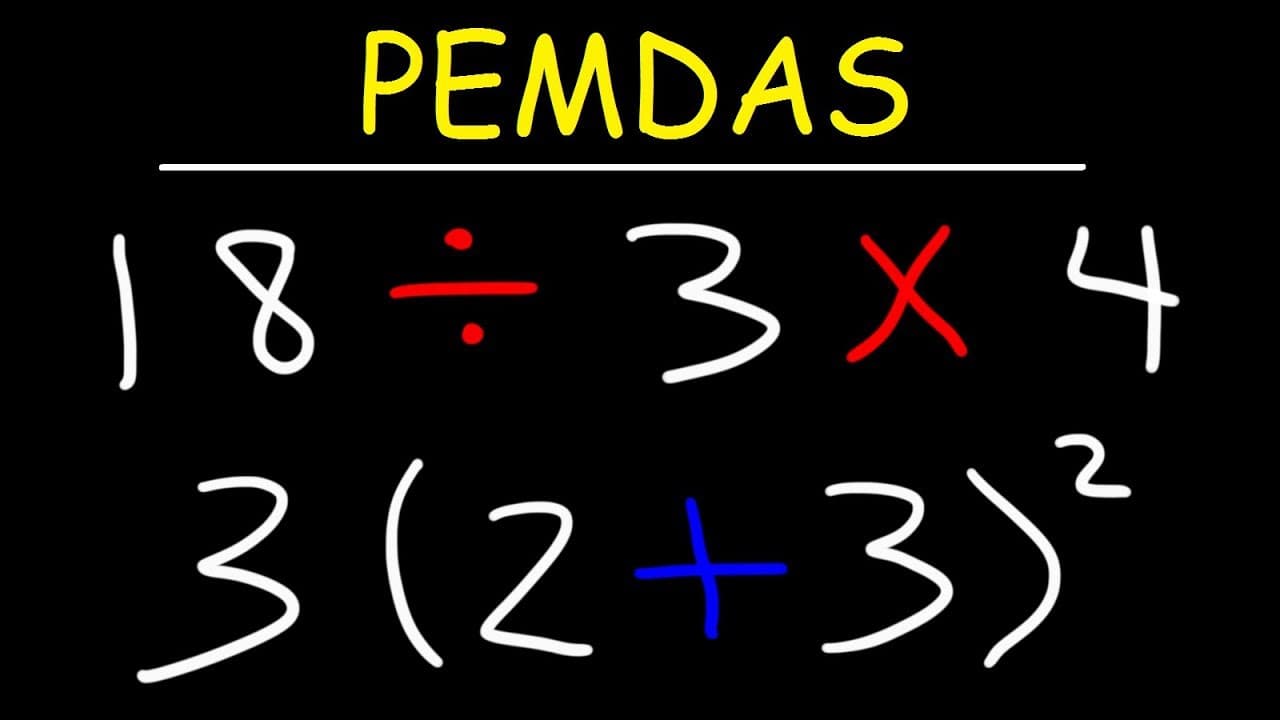
This video serves as a comprehensive tutorial on the Order of Operations in mathematics, commonly known by the acronym PEMDAS. It begins by defining the acronym—Parentheses, Exponents, Multiplication, Division, Addition, and Subtraction—and systematically walks viewers through examples of increasing complexity. The narrator specifically addresses the hierarchy of operations, explaining which steps take precedence and clarifying the often-misunderstood rule of calculating from "left to right" when dealing with operations of equal priority, such as multiplication and division. The video covers several key mathematical themes, including the foundational rules of arithmetic, the specific priority of exponents, and the critical distinction between squaring a negative number versus the negative of a squared number (e.g., (-3)² vs -3²). It also explores nested operations within parentheses and how to handle complex expressions involving fraction bars where the numerator and denominator must be simplified separately. For educators, this resource is highly valuable for solidifying pre-algebra and algebra skills. It is particularly effective at targeting common student misconceptions, such as the belief that multiplication always comes before division, or confusion regarding negative signs and exponents. The clear, step-by-step walkthroughs make it an excellent tool for introducing the concept, reviewing before a test, or providing remediation for students struggling with calculation accuracy.

The Organic Chemistry TutorThe Organic Chemistry Tutor

15mins 52s

Mastering Number Patterns and Sequences

Mastering Number Patterns and Sequences

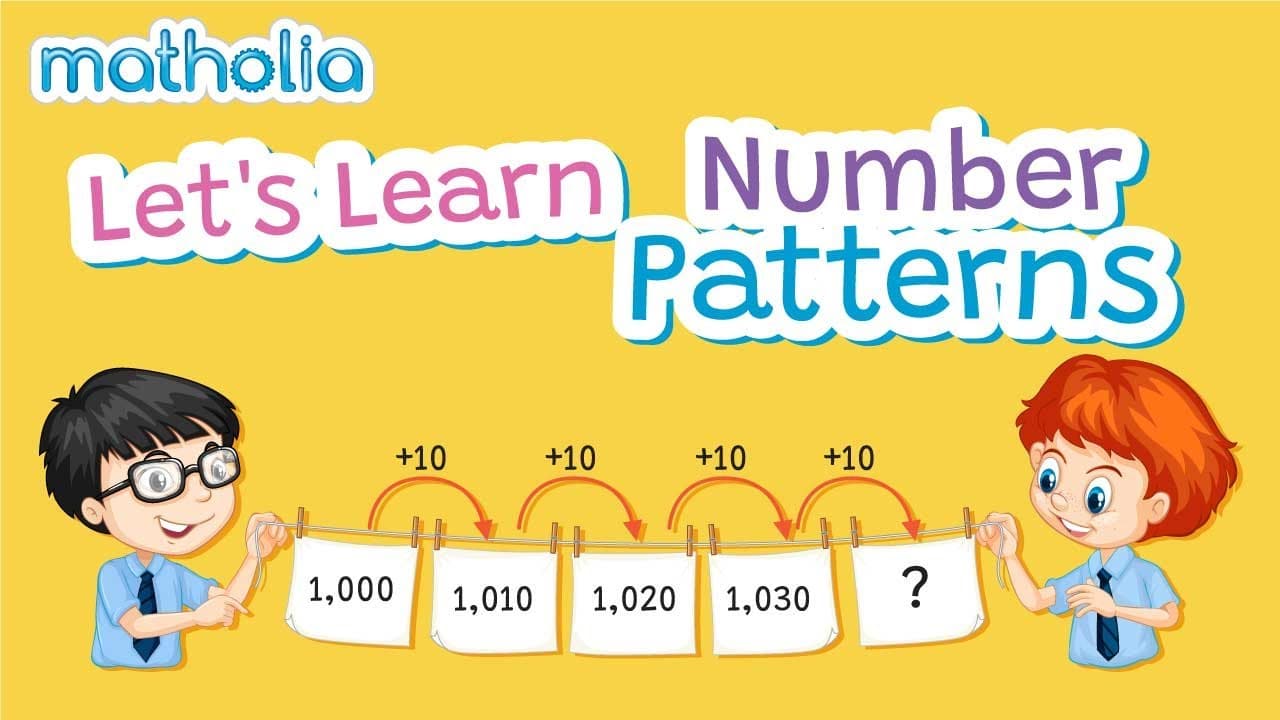
This educational video provides a clear, step-by-step tutorial on identifying and solving number patterns involving four-digit numbers. Through a series of animated examples using a "clothesline" visual metaphor, students are guided to recognize sequences that increase or decrease by constant amounts. The video covers a variety of intervals including 5, 10, 25, 50, 200, 600, and 1,000, requiring students to apply mental math strategies involving addition and subtraction. The content systematically progresses in difficulty. It begins with simple patterns where the next number in the sequence is missing, then moves to finding missing numbers in the middle of a sequence, and concludes with problems requiring the identification of multiple missing terms. Key themes include arithmetic sequences, place value awareness (noticing which digit changes), and the distinction between increasing (addition) and decreasing (subtraction) patterns. For teachers, this video serves as an excellent modeling tool for whole-group instruction or a self-paced review for struggling students. The clear visual representation of the "jump" between numbers helps solidify the concept of a constant rate of change. It provides immediate opportunities for formative assessment, allowing teachers to pause before the reveal and ask students to predict the rule and the next number, fostering algebraic thinking and mental computation fluency.

MatholiaChannelMatholiaChannel

3mins 44s

Materials

Double Triple Flashcards

Double Triple Flashcards

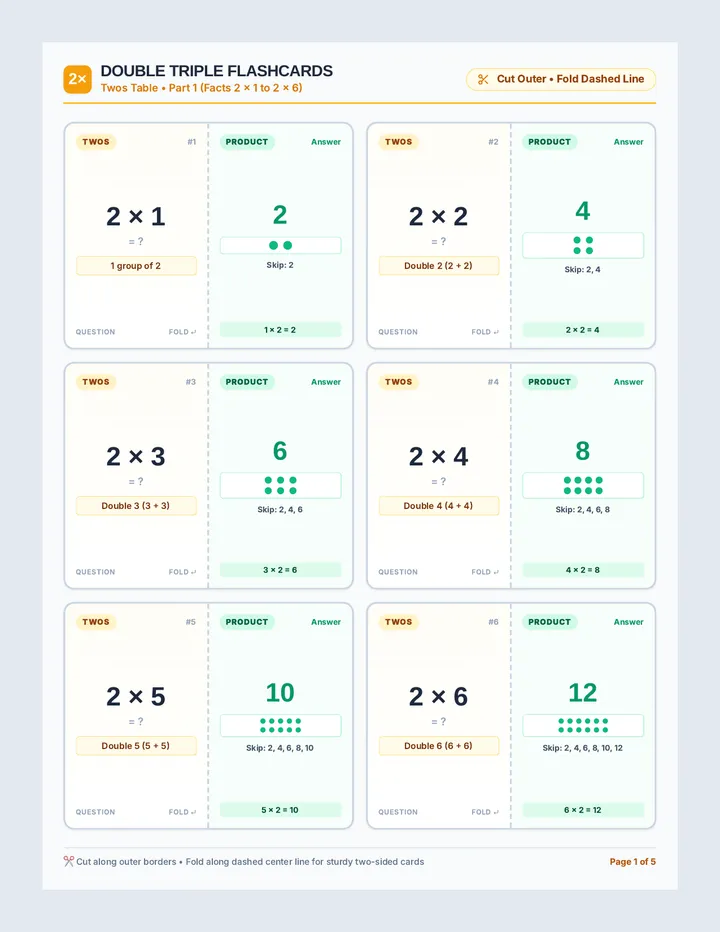
A 5-page printable set of 30 fold-and-cut multiplication flashcards covering the two and three times tables from 0 to 12. Each card features an equation and mental math prompt on the front, with the product, visual array, skip-counting path, and turnaround fact on the back.

CB

Caroline Beaumier

Patterns and Operations Workbook

Patterns and Operations Workbook

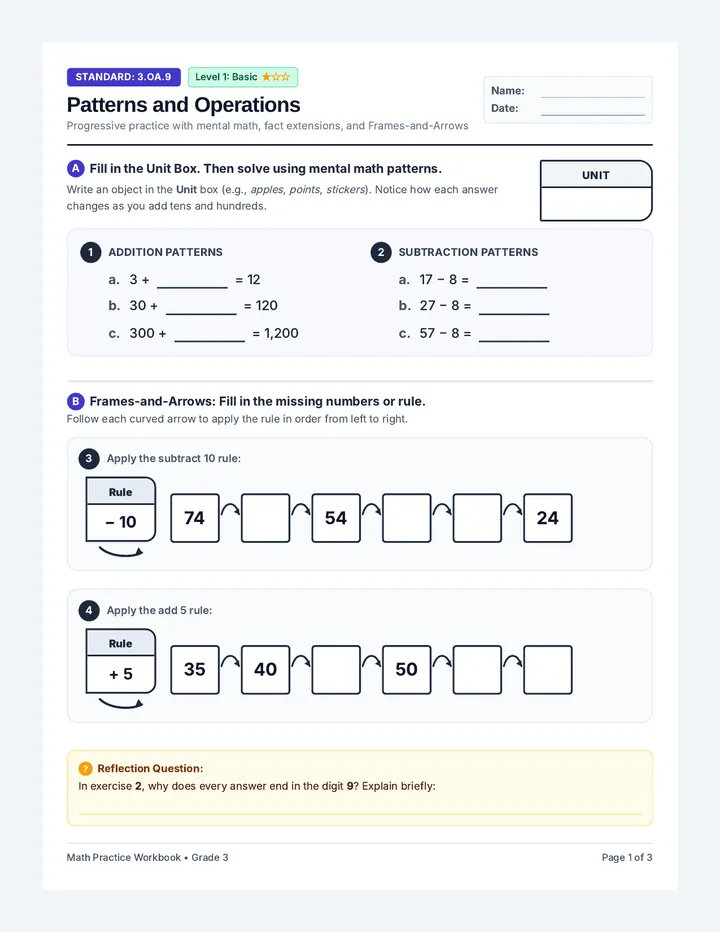
A 3-page progressive practice workbook featuring number patterns, mental addition and subtraction, and Everyday Math-style Frames-and-Arrows routines with graduated difficulty for third grade.

DL

Damaris Lopez Valentin

MCAS Grade Four Math Reference Chart

MCAS Grade Four Math Reference Chart

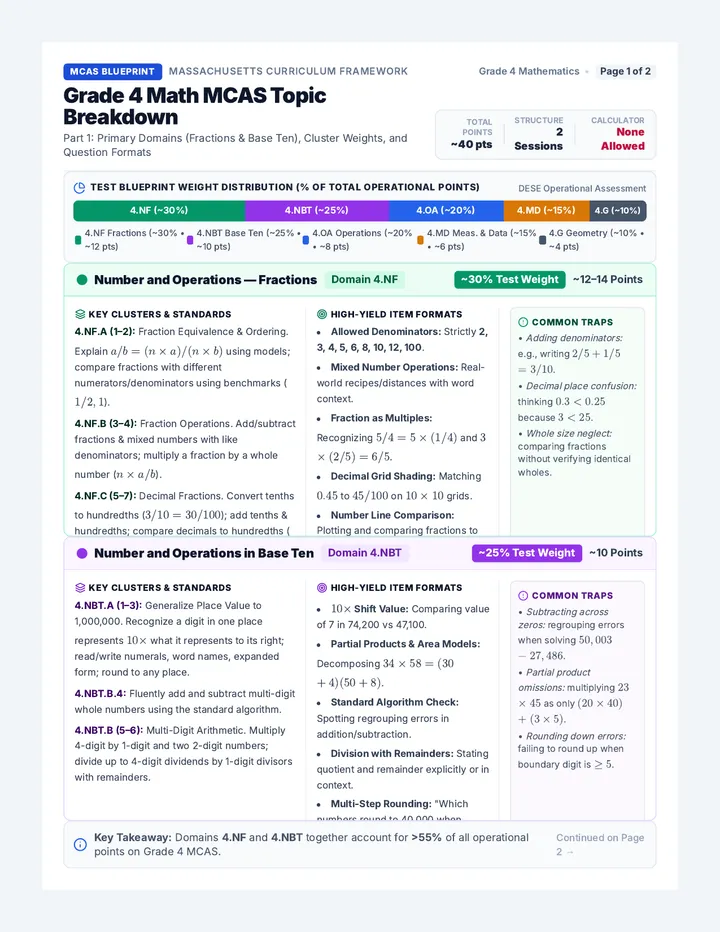
A comprehensive two-page reference chart detailing the Massachusetts MCAS Grade 4 Mathematics test blueprint, including domain weights, priority clusters, released item archetypes, common misconceptions, and constructed-response rubrics.

MS

Meaghan Smith

Number Craft Review Worksheet

Number Craft Review Worksheet

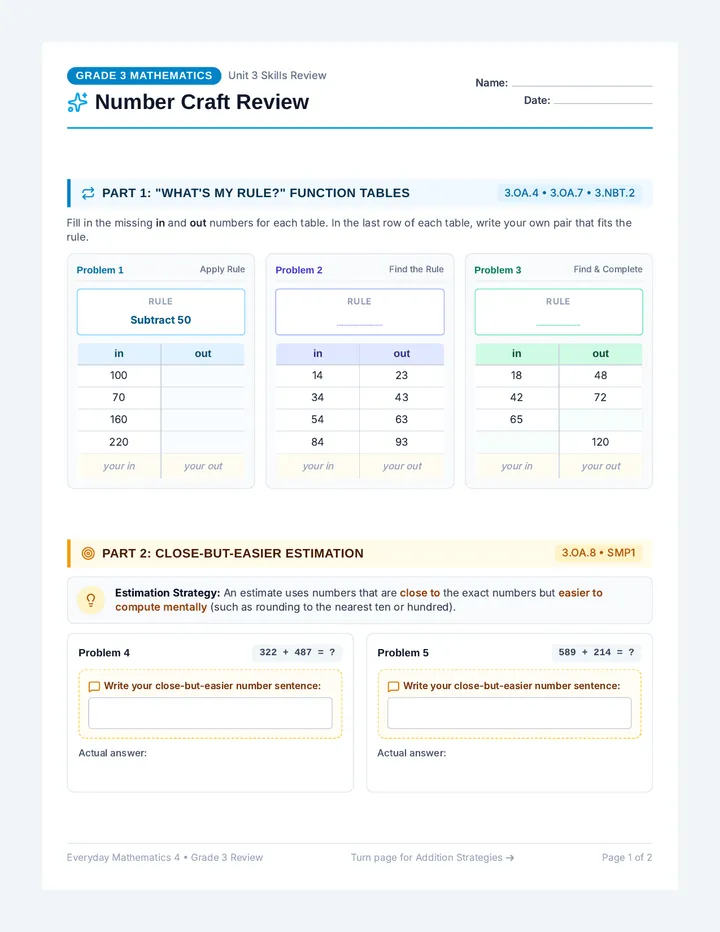
A comprehensive 2-page Grade 3 math review worksheet based on Everyday Mathematics Unit 3, covering What's My Rule function tables, close-but-easier estimation strategies, partial-sums addition, and column addition with place-value grids.

D

Dahlia.Sirilla

Parity Clash Game Slides

Parity Clash Game Slides

An interactive whole-group math game slide deck focusing on three-digit addition and subtraction parity patterns. Each round features a clean challenge slide without spoiled answers or proofs, followed by a dedicated reveal and justification slide.

H

holly.day

Math Quest Slides

Math Quest Slides

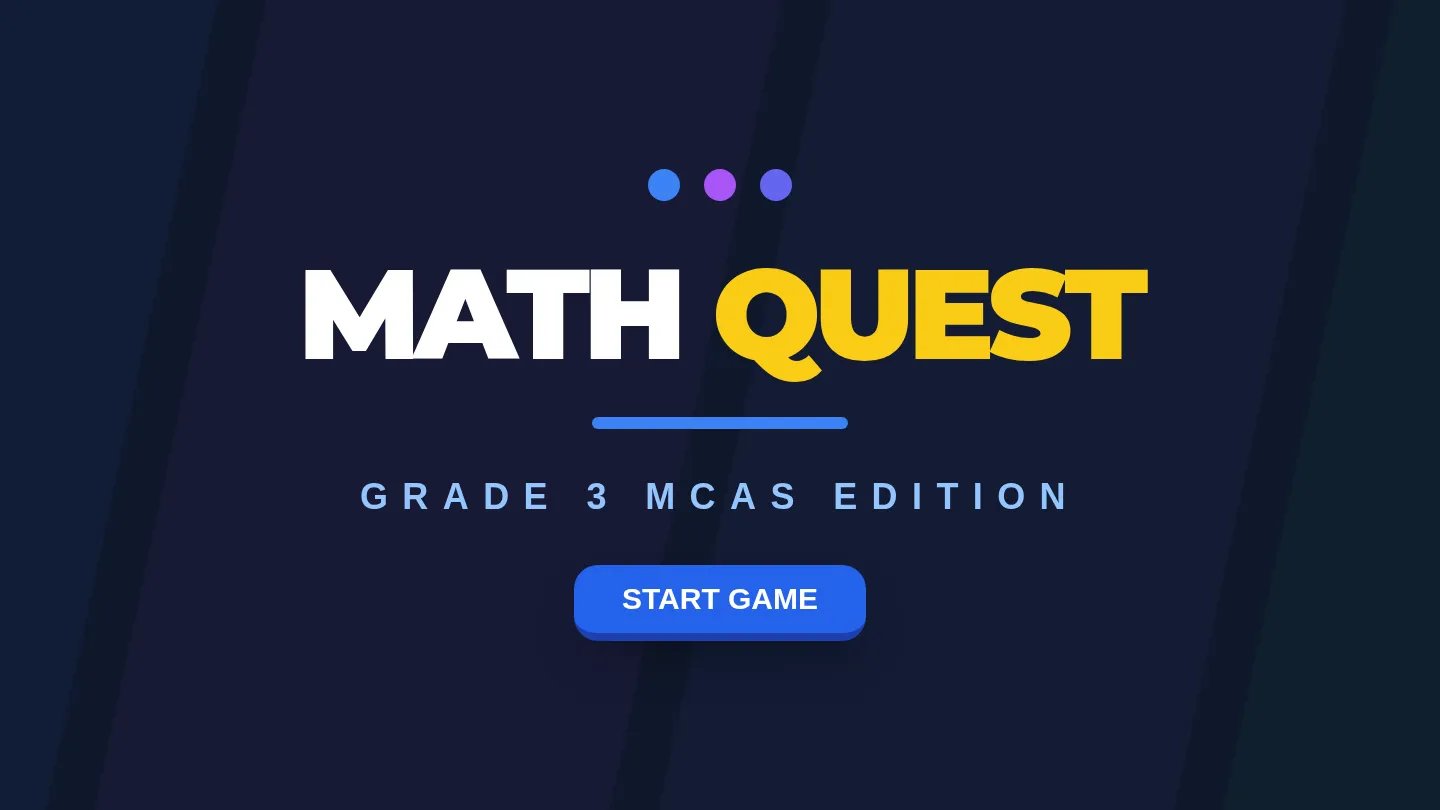
A comprehensive 55-slide Jeopardy-style math game for 3rd grade MCAS preparation. It covers operations, algebraic thinking, measurement (US Customary focus), data, geometry, and mixed review. All metric questions (mL, g, L, km, cm) have been replaced with US Customary alternatives. Visual rendering for equations and navigation has been optimized.

C

cfassel

Sequences

Camp Multi-Math Worksheet

Math Review Adventures

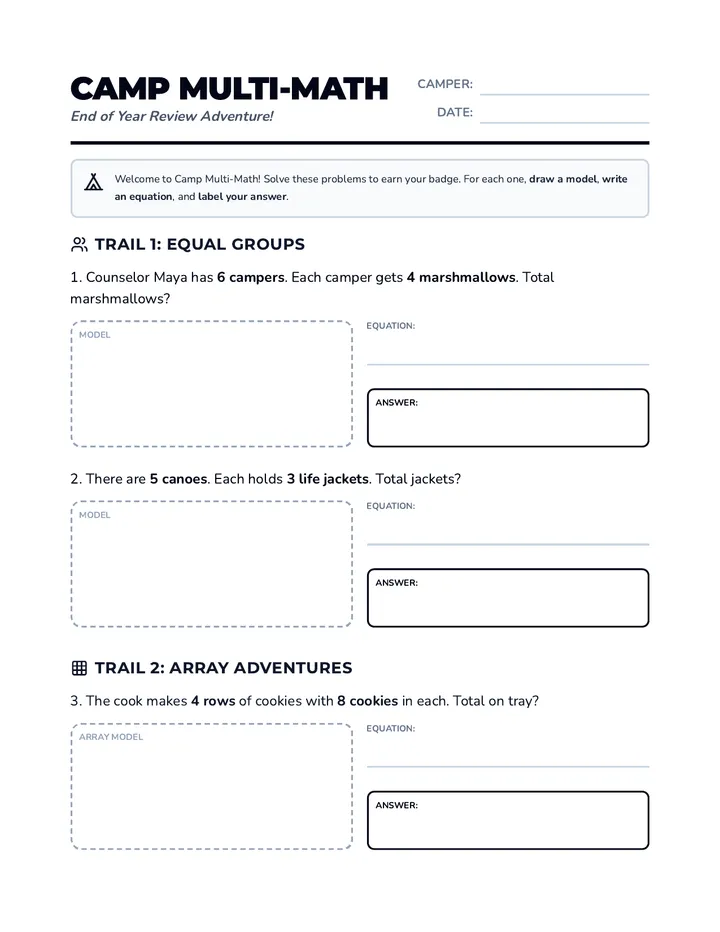
A collection of themed end-of-year math review adventures for different grade levels, focusing on spiraling key standards and problem-solving.

DB

Deborah Burton

21
3 Reads Strategy Poster

Math Blueprints Grade 5

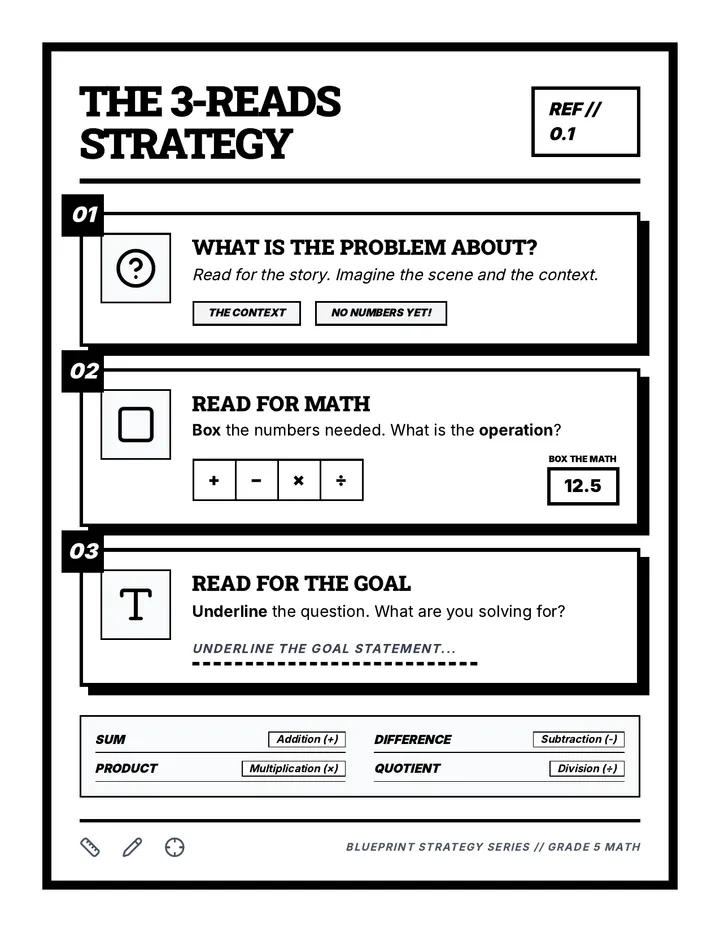
A comprehensive set of math supports for 5th-grade students in a co-taught environment. Each unit includes visual vocabulary, worked examples, cloze-style guided notes, and exit tickets featuring a 'Mistake of the Day' analysis.

HJ

Hope Joel

23
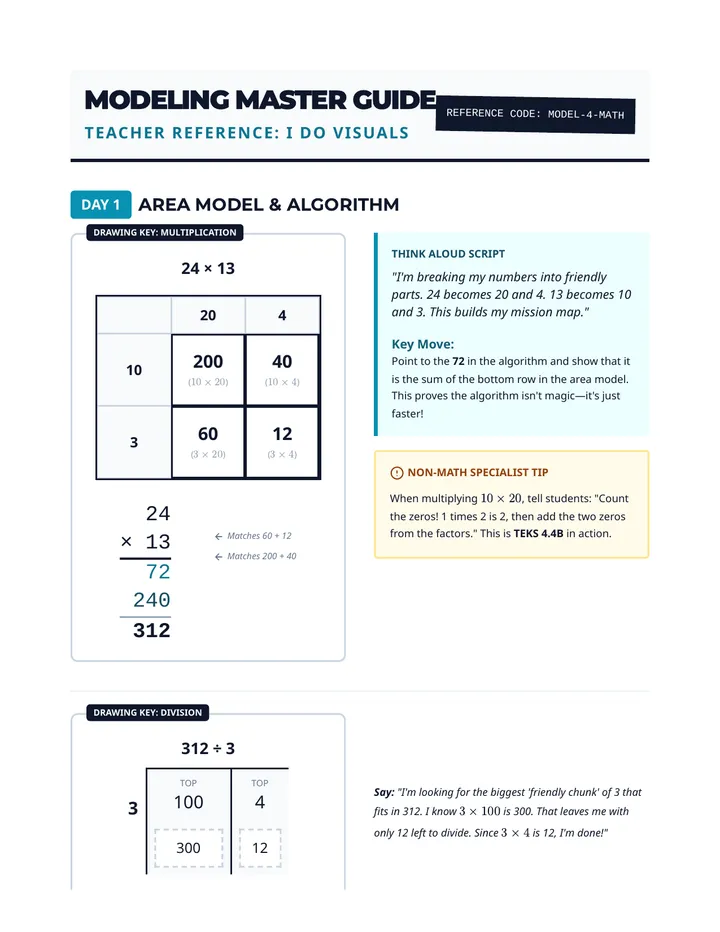
Modeling Master Guide

Math Mission STAAR Review

A 4-day intensive STAAR math review focused on multiplication and division standards for 4th grade. The unit uses a 'Math Mission' theme to engage students while covering complex multi-step problems and standard algorithms.

JJ

Jessica James

33
Stat Squad Slides

Data Analysis Mastery

A comprehensive progression through descriptive statistics, from foundational calculations to high-school level analytical applications, including outlier effects and algebraic problem-solving.

K

Karen.Ford

19
Morning Work Cover Page

Brain Blueprint Math Review

A comprehensive 5-day math review sequence designed for middle school students preparing for state testing. The sequence covers number systems, expressions, ratios, geometry, and statistics through a 'Brain Blueprint' theme.

AA

alicia accapezzato

7
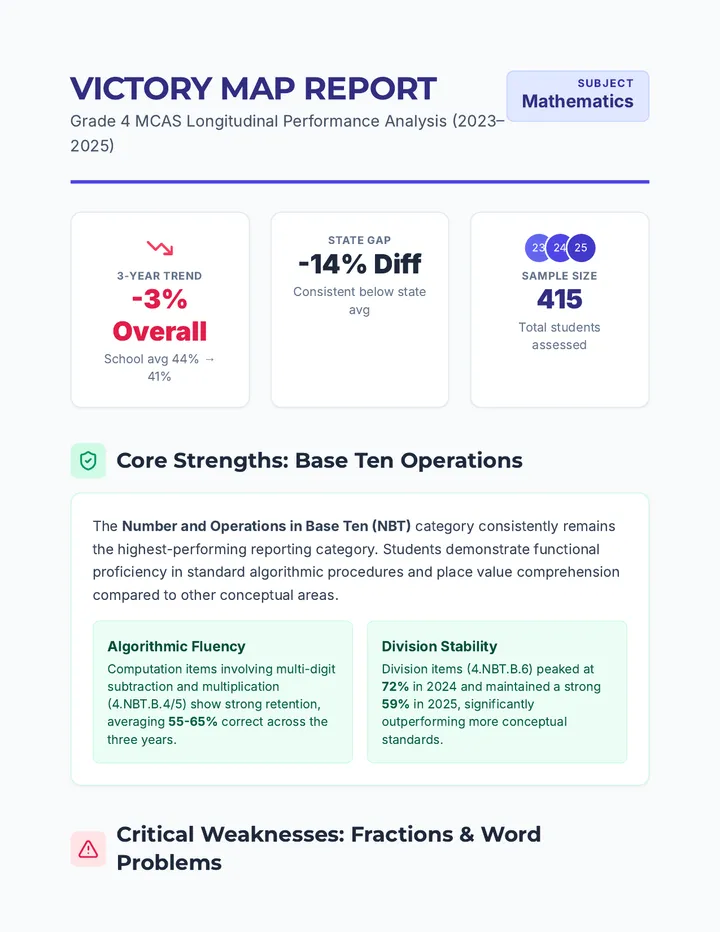
Victory Map Report

Math Performance Audit

A comprehensive multi-grade longitudinal analysis of MCAS Math data (Grades 3-4) for 2023-2025. This sequence provides diagnostic reporting, visual aids, and instructional intervention strategies based on identified categorical trends.

E

enmackay

9

Lessons

Math Radar Intake Slides

Math Skill Radar

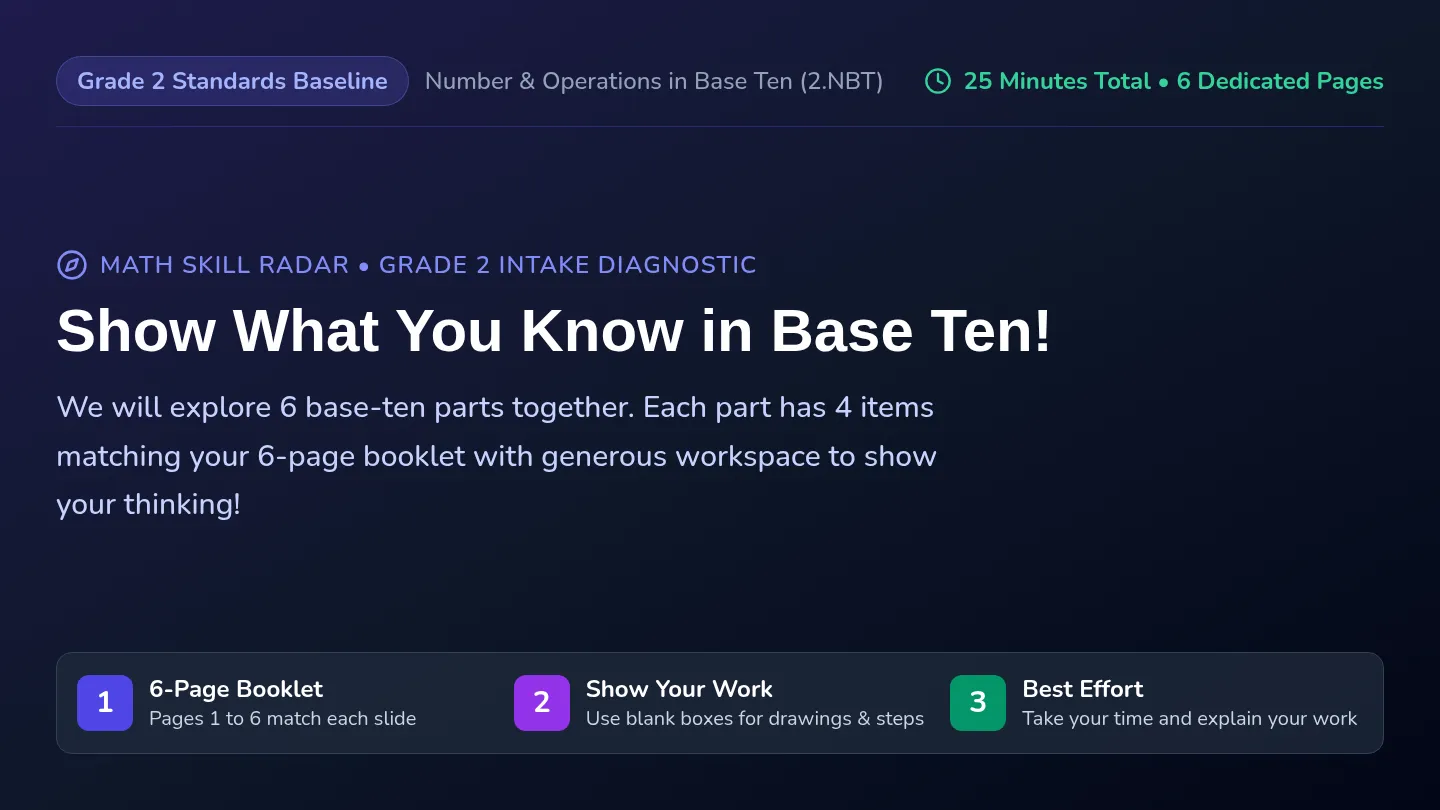
A comprehensive baseline math diagnostic and intervention suite for special education spanning early numeracy through Grade 4. Features complete tiered intake assessments, practice packets, manipulative work mats, and master scoring keys for both 1st Grade Base Ten (1.NBT) and 2nd Grade Base Ten (2.NBT), alongside K-1 early number sense tools.

S

Sara

20
Problem Marathon Handout

Operation Math Mastery

A collection of STAAR-aligned multi-step word problems for 4th-grade math, focusing on multiplication, division, fractions, and decimals using the RDW (Read, Draw, Write) strategy.

MC

Melinda Cortez

4
Snack Stand Warmup Worksheet

Pattern Power Warmup

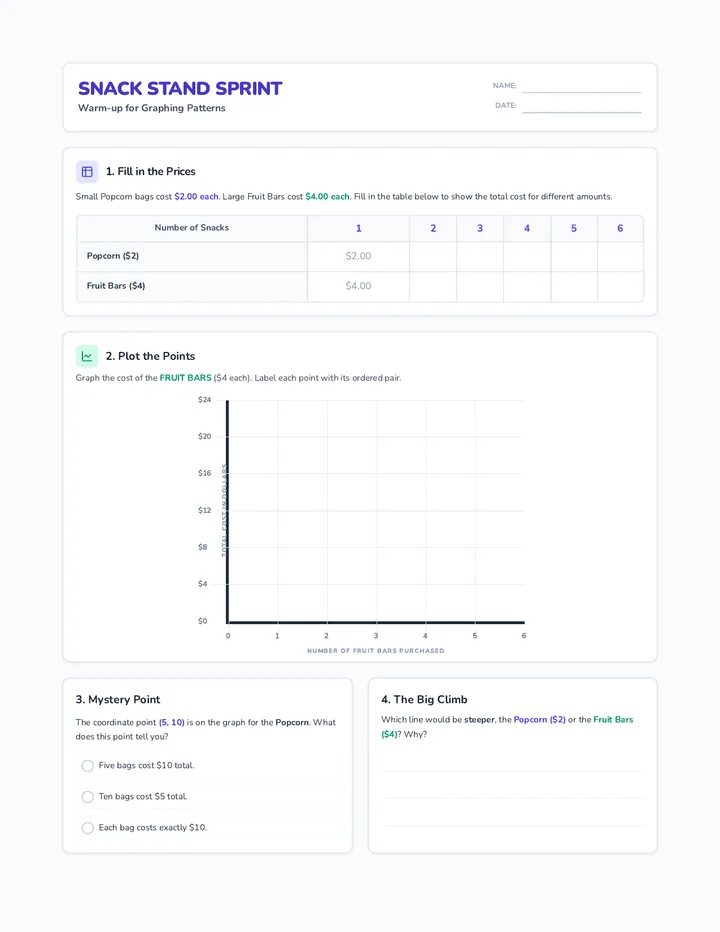
A quick warm-up session to prepare students for the Graphing Patterns Checkpoint, focusing on proportional relationships, data tables, and coordinate graphing.

MC

Maddisson Cozzens

33
Measurement Field Guide Slides

Drafting Board Measurement & Data Review

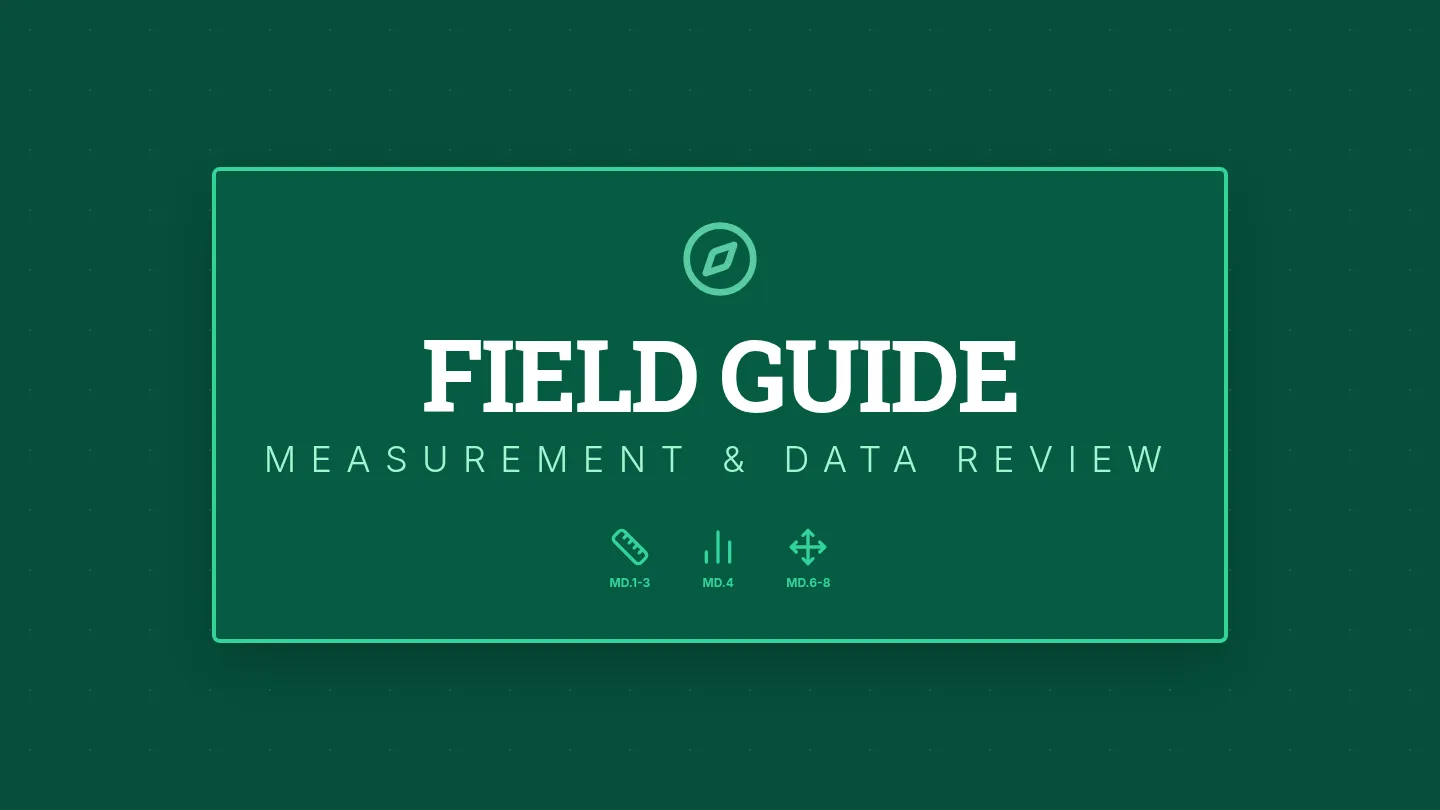
A precision-focused drafting-themed review of 4th grade Measurement and Data (MD) standards. Covers units and conversions (MD.1), measurement word problems (MD.2), area and perimeter (MD.3), line plots (MD.4), and angle measurement and addition (MD.6-7). Division has been removed from the curriculum.

DG

Debra Golden

18
Operation Logic Guide

Operation Logic

A foundational math lesson focusing on addition, subtraction, and multiplication with clear, structured steps and predictable patterns designed for students who benefit from visual checklists and high-contrast layouts.

MR

Maddy Roberts

21
Bridges Yearlong Map Document

Bridges Curriculum Navigator

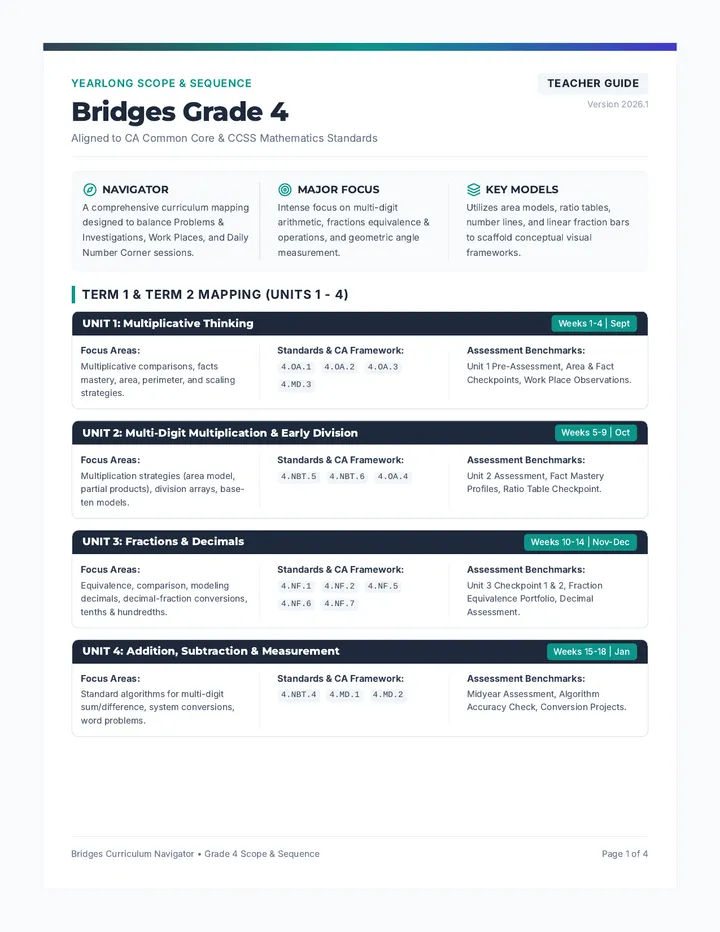
A comprehensive curriculum mapping, planning, and assessment suite for 4th Grade Bridges Math, fully aligned with Common Core and California State Standards (CCSS-M / CA Common Core). Includes a year-long scope and sequence, weekly and daily planning templates, and an assessment tracker.

AJ

Alexander Jacinto

7