© 2026 Lenny Learning Inc.
Bridges Curriculum Navigator • Lesson • Lenny.com
Bridges Curriculum Navigator A comprehensive curriculum mapping, planning, and assessment suite for 4th Grade Bridges Math, fully aligned with Common Core and California State Standards (CCSS-M / CA Common Core). Includes a year-long scope and sequence, weekly and daily planning templates, and an assessment tracker.
AJ Alexander Jacinto
Bridges Yearlong Map Document
A comprehensive year-long scope and sequence mapping out all 8 units of Bridges Grade 4 Math, with CCSS/CA standard alignments, pacing, and core focus areas.
Curriculum Planner Templates Document
Printable customizable weekly and daily planning templates specifically tailored to the Bridges Math workshop structure (Problems & Investigations, Number Corner, Work Places).
Bridges Assessment Tracker Document
A comprehensive assessment matrix and student tracking sheet covering unit checkpoints, baseline, quarterly assessments, and performance tasks.
Monthly Unit Plans Guide
A detailed curriculum implementation guide breaking down all 8 Units into 4-week monthly plans, including weekly sessions, Number Corner routines, Work Places, and the formal end-of-unit assessments.
Weekly Session Guide Document
A comprehensive session-by-session weekly guide detailing the daily plans (Days 1-5) for all 32 weeks of the Grade 4 Bridges curriculum, aligned with Common Core standards.
Session Delivery Manual Document
An instructional delivery manual containing the universal 3-part Bridges math workshop script, along with 8 fully realized lesson exemplars (one per Unit) spanning arrays, fractions, and angle calculations.
Bridges Curriculum Navigator A comprehensive curriculum mapping, planning, and assessment suite for 4th Grade Bridges Math, fully aligned with Common Core and California State Standards (CCSS-M / CA Common Core). Includes a year-long scope and sequence, weekly and daily planning templates, and an assessment tracker.
AJ Alexander Jacinto
Bridges Yearlong Map Document Yearlong Scope & Sequence
Bridges Grade 4
Aligned to CA Common Core & CCSS Mathematics Standards
Teacher Guide
Version 2026.1
Navigator
A comprehensive curriculum mapping designed to balance Problems & Investigations, Work Places, and Daily Number Corner sessions.
Major Focus
Intense focus on multi-digit arithmetic, fractions equivalence & operations, and geometric angle measurement.
Key Models
Utilizes area models, ratio tables, number lines, and linear fraction bars to scaffold conceptual visual frameworks.
Term 1 & Term 2 Mapping (Units 1 - 4)
UNIT 1: Multiplicative Thinking Weeks 1-4 | Sept
Focus Areas:
Multiplicative comparisons, facts mastery, area, perimeter, and scaling strategies.
Standards & CA Framework: 4.OA.1 4.OA.2 4.OA.3 4.MD.3
Assessment Benchmarks:
Unit 1 Pre-Assessment, Area & Fact Checkpoints, Work Place Observations.
UNIT 2: Multi-Digit Multiplication & Early Division Weeks 5-9 | Oct
Focus Areas:
Multiplication strategies (area model, partial products), division arrays, base-ten models.
Standards & CA Framework: 4.NBT.5 4.NBT.6 4.OA.4
Assessment Benchmarks:
Unit 2 Assessment, Fact Mastery Profiles, Ratio Table Checkpoint.
UNIT 3: Fractions & Decimals Weeks 10-14 | Nov-Dec
Focus Areas:
Equivalence, comparison, modeling decimals, decimal-fraction conversions, tenths & hundredths.
Standards & CA Framework: 4.NF.1 4.NF.2 4.NF.5 4.NF.6 4.NF.7
Assessment Benchmarks:
Unit 3 Checkpoint 1 & 2, Fraction Equivalence Portfolio, Decimal Assessment.
UNIT 4: Addition, Subtraction & Measurement Weeks 15-18 | Jan
Focus Areas:
Standard algorithms for multi-digit sum/difference, system conversions, word problems.
Standards & CA Framework: 4.NBT.4 4.MD.1 4.MD.2
Assessment Benchmarks:
Midyear Assessment, Algorithm Accuracy Check, Conversion Projects.
Bridges Curriculum Navigator • Grade 4 Scope & Sequence Page 1 of 4
Yearlong Scope & Sequence
Bridges Grade 4
Aligned to CA Common Core & CCSS Mathematics Standards
Teacher Guide
Version 2026.1
Term 3 & Term 4 Mapping (Units 5 - 8)
UNIT 5: Geometry & Measurement Weeks 19-22 | Feb
Focus Areas:
Angle measurement, classifying 2D polygons, line symmetry, protractor accuracy.
Standards & CA Framework: 4.G.1 4.G.2 4.G.3 4.MD.5 4.MD.6
Assessment Benchmarks:
Unit 5 Assessment, Angle Checkpoint, Polygon Sort Rubric.
UNIT 6: Multiplication, Division & Data Weeks 23-26 | Mar
Focus Areas:
Double-digit partial products, long division strategies, fraction line plots.
Standards & CA Framework: 4.NBT.5 4.NBT.6 4.OA.3 4.MD.4
Assessment Benchmarks:
Unit 6 Assessment, Complex Division Check, Line Plot Sheet.
UNIT 7: Patterns, Fractions & Decimals Weeks 27-31 | Apr
Focus Areas:
Pattern analysis, adding/subtracting mixed numbers, multiplying fractions by integers.
Standards & CA Framework: 4.OA.5 4.NF.3 4.NF.4
Assessment Benchmarks:
Unit 7 Assessment, Patterns Check, Multiplying Fractions Probe.
UNIT 8: Playground Design (Project-Based) Weeks 32-35 | May-June
Focus Areas:
Applying geometry, metric conversions, budgeting, scaling, blueprint drafting.
Standards & CA Framework: Multi-domain 4.MD.1 4.G.1
Assessment Benchmarks:
Playground Project Portfolio, Cumulative End of Year Assessment.
CA Standards for Mathematical Practice (SMPs) Integrated Daily
SMP 1 & 2 Make sense of problems & reason abstractly.
SMP 3 & 4 Construct arguments & model with mathematics.
SMP 5 & 6 Use math tools strategically & attend to precision.
SMP 7 & 8 Look for structures & patterns in repeat reasoning.
Bridges Curriculum Navigator • Grade 4 Scope & Sequence Page 2 of 4
Unit & Module Pacing Detail
First Semester (Units 1 - 4)
Modules & Sessions
Unit Module Key Conceptual Topics & Sessions Critical Math Models Assessment Checks U1 Mod 1: Factors/Multiples Multiplicative arrays, prime/composite patterns, factor rainbow. (Sess. 1-5) Grid paper, tile grids U1 Pre-Assessment U1 Checkpoints U1 Post-Assessment Mod 2: Prime & Composite Finding factors, playing "Product Game". (Sess. 1-5) T-charts, Venn diagrams Mod 3: Comparisons Scaling and comparison phrases (e.g. "times as many"). (Sess. 1-6) Strip diagrams, scale lines Mod 4: Area/Perimeter Real-world area formulas and composite shape calculations. (Sess. 1-5) Coordinate grids, tiles U2 Mod 1: Mult. Models Linear area models, partial products, half-and-double. (Sess. 1-5) Unlabeled area model, arrays U2 Pre-Assessment U2 Checkpoints U2 Post-Assessment Mod 2: Ratio Tables Proportional multiplication and scaling measurements. (Sess. 1-5) Ratio tables, skip-count strips Mod 3: Division Arrays Division as inverse of multiplication, grouping, remainders. (Sess. 1-5) Dimension lines, base-10 grids Mod 4: Multi-Step Word Solving equations with variables using brackets. (Sess. 1-5) Tape diagrams, parentheses U3 Mod 1: Fraction Equiv. Finding equivalent fractions and scaling denominators. (Sess. 1-5) Fractions strips, egg cartons U3 Pre-Assessment U3 Checkpoints U3 Post-Assessment Mod 2: Comparing Frac. Developing benchmark strategies (1/2, 1, 0) for comparisons. (Sess. 1-5) Double number lines Mod 3: Intro to Decimals Comparing tenths & hundredths, place value cards. (Sess. 1-5)
First Semester Pacing Note: Standard multi-digit addition and subtraction algorithm is a key California focus. Monitor pacing to ensure adequate time for fraction models in Unit 3, utilizing "Number Corner" daily to sustain calculation fluency.
Bridges Curriculum Navigator • Grade 4 Scope & Sequence Page 3 of 4
Unit & Module Pacing Detail
Second Semester (Units 5 - 8)
Modules & Sessions
Unit Module Key Conceptual Topics & Sessions Critical Math Models Assessment Checks U5 Mod 1: Angle Measure Angles as circle slices, reading protractors. (Sess. 1-5) Protractor wheels, degrees U5 Pre-Assessment U5 Checkpoint 1 U5 Post-Assessment Mod 2: Angle Addition Solving for unknown adjacent angles. (Sess. 1-5) Pattern blocks, ray lines Mod 3: Polygon Traits Classifying lines, perpendicular grids, and angles. (Sess. 1-5) Geoboards, sorting cards Mod 4: Line Symmetry Identifying and drawing axes of symmetry on polygons. (Sess. 1-5) Mirrors, folding papers U6 Mod 1: 2-Digit Arrays Extending multiplication algorithms (e.g., 24 x 36). (Sess. 1-5) Partial product grids U6 Pre-Assessment U6 Checkpoints U6 Post-Assessment Mod 2: Div. Strategies Division patterns, partial quotients calculations. (Sess. 1-5) Area model division charts Mod 3: Measurement Data Line plots to eighth-inches with calculations. (Sess. 1-5) Rulers, line fraction plots Mod 4: Remainder Shares Interpreting remainders as fractional shares. (Sess. 1-5) Bar diagrams, unit counters U7 Mod 1: Patterns Rules Analyzing rules of numerical inputs and outputs. (Sess. 1-5) In-out tables, grids U7 Pre-Assessment U7 Checkpoint 1 U7 Post-Assessment Mod 2: Mixed Numbers Addition and subtraction with like denominators. (Sess. 1-5) Fraction circles & cards Mod 3: Fraction Mult. Multiplying fraction units by whole numbers (e.g., 4 x 2/3). (Sess. 1-5) Number lines, ratio grids
Second Semester Pacing Note: Unit 8 is a real-world integration project. Balance pacing through Unit 6 & 7 carefully to ensure students have a strong baseline in double-digit multiplication and mixed numbers prior to planning.
Bridges Curriculum Navigator • Grade 4 Scope & Sequence Page 4 of 4
Curriculum Planner Templates Document Curriculum Planner Suite
Weekly Workshop Planner
Tailored for the Bridges Mathematics Framework
Weekly Template
Grade 4 Math Workshop
Week of:
Unit & Module:
Target CCSS Standards:
Focus Mathematical Practices:
Day
Number Corner (15-20 Min)
Problems & Investigations (45-50 Min)
Work Places & Diff. (15-20 Min)
Monday Date: ___/___
Tuesday Date: ___/___
Wednesday Date: ___/___
Thursday Date: ___/___
Friday Date: ___/___
Bridges Curriculum Navigator • Planning Templates Suite Page 1 of 2
Curriculum Planner Suite
Daily Session Plan
Deep-Dive Session Builder & Execution Guide
Daily Session
Grade 4 Execution
Unit / Mod / Session
Core CCSS Math Standard
Target Vocabulary Words
Required Manipulatives
Session Learning Objective (Students will be able to...)
Math Workshop Execution Sequence
1. Session Launch & Warm-Up (10-15 Min) Hook & Connect
2. Problems & Investigations (25-30 Min) Concept Build
3. Active Work Places & Differentiation (15-20 Min) Practice & Support
Support & Reteach Strategy:
Extension & Challenge Activity:
Formative Assessment Observations & Reflection Notes
Bridges Curriculum Navigator • Planning Templates Suite Page 2 of 2
Bridges Assessment Tracker Document Assessment Suite
Bridges Assessment Map
Grade 4 Comprehensive Assessment Framework & Standards Alignment
Assessment Matrix
CA Common Core
Diagnostic Checks
Identifies prior-grade learning gaps and establishes baseline capabilities in operations and fractions.
Formative Feedback
Conducted mid-unit via Module Checkpoints, observing student problem-solving strategies and models.
Summative Evidence
Validates standard mastery via formal post-assessments and final cumulative milestones.
Yearlong Summative & Performance Assessment Plan
Assessment Target CCSS / CA Domains Mathematical Skills Evaluated Key Formative Pre-Requisite Baseline 3.OA, 3.NBT, 3.NF Review of prior-year standards, multiplication facts, and early fraction models. First Week diagnostic tool Unit 1 Assessment 4.OA.1, 4.OA.2, 4.MD.3 Evaluating area/perimeter, and multiplicative comparisons ("times as many"). U1 Checkpoint 1 & 2 Unit 2 Assessment 4.NBT.5, 4.NBT.6, 4.OA.4 Multi-digit multiplication area models, early division remainders, and ratio scaling. U2 Checkpoint 1 Unit 3 Assessment 4.NF.1, 4.NF.2, 4.NF.6 Comparing fractions using benchmarks, decimal grids, and decimal equivalence. U3 Fraction/Decimal Checkpoint Midyear Exam 4.OA, 4.NBT, 4.NF Cumulative review of Units 1-4, standard addition/subtraction algorithm competency. Quarterly progress tracking Unit 5 Assessment 4.G.1, 4.G.2, 4.MD.6 Using protractors, solving unknown adjacent angles, and polygon traits. U5 Geoboard Checkpoint Unit 6 Assessment 4.NBT.5, 4.NBT.6, 4.MD.4 Multi-digit partial quotients, and plotting data on fractional line plots. U6 Long Division Quiz Unit 7 Assessment 4.OA.5, 4.NF.3, 4.NF.4 Adding and subtracting mixed numbers, and multiplying integers by fraction units. U7 Mixed Number Check Cumulative Final All Grade 4 CCSS-M Domains Comprehensive test of all grade-level skills, measuring readiness for Grade 5.
Monthly Unit Plans Guide Bridges Monthly Blueprint
UNIT 1: Multiplicative Thinking
Month: September (Weeks 1 - 4) • CA Common Core Focus: Multiplicative Comparisons
Month 1
Weekly Lesson Progression
Week 1
Module 1: Factors & Multiples (Sessions 1 - 5)
Identify factor pairs, multiples, prime & composite numbers. Master basic multiplicative comparison equations. (CCSS: 4.OA.1, 4.OA.4)
Week 2
Module 2: Prime, Composite & Factor Patterns (Sessions 1 - 5)
Investigate factor patterns, skip counting on the hundred grid, and master strategies for the "Product Game." (CCSS: 4.OA.4, 4.OA.5)
Week 3
Module 3: Multiplicative Comparison Equations (Sessions 1 - 5)
Translate multiplicative comparison stories into equations with variables. Compare objects via tape diagrams. (CCSS: 4.OA.1, 4.OA.2)
Week 4
Module 4: Measurement, Area & Perimeter (Sessions 1 - 5)
Apply area & perimeter formulas to multi-step real-world problems. Execute Unit 1 Assessment. (CCSS: 4.MD.3, 4.OA.3)
Routine Integrations
Number Corner Focus:
Calendar Grid pattern sequences (multiples); daily decimal fraction pennies.
Work Places:
1A Product Game; 1B Factor Rainbows; 1C Area Showdown.
End-of-Unit Assessment
Assessment Target:
Evaluate factoring, prime classification, area, and comparison problems.
Assessment Structure:
Formal Post-Assessment (Paper) + Area & Perimeter Performance Task.
Bridges Curriculum Navigator • Unit Plans Page 1 of 8
Bridges Monthly Blueprint
UNIT 2: Multiplication & Division
Month: October (Weeks 5 - 8) • CA Common Core Focus: Multi-Digit Arrays
Month 2
Weekly Lesson Progression
Week 1
Module 1: Multiplication Models (Sessions 1 - 5)
Model double-digit numbers with area grids. Conceptualize partial products using the area model framework. (CCSS: 4.NBT.5)
Week 2
Module 2: Ratio Tables & Scaling (Sessions 1 - 5)
Develop double-and-half strategies. Use ratio tables to model multiplicative proportional structures. (CCSS: 4.NBT.5, 4.OA.2)
Week 3
Module 3: Division Arrays & Remainders (Sessions 1 - 5)
Define division as the missing dimension of an area rectangle. Interpret remainders in real-world word problems. (CCSS: 4.NBT.6, 4.OA.3)
Week 4
Module 4: Multi-Step Problems & Systems (Sessions 1 - 5)
Weekly Session Guide Document Weekly Daily Schedule
UNIT 1: Multiplicative Thinking
Day-by-Day Lesson Directory • Weeks 1 - 4 (September)
U1
WEEK 1: Factors & Multiples CCSS: 4.OA.4
D1: Session 1 - Playing the Factor Bingo Game
D2: Session 2 - Arrays & Dimensions on Grid Paper
D3: Session 3 - Finding Factors Pairs Systematic T-Charts
D4: Session 4 - Classifying Prime vs. Composite Values
D5: Session 5 - Creating Factor Rainbow Maps
WEEK 2: Prime & Pattern Rules CCSS: 4.OA.5
D1: Session 1 - Product Game Math Strategies
D2: Session 2 - Hundred Grid Sequence Strings
D3: Session 3 - Prime Sieve of Eratosthenes
D4: Session 4 - Multiple Patterns on the Axis
D5: Session 5 - Mid-Module 2 Quiz Checkpoint
WEEK 3: Multiplicative Comparisons CCSS: 4.OA.1
D1: Session 1 - Naming "Times as Many" Scenarios
D2: Session 2 - Tape Diagrams Comparison Models
D3: Session 3 - Translating Words to Math Variables
D4: Session 4 - Solving Multiplicative Word Stories
D5: Session 5 - Comparison Models Quiz
WEEK 4: Area & Perimeter Formulas CCSS: 4.MD.3
D1: Session 1 - Exploring Area Models & Formulas
D2: Session 2 - Perimeter Dimensions & Formulas
D3: Session 3 - Compound Composite Shapes Area
D4: Session 4 - Multi-Step Practice Review Sheet
D5: Session 5 - Unit 1 Formal Post-Assessment
Unit 1 Teacher Setup: Prepare centimeter blocks and product game markers. Integrate the Daily Calendar Grid tracking multiples daily to reinforce Week 1 & 2 skills prior to the final exam.
Bridges Curriculum Navigator • Weekly Daily Plans Page 1 of 8
Weekly Daily Schedule
UNIT 2: Multi-Digit Multiplication
Day-by-Day Lesson Directory • Weeks 5 - 8 (October)
U2
WEEK 1: Multiplication Models CCSS: 4.NBT.5
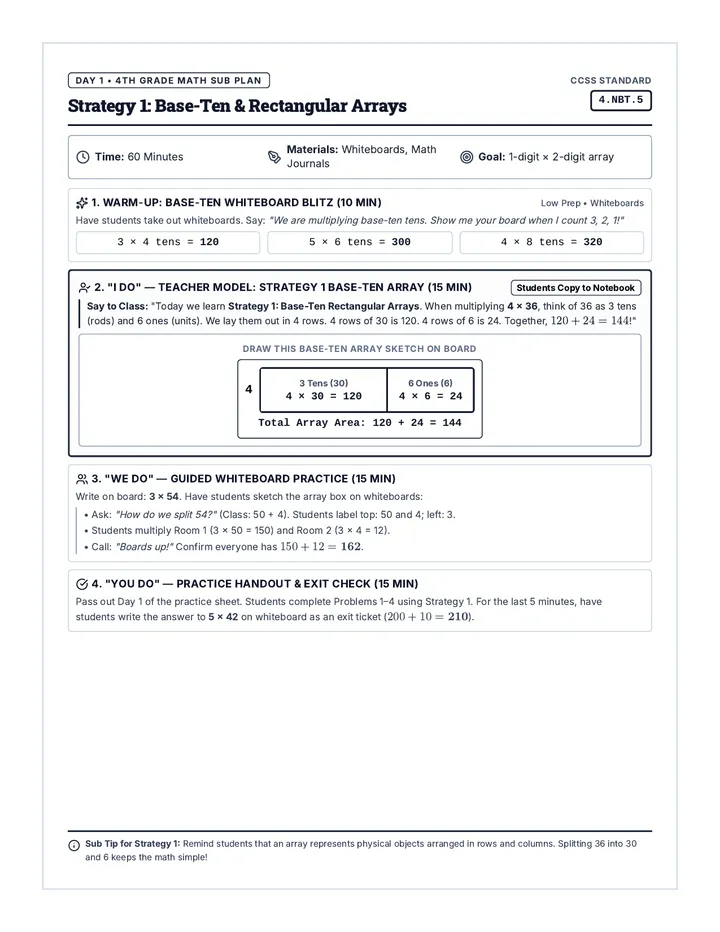
Session 1 - Base-Ten Multiplication Arrays
Session Delivery Manual Document Instructional Facilitation Manual
The Bridges Workshop Delivery Script
Universal 3-Part Math Workshop Facilitation Protocol (Pacing & Prompting Guide)
Framework
Every standard Bridges Grade 4 session is engineered as a three-part construct. Below is the universal prompting and script guide that teachers should utilize to deliver any of the 160 daily sessions inside the curriculum navigator.
Part 1: The Session Launch (10 - 15 Minutes) Connect & Engage
Objective: Hook student interest, connect the day's tasks to prior models, and introduce key terminology.
Teacher Script: "Class, look at this model on the board. What do you notice? Turn to your partner and share how this relates to what we explored yesterday. Today, we are going to expand this thinking to discover..."
Part 2: Problems & Investigations (25 - 30 Minutes) Guided Exploration
Objective: Deep-dive into conceptual math structures, utilizing visual models (area grids, ratio tables, number lines).
Teacher Script: "I want you to represent this calculation on your grid paper. Don't calculate standard columns first; show me the partial products. Why did we divide the area model this way? What does this section represent?"
Part 3: Work Places & Differentiation (15 - 20 Minutes) Independent Practice
Objective: Rotate student groups through structured games and targeted tier support sheets.
Teacher Script: "Group A, you are heading to Work Place 2A to play Area Conquest. Group B, join me at the teacher table with your grid boards so we can review..."
8 Unit Core Exemplars: To establish concrete frameworks, the following pages provide 8 fully realized lesson exemplars—one representing the core mathematical standard focus for each of the 8 units. Use these as a reference to write out matching session details.
Bridges Curriculum Navigator • Session delivery Manual Page 1 of 4
Lesson Plans Portfolio
Unit 1 & Unit 2 Session Exemplars
Step-by-Step Launch & Investigation Scripts
Exemplars
U1, W1, D2: Factor Pairs on Grids 4.OA.4
Objectives & Materials:
Model factors with tile grids. Determine factor pairings.
Prep: 24 red tiles per pair, grid journals.
Instructional Script:
1. Launch: Give each pair 12 tiles. Ask: "Can we make a perfect rectangle that is 5 units wide? Why not? Right, because 12 is not divisible by 5. What widths work?"
10x10 grids, meter sticks
Mod 4: Dec. Addition Adding decimal tenths/hundredths, money integrations. (Sess. 1-5) Base-ten blocks, number lines
U4 Mod 1: Multi-Digit Add Transitioning conceptual models to standard algorithm. (Sess. 1-5) Standard algorithm columns U4 Pre-Assessment
Mod 2: Multi-Digit Sub Decomposition models with algorithm, borrowing over zeros. (Sess. 1-5) Place value proof drawings
U8 Mod 1: Design Concepts Planning field zones, scaling blueprint distances. (Sess. 1-5) Scale diagrams, charts Playground Plan Rubric
Mod 2: Cost Analysis Pricing materials, budget sheets, pitching the design. (Sess. 1-5) Financial ledgers
End-of-Year standard validation
Bridges Standard Alignment Performance Levels Emerging (EM) Score Range: 0% - 59%
Requires tier-3 support and targeted intervention.
Developing (DV) Score Range: 60% - 79%
Grasping concepts; needs guided practice & workplaces.
Proficient (PR) Score Range: 80% - 94%
Meeting all grade-level standard expectations with precision.
Advanced (AD) Score Range: 95% - 100%
Applies complex scaling and logic to novel problems.
Bridges Curriculum Navigator • Grade 4 Assessment Map Page 1 of 2
Classroom Roster Tracker Grade 4 Bridges Unit Assessments Recording Log
Directions: Record students' scores or achievement levels (EM, DV, PR, AD) for each of the core Bridges Unit Assessments below. Use the final columns to track the crucial diagnostic benchmark scores across the school term.
Student Name U1 U2 U3 U4 Base U5 U6 U7 Final 1. 2. 3. 4. 5. 6. 7. 8. 9. 10. 11. 12. 13. 14. 15.
Roster Key: Mark grades or mastery standards (EM, DV, PR, AD) to dynamically track interventions and workshop group setups.
Pacing Guidelines: Aim to complete assessments within 2 days of completing each corresponding Bridges Unit.
Bridges Curriculum Navigator • Grade 4 Assessment Map Page 2 of 2
Solve multi-operation word problems, writing variables for unknowns. Execute Unit 2 Assessment. (CCSS: 4.OA.3, 4.NBT.5)
Routine Integrations Calendar Collector: estimating ounces & grams; base-ten multiplication check-ins.
2A Area Conquest; 2B Ratio Speedways; 2C Division Bingo.
End-of-Unit Assessment Verify partial product multiplication algorithms and division area representations.
Formal Post-Assessment (Paper) + Ratio Table Calculation Probe.
Bridges Curriculum Navigator • Unit Plans Page 2 of 8
Bridges Monthly Blueprint
UNIT 3: Fractions & Decimals Month: Nov-Dec (Weeks 9 - 12) • CA Common Core Focus: Fraction Equivalence
Weekly Lesson Progression Module 1: Fraction Equivalence (Sessions 1 - 5)
Identify equivalent fractions using linear fraction strips and grid blocks. Master multiplication equivalence scaling. (CCSS: 4.NF.1)
Module 2: Benchmark Fraction Comparisons (Sessions 1 - 5)
Compare unlike fractions utilizing double number lines and baseline benchmarks (1/2, 1, 0). (CCSS: 4.NF.2)
Module 3: Decimal Fractions & Tenths (Sessions 1 - 5)
Model decimals on 10x10 grids. Convert fraction expressions into tenths and hundredths decimals. (CCSS: 4.NF.5, 4.NF.6)
Module 4: Decimal Operations & Values (Sessions 1 - 5)
Add decimal fractions with base-ten blocks. Apply decimal comparing strategies. Execute Unit 3 Assessment. (CCSS: 4.NF.5, 4.NF.7)
Routine Integrations Calendar Grid: decimal cards; tracking base-ten pennies and dimes grids.
3A Fraction Strips Duel; 3B Decimal Grids Race; 3C Benchmark sorting.
End-of-Unit Assessment Measure equivalent models representation, benchmark sorting, and decimal values.
Formal Post-Assessment (Paper) + Decimal 10x10 Grid representation task.
Bridges Curriculum Navigator • Unit Plans Page 3 of 8
Bridges Monthly Blueprint
UNIT 4: Computation & Measurement Month: January (Weeks 13 - 16) • CA Common Core Focus: Standard Algorithms
Weekly Lesson Progression Module 1: Multi-Digit Addition Algorithm (Sessions 1 - 5)
Master the standard vertical addition algorithm using place-value concept drawings and carrying proof blocks. (CCSS: 4.NBT.4)
Module 2: Multi-Digit Subtraction Algorithm (Sessions 1 - 5)
Solve complex subtraction columns utilizing standard borrowing and subtraction regrouping algorithms over zeroes. (CCSS: 4.NBT.4)
Module 3: Measurement Unit Conversions (Sessions 1 - 5)
Convert measurement systems (kg/g, liters/ml, km/m) and organize them into structured ratio tables. (CCSS: 4.MD.1, 4.MD.2)
Module 4: Multi-Step Real World Word Problems (Sessions 1 - 5)
Integrate addition & subtraction algorithms to solve measurement problems. Execute Unit 4 Assessment. (CCSS: 4.OA.3, 4.NBT.4)
Routine Integrations Calendar Grid: multi-digit operations equations; checking daily metric temperature.
4A Summit Climbers addition; 4B Conversion Rally; 4C Subtraction Squares.
End-of-Unit Assessment Evaluate computational speed and standard subtraction/addition algorithm precision.
Formal Post-Assessment (Paper) + Standard algorithm speed probe.
Bridges Curriculum Navigator • Unit Plans Page 4 of 8
Bridges Monthly Blueprint
UNIT 5: Geometry & Measurement Month: February (Weeks 17 - 20) • CA Common Core Focus: Angle Measurements
Weekly Lesson Progression Module 1: Angle Measurement Foundations (Sessions 1 - 5)
Define angles as circular degree arcs. Read and measure acute, obtuse, and right angles with physical protractors. (CCSS: 4.MD.5, 4.MD.6)
Module 2: Additive Angle Calculations (Sessions 1 - 5)
Decompose adjacent angles into additive pieces. Solve for unknown variables in complex angle ray diagrams. (CCSS: 4.MD.7)
Module 3: Polygon Attributes Classification (Sessions 1 - 5)
Classify triangles and quadrilaterals based on parallel lines, perpendicular intersections, and interior angles. (CCSS: 4.G.1, 4.G.2)
Module 4: Line Symmetry Realization (Sessions 1 - 5)
Identify line-symmetric shapes. Draw precise vertical and horizontal axes of symmetry. Execute Unit 5 Assessment. (CCSS: 4.G.3)
Routine Integrations Calendar Grid: line plots measuring angles of geometric designs; protractor wheels.
5A Polygon Sort; 5B Angle Estimators; 5C Geoboard Coordinates.
End-of-Unit Assessment Verify angle reading precision, adjacent ray calculations, and polygon classification.
Formal Post-Assessment (Paper) + Polygon attributes classifications chart.
Bridges Curriculum Navigator • Unit Plans Page 5 of 8
Bridges Monthly Blueprint
UNIT 6: Multiplication, Division & Data Month: March (Weeks 21 - 24) • CA Common Core Focus: Complex Division
Weekly Lesson Progression Module 1: Double-Digit Area Arrays (Sessions 1 - 5)
Multiply double-digit integers (e.g. 24 x 36) utilizing the area model framework and standard partial product grids. (CCSS: 4.NBT.5)
Module 2: Partial Quotients Division (Sessions 1 - 5)
Solve multi-digit division problems using partial quotients, ratio estimation, and rectangular arrays. (CCSS: 4.NBT.6, 4.OA.3)
Module 3: Fractional Line Plots Data (Sessions 1 - 5)
Measure items to eighths-inch precision. Organize measurements onto line plots and subtract fractional plot values. (CCSS: 4.MD.4)
Module 4: Division Remainder Fractions (Sessions 1 - 5)
Interpret division remainders as fractional splits. Solve multi-step word problems. Execute Unit 6 Assessment. (CCSS: 4.OA.3, 4.NF.3)
Routine Integrations Calendar Grid: fractional multiplication and subtraction equations; metric conversion tables.
6A Double Conquest; 6B Quotient Trails; 6C Fraction Plots.
End-of-Unit Assessment Validate double-digit multiplication layouts and fractional remainder splits.
Formal Post-Assessment (Paper) + Fractional data line plot creation task.
Bridges Curriculum Navigator • Unit Plans Page 6 of 8
Bridges Monthly Blueprint
UNIT 7: Mixed Numbers & Patterns Month: April (Weeks 25 - 28) • CA Common Core Focus: Fraction Arithmetic
Weekly Lesson Progression Module 1: Numerical Input-Output Patterns (Sessions 1 - 5)
Map pattern inputs and outputs inside structured in-out tables. Analyze sequential number rule progressions. (CCSS: 4.OA.5)
Module 2: Mixed Number Sums & Differences (Sessions 1 - 5)
Solve sums and differences of mixed numbers with common denominators. Convert improper fraction units. (CCSS: 4.NF.3c, 4.NF.3d)
Module 3: Fractions Integer Scaling (Sessions 1 - 5)
Decompose fractions into integer unit multiples (e.g. 4 x 2/3 = 8/3). Model solutions along linear number axes. (CCSS: 4.NF.4a, 4.NF.4b)
Module 4: Financial Ledger Decimal Links (Sessions 1 - 5)
Link fraction scaling calculations to decimal cents and pricing calculations. Execute Unit 7 Assessment. (CCSS: 4.OA.3, 4.NF.4c)
Routine Integrations Calendar Grid: graphing sequential coordinates; decimal pattern sequence strings.
7A Input-Output grids; 7B Mixed Numbers Race; 7C Integer Fraction scaling.
End-of-Unit Assessment Assess mixed number addition/subtraction, pattern tables, and whole-number multiplication.
Formal Post-Assessment (Paper) + In-Out table pattern prediction task.
Bridges Curriculum Navigator • Unit Plans Page 7 of 8
Bridges Monthly Blueprint
UNIT 8: Playground Design Month: May-June (Weeks 29 - 32) • CA Common Core Focus: Integrated Projects
Weekly Lesson Progression Module 1: Blueprint Research & Scale Sketching (Sessions 1 - 5)
Review playground structures, map safety buffers, and sketch physical site dimensions using geometric scale cards. (CCSS: 4.MD.1, 4.G.1)
Module 2: Boundary Area & Material Conversions (Sessions 1 - 5)
Calculate surface area segments and metric distances of equipment layouts, converting yards, feet, and meters. (CCSS: 4.MD.2, 4.MD.3)
Module 3: Budget Ledger & Cost Calculations (Sessions 1 - 5)
Write financial sheets. Calculate costs of play equipment and labor using multi-digit vertical algorithms. (CCSS: 4.OA.3, 4.NBT.5)
Module 4: Blueprint Presentations & Final Exam (Sessions 1 - 5)
Present playground proposals to the class, defending geometric layouts. Execute EOY Final Assessment. (CCSS: Multi-domain)
Routine Integrations Calendar Grid: graphing 3D solids; cumulative daily volume metrics challenges.
8A Blueprint Drafting; 8B Budget Ledgers; 8C Scale Area Cards.
End-of-Unit Assessment Summative verification of metric dimensions, perimeter formulas, budgeting, and scaling.
Playground Design Blueprint Portfolio Rubric + Cumulative End-of-Year Exam.
Bridges Curriculum Navigator • Unit Plans Page 8 of 8
D1:
D2: Session 2 - Drawing Partial Product Rectangles
D3: Session 3 - Segmenting Area Models conceptually
D4: Session 4 - Unlabeled Area Model Diagrams
D5: Session 5 - Area Model Practice CheckpointWEEK 2: Ratio Tables & Scaling CCSS: 4.OA.2
D1: Session 1 - Proportional Scaling Columns
D2: Session 2 - Halving & Doubling Strategies
D3: Session 3 - Filling the Ratio Table Ledger
D4: Session 4 - Scaling Measurement Recipes
D5: Session 5 - Ratio Tables Calculation Quiz
WEEK 3: Division & Remainders CCSS: 4.NBT.6
D1: Session 1 - Dividing with base-ten regrouping
D2: Session 2 - Division represented as Area Rectangle
D3: Session 3 - Interpreting Remainder story word scenarios
D4: Session 4 - Calculating Division with Remainders
D5: Session 5 - Division Concepts Quiz
WEEK 4: Multi-Step Problems CCSS: 4.OA.3
D1: Session 1 - Solving bracketed arithmetic equations
D2: Session 2 - Placing Variables for unknowns
D3: Session 3 - Multi-step comparison stories
D4: Session 4 - Practice test and review matrices
D5: Session 5 - Unit 2 Formal Post-Assessment
Unit 2 Teacher Setup: Cut and organize ratio tables matching mats. Introduce daily metric estimation checks inside the October Number Corner routine to scaffold ratio scaling calculations.
Bridges Curriculum Navigator • Weekly Daily Plans Page 2 of 8
UNIT 3: Fractions & Decimals Day-by-Day Lesson Directory • Weeks 9 - 12 (Nov-Dec)
WEEK 1: Fraction Equivalence CCSS: 4.NF.1
D1: Session 1 - Identifying Fraction Area Partitions
D2: Session 2 - Creating Linear Fraction Strip Maps
D3: Session 3 - Equivalence Paper Folding Tasks
D4: Session 4 - Denominator Scaling calculations
D5: Session 5 - Fraction Equivalence Quiz Check
WEEK 2: Comparing Fractions CCSS: 4.NF.2
D1: Session 1 - Benchmark Sorting using 1/2 and 1
D2: Session 2 - Double Number Line comparisons
D3: Session 3 - Finding Common Denominator values
D4: Session 4 - Comparing mixed fraction values
D5: Session 5 - Fraction Comparisons Quiz
WEEK 3: Intro to Decimals CCSS: 4.NF.6
D1: Session 1 - Tenths grids models representation
D2: Session 2 - Hundredths grids models representation
D3: Session 3 - Converting Tenths to decimal format
D4: Session 4 - Linking pennies & dimes money scales
D5: Session 5 - Decimal Representation Quiz
WEEK 4: Decimal Operations CCSS: 4.NF.5
D1: Session 1 - Sums of Tenths and Hundredths
D2: Session 2 - Writing decimal equations expressions
D3: Session 3 - Calculating grids sums with block models
D4: Session 4 - Post-test preparation matrices review
D5: Session 5 - Unit 3 Formal Post-Assessment
Unit 3 Teacher Setup: Prepare fraction cards and overhead decimal transparent grids. Connect the daily decimal cards within Number Corner to establish a base-ten understanding before the summative test.
Bridges Curriculum Navigator • Weekly Daily Plans Page 3 of 8
UNIT 4: Computation & Measurement Day-by-Day Lesson Directory • Weeks 13 - 16 (January)
WEEK 1: Vertical Addition CCSS: 4.NBT.4
D1: Session 1 - Place value columns regrouping
D2: Session 2 - Standard vertical addition sketches
D3: Session 3 - Solving multi-digit algorithm steps
D4: Session 4 - Addition problem solving tasks
D5: Session 5 - Addition Algorithm Quiz Check
WEEK 2: Vertical Subtraction CCSS: 4.NBT.4
D1: Session 1 - Regrouping decomposition base-ten blocks
D2: Session 2 - Regrouping vertical borrowing algorithms
D3: Session 3 - Borrowing calculations over multiple zeroes
D4: Session 4 - Solving multi-step subtraction columns
D5: Session 5 - Subtraction Algorithm Quiz Check
WEEK 3: Metric Conversions CCSS: 4.MD.1
D1: Session 1 - Kilograms to grams conversions
D2: Session 2 - Liters to milliliters conversions
D3: Session 3 - Kilometers to meters conversions
D4: Session 4 - Filling multi-unit ratio scaling tables
D5: Session 5 - Metric Conversions Quiz Check
WEEK 4: Problem Solving CCSS: 4.OA.3
D1: Session 1 - Balancing standard algorithms scales
D2: Session 2 - Real-world measurement word stories
D3: Session 3 - Checking estimations of complex sums
D4: Session 4 - Practice test and review workbook
D5: Session 5 - Unit 4 Formal Post-Assessment
Unit 4 Teacher Setup: Prepare place-value charts and meter scales. Work Place "Summit Climbers" must be introduced early on Day 5 of Week 1 to sustain computational automaticity.
Bridges Curriculum Navigator • Weekly Daily Plans Page 4 of 8
UNIT 5: Geometry & Measurement Day-by-Day Lesson Directory • Weeks 17 - 20 (February)
WEEK 1: Angle Measure CCSS: 4.MD.6
D1: Session 1 - Segmenting circle degree partitions
D2: Session 2 - Naming Acute, Obtuse & Right angles
D3: Session 3 - Aligning protractors line bases
D4: Session 4 - Measuring angles of real drawings
D5: Session 5 - Angle Measurement Quiz Check
WEEK 2: Additive Angles CCSS: 4.MD.7
D1: Session 1 - Adding adjacent angle segment measurements
D2: Session 2 - Solving for unknown angle variable x
D3: Session 3 - Splitting straight angles into parts
D4: Session 4 - Multi-step angle ray word problems
D5: Session 5 - Additive Angles Quiz Check
WEEK 3: Polygon Attributes CCSS: 4.G.2
D1: Session 1 - Drawing parallel and perpendicular lines
D2: Session 2 - Classifying right and isosceles triangles
D3: Session 3 - Sorting quadrilaterals by traits
D4: Session 4 - Sorting polygons into Venn diagrams
D5: Session 5 - Polygon Classification Quiz Check
WEEK 4: Line Symmetry CCSS: 4.G.3
D1: Session 1 - Identifying bilateral line symmetry
D2: Session 2 - Drawing precise axes of symmetry
D3: Session 3 - Creating symmetrical pattern tiles
D4: Session 4 - Reviewing geometry vocabulary books
D5: Session 5 - Unit 5 Formal Post-Assessment
Unit 5 Teacher Setup: Organize geometric pattern blocks and hand-held mirrors. The Daily Number Corner Calendar Collector tracking angles will reinforce measuring precision prior to Week 4 checks.
Bridges Curriculum Navigator • Weekly Daily Plans Page 5 of 8
UNIT 6: Multiplication, Division & Data Day-by-Day Lesson Directory • Weeks 21 - 24 (March)
WEEK 1: 2-Digit Multiplication CCSS: 4.NBT.5
D1: Session 1 - Double-digit area model layouts
D2: Session 2 - Writing partial products columns
D3: Session 3 - Segmenting area blocks calculations
D4: Session 4 - Double-digit calculation practice
D5: Session 5 - Multi-Digit Multiplication Quiz Check
WEEK 2: Complex Division CCSS: 4.NBT.6
D1: Session 1 - Division scaling with ratio tables
D2: Session 2 - Partial quotients division algorithm
D3: Session 3 - Division models rectangular area sketches
D4: Session 4 - Calculating complex quotient division
D5: Session 5 - Partial Quotients Quiz Check
WEEK 3: Fraction Line Plots CCSS: 4.MD.4
D1: Session 1 - Measuring items to eighth-inch precision
D2: Session 2 - Formatting line plots axis markings
D3: Session 3 - Plotting fractional data distributions
D4: Session 4 - Subtracting data points differences
D5: Session 5 - Fraction Line Plots Quiz Check
WEEK 4: Division Remainders CCSS: 4.NF.3
D1: Session 1 - Splitting remainder values into fractions
D2: Session 2 - Division group remainder story problems
D3: Session 3 - Fraction remainder story calculations
D4: Session 4 - Post-test preparation matrices review
D5: Session 5 - Unit 6 Formal Post-Assessment
Unit 6 Teacher Setup: Prepare ruler rules and fractional plot charts. Students must play "Double Conquest" starting in Week 1 to master double-digit partial product structures.
Bridges Curriculum Navigator • Weekly Daily Plans Page 6 of 8
UNIT 7: Mixed Numbers & Patterns Day-by-Day Lesson Directory • Weeks 25 - 28 (April)
WEEK 1: Pattern Rules CCSS: 4.OA.5
D1: Session 1 - Mapping Input-Output patterns tables
D2: Session 2 - Naming arithmetic multiplier rules
D3: Session 3 - Generating coordinate table pairs
D4: Session 4 - Plotting pattern coordinates on grids
D5: Session 5 - Input-Output Patterns Quiz Check
WEEK 2: Mixed Numbers CCSS: 4.NF.3c
D1: Session 1 - Sums of mixed fraction common denominators
D2: Session 2 - Differences of mixed fraction common denominators
D3: Session 3 - Regrouping mixed values borrowing fraction models
D4: Session 4 - Solving multi-step mixed fraction stories
D5: Session 5 - Mixed Numbers Arithmetic Quiz
WEEK 3: Fraction Scaling CCSS: 4.NF.4b
D1: Session 1 - Repeated fraction sums modeling
D2: Session 2 - Multiplying fraction unit by whole numbers
D3: Session 3 - Modeling products along linear axes
D4: Session 4 - Solving fraction integer word problems
D5: Session 5 - Fraction Integer Multiplication Quiz
WEEK 4: Financial Ledger CCSS: 4.NF.4c
D1: Session 1 - Coin fraction calculations
D2: Session 2 - Recording items inside financial ledger
D3: Session 3 - Store budgeting math scenarios
D4: Session 4 - Post-test preparation workbook review
D5: Session 5 - Unit 7 Formal Post-Assessment
Unit 7 Teacher Setup: Prepare coordinate pattern grids and ledger sheets. Daily Calendar coordinate graphing will establish coordinate pair skills prior to the final module.
Bridges Curriculum Navigator • Weekly Daily Plans Page 7 of 8
UNIT 8: Playground Design Day-by-Day Lesson Directory • Weeks 29 - 32 (May-June)
WEEK 1: Blueprint Sketching CCSS: 4.MD.1
D1: Session 1 - Analyzing playground safety requirements
D2: Session 2 - Equipment space buffer dimensions
D3: Session 3 - Drawing perimeter boundary lines
D4: Session 4 - Designing map scaling dimensions
D5: Session 5 - Blueprint Outline Review Check
WEEK 2: Material Calculations CCSS: 4.MD.3
D1: Session 1 - Calculating surface area segments
D2: Session 2 - Safety woodchips turf area maps
D3: Session 3 - Metric distance conversions on blueprints
D4: Session 4 - Border liner perimeter sums
D5: Session 5 - Material Calculations Quiz
WEEK 3: Budget & Costs CCSS: 4.OA.3
D1: Session 1 - Estimating play equipment catalog pricing
D2: Session 2 - Calculating multi-digit labor fees
D3: Session 3 - Computing turf delivery multiplier costs
D4: Session 4 - Balancing the final budget ledger sheet
D5: Session 5 - Budget Balance Review Check
WEEK 4: Presentations CCSS: 4.G.1
D1: Session 1 - Constructing 3D scaled block models
D2: Session 2 - Drafting defensive pitch posters
D3: Session 3 - Pitching playground plans to class
D4: Session 4 - Cumulative Grade 4 review matrices
D5: Session 5 - End-of-Year Cumulative Final Exam
Unit 8 Teacher Setup: Collect grid paper card stocks and glue sticks. Daily Number Corner solid metrics challenges will support the 3D construction phase during Week 4.
Bridges Curriculum Navigator • Weekly Daily Plans Page 8 of 8
2. Investigation: Let students explore making all possible rectangles for 24 tiles. Instruct: "Draw your arrays in your grid journals and label the dimensions (e.g. 3 x 8, 4 x 6). Write down the factor list of 24 on your board."
3. Reflection: "What makes 24 a composite number instead of prime? Correct, it has more than two factors."
U2, W1, D3: Partial Products Area Models 4.NBT.5
Solve 12 x 15 using area models. Connect to partial products.
Prep: Colored markers, grid boards.
1. Launch: Write "12 x 15" on the board. Say: "We don't want to add 15 twelve times. How can we partition 12 and 15 into tens and ones to make this easier?"
2. Investigation: Sketch a rectangle. Partition sides into (10+2) and (10+5). Script: "Calculate the area of each quadrant. We have 10x10=100, 10x5=50, 2x10=20, and 2x5=10. What is our sum? 100+50+20+10 = 180."
3. Reflection: "How do these four quadrant values connect to partial products? They represent the segments of the area model."
Bridges Curriculum Navigator • Session delivery Manual Page 2 of 4
Unit 3, 4 & 5 Session Exemplars Step-by-Step Launch & Investigation Scripts
U3, W2, D1: Comparing Fractions via 1/2 Benchmark 4.NF.2
Compare 3/8 and 4/6 using half as a baseline scale. Prep: Fraction strip sets.
Launch: "If you have eaten 3/8 of a pizza, have you eaten more or less than half? Why? Yes, because half of 8 is 4."
Investigation: Have students place 3/8 strip and 4/6 strip against a 1/2 strip block. Ask: "Since 3/8 is less than 1/2, and 4/6 is greater than 1/2, what comparison statement can we write? Right, 3/8 < 4/6."
U4, W2, D3: Subtraction Algorithms over Zeroes 4.NBT.4
Borrow over zero column digits. Prep: Place-value block mats, markers.
Launch: Write "4,005 - 1,428" vertically. "How can we borrow from the tens if it's a zero? How does the thousands place help?"
Investigation: Model decomposition step-by-step: borrow 1 thousand (leaves 3), make 10 hundreds, borrow 1 hundred (leaves 9) to make 10 tens, borrow 1 ten (leaves 9) to make 15 ones. Calculate: 15-8=7, 9-2=7, 9-4=5, 3-1=2. Sum is 2,577.
U5, W1, D3: Aligning Protractors Bases 4.MD.6
Measure adjacent angle intersections with protractors. Prep: Plastic protractors.
Launch: "Why are there two numbers on the protractor scale? How do we know whether to read 50 degrees or 130 degrees?"
Investigation: "First, classify the angle. Is it acute? If yes, it MUST be less than 90, so read the smaller scale. Align the origin hole with the vertex ray."
Bridges Curriculum Navigator • Session delivery Manual Page 3 of 4
Unit 6, 7 & 8 Session Exemplars Step-by-Step Launch & Investigation Scripts
U6, W2, D2: Partial Quotients division columns 4.NBT.6
Calculate 136 ÷ 4 using partial quotients. Prep: Whiteboards, ratio grids.
Launch: "Think about factors of 4. What are some easy multiples we can subtract from 136? Can we subtract 4 x 10? What about 4 x 30?"
Investigation: Write vertical column. Subtract 4 x 30 = 120 (leaves 16). Ask: "What's left? 16. How many 4s are in 16? 4. Write 4. Add partial quotients: 30 + 4 = 34."
U7, W3, D2: Fraction Whole-Number Scaling 4.NF.4b
Calculate 4 x 2/3 as integer scaling multiples. Prep: Number lines worksheets.
Launch: "If we have 4 bags of apples and each weighs 2/3 of a pound, how can we calculate the total weight without standard equations?"
Investigation: Model 4 hops of 2/3 along a fraction number line: 2/3, 4/3, 6/3, 8/3. Show that 8/3 is equivalent to 2 whole integers and 2/3.
U8, W2, D1: Area of Safety Buffers 4.MD.3
Map dimensions of a swing zone safety buffer. Prep: Blueprint grid boards.
Launch: "If a swing set is 10 x 6 feet, we can't place a sandbox right next to it. We need a 6-foot safety buffer all around. How does that change our area?"
Investigation: Draw new dimensions on blueprints: add 6 ft to all sides. (Width is 10+12=22, Length is 6+12=18). Solve for Area: 22 x 18 = 396 sq. feet.
Bridges Curriculum Navigator • Session delivery Manual Page 4 of 4