Lenny.com
Explore
Create
ActivitiesNewMathEnglish Language ArtsScience & EngineeringSocial StudiesGlobal LanguagesHealth & Physical EducationSpecial EducationCounseling & Life SkillsArts & CreativityESL
Lenny.com
Lenny.com
Explore
Create
ActivitiesNewMathEnglish Language ArtsScience & EngineeringSocial StudiesGlobal LanguagesHealth & Physical EducationSpecial EducationCounseling & Life SkillsArts & CreativityESL
Lenny.com
Lenny.com

Solutions

Lenny for EducatorsLenny for SchoolsLenny for Districts

Product

ExploreSign inCreateSupportAbout

Resources

Getting startedMTSS Acceleration Program

© 2026 Lenny Learning Inc.

TermsPrivacyAccessibility
LinkedInInstagramX
Lenny
MathNumbers & CountingCounting ObjectsNumber NamesComparing NumbersNumber OperationsCounting SequenceNumbers 0-10Place Value Understanding and SystemAdd and Subtract Within 20Addition and Subtraction ConceptsAddition and Subtraction EquationsAddition and Subtraction ProblemsFoundations for MultiplicationMultiplication and Division PropertiesMultiply and Divide Within 100Multiplication and Division ProblemsFactors and MultiplesProperties of OperationsPatterns and RelationshipsGenerate and Analyze PatternsMulti-Digit ArithmeticPlace Value OperationsMulti-Digit and Decimal OperationsNumerical ExpressionsFour Operations and PatternsFour Operations Problem SolvingMeasurement & DataMeasurable AttributesMeasuring LengthsMeasure and Estimate Lengths in Standard UnitsRelate Addition and Subtraction to LengthClassifying and Counting ObjectsTime and MoneyArea Concepts and MeasurementPerimeter and Area MeasuresAngle Concepts and MeasurementTime, Volume, and MassMeasurement Unit ConversionsGeometryIdentifying ShapesShapes and AttributesShape Attributes and ReasoningShapes and CompositionClassifying 2D FiguresGeometric Figures and RelationshipsLines, Angles, and ShapesAngle, Area, and VolumeGeometric MeasurementVolume of 3D ShapesCoordinate Plane ApplicationsTransformations in the PlaneCongruence and SimilarityUnderstand congruence in terms of rigid motionsSimilarity and TransformationsProve Theorems Involving SimilarityPythagorean TheoremTrigonometry for General TrianglesMake Geometric ConstructionsProve Geometric TheoremsTheorems About CirclesFind Arc Lengths And Areas of Sectors of CirclesVolume FormulasRelationships Between Two-Dimensional and Three-Dimensional ObjectsProve Simple Geometric Theorems AlgebraicallyTranslate Between Geometric Description and Equation for Conic SectionApply Geometric Concepts in Modeling SituationsFractions & DecimalsFractions as NumbersBuilding FractionsFraction Equivalence and OrderingAdding and Subtracting FractionsMultiplying and Dividing FractionsDividing FractionsDecimal FractionsMulti-Digit Computation and FactorsAdd, Subtract, Multiply, and Divide Rational NumbersRational Number SystemIrrational Numbers and ApproximationsRatiosRatios and ProportionsProportional RelationshipsUnit RateAlgebraAlgebraic ExpressionsGenerate Equivalent ExpressionsQuantitative RelationshipsProportional Relationships and Linear EquationsEquations and InequalitiesEquation Solving and ReasoningLinear Equations and SystemsGraph Equations and InequalitiesSystems of EquationsReal-World Algebraic ProblemsQuantitative Reasoning with UnitsExpression StructureEquivalent Expression FormsRadicals and Integer ExponentsRational ExponentsRational and Irrational NumbersPolynomial OperationsPolynomial IdentitiesPolynomial Zeros and FactorsRational ExpressionsComplex Number OperationsComplex Numbers in PolynomialsComplex Numbers on PlaneStatistics & ProbabilityRepresent and Interpret DataData DistributionsStatistical VariabilityProbability ModelsCompound Event ProbabilitiesStatistical SamplingInterpret Categorical and Quantitative DataBivariate Data PatternsInterpret Linear ModelsComparing Two PopulationsRandom Processes in StatisticsIndependence and Conditional ProbabilityExpected ValuesProbability-Based Decision MakingStatistical Inference and ConclusionsFunctionsFunction Concepts and NotationDefine and Compare FunctionsInterpret Functions in ContextAnalyze Function RepresentationsModel Relationships with FunctionsIdentify Linear vs Exponential GrowthDistinguish Between Function TypesCompare Growth RatesInterpret Function ExpressionsBuild Functions from RelationshipsConstruct and Model FunctionsTransform and Combine FunctionsModel Comparison and SelectionSolve Exponential EquationsTrigonometryTrigonometric Ratios Involving Right TrianglesTrigonometric Functions and Unit CircleModel with Trigonometric FunctionsTrigonometric IdentitiesVectors & MatricesIntroduction to Vectors and MatricesVector QuantitiesVector OperationsMatrix OperationsCalculusLimits and ContinuityDerivative Concepts and NotationDerivative Rules and TechniquesApplications of DerivativesOptimization ProblemsRelated RatesCurve Sketching and AnalysisIntegration Concepts and NotationAntiderivatives and Indefinite IntegralsDefinite Integrals and AreaFundamental Theorem of CalculusIntegration TechniquesApplications of IntegrationDifferential EquationsSequences and SeriesParametric and Polar FunctionsVector-Valued Functions

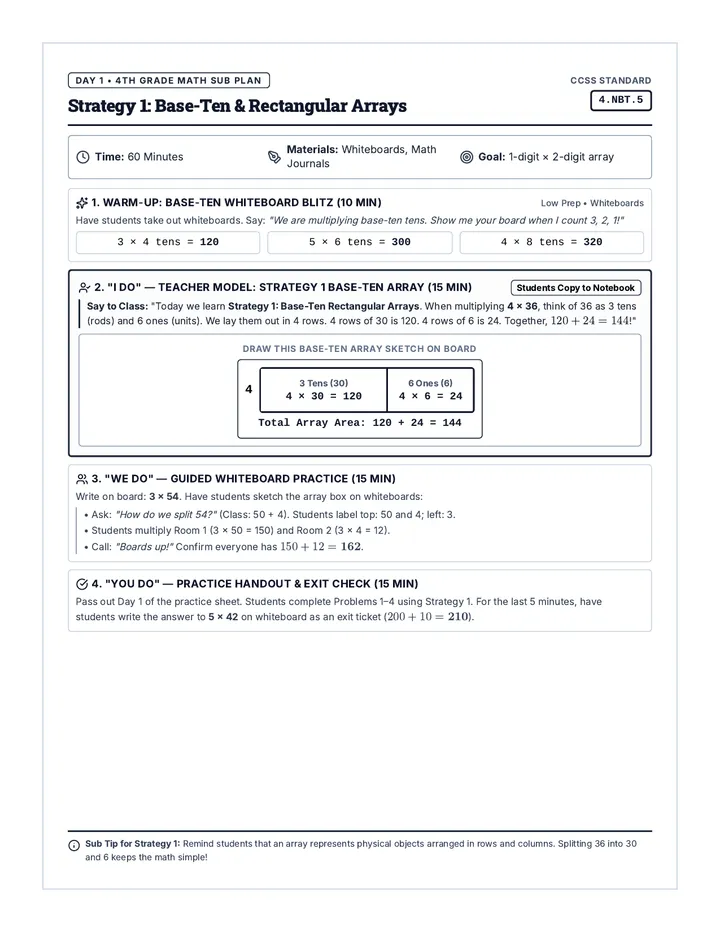
Multiplication Mastery Week

A comprehensive 5-day math curriculum sequence for 4th Grade standard 4.NBT.5, featuring scripted sub plans with gradual release, low-prep whiteboard and manipulative routines, student notebook guides, and a spiraled weekly homework packet.

RMRodnesha Minor
Single Digit Area

Days 1 and 2 focus on multiplying up to four-digit whole numbers by a one-digit whole number using place value strategies, base-ten models, and rectangular area models with scripted gradual release for the substitute teacher.

Double Digit Models

Days 3 and 4 tackle multiplying two two-digit numbers using 4-part rectangular area models and partial products, featuring turnkey scripts, whiteboard showdown routines, and student notebook organizers.

Spiral And Problem Solving

Day 5 synthesizes multiplication strategies with multi-step word problems, error analysis, and includes the complete 4-night spiraled weekly homework packet and full answer keys.

Multiplication Mastery Week

A comprehensive 5-day math curriculum sequence for 4th Grade standard 4.NBT.5, featuring scripted sub plans with gradual release, low-prep whiteboard and manipulative routines, student notebook guides, and a spiraled weekly homework packet.

RMRodnesha Minor

Grade 4 Math • Standard 4.NBT.5 • Strategy 2: Distributive Area Model • Printer-Friendly

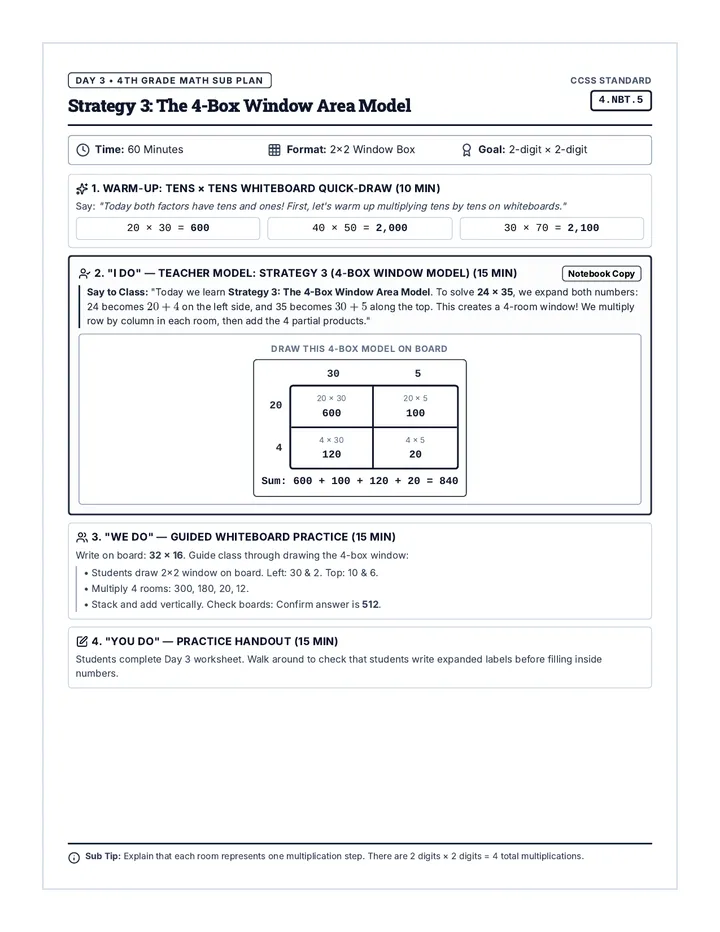
Say to Class: "Today we learn Strategy 4: Vertical Partial Products! It uses the exact same four products as the window box, but we write them vertically in lines under the problem. Notice how each line corresponds to multiplying ones by ones, ones by tens, tens by ones, and tens by tens."

Draw This Side-By-Side Connection On Board

Strategy 3: Window

800

60

240

18

Strategy 4: Vertical Stack

43

× 26

18 (6 × 3)

240 (6 × 40)

60 (20 × 3)

800 (20 × 40)

1,118

3. "We Do" — Whiteboard Showdown Game (15 min)

• Challenge #1: Solve 34 × 25 using Strategy 4. (Answer: 20 + 150 + 80 + 600 = 850).

• Challenge #2: Solve 52 × 18. (Answer: 16 + 400 + 20 + 500 = 936).

• Celebrate accurate vertical alignment!

4. "You Do" — Practice Handout (15 min)

Students complete Day 4 practice. Give students the option to verify their partial products using the Strategy 3 window model.

Connection: Both Strategy 3 and Strategy 4 yield the identical 4 partial sums. Let students use whichever visual makes them most confident!

Substitute Name:

Dates Covered:

Classroom / Period:

Contact Phone:

Weekly Strategy Implementation Checklist

Day 1: Strategy 1 — Base-Ten Rectangular Arrays (1-digit × 2-digit) [   ] Done   [   ] Needs Review

Day 2: Strategy 2 — Distributive Area Model (1-digit × up to 4-digit) [   ] Done   [   ] Needs Review

Day 3: Strategy 3 — 4-Box Window Area Model (2-digit × 2-digit) [   ] Done   [   ] Needs Review

Day 4: Strategy 4 — Vertical Partial Products Algorithm (2-digit × 2-digit) [   ] Done   [   ] Needs Review

Day 5: Strategy 5 — Strategy Selection & Multi-Step Modeling (4.OA.3) [   ] Done   [   ] Needs Review

Students Mastering Strategies 1–5:

Students Needing Small Group Intervention:

Substitute Notes on Behavior, Homework & Supplies:

Grade 4 Math • Sub Transition Documentation • Completed Homework Packet Filed with Answer Key

Show 4 partial products:

Answer:

4. [4.NBT.5] Missing Distributive Room:

In the area model for 5 × 3,462:

15,000 + 2,000 + [        ] + 10 = 17,310

Missing Value:

5. [4.NBT.5] Word Problem:

A library bought 8 novel sets. Each set costs $215. What was the total cost?

Workspace:

Total: $

6. [4.NBT.2 - Compare Numbers]

Compare using >, <, or = :

405,290   [     ]   450,199

Compare highest place value first

7. [4.NBT.4 - Subtraction with Zeros]

Solve: 60,000 - 24,675

Stack & regroup across zeros:

Difference:

8. [4.OA.4 - Factors & Prime/Composite]

List all factor pairs of 36:

Pairs:

Is 36 Prime or Composite?

More than 2 factors?

9. [4.G.1 - Geometry Lines]

Which lines cross at a 90° right angle?

[   ] Parallel lines

[   ] Perpendicular lines

Check angle property

10. [4.OA.3 - Multi-Step Problem]

Maya had 160 beads. She used 45 for a necklace and 38 for a bracelet. Left?

Step 1 (Add) & Step 2 (Subtract):

Left: beads

Tuesday Homework • Exactly 10 Questions • Strategy 2 Focus (4.NBT.5) & Spiral Review (No Rounding) • Printer-Friendly

Wednesday Homework • 10 Questions

Strategy 3 Focus: 4-Box Window Models + Spiral Review

Name:

Date:

1. [4.NBT.5] Solve: 23 × 15 Strategy 3

Draw 4-box window:

Product:

2. [4.NBT.5] Solve: 34 × 26 Strategy 3

Draw 4-box window:

Product:

3. [4.NBT.5] Solve: 45 × 32 Strategy 3

Show 4 room calculations:

Product:

4. [4.NBT.5] Add Window Rooms:

For \(28 \times 14 = (20+8) \times (10+4)\):

Rooms: 200 + 80 + 80 + 32

Add them vertically:

Product:

5. [4.NBT.5] Word Problem:

A theater has 24 rows with 18 seats in each row. How many seats total?

Workspace:

Total: seats

6. [4.OA.1 - Multiplicative Comparison]

Kendra has 9 cards. Caleb has 5 times as many cards. How many does Caleb have?

Equation: 9 × 5 =

Caleb has: cards

7. [4.OA.4 - Prime or Composite]

Is the number 29 prime or composite? Explain using its factors.

Factors of 29:

Classification:

Only 1 and itself?

8. [4.MD.3 - Area of Rectangle]

A rug is 16 feet long and 7 feet wide. Find area: (Area = L × W)

Workspace:

Area: sq ft

9. [4.NBT.4 - Subtraction]

Solve: 85,214 - 39,468

Stack & regroup:

Difference:

10. [4.MD.4 - Line Plot Fractions]

Ribbon lengths: \(\frac{1}{4}, \frac{2}{4}, \frac{2}{4}, \frac{3}{4}, \frac{4}{4}\) in. Difference between longest and shortest?

Equation: \(\frac{4}{4} - \frac{1}{4} =\)

Difference: in.

Wednesday Homework • Exactly 10 Questions • Strategy 3 Focus (4.NBT.5) & Spiral Review (No Rounding) • Printer-Friendly

Thursday Homework • 10 Questions

Strategy 4 & 5 Focus: Partial Products & Multi-Step + Spiral

Name:

Date:

1. [4.NBT.5] Solve: 53 × 42 Strategy 4

Stack partial products:

Product:

2. [4.NBT.5] Solve: 64 × 38 Strategy 4

Stack partial products:

Product:

3. [4.NBT.5] Solve: 75 × 24 Your Choice

Pick Strategy 3 or 4:

Product:

4. [4.NBT.5] True or False Check:

\(35 \times 46 = (30 \times 40) + (30 \times 6) + (5 \times 40) + (5 \times 6)\)

[   ] True [   ] False

Evaluates to 1,610

5. [4.NBT.5] Word Problem:

An apple orchard has 35 rows of trees with 28 trees in each row. Total trees?

Workspace:

Total: trees

6. [4.NBT.1 - Digit Value]

In 784,210, the 8 is in the ten-thousands place. What is its value?

Value = 8 × 10,000

Value:

7. [4.G.1 - Geometry Angles]

Which angle has a measure greater than 90°?

[   ] Acute angle     [   ] Obtuse angle

A ray has: [   ] 1 endpoint   [   ] 2 endpoints

Geometry terms

8. [4.OA.4 - Multiples of 8]

List the first 5 multiples of 8:

8, ____, ____, ____, ____

Skip count by 8

9. [4.MD.4 - Line Plot Addition]

Add 3 ribbon measurements: \(\frac{2}{8}\) ft + \(\frac{3}{8}\) ft + \(\frac{2}{8}\) ft.

Workspace:

Total: ft

10. [4.OA.3 - Multi-Step Problem]

A baker made 18 trays with 12 cookies each. Sold 150 cookies. How many left?

Step 1 (18×12) & Step 2 (subtract 150):

Left: cookies

Thursday Homework • Exactly 10 Questions • Strategy 4/5 Focus (4.NBT.5) & Spiral Review (No Rounding) • Printer-Friendly

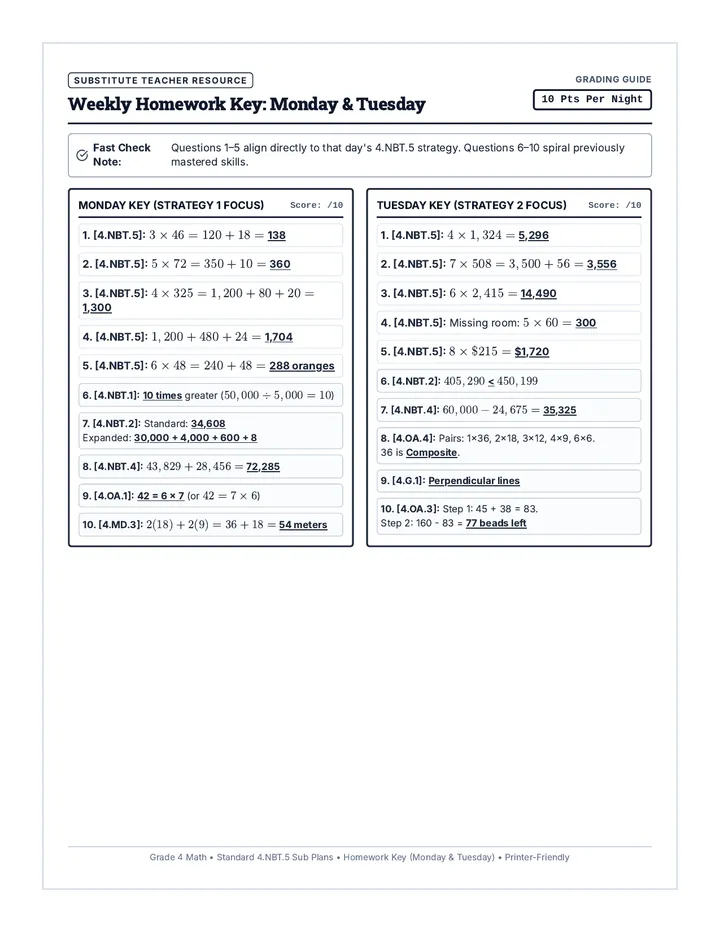
Substitute Teacher Resource

Weekly Homework Key: Wednesday & Thursday

Grading Guide 10 Pts Per Night

Strategy Equivalence: Whether students use Strategy 3 (Window) or Strategy 4 (Partial Products), all partial sums match!

Wednesday Key (Strategy 3 Focus) Score: /10

1. [4.NBT.5]: \(23 \times 15 = 200+100+30+15 =\) 345

2. [4.NBT.5]: \(34 \times 26 = 600+180+80+24 =\) 884

3. [4.NBT.5]: \(45 \times 32 = 1,200+80+150+10 =\) 1,440

4. [4.NBT.5]: \(200 + 80 + 80 + 32 =\) 392

5. [4.NBT.5]: \(24 \times 18 = 200+160+40+32 =\) 432 seats

6. [4.OA.1]: \(9 \times 4 =\) 36 cards (or \(9 \times 5 = 45\))

7. [4.OA.4]: 29 is Prime (only factors are 1 and 29).

8. [4.MD.3]: \(16 \times 7 =\) 112 sq ft

9. [4.NBT.4]: \(85,214 - 39,468 =\) 45,746

10. [4.MD.4]: \(\frac{4}{4} - \frac{1}{4} =\) \(\frac{3}{4}\) in.

Thursday Key (Strategy 4 & 5) Score: /10

1. [4.NBT.5]: \(53 \times 42 = 2,000+100+120+6 =\) 2,226

2. [4.NBT.5]: \(64 \times 38 = 1,800+480+120+32 =\) 2,432

3. [4.NBT.5]: \(75 \times 24 = 1,400+280+100+20 =\) 1,800

4. [4.NBT.5]: True. Both sides equal 1,610.

5. [4.NBT.5]: \(35 \times 28 = 600+240+100+40 =\) 980 trees

6. [4.NBT.1]: Value is 80,000 (\(8 \times 10,000\))

7. [4.G.1]: Obtuse angle; Ray has 1 endpoint.

8. [4.OA.4]: Multiples of 8: 8, 16, 24, 32, 40

9. [4.MD.4]: \(\frac{2}{8} + \frac{3}{8} + \frac{2}{8} =\) \(\frac{7}{8}\) ft

10. [4.OA.3]: Step 1: 18 × 12 = 216.
Step 2: 216 - 150 = 66 cookies left

Grade 4 Math • Standard 4.NBT.5 Sub Plans • Homework Key (Wednesday & Thursday) • Printer-Friendly
You might also like

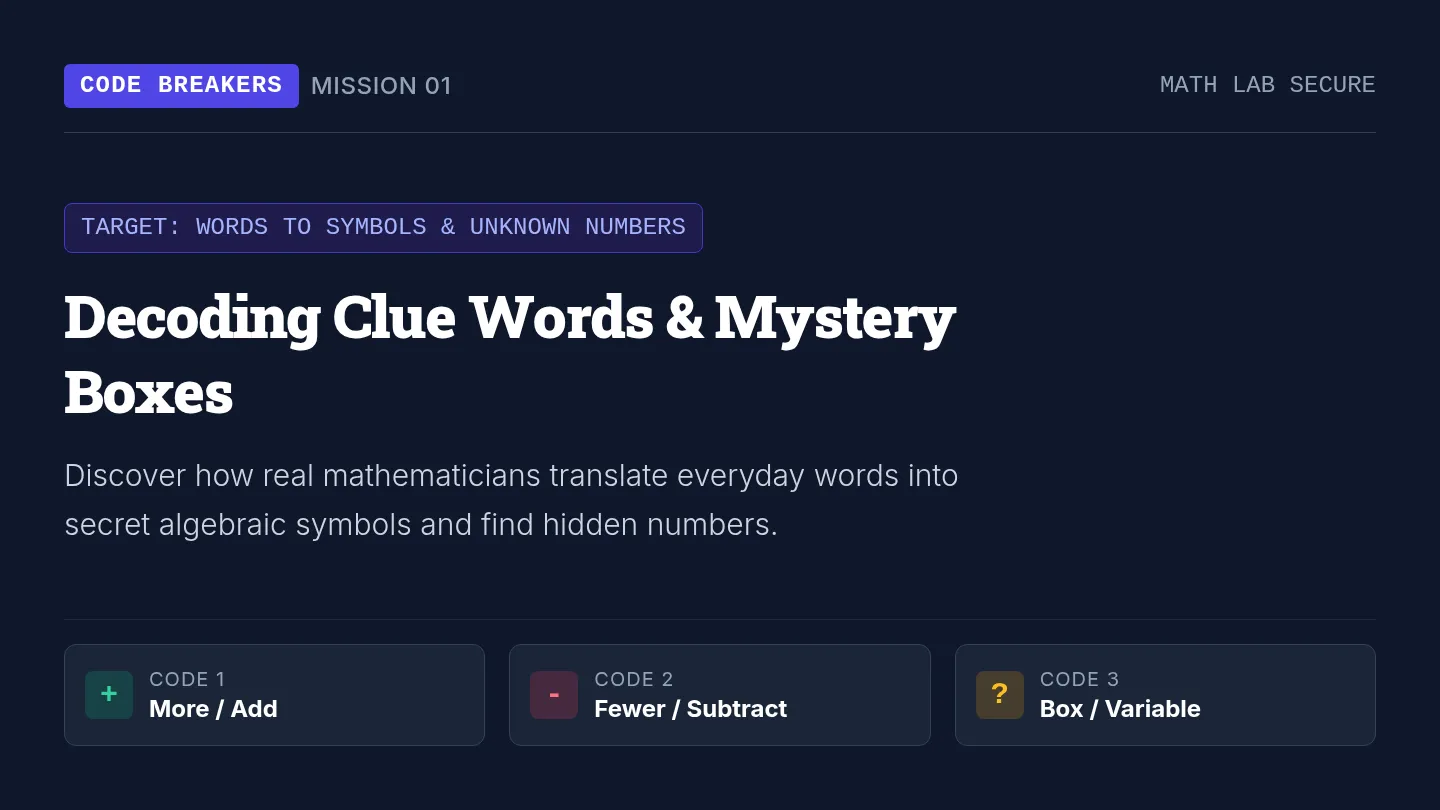
Clue Words Presentation

Code Breakers Squad

A scaffolded pre-algebra sequence designed for sixth graders building confidence from second-grade arithmetic foundations. Students use code-breaking visual models, mystery boxes, number swaps, and equal-group arrays to master algebraic concepts without cognitive overload. Each lesson bridges concrete representations to symbolic expressions with age-respectful styling and supportive pacing.

MJ

Meg Jones

9
Problem Solving Sub Guide

Spiral And Problem Solving

Day 5 synthesizes multiplication strategies with multi-step word problems, error analysis, and includes the complete 4-night spiraled weekly homework packet and full answer keys.

RM

Rodnesha Minor

3
Weekly Homework Answer Key

Weekly Homework Answer Key

Printer-friendly complete worked answer key for the Monday through Thursday homework packet, labeled by Strategy 1-5 and spiraled standards for quick grading by a substitute teacher.

RM

Rodnesha Minor

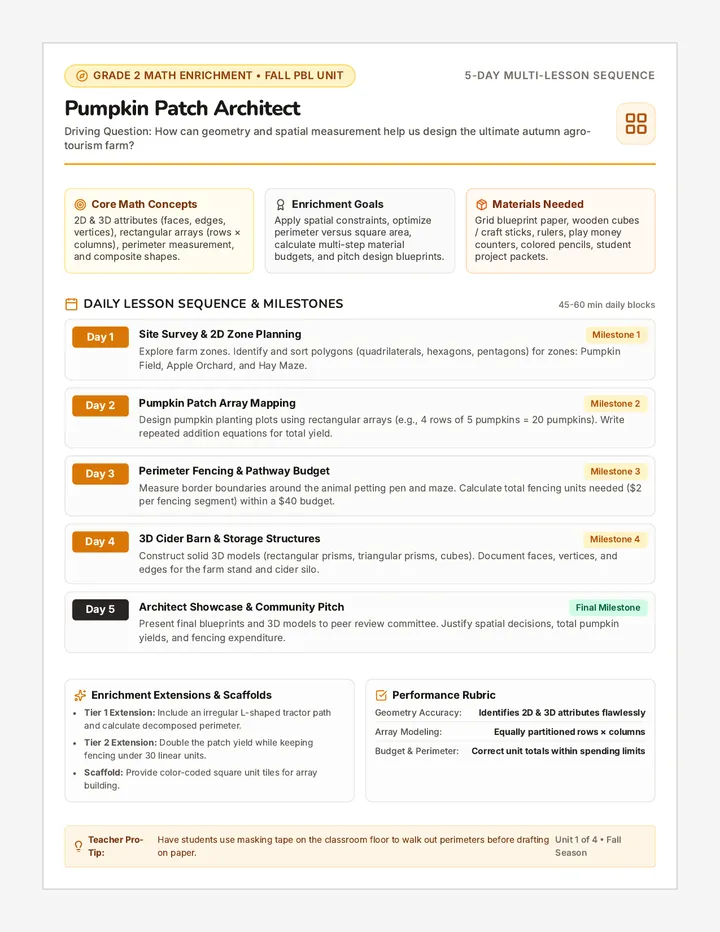
Pumpkin Patch Unit Plan

Seasonal Math Quests

A collection of four seasonal project-based learning units for Grade 2 math enrichment featuring autumn harvest and winter wonderland design missions. Students apply advanced geometry, multi-digit money math, precision measurement, and elapsed time to solve authentic real-world challenges.

K

kkipperman

8
Double Digit Sub Guide

Double Digit Models

Days 3 and 4 tackle multiplying two two-digit numbers using 4-part rectangular area models and partial products, featuring turnkey scripts, whiteboard showdown routines, and student notebook organizers.

RM

Rodnesha Minor

2
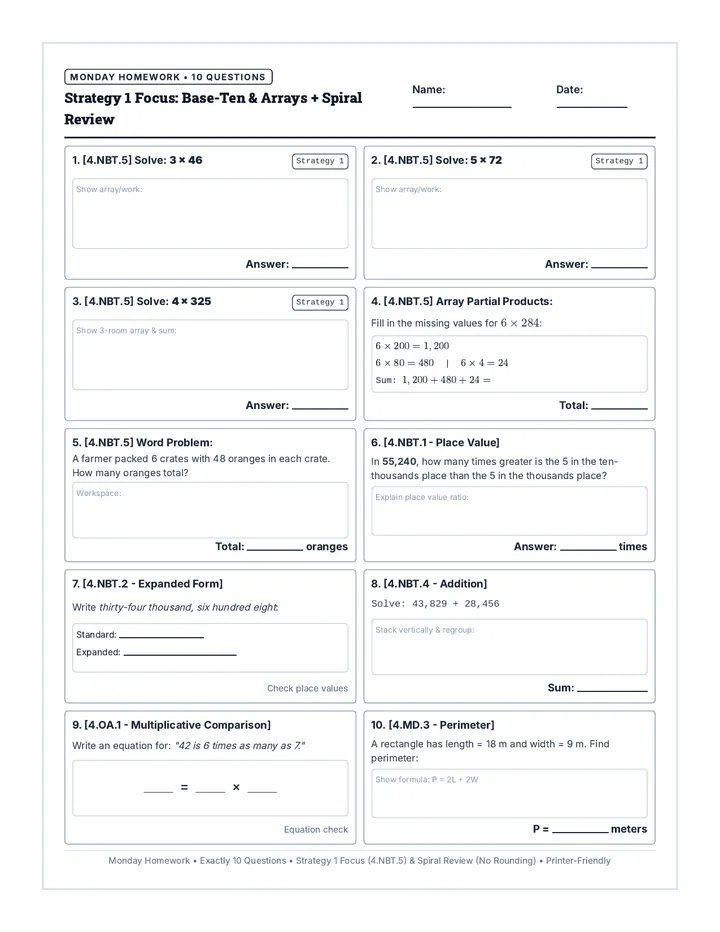
Weekly Spiral Homework Sheet

Weekly Spiral Homework Sheet

Printer-friendly 4-night weekly homework packet aligned to 4.NBT.5 with generous student workspaces, highlighting Strategies 1 through 4/5 and spiraling prior standards with no rounding.

RM

Rodnesha Minor

Fourth Grade Math Worksheet

Math Powerhouse

A targeted multi-grade mathematics sequence focusing on mastering whole-number operations including addition, subtraction, and multi-digit multiplication. It equips fourth and fifth-grade learners with procedural fluency, conceptual problem-solving, and rigorous challenge tasks.

T

temetropolis

4
Single Digit Sub Guide

Single Digit Area

Days 1 and 2 focus on multiplying up to four-digit whole numbers by a one-digit whole number using place value strategies, base-ten models, and rectangular area models with scripted gradual release for the substitute teacher.

RM

Rodnesha Minor

2
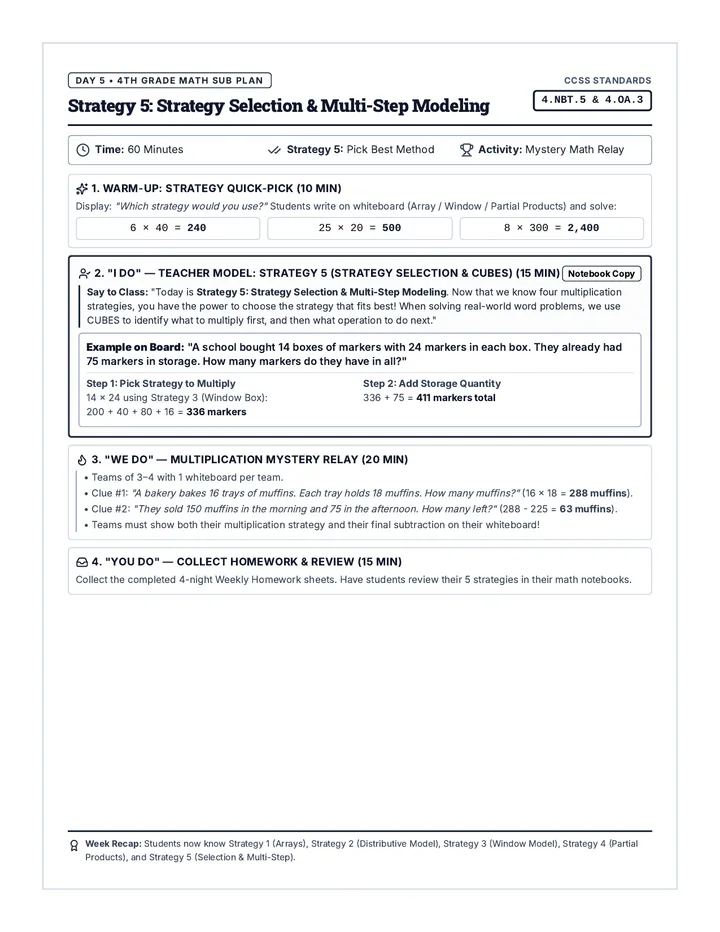
Problem Solving Sub Guide

Problem Solving Sub Guide

Printer-friendly scripted sub guide for Day 5 introducing Strategy 5 (Strategy Selection & Multi-Step Word Problems) with a review relay and end-of-week teacher handoff form.

RM

Rodnesha Minor

Linear Equations Practice Worksheet

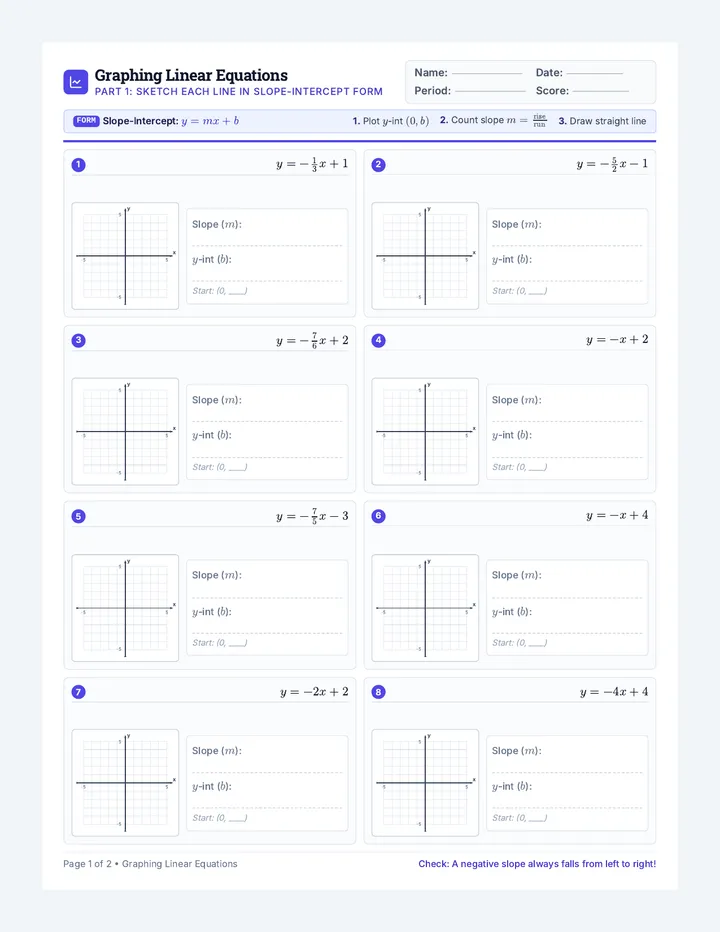
Coordinate Geometry Mastery

A secondary mathematics curriculum sequence exploring linear functions and geometric transformations on the Cartesian coordinate plane, featuring print-ready guided practice and teacher keys.

FM

Fernando Mancini

4
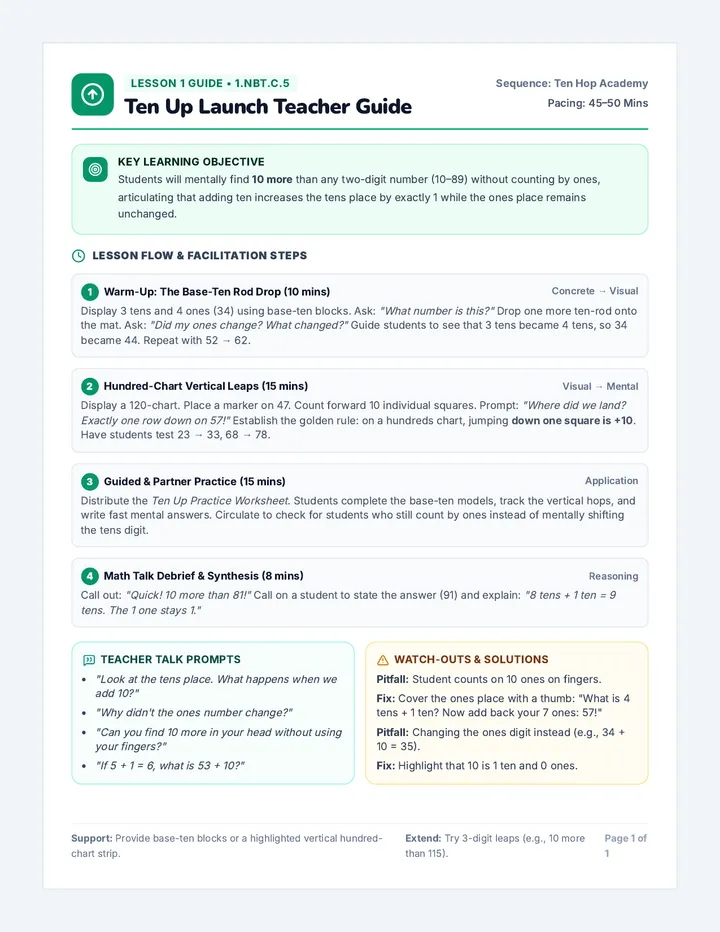
Ten Up Teacher Guide

Ten Hop Academy

A comprehensive 3-lesson primary math sequence designed to develop first graders' mental fluency with finding 10 more and 10 less than any two-digit number. Students transition from concrete base-ten models and hundreds-chart leap patterns to rapid mental calculations and clear verbal explanations.

K

kkipperman

9
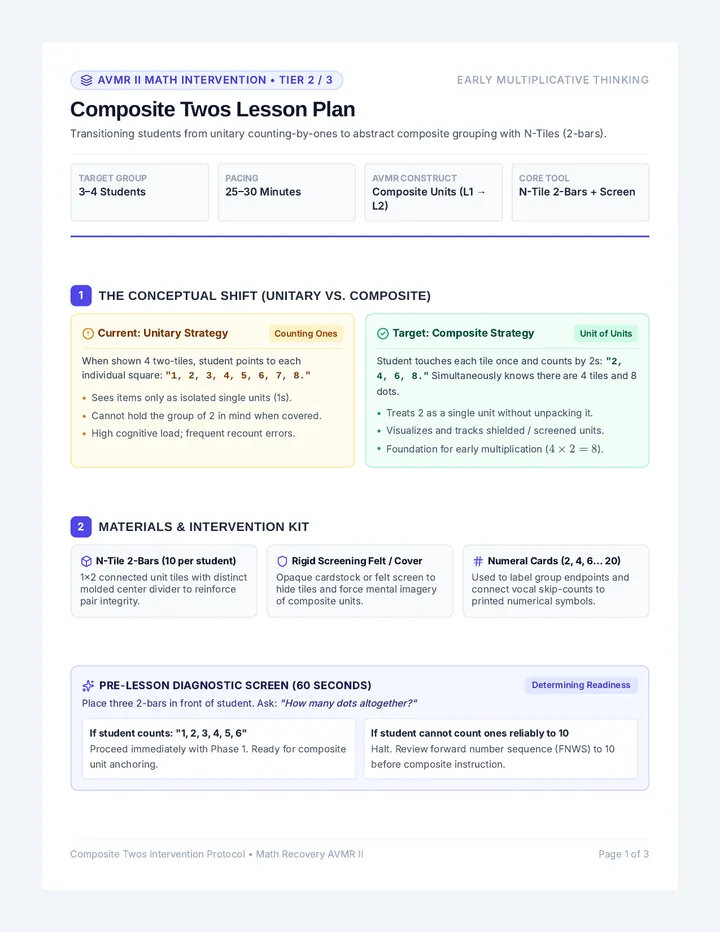
Composite Twos Lesson Plan

Math Intervention Suite

A comprehensive math intervention suite targeting foundational construct progressions from early multiplicative units to conceptual fraction schemes.

JW

Julie Whitehead

13