MCAS Grade Four Math Reference Chart
MCAS Blueprint Massachusetts Curriculum Framework
Grade 4 Mathematics • Page 1 of 2
Grade 4 Math MCAS Topic Breakdown
Part 1: Primary Domains (Fractions & Base Ten), Cluster Weights, and Question Formats
Total Points
~40 pts
Structure
2 Sessions
Calculator
None Allowed
Test Blueprint Weight Distribution (% of Total Operational Points) DESE Operational Assessment
4.NF (~30%)
4.NBT (~25%)
4.OA (~20%)
4.MD (~15%)
4.G (~10%)
4.NF Fractions (~30% • ~12 pts) 4.NBT Base Ten (~25% • ~10 pts) 4.OA Operations (~20% • ~8 pts) 4.MD Meas. & Data (~15% • ~6 pts) 4.G Geometry (~10% • ~4 pts)
Number and Operations — Fractions Domain 4.NF
~30% Test Weight ~12–14 Points
Key Clusters & Standards
- 4.NF.A (1–2): Fraction Equivalence & Ordering. Explain \(a/b = (n \times a)/(n \times b)\) using models; compare fractions with different numerators/denominators using benchmarks (\(1/2, 1\)).
- 4.NF.B (3–4): Fraction Operations. Add/subtract fractions & mixed numbers with like denominators; multiply a fraction by a whole number (\(n \times a/b\)).
- 4.NF.C (5–7): Decimal Fractions. Convert tenths to hundredths (\(3/10 = 30/100\)); add tenths & hundredths; compare decimals to hundredths (\(<, =, >\)).
High-Yield Item Formats
- Allowed Denominators: Strictly 2, 3, 4, 5, 6, 8, 10, 12, 100.
- Mixed Number Operations: Real-world recipes/distances with word context.
- Fraction as Multiples: Recognizing \(5/4 = 5 \times (1/4)\) and \(3 \times (2/5) = 6/5\).
- Decimal Grid Shading: Matching \(0.45\) to \(45/100\) on \(10\times 10\) grids.
- Number Line Comparison: Plotting and comparing fractions to \(1/2\).
Common Traps
• Adding denominators: e.g., writing \(2/5 + 1/5 = 3/10\).
• Decimal place confusion: thinking \(0.3 < 0.25\) because \(3 < 25\).
• Whole size neglect: comparing fractions without verifying identical wholes.
Number and Operations in Base Ten Domain 4.NBT
~25% Test Weight ~10 Points
Key Clusters & Standards
- 4.NBT.A (1–3): Generalize Place Value to 1,000,000. Recognize a digit in one place represents \(10\times\) what it represents to its right; read/write numerals, word names, expanded form; round to any place.
- 4.NBT.B.4: Fluently add and subtract multi-digit whole numbers using the standard algorithm.
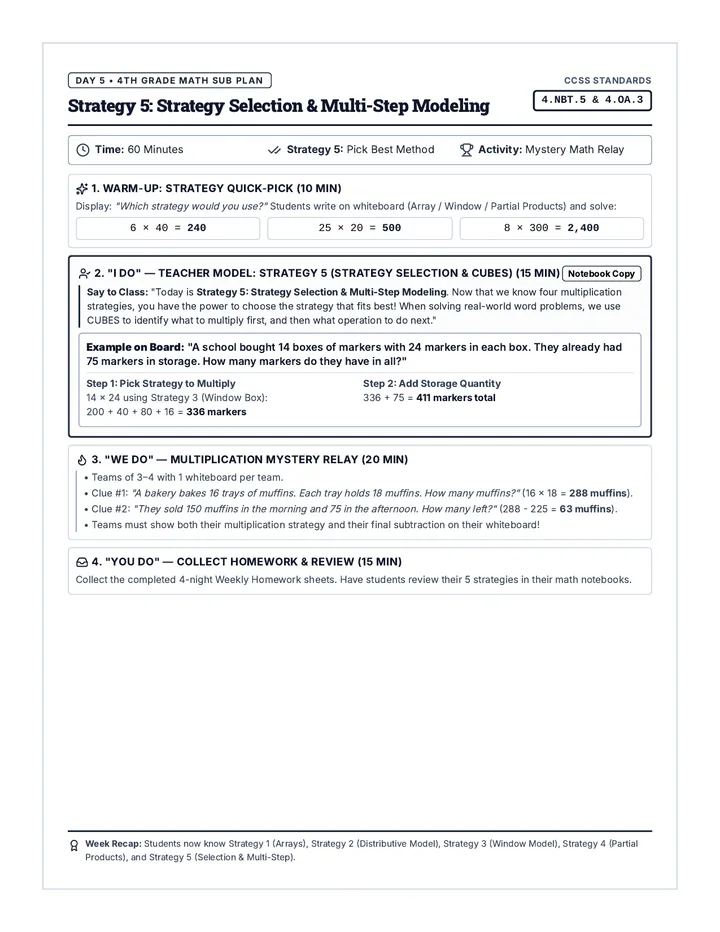
- 4.NBT.B (5–6): Multi-Digit Arithmetic. Multiply 4-digit by 1-digit and two 2-digit numbers; divide up to 4-digit dividends by 1-digit divisors with remainders.
High-Yield Item Formats
- \(10\times\) Shift Value: Comparing value of 7 in 74,200 vs 47,100.
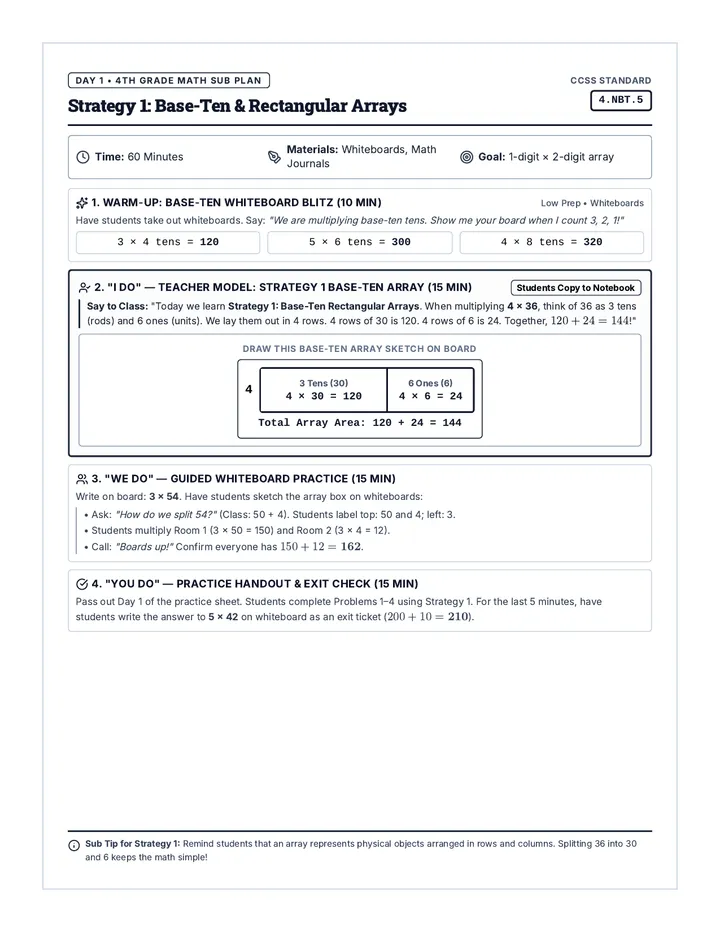
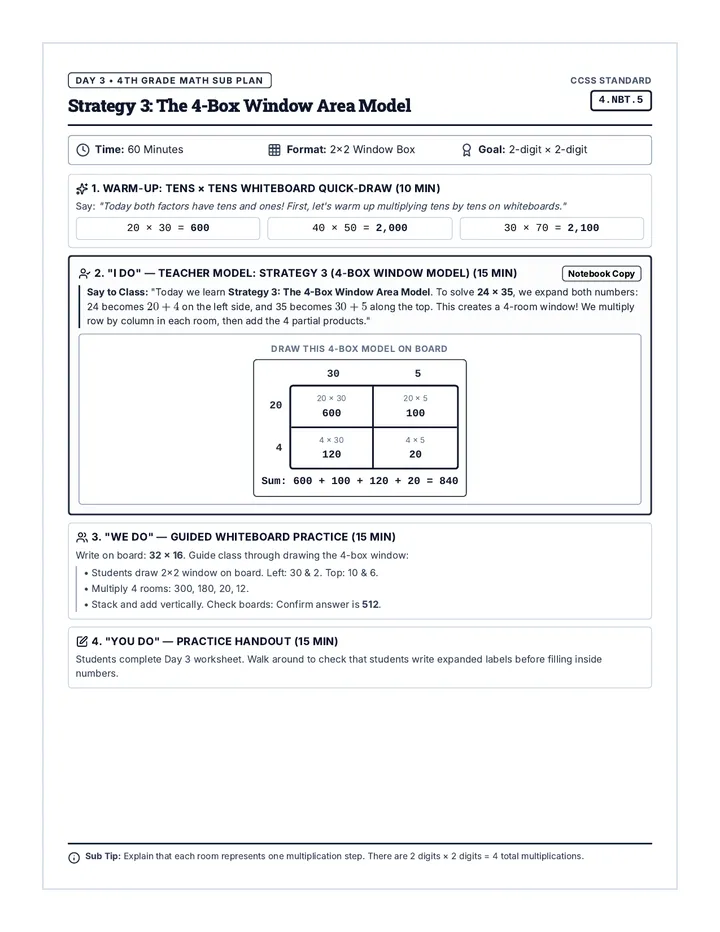
- Partial Products & Area Models: Decomposing \(34 \times 58 = (30+4)(50+8)\).
- Standard Algorithm Check: Spotting regrouping errors in addition/subtraction.
- Division with Remainders: Stating quotient and remainder explicitly or in context.
- Multi-Step Rounding: "Which numbers round to 40,000 when rounded to nearest 10,000?"
Common Traps
• Subtracting across zeros: regrouping errors when solving \(50,003 - 27,486\).
• Partial product omissions: multiplying \(23 \times 45\) as only \((20 \times 40) + (3 \times 5)\).
• Rounding down errors: failing to round up when boundary digit is \(\ge 5\).
Key Takeaway: Domains 4.NF and 4.NBT together account for >55% of all operational points on Grade 4 MCAS.
Continued on Page 2 →
MCAS Blueprint Massachusetts Curriculum Framework
Grade 4 Mathematics • Page 2 of 2
Operations, Measurement, Geometry & Scoring
Part 2: Supporting Domains, Question Types, 3-Point Scoring Rubric, and Test Strategy
Operations & Algebraic Thinking (4.OA) Standards: 4.OA.1 – 4.OA.5
~20% Weight ~8 Points
Key Standards: Multiplicative comparisons (\(a \times b = c\) as "\(c\) is \(a\) times as many as \(b\)"); 2-step word problems (4 operations) with letter unknowns; factors & multiples (1–100); prime vs. composite; shape/number pattern generation.
MCAS Focus: Multiplicative comparison ("\(4\) times as tall") vs additive ("\(4\) feet taller"); interpreting remainders in multi-step word problems (round up, drop, or remainder).
Measurement & Data (4.MD) Standards: 4.MD.1 – 4.MD.7
~15% Weight ~6 Points
Key Standards: Relative sizes of units & conversion tables (\(km, m, cm; kg, g; lb, oz; hr, min, sec\)); area & perimeter formulas; fractional line plots (\(1/8, 1/4, 1/2\)); angle concepts, protractor measurement, and additive angles.
MCAS Focus: Solving for unknown angles decomposed on a ray (\(\angle A + \angle B = 90^\circ\) or \(180^\circ\)); finding missing side given rectangle area (\(A = l \times w\)).
Geometry (4.G) Standards: 4.G.1 – 4.G.3
~10% Weight ~4 Points
Key Standards: Draw and identify points, lines, segments, rays, angles (right, acute, obtuse), perpendicular & parallel lines; classify 2D figures by angles and line properties (e.g. right triangles); lines of symmetry.
MCAS Focus: Multiple-select questions ("Select all polygons that contain at least one pair of parallel lines and no right angles"); identifying symmetry lines in plane shapes.
MCAS Item Types & Distribution
Selected Response (SR) Single-select multiple choice
1 pt (~20–24 items)
Technology-Enhanced (TE) Multi-select, inline drop-down, drag & drop
1–2 pts (~6–8 items)
Short Answer (SA) Exact numeric entry into response box
1 pt (~4 items)
Constructed Response (CR) Multi-part task requiring work & explanation
3 pts (2 items = 6 pts)
3-Point Constructed Response Rubric
Score 3: Complete understanding. Correct answers to all parts with clear, sound mathematical reasoning, equations, and thorough work shown.
Score 2: Partial understanding. Correct answers with minor computational error, or solid reasoning with minor calculation omission.
Score 1: Minimal understanding. Shows partial correct work on one part; incomplete explanation without cohesive rationale.
Score 0: Untenable response; incorrect answer with completely irrelevant work or response is blank.
High-Yield Grade 4 Instructional Priorities Checklist
Teacher Action Items
1. Fraction Fluency First
Practice decomposing fractions, like-denominator operations, and decimal equivalents (\(0.7 = 7/10 = 70/100\)) daily.
2. Algorithm Precision
Ensure student fluency in the standard addition/subtraction algorithm across multiple zeros (\(40,000 - 18,349\)).
3. Vocabulary & Angles
Master protractor reading and additive angle formulas (\(x + 35^\circ = 90^\circ\)), plus prime vs. composite identification.