Function Faceoff Handout
Algebra 1 • Skill Launcher
Do Now: Slope & Function Review
Name:
Date: Period:
Warm-Up Focus: Review evaluating expressions, calculating slope, and reading values from tables and graphs.
10 Minutes
1
Evaluating Functions (Input → Output)
a. Given \(f(x) = 3x - 2\):
Find \(f(1)\):
\(f(1) =\) _____
Find \(f(4)\):
\(f(4) =\) _____
b. Given \(g(x) = x^2 + 3\):
Find \(g(2)\):
\(g(2) =\) _____
Find \(g(5)\):
\(g(5) =\) _____
2
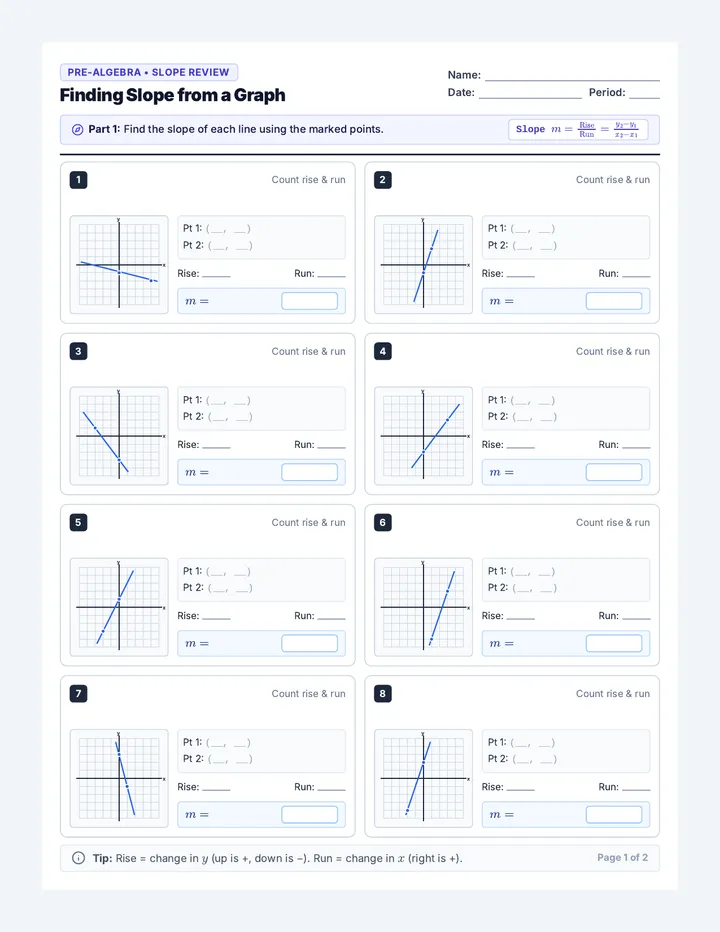
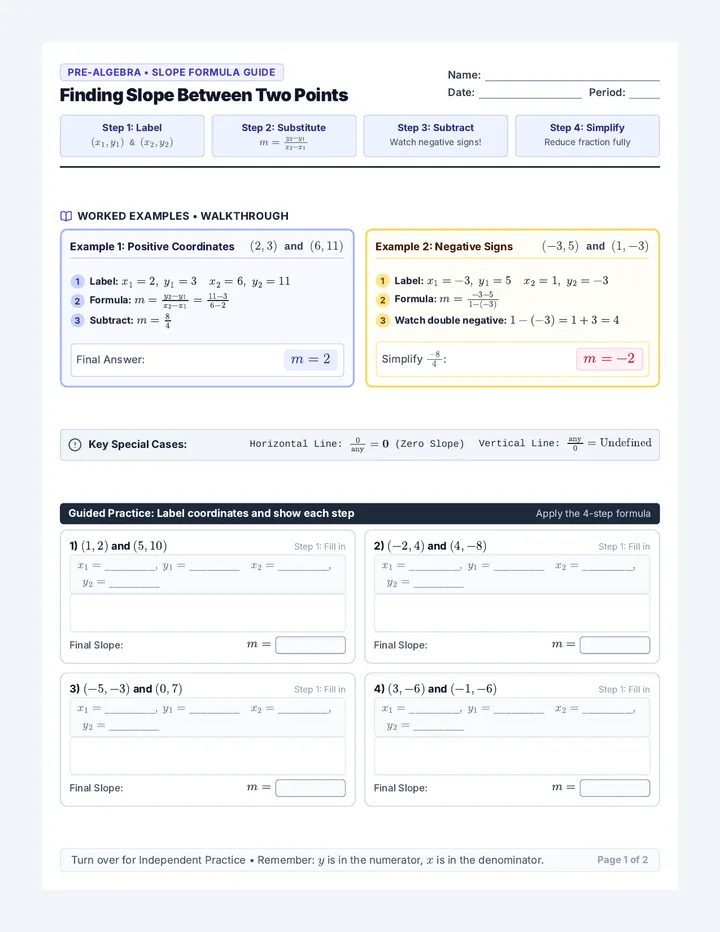
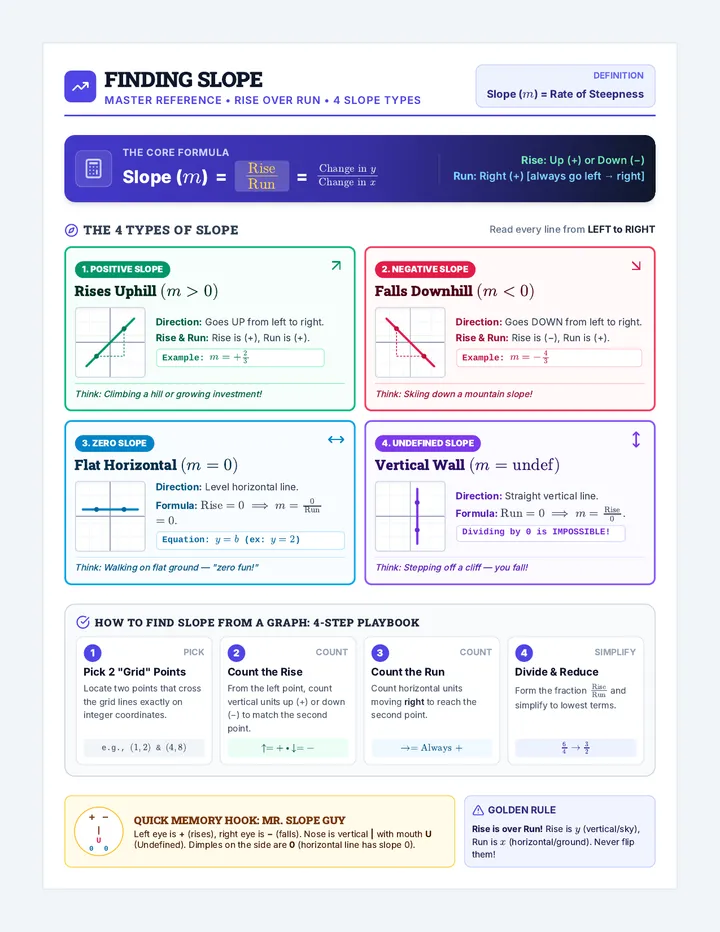
Slope Formula: \(m = \frac{y_2 - y_1}{x_2 - x_1}\)
\(\text{Slope} = \frac{\Delta y}{\Delta x}\)
a. Find slope between \((2, 5)\) and \((6, 17)\):
Slope \(m\) = ______
b. Find slope between \((1, 8)\) and \((4, 2)\):
Slope \(m\) = ______
3
Reading Representations
From this Table:
When \(x = 1\), \(y =\) _____
When \(x = 3\), \(y =\) _____
\(\frac{\Delta y}{\Delta x} = \frac{\_\_\_\_ - \_\_\_\_}{\_\_\_\_ - \_\_\_\_} =\) _____
(1, 2) (3, 6)
From this Graph:
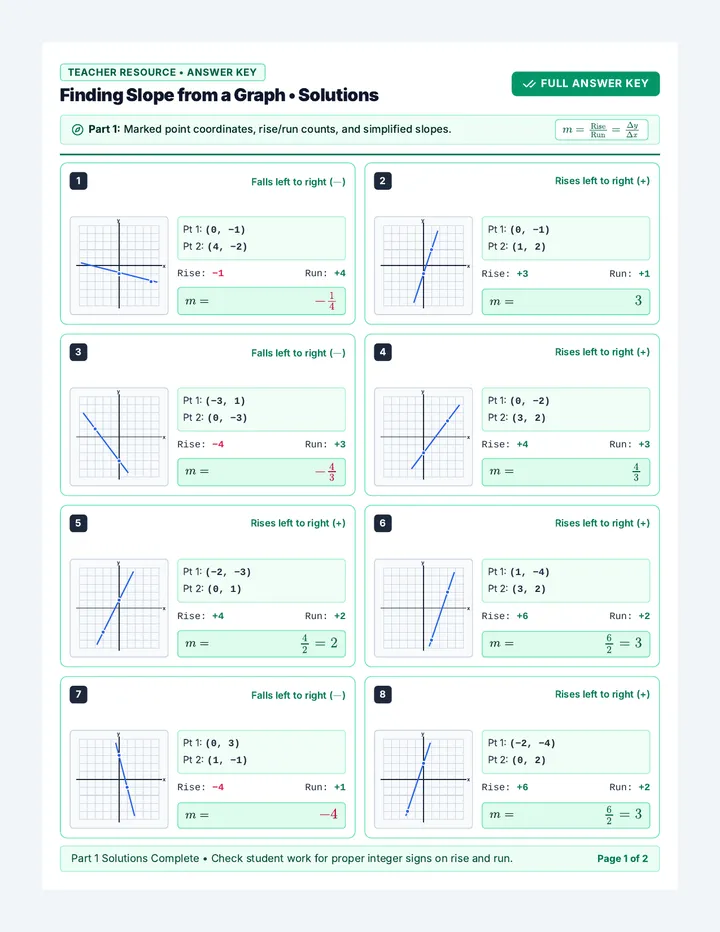
Rise = _____
Run = _____
\(\text{Slope} = \frac{\text{Rise}}{\text{Run}} =\) _____
Concept Reflection
What is the difference between a positive rate of change and a negative rate of change?
Page 1 • Prerequisite Do Now
Reference Guide
Average Rate of Change Blueprint
Interval: \([a, b]\) means \(x_1 = a\) and \(x_2 = b\)
Definition & Formula
The average rate of change of a function \(f(x)\) over the interval from \(x = a\) to \(x = b\) measures how much the output changes on average per unit of input:
\[ \text{Rate of Change} = \frac{f(b) - f(a)}{b - a} = \frac{\Delta y}{\Delta x} \]
Common Trap: The interval \(x = a\) to \(x = b\) gives you two x-values, NOT an \((x, y)\) coordinate pair! You must find the corresponding \(y\)-values for each \(x\).
Step-by-Step Strategy for Each Representation
A
From an Equation
- Substitute \(x = a\) to calculate \(f(a)\).
- Substitute \(x = b\) to calculate \(f(b)\).
- Write the points \((a, f(a))\) and \((b, f(b))\).
- Compute \(\frac{f(b) - f(a)}{b - a}\).
📌 Careful with exponents & negatives!
B
From a Graph
- Find \(x = a\) on horizontal axis & read \(y_1\).
- Find \(x = b\) on horizontal axis & read \(y_2\).
- Plot the endpoints \((a, y_1)\) and \((b, y_2)\).
- Calculate slope \(m = \frac{\text{rise}}{\text{run}}\).
📌 If line is straight, slope is constant!
C
From a Table
- Find row with \(x = a\) and circle \(y_1\).
- Find row with \(x = b\) and circle \(y_2\).
- Find change in output: \(\Delta y = y_2 - y_1\).
- Divide by change in input: \(\frac{\Delta y}{b - a}\).
📌 Always do \(\Delta y \div \Delta x\), not \(\Delta x \div \Delta y\)!
Worked Example: Find Rate of Change for \(g(x) = x^2 - 2x\) over \([1, 4]\) Model Walkthrough
Step 1: Evaluate Endpoints
\(g(1) = (1)^2 - 2(1) = 1 - 2 = \mathbf{-1}\)
\(g(4) = (4)^2 - 2(4) = 16 - 8 = \mathbf{8}\)
Points: \((1, -1)\) and \((4, 8)\)
Step 2: Apply the Formula
\(\text{Rate} = \frac{g(4) - g(1)}{4 - 1}\)
\(\text{Rate} = \frac{8 - (-1)}{4 - 1} = \frac{8 + 1}{3}\)
Step 3: Simplify & Conclude
\(\text{Rate} = \frac{9}{3} = \mathbf{3}\)
The average rate of change over \([1, 4]\) is 3.
Page 2 • Concept Notes & Strategy Blueprint
Guided Practice • Level 1
Mastering Each Format Individually
Target Interval: \([1, 3]\)
1 Equation: \(h(x) = x^2 - 4x\) over \([1, 3]\)
\(a = 1, b = 3\)
Step 1: Find \(h(1)\)
\(h(1) =\) ______
Step 2: Find \(h(3)\)
\(h(3) =\) ______
Step 3: \(\frac{h(3) - h(1)}{3 - 1}\)
Rate = ______
2 Graph: Function \(j(x)\) over \([1, 3]\)
Find points at \(x=1\) & \(x=3\)
x y 1 2 3 4 1 2 3 4 5
Point at \(x = 1\):
\((1, \_\_\_\_)\)
Point at \(x = 3\):
\((3, \_\_\_\_)\)
Calculate Rate of Change:
Rate of Change = ______
3 Table: Function \(k(x)\) over \([1, 3]\)
Identify rows for \(x = 1\) & \(x = 3\)
| \(x\) | \(k(x)\) |
|---|
| 0 | 1 |
| 1 | 5 |
| 2 | 11 |
| 3 | 19 |
| 4 | 29 |
Calculate Rate of Change:
Rate of Change = ______
Rank the 3 functions above from least to greatest rate of change:
< <
Check: Did any function have a negative rate of change?
Page 3 • Guided Practice: Single Representations
Guided Practice • Level 2
Function Faceoffs: Comparing Rates
Direct preparation for your exit ticket challenge.
Faceoff 1 Which function has a greater rate of change over \([0, 2]\)?
Interval: \(x = 0\) to \(x = 2\)
Function P: \(f(x) = 2x^2 - 1\)
\(f(0) =\) _____
\(f(2) =\) _____
Rate = ______
Function Q: Table
Rate = ______
Conclusion: Function has the greater rate of change because .
Faceoff 2 Which function has a greater rate of change over \([1, 4]\)?
Interval: \(x = 1\) to \(x = 4\)
Function R: Linear Graph
(1, 2) (4, 8)
Points: \((1, 2)\) & \((4, 8)\)
Rate = ______
Function S: \(g(x) = 10 - x\)
\(g(1) = 10 - 1 =\) _____
\(g(4) = 10 - 4 =\) _____
Rate = ______
Conclusion: Function has the greater rate because .
Error Analysis: Spot the Mistake!
Marcus says: "Function A has a rate of change of \(-5\) and Function B has a rate of change of \(2\). Therefore, Function A has the greater rate of change because \(5\) is bigger than \(2\)."
Is Marcus correct? Explain his mathematical error:
Page 4 • Guided Practice: Comparative Showdowns
Exit Ticket Mastery Assessment
Multi-Representation Rate Comparison
Name:
Score: / 10
- **
Which function has a greater rate of change over the interval \(x = 1\) to \(x = 2\)?
Function A
\[ f(x) = x^2 - 7x \]
Find \(f(1)\):
Find \(f(2)\):
Rate Calculation: \(\frac{f(2) - f(1)}{2 - 1}\)
Rate of Change:
______
Function B
x y 1 2 3 4 5 6 -1 -2 -3 -4 -5 -6 1 2 3 4 5 6 -1 -2 -3 -4 -5 -6
At \(x = 1\): \((1, \_\_\_\_)\)
At \(x = 2\): \((2, \_\_\_\_)\)
Rate / Slope Calculation: \(\frac{y_2 - y_1}{x_2 - x_1}\)
Rate of Change:
______
Function C
\(f(1) = \_\_\_\_\)
\(f(2) = \_\_\_\_\)
Rate Calculation: \(\frac{f(2) - f(1)}{2 - 1}\)
Rate of Change:
______
Final Answer & Mathematical Justification
Compare calculated values
Select the function with the greater rate of change:
Function A Function B Function C
Explain your mathematical reasoning using the calculated rates of change:
Self-Confidence Rating: (1 = Need Practice, 4 = Got It Mastered!)
Page 5 • Exit Ticket