Rate to Slope Slides
Grade 8 Mathematics • Linear Relationships
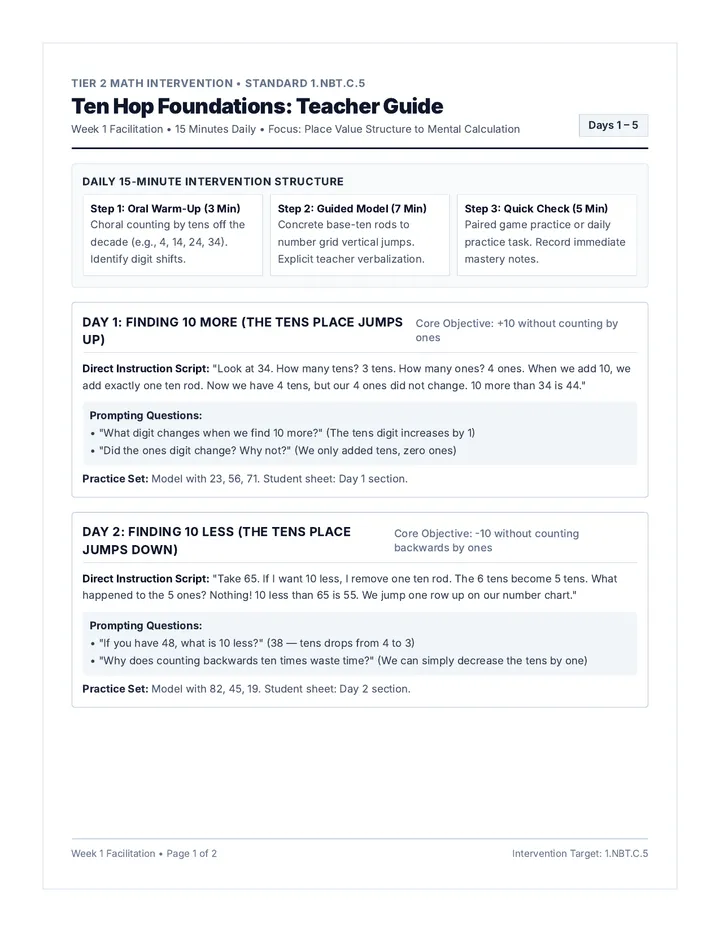
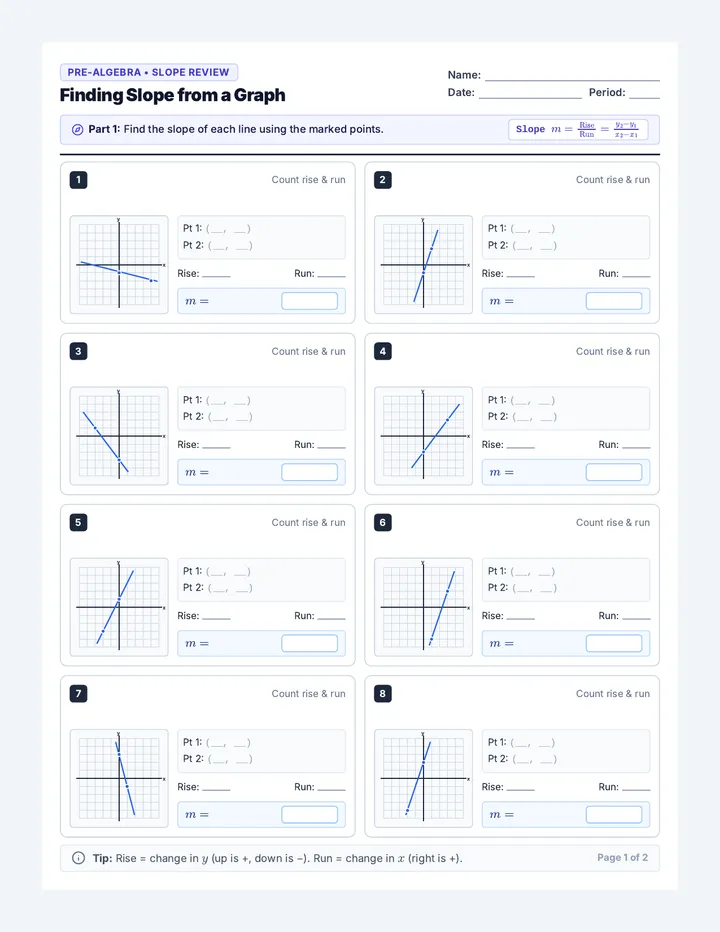
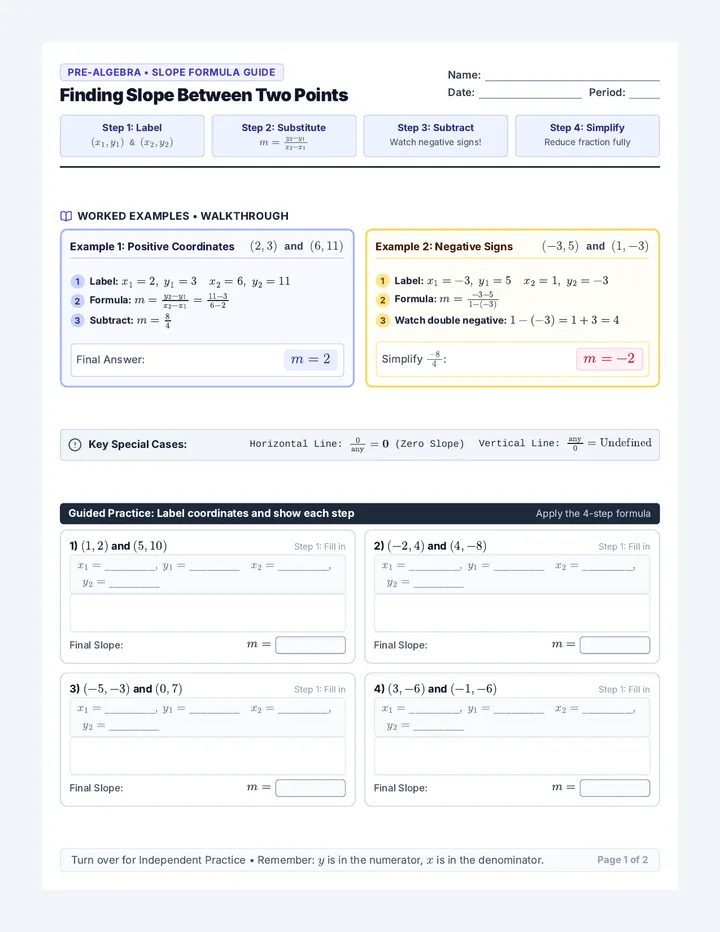
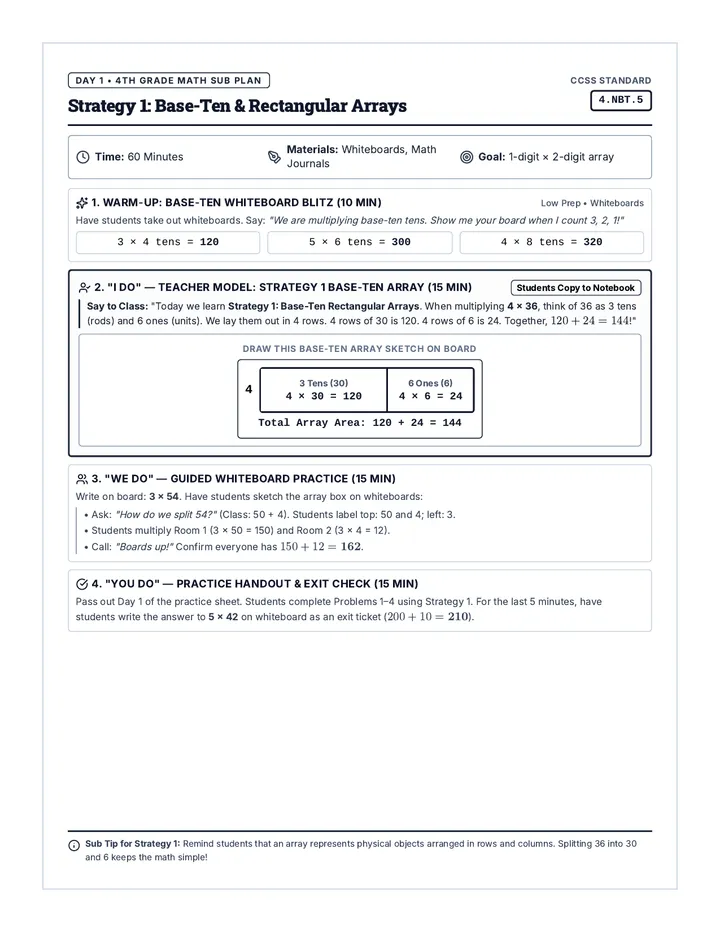
Connecting Proportional Relationships to Slope
Discover why the unit rate \(k\) you know from proportional tables is the exact same constant as linear slope \(m\) on the coordinate plane.
1. Tables & Ratios
2. Slope Triangles
3. Real-World Velocity
The Delivery Rover Challenge 01 / HOOK
Rover Swift
Model A
Distance Traveled 30 meters
Elapsed Time 2 seconds
Unit Rate: 15 m/s
Rover Dash
Model B
Distance Traveled 40 meters
Elapsed Time 4 seconds
Unit Rate: 10 m/s
Key Question: If both rovers start at \((0,0)\), how will their rates look when graphed on the exact same coordinate plane?
Which line will be steeper?
Foundations Review 02 / FOUNDATION
What Makes a Relationship Proportional?
Before we find slope, review the two non-negotiable rules of proportional relationships:
1
Constant Ratio (\(k\))
The ratio of the dependent variable to the independent variable is always fixed:
\(k = \frac{y}{x}\) • \(y = kx\)
2
Passes Through the Origin
The graph is always a straight line passing through the point of zero input:
Origin \((0, 0)\)
Remember: A line that does not pass through \((0,0)\) is linear, but not proportional!
Step-by-Step Connection 03 / TABLE TO GRAPH
Rover Swift Data
| Time \(x\) (s) | Distance \(y\) (m) | Ratio \(\frac{y}{x}\) |
|---|
| \(0\) | \(0\) | Origin \((0,0)\) |
| \(1\) | \(15\) | \(\frac{15}{1} = 15\) |
| \(2\) | \(30\) | \(\frac{30}{2} = 15\) |
| \(3\) | \(45\) | \(\frac{45}{3} = 15\) |
Every \(+1\) second in \(x\) produces a constant \(+15\) meters in \(y\).
The Coordinate Meaning
1
Points form a direct line
\((0,0) \rightarrow (1,15) \rightarrow (2,30) \rightarrow (3,45)\)
2
Vertical & Horizontal Steps
For every \(1\) unit right, the line climbs \(15\) units up.
3
Special Point: \((1, r)\)
Point \((1, 15)\) reveals the unit rate immediately!
Moving horizontally is the RUN, moving vertically is the RISE.
The Core Identity 04 / THE FORMULA
Unit Rate (\(k\)) = Slope (\(m\))
In linear algebra, slope is simply the rate of change graphed in space.
Unit Rate in Tables (\(k\))
The constant ratio of \(y\) to \(x\) across any pair of proportional values:
\(k = \frac{y}{x}\)
Slope on Graphs (\(m\))
The vertical change divided by horizontal change between any two points:
\(m = \frac{\text{rise}}{\text{run}} = \frac{\Delta y}{\Delta x}\)
Through origin \((0,0)\) to any point \((x,y)\): \(m = \frac{y - 0}{x - 0} = \frac{y}{x} = k\)
Geometric Insight 05 / SIMILAR TRIANGLES
Time (s) Distance (m) 1 2 3 15 30 45 run = 1 rise = 15 run = 2 rise = 30
Why Any Two Points Give the Same Slope
Small Triangle:
\(\text{Slope} = \frac{\text{rise}}{\text{run}} = \frac{15}{1} = \mathbf{15}\)
Large Triangle:
\(\text{Slope} = \frac{\text{rise}}{\text{run}} = \frac{30}{2} = \mathbf{15}\)
Because the slope triangles are similar triangles, the ratio \(\frac{\text{rise}}{\text{run}}\) simplifies to the exact same unit rate anywhere on the line!
Conclusion: You can choose any two convenient points to measure slope.
Essential Anchor 06 / SIGNATURE POINT
The Power of Point \((1, r)\)
In every proportional graph, two coordinates tell the entire story:
(0,0)
The Origin
Confirms proportionality. Represents the initial baseline: at \(0\) input, there is \(0\) output.
Example: 0 seconds elapsed means 0 meters traveled.
(1, r)
The Unit Rate Point
Reveals the slope directly. When the horizontal coordinate is \(1\), the vertical coordinate is \(r = m\).
Example: \((1, 15)\) means the slope is \(15\), speed is \(15\text{ m/s}\).
Pro-Tip: To quickly find the equation of a proportional graph, find the \(y\)-value where \(x = 1\). That value is \(m\), giving \(y = mx\)!
Visual Comparison 07 / STEEPNESS
Steeper Line = Greater Rate of Change
Comparing Rover Swift (\(m = 15\)) and Rover Dash (\(m = 10\)):
Time (s) Dist (m) Swift: m = 15 Dash: m = 10
Rover Swift: \(y = 15x\)
Climbs \(15\) meters for every \(1\) second. Steeper slope reflects the faster velocity.
Rover Dash: \(y = 10x\)
Climbs only \(10\) meters for every \(1\) second. Flatter slope reflects the slower velocity.
Key Rule: A steeper slope indicates a faster rate of increase.
Visual steepness allows instant qualitative comparisons before performing exact calculations!
Wrap-Up & Challenge 08 / SUMMARY
The Rate-to-Slope Blueprint
Keep these 3 essential mathematical truths in mind during today's lab:
1
Equal Values
Unit Rate \(k\) in a proportional table is exactly equal to linear slope \(m\):
\(m = k = \frac{\Delta y}{\Delta x}\)
2
Anchor Coordinates
Proportional lines always hit \((0,0)\), and the coordinate \((1, r)\) gives the slope directly:
\((1, r) \implies m = r\)
3
Slope Triangles
Slope triangles are similar; picking larger or smaller intervals will not change the slope:
\(\frac{15}{1} = \frac{30}{2} = 15\)
Now opening the Rate to Slope Worksheet!
Get ready to calculate, plot, and verify.
Rate to Slope Worksheet
Student Investigation CCSS: 8.EE.B.5 • 7.RP.A.2
Rate to Slope Lab Worksheet
Name: ______________
Date: ________
Class: ______________
Score: ____ / 25
Key Relationship: In proportional equations \(y = kx\), unit rate \(k = \frac{y}{x}\) equals slope \(m = \frac{\text{rise}}{\text{run}} = \frac{\Delta y}{\Delta x}\).
\(m = k = \frac{y}{x}\)
1
Investigation 1: Fresh Squeeze Juice Bar
The juice bar sells bottles of cold-pressed orange juice. The relationship between bottles purchased (\(x\)) and cost in dollars (\(y\)) is proportional.
| Bottles (\(x\)) | Cost (\(y\)) | \(\frac{y}{x}\) |
|---|
| 0 | $0 | --- |
| 2 | $6 | |
| 4 | $12 | |
| 6 | $18 | |
| 8 | $24 | |
Fill in \(\frac{y}{x}\) above to verify the constant unit rate.
0 2 4 6 8 10 Bottles (\(x\)) 6 12 18 24 Cost ($)
Plot the points and connect with a line passing through \((0,0)\).
(a) Unit Rate Calculation: What is the unit rate \(k = \frac{y}{x}\)? What does this value mean in this context?
(b) Slope Triangle Comparison: Calculate slope \(m = \frac{\text{rise}}{\text{run}}\) for two different pairs of points:
Triangle 1: From \((0,0)\) to \((2,6)\)
Rise = ________ | Run = ________
Slope \(m\) = \(\frac{\text{rise}}{\text{run}}\) =
Triangle 2: From \((2,6)\) to \((6,18)\)
Rise = ________ | Run = ________
Slope \(m\) = \(\frac{\text{rise}}{\text{run}}\) =
(c) The Point \((1, r)\): State the coordinates where \(x = 1\) and explain its significance.
(d) Equation: Write an equation for total cost \(y\) in terms of \(x\) bottles in the form \(y = mx\):
\(y =\) ___________ \(x\)
Rate to Slope Lab • Page 1 of 2 Turn over for Part 2: Dual Velocity & Error Analysis →
Application & Reasoning
Comparing Rates & Mathematical Argumentation
Student Name: _____________________
2
Investigation 2: Autonomous Delivery Drones
Two robotic delivery drones are flying in straight paths at constant speeds. Their distances (\(d\) in meters) over time (\(t\) in seconds) are recorded below.
<table class="w-full text-center border-collapse mt-1 bg-white rounded border border-cyan-200 text-[10px]"><tbody><tr class="bg-cyan-100/60 font-semibold text-cyan-900"><td class="p-0.5 border border-cyan-200">Time \(t\) (s)</td><td class="p-0.5 border border-cyan-200">0</td><td class="p-0.5 border border-cyan-200">2</td><td class="p-0.5 border border-cyan-200">4</td><td class="p-0.5 border border-cyan-200">6</td></tr><tr><td class="p-0.5 border border-cyan-200 font-semibold text-cyan-900">Dist \(d\) (m)</td><td class="p-0.5 border border-cyan-200">0</td><td class="p-0.5 border border-cyan-200">30</td><td class="p-0.5 border border-cyan-200">60</td><td class="p-0.5 border border-cyan-200">90</td></tr></tbody></table>
Slope Check Exit Ticket
Quick Check • 5 Minutes
Slope Check Exit Ticket
Connecting Proportional Relationships to Slope
Name: ______________
Period: ____
Date: ________
Score: ___/10
1
Fueling Up: Table to Slope
3 points
The table shows the proportional relationship between gallons of gasoline pumped (\(x\)) and total cost in dollars (\(y\)):
| Gallons (\(x\)) | Cost (\(y\)) |
|---|
| 0 | $0.00 |
| 3 | $12.00 |
| 6 | $24.00 |
Unit Rate \(k = \frac{y}{x}\): $________ / gallon
Slope \(m\) of the line: \(m = \) ________
What does coordinate \((1, 4)\) mean in this situation?
2
Slope Triangle Verification
4 points
0 2 4 6 8 \(x\) 5 10 15 20 \(y\)
Using points \((0,0)\) and \((4, 10)\):
Rise (\(\Delta y\)) = _____ Run (\(\Delta x\)) = _____
Slope \(m = \frac{\text{rise}}{\text{run}}\):
\(m =\) ________ (decimal: ______)
Equation (\(y = mx\)):
\(y =\) ______________________
3
Rate Comparison & Steepness
3 points
Tank A fills at a rate of \(4.5\) gal/min. Tank B is modeled by the equation \(y = 3.2x\) (\(x\) = min, \(y\) = gal).
Which tank fills faster?
Tank A (\(4.5\) gal/min)
Tank B (\(3.2\) gal/min)
How would you spot this on a graph?
Self-Rating: Understanding connecting unit rate to slope:
1 - Need help 2 - Getting there 3 - Got it 4 - Could teach
Rate to Slope Lab • Formative Exit Ticket CCSS: 8.EE.B.5, 7.RP.A.2
Rate to Slope Facilitation Guide
Teacher Facilitation Guide Grades 7–8 Mathematics
Rate to Slope Lab: Facilitation Guide
Unit: Linear Relationships CCSS: 8.EE.B.5 • 7.RP.A.2
Learning Targets
- Connect representations: Students prove that the unit rate \(k = \frac{y}{x}\) equals the geometric slope \(m = \frac{\Delta y}{\Delta x}\).
- Interpret point \((1, r)\): Students explain why the unit rate appears at coordinate \((1, r)\) on proportional graphs.
- Compare steepness: Students visually compare slopes to deduce relative speeds and costs without prior calculation.
Pacing (45–50 min)
Warm-up / Rover Hook: 7 min
Slide Deck Instruction: 12 min
Partner Investigation: 16 min
Synthesis & Error Debate: 7 min
Formative Exit Ticket: 5 min
Key Misconceptions & Teacher Moves
Misconception 1: The "Run Over Rise" Inversion Trap (\(\frac{\Delta x}{\Delta y}\))
Students frequently compute \(\frac{x}{y}\) because \(x\) is read first. Intervention: Reinforce physical movement: “To climb stairs, you must elevate (rise \(y\)) before you step forward (run \(x\)).” Highlight that unit rate is always dependent units per 1 independent unit (e.g., dollars per bottle).
Misconception 2: Thinking Slope Depends on Which Points Are Chosen
Students believe choosing points further apart produces a different slope. Intervention: Emphasize similar triangles from Slide 6. Show that \(\frac{6}{2} = 3\) and \(\frac{12}{4} = 3\). The fractions are equivalent!
Misconception 3: Assuming Any Straight Line Has a Unit Rate of \(\frac{y}{x}\)
Students attempt to find unit rate simply by dividing \(y/x\) for non-proportional lines (where \(y\)-intercept \(\neq 0\)). Intervention: Emphasize that \(m = k = \frac{y}{x}\) only holds true when the line passes through origin \((0,0)\).
Higher-Order Facilitation Prompts
While Graphing:
“Before calculating numbers, look at both lines. Which rover or drone is traveling faster, and how do your eyes tell you that?”
Analyzing \((1, r)\):
“If I told you a line passes through \((1, 28.5)\), what is the slope and the equation immediately without calculating anything?”
Rate to Slope Lab • Teacher Facilitation Guide (Page 1 of 2) See Page 2 for Complete Master Answer Keys →
Solutions & Rubrics
Master Answer Keys: Worksheet & Exit Ticket
100% Verified