Distributive Area Guided Notes
Lesson 7: Mastering the Distributive Property for Area
3rd Grade • Unit 3 • Standards: 3.MD.C.7b, 7c • 3.OA.B.5
Name:
Target I can use the break-apart strategy to find the area of rectangles with larger dimensions, and explain why this strategy works.
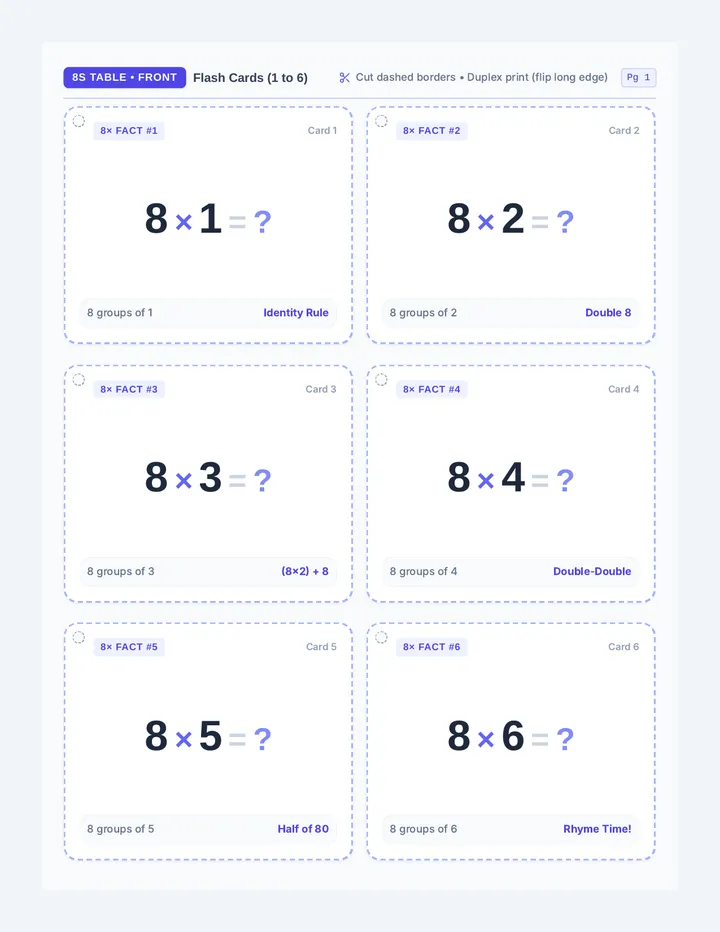
Fluency • Quick 8s Facts
Sprint: Multiply accurately by 8
1. 8 × 7 =
2. 8 × 2 =
3. 8 × 9 =
4. 8 × 5 =
5. 8 × 3 =
6. 8 × 8 =
7. 8 × 6 =
8. 8 × 10 =
9. 8 × 1 =
10. 8 × 4 =
11. 8 × 6 =
12. 8 × 8 =
13. 8 × 3 =
14. 8 × 5 =
15. 8 × 9 =
16. 8 × 2 =
17. 8 × 7 =
18. 8 × 4 =
19. 8 × 0 =
20. 8 × 10 =
Key Vocabulary
Distributive Property
Breaking apart one factor into two addends, multiplying each part, then adding products.
Decompose
To break a number into two smaller addends that combine back to the original number.
Partial Area
The area of one smaller rectangle after breaking apart the larger rectangle.
Total Area
The sum of all partial areas, which equals the full area of the original whole rectangle.
I DO
Modeled Problem • 3 Ways to Decompose
Whole-Class Demonstration
Problem 1: A rectangle is 6 feet tall and 14 feet wide. Show three different ways to break apart this rectangle to find its total area.
Method 1: Break 14 into 10 + 4
10 ft 4 ft
6 × 10 __ sq ft
6 × 4 __ sq ft
Height: 6 ft
(6 × ) + (6 × )
= +
= sq ft
Method 2: Break 14 into 7 + 7
7 ft 7 ft
6 × 7 __ sq ft
6 × 7 __ sq ft
Height: 6 ft
(6 × ) + (6 × )
= +
= sq ft
Method 3: Break 14 into 5 + 9
5 ft 9 ft
6 × 5 __ sq ft
6 × 9 __ sq ft
Height: 6 ft
(6 × ) + (6 × )
= +
= sq ft
Explain • All three give the same answer because:
Key Idea: No matter how you break apart the factor, the total area stays the same — you are just splitting the exact same rectangle in a different place!
WE DO
Guided Practice: Break Apart & Distribute
Work together to decompose one factor, sketch and label the model, then compute the total area.
4 Word Problems
Problem 1 Bulletin Board
Ms. Rivera is covering a rectangular bulletin board that is 4 feet tall and 13 feet wide. Use the distributive property to find the area of the bulletin board.
Step 1: Decompose 13 13 = ____ + ____
____ ft ____ ft
4 × ____ ____ sq ft
4 × ____ ____ sq ft
Height: 4 ft
Step 2: Distributive Equation
( 4 × ) + ( 4 × )
= +
Total Area:
sq ft
Problem 2 Playground Sandbox
A rectangular sandbox at the playground is 6 meters tall and 12 meters wide. Use the distributive property to find the area of the sandbox.
Step 1: Decompose 12 12 = ____ + ____
____ m ____ m
6 × ____ ____ sq m
6 × ____ ____ sq m
Height: 6 m
Step 2: Distributive Equation
( 6 × ) + ( 6 × )
= +
Total Area:
sq meters
Problem 3 Fabric Cut
The art teacher needs to cut a piece of fabric that is 5 inches tall and 16 inches wide. Use the distributive property to find the area of the fabric.
Step 1: Decompose 16 16 = ____ + ____
____ in ____ in
5 × ____ ____ sq in
5 × ____ ____ sq in
Height: 5 in
Step 2: Distributive Equation
( 5 × ) + ( 5 × )
= +
Total Area:
sq inches
Problem 4 Yoga Mat
A rectangular yoga mat is 7 feet tall and 14 feet wide. Use the distributive property to find the area of the mat.
Step 1: Decompose 14 14 = ____ + ____
____ ft ____ ft
7 × ____ ____ sq ft
7 × ____ ____ sq ft
Height: 7 ft
Step 2: Distributive Equation
( 7 × ) + ( 7 × )
= +
Total Area:
sq ft
Remember: Partial Area 1 + Partial Area 2 = Total Area of the whole rectangle. Page 2 of 2