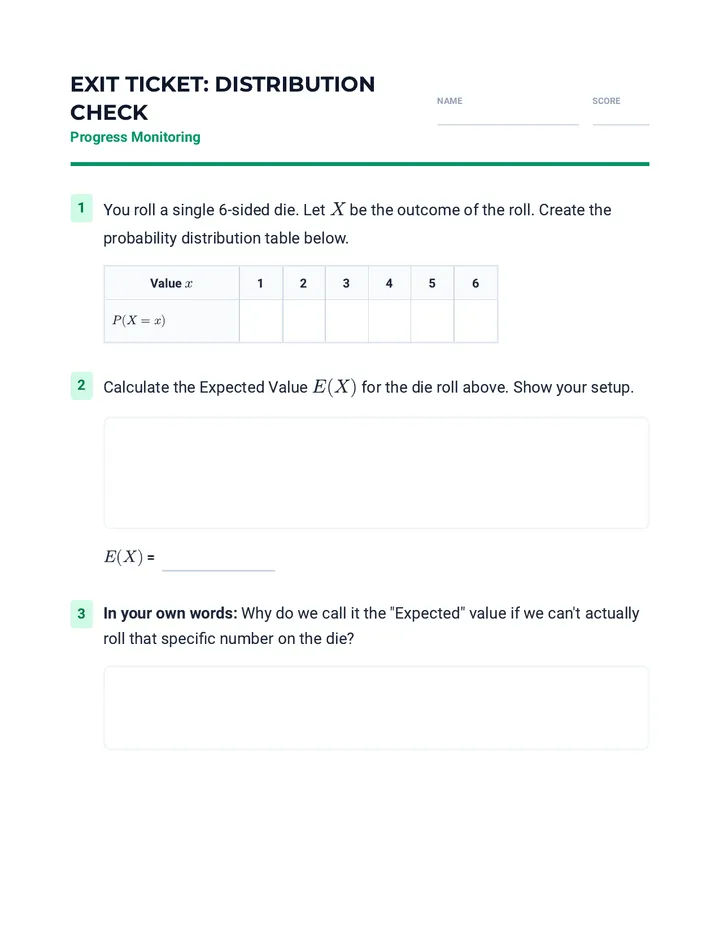
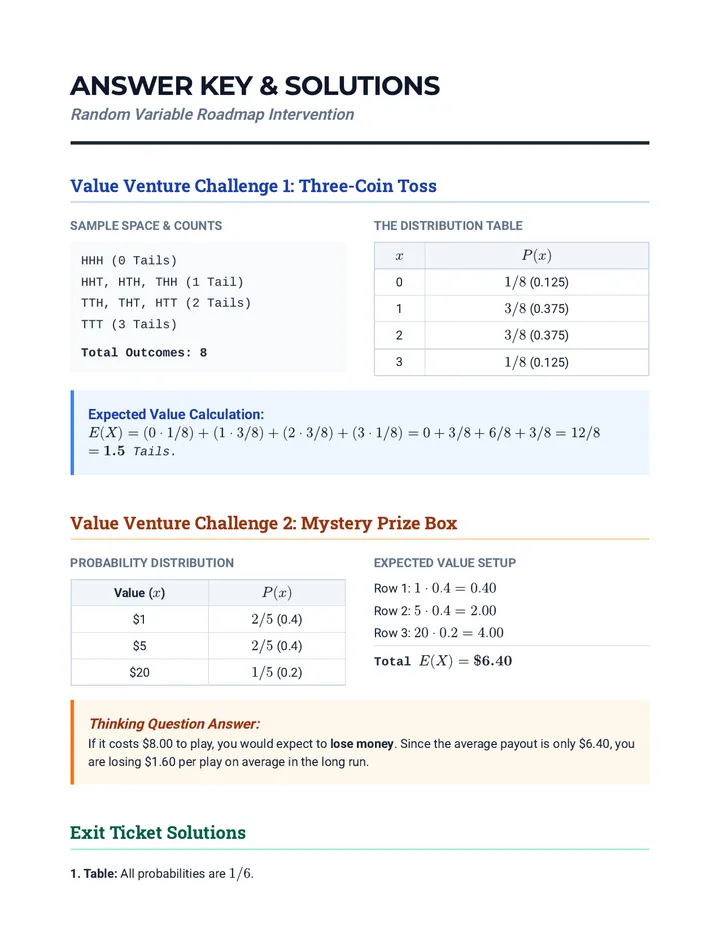
Mathematical foundations for calculating the long-term average of random variables across multiple trials. Addresses discrete probability distributions and applications in game theory and financial forecasting.
A comprehensive unit on adding and subtracting integers for grades 5-7, focusing on visual supports, mnemonic rules, and scaffolded practice for students with diverse learning needs.
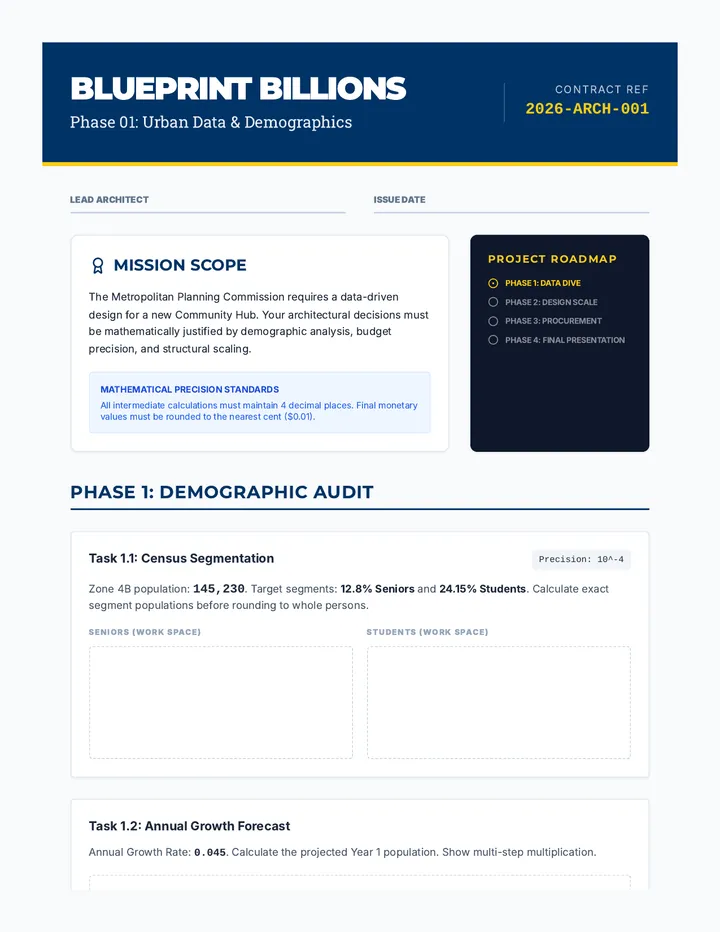
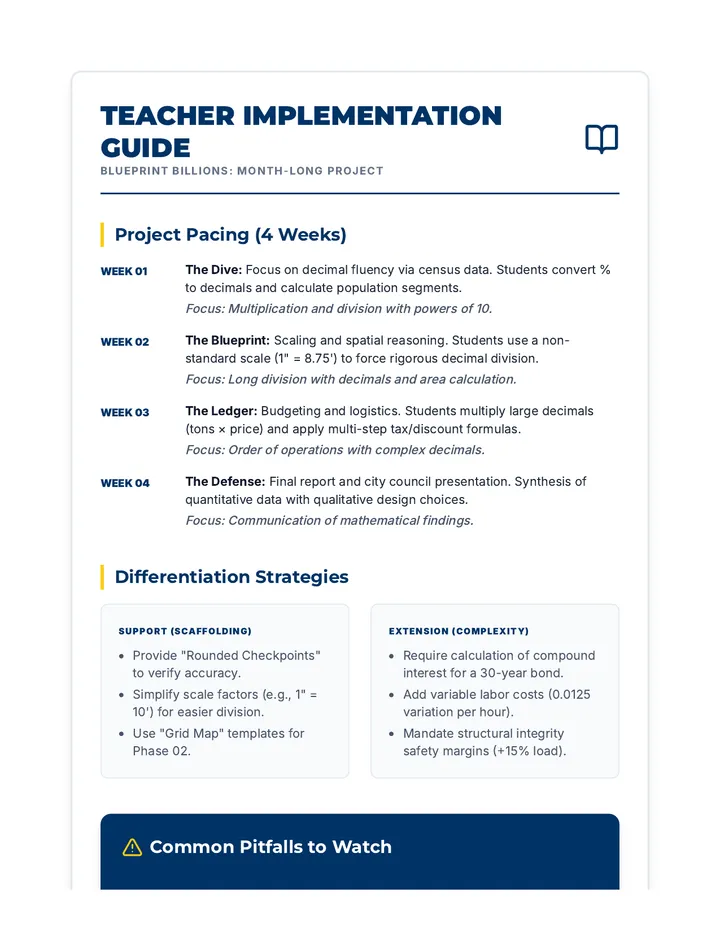
A month-long architectural design and statistical analysis project for high school students, focusing on precision decimal operations through real-world urban planning, budgeting, and data synthesis.
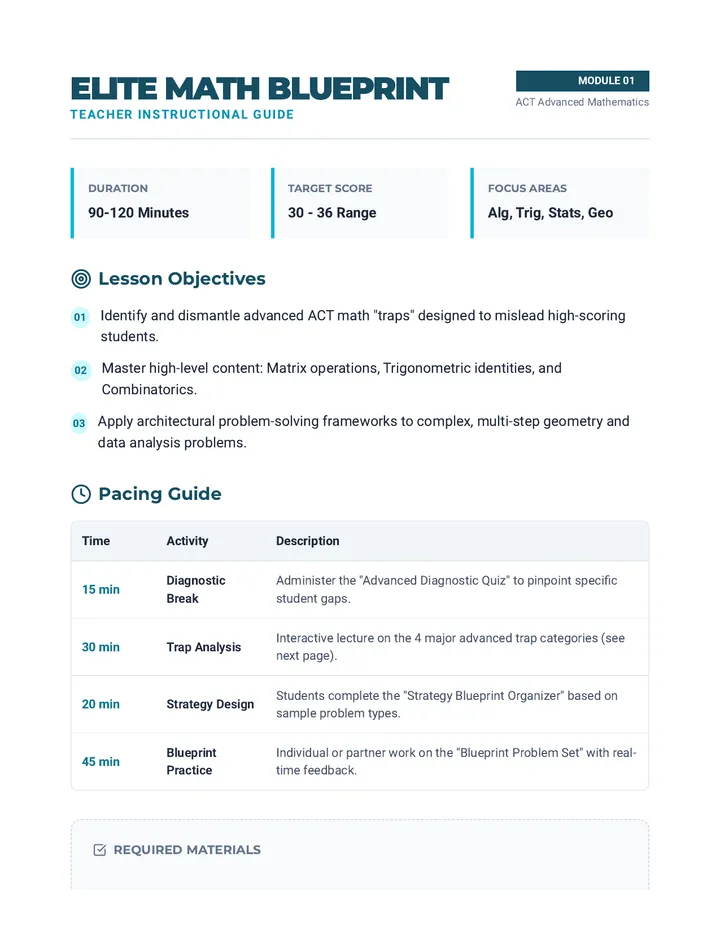
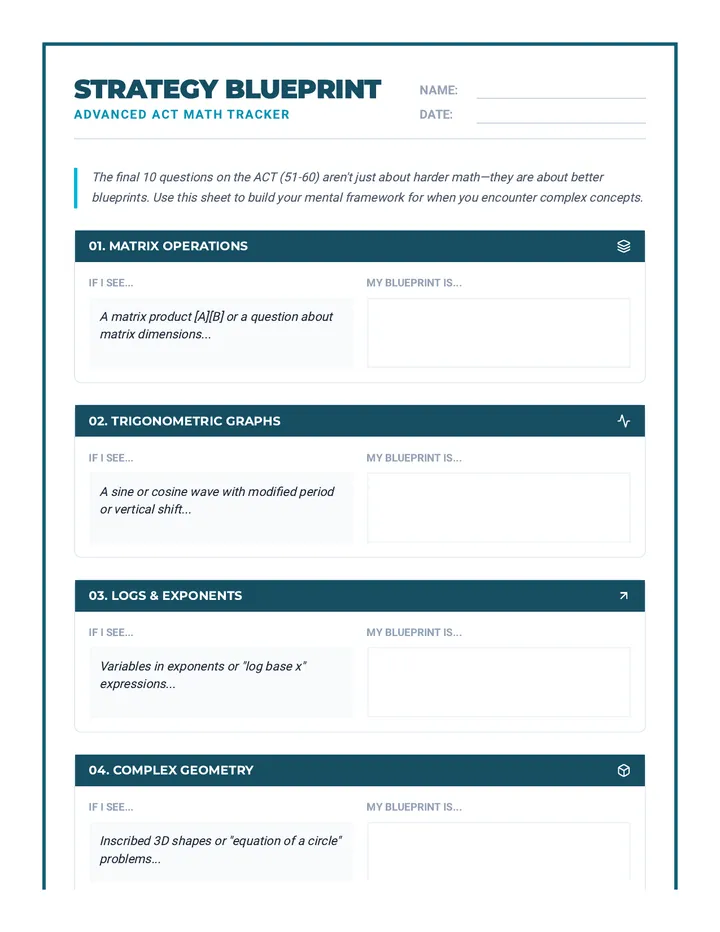
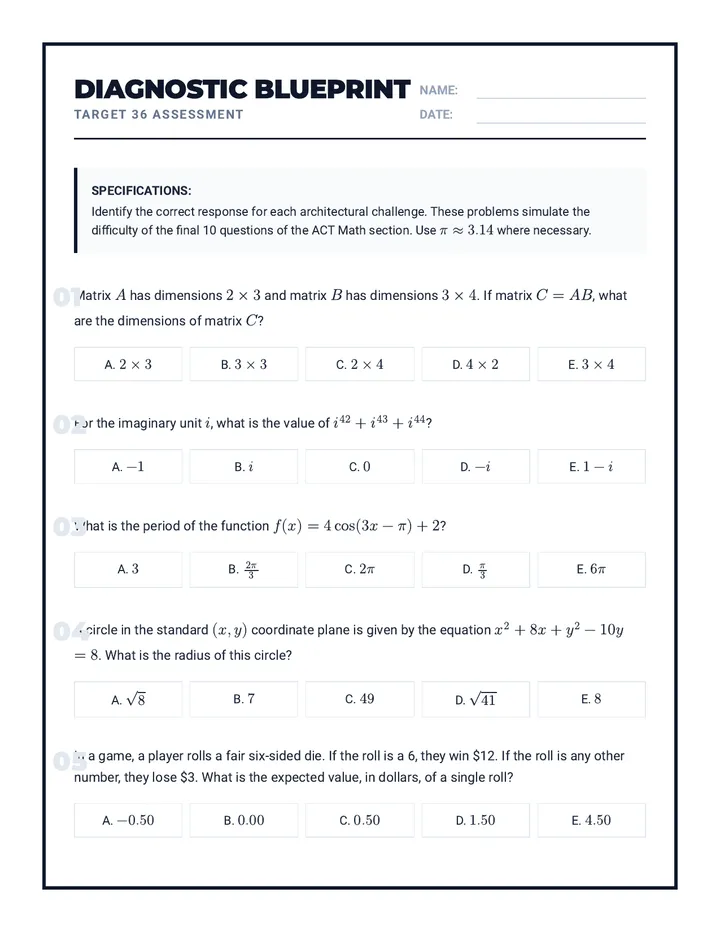
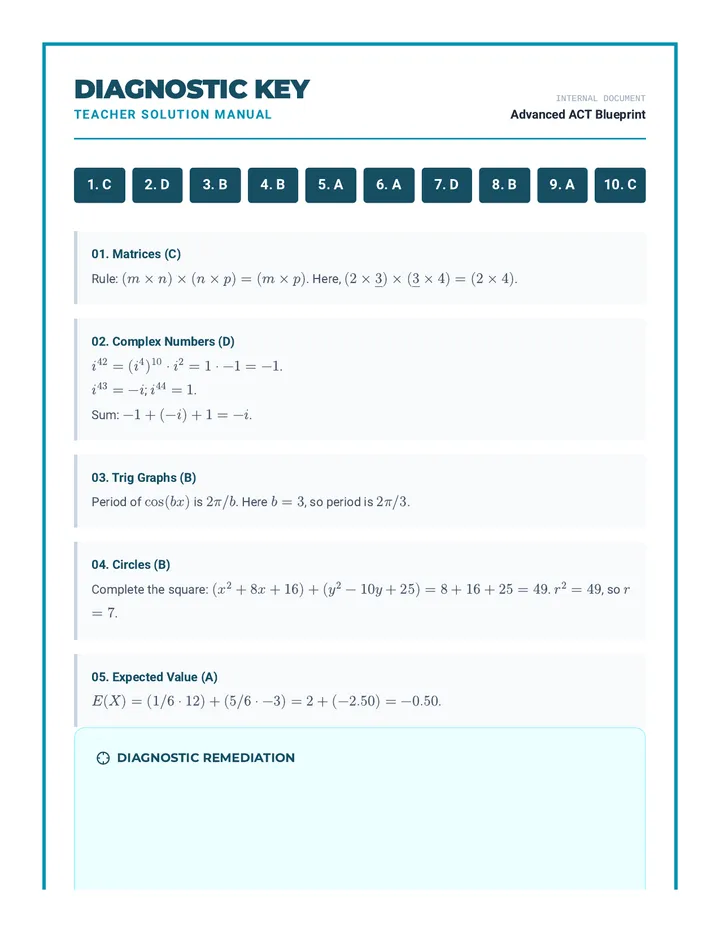
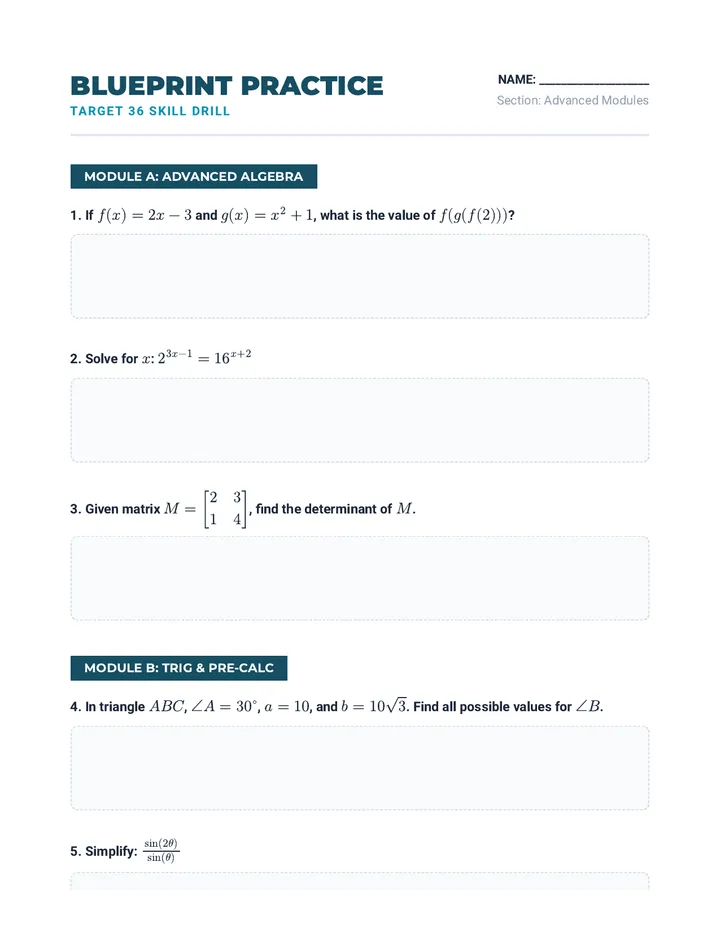
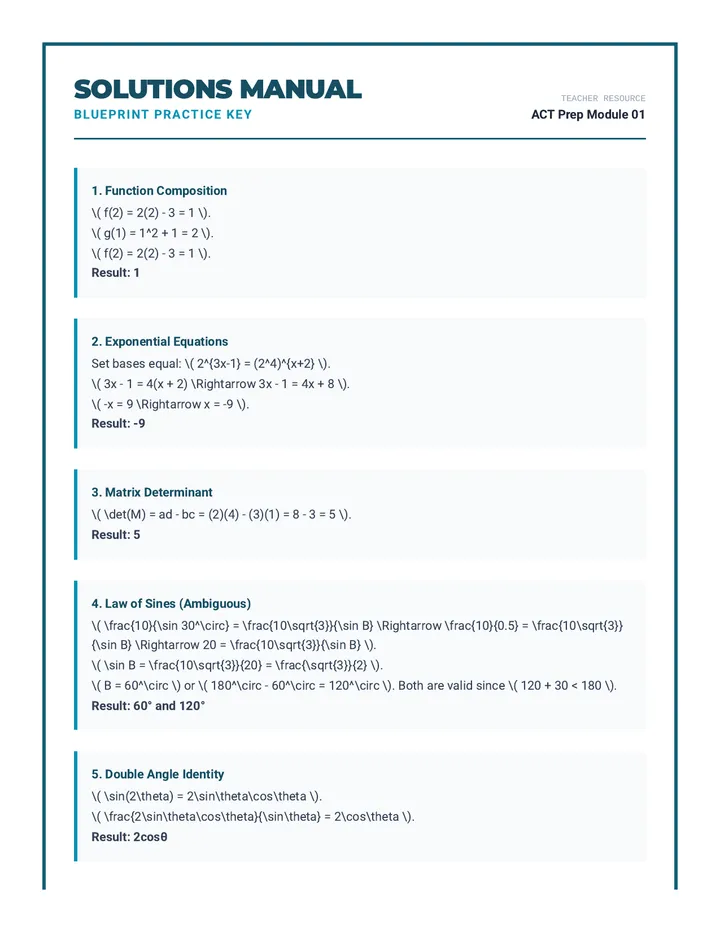
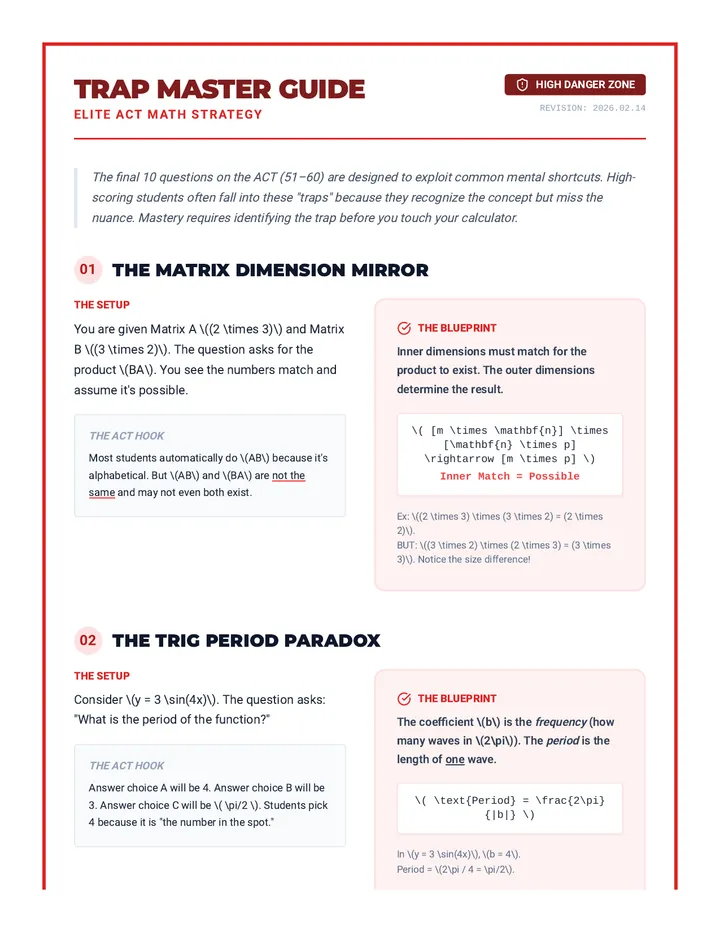
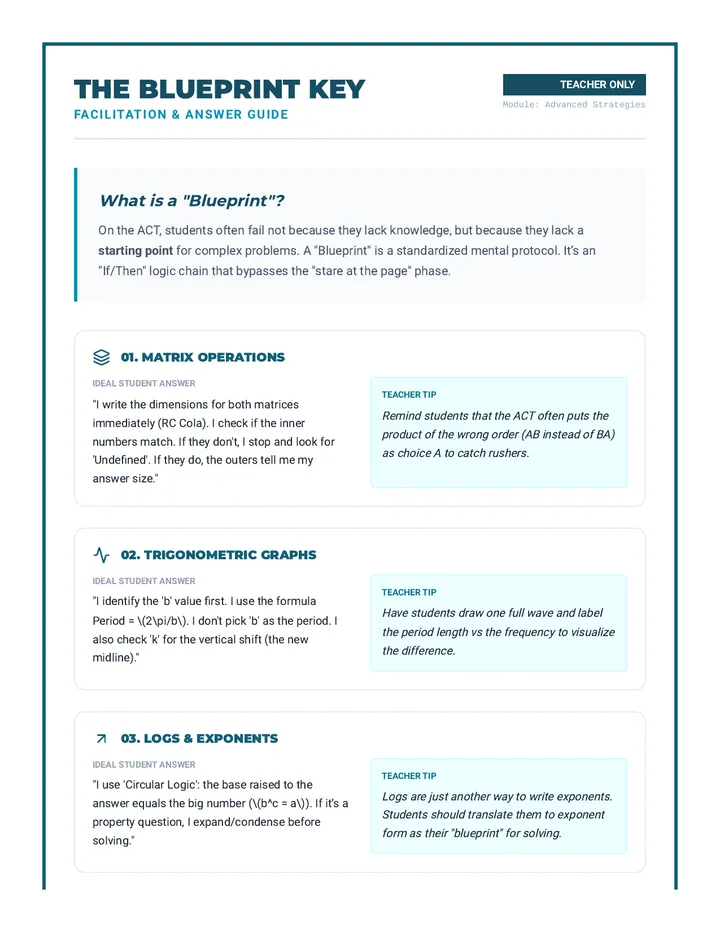
A comprehensive prep sequence for the most challenging questions on the ACT Math and Science sections. It focuses on high-level conceptual blueprints for math topics like complex numbers and matrices, alongside speed-reading and data-interpretation strategies for the Science section.
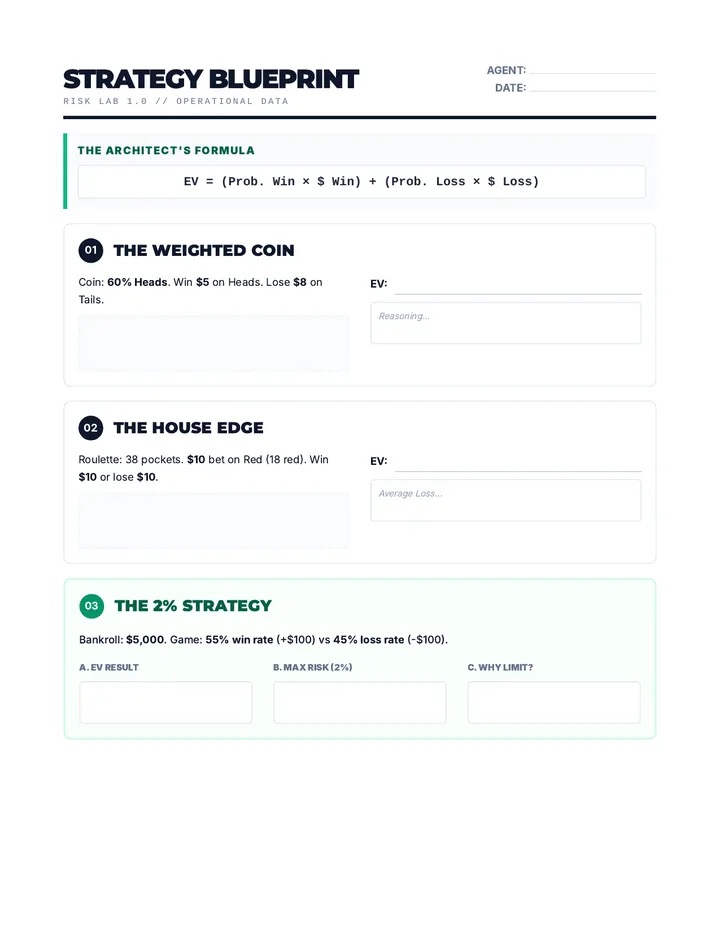
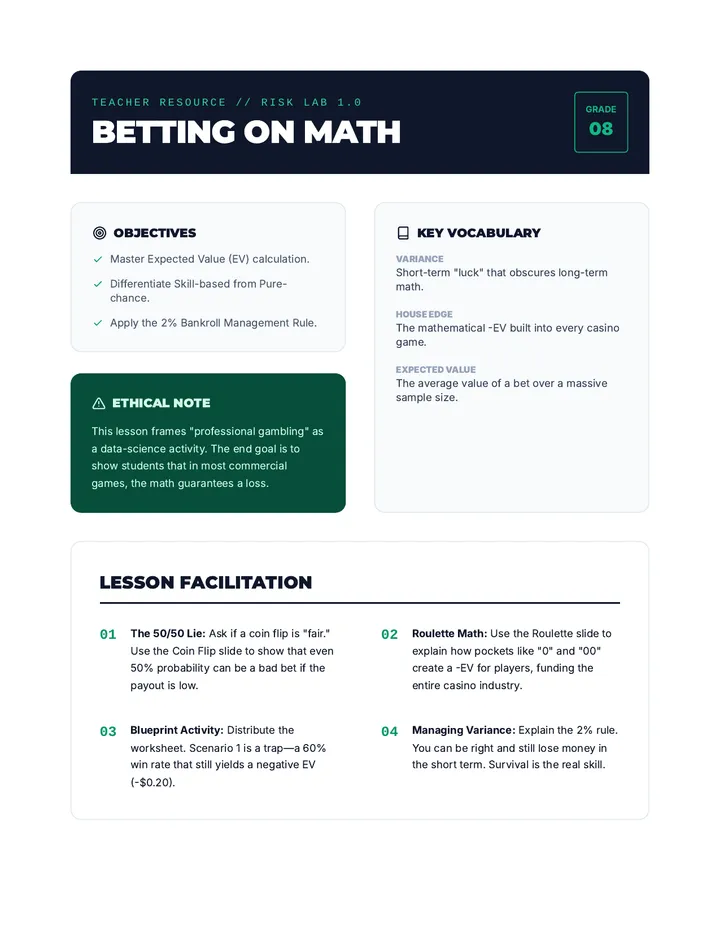
A high-stakes dive into the mathematics of probability, risk assessment, and expected value, teaching students how to analyze games of chance and skill through a professional lens.
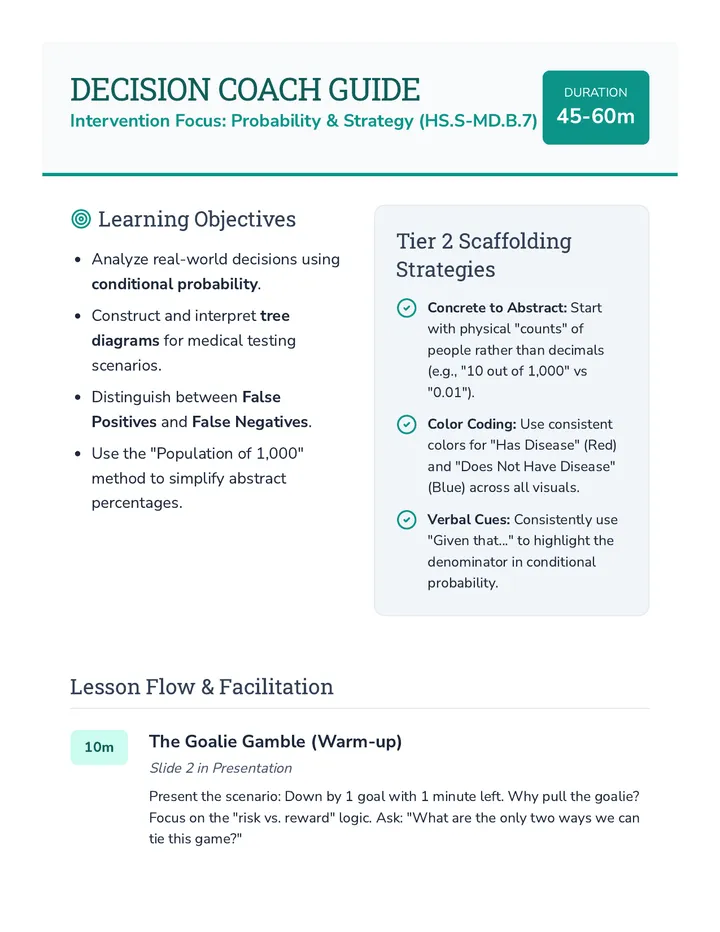
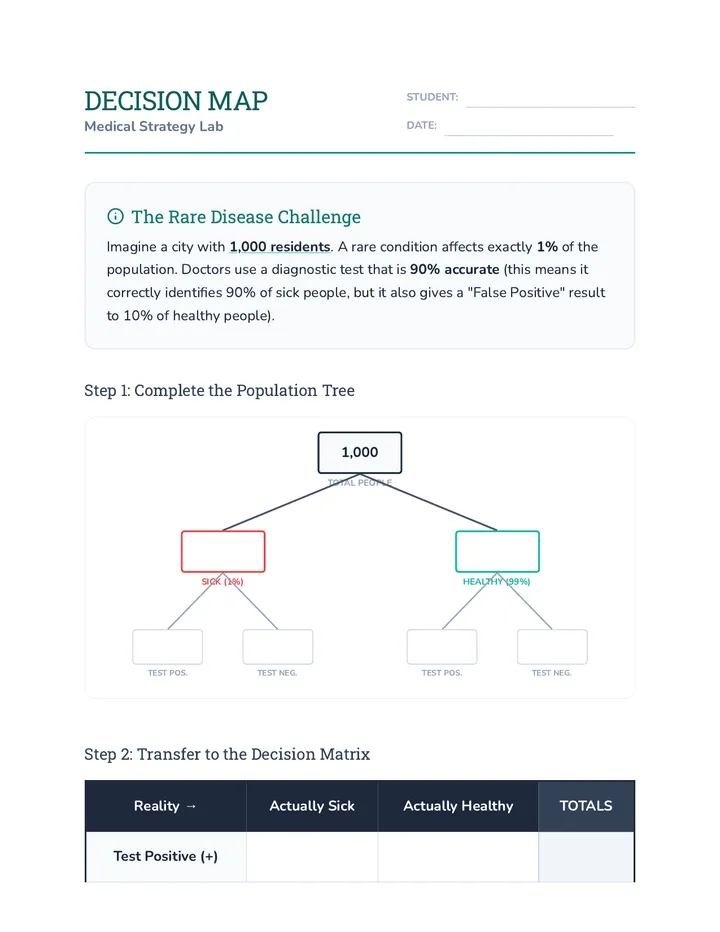
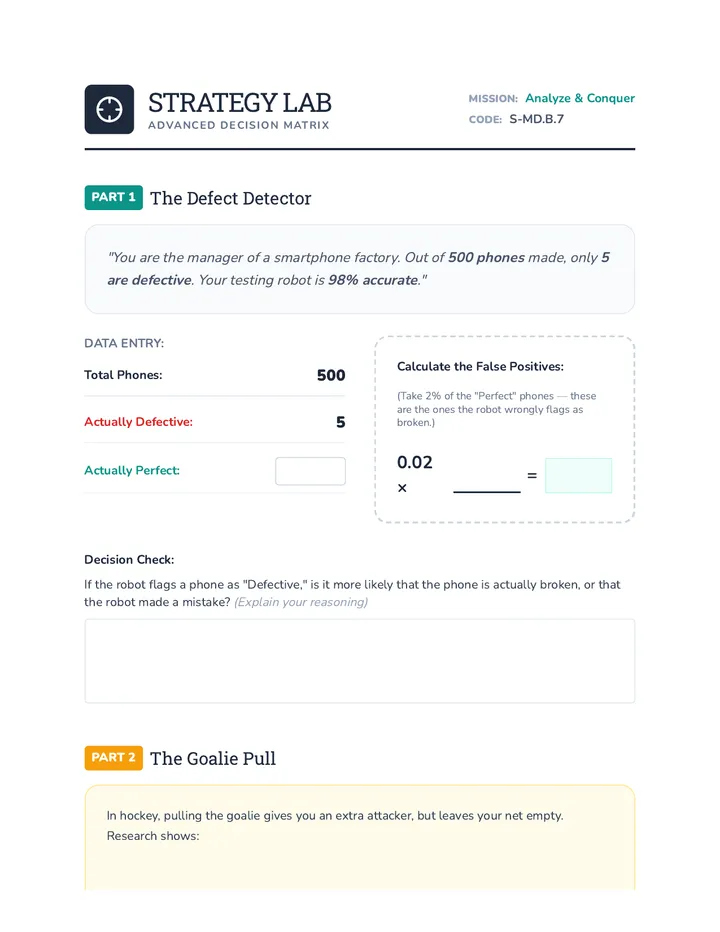
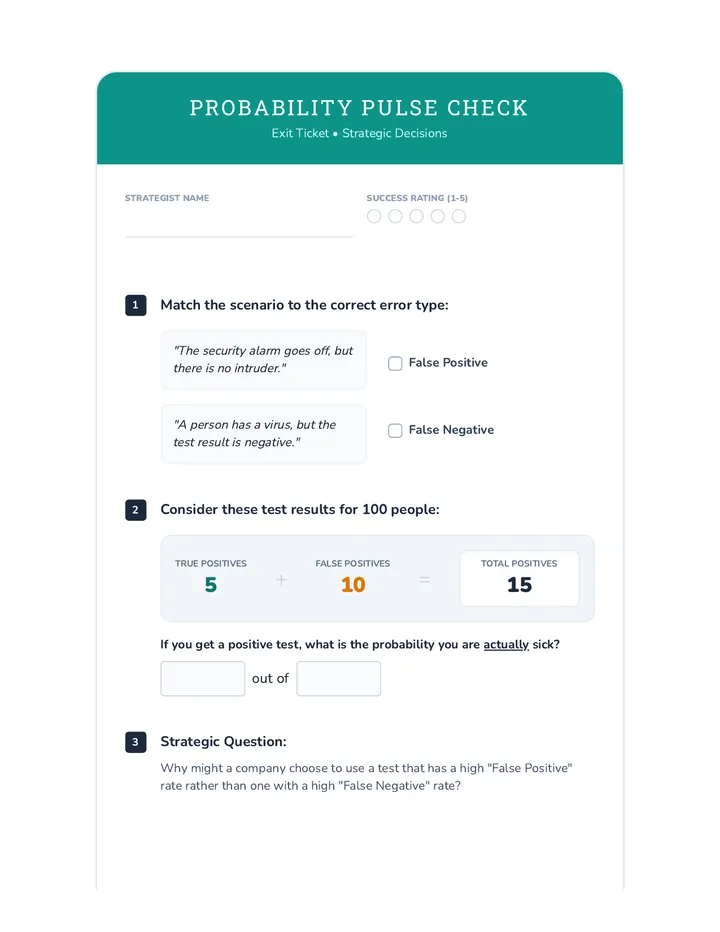
A Tier 2 intervention sequence focused on using probability to analyze decisions, specifically targeting medical testing (false positives/negatives) and game-time strategies. Students learn to use tree diagrams and contingency tables to navigate complex conditional probability scenarios.
A Tier 2 statistics intervention focusing on calculating and interpreting expected values in games of chance. Students transition from intuitive guesses to formal probability distributions and compare experimental data to theoretical outcomes.
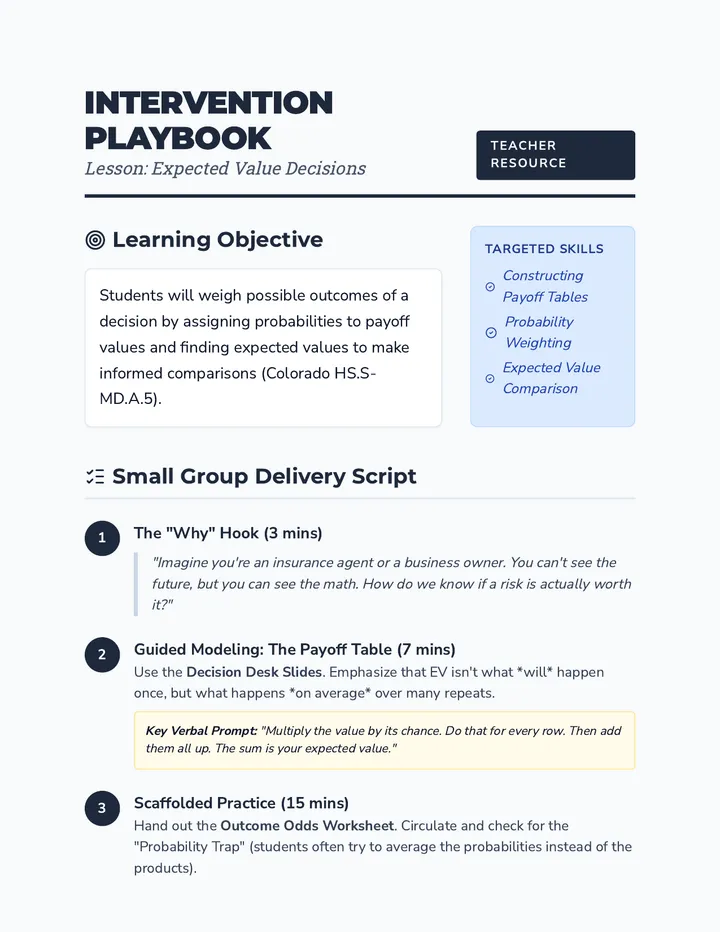
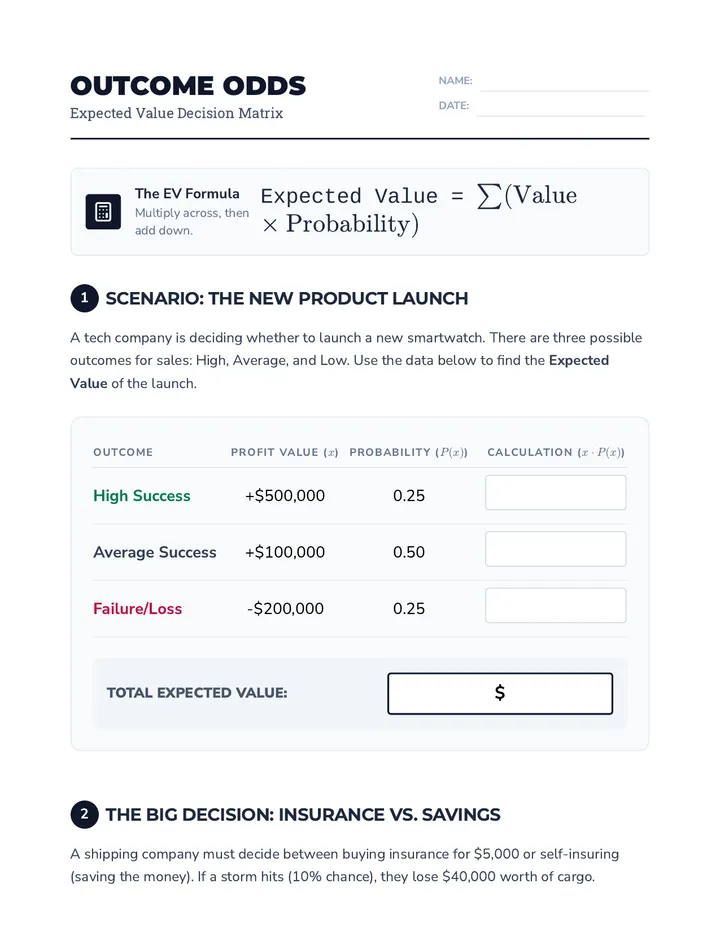
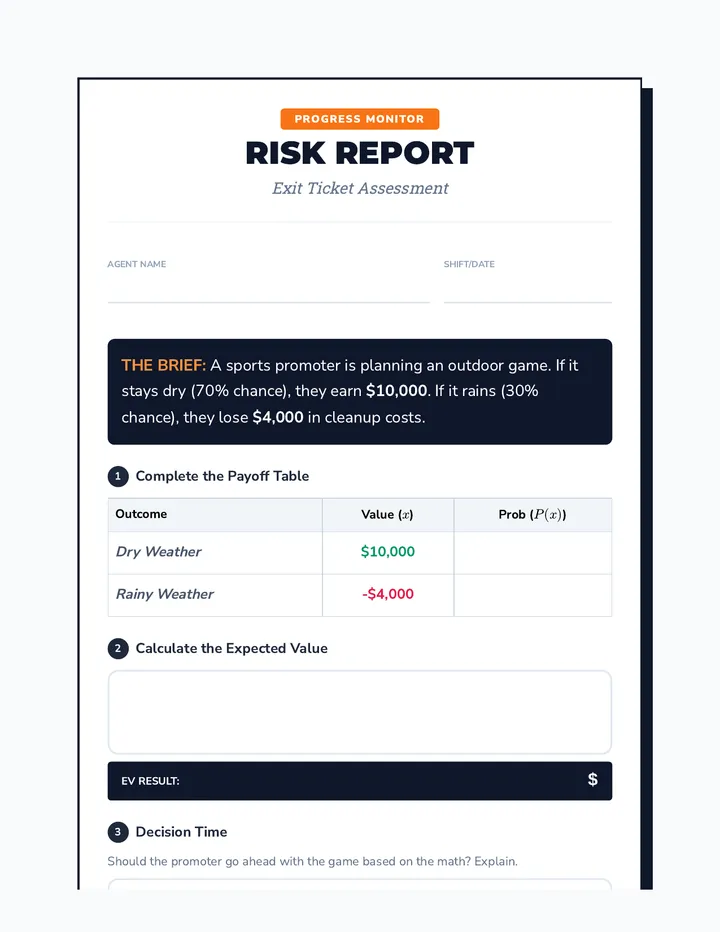
A high school statistics intervention sequence focused on decision-making through expected value calculations. Students learn to construct payoff tables, assign probabilities, and compare outcomes in real-world scenarios.
A Tier 2 intervention sequence focused on helping students develop empirical probability distributions and calculate expected values using real-world household data. This sequence provides high-scaffolding and structured practice for small group instruction.
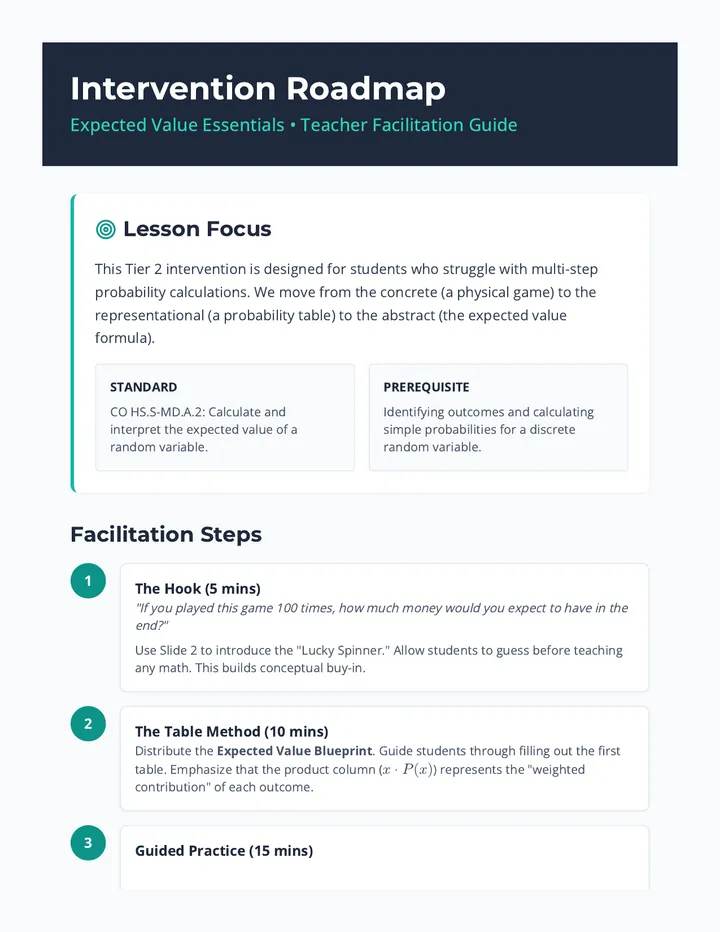
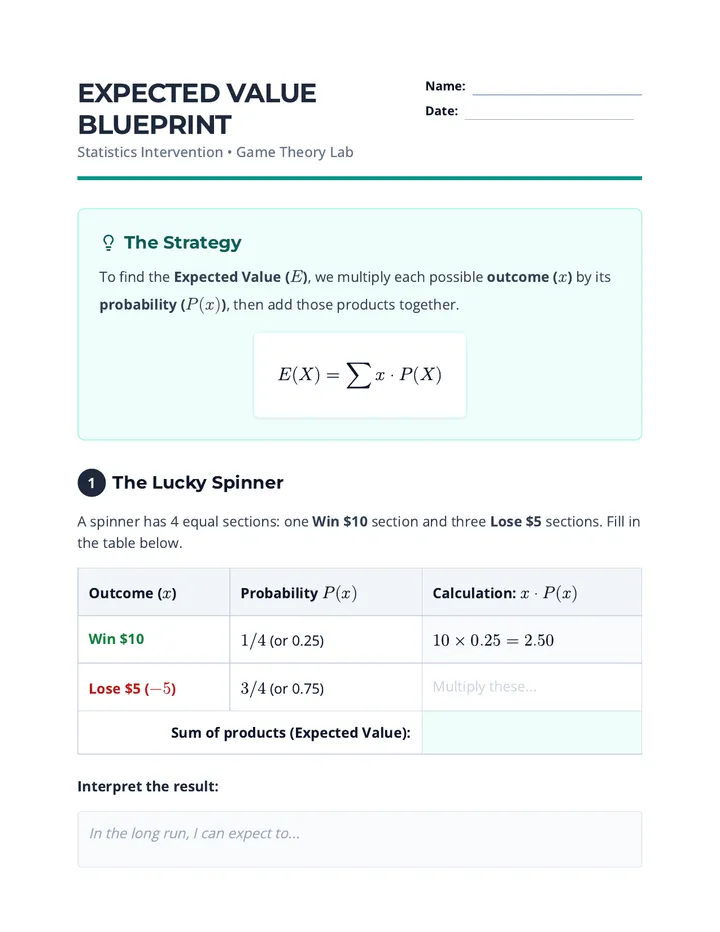
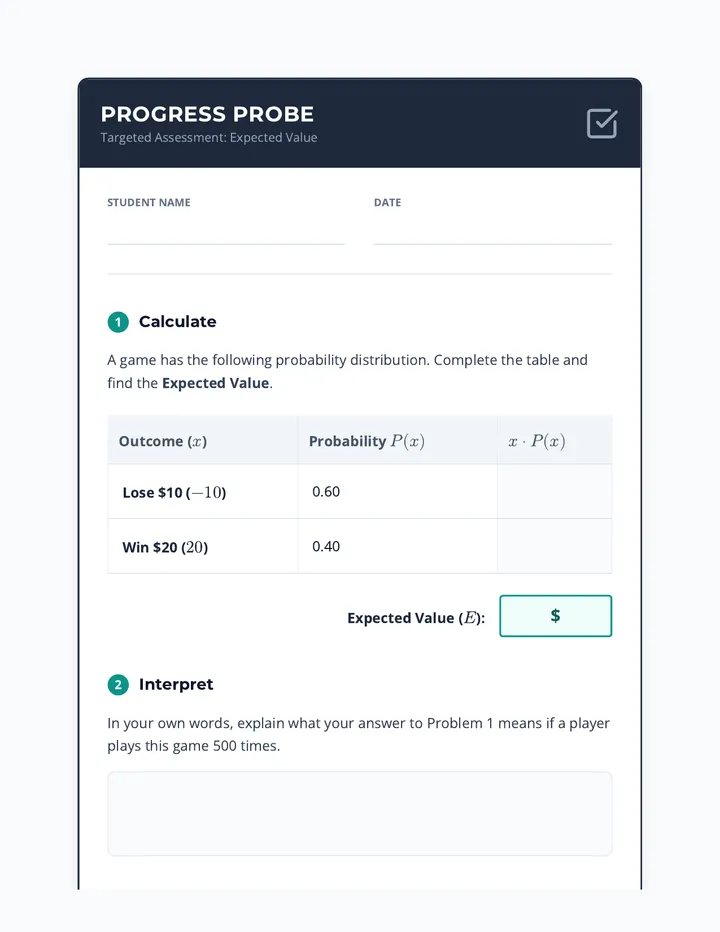
A targeted intervention sequence focused on helping High School students master the calculation and interpretation of expected value using concrete game scenarios and scaffolded table methods.
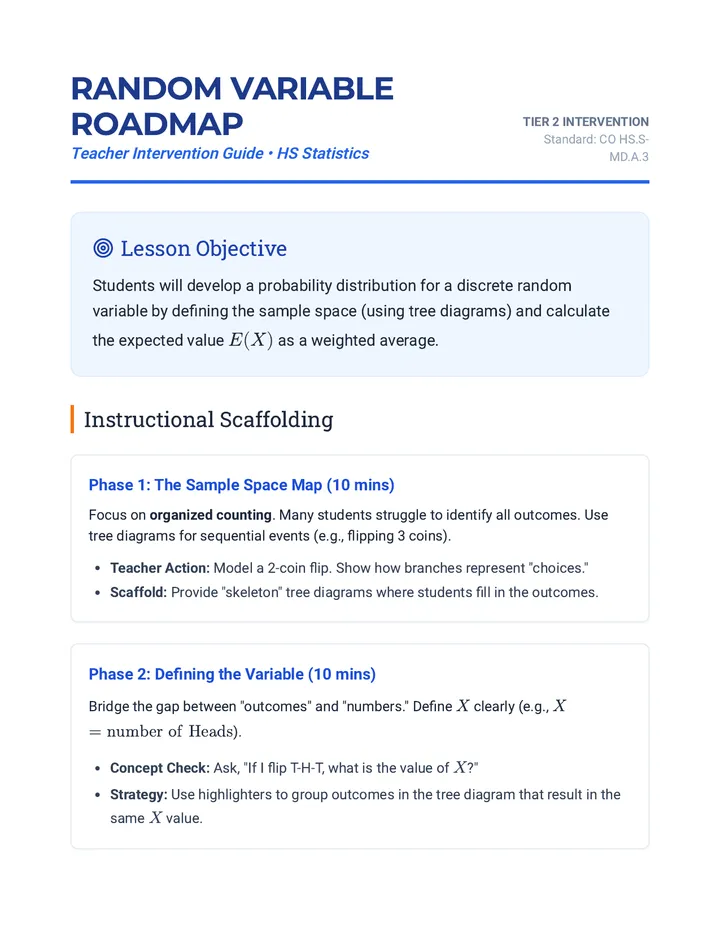
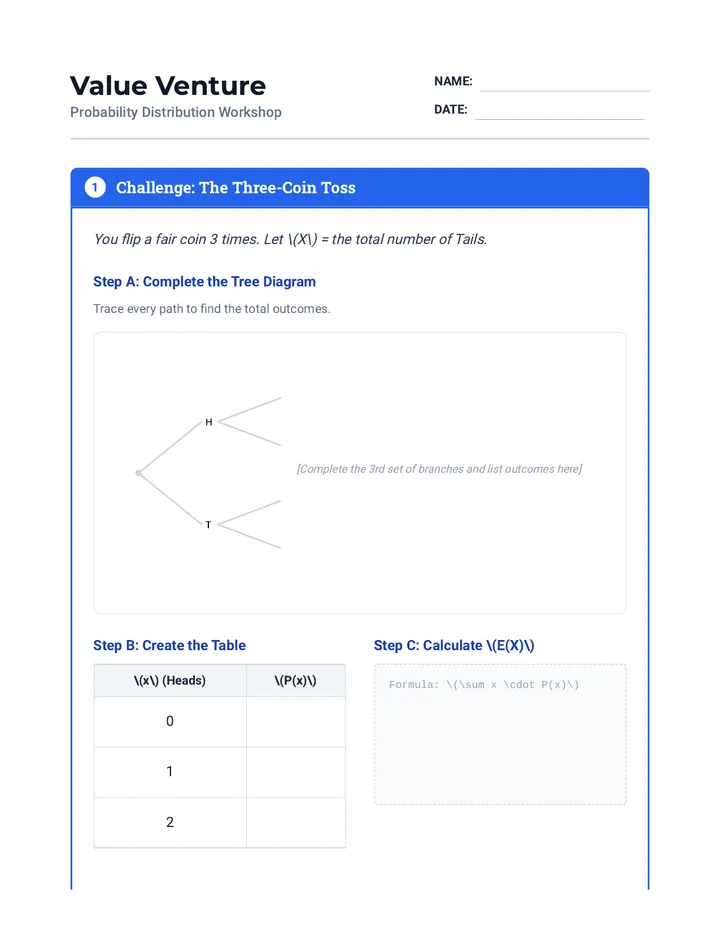
A targeted intervention sequence focused on foundational probability concepts, specifically developing discrete probability distributions and calculating expected values through visual scaffolds like tree diagrams and organized counting.
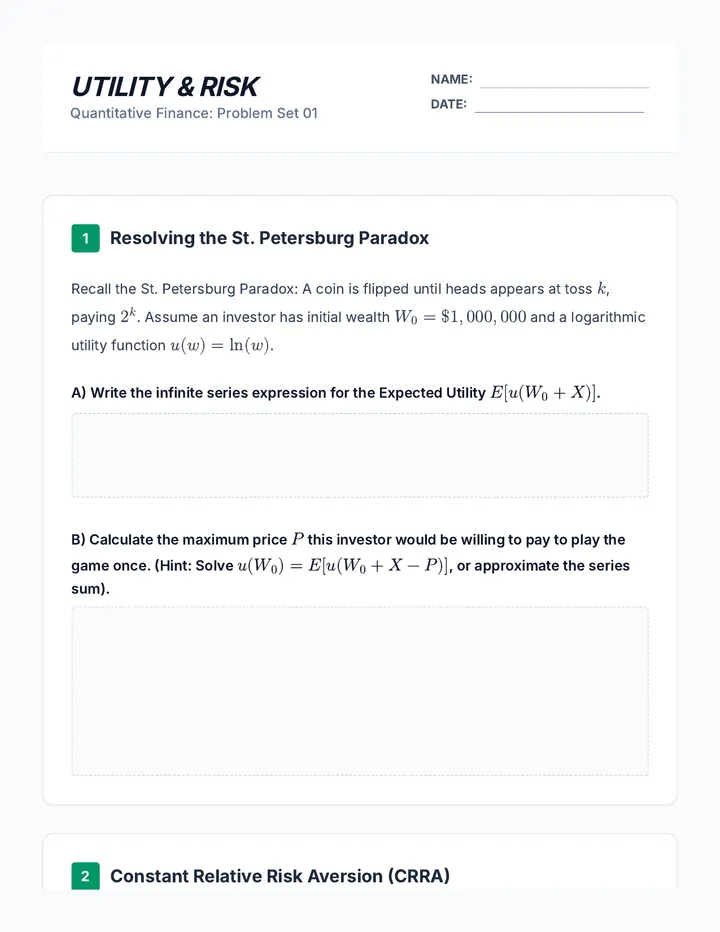
A graduate-level exploration of expected value applications in finance, covering utility theory, portfolio optimization, risk-neutral pricing, and tail risk metrics. Students transition from theoretical foundations to computational implementation using Monte Carlo methods.
A graduate-level exploration of expected value through the lens of measure theory, covering Lebesgue integration, fundamental inequalities, convergence theorems, and conditional expectation using Sigma-algebras.
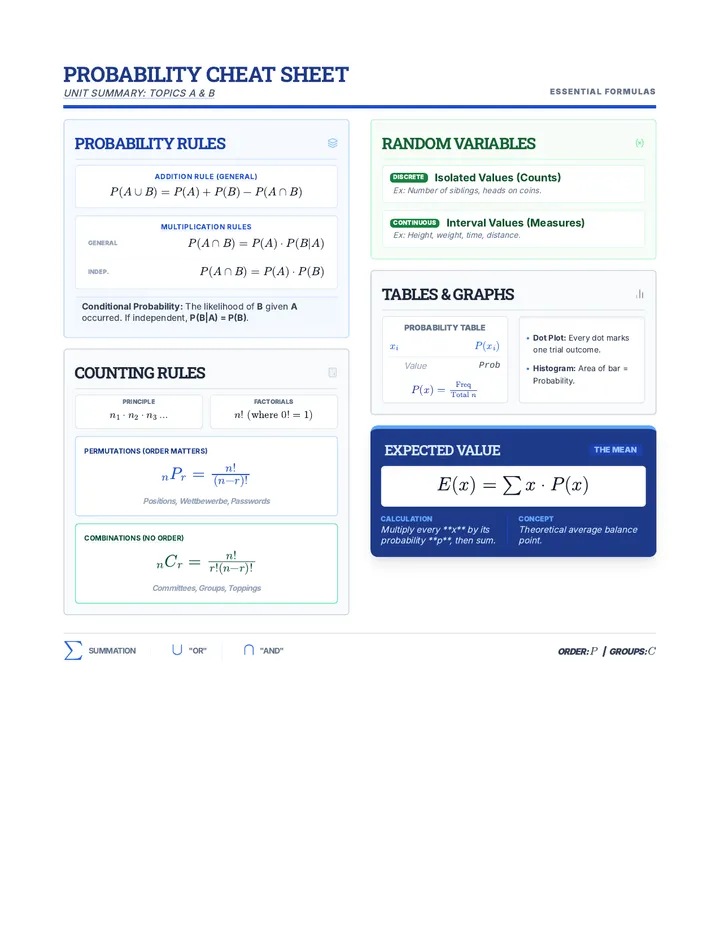
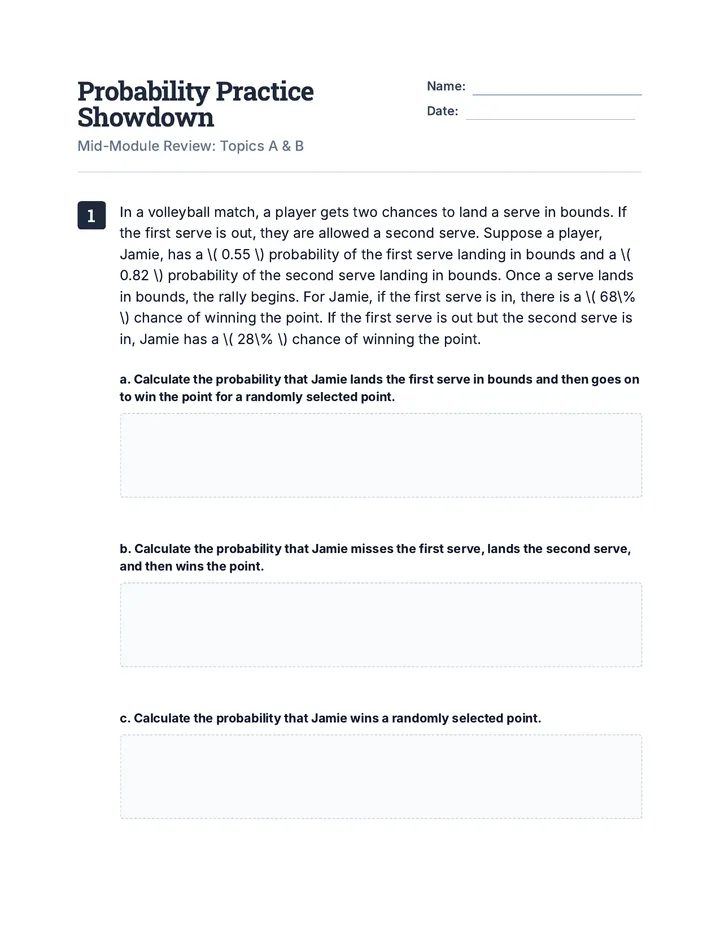
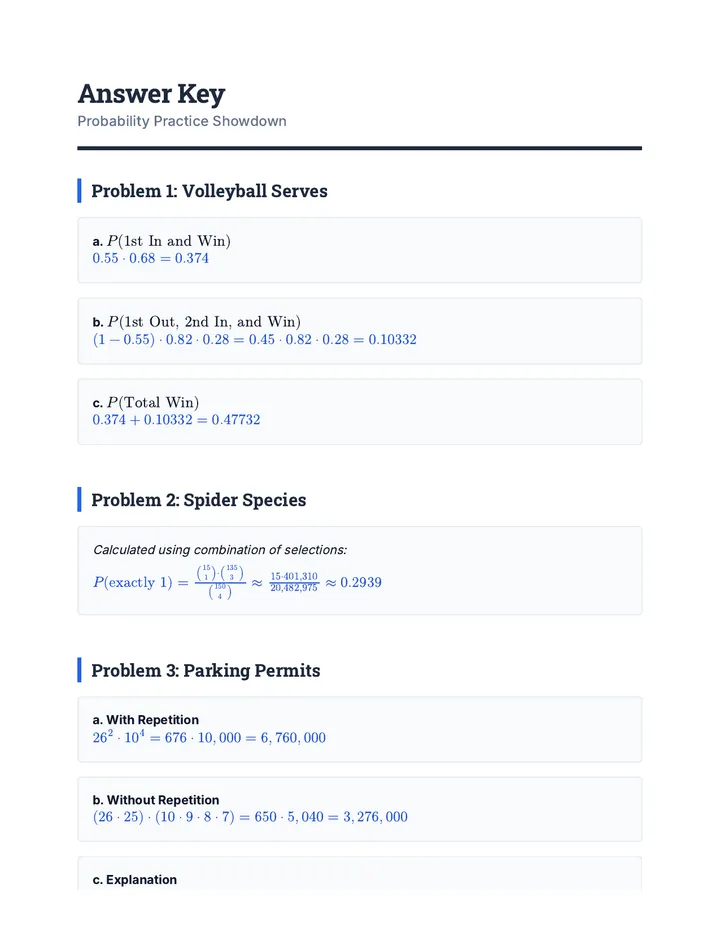
A comprehensive lesson covering probability rules, counting principles, discrete random variables, and empirical distributions. Includes a condensed reference sheet and a practice review worksheet.
An introduction to random variables, distinguishing between discrete and continuous types, graphing probability distributions, and calculating mean and standard deviation.
A lesson focused on calculating the mean, variance, and standard deviation of binomial probability distributions in real-world contexts.
A comprehensive 7th-grade math review focused on NYS common core standards, simulating a test environment with confidence-building exercises and error analysis.
Master planning resources, pacing guides, and curriculum frameworks for advanced high school mathematics courses.
A focused lesson on the binomial distribution, covering the BINS criteria, identifying parameters, and calculating probabilities using digital spreadsheet tools.
A comprehensive assessment covering discrete random variables, permutations, combinations, and the binomial probability distribution based on real-world statistical data.
A lesson focused on applying binomial distribution concepts to real-world scenarios through a creative coloring activity. Students translate narrative word problems into mathematical models to calculate probabilities, means, and variances.
An introductory exploration of random variables, probability distributions, and statistical measurements including mean, standard deviation, and linear transformations.
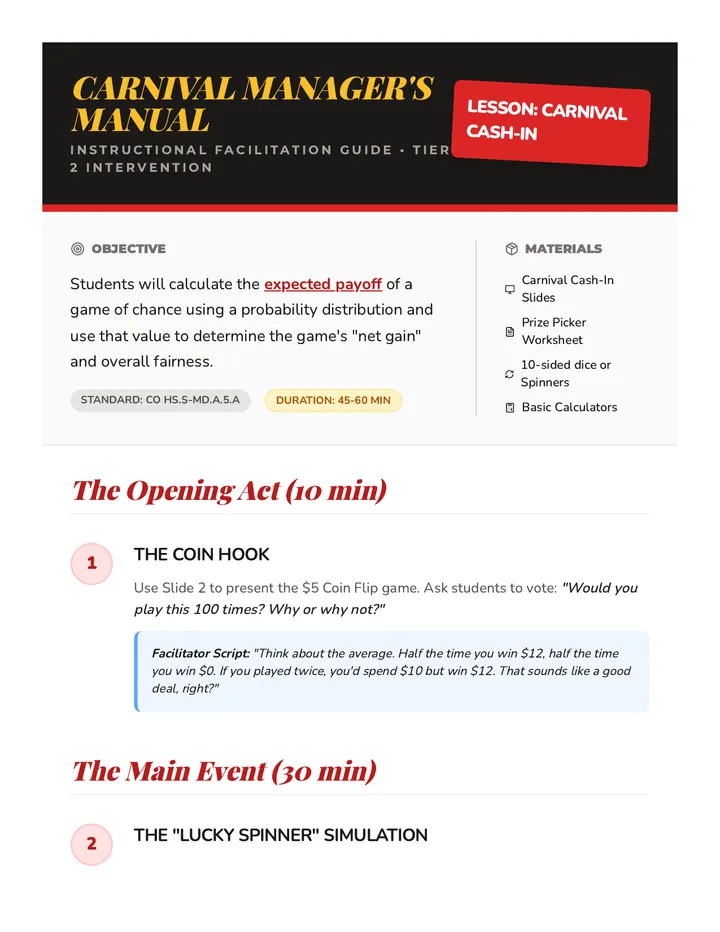
A Tier 2 intervention lesson focused on calculating expected payoffs for games of chance using a vintage carnival theme. Students use probability distributions to determine if carnival games are 'fair' through scaffolded, hands-on simulations.
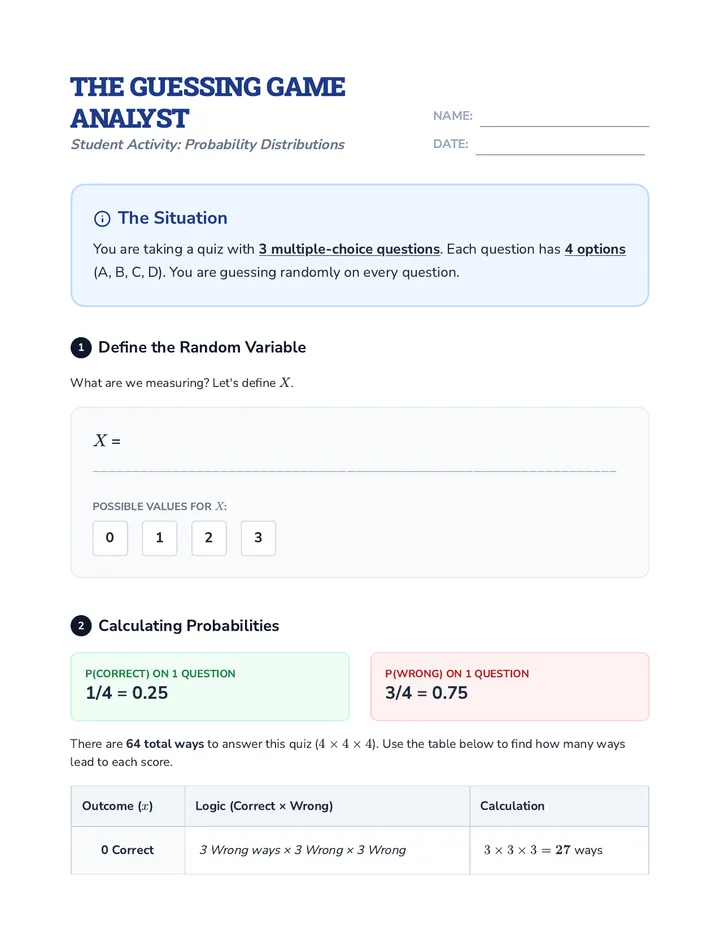
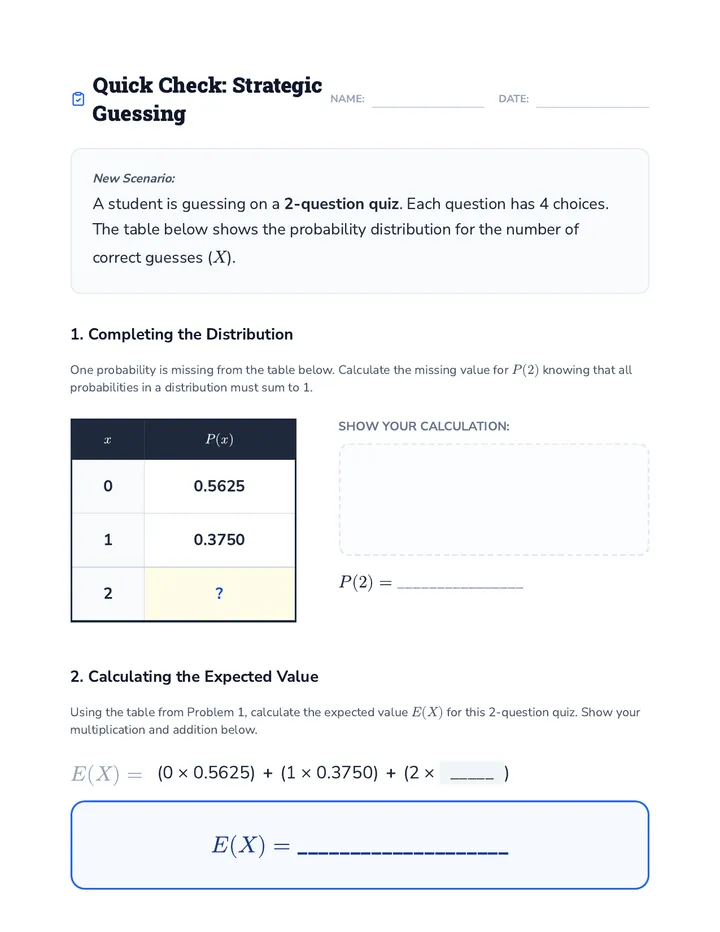
A Tier 2 intervention lesson focusing on creating probability distributions and calculating expected values through the lens of guessing on multiple-choice tests. Includes scaffolded instruction, visual models, and progress monitoring.
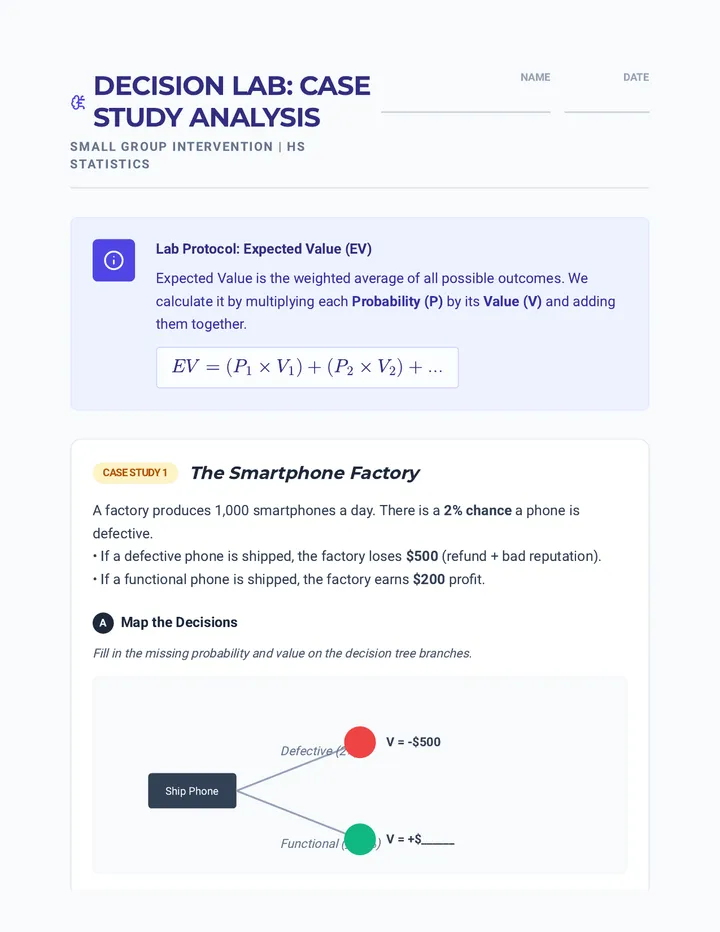
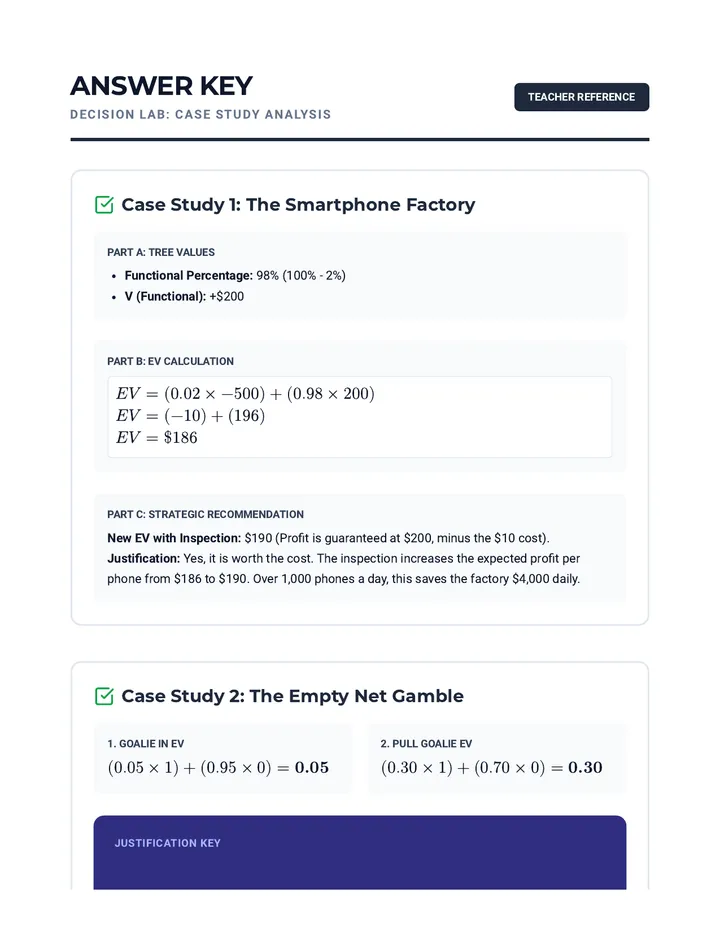
A Tier 2 intervention lesson focusing on using probability and expected value to analyze real-world decisions in medical testing, product quality, and sports strategy. Students use decision trees and justification templates to move from calculations to reasoned arguments.