Scale Factors & Proportions Ratio: \(k^2\)
\(\text{Linear Scale} = k \implies \text{Area Ratio} = k^2\)
TSIA2 Test Day Geometry Checklist
1. Check Dimensions Verify whether a given circle value is the radius or diameter before plugging into formulas.
2. Watch Boundaries For semicircles or track shapes, remember to add straight edges (\(+d\)) to curved arc lengths.
3. Check Units Look for mismatched units (\(\text{cm}\) to \(\text{m}^2\)). Remember to square conversion factors for 2D area.
4. SA vs Volume Capacity = Volume (\(V = lwh\)). Wrapping / outside coverage = Surface Area (\(2(lw + lh + wh)\)).
TSIA2 College Readiness Mathematics Review • Reference Sheet Printable 1-Page Formula Guide
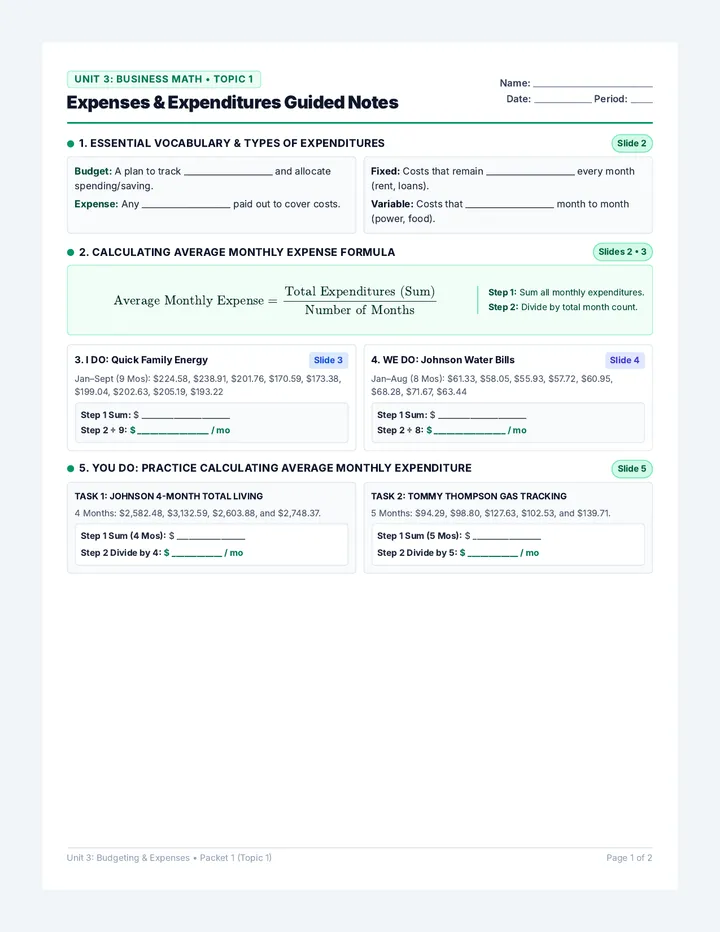
Prob 3.1 \(1 : 4\)
Circle 1: \(d = 8 \implies r_1 = 4 \implies A_1 = 16\pi\).
Circle 2: \(r_2 = 8 \implies A_2 = 64\pi\).
Ratio: \(\frac{16\pi}{64\pi} = \frac{1}{4} = 1:4\).
Trap: \(1:2\) is the linear radius ratio.
Prob 3.2 \(1 : 9\)
Circle X: \(r = 3 \implies A_X = 9\pi\).
Circle Y: \(r = 9 \implies A_Y = 81\pi\).
Ratio: \(\frac{9\pi}{81\pi} = \frac{1}{9} = 1:9\).
Trap: \(1:3\) forgot to square scale.
Prob 3.3 \(9 : 1\)
Linear scale: \(d_P = 3d_Q \implies r_P = 3r_Q\).
Area scale: Ratio is \((3)^2 : (1)^2 = 9 : 1\).
Order: P to Q \(\implies 9:1\).
Trap: \(3:1\) forgets quadratic scale.
Scoring Insight: For Types 1–3, test-takers who isolate the radius before computing area and square the unit conversion factors achieve over 85% accuracy on TSIA2 Quantitative Reasoning.
TSIA2 Mathematics Review • Answer Key Page 1 of 2
TSIA2 Mathematics • Complete Solution Manual
Instructor / Self-Check Types 4 – 6 Solutions
Type 4: Perimeter of Semicircles (Boundary Closure) Formula: \(P = \pi r + d\)
Prob 4.1 \(25.7\text{ in}\)
Radius: \(r = \frac{10}{2} = 5\text{ in}\).
Curved: \(\pi(5) \approx 15.71\text{ in}\).
Total: \(15.71 + 10 = 25.7\text{ in}\).
Trap: \(15.7\text{ in}\) forgot diameter base!
Prob 4.2 \(103\text{ m}\)
Curved: \(\pi(20) \approx 62.83\text{ m}\).
Diameter: \(d = 2(20) = 40\text{ m}\).
Total: \(62.83 + 40 \approx 103\text{ m}\).
Trap: \(63\text{ m}\) is only curved arc.
Prob 4.3 \(3\pi + 6\)
Radius: \(r = \frac{6}{2} = 3\text{ ft}\).
Curved: \(\pi(3) = 3\pi\text{ ft}\).
Total: \(3\pi + 6\text{ ft}\).
Trap: \(3\pi\) omits flat boundary edge.
Type 5: Rectangular Prisms (Surface Area vs. Volume) Formula: \(SA = 2(lw + lh + wh)\)
Prob 5.1 \(332\text{ sq cm}\)
Faces: \(40 + 90 + 36 = 166\).
Double: \(2(166) = 332\text{ cm}^2\).
Volume: \(10 \times 4 \times 9 = 360\text{ cm}^3\).
Trap: \(166\) forgot \(\times 2\); \(360\) is volume.
Prob 5.2 \(158\text{ sq in}\)
Faces: \(40 + 24 + 15 = 79\).
Double: \(2(79) = 158\text{ sq in}\).
Volume: \(8 \times 5 \times 3 = 120\text{ cu in}\).
Trap: \(79\) is sum of only 3 faces.
Prob 5.3 \(148\text{ sq cm}\)
Height: \(h = \frac{120}{6 \times 4} = 5\text{ cm}\).
Faces: \(24 + 30 + 20 = 74\).
Total SA: \(2(74) = 148\text{ sq cm}\).
Trap: \(74\) forgot to multiply by 2.
Type 6: Volume of Cylinders Formula: \(V = \pi r^2 h\)
Prob 6.1 \(54\pi\text{ cu cm}\)
Radius: \(r = 3\text{ cm}\), \(h = 6\text{ cm}\).
Formula: \(V = \pi(3^2)(6)\).
Result: \(\pi(9)(6) = 54\pi\text{ cu cm}\).
Trap: \(18\pi\) forgot to square \(r\) (\(3 \times 6\)).
Prob 6.2 \(300\pi\text{ cu in}\)
Radius: \(r = \frac{10}{2} = 5\text{ in}\).
Formula: \(V = \pi(5^2)(12)\).
Result: \(\pi(25)(12) = 300\pi\text{ cu in}\).
Trap: \(1,200\pi\) used diameter 10 as radius.
Prob 6.3 \(3\text{ m}\)
Setup: \(\pi r^2(8) = 72\pi\).
Divide by \(8\pi\): \(r^2 = 9\).
Solve: \(r = \sqrt{9} = 3\text{ m}\).
Trap: \(9\text{ m}\) forgot square root.
Performance Benchmark: Scoring 15+ out of 18 correct indicates College Readiness mastery on TSIA2 Geometric & Spatial Reasoning. Review the trap notes for any missed problems.
TSIA2 Mathematics Review • Answer Key Page 2 of 2
TSIA2 Mathematics Review • Circles Focus Page 1 of 2
TSIA2 Mathematics • Target Focus Assignment
Name:
Date:
Cylinder Reference Formulas (Keep All Measurements in Same Units) No Unit Conversion Needed
Cylinder Volume \(V = \pi r^2 h\)
Base Circular Area \(B = \pi r^2\)
Lateral Area \(LA = 2\pi rh\)
Total Surface Area \(SA = 2\pi r^2 + 2\pi rh\)
Question 1 • Worked Sample Solution Walkthrough Included
What is the volume of a cylinder with a radius \(r = 4\text{ cm}\) and a height \(h = 7\text{ cm}\)? (Leave \(\pi\) in your answer.)
(A) \(28\pi\text{ cu cm}\)
(B) \(56\pi\text{ cu cm}\)
(C) \(112\pi\text{ cu cm}\) ✓
(D) \(448\pi\text{ cu cm}\)
Step 1: Base area \(B = \pi r^2 = \pi(4^2) = 16\pi\text{ sq cm}\). Step 2: Volume \(V = 16\pi \times 7 = 112\pi\text{ cu cm}\). Correct is (C). Trap: \(28\pi\) forgot to square \(r\) (\(4 \times 7\)).
Question 2 Given Radius & Height
What is the volume of a cylinder with radius \(r = 3\text{ cm}\) and height \(h = 6\text{ cm}\)? (Leave \(\pi\) in your answer.)
\(108\pi\text{ cu cm}\)
\(54\pi\text{ cu cm}\)
\(36\pi\text{ cu cm}\)
\(18\pi\text{ cu cm}\)
Scratch Work:
Question 3 Diameter to Volume
A cylindrical canister has a diameter of \(12\text{ inches}\) and a height of \(5\text{ inches}\). What is the volume of the canister in cubic inches? (Leave \(\pi\) in your answer.)
\(60\pi\text{ cu in}\)
\(180\pi\text{ cu in}\)
\(360\pi\text{ cu in}\)
\(720\pi\text{ cu in}\)
Scratch Work:
Question 4 Finding Missing Radius
A water storage cylinder has a volume of \(96\pi\text{ cu ft}\) and a height of \(6\text{ ft}\). What is the radius of the circular base in feet?
\(4\text{ ft}\)
\(8\text{ ft}\)
\(16\text{ ft}\)
\(32\text{ ft}\)
Scratch Work:
Question 5 Total Surface Area
A solid cylinder has a base radius of \(5\text{ cm}\) and a height of \(8\text{ cm}\). What is the total outside surface area of the cylinder in square centimeters? (Leave \(\pi\) in your answer.)
\(80\pi\text{ sq cm}\)
\(105\pi\text{ sq cm}\)
\(130\pi\text{ sq cm}\)
\(200\pi\text{ sq cm}\)
Scratch Work:
TSIA2 Mathematics Review • Cylinders Focus Page 2 of 2
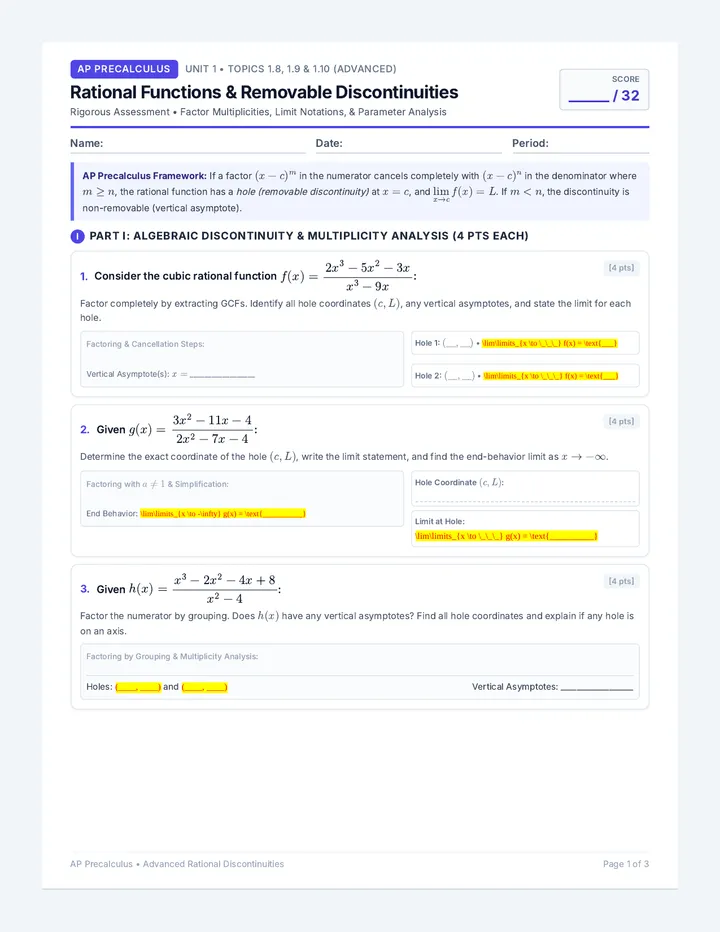
Area (2D) \(A = l \cdot w \iff l = \frac{A}{w}\)
Diagonal (Pythagorean) \(d = \sqrt{l^2 + w^2}\)
Question 1 • Worked Sample Solution Walkthrough Included
A rectangle has a length of \(14\text{ cm}\) and a width of \(8\text{ cm}\). What is the area of the rectangle in square centimeters?
(A) \(44\text{ sq cm}\)
(B) \(56\text{ sq cm}\)
(C) \(112\text{ sq cm}\) ✓
(D) \(224\text{ sq cm}\)
Area: \(A = l \times w = 14 \times 8 = 112\text{ sq cm}\). Correct is (C). Perimeter: \(2(14 + 8) = 44\text{ cm}\). Trap: \(44\) is perimeter, not area!
Question 2 Finding Perimeter from Area
A rectangular room has an area of \(96\text{ sq ft}\) and a width of \(8\text{ ft}\). What is the perimeter of this room in feet?
\(20\text{ ft}\)
\(32\text{ ft}\)
\(40\text{ ft}\)
\(48\text{ ft}\)
Scratch Work:
Question 3 Algebraic Dimensions
The length of a rectangle is \(5\text{ cm}\) greater than its width. If the perimeter is \(38\text{ cm}\), what is the area in square centimeters?
\(60\text{ sq cm}\)
\(70\text{ sq cm}\)
\(84\text{ sq cm}\)
\(105\text{ sq cm}\)
Scratch Work:
Question 4 Dimension Scaling Effect
A rectangular garden has dimensions \(16\text{ ft}\) by \(10\text{ ft}\). If the length is doubled and the width is halved, how does the new area compare to the original?
Halved (\(\frac{1}{2}\times\))
Doubled (\(2\times\))
Stays the same
Quadrupled (\(4\times\))
Scratch Work:
Question 5 Diagonal of a Rectangle
A rectangular display screen has a length of \(9\text{ inches}\) and a width of \(12\text{ inches}\). What is the diagonal distance across the screen in inches?
\(14\text{ in}\)
\(15\text{ in}\)
\(18\text{ in}\)
\(21\text{ in}\)
Scratch Work:
TSIA2 Mathematics Review • Rectangle Mastery Page 2 of 3
TSIA2 Mathematics • Target Focus Assignment
Name:
Date:
Cube Reference Formulas (Edge: \(s\), 6 Square Faces) No Unit Conversion Needed
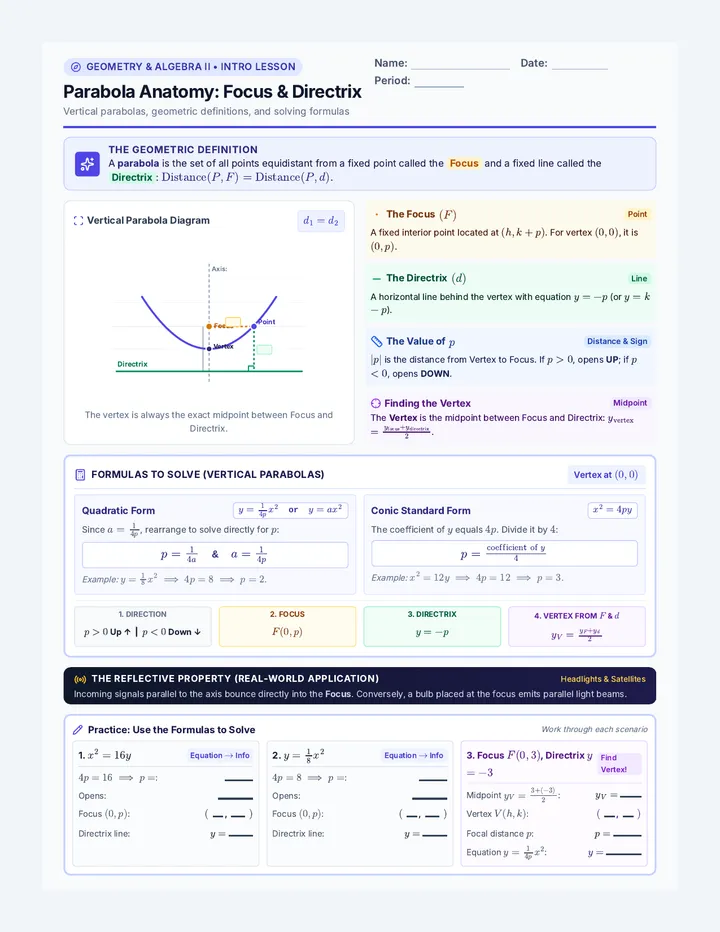
Volume (3D) \(V = s^3\)
Total Surface Area \(SA = 6s^2\)
One Face Area \(A_{\text{face}} = s^2\)
Edge from Volume \(s = \sqrt[3]{V}\)
Question 1 • Worked Sample Solution Walkthrough Included
A solid wooden cube has an edge length of \(5\text{ cm}\). What is the total outside surface area of the cube in square centimeters?
(A) \(25\text{ sq cm}\)
(B) \(125\text{ sq cm}\)
(C) \(150\text{ sq cm}\) ✓
(D) \(300\text{ sq cm}\)
Face Area: \(s^2 = 5^2 = 25\text{ sq cm}\). Total SA: \(6 \times 25 = 150\text{ sq cm}\). Correct is (C). Trap: \(125\) is the Volume (\(5^3\)), not Surface Area!
Question 2 Surface Area to Volume
A cube has a total surface area of \(96\text{ sq in}\). What is the total volume of this cube in cubic inches?
\(16\text{ cu in}\)
\(32\text{ cu in}\)
\(64\text{ cu in}\)
\(128\text{ cu in}\)
Scratch Work:
Question 3 Volume to Surface Area
What is the total surface area of a cube whose internal volume is \(216\text{ cu cm}\)?
\(108\text{ sq cm}\)
\(144\text{ sq cm}\)
\(216\text{ sq cm}\)
\(256\text{ sq cm}\)
Scratch Work:
Question 4 Volume Scaling Law
If the edge length of a cube is doubled from \(3\text{ ft}\) to \(6\text{ ft}\), by what factor does its volume increase?
\(2\times\)
\(4\times\)
\(6\times\)
\(8\times\)
Scratch Work:
Question 5 Single Face Area
A cube-shaped packing crate has a total volume of \(343\text{ cu ft}\). What is the area of just one of its square faces in square feet?
\(28\text{ sq ft}\)
\(49\text{ sq ft}\)
\(98\text{ sq ft}\)
\(294\text{ sq ft}\)
Scratch Work:
TSIA2 Mathematics Review • Cube Mastery Page 3 of 3
Step 1 (Find Radius): \(\pi r^2 = 100\pi \implies r^2 = 100 \implies r = 10\text{ ft}\).
Step 2 (Circumference): \(C = 2\pi r = 2\pi(10) = 20\pi\text{ ft}\).
Trap Alert: \(10\pi\) forgot factor of \(2\); \(50\pi\) halved area.
TSIA2 Mathematics Review • Circle Assignment Solutions Page 1 of 2
TSIA2 Mathematics • Target Focus Solution Manual
Answer Key Part 2: Cylinders
Volume: \(V = \pi r^2 h\) Base Area: \(B = \pi r^2\) Lateral Area: \(LA = 2\pi rh\) Total Surface Area: \(SA = 2\pi r^2 + 2\pi rh\)
Question 1 (Worked Sample) (C) \(112\pi\text{ cu cm}\)
• Given: Radius \(r = 4\text{ cm}\), height \(h = 7\text{ cm}\).
• Base Area: \(B = \pi(4^2) = 16\pi\text{ sq cm}\).
• Volume: \(V = 16\pi \times 7 = 112\pi\text{ cu cm}\).
Trap: \(28\pi\) forgot to square the radius (\(4 \times 7\)).
Question 2 (Radius & Height) (B) \(54\pi\text{ cu cm}\)
• Given: Radius \(r = 3\text{ cm}\), height \(h = 6\text{ cm}\).
• Volume Formula: \(V = \pi r^2 h = \pi(3^2)(6)\).
• Calculation: \(\pi(9)(6) = 54\pi\text{ cu cm}\).
Trap: \(18\pi\) forgot \(r^2\); \(36\pi\) is circumference \(\times\) height.
Question 3 (Diameter Given) (B) \(180\pi\text{ cu in}\)
• Find Radius: \(r = \frac{d}{2} = \frac{12}{2} = 6\text{ in}\).
• Base Area: \(\pi(6^2) = 36\pi\text{ sq in}\).
• Volume: \(36\pi \times 5 = 180\pi\text{ cu in}\).
Trap: \(720\pi\) used diameter 12 as radius (\(\pi \cdot 144 \cdot 5\)).
Question 4 (Missing Radius) (A) \(4\text{ ft}\)
• Equation: \(\pi r^2 h = 96\pi \implies \pi r^2(6) = 96\pi\).
• Divide by \(6\pi\): \(r^2 = 16\).
• Take root: \(r = \sqrt{16} = 4\text{ ft}\).
Trap: \(16\text{ ft}\) forgot to take the square root of \(r^2\).
Question 5 (Total Surface Area) (C) \(130\pi\text{ sq cm}\)
2 Circular Bases: \(2 \times (\pi \cdot 5^2) = 2(25\pi) = 50\pi\text{ sq cm}\).
Lateral Curved Wall: \(2\pi r h = 2\pi(5)(8) = 80\pi\text{ sq cm}\).
Total Surface Area: \(50\pi + 80\pi = 130\pi\text{ sq cm}\). Trap: \(80\pi\) is lateral only.
TSIA2 Round Solids Mastery Checklist
Full accuracy on circles and cylinders requires two automatic reflexes: (1) Always check if diameter or radius is provided, and (2) Never add lengths to areas—remember that perimeters are 1D, surface areas are 2D, and volumes are 3D.
TSIA2 Mathematics Review • Cylinder Assignment Solutions Page 2 of 2
Question 1 (Worked Sample) (C) \(112\text{ sq cm}\)
Area: \(A = l \times w = 14 \times 8 = 112\text{ sq cm}\).
Perimeter: \(2(14 + 8) = 2(22) = 44\text{ cm}\).
Trap Alert: \(44\) is the perimeter, not area!
Question 2 (Perimeter from Area) (C) \(40\text{ ft}\)
• Find Length: \(l = \frac{A}{w} = \frac{96}{8} = 12\text{ ft}\).
• Perimeter: \(2(l + w) = 2(12 + 8) = 2(20) = 40\text{ ft}\).
Trap: \(20\text{ ft}\) is semi-perimeter (\(l + w\)).
Question 3 (Algebraic Dimensions) (C) \(84\text{ sq cm}\)
• Setup: \(2(w + 5) + 2w = 38 \implies 4w + 10 = 38\).
• Solve: \(4w = 28 \implies w = 7\text{ cm}, l = 12\text{ cm}\).
• Area: \(A = 12 \times 7 = 84\text{ sq cm}\).
Trap: \(70\) uses \(7 \times 10\).
Question 4 (Dimension Scaling) (C) Stays the same
• Original Area: \(16 \times 10 = 160\text{ sq ft}\).
• New Dimensions: \(l = 32\text{ ft}\), \(w = 5\text{ ft}\).
• New Area: \(32 \times 5 = 160\text{ sq ft}\) (unchanged).
Rule: Multiplying by 2 and \(\frac{1}{2}\) cancels out: \(2 \times \frac{1}{2} = 1\).
Question 5 (Diagonal) (B) \(15\text{ in}\)
• Pythagorean: \(d = \sqrt{l^2 + w^2} = \sqrt{9^2 + 12^2}\).
• Calculate: \(\sqrt{81 + 144} = \sqrt{225} = 15\text{ inches}\).
Shortcut: 3-4-5 right triangle scaled by 3 (\(9-12-15\)).
Rectangle Mastery Summary
Remember that opposite sides are equal. The perimeter is \(2(l + w)\), not \(l + w\). For diagonals, always look for Pythagorean triples like \(3-4-5\) and \(5-12-13\).
TSIA2 Mathematics Review • Rectangle Solutions Page 2 of 3
TSIA2 Mathematics • Target Focus Solution Manual
Answer Key Part 3: Cubes
Volume: \(V = s^3 \iff s = \sqrt[3]{V}\) Total Surface Area: \(SA = 6s^2\) Face Area: \(A_{\text{face}} = s^2\)
Question 1 (Worked Sample) (C) \(150\text{ sq cm}\)
One Face: \(s^2 = 5^2 = 25\text{ sq cm}\).
Total SA: \(6 \times 25 = 150\text{ sq cm}\).
Trap Alert: \(125\) is the Volume (\(5^3\)), not Surface Area!
Question 2 (SA to Volume) (C) \(64\text{ cu in}\)
• Find Edge: \(6s^2 = 96 \implies s^2 = 16 \implies s = 4\text{ in}\).
• Calculate Volume: \(V = s^3 = 4^3 = 64\text{ cu in}\).
Trap: \(16\) is only the area of one face (\(s^2\)).
Question 3 (Volume to SA) (C) \(216\text{ sq cm}\)
• Find Edge: \(s = \sqrt[3]{216} = 6\text{ cm}\).
• Calculate SA: \(6(s^2) = 6(6^2) = 6(36) = 216\text{ sq cm}\).
Note: A cube with \(s = 6\) has numerically identical \(V\) and \(SA\)!
Question 4 (Volume Scaling) (D) \(8\times\)
• Linear scale factor: \(k = \frac{6}{3} = 2\).
• Volume scale factor: \(k^3 = 2^3 = 8\).
Trap: \(2\times\) is linear; \(4\times\) is surface area scaling (\(k^2\)).
Question 5 (Single Face Area) (B) \(49\text{ sq ft}\)
• Find Edge: \(s = \sqrt[3]{343} = 7\text{ ft}\).
• One Face Area: \(A_{\text{face}} = s^2 = 7^2 = 49\text{ sq ft}\).
Trap: \(294\text{ sq ft}\) is total surface area (\(6 \times 49\)).
Cube Mastery Summary
Always check whether a problem asks for the area of one face (\(s^2\)), the total surface area (\(6s^2\)), or the interior volume (\(s^3\)).
TSIA2 Mathematics Review • Cube Solutions Page 3 of 3