Lenny.com
Explore
Create
ActivitiesNewMathEnglish Language ArtsScience & EngineeringSocial StudiesGlobal LanguagesHealth & Physical EducationSpecial EducationCounseling & Life SkillsArts & CreativityESL
Lenny.com
Lenny.com
Explore
Create
ActivitiesNewMathEnglish Language ArtsScience & EngineeringSocial StudiesGlobal LanguagesHealth & Physical EducationSpecial EducationCounseling & Life SkillsArts & CreativityESL
Lenny.com
Lenny.com

Solutions

Lenny for EducatorsLenny for SchoolsLenny for Districts

Product

ExploreSign inCreateSupportAbout

Resources

Getting startedMTSS Acceleration Program

© 2026 Lenny Learning Inc.

TermsPrivacyAccessibility
LinkedInInstagramX
Lenny
MathNumbers & CountingCounting ObjectsNumber NamesComparing NumbersNumber OperationsCounting SequenceNumbers 0-10Place Value Understanding and SystemAdd and Subtract Within 20Addition and Subtraction ConceptsAddition and Subtraction EquationsAddition and Subtraction ProblemsFoundations for MultiplicationMultiplication and Division PropertiesMultiply and Divide Within 100Multiplication and Division ProblemsFactors and MultiplesProperties of OperationsPatterns and RelationshipsGenerate and Analyze PatternsMulti-Digit ArithmeticPlace Value OperationsMulti-Digit and Decimal OperationsNumerical ExpressionsFour Operations and PatternsFour Operations Problem SolvingMeasurement & DataMeasurable AttributesMeasuring LengthsMeasure and Estimate Lengths in Standard UnitsRelate Addition and Subtraction to LengthClassifying and Counting ObjectsTime and MoneyArea Concepts and MeasurementPerimeter and Area MeasuresAngle Concepts and MeasurementTime, Volume, and MassMeasurement Unit ConversionsGeometryIdentifying ShapesShapes and AttributesShape Attributes and ReasoningShapes and CompositionClassifying 2D FiguresGeometric Figures and RelationshipsLines, Angles, and ShapesAngle, Area, and VolumeGeometric MeasurementVolume of 3D ShapesCoordinate Plane ApplicationsTransformations in the PlaneCongruence and SimilarityUnderstand congruence in terms of rigid motionsSimilarity and TransformationsProve Theorems Involving SimilarityPythagorean TheoremTrigonometry for General TrianglesMake Geometric ConstructionsProve Geometric TheoremsTheorems About CirclesFind Arc Lengths And Areas of Sectors of CirclesVolume FormulasRelationships Between Two-Dimensional and Three-Dimensional ObjectsProve Simple Geometric Theorems AlgebraicallyTranslate Between Geometric Description and Equation for Conic SectionApply Geometric Concepts in Modeling SituationsFractions & DecimalsFractions as NumbersBuilding FractionsFraction Equivalence and OrderingAdding and Subtracting FractionsMultiplying and Dividing FractionsDividing FractionsDecimal FractionsMulti-Digit Computation and FactorsAdd, Subtract, Multiply, and Divide Rational NumbersRational Number SystemIrrational Numbers and ApproximationsRatiosRatios and ProportionsProportional RelationshipsUnit RateAlgebraAlgebraic ExpressionsGenerate Equivalent ExpressionsQuantitative RelationshipsProportional Relationships and Linear EquationsEquations and InequalitiesEquation Solving and ReasoningLinear Equations and SystemsGraph Equations and InequalitiesSystems of EquationsReal-World Algebraic ProblemsQuantitative Reasoning with UnitsExpression StructureEquivalent Expression FormsRadicals and Integer ExponentsRational ExponentsRational and Irrational NumbersPolynomial OperationsPolynomial IdentitiesPolynomial Zeros and FactorsRational ExpressionsComplex Number OperationsComplex Numbers in PolynomialsComplex Numbers on PlaneStatistics & ProbabilityRepresent and Interpret DataData DistributionsStatistical VariabilityProbability ModelsCompound Event ProbabilitiesStatistical SamplingInterpret Categorical and Quantitative DataBivariate Data PatternsInterpret Linear ModelsComparing Two PopulationsRandom Processes in StatisticsIndependence and Conditional ProbabilityExpected ValuesProbability-Based Decision MakingStatistical Inference and ConclusionsFunctionsFunction Concepts and NotationDefine and Compare FunctionsInterpret Functions in ContextAnalyze Function RepresentationsModel Relationships with FunctionsIdentify Linear vs Exponential GrowthDistinguish Between Function TypesCompare Growth RatesInterpret Function ExpressionsBuild Functions from RelationshipsConstruct and Model FunctionsTransform and Combine FunctionsModel Comparison and SelectionSolve Exponential EquationsTrigonometryTrigonometric Ratios Involving Right TrianglesTrigonometric Functions and Unit CircleModel with Trigonometric FunctionsTrigonometric IdentitiesVectors & MatricesIntroduction to Vectors and MatricesVector QuantitiesVector OperationsMatrix OperationsCalculusLimits and ContinuityDerivative Concepts and NotationDerivative Rules and TechniquesApplications of DerivativesOptimization ProblemsRelated RatesCurve Sketching and AnalysisIntegration Concepts and NotationAntiderivatives and Indefinite IntegralsDefinite Integrals and AreaFundamental Theorem of CalculusIntegration TechniquesApplications of IntegrationDifferential EquationsSequences and SeriesParametric and Polar FunctionsVector-Valued Functions

Holes and Limits Assessment

A focused AP Precalculus mini-assessment and worked solutions key targeting rational functions, removable discontinuities (holes), graphical limit notations, and numerical table investigations.

RRobinson

Holes and Limits Assessment

A focused AP Precalculus mini-assessment and worked solutions key targeting rational functions, removable discontinuities (holes), graphical limit notations, and numerical table investigations.

RRobinson
  • [1 pt] Limit statement: \(\lim\limits_{x \to 4} g(x) = \frac{13}{9}\)
  • [1 pt] Horizontal asymptote limit: \(\frac{3}{2}\)
  • Watch For: Sign errors when factoring \((2x+1)(x-4)\).

    1. \(h(x) = \dfrac{x^3 - 2x^2 - 4x + 8}{x^2 - 4}\)

    4 Points Total

    Step 1: Factor numerator by grouping:

    \(x^2(x - 2) - 4(x - 2) = (x^2 - 4)(x - 2) = (x - 2)^2(x + 2)\)

    Denominator: \((x - 2)(x + 2)\). Both denominator factors cancel out!
    Simplified form: \(\widetilde{h}(x) = x - 2\) for \(x \ne 2, -2\).

    Hole 1: at \(x = 2 \implies y = 2 - 2 = 0 \implies\) \((2, 0)\) (x-intercept hole!)
    Hole 2: at \(x = -2 \implies y = -2 - 2 = -4 \implies\) \((-2, -4)\)
    Vertical Asymptotes: NONE (multiplicities in num \(\ge\) denom).

    Scoring Breakdown:

    • [1 pt] Correct factoring by grouping to \((x-2)^2(x+2)\)
    • [1 pt] Identifying Hole 1 at \((2, 0)\)
    • [1 pt] Identifying Hole 2 at \((-2, -4)\)
    • [1 pt] Explaining why there are NO vertical asymptotes

    AP Takeaway: A hole on the x-axis occurs when numerator has higher multiplicity than denominator.

    AP Precalculus Teacher Key • Solutions Page 1 of 3 Advanced Holes & Discontinuities

    Part II: Graphical Limit Analysis Solutions Grading Keys for Graphical Questions 4 & 5

    1. Solution & Scoring for Graph \(y = f(x)\) 4 Points Total

    Graph Analysis:

    • Hole at: \((3, 4)\)

    • Vertical Asymptote: \(x = 1\)

    • Horizontal Asymptote: \(y = 2\)

    Underlying Function:
    \(f(x) = \dfrac{2(x-3)(x+1)}{(x-3)(x-1)} = \dfrac{2x+2}{x-1} \quad (x \ne 3)\)

    (a) Two-Sided Limit & Function Value [1.5 pts]:

    \(\lim\limits_{x \to 3} f(x) = 4\)

    \(f(3)\) does not exist (DNE / undefined) because there is an open circle at \(x = 3\).

    (b) Limit Arithmetic Evaluation [1.5 pts]:

    \(\lim\limits_{x \to 3} \left[ (f(x))^2 - 2f(x) \right] = (4)^2 - 2(4) = 16 - 8 = \mathbf{8}\)

    Apply limit properties: \([\lim f]^2 - 2[\lim f]\).

    (c) Continuous Extension Value [1 pt]:

    \(k = 4\)

    For continuity, \(F(3) = \lim\limits_{x \to 3} f(x) \implies k = 4\).

    1. Solution & Scoring for Graph \(y = g(x)\) 4 Points Total

    Graph Analysis:

    • Hole at: \((-2, -2)\)

    • Vertical Asymptote: \(x = 1\)

    • Horizontal Asymptote: \(y = -1\)

    Underlying Function:
    \(g(x) = \dfrac{-(x+2)(x-4)}{(x+2)(x-1)} = \dfrac{4-x}{x-1} \quad (x \ne -2)\)

    (a) Removable Discontinuity Limits [1.5 pts]:

    \(\lim\limits_{x \to -2^-} g(x) = -2\)

    \(\lim\limits_{x \to -2^+} g(x) = -2\)

    \(\lim\limits_{x \to -2} g(x) = -2\) • Hole: \((-2, -2)\)

    (b) Non-Removable (VA) Behavior [1.5 pts]:

    \(\lim\limits_{x \to 1^-} g(x) = -\infty\)

    \(\lim\limits_{x \to 1^+} g(x) = +\infty\)

    Contrasts finite limit at hole with infinite limit at asymptote.

    (c) Transformed Limit Evaluation [1 pt]:

    \(\lim\limits_{x \to -2} \dfrac{1}{[g(x)]^2} = \dfrac{1}{(-2)^2} = \mathbf{\dfrac{1}{4}}\) (or 0.25)

    AP Precalculus Teacher Key • Solutions Page 2 of 3 Graphical Limits

    Part III & IV: Tables & AP Parameter FRQ Solutions Grading Keys for Questions 6, 7, and 8

    1. Solution for Table: \(r(x) = \dfrac{2x^2 - 5x + 2}{x^2 - 4} = \dfrac{2x - 1}{x + 2} \quad (x \ne 2)\)

    4 Points Total

    \(x\)1.91.991.9992.02.0012.012.1
    \(r(x)\)0.7180.7470.750Undefined0.7500.7530.780

    Hole Location [2 pts]: \((2, \frac{3}{4})\) or \((2, 0.75)\)

    Exact Limit [2 pts]: \(\lim\limits_{x \to 2} r(x) = \frac{3}{4}\)

    1. Solution for Table: \(k(x) = \dfrac{x^3 - 8}{x^2 - 2x} = \dfrac{x^2 + 2x + 4}{x} \quad (x \ne 2)\)

    4 Points Total

    \(x\)1.91.991.9992.02.0012.012.1
    \(k(x)\)6.0056.0006.000Undefined6.0006.0006.005

    Hole Location [2 pts]: \((2, 6)\)

    Difference of Cubes Limit [2 pts]: \(\lim\limits_{x \to 2} k(x) = 6\)

    1. Solution for AP Parameter FRQ Challenge

    4 Points Total

    (a) Finding Parameter \(k\) [1 pt]:

    Denominator has zero at \(x = 3\) since \(3^2 + 3 - 12 = 0\). For a hole, numerator must also vanish at \(x = 3\):
    \(2(3)^2 + 3k - 15 = 0 \implies 18 + 3k - 15 = 0 \implies 3k = -3 \implies \mathbf{k = -1}\).

    (b) Hole Coordinates & Limit [1 pt]:

    \(P(x) = \dfrac{(2x + 5)(x - 3)}{(x + 4)(x - 3)} = \dfrac{2x + 5}{x + 4}\).
    \(\lim\limits_{x \to 3} P(x) = \dfrac{2(3) + 5}{3 + 4} = \mathbf{\dfrac{11}{7}} \implies\) Hole: \((3, \frac{11}{7})\).

    (c) Vertical Asymptote Limits at \(x = -4\) [1 pt]:

    \(\lim\limits_{x \to -4^-} P(x) = \dfrac{-3}{0^-} = \mathbf{+\infty}\)

    \(\lim\limits_{x \to -4^+} P(x) = \dfrac{-3}{0^+} = \mathbf{-\infty}\)

    (d) Continuous Extension Function [1 pt]:

    \(H(x) = \begin{cases} P(x), & x \ne 3 \\ \mathbf{\dfrac{11}{7}}, & x = 3 \end{cases}\)

    Defines the hole's limit value as the function value at \(x = 3\).

    AP Precalculus Teacher Key • Solutions Page 3 of 3 Scoring Rubric Complete
    You might also like

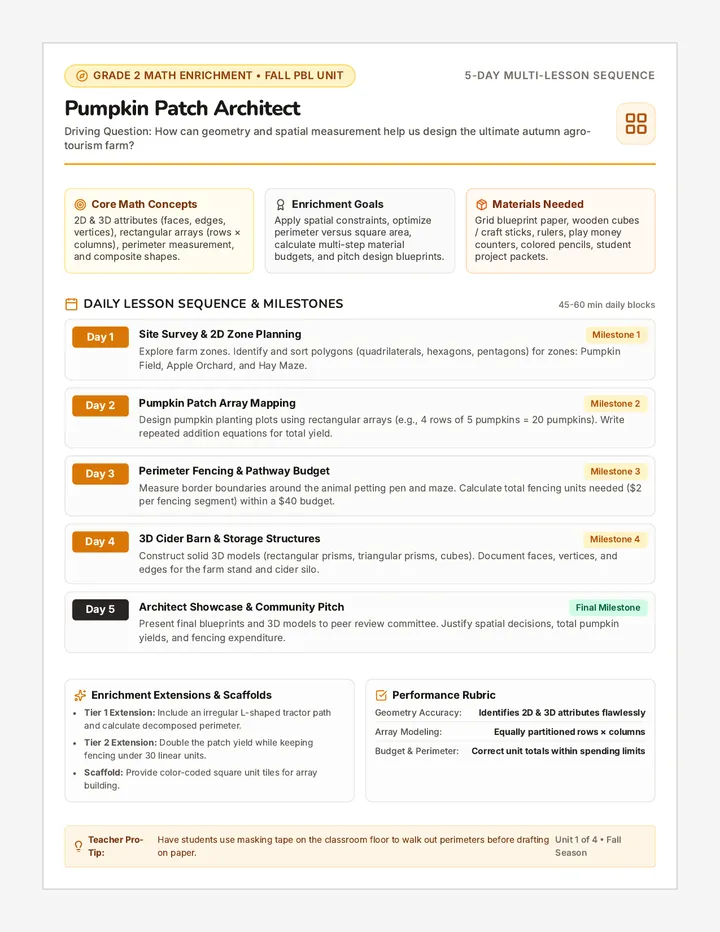
    Pumpkin Patch Unit Plan

    Seasonal Math Quests

    A collection of four seasonal project-based learning units for Grade 2 math enrichment featuring autumn harvest and winter wonderland design missions. Students apply advanced geometry, multi-digit money math, precision measurement, and elapsed time to solve authentic real-world challenges.

    K

    kkipperman

    8
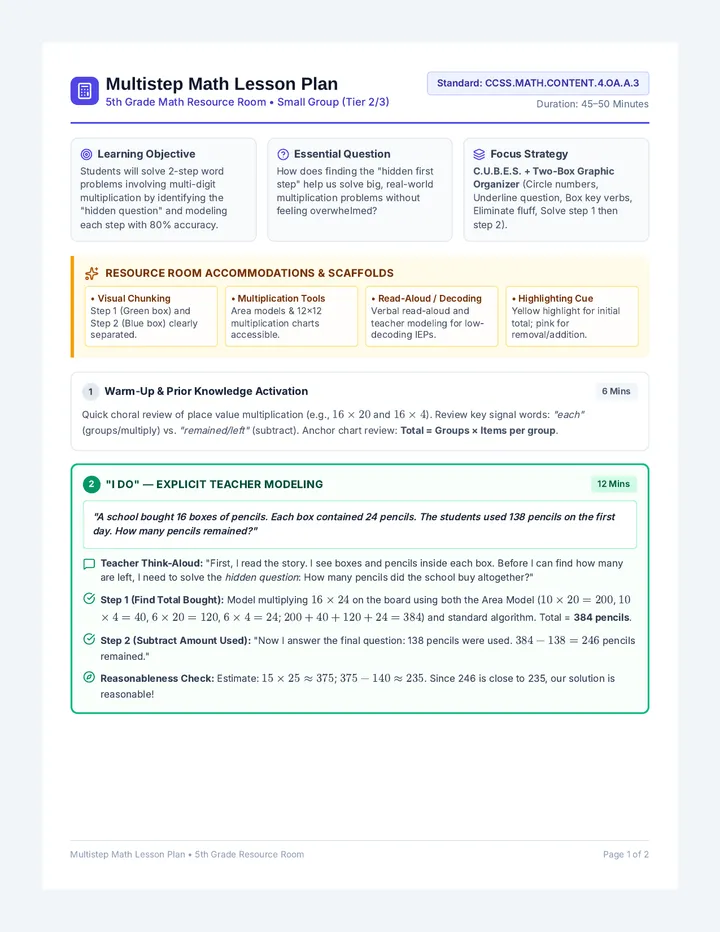
    Multistep Math Lesson Plan

    Multistep Multiplication Mission

    A targeted 5th-grade math resource room lesson addressing standard 4.OA.3 through multi-digit multiplication and two-step word problems using the 'I Do, We Do, You Do' gradual release model with visual supports and accommodations.

    AC

    Aaron Conlin

    4
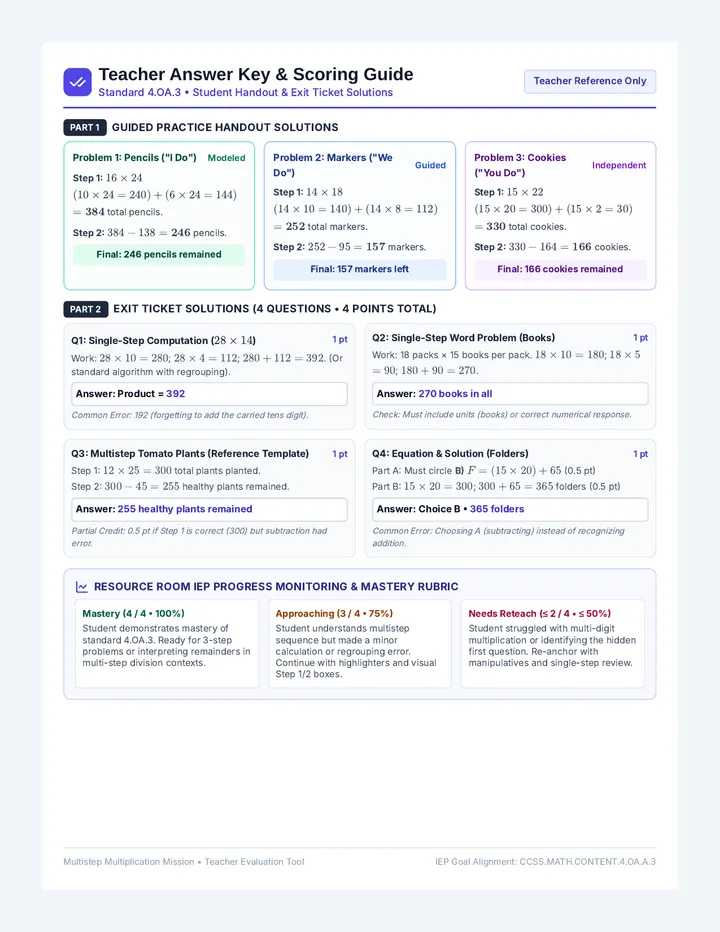
    Multistep Mastery Answer Key

    Multistep Mastery Answer Key

    A comprehensive one-page teacher answer key and IEP progress-monitoring tracker providing step-by-step worked solutions for both the Student Handout and the 4-question Exit Ticket, including error analysis notes.

    AC

    Aaron Conlin

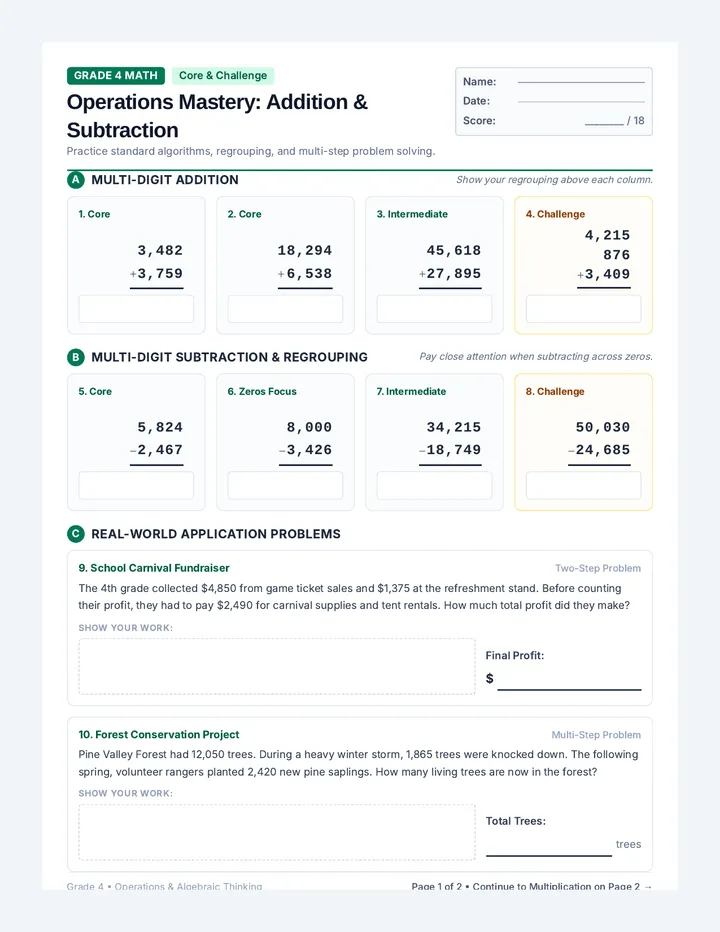
    Fourth Grade Math Worksheet

    Math Powerhouse

    A targeted multi-grade mathematics sequence focusing on mastering whole-number operations including addition, subtraction, and multi-digit multiplication. It equips fourth and fifth-grade learners with procedural fluency, conceptual problem-solving, and rigorous challenge tasks.

    T

    temetropolis

    4
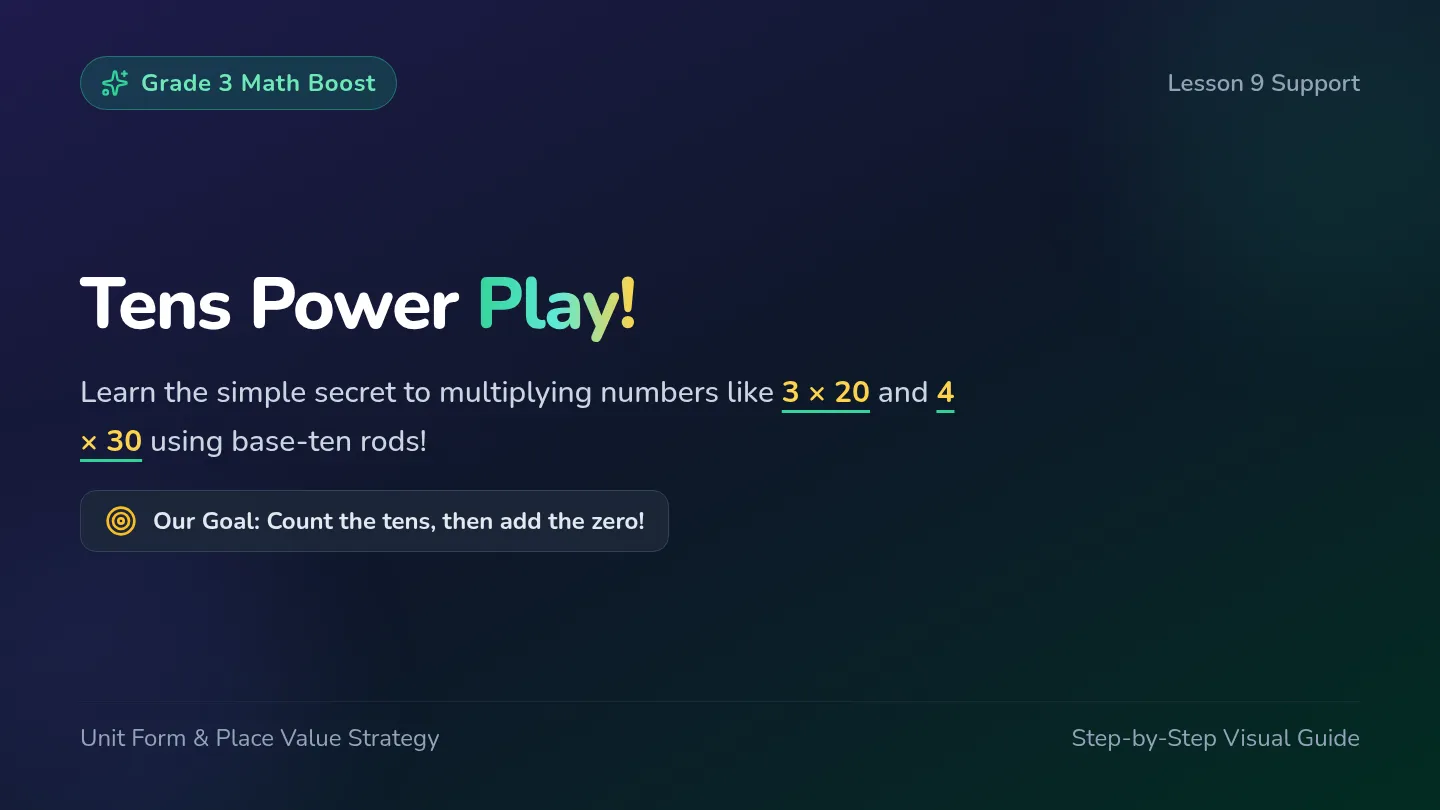
    Tens Power Slides

    Tens Power Play

    A modified, highly scaffolded math lesson designed for students needing foundational support in multiplying single-digit numbers by multiples of 10. The lesson transitions students from concrete base-ten models to unit form reasoning with structured visual supports and manageable basic facts.

    JW

    Jorlian Wynes

    5
    Multistep Mastery Exit Ticket

    Multistep Mastery Exit Ticket

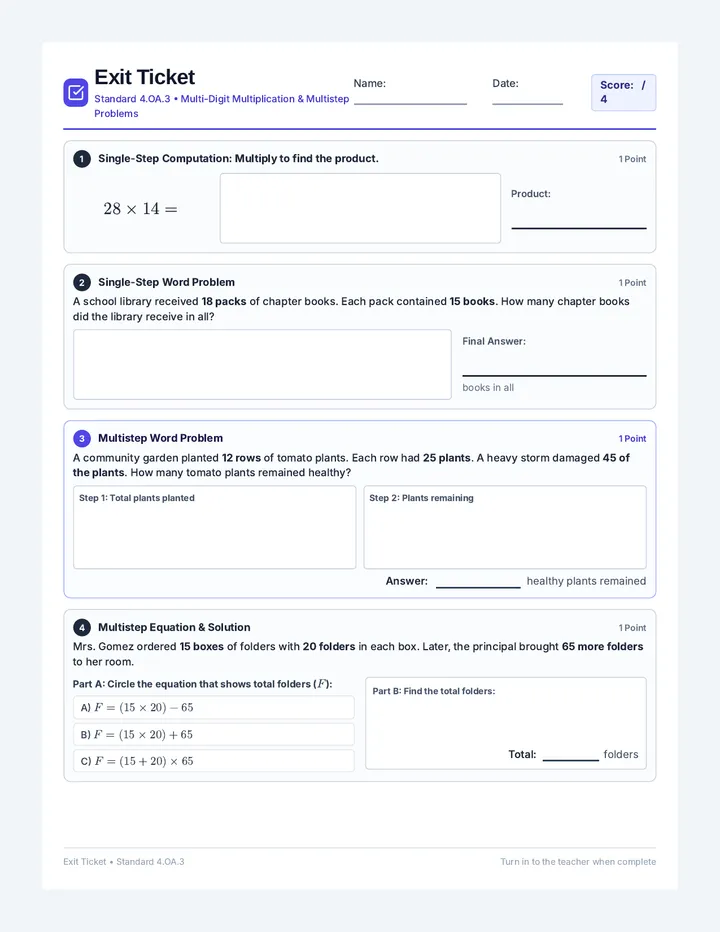
    A one-page 4-question student Exit Ticket assessing Standard 4.OA.3, including single-step computation, a single-step word problem, a multi-step word problem following the reference template, and an equation representation question with ample handwriting space.

    AC

    Aaron Conlin

    Linear Equations Practice Worksheet

    Coordinate Geometry Mastery

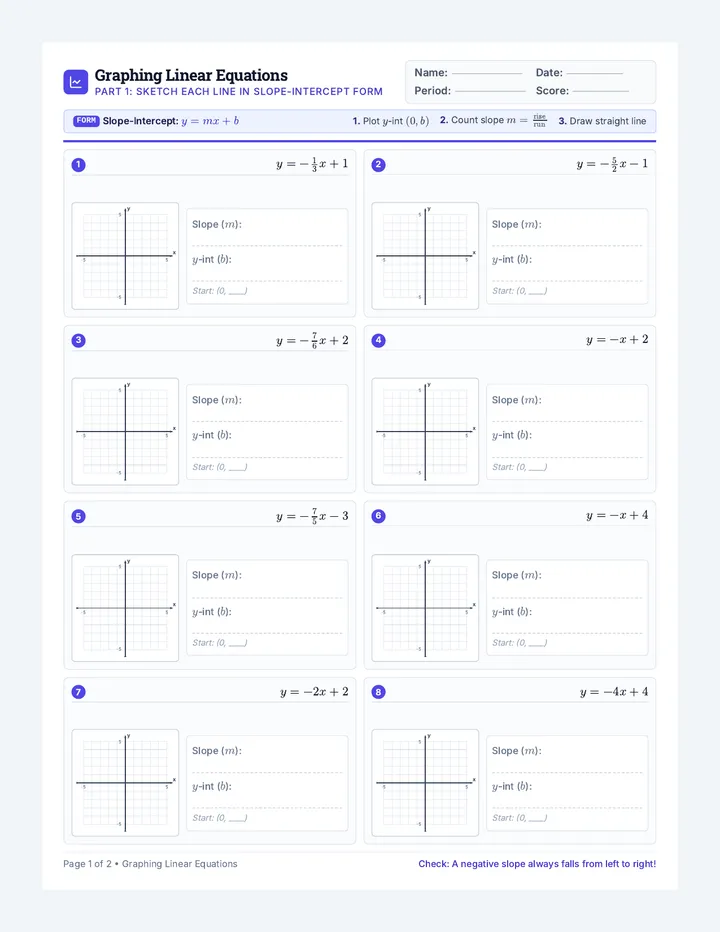
    A secondary mathematics curriculum sequence exploring linear functions and geometric transformations on the Cartesian coordinate plane, featuring print-ready guided practice and teacher keys.

    FM

    Fernando Mancini

    4
    Number Power Practice Packet

    Place Value Power

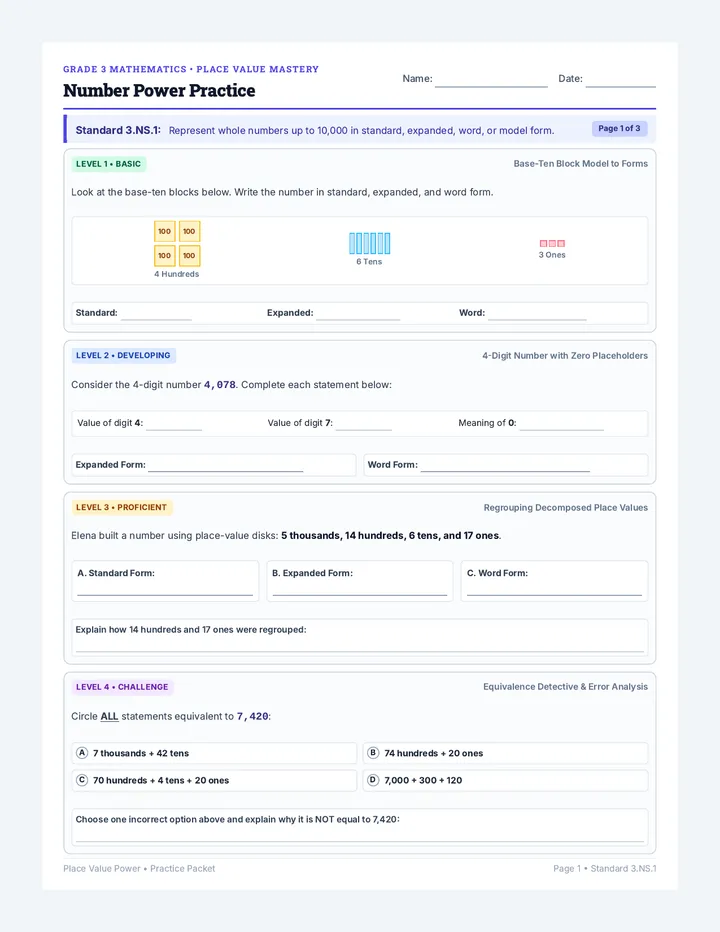
    A comprehensive third-grade mathematics unit covering place value representations up to 10,000, rounding to the nearest ten with benchmark values and number lines, and real-world word problems using algebraic equations and bar models.

    C

    craig.buckler

    6
    Step by Step Student Handout

    Step by Step Student Handout

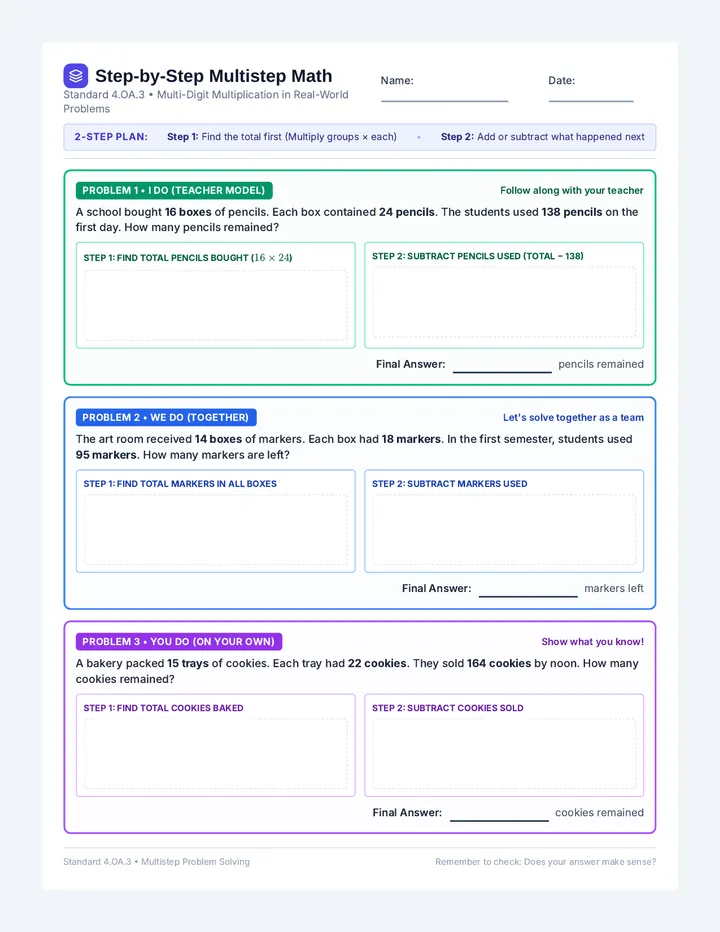
    A one-page student-facing guided practice worksheet designed for a 5th-grade resource room, featuring the 'I Do, We Do, You Do' gradual release structure with structured Step 1 and Step 2 work spaces for multi-digit multiplication word problems.

    AC

    Aaron Conlin

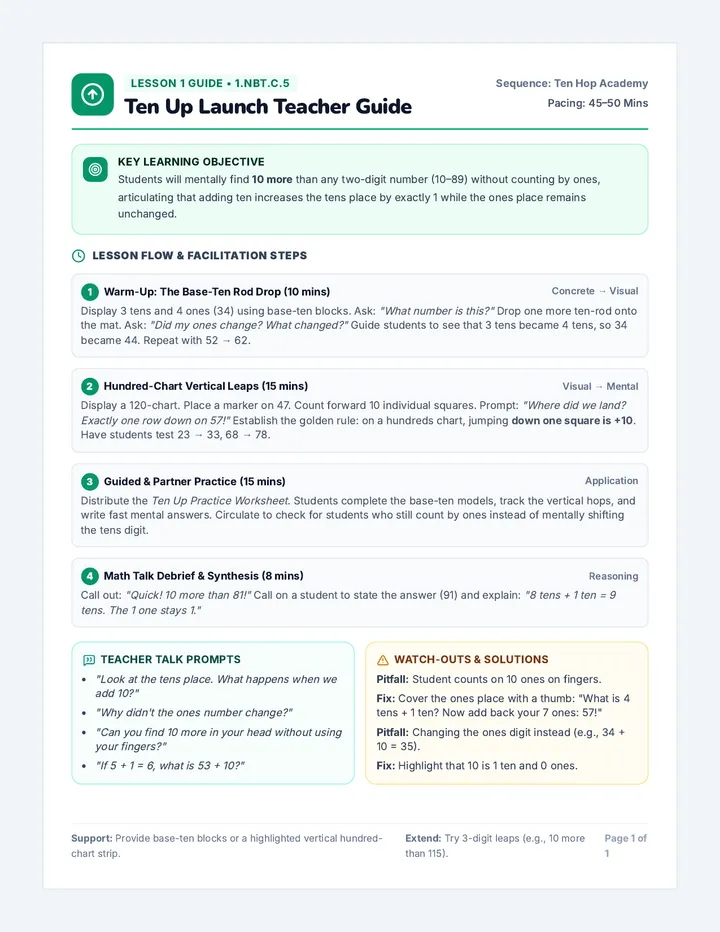
    Ten Up Teacher Guide

    Ten Hop Academy

    A comprehensive 3-lesson primary math sequence designed to develop first graders' mental fluency with finding 10 more and 10 less than any two-digit number. Students transition from concrete base-ten models and hundreds-chart leap patterns to rapid mental calculations and clear verbal explanations.

    K

    kkipperman

    9
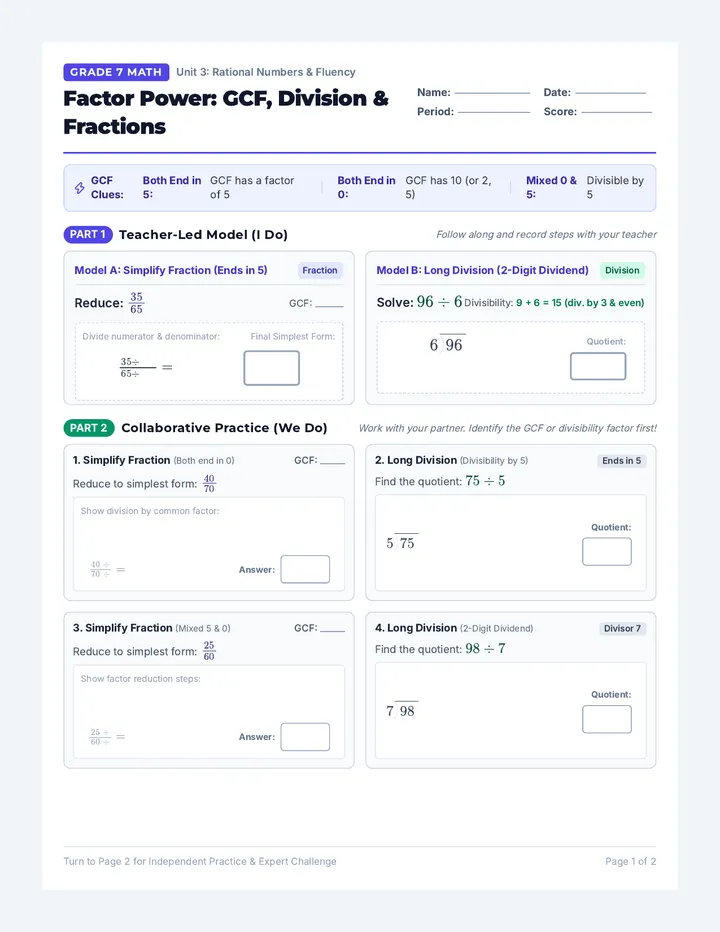
    Factor Power Worksheet

    Factor Power

    A targeted 7th-grade mathematics lesson designed to build student fluency in identifying Greatest Common Factors (GCF) and divisibility rules, seamlessly bridging conceptual factor knowledge with long division of 2-digit numbers and fraction simplification.

    CG

    Connor Green

    2
    Multistep Math Lesson Plan

    Multistep Math Lesson Plan

    A comprehensive two-page teacher lesson plan designed for a 5th-grade math resource room addressing standard 4.OA.3 using the gradual release 'I Do, We Do, You Do' model, complete with special education accommodations, teacher scripts, and misconception analysis.

    AC

    Aaron Conlin