Standard Form Slides Algebra 1 Linear Equations
Unit 4 • Lesson 3
Standard Form Showdown
Mastering the equation \(Ax + By = C\), uncovering hidden intercepts, and modeling real-world budget constraints.
Identify standard form rules
Use the Cover-Up Method
Turn & Talk with partners
Warm-Up Launch
The Snack Shack Dilemma
Bell Ringer Review
The Situation
You have exactly $18 to spend. Popcorn (\(x\)) costs $3 each and sodas (\(y\)) cost $2 each.
\(3x + 2y = 18\)
Notice how neither variable is alone on one side!
Quick Thinking
1 If you buy 0 sodas , how many popcorns can you buy?
2 If you buy 0 popcorns , how many sodas can you buy?
Key Takeaway: These represent your intercept values !
Algebra 1 • Standard Value & Standard Form
Core Concept
Anatomy of Standard Form
Definition & Constraints
\(Ax + By = C\)
Rule 1: Integers Only
\(A\), \(B\), and \(C\) must be integers. No fractions and no decimals allowed!
Rule 2: Positive Leading A
The coefficient \(A\) must be non-negative: \(A \ge 0\). If it's negative, multiply everything by \(-1\).
Rule 3: Both Sides Grouped
Both variable terms (\(x\) and \(y\)) sit on the left side, with the constant \(C\) alone on the right.
Also known as: \(A\) and \(B\) cannot both equal 0 at the same time.
Turn & Talk #1
Standard Form or Imposter?
2 Minutes
A) \(4x - 7y = 28\) Standard?
B) \(y = 3x - 5\) Standard?
C) \(-2x + 6y = 10\) Standard?
D) \(\frac{1}{2}x + 3y = 4\) Standard?
Partner Discussion Prompts
• Partner A: Identify which equation is currently in true standard form and defend why.
• Partner B: Pick one "imposter" and explain what rule it breaks. What move would fix it?
Sentence Starter: "Equation C is not in standard form because \(A\) is negative, so we must..."
Turn to your elbow partner • Both partners must speak Algebra 1 Showdown
Superpower Strategy
The "Cover-Up" Method
Finding Key Intercept Values
To graph or analyze \(Ax + By = C\), find where the line hits each axis!
Find \(x\)-Intercept Set \(y = 0\)
Cover up the \(y\)-term with your thumb and solve for \(x\):
Example: \(2x + 4y = 12\)
\(2x + \text{[COVERED]} = 12\)
\(2x = 12 \implies x = 6\)
Point on graph: \((6, 0)\)
Find \(y\)-Intercept Set \(x = 0\)
Cover up the \(x\)-term with your thumb and solve for \(y\):
Example: \(2x + 4y = 12\)
\(\text{[COVERED]} + 4y = 12\)
\(4y = 12 \implies y = 3\)
Point on graph: \((0, 3)\)
Plot \((6, 0)\) and \((0, 3)\) , connect with a ruler, and your line is done!
Turn & Talk #2
Intercept Investigation
2.5 Minutes
Investigate this standard form equation:
\(5x - 2y = 20\)
Watch out for the subtraction sign in front of \(2y\)!
Your Mission
1 Partner B: Cover the \(y\)-term and find the \(x\)-intercept coordinate pair.
2 Partner A: Cover the \(x\)-term and find the \(y\)-intercept coordinate pair.
3 Together: What is the slope \(m\) between these two points?
Remember: the \(y\)-intercept includes the negative sign! \(-2y = 20 \implies y = -10\) \((4, 0)\) and \((0, -10)\)
Bridging Concepts
Converting: Standard to Slope-Intercept
Two-Step Transformation
Step 1
Move the \(x\)-term
Subtract (or add) the \(Ax\) term from both sides to isolate the \(y\) term.
\(3x + 2y = 12\)
Step 2
Divide by \(B\)
Divide every single term on both sides by the coefficient of \(y\).
\(\frac{2y}{2} = \frac{-3x}{2} + \frac{12}{2}\)
Why It Matters
The Slope Formula
Notice a shortcut pattern? For any standard form \(Ax + By = C\):
Slope:
\(m = -\frac{A}{B}\)
\(y\)-intercept:
\(b = \frac{C}{B}\)
Standard form is best for intercepts; slope-intercept is best for graphing slopes!
Wrap-Up
Lesson Debrief & Exit Ticket
Individual Mastery
Key Standard Form Rules
Format: \(Ax + By = C\)
\(A, B, C\) are integers (no fractions!)
Leading coefficient \(A \ge 0\)
Cover-up to find \((x, 0)\) and \((0, y)\)
Exit Ticket Time
Please clear your desks and complete the 3-question Exit Ticket independently:
1. Verify standard form constraints.
2. Calculate intercepts for \(3x - 4y = 24\).
3. Interpret an intercept in a real-world scenario.
Turn your paper in to the bin before the bell rings!
Great job collaborating today! Let's see your individual mastery.
Standard Form Bell Ringer Algebra 1 • Unit 4: Linear Relations
Standard Form Bell Ringer
Warm-Up • Activate Prior Knowledge (5–7 Minutes)
Name:
Date:
Period:
Mission: Complete these warm-up tasks independently before lesson launch. Show your work!
Target: 6 Mins
1
The Power of Zero (Substitution)
Evaluating Equations
Given the linear equation \(4x + 3y = 24\), evaluate for the following:
Part A: If \(y = 0\), find \(x\):
Coordinate point: (____, 0)
Part B: If \(x = 0\), find \(y\):
Coordinate point: (0, ____)
2
Axis Intercepts Identification
Geometry of Lines
Where on a coordinate plane does a line cross the \(x\)-axis? Circle your answer:
A Where the \(x\)-coordinate is always \(0\)
B Where the \(y\)-coordinate is always \(0\)
C Where both \(x\) and \(y\) equal \(1\)
D At the exact center of the line segment
3
The Snack Shack Dilemma
Lesson Hook
Maya has $18 to spend on popcorn (\(x\)) at $3 each and sodas (\(y\)) at $2 each.
Part A: Write an algebraic equation relating popcorn (\(x\)), sodas (\(y\)), and the total $18:
Part B: If she buys 0 sodas , how many popcorns?
Part C: If she buys 0 popcorns , how many sodas?
Ready for lesson launch! Hold your pencil high when completed.
Algebra 1 • Standard Form
Standard Form Exit Ticket Algebra 1 • Formative Assessment
Standard Form Exit Ticket
Showdown Checkpoint • Independent Work (5–8 Minutes)
Name:
Date:
Period:
Directions: Complete each task independently. Demonstrate clear algebraic thinking for full credit.
Score: / 4 pts
1
Standard Form Criteria (1 pt)
Constraint Check
Which equation is correctly written in standard form \(Ax + By = C\)?
A \(y = -\frac{2}{3}x + 5\)
B \(-3x + 4y = 12\)
C \(5x - 2y = 20\)
D \(\frac{1}{4}x + 2y = 8\)
2
Calculating Intercepts (1 pt)
Cover-Up Method
Use the cover-up method to find both intercepts of the equation: \(3x - 4y = 24\)
Find the \(x\)-intercept (Set \(y=0\)):
Coordinate: (____, 0)
Find the \(y\)-intercept (Set \(x=0\)):
Coordinate: (0, ____)
3
Converting Forms (1 pt)
Two-Step Rearrangement
Convert \(2x + 5y = 15\) into slope-intercept form (\(y = mx + b\)). Show each step:
Final Form:
4
Real-World Meaning (1 pt)
Contextual Interpretation
A high school drama club sells student tickets (\(x\)) for $5 and adult tickets (\(y\)) for $10 to reach a budget goal: \(5x + 10y = 500\).
What does the \(x\)-intercept \((100, 0)\) mean in the context of ticket sales?
Place completed ticket into the turn-in bin before exiting.
Algebra 1 • Standard Value Mastery
Standard Form Teacher Guide Instructional Resource • Algebra 1
Standard Form Teacher Guide
Pacing, Turn & Talk Facilitation, and Complete Answer Keys
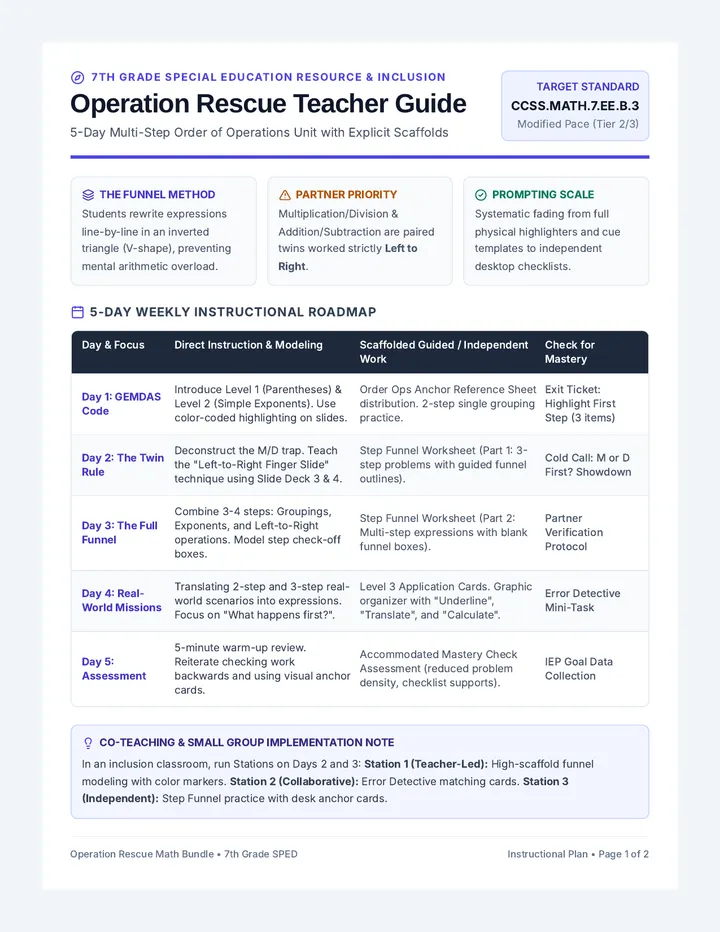
Standard: CCSS.MATH.HSA.CED.A.2
Target: Linear Standard Form \(Ax + By = C\)
Duration: 45–50 Minutes
Bell Ringer 6–8 mins
Concept & T&T #1 12–15 mins
Cover-Up & T&T #2 15–18 mins
Exit Ticket 7–10 mins
Turn & Talk Facilitation Protocols
Turn & Talk #1 (Rules Check):
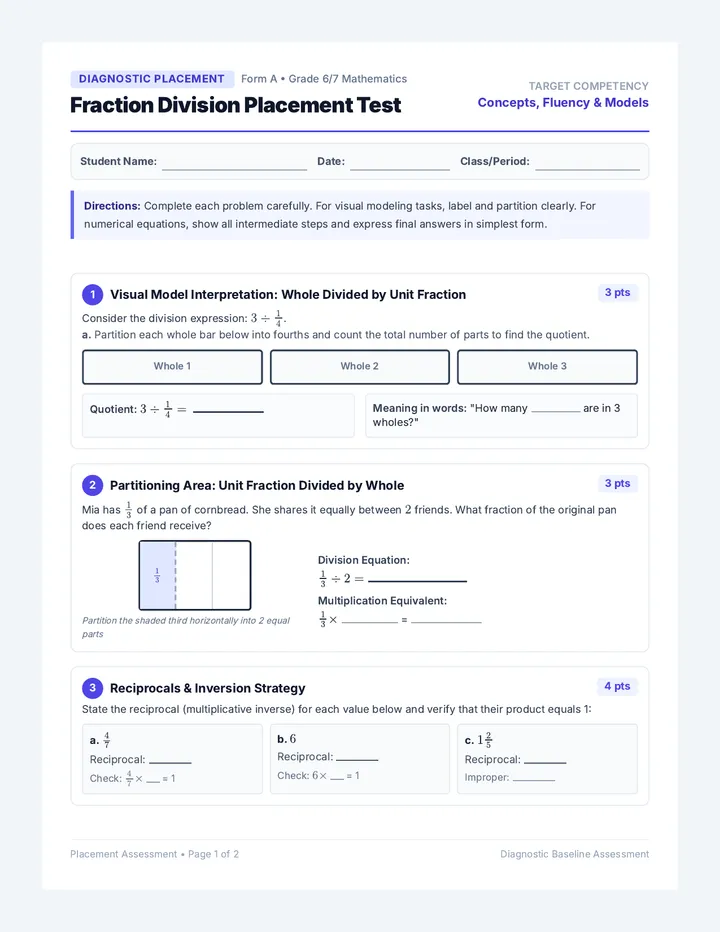
Ensure Partner A defends why equation A (\(4x - 7y = 28\)) is standard form. Listen for Partner B noting equation C has a negative leading coefficient (\(-2x\)) and equation D has fraction \(\frac{1}{2}\).
Turn & Talk #2 (Cover-Up Strategy):
Have students physically use an index card or thumb to cover the other term. Watch for the negative sign in \(-2y = 20 \implies y = -10\). Intercepts are \((4, 0)\) and \((0, -10)\).
Key Misconceptions to Address
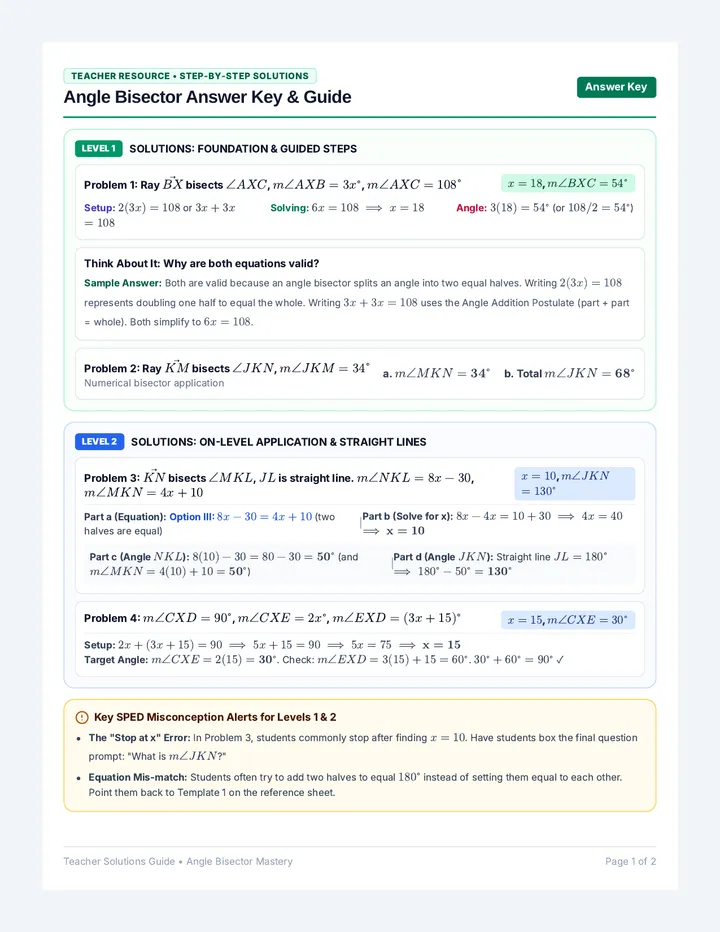
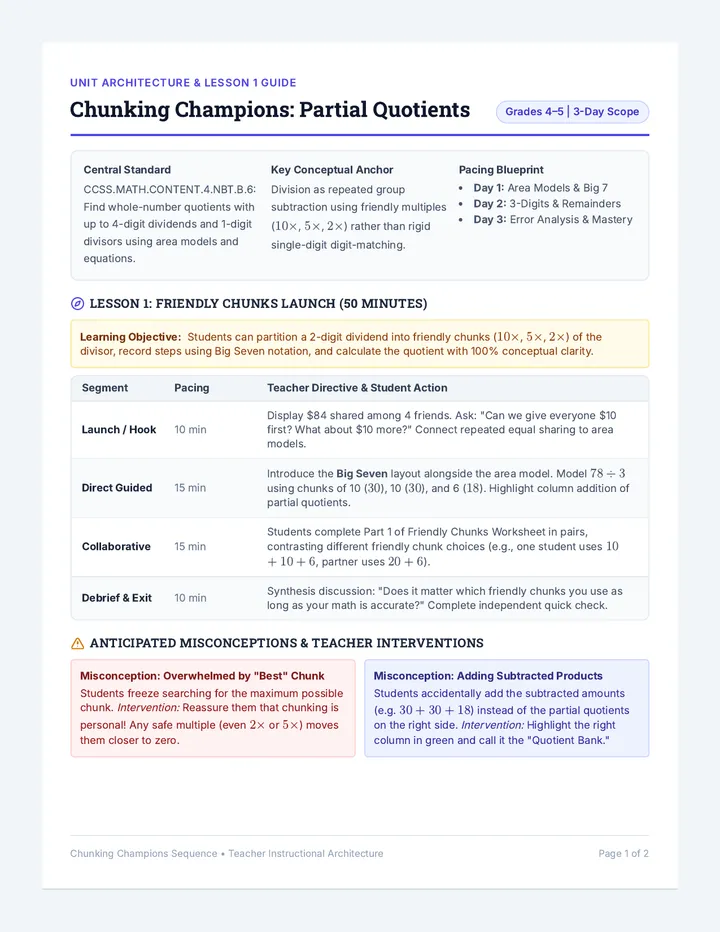
Sign Drops: When covering \(Ax\) in \(Ax - By = C\), students often forget the negative sign belongs to \(By\). Remind them: "The sign in front stays with the term!" Writing Coordinates: Students often write \((0, 6)\) instead of \((6, 0)\) for \(x\)-intercepts. Emphasize that the non-zero value matches the axis name.Dividing in Form Conversion: When converting to \(y = mx + b\), students forget to divide the constant \(C\) by \(B\).
Bell Ringer Solutions Warm-Up Key
Q1: Part A: \(4x = 24 \implies x = 6\), coordinate: \((6, 0)\). Part B: \(3y = 24 \implies y = 8\), coordinate: \((0, 8)\).
Q2: Option B (Where the \(y\)-coordinate is always 0).
Q3: Part A: \(3x + 2y = 18\). Part B: \(3x = 18 \implies 6\) bags. Part C: \(2y = 18 \implies 9\) sodas.
Exit Ticket Solutions & Rubric 4 pts total
Q1 (1 pt): Option C (\(5x - 2y = 20\)). A is slope-intercept, B has \(A < 0\), D has fraction.
Q2 (1 pt): \(x\)-intercept: \(3x = 24 \implies (8, 0)\); \(y\)-intercept: \(-4y = 24 \implies (0, -6)\).
Q3 (1 pt): \(5y = -2x + 15 \implies y = -\frac{2}{5}x + 3\).
Q4 (1 pt): Selling 100 student tickets (and 0 adult tickets) meets the full $500 budget goal.