Chunking Launch Teacher Guide Unit Architecture & Lesson 1 Guide
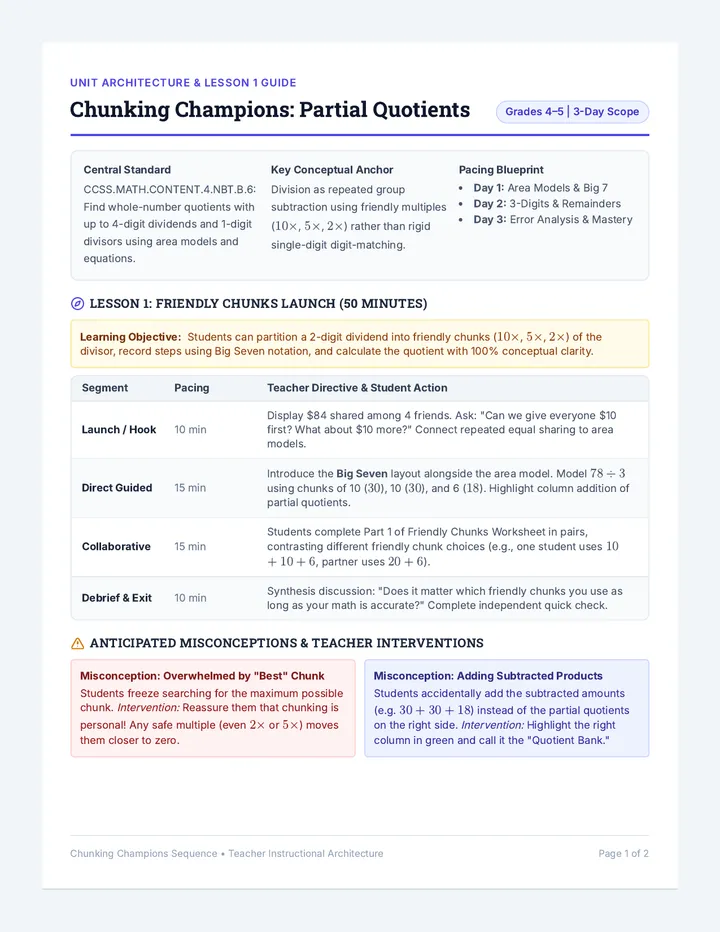
Chunking Champions: Partial Quotients
Grades 4–5 | 3-Day Scope
Central Standard
CCSS.MATH.CONTENT.4.NBT.B.6: Find whole-number quotients with up to 4-digit dividends and 1-digit divisors using area models and equations.
Key Conceptual Anchor
Division as repeated group subtraction using friendly multiples (\(10\times\), \(5\times\), \(2\times\)) rather than rigid single-digit digit-matching.
Pacing Blueprint
Day 1: Area Models & Big 7Day 2: 3-Digits & RemaindersDay 3: Error Analysis & Mastery
Lesson 1: Friendly Chunks Launch (50 Minutes)
Learning Objective: Students can partition a 2-digit dividend into friendly chunks (\(10\times\), \(5\times\), \(2\times\)) of the divisor, record steps using Big Seven notation, and calculate the quotient with 100% conceptual clarity.
Segment Pacing Teacher Directive & Student Action
Launch / Hook 10 min Display $84 shared among 4 friends. Ask: "Can we give everyone $10 first? What about $10 more?" Connect repeated equal sharing to area models.
Direct Guided 15 min Introduce the Big Seven layout alongside the area model. Model \(78 \div 3\) using chunks of 10 (\(30\)), 10 (\(30\)), and 6 (\(18\)). Highlight column addition of partial quotients.
Collaborative 15 min Students complete Part 1 of Friendly Chunks Worksheet in pairs, contrasting different friendly chunk choices (e.g., one student uses \(10 + 10 + 6\), partner uses \(20 + 6\)).
Debrief & Exit 10 min Synthesis discussion: "Does it matter which friendly chunks you use as long as your math is accurate?" Complete independent quick check.
Anticipated Misconceptions & Teacher Interventions
Misconception: Overwhelmed by "Best" Chunk
Students freeze searching for the maximum possible chunk. Intervention: Reassure them that chunking is personal! Any safe multiple (even \(2\times\) or \(5\times\)) moves them closer to zero.
Misconception: Adding Subtracted Products
Students accidentally add the subtracted amounts (e.g. \(30 + 30 + 18\)) instead of the partial quotients on the right side. Intervention: Highlight the right column in green and call it the "Quotient Bank."
Chunking Champions Sequence • Teacher Instructional Architecture Page 1 of 2
Instructional Scripts & Strategies
Facilitation Guide & Question Stems
Lesson 1 Support
Scripted Modeling: Transitioning Area Model to Big 7
"Class, look at \(96 \div 4\). Traditional division asks, 'How many 4s are in 9?' But 9 isn't 9—it's 90! Instead of guessing the highest digit, let's pull out easy chunks we know in our sleep. Do we have enough for each friend to get 10? Yes! \(4 \times 10 = 40\). We subtract 40, leaving 56. Can we give another 10? Absolutely! \(4 \times 10 = 40\). Now we have 16 left. How many 4s make 16? Exactly 4! Now, let's tally our quotient bank on the right: \(10 + 10 + 4 = 24\)."
High-Leverage Formative Question Stems
To Prompt Chunk Selection:
"What is a friendly multiple of your divisor that you can calculate in your head instantly? What is \(10\times\)? What is half of that (\(5\times\))?"
To Diagnose Stopping Points:
"Look at your remaining amount. Is it smaller than your divisor? How do you know whether to keep chunking or stop?"
To Compare Student Strategies:
"Maya used chunks of \(10 + 10 + 4\). Leo used chunks of \(20 + 4\). Why did both get 24? Which strategy felt faster, and why?"
To Check for Understanding:
"Explain to your partner why we subtract the products inside the Big 7 but add the numbers on the right rail."
Tiered Differentiation Pathways
Support
Provide a Friendly Multiples T-Chart alongside each problem. Have students pre-write \(1\times, 2\times, 5\times, 10\times\) for their divisor before beginning any Big 7 problem.
On-Target
Encourage students to transition from single \(10\times\) chunks to larger multiples of ten (\(20\times, 30\times\)) to reduce the number of subtraction tiers.
Extension
Challenge students to solve problems using the least possible number of chunks (e.g., target 2 chunks max) and create their own real-world sharing scenario.
Day 1 Mastery Checklist
Can record Big 7 vertical setup correctly
Consistently uses \(10\times\) or \(5\times\) benchmark chunks
Subtracts accurately down to zero remainder
Sums the partial quotient column accurately
Chunking Champions Sequence • Teacher Instructional Architecture Page 2 of 2
Friendly Chunks Slides Chunking Champions • Day 1
Visual Math Series
Division Without the Guesswork: Friendly Chunks
You don't need to guess the exact answer in one shot. Take out bites you already know: 10×, 5×, or 2×!
Safe & Flexible Choose chunks you trust
Area Model Link Visual rectangular slices
Big 7 Notation Track quotients clearly
Conceptual Foundation Problem: Share $84 among 4 friends
Instead of dividing all at once, let's distribute friendly chunks!
Chunk 1: Give each friend $10 → Subtotal: \(4 \times 10 = 40\). Left: $44.
Chunk 2: Give each friend $10 → Subtotal: \(4 \times 10 = 40\). Left: $4.
Chunk 3: Give each friend $1 → Subtotal: \(4 \times 1 = 4\). Left: $0.
The Area Model View
40 \(4 \times 10\)
40 \(4 \times 10\)
4 \(4 \times 1\)
Total Quotient: \(10 + 10 + 1 = 21\)
Key Insight: Friendly pieces always combine to the exact total! Slide 2 of 5
The Algorithm Introducing the "Big Seven"
Let's record chunks vertically using the Big 7!
The right column is your Quotient Bank . Record how many times the divisor was subtracted, then add them up at the bottom!
1 Pick a friendly multiple (\(3 \times 20 = 60\))
2 Subtract from your remaining total
3 Add the quotient bank: \(20 + 6 = 26\)
Calculation Area Quotient Bank
3
78
20
−
60
(\(3 \times 20\))
18
6
−
18
(\(3 \times 6\))
0
26
Notice: The vertical rail keeps partial quotients organized! Slide 3 of 5
Flexible Thinking Comparing Two Student Pathways for \(96 \div 4\)
Does every student have to pick the same chunks? No!
Maya's Path (Cautious 10s) 3 Steps
• Takes \(4 \times 10 = 40\) → leaves \(56\)
• Takes \(4 \times 10 = 40\) → leaves \(16\)
• Takes \(4 \times 4 = 16\) → leaves \(0\)
Quotient: \(10 + 10 + 4 = 24\)
Leo's Path (Bold 20s) 2 Steps
• Takes \(4 \times 20 = 80\) → leaves \(16\)
• Takes \(4 \times 4 = 16\) → leaves \(0\)
Quotient: \(20 + 4 = 24\)
The Golden Rule: Both paths are 100% correct! Choose chunks that give you complete confidence.
Friendly Chunks Worksheet Lesson 1 Practice • Conceptual Foundations
Friendly Chunks Worksheet
Name:
Date:
Friendly Multiples Tip: Think of easy bites like \(10\times\), \(5\times\), or \(2\times\) of your divisor! Subtract the chunk, then tally your bank on the right.
A Bridge the Models: From Rectangle to Big Seven
1. Solve \(72 \div 3\) using both models:
Area Model: Fill in the missing quotient chunks:
Chunk 1 (\(3 \times 20\)) 60
Chunk 2 (\(3 \times \text{?}\)) 12
Big 7 Layout Quotient Bank
3 | 72 20
− 60 (\(3 \times 20\))
12 ____
− 12 Remainder: 0
Total Quotient:
2. Solve \(84 \div 4\) using both models:
Area Model: Fill in the missing quotient chunks:
Chunk 1 (\(4 \times 10\)) 40
Chunk 2 (\(4 \times \text{?}\)) 44
Big 7 Layout Quotient Bank
4 | 84 10
− 40 (\(4 \times 10\))
44 ____
− ___ Remainder: 0
Total Quotient:
B Guided Big Seven Practice
3. Calculate \(96 \div 3\) Hint: Start with \(10\times\) or \(20\times\)
Work / Subtraction Quotient Bank
3 | 96
Final Quotient:
4. Calculate \(85 \div 5\) Hint: Start with \(10\times 5 = 50\)
Work / Subtraction Quotient Bank
5 | 85
Final Quotient:
Friendly Chunks Worksheet • Student Handout Page 1 of 2
C Independent Partial Quotients Practice
Show all chunking steps clearly
5. \(76 \div 4\)
4 | 76
Quotient:
6. \(98 \div 2\)
2 | 98
Quotient:
7. \(91 \div 7\)
7 | 91
Quotient:
D Word Problems & Strategy Reflection
8. The community tennis club has 92 tennis balls. They are packaging them into cans of 4 balls each. How many full cans can they pack?
Show your Big 7 work:
Multiplication Check (\(\text{Quotient} \times 4\)):
Answer with unit label:
9. Mathematical Thinking: Compare Strategy Pathways
Camila solved \(84 \div 6\) using chunks of \(10 + 2 + 2\). Marcus solved \(84 \div 6\) using chunks of \(10 + 4\). Both students got the answer 14. Explain why both approaches work and which one you prefer.
Friendly Chunks Worksheet • Student Handout Page 2 of 2
Friendly Chunks Answer Key [TEACHER ANSWER KEY] • Lesson 1
Friendly Chunks Answer Key
Complete Solutions
Scoring Note: In partial quotients, multiple pathways are completely valid! As long as the products subtracted are correct multiples of the divisor and the remaining difference reaches 0, award full credit.
A Section A: Area Model to Big 7 Bridge (Solutions)
1. \(72 \div 3 = \mathbf{24}\)
Area Model Chunk 2: \(3 \times \mathbf{4} = 12\). Missing factor is 4 .
Big 7 Layout Quotient Bank
3 | 7220
− 60(\(3 \times 20\))
124
− 12(\(3 \times 4\))
Total Quotient: 20 + 4 = 24
2. \(84 \div 4 = \mathbf{21}\)
Area Model Chunk 2: \(4 \times \mathbf{11} = 44\) (or \(10 + 1\)). Missing factor is 11 .
Big 7 Layout Quotient Bank
4 | 8410
− 40(\(4 \times 10\))
4410
− 40(\(4 \times 10\))
41
− 4(\(4 \times 1\))
Total Quotient: 10+10+1 = 21
B Section B: Guided Big Seven Practice (Solutions)
3. \(96 \div 3 = \mathbf{32}\)
3 | 9620
− 60(leaves 36)
3610
− 30(leaves 6)
62
− 6(remainder 0)
Sum Quotient: 20 + 10 + 2 = 32
Alternative: \(30 + 2 = 32\) in two steps is also excellent!
4. \(85 \div 5 = \mathbf{17}\)
5 | 8510
− 50(leaves 35)
357
− 35(leaves 0)
Sum Quotient: 10 + 7 = 17
Check: \(17 \times 5 = (10 \times 5) + (7 \times 5) = 50 + 35 = 85\).
Friendly Chunks Answer Key • Page 1 Page 1 of 2
C Independent Practice & Applications (Solutions)
Answers • Section C & D
5. \(76 \div 4 = \mathbf{19}\)
4 | 76 | 10
− 40
36 | 9
− 36
10 + 9 = 19
6. \(98 \div 2 = \mathbf{49}\)
2 | 98 | 40
− 80
18 | 9
− 18
40 + 9 = 49
7. \(91 \div 7 = \mathbf{13}\)
7 | 91 | 10
− 70
21 | 3
Big Seven Slides Chunking Champions • Day 2
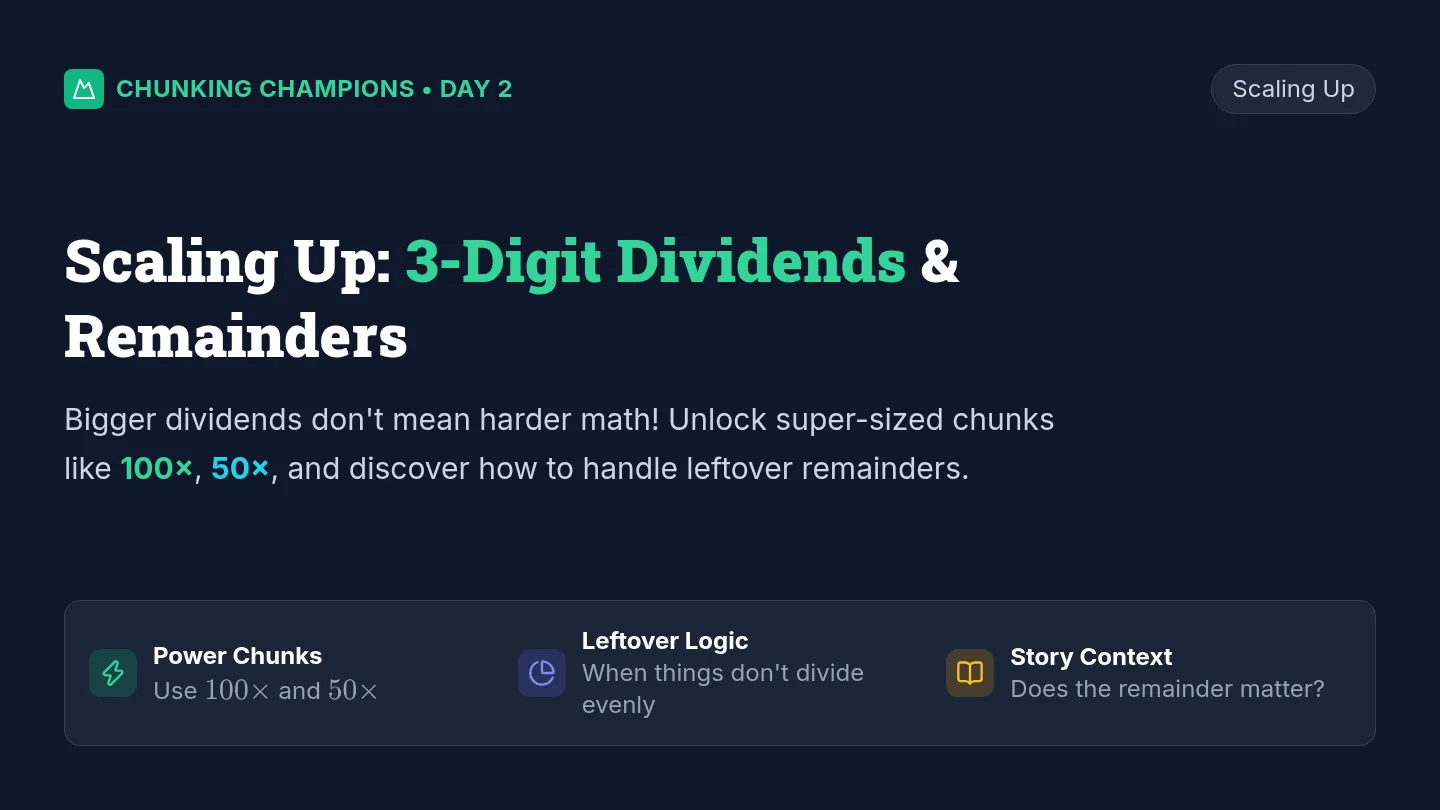
Scaling Up
Scaling Up: 3-Digit Dividends & Remainders
Bigger dividends don't mean harder math! Unlock super-sized chunks like 100×, 50×, and discover how to handle leftover remainders.
Power Chunks Use \(100\times\) and \(50\times\)
Leftover Logic When things don't divide evenly
Story Context Does the remainder matter?
Strategy In Action Problem: \(468 \div 3\)
Start Big: Can we take out a chunk of 100?
Bite 1: \(3 \times 100 = 300\). Subtract \(300\), leaves \(168\).
Bite 2: Can we take \(3 \times 50 = 150\)? Yes! Leaves \(18\).
Bite 3: \(3 \times 6 = 18\). Leaves \(0\).
Subtraction Work Quotients
3
468
100
−
300
(\(3 \times 100\))
168
50
−
150
(\(3 \times 50\))
18
6
−
18
(\(3 \times 6\))
0
156
By using \(100\times\) and \(50\times\), we solved 468 in just 3 easy steps! Slide 2 of 5
Key Concept Understanding Leftovers
When do we stop chunking? The Remainder Rule!
The Golden Rule
You MUST stop chunking when the remaining number is strictly smaller than your divisor !
If dividing by 4 , leftovers of 1, 2, or 3 are remainders!
Writing Your Final Answer
Add your quotient bank as usual, then attach the remainder with an R :
Quotient: 136 R 3
Never have a remainder equal to or bigger than your divisor! Slide 3 of 5
Contextual Reasoning What does the remainder actually mean?
Three Ways to Treat a Remainder in Real Life
Round Up (+1)
Field Trips: 125 students need vans that hold 8. \(125 \div 8 = 15 \text{ R } 5\). You need 16 vans so no child is left behind!
Drop It (Ignore)
Full Packages: 87 apples into bags of 6. \(87 \div 6 = 14 \text{ R } 3\). You can only sell 14 full bags .
The Remainder IS It
Leftover Treats: 25 cookies shared among 4 kids. Each gets 6 cookies; exactly
Division Detective Worksheet Lesson 2 Practice • 3-Digit Scaling & Remainders
Division Detective Worksheet
Name:
Date:
Detective Clue: Look at the hundreds digit first! Can you use \(100\times\) or \(50\times\)? Stop when your leftover is less than the divisor.
A Case Files: 3-Digit Partial Quotients
Case 1: \(384 \div 3\)
Target: Exact quotient
Work Quotient Bank
3 | 384
Quotient:
Case 2: \(525 \div 5\)
Target: Exact quotient
Work Quotient Bank
5 | 525
Quotient:
Case 3: \(473 \div 4\)
Notice: Leftover expected!
Work Quotient Bank
4 | 473
Quotient & R:
Remainder Rule Diagnostic
If you are dividing by 6 , which of the following could be a remainder? Circle ALL possible remainders:
0 3 5 6 8
Division Detective Worksheet • Student Handout Page 1 of 2
B Advanced Case Files
Precision & Leftovers
Case 4: \(658 \div 6\) Start with \(6 \times 100\)
Work Quotient Bank
6 | 658
Answer (Quotient & R):
Case 5: \(742 \div 7\) Watch the tens place!
Work Quotient Bank
7 | 742
Answer (Quotient & R):
C Real-World Remainder Dilemmas: Round Up, Drop, or Keep?
Case 6: The Field Trip Fleet
There are 135 fourth-grade students and chaperones going to the science museum. Each passenger van holds 8 people. How many vans must the school reserve so that everybody has a seat?
Show division equation & work:
Vans needed:
Did you round up or drop R?
Case 7: The Art Ribbon Kits
Ms. Chen has 226 yards of decorative craft ribbon. She needs 5 yards of ribbon to create each complete craft kit. How many complete kits can she assemble?
Show division equation & work:
Complete kits:
What happens to leftover ribbon?
Division Detective Worksheet • Student Handout Page 2 of 2
Division Detective Answer Key [TEACHER ANSWER KEY] • Lesson 2
Division Detective Answer Key
3-Digits & Remainders
Scoring Standards: Accept any valid chunking sequence that accurately subtracts correct multiples and isolates the remainder. Remainder must be strictly less than the divisor!
A Case Files 1–3 Solutions
Case 1: \(384 \div 3 = \mathbf{128}\)
3 | 384 | 100
− 300
84 | 20
− 60
24 | 8
− 24
0 (R 0)
100+20+8 = 128
Check: \(128 \times 3 = 384\)
Case 2: \(525 \div 5 = \mathbf{105}\)
5 | 525 | 100
− 500
25 | 5
− 25
0 (R 0)
100 + 5 = 105
Note: Remind students of the 0 tens in the quotient!
Case 3: \(473 \div 4 = \mathbf{118 \text{ R } 1}\)
4 | 473 | 100
− 400
73 | 10
− 40
33 | 8
− 32
1 (R 1)
118 Remainder 1
Check: \((118 \times 4) + 1 = 473\)
Remainder Rule Diagnostic Key
When dividing by 6, any remainder must satisfy \(0 \le R < 6\).
✓ 0 (No remainder) ✓ 3 (Valid) ✓ 5 (Valid) 6 (Invalid) 8 (Invalid)
Teacher note: If students circled 6 or 8, re-teach that another full group of 6 can be extracted.
Division Detective Answer Key • Page 1 Page 1 of 2
B Advanced Case Files & Dilemma Solutions
Answers • Section B & C
Case 4: \(658 \div 6 = \mathbf{109 \text{ R } 4}\)
6 | 658 | 100
− 600
58 | 9
− 54
4 (R 4)
Quotient: 109 Remainder 4
Verification: \((109 \times 6) + 4 = 654 + 4 = 658\).
Case 5: \(742 \div 7 = \mathbf{106}\)
7 | 742 | 100
− 700
42 | 6
− 42
0 (R 0)
Quotient: 106
Watch for students writing 16 instead of 106!
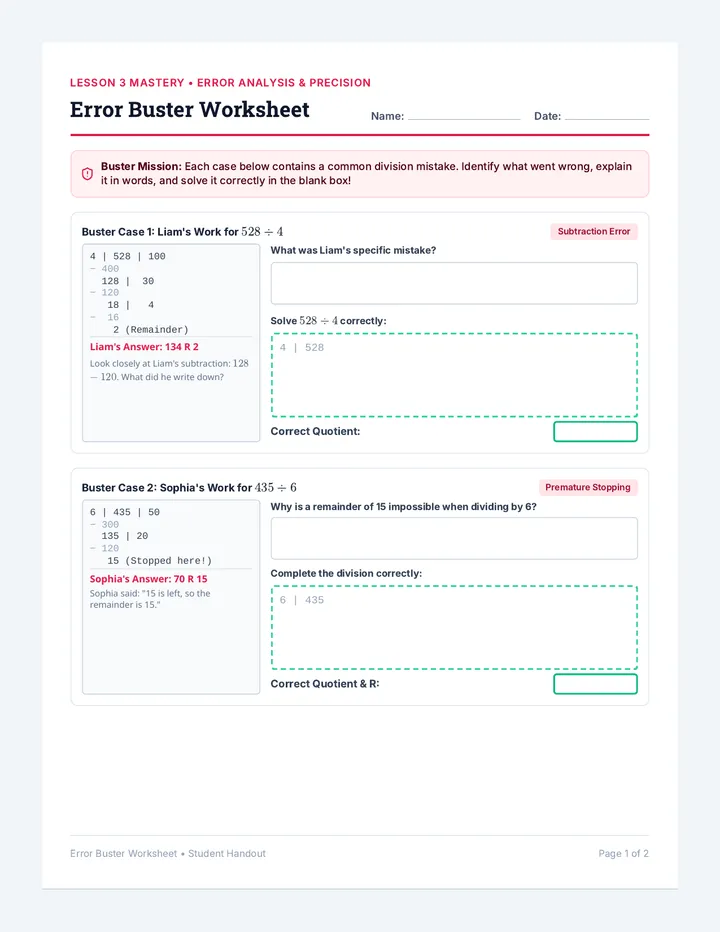
Error Buster Worksheet Lesson 3 Mastery • Error Analysis & Precision
Error Buster Worksheet
Name:
Date:
Buster Mission: Each case below contains a common division mistake. Identify what went wrong, explain it in words, and solve it correctly in the blank box!
Buster Case 1: Liam's Work for \(528 \div 4\) Subtraction Error
4 | 528 | 100
− 400
128 | 30
− 120
18 | 4
− 16
2 (Remainder)
Liam's Answer: 134 R 2
Look closely at Liam's subtraction: \(128 - 120\). What did he write down?
What was Liam's specific mistake?
Solve \(528 \div 4\) correctly:
4 | 528
Correct Quotient:
Buster Case 2: Sophia's Work for \(435 \div 6\) Premature Stopping
6 | 435 | 50
− 300
135 | 20
− 120
15 (Stopped here!)
Sophia's Answer: 70 R 15
Sophia said: "15 is left, so the remainder is 15."
Why is a remainder of 15 impossible when dividing by 6?
Complete the division correctly:
6 | 435
Correct Quotient & R:
Error Buster Worksheet • Student Handout Page 1 of 2
B Mixed Practice & Real-World Synthesis
Fluency Check
1. Model Match: Draw a line connecting the division equation to its matching area model decomposition:
(a) \(144 \div 4\) •
(b) \(186 \div 3\) •
• Model 1: \([3 \times 60 = 180] + [3 \times 2 = 6]\)
• Model 2: \([4 \times 30 = 120] + [4 \times 6 = 24]\)
2. Calculate \(624 \div 6\)
6 | 624
Quotient:
3. Calculate \(349 \div 5\)
5 | 349
Quotient & R:
4. Multi-Step Challenge: The Bakery Box Dilemma
Sunrise Bakery baked 386 blueberry muffins. They pack 6 muffins into each specialty box and sell each full box for $8. Leftover muffins are sold individually for $1 each. How much total money does the bakery make if they sell all full boxes and all leftover muffins?
Step 1: Divide \(386 \div 6\) using Big 7:
6 | 386
Step 2: Multiply & Add Total Dollars:
Total Revenue:
Confidence Rating: How confident do you feel using the Big 7 method?
1: Need Help 2: Getting There 3: Champion!
Error Buster Worksheet • Student Handout Page 2 of 2
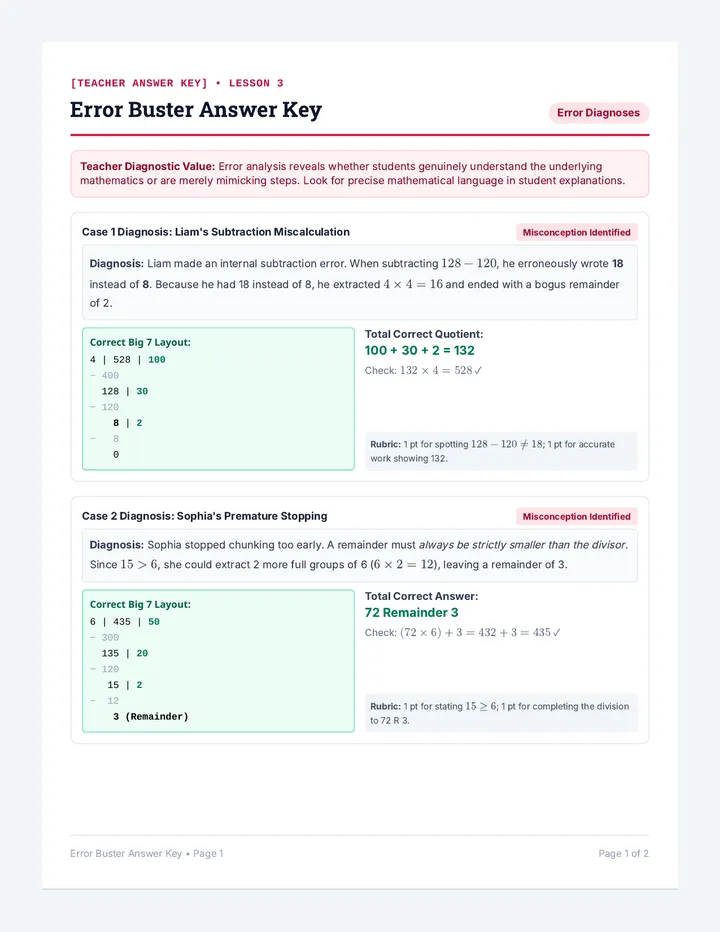
Error Buster Answer Key [TEACHER ANSWER KEY] • Lesson 3
Error Buster Answer Key
Error Diagnoses
Teacher Diagnostic Value: Error analysis reveals whether students genuinely understand the underlying mathematics or are merely mimicking steps. Look for precise mathematical language in student explanations.
Case 1 Diagnosis: Liam's Subtraction Miscalculation Misconception Identified
Diagnosis: Liam made an internal subtraction error. When subtracting \(128 - 120\), he erroneously wrote 18 instead of 8 . Because he had 18 instead of 8, he extracted \(4 \times 4 = 16\) and ended with a bogus remainder of 2.
Correct Big 7 Layout:
4 | 528 | 100
− 400
128 | 30
− 120
8 | 2
− 8
0
Total Correct Quotient: 100 + 30 + 2 = 132 Check: \(132 \times 4 = 528\) ✓
Rubric: 1 pt for spotting \(128 - 120 \ne 18\); 1 pt for accurate work showing 132.
Case 2 Diagnosis: Sophia's Premature Stopping Misconception Identified
Diagnosis: Sophia stopped chunking too early. A remainder must always be strictly smaller than the divisor . Since \(15 > 6\), she could extract 2 more full groups of 6 (\(6 \times 2 = 12\)), leaving a remainder of 3.
Correct Big 7 Layout:
6 | 435 | 50
− 300
135 | 20
− 120
15 | 2
− 12
3 (Remainder)
Total Correct Answer: 72 Remainder 3 Check: \((72 \times 6) + 3 = 432 + 3 = 435\) ✓
Rubric: 1 pt for stating \(15 \ge 6\); 1 pt for completing the division to 72 R 3.
Error Buster Answer Key • Page 1 Page 1 of 2
B Mixed Practice & Real-World Synthesis (Solutions)
Answers • Section B
1. Model Match Solutions:
(a) \(144 \div 4\) → Model 2
\([4 \times 30 = 120] + [4 \times 6 = 24] = 144\). Quotient: \(30 + 6 = 36\).
(b) \(186 \div 3\) → Model 1
\([3 \times 60 = 180] + [3 \times 2 = 6] = 186\). Quotient: \(60 + 2 = 62\).
2. \(624 \div 6 = \mathbf{104}\)
6 | 624 | 100