Lenny.com
Explore
Create
ActivitiesNewMathEnglish Language ArtsScience & EngineeringSocial StudiesGlobal LanguagesHealth & Physical EducationSpecial EducationCounseling & Life SkillsArts & CreativityESL
Lenny.com
Lenny.com
Explore
Create
ActivitiesNewMathEnglish Language ArtsScience & EngineeringSocial StudiesGlobal LanguagesHealth & Physical EducationSpecial EducationCounseling & Life SkillsArts & CreativityESL
Lenny.com
Lenny.com

Solutions

Lenny for EducatorsLenny for SchoolsLenny for Districts

Product

ExploreSign inCreateSupportAbout

Resources

Getting startedMTSS Acceleration Program

Newsletters

School Funding Newsletter

© 2026 Lenny Learning Inc.

TermsPrivacyAccessibility
LinkedInInstagramX
Lenny
MathNumbers & CountingCounting ObjectsNumber NamesComparing NumbersNumber OperationsCounting SequenceNumbers 0-10Place Value Understanding and SystemAdd and Subtract Within 20Addition and Subtraction ConceptsAddition and Subtraction EquationsAddition and Subtraction ProblemsFoundations for MultiplicationMultiplication and Division PropertiesMultiply and Divide Within 100Multiplication and Division ProblemsFactors and MultiplesProperties of OperationsPatterns and RelationshipsGenerate and Analyze PatternsMulti-Digit ArithmeticPlace Value OperationsMulti-Digit and Decimal OperationsNumerical ExpressionsFour Operations and PatternsFour Operations Problem SolvingMeasurement & DataMeasurable AttributesMeasuring LengthsMeasure and Estimate Lengths in Standard UnitsRelate Addition and Subtraction to LengthClassifying and Counting ObjectsTime and MoneyArea Concepts and MeasurementPerimeter and Area MeasuresAngle Concepts and MeasurementTime, Volume, and MassMeasurement Unit ConversionsGeometryIdentifying ShapesShapes and AttributesShape Attributes and ReasoningShapes and CompositionClassifying 2D FiguresGeometric Figures and RelationshipsLines, Angles, and ShapesAngle, Area, and VolumeGeometric MeasurementVolume of 3D ShapesCoordinate Plane ApplicationsTransformations in the PlaneCongruence and SimilarityUnderstand congruence in terms of rigid motionsSimilarity and TransformationsProve Theorems Involving SimilarityPythagorean TheoremTrigonometry for General TrianglesMake Geometric ConstructionsProve Geometric TheoremsTheorems About CirclesFind Arc Lengths And Areas of Sectors of CirclesVolume FormulasRelationships Between Two-Dimensional and Three-Dimensional ObjectsProve Simple Geometric Theorems AlgebraicallyTranslate Between Geometric Description and Equation for Conic SectionApply Geometric Concepts in Modeling SituationsFractions & DecimalsFractions as NumbersBuilding FractionsFraction Equivalence and OrderingAdding and Subtracting FractionsMultiplying and Dividing FractionsDividing FractionsDecimal FractionsMulti-Digit Computation and FactorsAdd, Subtract, Multiply, and Divide Rational NumbersRational Number SystemIrrational Numbers and ApproximationsRatiosRatios and ProportionsProportional RelationshipsUnit RateAlgebraAlgebraic ExpressionsGenerate Equivalent ExpressionsQuantitative RelationshipsProportional Relationships and Linear EquationsEquations and InequalitiesEquation Solving and ReasoningLinear Equations and SystemsGraph Equations and InequalitiesSystems of EquationsReal-World Algebraic ProblemsQuantitative Reasoning with UnitsExpression StructureEquivalent Expression FormsRadicals and Integer ExponentsRational ExponentsRational and Irrational NumbersPolynomial OperationsPolynomial IdentitiesPolynomial Zeros and FactorsRational ExpressionsComplex Number OperationsComplex Numbers in PolynomialsComplex Numbers on PlaneStatistics & ProbabilityRepresent and Interpret DataData DistributionsStatistical VariabilityProbability ModelsCompound Event ProbabilitiesStatistical SamplingInterpret Categorical and Quantitative DataBivariate Data PatternsInterpret Linear ModelsComparing Two PopulationsRandom Processes in StatisticsIndependence and Conditional ProbabilityExpected ValuesProbability-Based Decision MakingStatistical Inference and ConclusionsFunctionsFunction Concepts and NotationDefine and Compare FunctionsInterpret Functions in ContextAnalyze Function RepresentationsModel Relationships with FunctionsIdentify Linear vs Exponential GrowthDistinguish Between Function TypesCompare Growth RatesInterpret Function ExpressionsBuild Functions from RelationshipsConstruct and Model FunctionsTransform and Combine FunctionsModel Comparison and SelectionSolve Exponential EquationsTrigonometryTrigonometric Ratios Involving Right TrianglesTrigonometric Functions and Unit CircleModel with Trigonometric FunctionsTrigonometric IdentitiesVectors & MatricesIntroduction to Vectors and MatricesVector QuantitiesVector OperationsMatrix OperationsCalculusLimits and ContinuityDerivative Concepts and NotationDerivative Rules and TechniquesApplications of DerivativesOptimization ProblemsRelated RatesCurve Sketching and AnalysisIntegration Concepts and NotationAntiderivatives and Indefinite IntegralsDefinite Integrals and AreaFundamental Theorem of CalculusIntegration TechniquesApplications of IntegrationDifferential EquationsSequences and SeriesParametric and Polar FunctionsVector-Valued Functions

Rotational Symmetry Spin

A targeted special education geometry lesson reviewing rotational symmetry, mapping regular polygons onto themselves using the 360/n formula, and analyzing coordinate rotations.

Ttimothy.nixon

Rotational Symmetry Spin

A targeted special education geometry lesson reviewing rotational symmetry, mapping regular polygons onto themselves using the 360/n formula, and analyzing coordinate rotations.

Ttimothy.nixon

What is the degree of rotation that maps the Hexagon and Octagon onto themselves, but leaves the Pentagon out?

Show thinking:

Rotation Angle

Shape Behavior: 90° vs. 180° Turns

9. The Non-Square Rectangle Opposite sides congruent

Length > Width

Does a 90° turn map this rectangle onto itself?

Yes No (it turns vertical)

Does a 180° turn map this rectangle onto itself?

Yes No

10. Equilateral Triangle at 180° Base angles: 120°

Original (Point UP)

→

Sketch here

Does a 180° turn map the equilateral triangle onto itself? Explain why:

11. Rigid Motion Notation: Which transformation is NOT equivalent to a 180° rotation about the origin?

Recall rule: R180°(x, y) = (-x, -y). Opposite signs for both coordinates.

A) Reflection over x-axis then y-axis (ry ∁ rx)

B) Reflection over y-axis then x-axis (rx ∁ ry)

C) Rotation of 180° about origin (R180°, (0,0))

D) Translation 4 units left and 4 down (T-4, -4)

Self-Check: How confident do you feel finding rotation angles?

👍 Got it! ✋ Need practice 🤔 Need help

A) Equilateral Triangle
C) Regular Hexagon

• Triangle: 240° ÷ 120° = 2 (Whole number ✓)

• Hexagon: 240° ÷ 60° = 4 (Whole number ✓)

• Pentagon: 240° ÷ 72° = 3.33 (✗)

• Octagon: 240° ÷ 45° = 5.33 (✗)

Q7: Maps at 315°? D only

Answer: D) Regular Octagon.

• Octagon base angle = 45°

• 315° ÷ 45° = 7 (Exact match! ✓)

• 45, 90, 135, 180, 225, 270, 315°, 360°

• Square (90), Pentagon (72), Hexagon (60) do not divide 315 evenly.

Q8: Shared Mystery Angle (Hexagon & Octagon YES, Pentagon NO) θ = 180°

Step-by-step logic: We need a common multiple of Hexagon's base (60°) and Octagon's base (45°) that is NOT a multiple of Pentagon's base (72°).

Hexagon multiples: 60, 120, 180, 240...

Octagon multiples: 45, 90, 135, 180...

Pentagon multiples: 72, 144, 216... (180 is not here!)

*Note: 360° also maps all onto themselves, but 180° is the intended rotation strictly between 0° and 360°.

Reasoning & Coordinate Transformation Solutions

Q9: Rectangle

90°: NO. Rectangle becomes vertical; dimensions do not align with original horizontal orientation.

180°: YES. Opposite sides are parallel and congruent; horizontal orientation is restored.

Q10: Triangle at 180°

Answer: NO.

Explanation: The apex rotates from pointing UP to pointing DOWN. A regular triangle only maps onto itself at multiples of 120° (120°, 240°, 360°).

Q11: Rigid Motion

Answer: D (T-4,-4)

R180° changes (x,y) to (-x,-y). Both composite reflections (ry ∁ rx and rx ∁ ry) also yield (-x,-y). A translation shifts points without inverting coordinates.

Special Education Co-Teaching & Accommodation Strategies

1. Tracing Paper (Patty Paper)

Have students trace the polygon, put a pencil point in the center, and rotate until the outline snaps back into alignment.

2. Calculator Routine

Teach the "Test by Division" routine: target angle ÷ base angle = whole number? Yes = maps onto itself. Decimal = fails!

3. Odd vs. Even Side Anchor

Highlight that even-sided regular polygons always hit 180°, while odd-sided ones never do. Keep this on the board as a reference!

Geometry 3.08 • Rotational Symmetry Page 2 Answer Key
You might also like

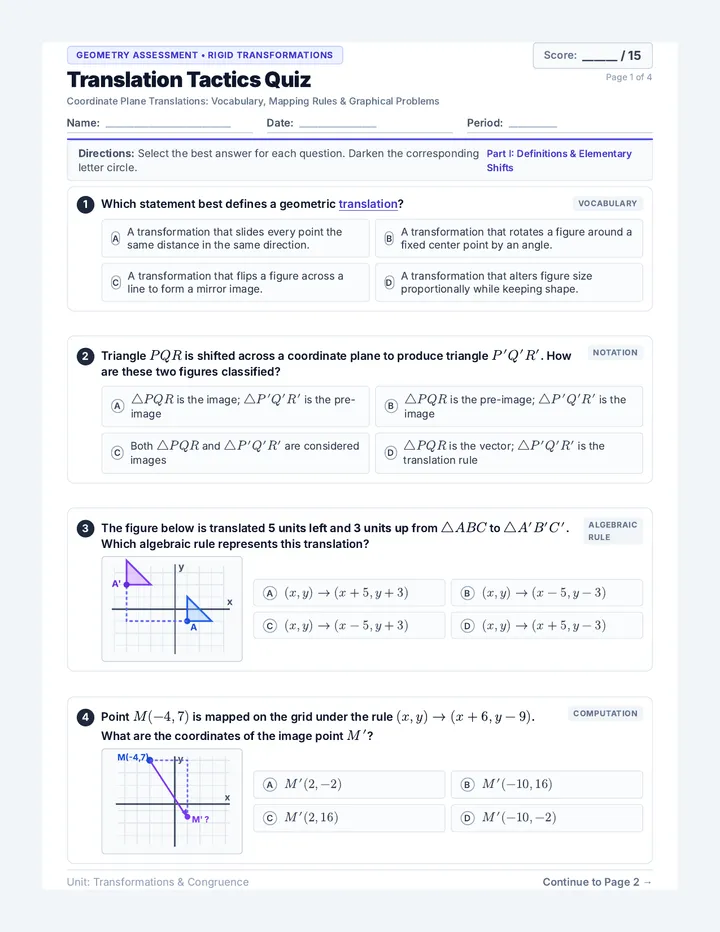
Translation Tactics Quiz

Math Mastery Units

Comprehensive secondary mathematics units covering coordinate geometry transformations and linear functions in slope-intercept form.

FM

Fernando Mancini

4
Digit Multiply Slides

Double Digit Multiply

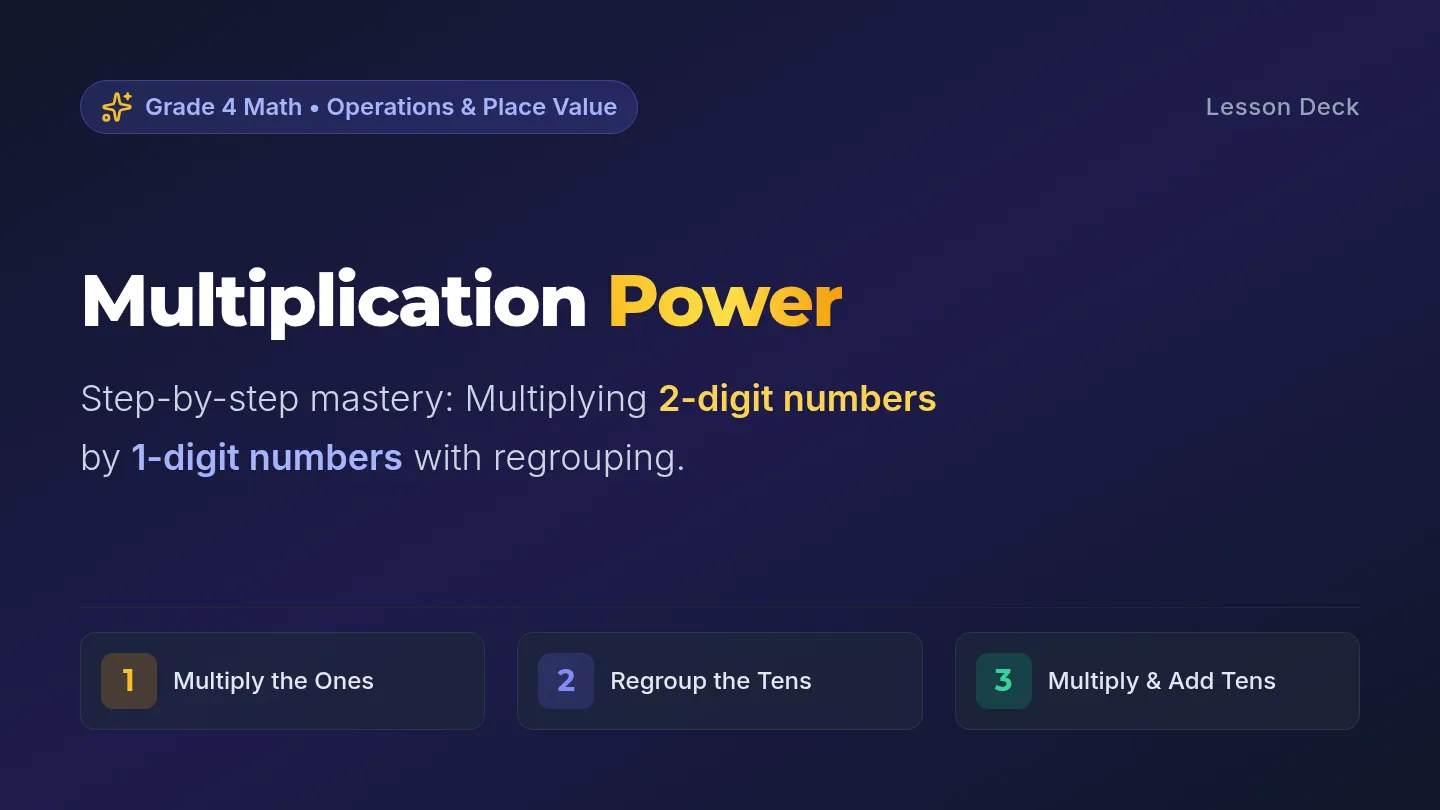
A comprehensive elementary math lesson introducing 2-digit by 1-digit multiplication using the standard algorithm and place-value reasoning. Includes instructional presentation slides, scaffolded student practice sheets with generous workspace, and an annotated teacher answer key.

L

lwalker

3
Digit Blast Answer Key

Digit Blast Answer Key

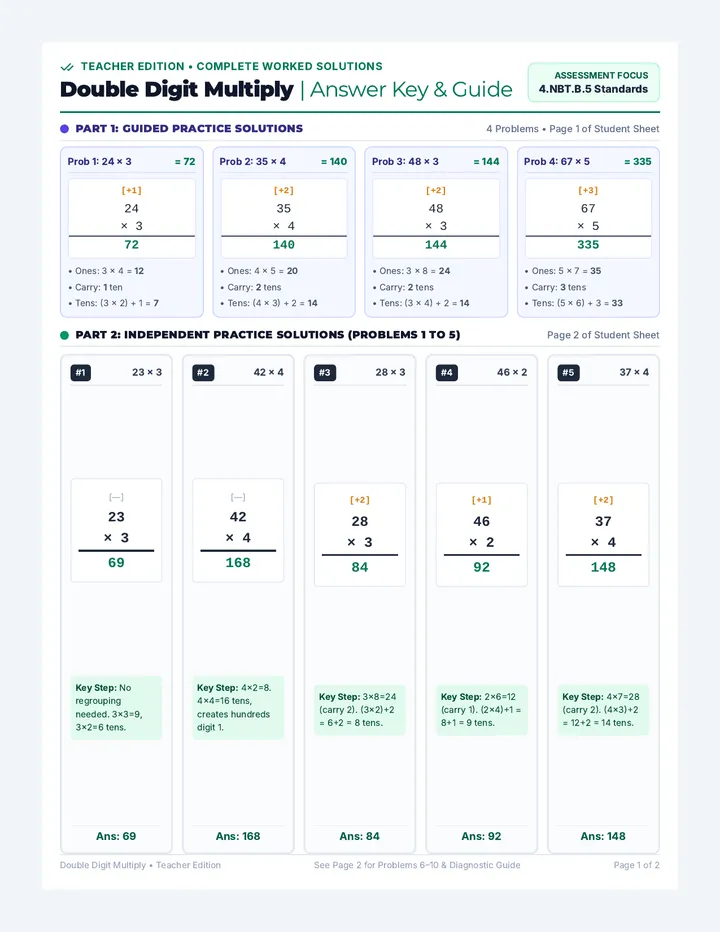
A complete 2-page teacher answer key and instructional troubleshooting guide. Contains step-by-step worked solutions for all 4 guided practice and 10 independent practice problems, plus common error diagnoses and remediation strategies.

L

lwalker

Equal Groups Slides

Equal Group Explorers

A three-part intervention sequence designed for students struggling with early multiplication concepts. The sequence methodically transitions learners from concrete equal groups to repeated addition, number line skip-counting, and formal multiplication notation.

B

bower

9
Customary Conversions Slides

Customary Unit Conversions

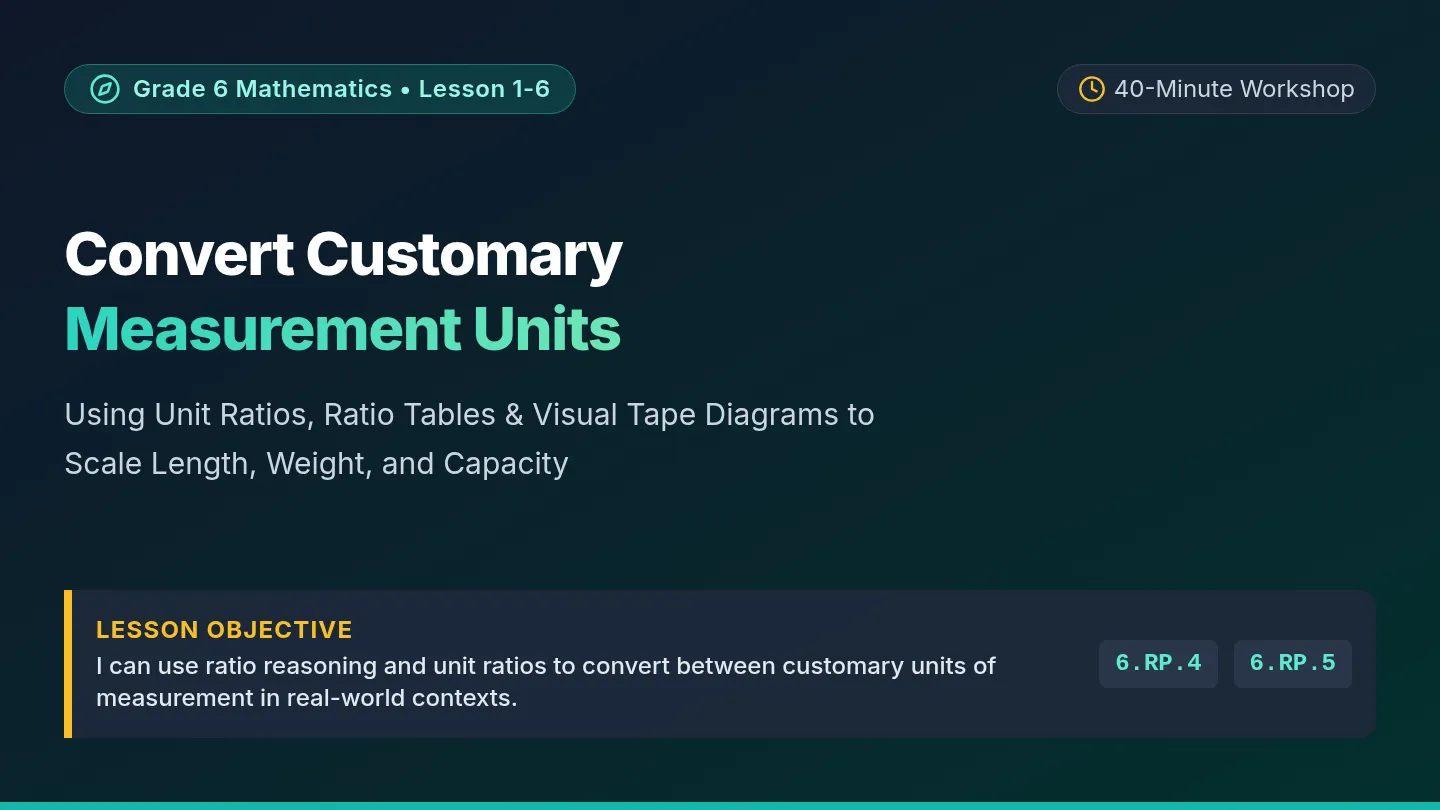
A comprehensive 40-minute grade 6 mathematics lesson on converting customary measurement units using unit ratios, equivalent ratio tables, and visual tape diagrams. Students master bidirectional conversions across length, weight, and capacity while connecting proportional reasoning to real-world problem contexts.

RG

Richard Gist

3
Digit Blast Worksheet

Digit Blast Worksheet

A 3-page comprehensive student practice packet for 2-digit by 1-digit multiplication. Page 1 features a clear visual anchor chart and 4 scaffolded guided practice walkthroughs. Pages 2 and 3 provide 10 independent practice problems (5 per page) with extra-large computation boxes, dedicated carry boxes, and generous white space to show work, plus a real-world word problem challenge.

L

lwalker

Main Idea Detectives Worksheet

Grade Four Power Skills

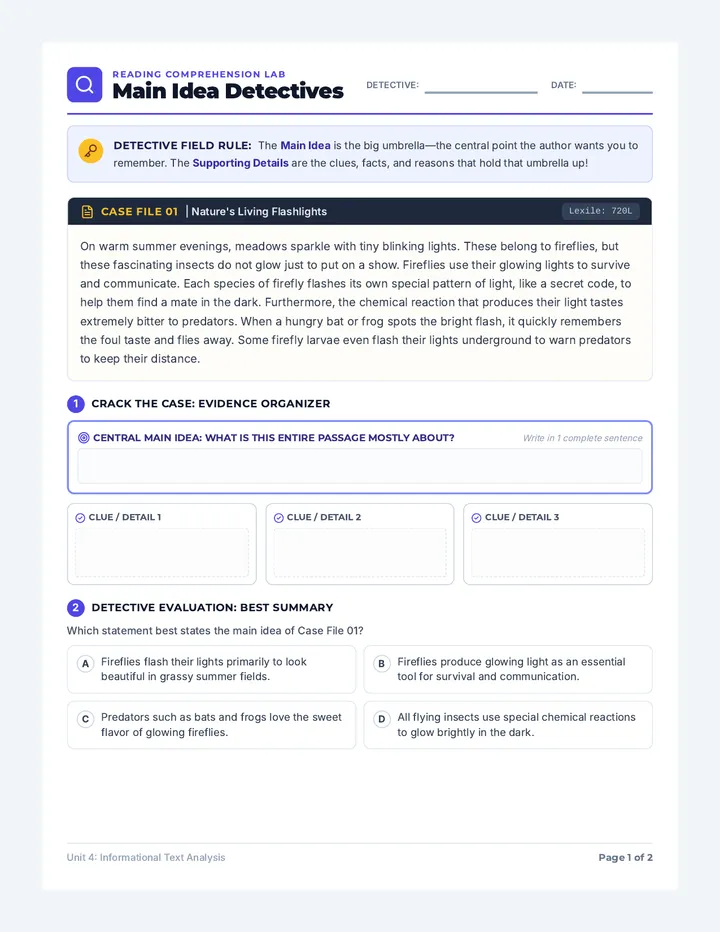
An integrated fourth-grade mastery curriculum covering core informational reading comprehension strategies and essential mathematics fluency.

C

cserrano

3
Factor Foundations Worksheet

Factor Foundations

A comprehensive mathematics lesson introducing the concept of factors through basic number facts, divisibility testing, and algebraic monomial expansion with variables.

MR

Mary Roche

2
Digit Multiply Slides

Digit Multiply Slides

An 8-slide instructional presentation detailing step-by-step procedures for 2-digit by 1-digit multiplication with regrouping. Features place-value models, standard vertical algorithm walkthroughs, guided practice checks, and key tips for avoiding common calculation errors.

L

lwalker

Operation Order Worksheet

Expression Mastery

A comprehensive pre-algebra sequence covering algebraic expressions, grouping rules, order of operations with exponents, and the distributive property with like terms.

K

kandrews

4
Bargain Hunter Worksheet

Smart Shopper Challenge

A practical consumer math lesson focusing on real-world financial literacy. Students calculate unit prices, evaluate percentage discounts and coupons, and determine final checkout costs including sales tax.

CD

Cheri Donahoe

4
Complex Operations Assessment

Complex Operations Assessment

A rigorous 3-page printable unit assessment on complex numbers and operations for Algebra 2 and Honors Algebra 2. Includes conceptual foundations, radical simplifications, arithmetic operations, complex conjugates, division, quadratic equations with complex roots, complex plane graphing, modulus, and honors extensions.

R

Robinson