Operation Order Worksheet Order of Operations Challenge
PEMDAS with Powers & Exponents
Student Practice
Name:
Date:
Period:
Execution Order:
1. P Grouping \(( \ ), [ \ ]\)
→
2. E Exponents \(a^n\)
→
3. MD Multiply / Divide (Left → Right)
→
4. AS Add / Subtract (Left → Right)
Level 1
Skill Builder: Basic Powers & Two-Step Expressions
Show all steps clearly
#1 \(5^2 - 14\)
Answer:
#2 \(3 \cdot 2^3 + 7\)
Answer:
#3 \(18 \div 3^2 + 6\)
Answer:
#4 \((7 - 3)^2 - 5\)
Answer:
Level 2
Core Practice: Multi-Step Expressions & Grouping
Underline each completed operation
#5 \(4^2 + 5 \cdot (9 - 6)\)
Answer:
#6 \(30 - 2 \cdot (3^2 - 1)\)
Answer:
#7 \((12 - 4) \div 2^2 + 6 \cdot 3\)
Answer:
#8 \(7 \cdot 2^2 - (15 + 9) \div 3\)
Answer:
PEMDAS & Exponents • Lesson Practice Page 1 of 2
Order of Operations Challenge (Continued)
Name: Period:
Level 3
Mastery Tier: Nested Brackets & Fraction Bars
Evaluate inner brackets first; simplify numerator & denominator
#9 \(3 \cdot [4^2 - (5 + 2 \cdot 3)]\)
Answer:
#10 \(\dfrac{5^2 - 3^2}{2^3 - 4}\)
Answer:
#11 \(2 \cdot (3 + 1)^2 - [18 \div (2 \cdot 3)]\)
Answer:
#12 \(\dfrac{4 \cdot (7 - 2) + 2^3}{14 - 2 \cdot 3}\)
Answer:
Analysis
Error Detective: Find the Mistake & Correct It
#13 Case A \(24 - 4 \cdot 2^2 + 5\)
Student's Incorrect Work:
Line 1: \(= 20 \cdot 2^2 + 5\)
Explain error & solve correctly:
Correct Answer:
#14 Case B \(18 \div 3 \cdot 2 + 4^2\)
Student's Incorrect Work:
Line 1: \(= 18 \div 6 + 16\)
Explain error & solve correctly:
Correct Answer:
Puzzle
Equation Architect: Insert Parentheses
Insert exactly one pair of parentheses \(( \ )\) into each equation to make the equality true.
#15 Target = 32 8 + 4 × 3 - 2² = 32
New Equation:
#16 Target = 24 30 ÷ 2 + 3 × 4 = 24
New Equation:
PEMDAS & Exponents • Lesson Practice Page 2 of 2
Operation Order Answer Key Order of Operations Challenge
Teacher Solutions & Step-by-Step Key
TEACHER ANSWER KEY
Key Watch Point: Multiplication does not precede Division; they have equal priority evaluated strictly Left → Right.
Pages 1 & 2 Solutions
Level 1 Solutions
Skill Builder: Basic Powers & Two-Step Expressions
1 point per step + 1 point final answer
#1 \(5^2 - 14\)
Step 1: Exponent → \(5^2 = 25\)
Step 2: Subtract → \(25 - 14 = 11\)
Answer: 11
#2 \(3 \cdot 2^3 + 7\)
Step 1: Exponent → \(2^3 = 8\)
Step 2: Multiply → \(3 \cdot 8 = 24\)
Step 3: Add → \(24 + 7 = 31\)
Answer: 31
#3 \(18 \div 3^2 + 6\)
Step 1: Exponent → \(3^2 = 9\)
Step 2: Divide → \(18 \div 9 = 2\)
Step 3: Add → \(2 + 6 = 8\)
Answer: 8
#4 \((7 - 3)^2 - 5\)
Step 1: Parentheses → \((7 - 3) = 4\)
Step 2: Exponent → \(4^2 = 16\)
Step 3: Subtract → \(16 - 5 = 11\)
Answer: 11
Level 2 Solutions
Core Practice: Multi-Step Expressions & Grouping
Verify intermediate order
#5 \(4^2 + 5 \cdot (9 - 6)\)
\(= 4^2 + 5 \cdot (3)\) [Parentheses first]
\(= 16 + 5 \cdot 3\) [Evaluate exponent]
\(= 16 + 15\) [Multiply before add]
\(= 31\)
Answer: 31
#6 \(30 - 2 \cdot (3^2 - 1)\)
\(= 30 - 2 \cdot (9 - 1)\) [Exponent in ( )]
\(= 30 - 2 \cdot (8)\) [Finish inside ( )]
\(= 30 - 16\) [Multiply \(2 \cdot 8\)]
\(= 14\)
Answer: 14
#7 \((12 - 4) \div 2^2 + 6 \cdot 3\)
\(= 8 \div 2^2 + 6 \cdot 3\) [Parentheses]
\(= 8 \div 4 + 6 \cdot 3\) [Exponent]
\(= 2 + 18\) [Divide & Multiply L→R]
\(= 20\)
Answer: 20
#8 \(7 \cdot 2^2 - (15 + 9) \div 3\)
\(= 7 \cdot 2^2 - 24 \div 3\) [Parentheses]
\(= 7 \cdot 4 - 24 \div 3\) [Exponent]
\(= 28 - 8\) [Multiply & Divide]
\(= 20\)
Answer: 20
PEMDAS & Exponents • Teacher Answer Key Page 1 of 2
Answer Key: Advanced Tiers & Analysis (Page 2)
Scoring Guide
Level 3 Solutions
Mastery Tier: Nested Brackets & Fraction Bars
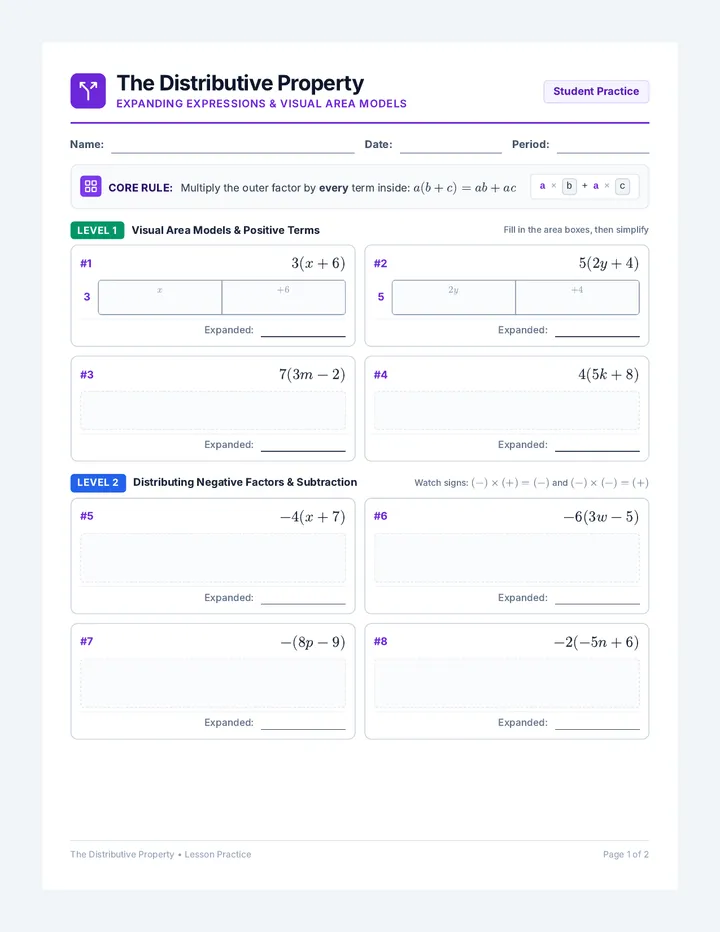
Distributive Property Worksheet The Distributive Property
Expanding Expressions & Visual Area Models
Student Practice
Name:
Date:
Period:
Core Rule: Multiply the outer factor by every term inside: \(a(b + c) = ab + ac\)
a × b + a × c
Level 1
Visual Area Models & Positive Terms
Fill in the area boxes, then simplify
#1 \(3(x + 6)\)
3
\(x\)
\(+6\)
Expanded:
#2 \(5(2y + 4)\)
5
\(2y\)
\(+4\)
Expanded:
#3 \(7(3m - 2)\)
Expanded:
#4 \(4(5k + 8)\)
Expanded:
Level 2
Distributing Negative Factors & Subtraction
Watch signs: \((-)\times(+) = (-)\) and \((-)\times(-) = (+)\)
#5 \(-4(x + 7)\)
Expanded:
#6 \(-6(3w - 5)\)
Expanded:
#7 \(-(8p - 9)\)
Expanded:
#8 \(-2(-5n + 6)\)
Expanded:
The Distributive Property • Lesson Practice Page 1 of 2
Distributive Property (Continued)
Name: Period:
Level 3
Distribute & Combine Like Terms
Step 1: Distribute | Step 2: Combine terms
#9 \(4(2x + 5) + 3x\)
Simplified:
#10 \(7(y - 2) - 4y + 9\)
Simplified:
#11 \(5(3a - 4) - 2(a + 6)\)
Simplified:
#12 \(-3(2m - 1) + 4(3m + 5)\)
Simplified:
Analysis
Error Detective: Spot the Distribution Mistake
#13 Case A Simplify: \(-5(2x - 4)\)
Student Claim:
\(-5(2x - 4) = -10x - 20\)
Explain the error and write the correct expression:
Correct:
#14 Case B Simplify: \(3 + 2(x + 4)\)
Student Claim:
\(3 + 2 = 5 \implies 5(x + 4) = 5x + 20\)
Explain the error and write the correct expression:
Correct:
Application
Geometric Application: Perimeter & Area Expressions
#15 Rectangle Model Geometry
A rectangle has width \(w = 4\) and length \(l = 3x + 5\). Write and simplify expressions for its Area and Perimeter:
Area \(= 4(3x + 5)\):
Perimeter \(= 2l + 2w\):
Distributive Property Answer Key The Distributive Property
Teacher Solutions & Step-by-Step Key
TEACHER ANSWER KEY
Frequent Trap: Watch out for negative outer signs; remind students that \(-a(b - c) = -ab + ac\).
Pages 1 & 2 Solutions
Level 1 Solutions
Visual Area Models & Positive Terms
1 pt for area model + 1 pt for simplified expression
#1 \(3(x + 6)\)
3
\(3 \cdot x\) \(3x\)
\(3 \cdot 6\) \(+18\)
Expanded: \(3x + 18\)
#2 \(5(2y + 4)\)
5
\(5 \cdot 2y\) \(10y\)
\(5 \cdot 4\) \(+20\)
Expanded: \(10y + 20\)
#3 \(7(3m - 2)\)
Term 1: \(7 \cdot 3m = 21m\)
Term 2: \(7 \cdot (-2) = -14\)
Expanded: \(21m - 14\)
#4 \(4(5k + 8)\)
Term 1: \(4 \cdot 5k = 20k\)
Term 2: \(4 \cdot 8 = 32\)
Expanded: \(20k + 32\)
Level 2 Solutions
Distributing Negative Factors & Subtraction
Verify sign multiplication
#5 \(-4(x + 7)\)
\((-4 \cdot x) + (-4 \cdot 7)\)
\(= -4x - 28\)
Expanded: \(-4x - 28\)
#6 \(-6(3w - 5)\)
\((-6 \cdot 3w) + (-6 \cdot -5)\)
\(= -18w + 30\) [Negative × Negative = Positive]
Expanded: \(-18w + 30\)
#7 \(-(8p - 9)\)
Implicit \(-1\): \(-1(8p - 9)\)
\(= -8p + 9\)
Expanded: \(-8p + 9\)
#8 \(-2(-5n + 6)\)
\((-2 \cdot -5n) + (-2 \cdot 6)\)
\(= 10n - 12\)
Expanded: \(10n - 12\)
The Distributive Property • Teacher Answer Key Page 1 of 2
Answer Key: Combining Terms & Applications (Page 2)
Scoring Guide
Level 3 Solutions
Distribute & Combine Like Terms
1 pt for distribution + 1 pt for combining
#9 \(4(2x + 5) + 3x\)
Distribute: \(8x + 20 + 3x\)
Combine: \((8x + 3x) + 20 = 11x + 20\)
Simplified: \(11x + 20\)
#10 \(7(y - 2) - 4y + 9\)
Distribute: \(7y - 14 - 4y + 9\)
Combine: \((7y - 4y) + (-14 + 9) = 3y - 5\)
Simplified: \(3y - 5\)
#11 \(5(3a - 4) - 2(a + 6)\)
Distribute 5 and \(-2\): \(15a - 20 - 2a - 12\)
Combine: \((15a - 2a) + (-20 - 12) = 13a - 32\)
Simplified: \(13a - 32\)